
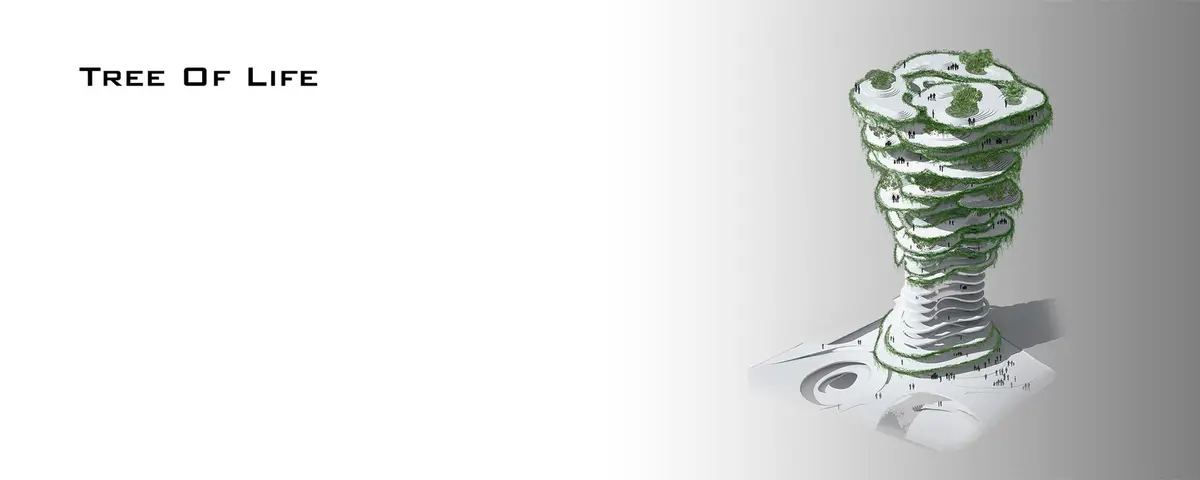
Tree of Life: A Vertical Cemetery That Composts the Dead to Feed the Living
An ecological cemetery in Shanghai stacks 15,000 square meters of memorial gardens, turning human composting into nutrient-rich soil for terraced green spa


What if a cemetery could produce life instead of consuming land? Tree of Life proposes exactly that: a vertical ecological cemetery in Shanghai where human remains decompose into nutrient-rich compost within a single month, feeding the very memorial gardens that visitors walk through. It is a building where death is not stored but metabolized, converting bodies placed in vessels of wood chips, alfalfa, and straw into soil that sustains layered green terraces rising above the city.
The project is the work of designers Rashed Fatehi, Adeleh M. Mousavi, Javad Sheary, and Kamran Afshar Naderi. Sited in Shanghai, one of the world's densest metropolitan regions, the design confronts a real and growing problem: traditional cemeteries devour horizontal land that cities cannot spare. By going vertical and covering only 50% of the site at ground level, Tree of Life treats burial infrastructure with the same spatial logic architects apply to housing and offices, but with a radically different program.
A Tower Structured Around the Life Cycle
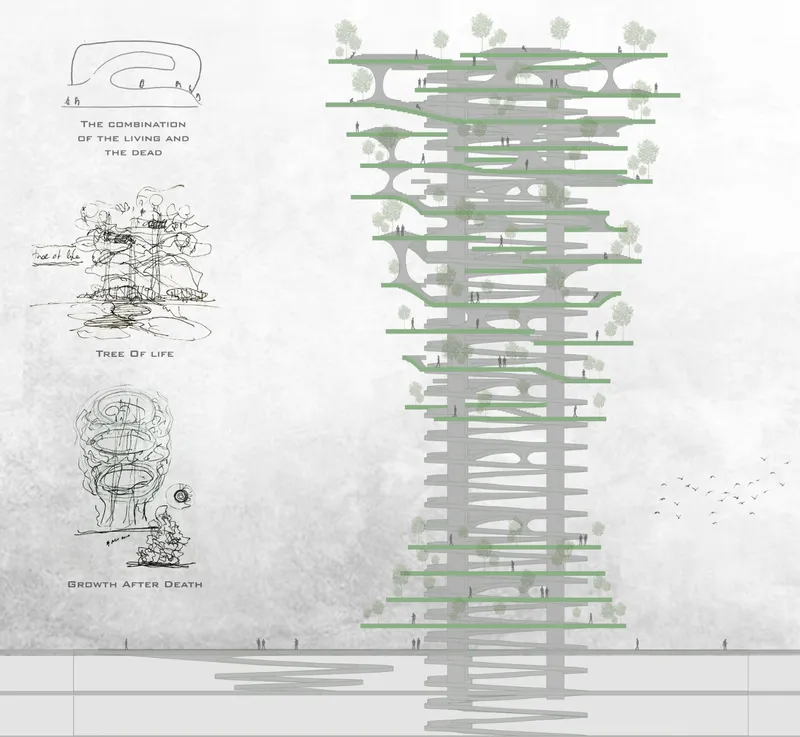
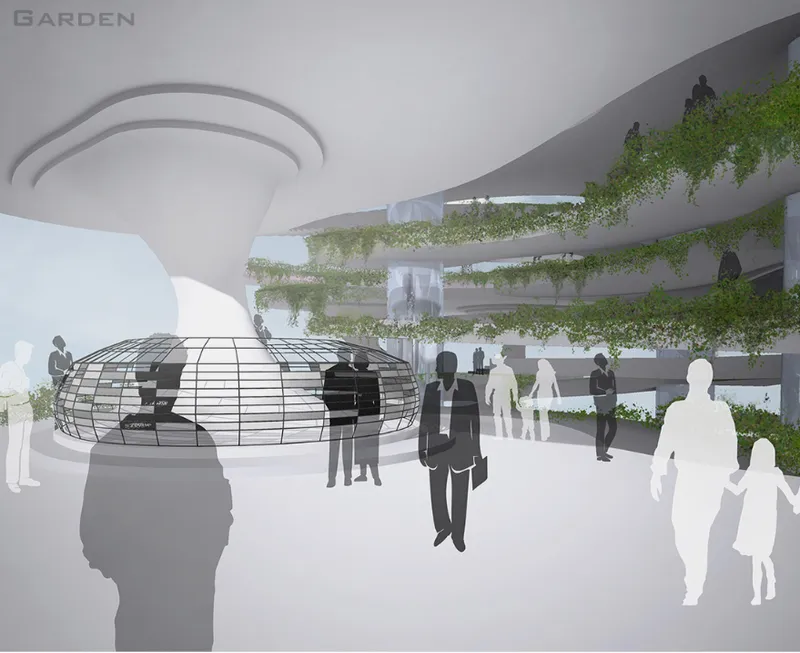
The elevation drawing reveals the building's fundamental proposition: a stacked sequence of planted terraces rising vertically, each level serving as both memorial garden and ecological processing zone. The form draws from the Tree of Life, a symbol shared across religious and philosophical traditions that encodes the cycle of birth, growth, and death. The interior rendering makes this legible at the human scale. A spiraling planted atrium wraps around a central wire cage structure, creating a continuous vertical garden that visitors ascend through. Figures appear small against the height of the space, reinforcing that this is architecture scaled to something larger than individual grief.
The structural concept is not merely symbolic. The vertical organization allows the cemetery to accommodate up to 5,000 people in its initial phase, with expansion capacity to serve over a million. At 15,000 square meters of usable floor area in its mid-phase, the building packs significant programmatic density into a form that reads as landscape rather than infrastructure.
Terraced Landscapes That Blur Ground and Roof
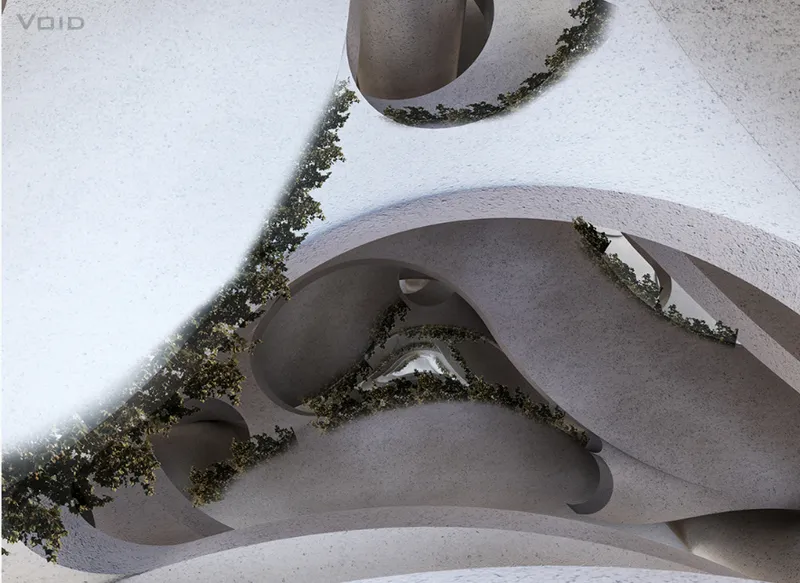
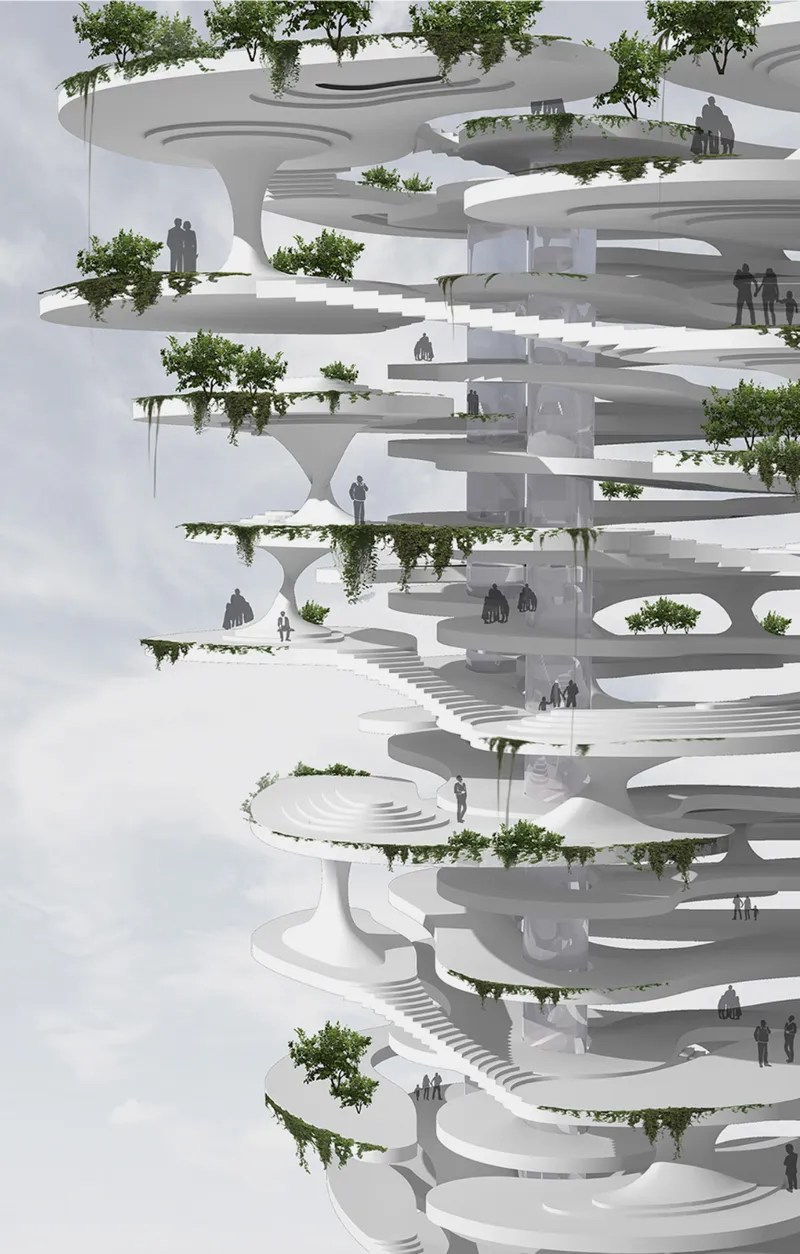
Seen from above, the cascading terraces dissolve the distinction between building and terrain. Planted strips wind through white surfaces in organic curves, creating memorial zones that feel closer to park topography than to conventional cemetery plots. The aerial view reveals how the design carves intimate garden rooms from what could otherwise be monotonous floor plates. Each terrace offers a different spatial condition, with planted edges framing views downward to the levels below.
The stacked white platforms connected by stairs show how the building maintains physical continuity between levels. Trees grow at multiple heights, their canopies creating a layered forest effect visible from the street. The 5% slope ramps woven throughout the structure ensure that every level remains accessible to visitors with disabilities, while underground spiral parking accommodates over 200 vehicles without intruding on the memorial spaces above.
Carbon Capture and Energy Independence Built into the Facade
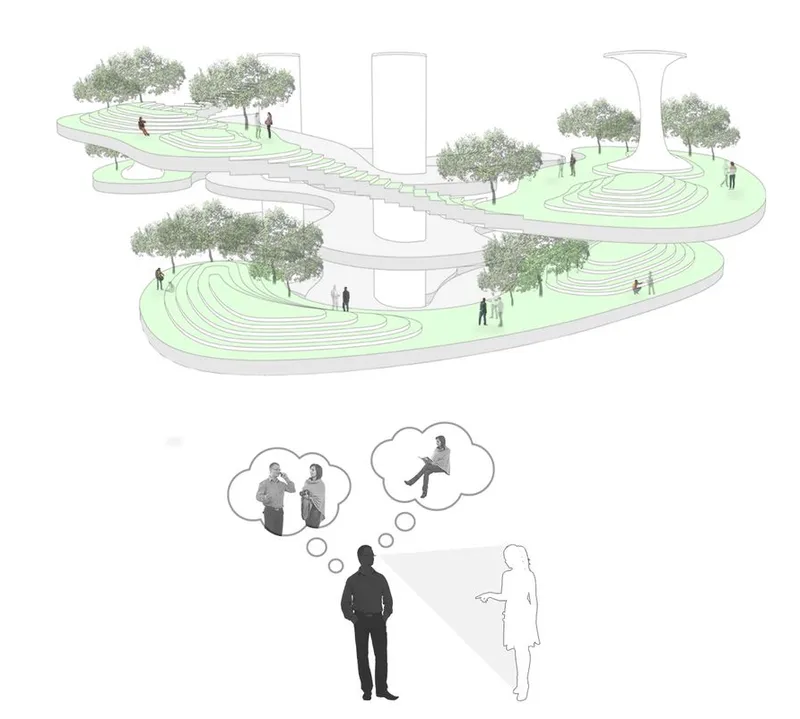
The axonometric diagram strips the building to its essential systems: three planted levels connected by stairs, with figures and trees populating each platform. What the drawing does not immediately show, but the designers detail in their program, is the environmental technology embedded in the structure. Solar panels integrated into the facade target near energy self-sufficiency. Water recycling systems manage both consumption and irrigation across the green layers. Most unusually, the building incorporates porous coordination polymer (PCP) technology, a zinc-based organic material developed at Kyoto University that absorbs CO₂ from polluted air and remains effective even after 10 operational cycles. In a city like Shanghai, where air quality is a persistent concern, this transforms the cemetery from a passive memorial into an active urban filter.
Inclusive Rites and Digital Memory
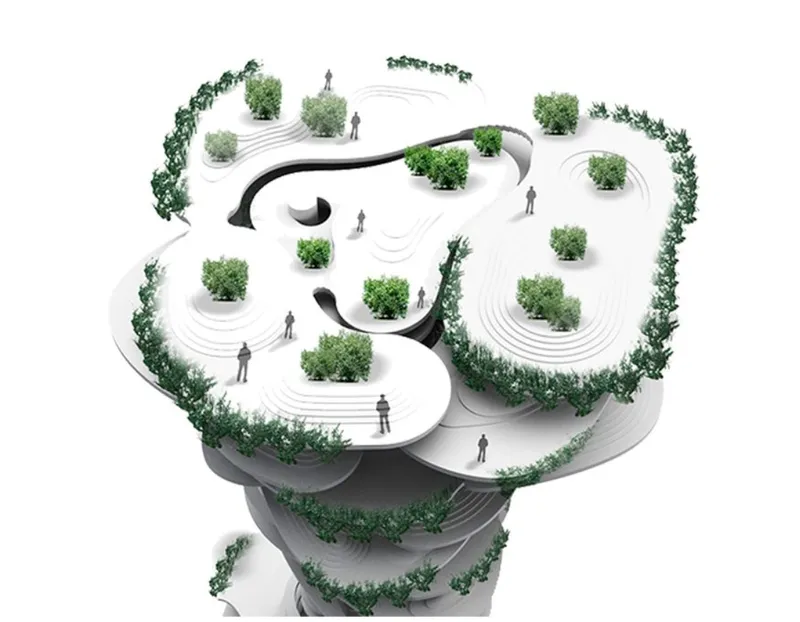
The lobed roof garden seen from above, with its planted edges and figures moving through open space, suggests the kind of contemplative public ground that the designers intend to host multiple forms of remembrance. Spaces within the building are divided to accommodate various religions and cultural rites, a deliberate inclusivity that acknowledges Shanghai's cosmopolitan population. The design does not impose a single narrative of death but provides a framework flexible enough for personalized ceremony.
Beyond the physical, Tree of Life integrates digital memorial technologies: DNA banking, 3D projections of the deceased, and digital archives that visitors can access within immersive garden settings. These tools transform the act of visiting a grave from standing before a headstone into engaging with a layered record of a person's life. The cemetery becomes a kind of living archive, where biological decomposition and digital preservation run in parallel.
Why This Project Matters
Cemeteries are among the least questioned building types in architecture. They occupy vast tracts of urban and suburban land, contribute nothing to energy systems or ecological cycles, and resist adaptation over time. Tree of Life challenges every one of those assumptions. By composting human remains into soil that feeds memorial gardens, integrating CO₂ absorption into the building envelope, and stacking a program that serves up to a million people on a footprint covering half its site, the project treats death as a design problem worthy of the same innovation applied to housing, transport, or energy.
What makes the proposal compelling is its refusal to separate the spiritual from the technical. The Tree of Life symbolism, the inclusive religious programming, and the immersive digital memorials all sit comfortably alongside composting vessels, PCP carbon capture, and solar facades. Fatehi, Mousavi, Sheary, and Afshar Naderi have produced a design where ecological performance and human meaning are not in tension but are genuinely the same thing. In a discipline that often struggles to reconcile sustainability with emotion, that integration alone makes this project worth studying.
View the Full Project
About the Designers
Designers: Rashed Fatehi, Adeleh M. Mousavi, Javad Sheary, Kamran Afshar Naderi
Enter a Design Competition on uni.xyz
uni.xyz runs architecture and design competitions year-round that reward proposals with spatial conviction and real site intelligence.
Project credits: Tree of Life - Ecological Cemetery in Shanghai by Rashed Fatehi, Adeleh M. Mousavi, Javad Sheary, Kamran Afshar Naderi.


Popular Articles
Popular articles from the community


Manzana Morphosis: Stretching Barcelona's Grid into a Living Landscape for 2050
A radical reworking of the Eixample manzana turns density into a tool for generous public space, vertical ecology, and environmental performance.

The Amber Palace Opera: A Geological Fiction Surfaces on Tallinn's Baltic Waterfront
Pierre Brillard reimagines a Baltic legend as a public landscape, opera house, and waterfront promenade rooted in Tallinn's coastal identity.

Opera on the Sea: Driftwood Logic Shapes a Timber Opera House on Estonia's Coast
Trevor Orgill's opera house translates the entangled drift of floating timber into a civic building where wood, water, and music converge.

Extended Shell: Retrofitting Kolkata's Balconies as Living Urban Thresholds
A modular retrofit system recovers the social and environmental intelligence of Kolkata's historic verandas for contemporary Park Street residents.

Similar Reads
You might also enjoy these articles

Shakur's House: Exposed Brick as an Interior Organiser in a 168 m² Mashhad Residence
Brick moves indoors in this Mashhad residence, where masonry walls, glass partitions and teal planes sequence a compact home without closing it off.

Day and Night Park: A Time-Based Urban Newsstand in Beijing
A temporary urban newsstand in Beijing blending travel, light, and reading through poetic colors, compact form, and community-focused design.

Modernist Patio Renovation in El Masnou, Barcelona by Oliver Segura Arquitectura + Cebrià Arquitectura
Modernist patio renovation blending tradition and innovation with a movable pool, leveled floors, and Catalan materials in El Masnou.

Alto Residencial Coop: Cooperative Housing Development in Santiago de Compostela by Carbajo Barrios Arquitectos
A linear cooperative housing complex blending white volumes and perforated metal façades, enhancing community living, natural light, privacy, and urban integration.

Explore Vertical Cemetery Competitions
Discover active competitions in this discipline

Challenge to reimagine the Iron Throne

Photograph architecture without architects

Illustrate the lost glory of Angkor Wat - Render Challenge

Design challenge to reuse E-waste
Comments (0)
Please login or sign up to add comments
No comments yet. Be the first to comment!