
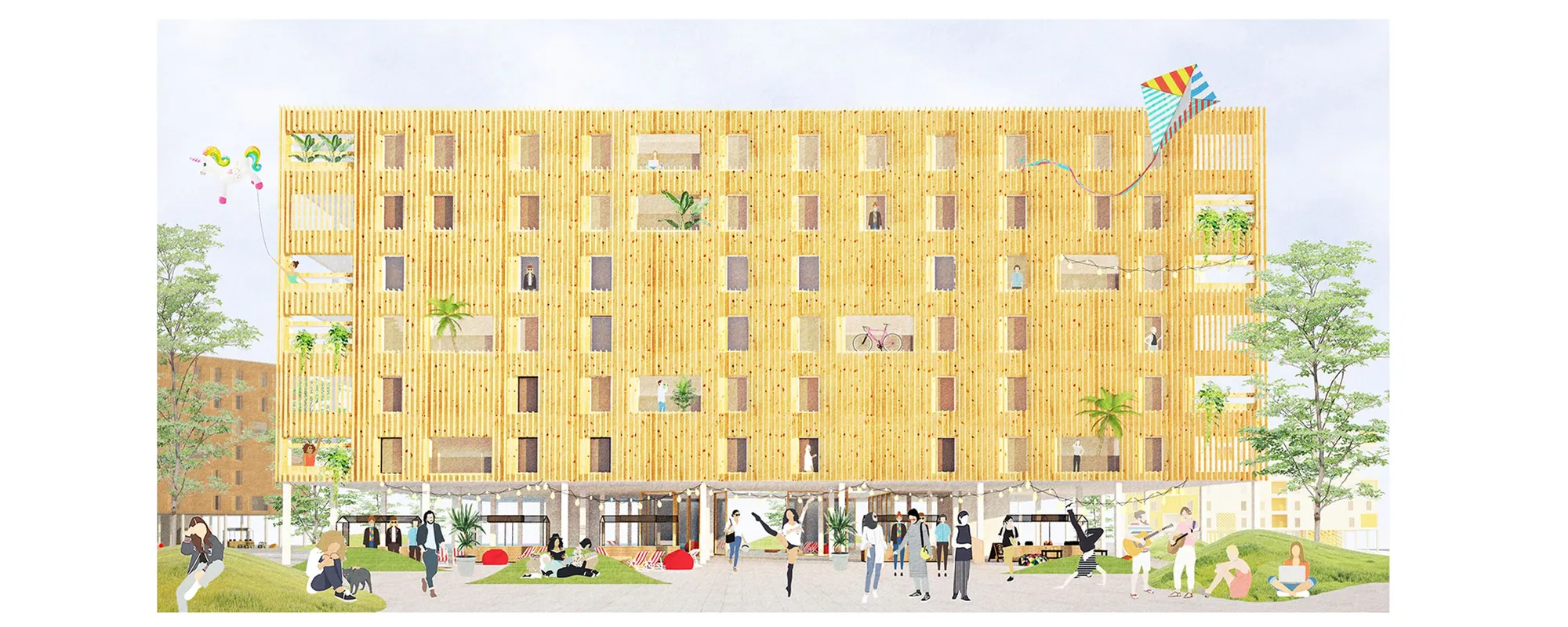
3-Living: Co-Living for Three Kinds of Resident
A winning co-living design that segments residents into travellers, workers, and lifers, giving each group its own spatial strategy in one building.


Three kinds of people need three kinds of rooms. 3-Living, a project by Martyna Slowinska, designs a co-living building around this observation. Travellers need short stays and flexible spaces. Workers need reliable infrastructure and quiet. Lifers need permanence and storage. The building provides all three, stacked vertically in a six-storey timber structure where the ground floor is public, the middle floors are shared, and the upper floors are private.
The project won the Hustle Hub '19 competition on uni.xyz. It is the most systematically resolved entry in the series: three user groups, three spatial strategies, one building that serves them all without compromise.
The Facade: Timber, Irregular, Alive
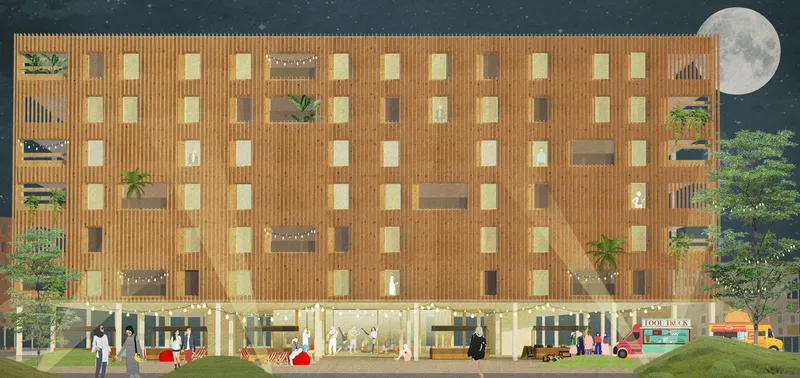
The night render establishes the building's character immediately. A six-storey timber-clad facade with irregularly placed windows of different sizes. Plants spill from balconies. String lights hang across the ground floor, where a glass-fronted retail space opens onto the street next to a food truck. A full moon hangs behind the building. The atmosphere is warm, social, and unmistakably residential.
The irregular windows are not random. They correspond to the different unit types behind them: small windows for bathrooms and kitchens, large ones for living rooms, tall narrow ones for bedrooms. The facade is a diagram of the plan, readable from the street. You can see the variety of life inside before you enter.
Three Groups, Three Stays
The project identifies three resident types by how long they stay. The Travel Group (bloggers, photographers, adventurers) stays for days or weeks. They need minimal private space and maximum access to communal areas. The Work Group (IT specialists, designers, entrepreneurs) stays for months. They need reliable wifi, quiet rooms, and co-working. The Life Group stays indefinitely. They need full apartments with kitchens, storage, and balconies.
This classification drives the plan. Short-stay units are small and clustered near shared kitchens. Medium-stay units are larger with private bathrooms. Long-stay units are full apartments. The building gets more private as you go up. The ground floor belongs to everyone. The top floor belongs to the resident who lives there longest.
The Communal Spaces: Kitchen, Terrace, Core
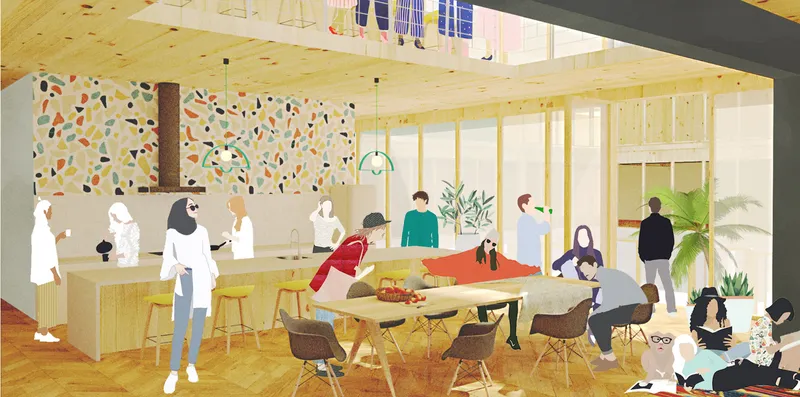
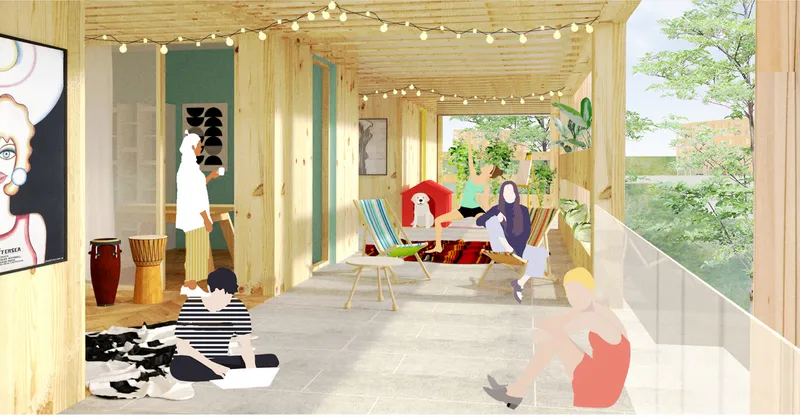
The two interior renders show the project's communal life. The kitchen and lounge has a terrazzo feature wall, a timber ceiling structure, a cooking counter, dining tables, and soft seating zones. People cook, chat, and work simultaneously. The space is not programmed for a single activity. It is sized and furnished for all of them at once.
The open terrace is the second communal highlight: a timber-framed outdoor room with string lights, djembe drums, deck chairs, and plants. It is the kind of space that co-living brochures promise and plans rarely deliver. Here it is real: a shared outdoor living room with enough furniture and atmosphere to draw people out of their private units.
The Section and the Plans
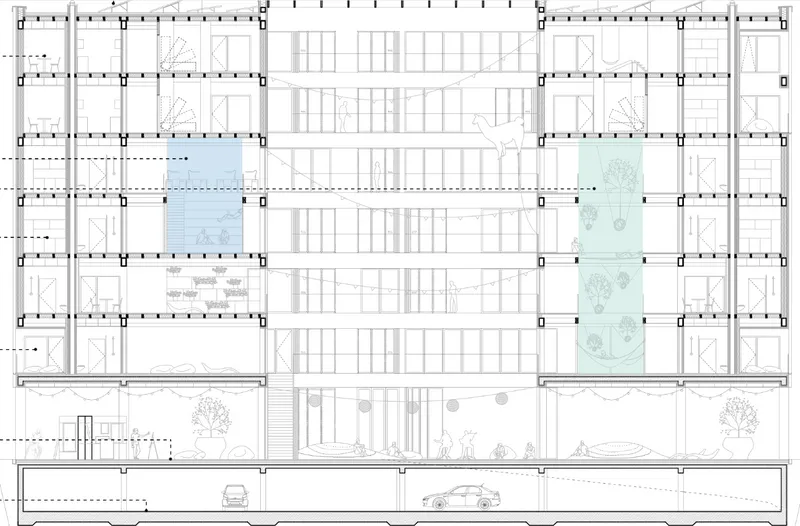
The section shows the building's vertical logic. Ground floor is public: retail, markets, events. Above it, parking. Then residential floors with double-height communal voids (highlighted in blue and green) that create vertical connections between levels. The voids ensure that shared spaces are not tucked into leftover corners. They are the largest rooms in the building.
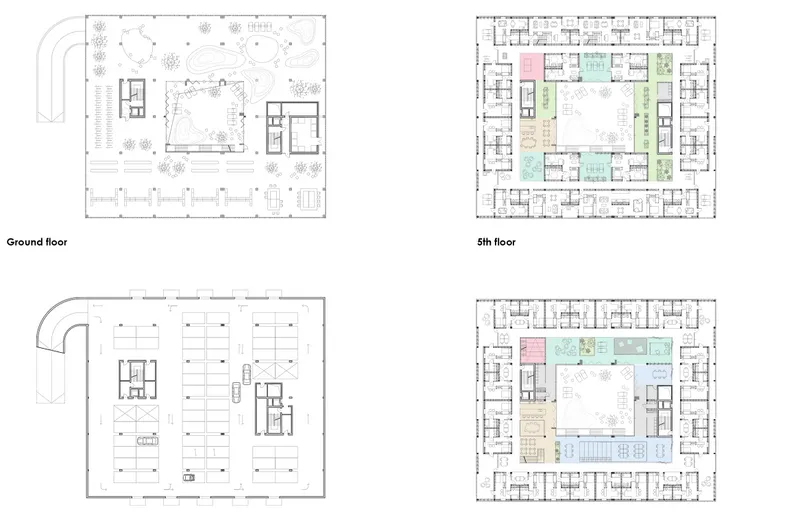
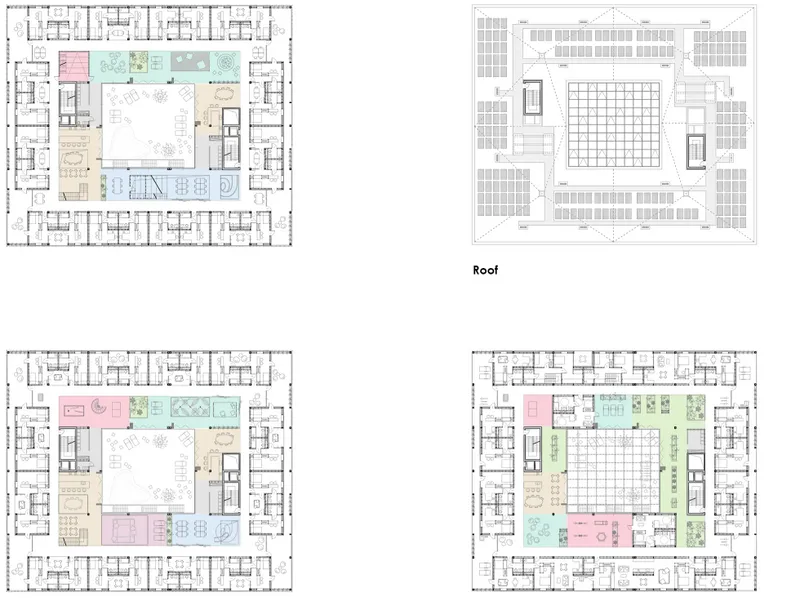
The floor plans confirm the system. The ground floor has a landscaped courtyard. Upper floors ring the courtyard with apartments, colour-coded by type. The central shared space grows larger on some floors and smaller on others, depending on how many short-stay versus long-stay units surround it. The plan is flexible because the module is standardised. The variety comes from how the modules are combined.
Why This Project Won
The Hustle Hub competition asked for co-living. 3-Living won because it answered the question the brief was really asking: co-living for whom? Most entries designed one kind of shared space and hoped it would suit everyone. This entry designed three kinds of shared space, matched them to three kinds of resident, and stacked them in a building that makes the differences visible.
For anyone studying co-living typologies, the lesson is segmentation. Not all shared-living residents are the same. A traveller staying three days has different needs from an entrepreneur staying three months. A building that acknowledges this and provides for it will be more successful than one that treats all residents as identical.
View the Full Project
About the Designer
Designer: Martyna Slowinska
Enter a Design Competition on uni.xyz
If co-living typologies, modular housing, or user-segmented residential design is the kind of work you want to explore, uni.xyz runs competitions year-round that reward systematic thinking applied to real spatial problems.
Project credits: 3-Living by Martyna Slowinska. Winner, Hustle Hub '19 (uni.xyz).




Popular Articles
Popular articles from the community


The Musturak Paradise: Senior Living Architecture for a Connected Future in Temara, Morocco
The Musturak Paradise reimagines senior living architecture in Temara via private homes, social spaces, culture, community, and shared care.

Hill & Cross Opera: Sculptural Opera House Architecture Shaped by Tallinn’s Landscape and Identity
Hill & Cross Opera reimagines opera house architecture in Tallinn through its sculptural hill, civic plaza, glass wave and a luminous cross.

Riyadh For All: Intergenerational Urban Design for Active Aging in Rabat
Riyadh For All reimagines urban design in Rabat with intergenerational co-living, adaptive courtyards, and Moroccan cultural exchange today.

Conexión: Biophilic Design Reimagines High-Rise Living in Hong Kong
Conexión reimagines high-rise living in Hong Kong through biophilic design, green facades, shared spaces, daylight, water and nature within.


Similar Reads
You might also enjoy these articles

Day and Night Park: A Time-Based Urban Newsstand in Beijing
A temporary urban newsstand in Beijing blending travel, light, and reading through poetic colors, compact form, and community-focused design.

Modernist Patio Renovation in El Masnou, Barcelona by Oliver Segura Arquitectura + Cebrià Arquitectura
Modernist patio renovation blending tradition and innovation with a movable pool, leveled floors, and Catalan materials in El Masnou.

Alto Residencial Coop: Cooperative Housing Development in Santiago de Compostela by Carbajo Barrios Arquitectos
A linear cooperative housing complex blending white volumes and perforated metal façades, enhancing community living, natural light, privacy, and urban integration.

Vil Genis School by BPA ARCHITECTURE – Massy, France
Vil Genis School in Massy, France, features sustainable design, south-facing classrooms, community integration, accessible spaces, and modern educational architecture.




Comments (0)
Please login or sign up to add comments
No comments yet. Be the first to comment!