
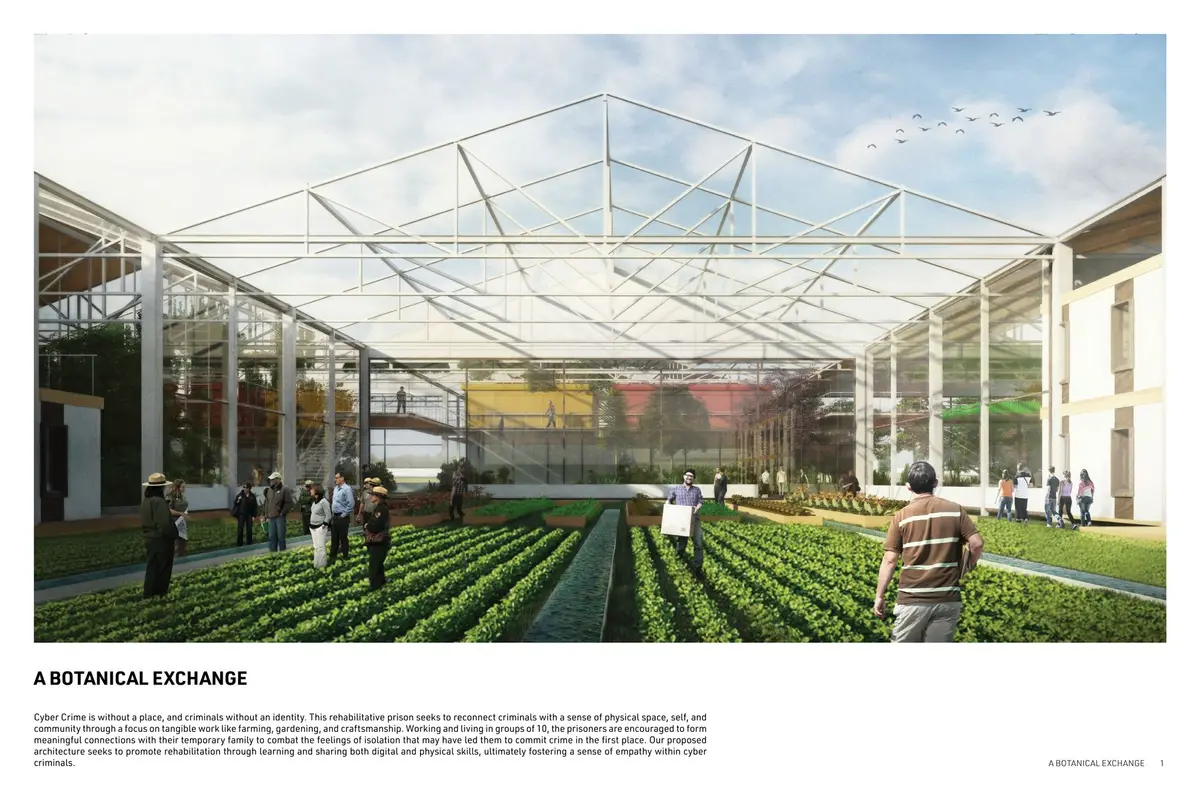
A Botanical Exchange: A Prison Campus Where Agriculture Replaces Confinement
Strip barns, suspended pods, and Dutch dike walls reimagine incarceration as a landscape of rehabilitation for cybercrime offenders.


What does it mean to imprison someone whose crime has no physical location? Cybercrime operates without walls, borders, or tangible geography, and its perpetrators often lack any rooted sense of place. "A Botanical Exchange" answers that paradox by designing a prison that does not look or behave like one. Instead of stripping inmates of spatial identity, it rebuilds it through agriculture, gardening, and craftsmanship, grounding people in the rhythms of the land as a path toward rehabilitation.
Designed by Cian Hrabi, Madeline Kim, and Ardy Chang, this project is the winning entry of the Switching Prisons competition on uni.xyz. The brief challenged participants to rethink incarceration from the ground up. This team responded with a campus of strip barns and agricultural greenhouses, where security is achieved through social bonds rather than razor wire, and the architecture of confinement gives way to a landscape of cultivation.
Barns as Buildings: A Massing Strategy Borrowed from Agriculture
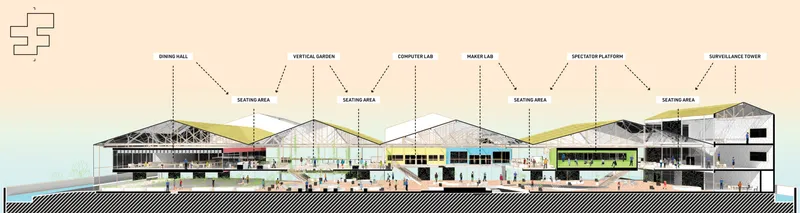
The longitudinal section reveals the project's core architectural move: undulating roof volumes that draw their formal logic from strip barns and agricultural greenhouses. Each volume shelters a different programmatic zone, from residential units to workshop spaces to communal forums, but they share a continuous ground plane. The designers deliberately rejected the conventional prison layout of sealed corridors and stacked cells. Instead, the ground floor operates as a fluid landscape where distinct programs bleed into one another, connected by informal discussion spaces that function much like the quads and courtyards of a university campus.
This massing strategy prioritizes what the designers call "programmatic autonomy." Each barn maintains its own identity and function, yet the spaces between them become as important as the spaces within. Education happens not just in classrooms but through the structured exchange that occurs when people move between agricultural work, craft production, and communal gathering. The architecture is calibrated to make those encounters feel organic rather than surveilled.
Growing Upward: Translucent Canopies and Vertical Planting
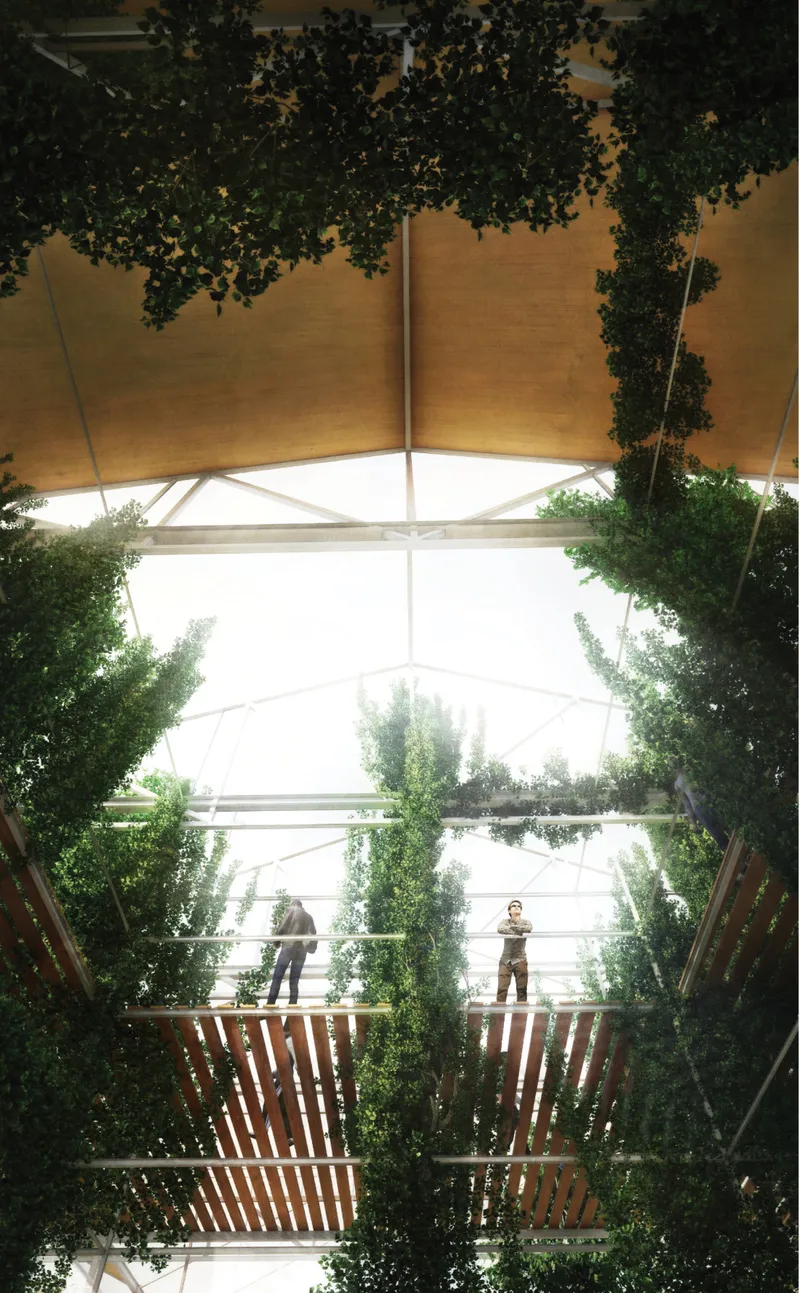

Two interior perspectives reveal how the greenhouse typology extends beyond metaphor into literal spatial experience. Looking upward through the translucent canopy, white steel trusses frame vertical planting that hangs between levels, blurring the threshold between built structure and cultivated landscape. In the courtyard view, timber and white steel hybrid roof structures shelter suspended planters while people circulate on open stairs below. The architecture makes cultivation visible and participatory: plants are not decorative afterthoughts but embedded into the structural logic of the building.
The suspended pods mentioned in the designers' sectional strategy appear here as vantage points within the barn volumes, encouraging both observation and engagement. A suspended forum bridges different programmatic areas, creating what the team describes as a space for "knowledge exchange." The effect is an interior world that feels more like a botanical garden crossed with a workshop than a correctional facility. Light filters through translucent panels, steel trusses recall agricultural infrastructure, and the presence of growing things orients daily life around care and patience rather than punishment.
Security Without Fortification: The Dutch Dike and Social Trust
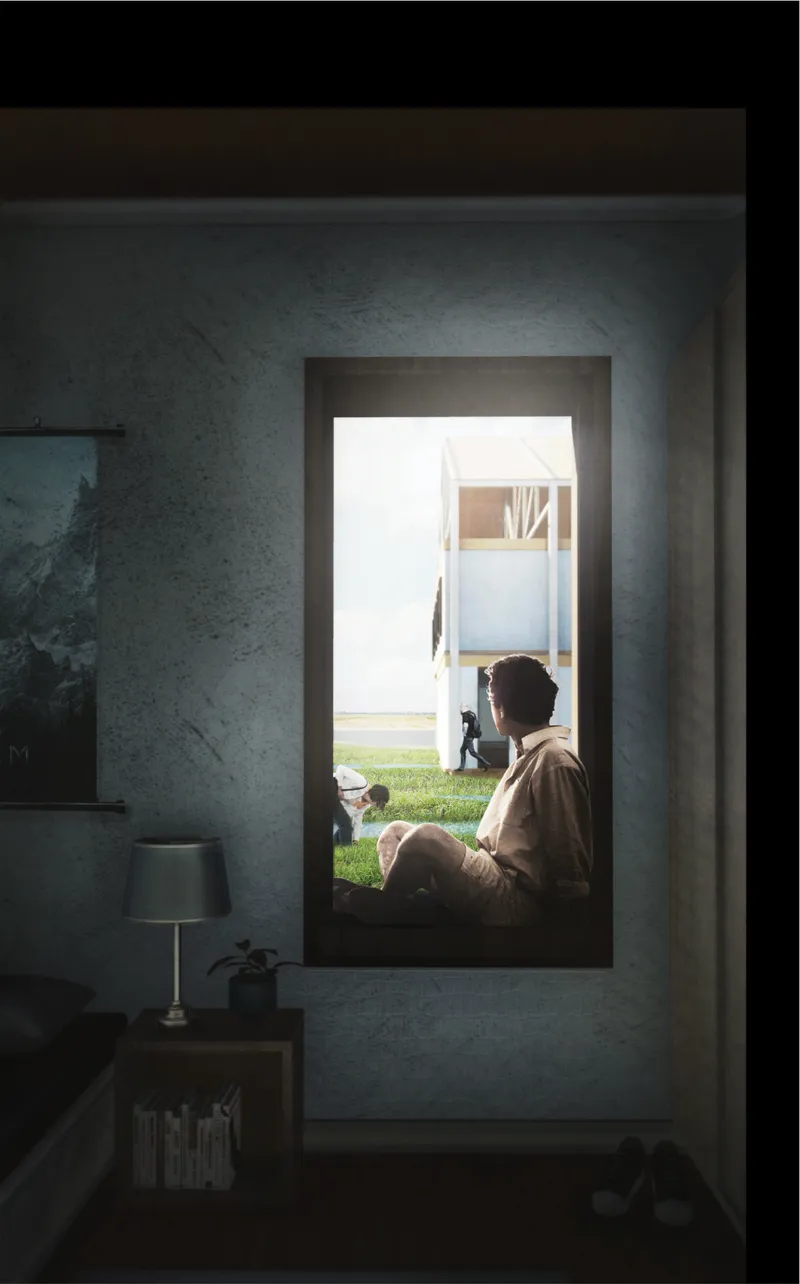
One of the most compelling images shows a single figure seated in a deep window recess, gazing out toward a grassed courtyard beyond concrete walls. The scene is quiet, contemplative, and notably free of the visual cues we associate with incarceration: no bars, no wire, no watchtowers in the sightline. The containment strategy relies instead on a half-wall inspired by a traditional Dutch dike, a landform that ensures boundary without projecting hostility. It blends into the surrounding landscape so seamlessly that the perimeter reads as topography rather than barrier.
Security is further decentralized through social architecture. Guards are assigned to small groups of inmates, building mutual trust rather than enforcing compliance from a distance. Dedicated security barns house surveillance and administrative functions, but they are absorbed into the campus vocabulary, indistinguishable in form from the workshop and residential barns. The result is a security model that operates through proximity and relationship rather than separation and fear.
Plan Configurations: Courtyard Logics and Circulation Routes

The axonometric drawing shows two configurations of a square plan organized around courtyards with clearly delineated circulation routes. These diagrams expose the project's organizational discipline beneath its pastoral aesthetic. Residential units are positioned for optimal interaction and privacy, balancing communal life with the need for retreat. Circulation is not a corridor but a network, offering multiple paths through the campus and encouraging the kind of chance encounter that fosters community integration.
The dual configurations suggest the design is conceived as an adaptable system rather than a fixed monument. Different courtyard arrangements could respond to varying inmate populations, security levels, or programmatic emphases. This flexibility reinforces the project's central argument: that rehabilitative architecture must be responsive to the people it serves, not a one-size-fits-all container.
Why This Project Matters
"A Botanical Exchange" matters because it refuses the false binary between security and dignity. Too much prison design treats these as competing priorities, where any gain in humane spatial quality must be paid for with a concession in control. Hrabi, Kim, and Chang demonstrate that the opposite is possible: a campus where the landscape itself provides containment, where the act of growing food builds the social bonds that reduce recidivism, and where the architecture of rehabilitation is rooted in the same structures that once sheltered crops and livestock.
The project also raises a pointed question about cybercrime and place. If the offense is placeless, what does it mean to sentence someone to a specific location? The designers' answer is that the sentence becomes the reconnection to place itself: to soil, to seasons, to the tangible labor of cultivation. It is a proposition that takes architecture's capacity to shape behavior seriously, and it does so without naivety, embedding real security infrastructure within a legible, humane spatial framework.
View the Full Project
About the Designers
Designers: Cian Hrabi, Madeline Kim, Ardy Chang
Enter a Design Competition on uni.xyz
uni.xyz runs architecture and design competitions year-round that reward proposals with spatial conviction and real site intelligence.
Project credits: A Botanical Exchange by Cian Hrabi, Madeline Kim, Ardy Chang Switching Prisons (uni.xyz).


Popular Articles
Popular articles from the community


LT2A and OPEN Architectes Thread a Brick and Glass High School Through a Wooded Belgian Campus
In Braine-l'Alleud, a 3,000 m² wing for Collège Cardinal Mercier pairs pale brick with a glazed colonnade, deferring to a small chapel and a dense wood.

Jaramillo Van Sluys Arquitectura and Urbanismo Turn a Demolished Registry Lot in Quito into an Orchard Plaza
In Quito's Centro Histórico, a 2,800 m² plaza exposes the San Agustín convent wall and redraws its lost Augustinian orchard in volcanic stone.

Juan García Correa, John González and Claudia Rueda Sink a Circular Amphitheater into a Manizales Engineering Building
On the La Nubia campus in Manizales, Colombia, the S1 Building folds labs and offices into a hillside of ramped lawns that double as a campus route.

Cube Design Draws an Ecological Corridor Between Two Shenzhen Hills with the Nankai Building
Beside Shenzhen's container docks, the Nankai Building pairs stacked balconies with a climbing green screen to connect two hillsides across its height.

Similar Reads
You might also enjoy these articles


Vereda Arquitetos Renovates a 40-Square-Meter Apartment Inside Niemeyer's Copan Building
A compact unit in São Paulo's most iconic residential tower gets a material overhaul that pairs exposed concrete with bold blue Formica.

Shakur's House: Exposed Brick as an Interior Organiser in a 168 m² Mashhad Residence
Brick moves indoors in this Mashhad residence, where masonry walls, glass partitions and teal planes sequence a compact home without closing it off.

Day and Night Park: A Time-Based Urban Newsstand in Beijing
A temporary urban newsstand in Beijing blending travel, light, and reading through poetic colors, compact form, and community-focused design.

Modernist Patio Renovation in El Masnou, Barcelona by Oliver Segura Arquitectura + Cebrià Arquitectura
Modernist patio renovation blending tradition and innovation with a movable pool, leveled floors, and Catalan materials in El Masnou.

Explore Penitentiary Competitions
Discover active competitions in this discipline

Challenge to design locus for the upliftment of human rights

Design challenge to reuse E-waste
Comments (0)
Please login or sign up to add comments
No comments yet. Be the first to comment!