

A House in Sardinia by Stera Architectures: Sculpting Concrete Elegance into Coastal Landscape
A sculptural coastal home in Sardinia by Stera Architectures, seamlessly blending concrete minimalism with landscape, light, and Mediterranean views.


Architectural Harmony with the Sardinian Landscape
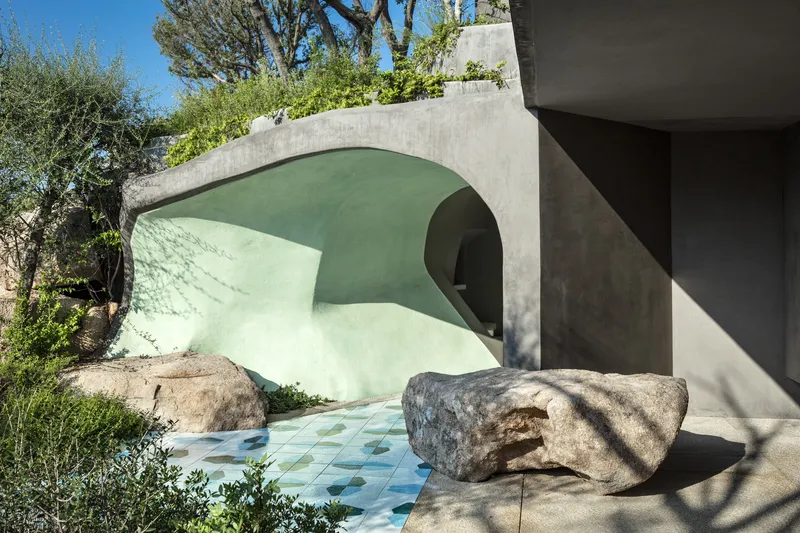
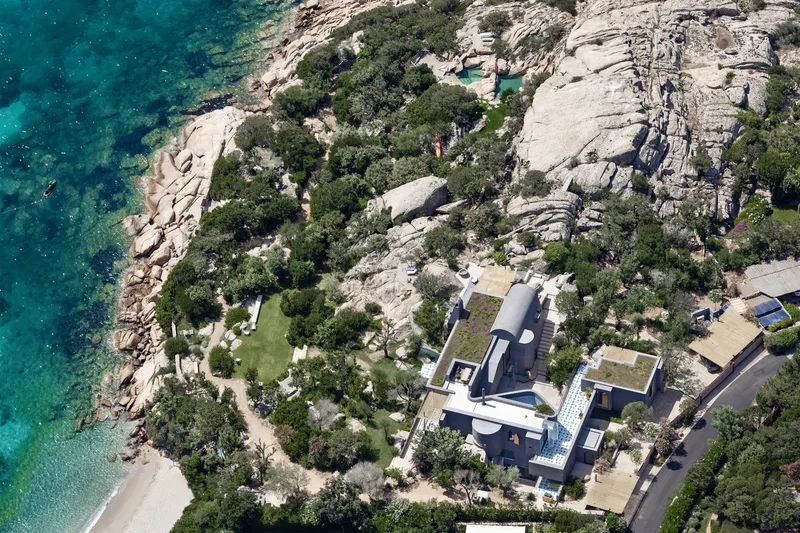
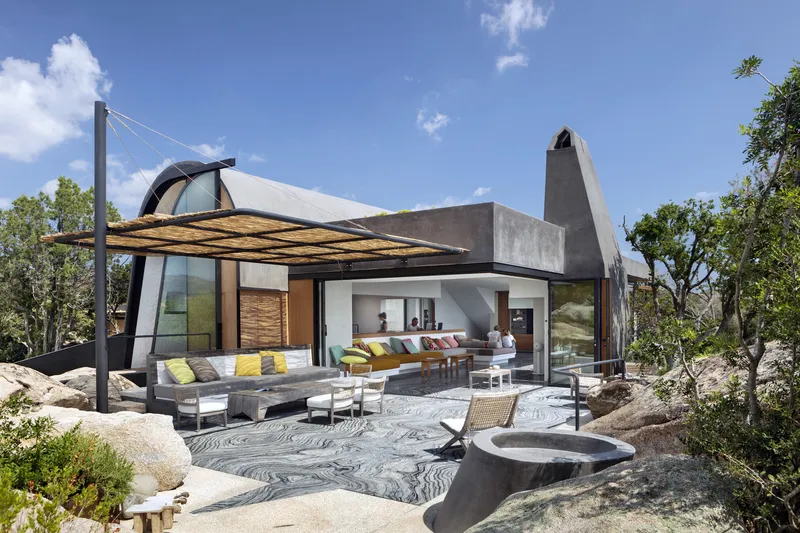
Designed by Stefania Stera of Stera Architectures, A House in Sardinia reimagines the synergy between built form and wild terrain. Nestled on a rugged coastal plot that dips toward the sea, the site previously housed a modest home that overlooked its potential. The former structure was limited in orientation and missed opportunities to engage with the natural rock formations, shaded woodlands to the north, and the breathtaking Mediterranean coastline.
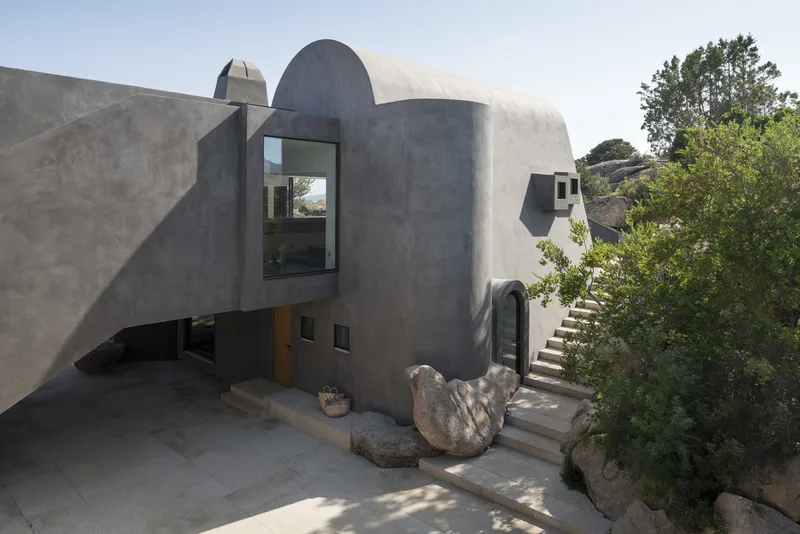
The new architectural vision seeks to embrace Sardinia’s raw landscape—leveraging light, terrain, and native materiality—to create a home deeply rooted in place. The house is not merely placed on the land; it is sculpted from it.


Design Philosophy: Site-Responsive Architecture
The project’s core principle was not to dominate the site but to enhance its inherent beauty. In the spirit of Porto Cervo’s original design ethos, initiated in the 1960s by the Aga Khan and Costa Smeralda consortium, the home is a testament to the philosophy of minimal intervention and maximum experience.
Stera introduced two powerful design axes:
- One aligned toward the sea, drawing views deep into the home
- Another ascending toward the cliffs, integrating the upper terrain
These axes defined the multi-leveled layout, uniting indoor and outdoor spaces in a continuous architectural promenade.



Fluid Spatial Composition and Circulation
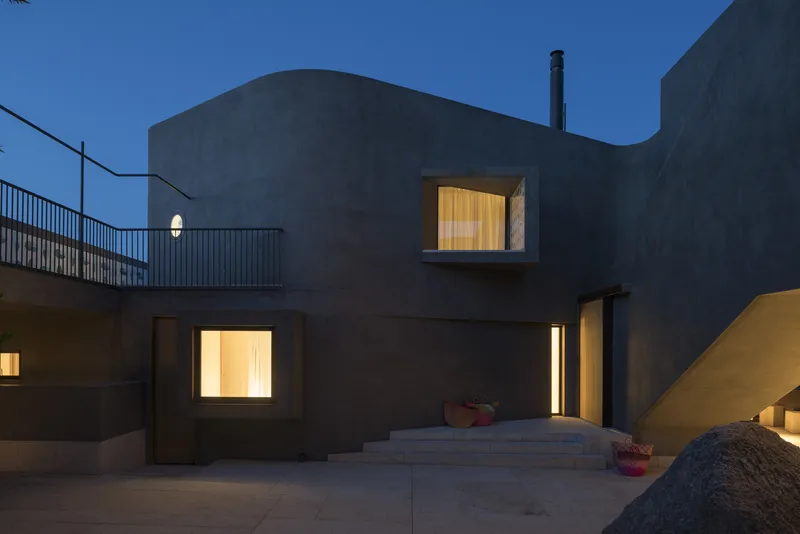
The residence offers a non-traditional spatial composition. The main entrance is a courtyard, not a foyer, acting as a sunlit heart of the house. Rooms unfold around it, echoing traditional Mediterranean courtyard homes but with contemporary precision.
- Ground Floor (Lower Level): Hollowed from the site to sit close to the sea. Features garden-facing rooms and green terraces, such as the “flying carpet” deck that appears to float over the coast.
- Upper Floor: Contains the living room, dining area, master suite, and study. These spaces are arranged to frame sea views, shaded patios, and serene courtyards.


Material Palette and Craftsmanship
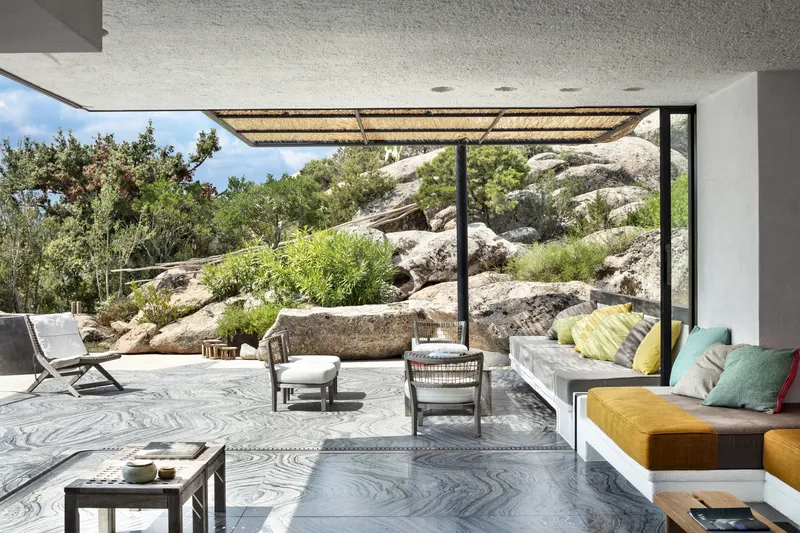
The architectural language is defined by monolithic concrete forms, juxtaposed with locally sourced craftsmanship. The use of natural stone, handmade finishes, and fine metalwork blends luxury with authenticity. The textures age gracefully, resonating with the Sardinian cliffs and coastal hues.
The house is enriched by:
- Custom window systems from OTTOSTUMM (Mogs M65 TB)
- Artisan contributions from Artigianato Pasella
- Integration of green roofing and courtyards that cool the structure passively

Integrated Landscape and Sustainable Vision
One of the home’s most poetic features is its landscape-led approach. Instead of manicured lawns, the architect retained the wild spirit of the land:
- A ledge path skirts the coast, offering access to hidden viewpoints
- Multiple courtyards and patios integrate sunlight, breezes, and nature
- The roof functions as a green terrace, further embedding the structure into its context


Living in a Sculptural Experience
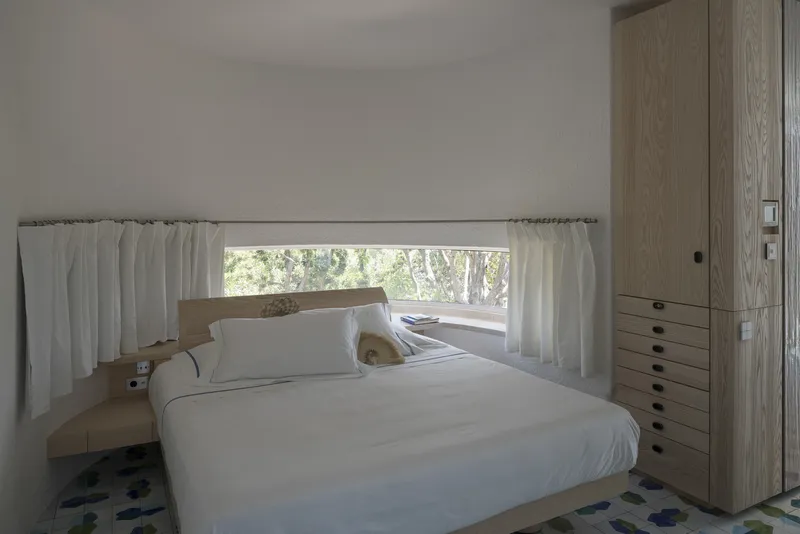
Every space within the house offers a framed experience—a visual story woven between stone, sky, and sea. From the U-shaped lounge facing the Mediterranean to the intimate bathrooms and stairways that unveil new perspectives, A House in Sardinia is not just a residence—it is a journey.
Whether accessed from the main courtyard, the "canyon" spine, or the sloping path that connects its levels, each transition celebrates space, texture, and light in a masterclass of site-responsive modernism.
A House in Sardinia by Stera Architectures is a breathtaking exploration of coastal minimalism. Rooted in place, craftsmanship, and light, it offers a refined retreat where modern design and ancient landscape converge. It is an architectural statement of timeless integration, honoring the island's heritage while looking boldly into the future.


All the photographs are works of Nicolas Borel, Tiziano Canu


Popular Articles
Popular articles from the community


David Macias Steps a Doorless Stone and Plaster House Down a Tropical Colombian Hillside
In the humid hills of Colombia, Threshold House replaces the front door with an open void and terraces its 850 m² down the slope instead of fighting it.

Architekt Andreas Gruber Scatters 23 Dark Timber Chalets Across a South Tyrolean Forest Edge
In Molini di Tures, Amonti Chalets breaks a resort into a hamlet of gabled timber houses, with parking, storage and services pushed into the slope.

Cube Design Draws an Ecological Corridor Between Two Shenzhen Hills with the Nankai Building
Beside Shenzhen's container docks, the Nankai Building pairs stacked balconies with a climbing green screen to connect two hillsides across its height.

U.GA Architects Wraps an Oval Rooftop Pool in Curved Board-Formed Concrete on Busan's Jeollidan-gil
In Busan's Jeonpo-dong, a 454 m² mixed-use block stacks a neighborhood facility, guest rooms and an oval rooftop pool inside spiraling concrete walls.

Similar Reads
You might also enjoy these articles


Hodi-Mandai Geram
Project Function: Preservation and revitalization of the Intangible heritage and socio-spatial identity of the Hodi by Housing, Cultural Memory Center, Sacred Grove, landscape, local tourism economy


Olio Towers: A Mid-Rise for Performers That Fuses Housing, Rehearsal, and Stage
Located blocks from Houston's Theater District, this modular tower stacks living units around a central performance atrium.

Oasis: Modular Green Housing Carved into Dhaka's Urban Fabric
A shortlisted Plugin Housing entry reclaims unauthorized settlements in Dhaka with stepped concrete volumes, green roofs, and ventilation-driven design.

Black Hole: A Floating Megastructure for the Post-Physical Era
Emiliano Mazzarotto envisions a spherical, self-scaling arena where e-sports, digital hotels, and holographic stadiums replace traditional public space.

Explore Seaside Architecture Competitions
Discover active competitions in this discipline

Challenge to reimagine the Iron Throne

Photograph architecture without architects

Illustrate the lost glory of Angkor Wat - Render Challenge

Design challenge to reuse E-waste
Comments (0)
Please login or sign up to add comments
No comments yet. Be the first to comment!