

Meal Mine: Architecture That Grows Its Own Food Supply
A modular co-housing proposal that merges aquaponics, vertical farming, and native orchards into a resilient urban food ecosystem starting in London.


What if a building could feed its residents the way soil feeds a forest? Meal Mine proposes exactly that: a co-housing model where the architecture itself operates as productive agricultural infrastructure. Aquaponics loops, fungiculture chambers, composting systems, and vertical farms are not bolted onto the structure as afterthoughts but woven into its section, its circulation, and its daily rituals. The result is a living framework where growing food is as ordinary as walking through a corridor.
Designed by Andreas Hardering, Emily Loh, and Steffen Poenitz, the project begins in London but is conceived as a globally responsive system adaptable to different climates and food cultures. Titled UMM...let's think about food., it positions itself at the intersection of food security, ecological restoration, and urban community. You can explore the full project here.
A Linear Landscape Where Rooftops Become Orchards
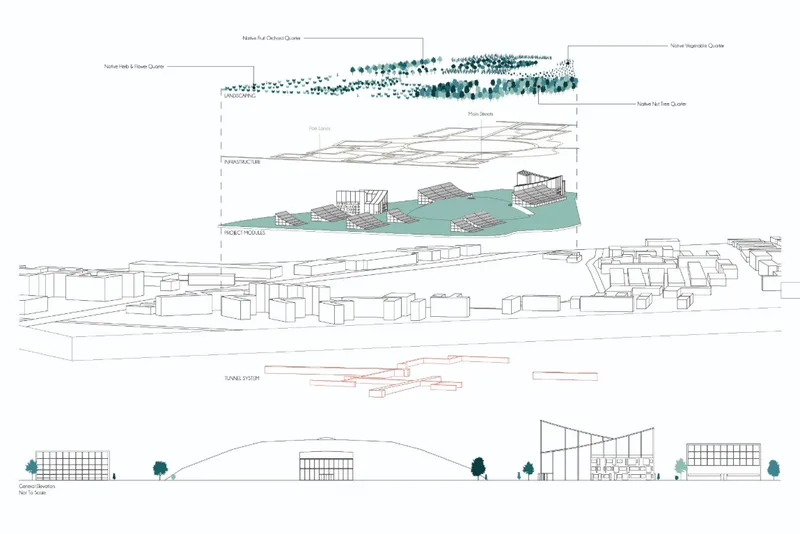
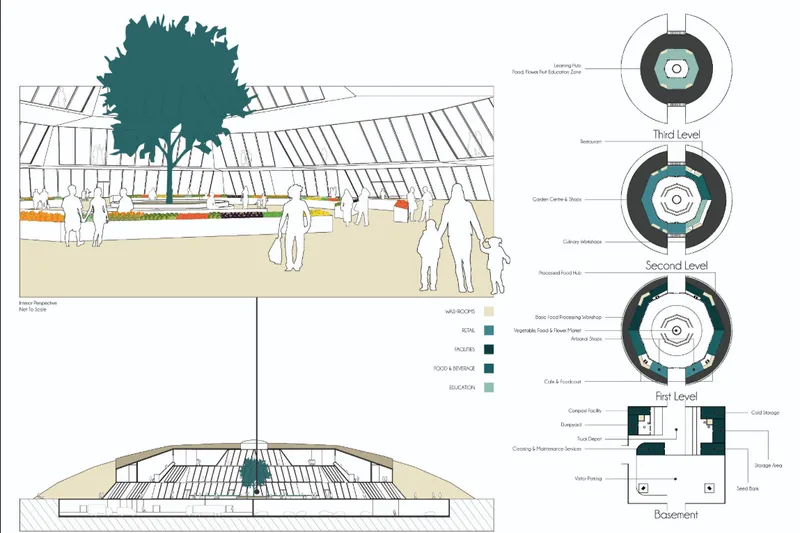
The composite elevation and section drawings reveal a development organized as a long, terrain-hugging form layered with rooftop vegetation. Native fruit orchards, nut trees, herbs, flowers, and vegetable plots occupy dedicated quarters across the building's surface, restoring biodiversity while generating food. Beneath sloped roof structures, the sections show figures inhabiting spaces that flow between residential and agricultural programs, with circular floor plan diagrams suggesting a modular logic that can be rotated and reconfigured.
What is striking here is the layered infrastructure strategy. The architects stack surface-level project modules above sub-surface tunnel systems that connect to public landscapes, creating a continuous loop between architecture and daily food practices. The building is not a container sitting on top of the ground; it is entangled with it, drawing from seasonal cycles and local produce variations to shape its internal rhythms.
Closed-Loop Systems Built Into the Section
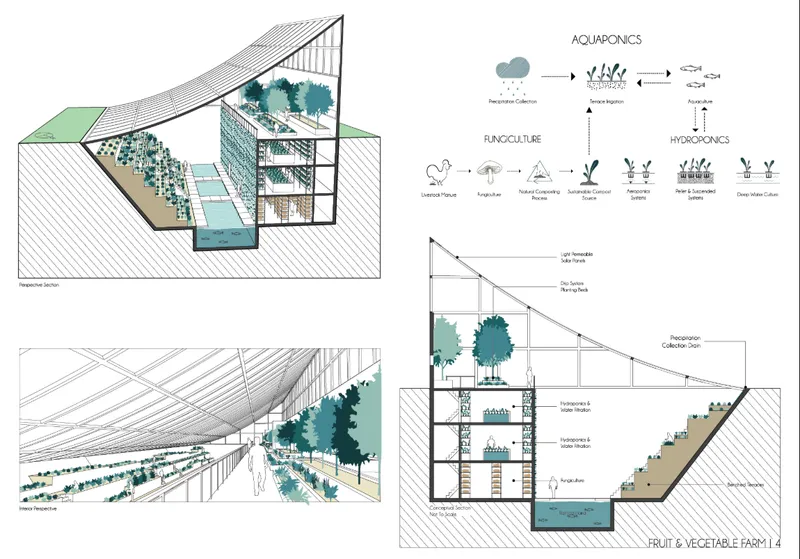
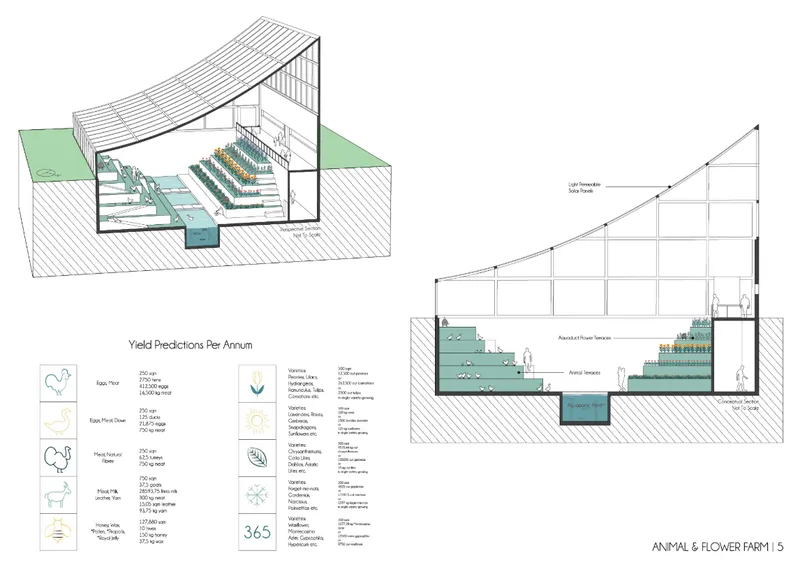
The axonometric and section drawings make the technical ambition legible. Aquaponics and hydroponics systems occupy terraced volumes where water and nutrients cycle through closed loops, producing high yields within compact architectural footprints. In the cutaway axonometric, tiered aquaculture pools and planting beds nestle under a sloped roof, stacking productive layers vertically to reduce land consumption. Organic waste from residents feeds fungiculture and composting processes that transform scraps into fertile soil, completing the nutrient cycle within the building itself.
Energy and water systems follow the same logic of self-sufficiency. Solar permeable panels, irrigation recycling, and precipitation collection minimize the project's ecological footprint. The designers treat these technologies not as discrete installations but as spatial generators: the slope of a roof collects rainwater, the depth of a basement accommodates mushroom cultivation, the orientation of a facade determines solar gain. Every design decision carries a double function.
Modular Units Organized Around Central Courtyards
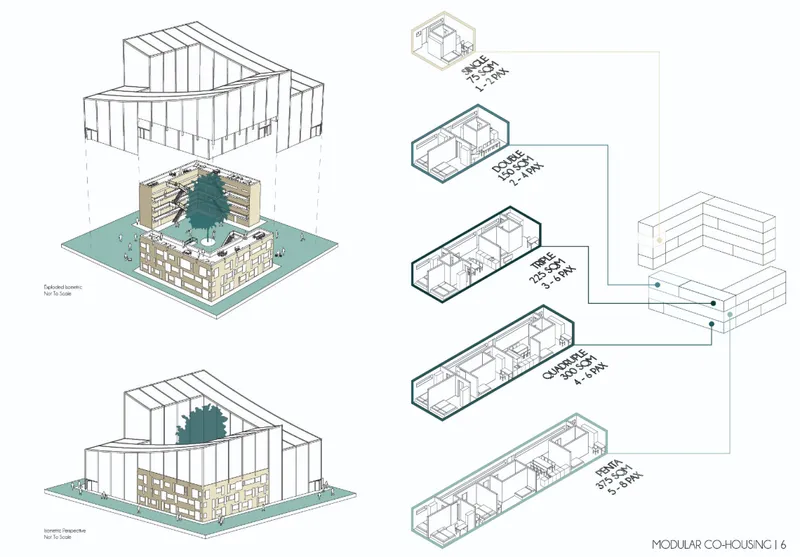
The isometric diagrams break down the co-housing logic into legible components. Modular units accommodate single, double, triple, quadruple, and penthouse configurations, each arranged around central courtyard trees that anchor communal life. Shared courtyards and communal areas are not residual spaces between buildings but the social engine of the project, where residents gather, tend integrated farms, and participate directly in the food production that sustains them.
The flexibility of this system is key to the project's claim of global applicability. The modules can be recombined to respond to different household structures, climatic conditions, and cultural food practices. Architecture here becomes a platform for ecological education: living in Meal Mine means understanding where your food comes from because you pass through it on your way to the front door.
Why This Project Matters
Meal Mine is ambitious in a way that refuses to separate the question of shelter from the question of sustenance. Too many sustainability proposals treat food production as a programmatic add-on, a rooftop garden tacked onto an otherwise conventional residential block. Hardering, Loh, and Poenitz argue that the architecture itself must be restructured around agricultural logic, from the section to the unit plan to the material cycle. The result is a proposal where resilience is not a marketing label but a spatial condition.
The project's strength lies in its systems thinking. By linking aquaponics, composting, vertical farming, native planting, and modular housing into a single coherent framework, it demonstrates that urban food security is not a problem to be solved in isolation. It requires rethinking how buildings meet the ground, how waste becomes resource, and how communal space can nurture both social bonds and literal nourishment. Meal Mine offers a compelling blueprint for cities that want to feed themselves.
View the Full Project
About the Designers
Designers: Andreas Hardering, Emily Loh, Steffen Poenitz
Enter a Design Competition on uni.xyz
uni.xyz runs architecture and design competitions year-round that reward proposals with spatial conviction and real site intelligence.
Project credits: UMM...let's think about food by Andreas Hardering, Emily Loh, Steffen Poenitz.


Popular Articles
Popular articles from the community


U.GA Architects Wraps an Oval Rooftop Pool in Curved Board-Formed Concrete on Busan's Jeollidan-gil
In Busan's Jeonpo-dong, a 454 m² mixed-use block stacks a neighborhood facility, guest rooms and an oval rooftop pool inside spiraling concrete walls.

longwave studio Reorganizes a 112 m² Tainan Apartment Around the Daily Routines of a Family and Two Cats
In Tainan, Taiwan, birch plywood, rust-red furniture and a freestanding plaster wall link arrival, storage, work and family life in one apartment.

David Macias Steps a Doorless Stone and Plaster House Down a Tropical Colombian Hillside
In the humid hills of Colombia, Threshold House replaces the front door with an open void and terraces its 850 m² down the slope instead of fighting it.

David Ortega Stacks a Two-Story Mexico City Penthouse Around a Steel Stair and a Pergola-Shaded Roof Terrace
In Colonia Roma, a 300 m² penthouse uses oak joinery, a planted steel stair and a slatted roof pergola to make a new-build apartment feel like a house.

Similar Reads
You might also enjoy these articles


Aquadapt: An Underwater Habitat That Rewrites Its Rooms by the Hour
Curved modules ring the seabed while one shell shifts from breakfast room to cinema, farm and football pitch as residents' needs change.

Play: Fragments of Their World: Remembered Architecture Rebuilt as a Modular Playground for Refugee Camps
Tom Gardner abstracts domes, arches and towers from the homelands of displaced families into a kit of child-scaled play parts for camp settlements.
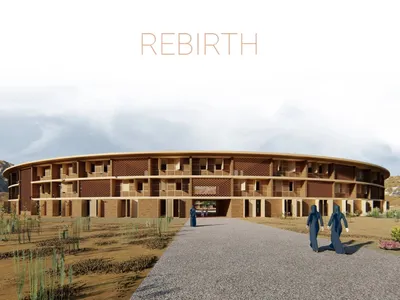
REBIRTH: A Circular Settlement Where Afghan Widows and Their Children Rebuild Life Together
A shortlisted Resile entry turns the circle into a protective ring of timber and brick, gathering homes, classrooms and gardens around a shared landscape.
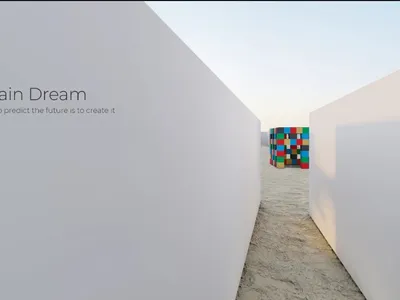
The Main Dream: A Recycled Plastic Kit That Lets Refugee Children Build Their Own Playground
Thirty-centimetre interlocking cubes that connect on three axes turn play into construction, letting children author the spaces they occupy.

Explore Urban Meal Mine Competitions
Discover active competitions in this discipline

Design challenge to equip cities with modern furniture

Design challenge to reuse E-waste
Comments (0)
Please login or sign up to add comments
No comments yet. Be the first to comment!