

A Wall to Live In: Modular Prison Architecture That Replaces Isolation with Landscape
A shortlisted entry in the Switching Prisons competition reimagines detention as a series of courtyard clusters woven with green space and adaptable living

What if a prison wall were not a barrier but a habitat? A Wall to Live In takes that provocation literally, proposing a detention facility for non-violent offenders in which the architectural perimeter is not a blank surface of control but a thick, inhabited zone of modular living units, workshops, canteens, and vegetable gardens. The project refuses the conventional logic of incarceration, where isolation is the default spatial tactic, and instead builds rehabilitation directly into the organization of the plan: courtyard clusters open to seasonal landscapes, adaptable residential cells sit above shared programme, and layered facade systems mediate between interior life and the world beyond.
Designed by Giovanna Zani, Davide Mele, and Valentina Geminiani, the project was shortlisted in the Switching Prisons competition. The brief asked entrants to rethink justice architecture as a vehicle for personal development and social reintegration rather than punishment. This team answered with a scheme rooted in three clear principles: modularity and flexibility, nature as a healing element, and a human-centered spatial approach that encourages reflection and responsibility.
Courtyard Clusters Replace Cellblocks
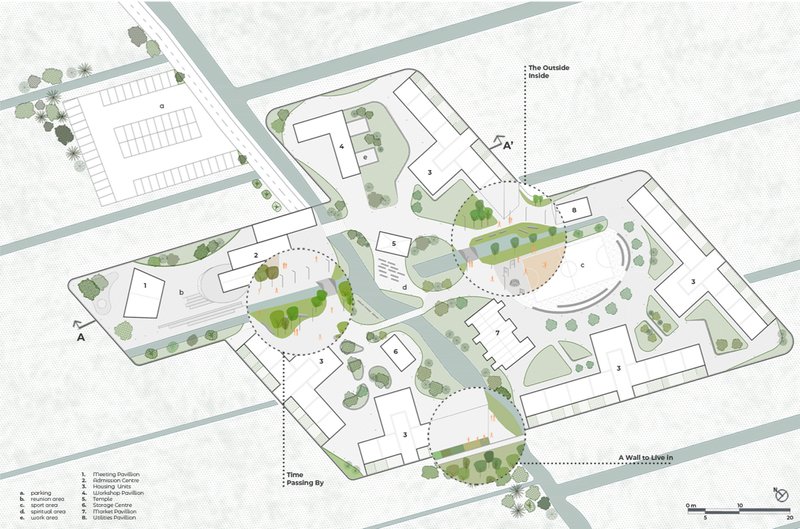
The site plan reveals the project's most radical departure from conventional prison typology. Instead of a single monolithic block ringed by perimeter walls, the scheme disperses its programme across multiple building clusters arranged around shared courtyards. Trees and landscaped paths line the surrounding streets, softening the institutional edge and embedding the facility within a civic fabric rather than sealing it away from one. The result is a campus-like organization where outdoor space is not residual but central to daily life.
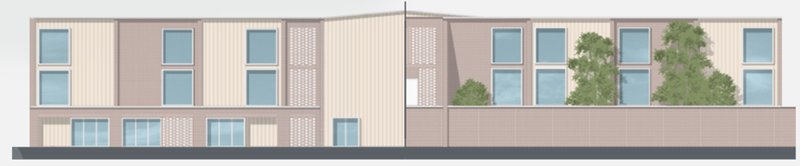
The elevation drawing makes the architectural language legible. Two-story volumes combine vertical wood planks, perforated brick panels, and generous window openings to create facades that breathe. Rooftop trees punctuate the silhouette, reinforcing the commitment to nature as a constant presence rather than a controlled amenity. The human scale of the buildings, no taller than two stories, avoids the oppressive verticality that characterizes most correctional facilities.
Sectional Logic: Double-Height Courtyards and Sloped Roofs
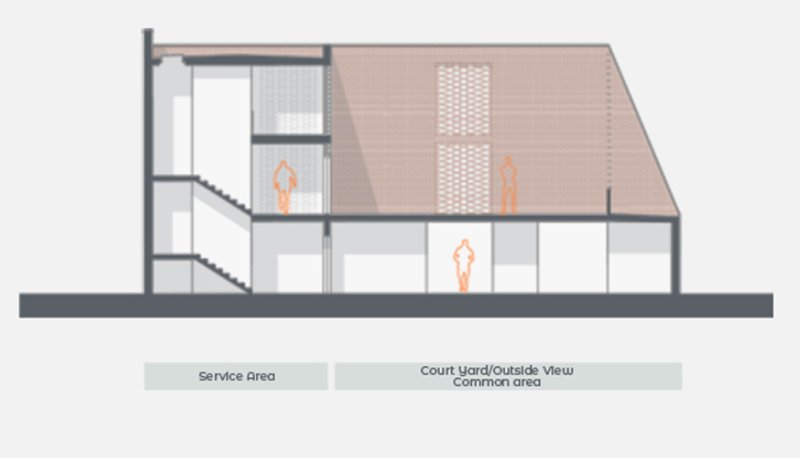
The building section cuts through a sloped roof form that opens into a double-height courtyard space, flanked by service areas and connected by an internal staircase. Figure silhouettes scattered through the drawing indicate the intended inhabitation: people moving freely between levels, gathering in the shared void, ascending to private quarters. The section is generous where it needs to be, offering volume and daylight in communal zones, and compact where privacy matters. The sloped roof is not merely formal; it creates differentiated ceiling heights that give spatial identity to each zone without relying on corridors or locked doors.
Stacking Programme: Living Units Over Workshops and Gardens
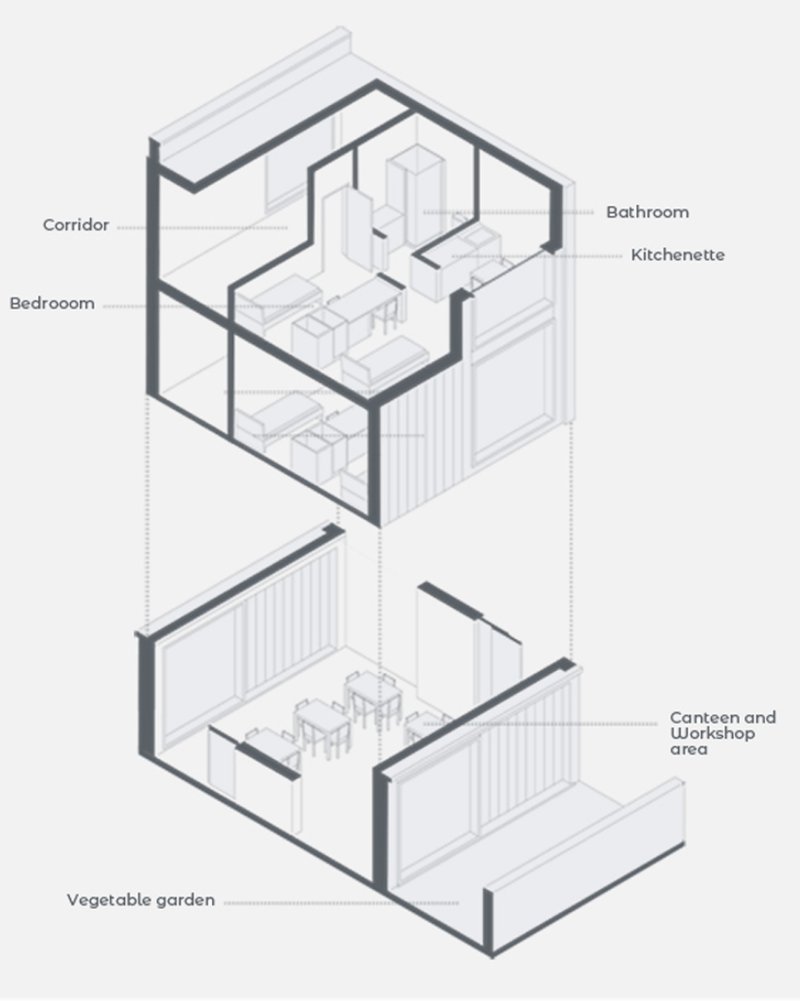
An exploded axonometric diagram lays out the vertical stacking strategy with clarity. Residential units sit above a shared canteen and workshop area, while a vegetable garden occupies the ground plane below. This layering is deliberate: productive and social programmes anchor the base, giving inmates daily access to communal work and food cultivation, while private living spaces sit above, offering a degree of separation and quiet. The garden is not decorative. It is a working landscape that ties seasonal rhythms to the daily routine, giving residents agency over something that grows.
Facade as Mediator: Brick, Wood, and Brise Soleil
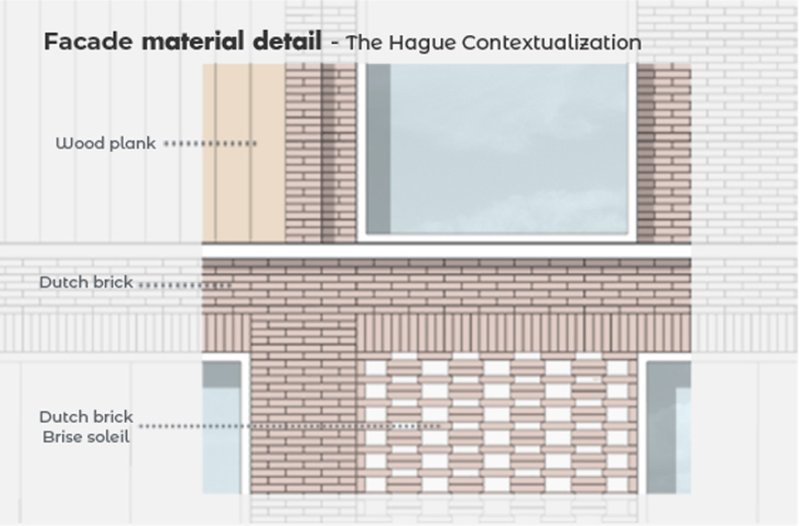
The facade detail drawing catalogs the material palette with precision: wood planks, Dutch brick patterns, brise soleil, and window openings, each assigned a specific role in mediating light, ventilation, and visual privacy. The layered system avoids the blankness of standard correctional enclosures. Brick provides thermal mass and texture. Wood planks introduce a domestic register. The brise soleil filters direct sunlight without blocking views. Together, these elements create an envelope that feels authored rather than specified from a security catalog.
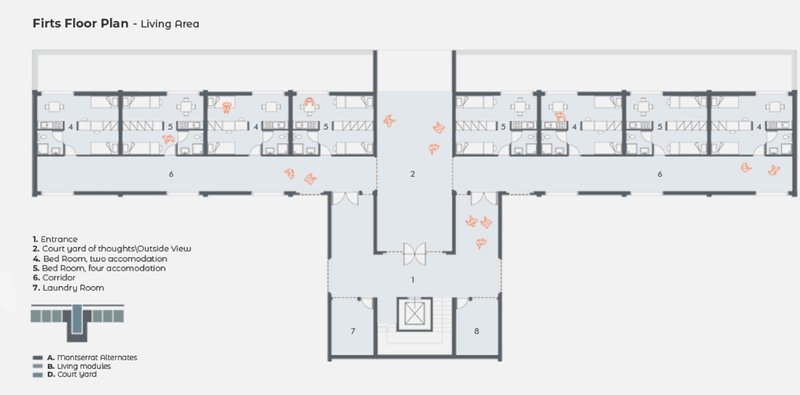
The first floor plan confirms how the residential units are organized in rows around the central courtyard, with a shared entrance below. The repetition of units is modular but not monotonous; each cluster frames its own version of the courtyard, and the entrance sequence moves through landscape before reaching any built threshold. This plan arrangement gives every unit visual access to green space and ensures that no resident is more than a few steps from the outdoors.
Why This Project Matters
A Wall to Live In demonstrates that rethinking prison architecture does not require abandoning discipline or security. It requires rethinking what those words mean spatially. Modularity here is not a buzzword; it is a strategy for matching programme to individual rehabilitation needs. Nature is not an accent but a structural principle that governs site organization, roof profiles, and facade performance. The project's strength lies in its refusal to treat incarceration as a single condition, instead offering a gradient of spaces from the most collective to the most private.
Zani, Mele, and Geminiani have produced a competition entry that reads as a clear, buildable proposition rather than a polemical sketch. The drawings communicate real material decisions, real sectional relationships, and a real commitment to the idea that architecture can participate in justice reform. In a field where the default response is either utopian abstraction or grim pragmatism, this project occupies a productive middle ground: humane, specific, and architecturally literate.
View the Full Project
About the Designers
Designers: Giovanna Zani, Davide Mele, Valentina Geminiani
Enter a Design Competition on uni.xyz
uni.xyz runs architecture and design competitions year-round that reward proposals with spatial conviction and real site intelligence.
Project credits: A Wall to Live In by Giovanna Zani, Davide Mele, Valentina Geminiani Switching Prisons (uni.xyz).




Popular Articles
Popular articles from the community

Bernardes Arquitetura Stretches a Timber Roof Along a Reservoir's Edge in Minas Gerais
Dam House in Itaúna lets a sweeping wooden canopy dissolve the boundary between hillside terrain and open water.
RDTH architekti Rips Out Nearly Every Wall in a Prague Apartment and Replaces Them with Furniture
A 101-square-meter post-war flat in Prague trades rigid partitions for a single rotated furniture block, curtains, and glass concrete.
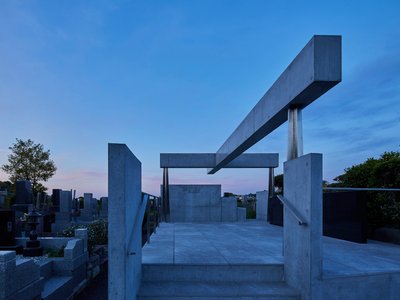
Takeshi Hosaka Architects Suspends a Concrete Cross Above a Yokohama Cemetery
A 28-square-meter burial renovation in Yokohama lifts the symbol of resurrection into the sky so mourners see it against heaven.
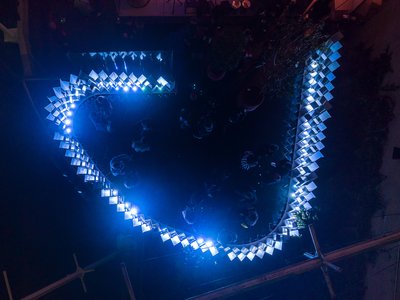
Rojkind Arquitectos and Think Parametric Build a Glueless Pavilion from 67 Interlocking Panels
A serpentine fiber-cement installation in Chapultepec Park celebrates a decade of architectural media in Mexico City.

Similar Reads
You might also enjoy these articles

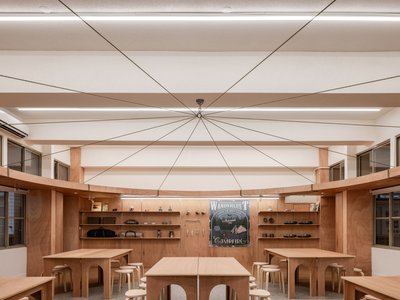
317studio Turns an 87 m² Classroom into a Forest Clearing for Scouts in New Taipei City
A rope canopy, student-made specimens, and campfire geometry replace rows of desks in this Scouting classroom in Xizhi District.
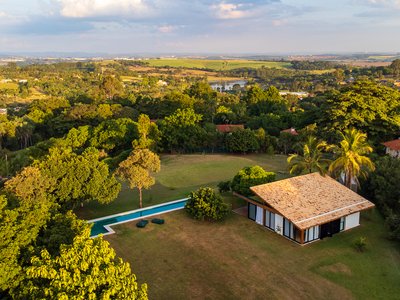
24 7 Arquitetura Builds a Timber Pavilion as a Family's First Act on a 5,000 m² Brazilian Plot
In Jaguariúna, a prefabricated glulam house nestles among mature trees as the opening move of a larger residential masterplan.
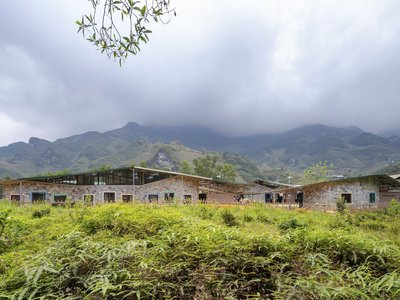
1+1>2 Architects Build a School from 900 Blocks of Hmong Stone on Vietnam's Rocky Plateau
On a barren valley in Ha Giang province, a community quarried its own stone to raise a kindergarten and primary school rooted in Hmong identity.
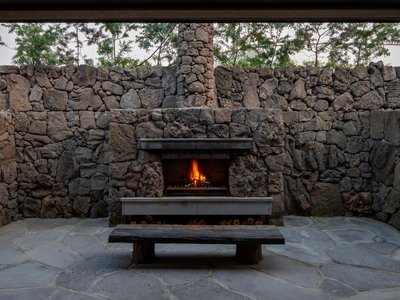
100A Associates Builds a Volcanic Stone Retreat on Jeju Island Rooted in Ritual and Restraint
Watarstay [Wa:Tar] in Bongseong-ri channels Jeju's basalt, reed, and hemp into a 150 m² hospitality space shaped by contemplation.






Comments (0)
Please login or sign up to add comments
No comments yet. Be the first to comment!