

Adaptive Learning Architecture: Innovation Core School in Toronto
A future-ready school in Toronto that redefines adaptive learning architecture through flexible spaces, inclusivity, and experiential education.


In the evolving discourse of educational design, adaptive learning architecture has emerged as a critical framework for shaping environments that respond to diverse student needs. The project Innovation Core, designed by Santiago Ortega, Manolo Rábago Lozano, Claudia Fuentes, and Michelle Haddad, positions itself at the forefront of this movement. Located conceptually within the multicultural context of Toronto, the project translates diversity into spatial experience, creating a school that is not only functional but deeply responsive to human variation.

Concept: Architecture as a Reflection of Diversity
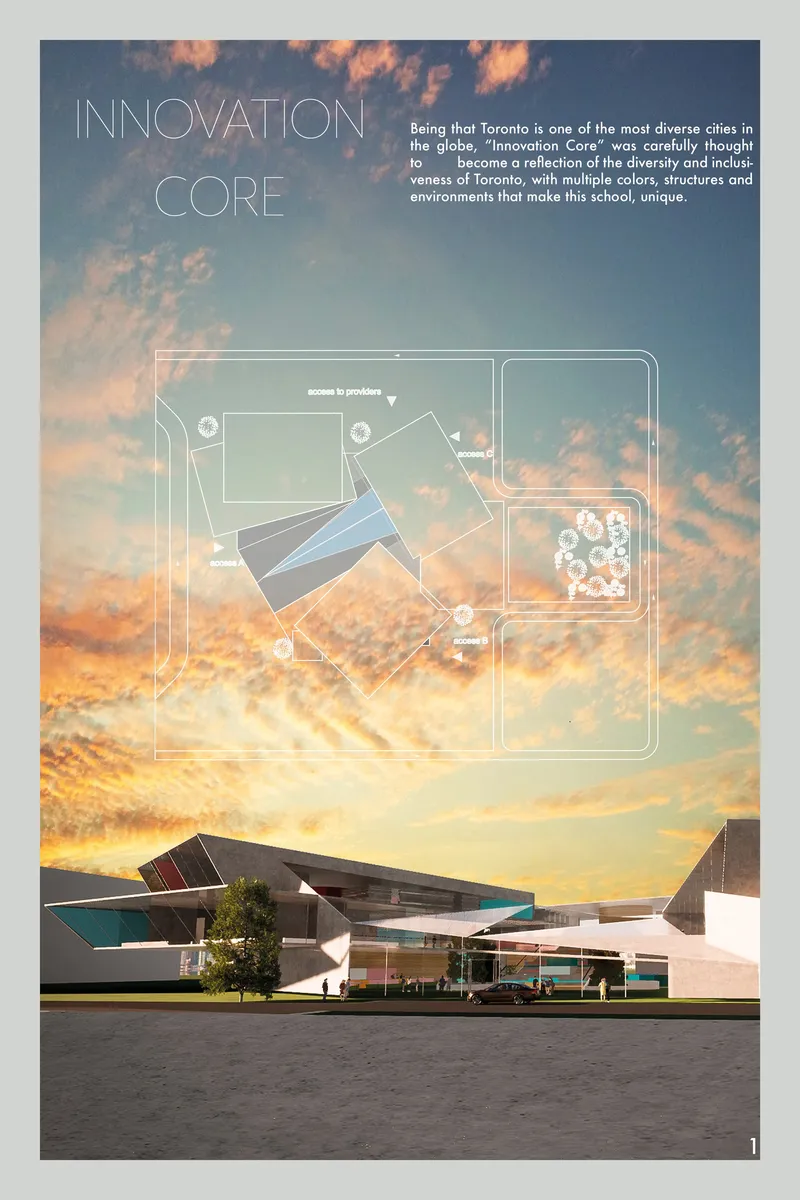
Toronto’s identity as one of the most diverse cities globally becomes the conceptual anchor of Innovation Core. The design interprets diversity not as an abstract idea but as a tangible spatial system. Through varied geometries, color-coded programs, and differentiated environments, the school becomes a physical manifestation of inclusivity.
Each programmatic layer—art, science, humanities, office spaces, cafeteria, and gym—is expressed distinctly yet integrated into a cohesive whole. This multi-layered spatial strategy ensures that students encounter a variety of environments, each designed to stimulate different cognitive and emotional responses.
Spatial Strategy: The Innovation Core
At the heart of the project lies the “Innovation Core,” a central organizational device that structures the entire school. Rather than a static corridor-based layout, the building is conceived through a process of volumetric manipulation—subtraction, rotation, and fragmentation—resulting in dynamic spatial interconnections.
This core acts as a social condenser, encouraging interaction, movement, and visibility across different zones. Circulation is not merely functional but experiential, transforming transitions between spaces into opportunities for learning and engagement.
Flexible Learning Environments
A defining feature of this adaptive learning architecture is its emphasis on flexibility. Classrooms are no longer fixed entities but modular spaces capable of expansion and transformation. Adjacent rooms can merge to accommodate larger groups, enabling collaborative learning and interdisciplinary activities.
Each room is uniquely designed with distinct colors, materials, and proportions. This intentional differentiation ensures that no two learning environments feel the same, reinforcing the idea that education is not standardized but personalized.
Experiential and Outdoor Learning
Innovation Core extends learning beyond the classroom. Gardens and micro-ecosystems are integrated into the design, creating outdoor laboratories for science education. These spaces allow students to engage directly with natural processes, fostering hands-on exploration and environmental awareness.
Even circulation paths are reimagined as learning corridors. Short walks between spaces become immersive experiences, encouraging observation, reflection, and informal interaction.

Interior Experience and Social Interaction
The interior architecture prioritizes openness, light, and connectivity. Large staircases function as central gathering spaces, doubling as informal learning zones where students can interact, discuss, and decompress between classes.
The use of natural light through expansive glazing enhances spatial quality while supporting well-being. Materials such as glass and concrete are employed strategically to create a balance between transparency and solidity, reinforcing both openness and structure.
Inclusivity Through Design
Inclusivity is embedded at every level of the project. The diversity of spaces ensures that students from different cultural, social, and learning backgrounds can find environments that resonate with them. The architecture avoids hierarchy, instead promoting equality through accessibility and adaptability.
Color plays a significant role in wayfinding and identity. Each zone is visually distinct, aiding orientation while also contributing to the overall narrative of diversity.
Sustainability and Environmental Response
The project incorporates environmentally conscious strategies, including extensive use of natural lighting and solar panels across the roof. These interventions reduce energy consumption while aligning the school with contemporary sustainability standards.
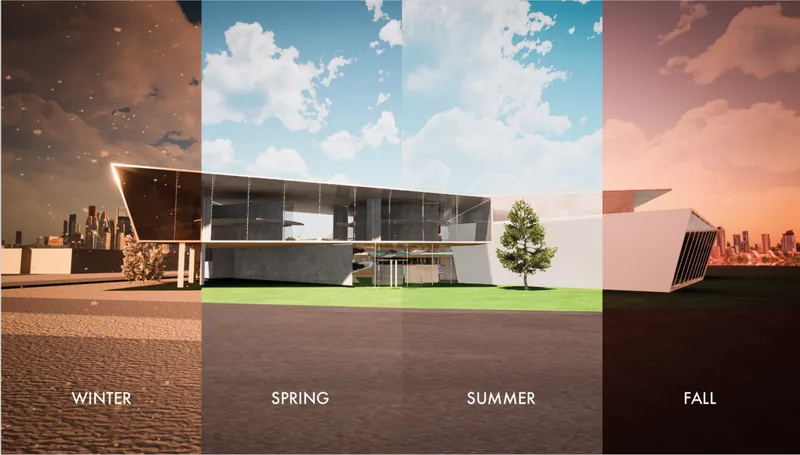
Seasonal adaptability is also considered, with the building responding to varying climatic conditions. This ensures comfort and usability throughout the year, reinforcing the concept of a responsive architectural system.
Programmatic Innovation
Innovation Core challenges conventional school typologies by redefining programmatic boundaries. Spaces are designed to serve multiple purposes, eliminating rigid distinctions between classrooms, social areas, and learning zones.
Specialized environments such as debate rooms encourage expression and critical thinking, while open-plan areas foster collaboration. This hybridization of spaces reflects a shift toward experiential and participatory education models.
Innovation Core exemplifies the potential of adaptive learning architecture to transform educational environments. By integrating flexibility, inclusivity, and experiential design, the project moves beyond traditional school models to create a dynamic ecosystem for learning.
Through its thoughtful spatial organization and responsiveness to human diversity, the project sets a benchmark for future educational architecture. It demonstrates that schools can be more than institutions of instruction—they can be environments that actively shape how students think, interact, and grow.



Popular Articles
Popular articles from the community


Co-life: Sustainable Architecture for Age-Friendly Community Living
Co-life reimagines sustainable architecture for seniors through courtyards, rammed earth, shared gardens, and spaces designed for belonging.

Co-Life: Senior Housing Design That Reconnects Older Adults With the City
Co-Life reimagines senior housing design through healing gardens, shared streets, workshops, and a sustainable community across generations.

The Ocean Hive: Sustainable Architecture for a Self-Sufficient Civilization at Sea
The Ocean Hive imagines sustainable architecture at sea, where modular habitats, algae, wave power and ocean waste sustain a growing colony.

Conexión: Biophilic Design Reimagines High-Rise Living in Hong Kong
Conexión reimagines high-rise living in Hong Kong through biophilic design, green facades, shared spaces, daylight, water and nature within.

Similar Reads
You might also enjoy these articles

Eco Chapel: A Green Architecture Pavilion Designed in Symbiosis with the Forest
Eco Chapel uses green architecture to weave prayer, learning and reuse into a forest pavilion shaped by modular hexagonal canopies for life.
Kaffeebühnen: Coffee Shop Architecture Designed as a Civic Stage Between Vienna’s City and Park
Kaffeebühnen turns coffee shop architecture into a civic stage, linking Vienna’s park edge, urban life, warm timber yards, and coffee craft.
Healing Façade: Sustainable Architecture for Reforestation, Community, and Sacred Ecology in Ethiopia
Healing Façade reimagines sustainable architecture as a living wall that restores soil, catches water and renews Ethiopia's forest churches.


Urban Forest: A Vertical Ecosystem for 5,000 Workers in Singapore's Changi Business Park
Radially stacked pods and layered green decks turn a 7-acre plot into 47 acres of ecological workspace projected for 2040.

Explore Learning Spaces Competitions
Discover active competitions in this discipline

Challenge to design public laboratory

Challenge to reimagine the Iron Throne

Photograph architecture without architects

Illustrate the lost glory of Angkor Wat - Render Challenge
Comments (0)
Please login or sign up to add comments
No comments yet. Be the first to comment!