

The Equipoise: Inclusive Housing That Speaks Kotachiwadi's Vernacular Language
A multigenerational home in Mumbai calibrates every surface and stair for a resident with dwarfism, without sacrificing heritage context.


What does it mean to design a house around a single person's body without making that accommodation visible? In Kotachiwadi, a fragile pocket of Portuguese-influenced vernacular housing in Mumbai, Studio TAB's answers that question with a prototype called "The Equipoise." The home is designed for a real multigenerational family whose second-generation father is a person with dwarfism. Instead of applying generic accessibility standards, the architects calibrated countertops, stair risers, window seats, and handles to his specific physical dimensions, embedding every adaptation so seamlessly into the architectural language that it reads as warmth rather than clinical accommodation.
Shortlisted in the Nano Nest 2020 competition, the project sits within Kotachiwadi's narrow lanes and vibrant facades, a neighborhood whose character survives despite relentless urban densification across Mumbai. The brief demanded compact, forward-thinking housing. Studio TAB responded with a split-level dwelling that respects the proportions and materiality of its neighbors while quietly rethinking how vertical domestic space can serve bodies of different sizes and ages.
A Butterfly Facade on a Heritage Street
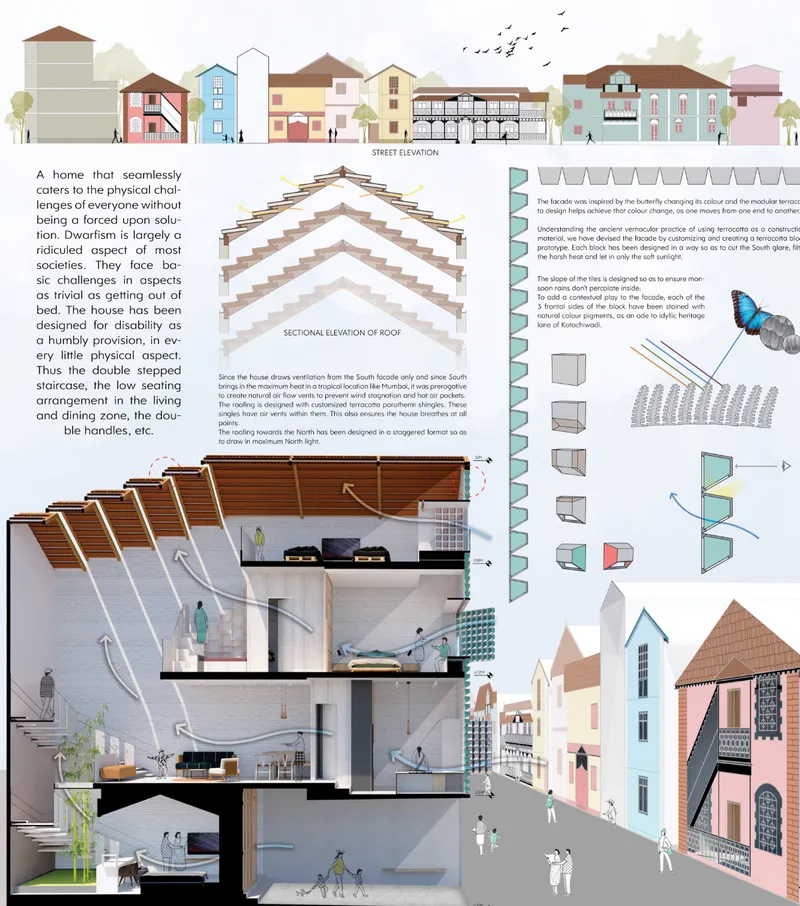
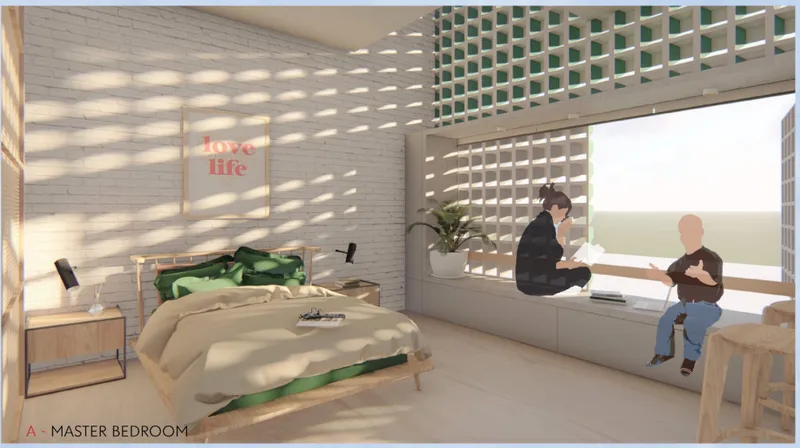
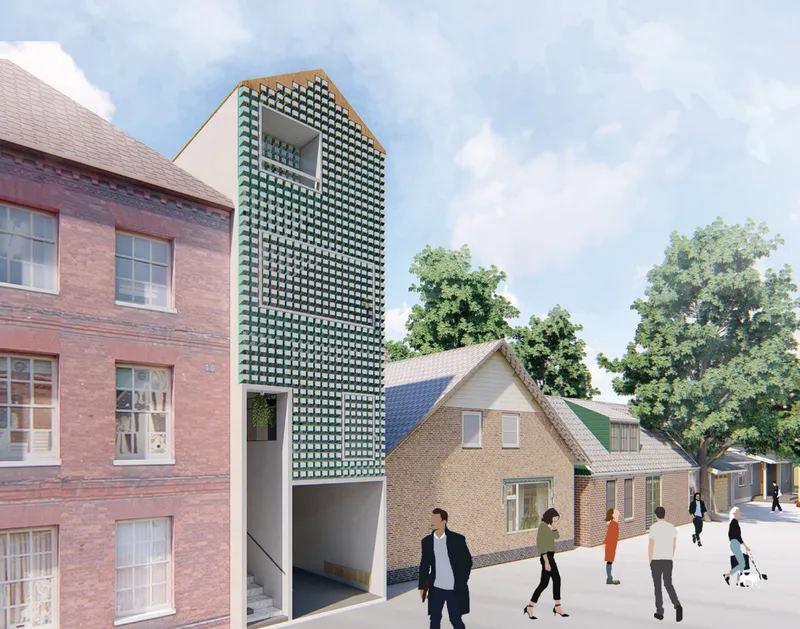
Street-facing elevations in Kotachiwadi follow a recognizable rhythm: double-sloped roofs, masonry walls, and fenestration patterns inherited from the area's Portuguese colonial origins. Studio TAB preserved that rhythm but introduced a facade concept inspired by a butterfly's metamorphosis, signaling adaptive change rather than rupture. The key material move is a screen of custom perforated terracotta blocks that filters daylight and ventilation into the interiors. These blocks are more than decorative; they serve as passive cooling elements suited to Mumbai's tropical climate while providing privacy from the narrow lane outside.
The sectional drawings reveal how a staggered roof system channels prevailing winds and light deep into the plan. The split-level arrangement creates diverse spatial volumes, each tuned to a different ceiling height, without resorting to a single uniform floor-to-floor dimension. From the street, the house appears to be a respectful neighbor. In section, it is a carefully orchestrated instrument of airflow, light, and ergonomic variation.
Invisible Adaptations: Designing for Dwarfism Without Labels
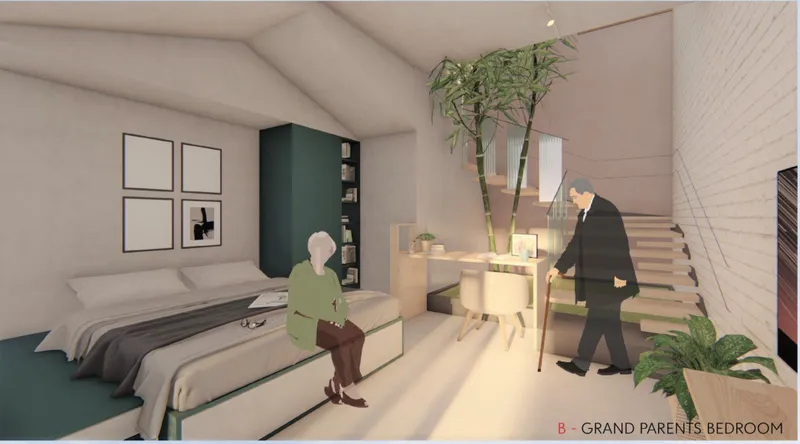
The most radical aspect of The Equipoise is its refusal to look radical. Standard countertops, full-sized staircases, and conventional fixture heights present daily obstacles for a person with dwarfism. Studio TAB's response includes a double-stepped staircase that halves the riser height, lowered window seats that promote eye-level interaction across split levels, custom double handles, and reduced fixture mounting heights. These are micro-interventions, not sweeping formal gestures, and they allow the resident to navigate his home with independence and dignity.
Crucially, none of these adaptations announce themselves. The reading nooks, the dining area, the kitchen counters all appear as natural extensions of the home's spatial logic. Soft transitions between activity zones replace abrupt vertical separations, so movement through the house feels continuous rather than segmented. A visitor might not notice the lowered handles or the shallower stair treads; that invisibility is the point.
Three Generations, One Vertical Section
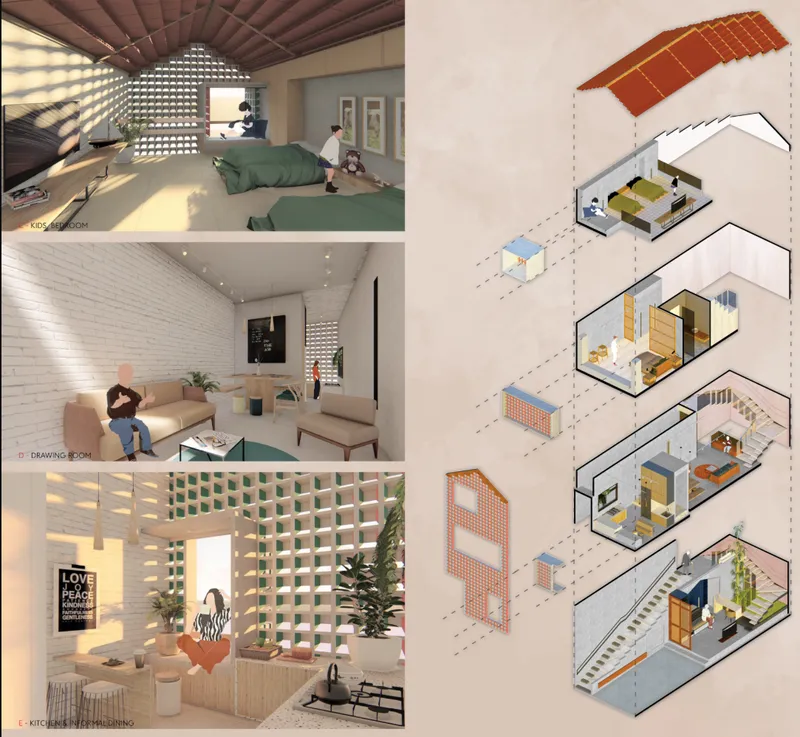
The exploded axonometric drawing lays bare the vertical logic. Grandparents and the physically challenged family member occupy the mid and lower levels, where access is easiest and daylight is generous through the perforated terracotta screen. Younger family members reside above, with the top floor offering intimate spaces for children. A roof terrace, highlighted in orange, caps the assembly and provides an outdoor room in a neighborhood where ground-level open space is essentially nonexistent.
This vertical zoning is informed not just by mobility but by daylight access, ventilation patterns, and usage frequency. Private and shared domains interweave: the central zones facilitate communal gatherings while bedrooms retreat to quieter edges of the plan. The result is a house that feels connected across all four levels without forcing togetherness on anyone.
A Staircase as Shared Memory
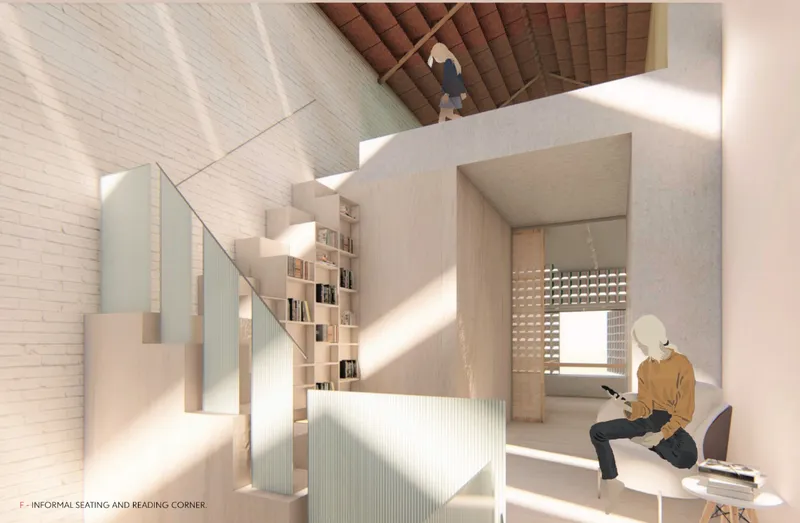
In a compact multigenerational house, the staircase is the most socially charged element. Studio TAB treats it as both a transitional device and a piece of furniture. Flanked by glass panels and lined with built-in shelving, the stair becomes a library wall, a display case, and a circulation spine simultaneously. Exposed timber beams overhead reinforce the tactile, craft-oriented material palette that runs through the project, connecting the interior atmosphere to Kotachiwadi's tradition of handmade building elements.
The double-stepped configuration, designed specifically for the resident with dwarfism, is visible here but reads as an architectural choice rather than an assistive device. That distinction matters. It transforms the act of ascending from a daily negotiation into something effortless and, in the designers' framing, symbolic of upward movement and shared family memory.
Why This Project Matters
Inclusive design in architecture too often defaults to code-minimum ramp slopes and grab bars. The Equipoise demonstrates that genuine inclusivity begins with a specific person, a specific body, and a specific set of daily rituals. By designing for one family's precise needs rather than for a regulatory checklist, Studio TAB produced a home that is more humane, more spatially inventive, and more contextually grounded than any universal template could achieve.
The project also proves that heritage sensitivity and progressive spatial thinking are not mutually exclusive. In Kotachiwadi, where every new intervention risks eroding the neighborhood's fragile character, The Equipoise holds the line on street rhythm, material continuity, and roof form while fundamentally rethinking what happens inside the section. It is a quiet manifesto: that the densifying city can still make room for empathy, specificity, and the dignity of the individual body.
View the Full Project
About the Designers
Designer: Studio TAB’s
Enter a Design Competition on uni.xyz
uni.xyz runs architecture and design competitions year-round that reward proposals with spatial conviction and real site intelligence.
Project credits: The Equipoise by Studio TAB’s Nano Nest 2020 (uni.xyz).


Popular Articles
Popular articles from the community


Opera by the Sea Estonia: Three Shells Dissolving Architecture into Tallinn's Coastline
A winning opera house proposal replaces monumental form with interconnected shells that blur the boundary between building, park and Baltic Sea.

Extended Shell: Retrofitting Kolkata's Balconies as Living Urban Thresholds
A modular retrofit system recovers the social and environmental intelligence of Kolkata's historic verandas for contemporary Park Street residents.

Tsunami Convergenics: Turning Catastrophic Ocean Forces into Underwater Housing Infrastructure
A speculative underwater settlement off the coast of Onagawa, Japan, treats tsunamis and typhoons as energy sources rather than threats.

Manzana Morphosis: Stretching Barcelona's Grid into a Living Landscape for 2050
A radical reworking of the Eixample manzana turns density into a tool for generous public space, vertical ecology, and environmental performance.

Similar Reads
You might also enjoy these articles

Day and Night Park: A Time-Based Urban Newsstand in Beijing
A temporary urban newsstand in Beijing blending travel, light, and reading through poetic colors, compact form, and community-focused design.

Modernist Patio Renovation in El Masnou, Barcelona by Oliver Segura Arquitectura + Cebrià Arquitectura
Modernist patio renovation blending tradition and innovation with a movable pool, leveled floors, and Catalan materials in El Masnou.

Alto Residencial Coop: Cooperative Housing Development in Santiago de Compostela by Carbajo Barrios Arquitectos
A linear cooperative housing complex blending white volumes and perforated metal façades, enhancing community living, natural light, privacy, and urban integration.
Vil Genis School by BPA ARCHITECTURE – Massy, France
Vil Genis School in Massy, France, features sustainable design, south-facing classrooms, community integration, accessible spaces, and modern educational architecture.


Comments (0)
Please login or sign up to add comments
No comments yet. Be the first to comment!