

AI Prison: Zero-Sunlight Architecture for Cybercriminal Rehabilitation
An underground AI-driven facility uses architectural psychology and light deprivation to reshape the digital behaviors of cyber offenders.


What does a prison look like when the crime scene is a screen and the weapon is code? For cybercriminals, the conventional cell block is functionally irrelevant. The offense happened in a dark room lit by monitors, often a garage or basement, and the punishment needs to speak the same spatial language. AI Prison proposes exactly that: a zero-sunlight, underground incarceration facility where architectural psychology and artificial intelligence converge to dismantle inmates' dependency on digital networks by immersing them in the very atmospheres that bred their offenses.
Designed by Reechal Mevada as a People's Choice Award entry for the Switching Prisons competition on uni.xyz, the project confronts a simple question: how do you rehabilitate someone whose entire criminal life exists in digital space? The answer here is architectural. Strip away sunlight, sever internet access, and construct underground cells that mirror the garage-like environments where hackers first learned their craft. The facility becomes not just a container for bodies but an active instrument of behavioral recalibration.
Thermal Data as Architectural Language
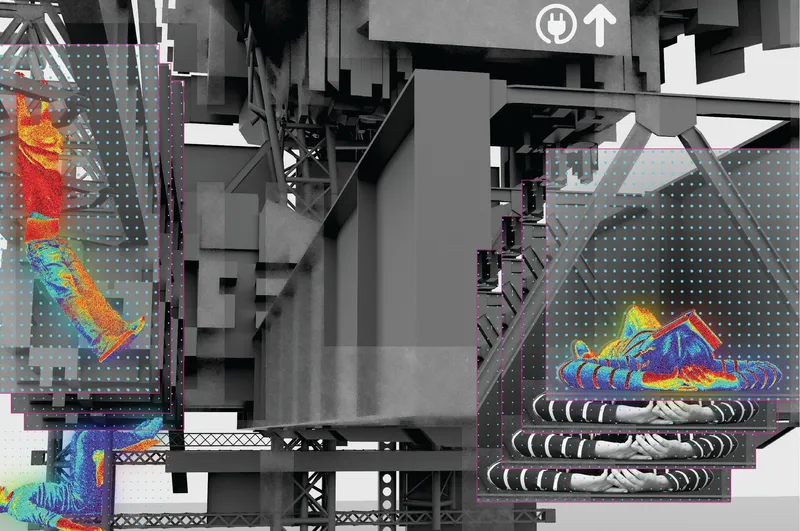
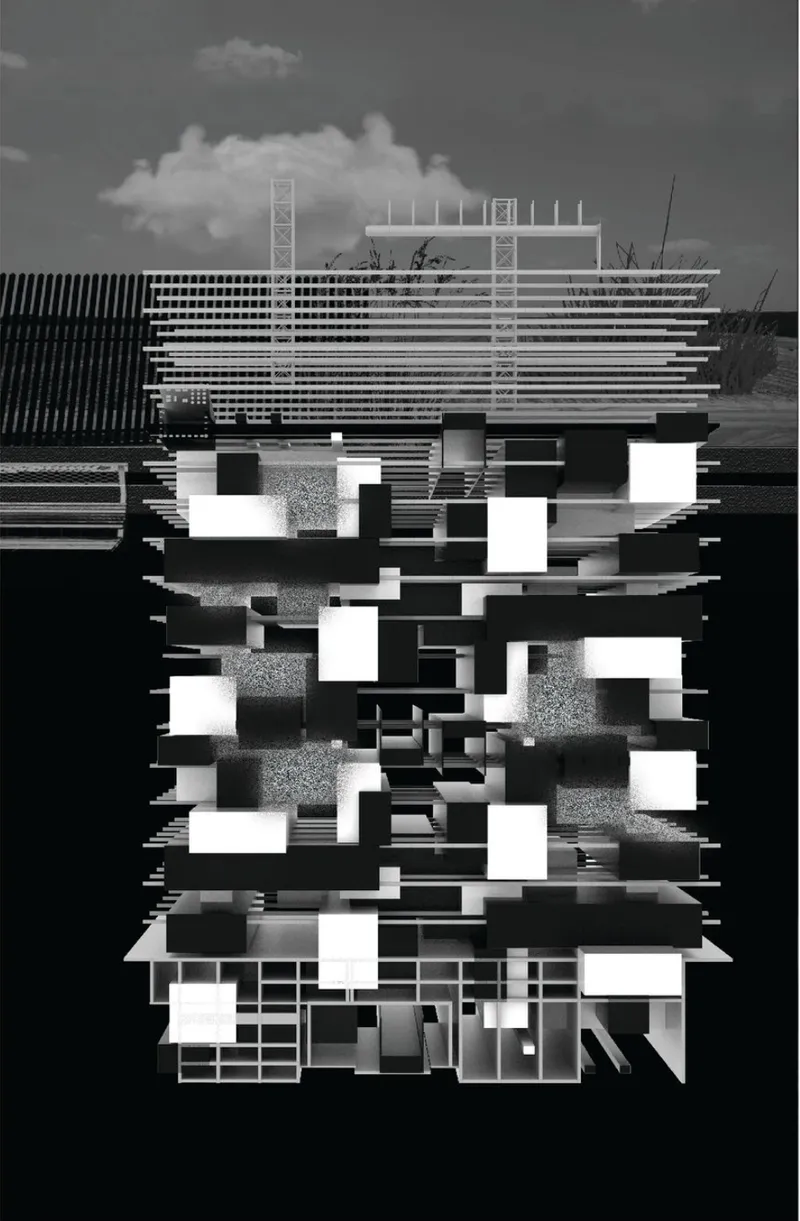
The axonometric drawings reveal a facility layered with colorful thermal data overlays mapped onto a structural steel framework. These are not decorative; they suggest a building that monitors and visualizes occupant behavior in real time, turning the architecture itself into a surveillance and diagnostic tool. The thermal mapping implies that AI systems track movement patterns, body heat, and spatial usage to inform rehabilitation protocols. In the exploded axonometric, stacked horizontal slabs and a striped vertical tower separate the facility into distinct programmatic zones, each one legible as a discrete layer in the security and rehabilitation apparatus.
Interior Voids Engineered Without Daylight

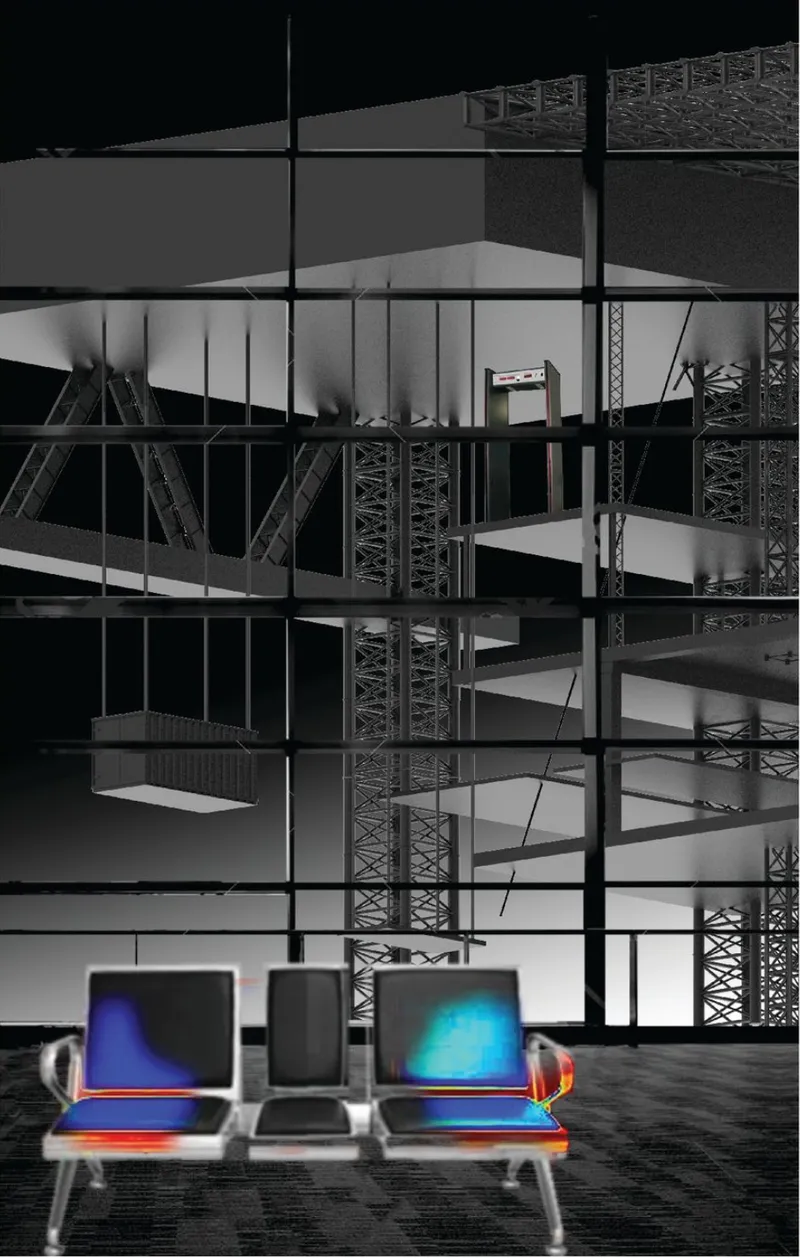
The interior atrium is striking in its deliberate absence of natural light. Stacked white picture frames hang suspended on truss columns, creating a vertigo-inducing spatial depth that reinforces the psychological dimension of confinement. The lighting is entirely artificial, controlled, measured. There is no sky. The section drawing reinforces this reading: multilevel platforms connected by steel trusses stack downward, with thermal screens positioned on low tables suggesting interface points where inmates interact with monitored digital environments. Every surface participates in the facility's broader logic of observation and controlled exposure.
The zero-sunlight concept is not arbitrary cruelty. It replicates the self-imposed conditions many cybercriminals already inhabit, the windowless rooms and screen-lit basements where code is written at 3 a.m. By making this environment the prison itself, the design forces inmates to confront the spatial reality of their own choices, transforming familiar comfort into conscious discomfort.
AI-Mapped Floors and Controlled Circulation
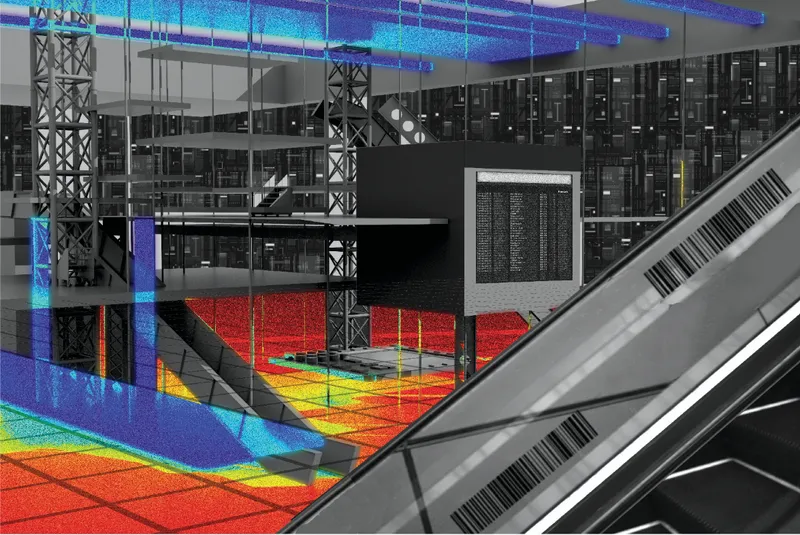
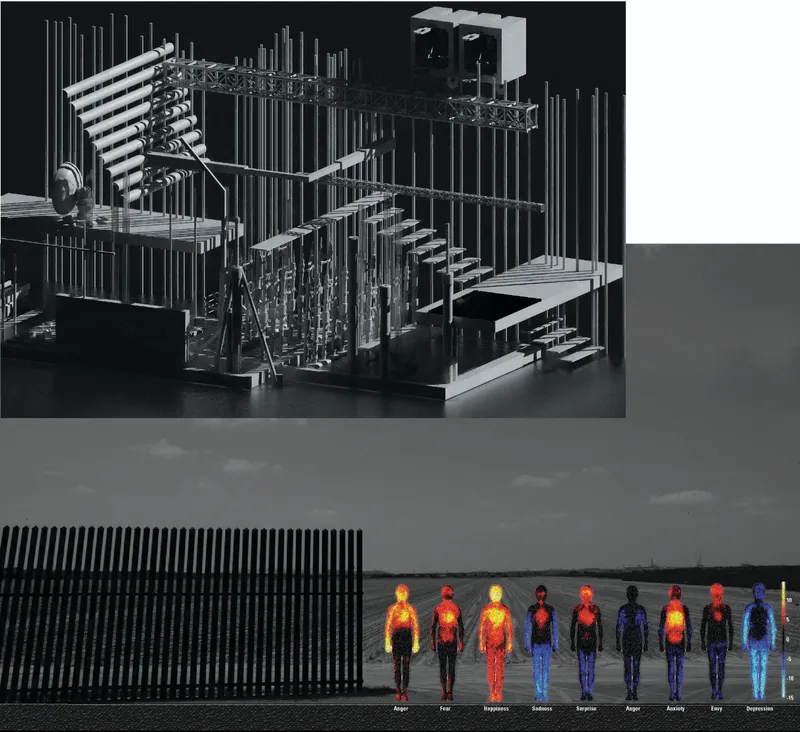
The interior atrium view with escalators reveals a floor surface saturated with colorful thermal mapping beneath blue-illuminated ceiling panels. Circulation is mechanical, directed by escalators rather than open corridors, limiting inmate autonomy over movement. The thermal floor mapping suggests that AI systems are embedded into the building's very surfaces, tracking and responding to spatial occupation in real time. It is architecture performing as both infrastructure and intelligence.
The final axonometric model pulls back to the building's urban edge, showing vertical rods and staircases rising above thermal figures standing by a waterfront at dusk. The contrast between the external setting and the buried, lightless interior is deliberate. The world above continues; the facility below operates on its own temporal and sensory logic. The waterfront context anchors the project in a real, inhabitable geography while reinforcing the radical disjunction between the freedom of the public realm and the total control of the spaces beneath it.
Why This Project Matters
AI Prison challenges one of the most under-examined assumptions in prison design: that all crimes demand the same spatial response. Cybercrime is placeless, networked, and screen-based, yet we continue to incarcerate digital offenders in facilities designed for physical violence. Mevada's proposal argues that the architecture of punishment should correspond to the architecture of the crime. By building underground, eliminating sunlight, and severing digital access, the facility inverts the hacker's workspace into a rehabilitation chamber.
The integration of AI into the building's surfaces and systems points toward a future where prisons are not passive enclosures but active participants in behavioral change. Whether or not one agrees with the ethics of light deprivation as a rehabilitation tool, the project forces a necessary conversation about how architecture should respond to crimes that have no physical scene, no weapon, and no victim you can point to in a room. That conversation alone makes the work valuable.
View the Full Project
About the Designers
Designer: Reechal Mevada
Enter a Design Competition on uni.xyz
uni.xyz runs architecture and design competitions year-round that reward proposals with spatial conviction and real site intelligence.
Project credits: AI-prison by Reechal Mevada Switching Prisons (uni.xyz).




Popular Articles
Popular articles from the community


Lunar Spiral: Space Architecture Shaped by the Mathematics of the Universe
Lunar Spiral reimagines space architecture through Fibonacci geometry, lunar regolith, levitating habitats, and self-sustaining Moon living.

Co-life: Sustainable Architecture for Age-Friendly Community Living
Co-life reimagines sustainable architecture for seniors through courtyards, rammed earth, shared gardens, and spaces designed for belonging.

Hill & Cross Opera: Sculptural Opera House Architecture Shaped by Tallinn’s Landscape and Identity
Hill & Cross Opera reimagines opera house architecture in Tallinn through its sculptural hill, civic plaza, glass wave and a luminous cross.

Riyadh For All: Intergenerational Urban Design for Active Aging in Rabat
Riyadh For All reimagines urban design in Rabat with intergenerational co-living, adaptive courtyards, and Moroccan cultural exchange today.

Similar Reads
You might also enjoy these articles

Day and Night Park: A Time-Based Urban Newsstand in Beijing
A temporary urban newsstand in Beijing blending travel, light, and reading through poetic colors, compact form, and community-focused design.

Modernist Patio Renovation in El Masnou, Barcelona by Oliver Segura Arquitectura + Cebrià Arquitectura
Modernist patio renovation blending tradition and innovation with a movable pool, leveled floors, and Catalan materials in El Masnou.

Alto Residencial Coop: Cooperative Housing Development in Santiago de Compostela by Carbajo Barrios Arquitectos
A linear cooperative housing complex blending white volumes and perforated metal façades, enhancing community living, natural light, privacy, and urban integration.

Vil Genis School by BPA ARCHITECTURE – Massy, France
Vil Genis School in Massy, France, features sustainable design, south-facing classrooms, community integration, accessible spaces, and modern educational architecture.






Comments (0)
Please login or sign up to add comments
No comments yet. Be the first to comment!