
Alphaville Architects Stack Courtyard Gardens Vertically in a Narrow Kyoto Townhouse
New Kyoto Town House 4 reimagines the tsuboniwa tradition by carving light-filled voids through three floors on a tight urban plot.

Kyoto's traditional townhouse, the machiya, solved an old problem with elegant simplicity: on a narrow strip of land hemmed in by neighbors, you punch a small courtyard, a tsuboniwa, into the plan to bring light and air deep into the interior. The arrangement works beautifully in one and two storeys. But as pressure mounts to build taller on these same slim lots, the courtyard logic breaks down. Light cannot reach the ground floor of a three-storey house through a single hole in the plan. Alphaville Architects, led by Kentaro Takeguchi and Asako Yamamoto, took that limitation as a design prompt for New Kyoto Town House 4: what if the tsuboniwa were not a planar device but a volumetric one, stacked and carved through section rather than simply punched through plan?
The result, completed in 2022 near Teramachi street, is a 218 m² residence for a family that splits its time between Japan and the United States. Patios, terraces, and light gardens are carved out of the building mass like boolean operations, creating polygonal prisms of open air that deliver sky views, cross-ventilation, and sight lines to the surrounding city. The house's diagonal bracing system, running on a slanted axis from first to third floor, does more than hold the building up: it choreographs views and movement, introducing auxiliary lines that cut against Kyoto's strict urban grid and extend the eye from interior rooms through gable walls to the rooftops beyond.
A Black Screen on a Tight Street
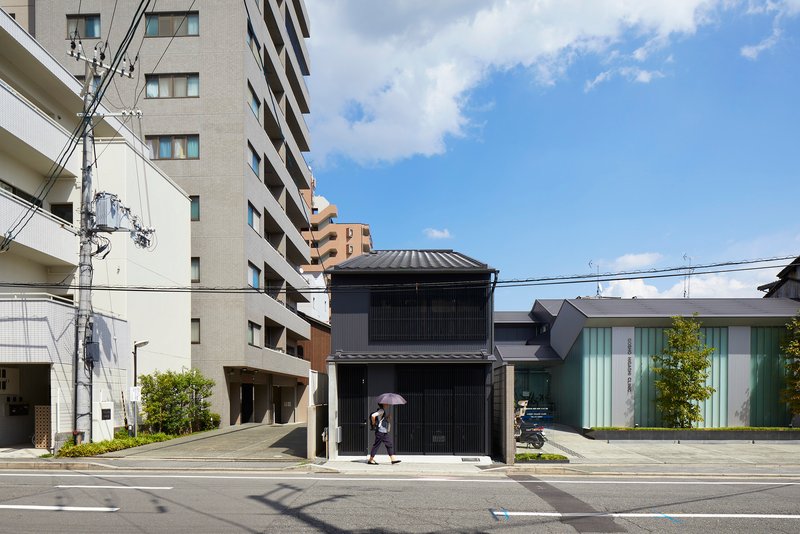
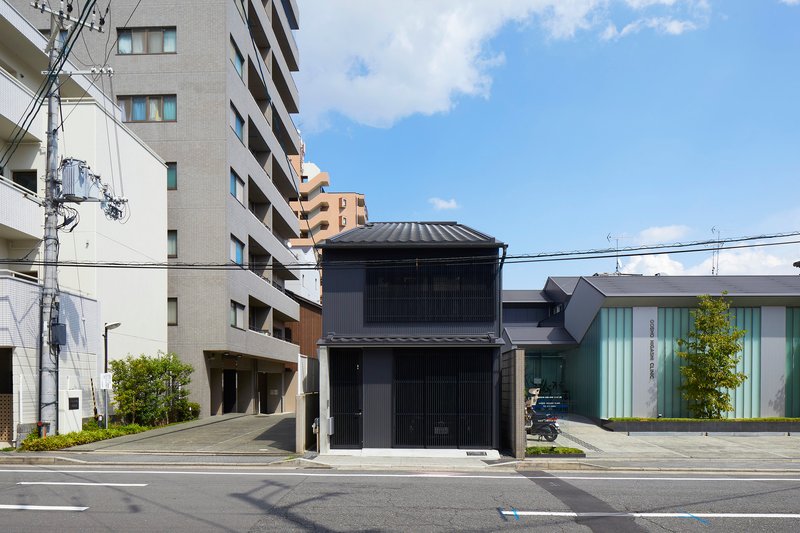
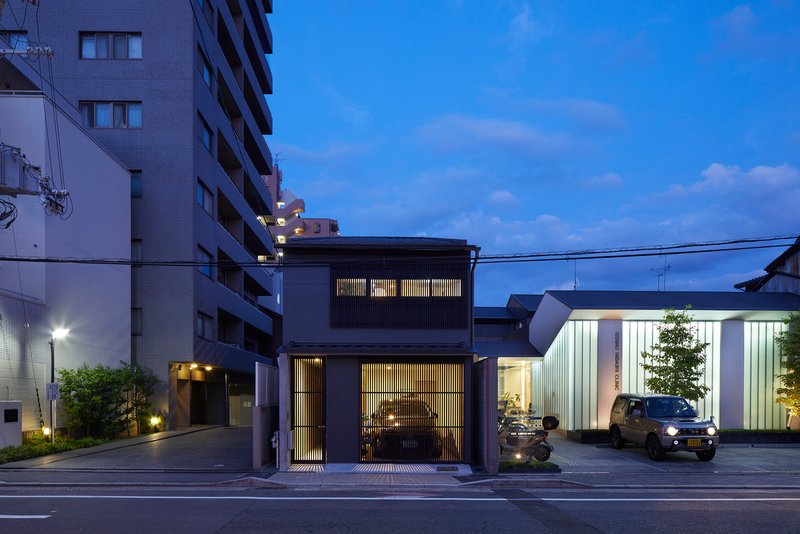
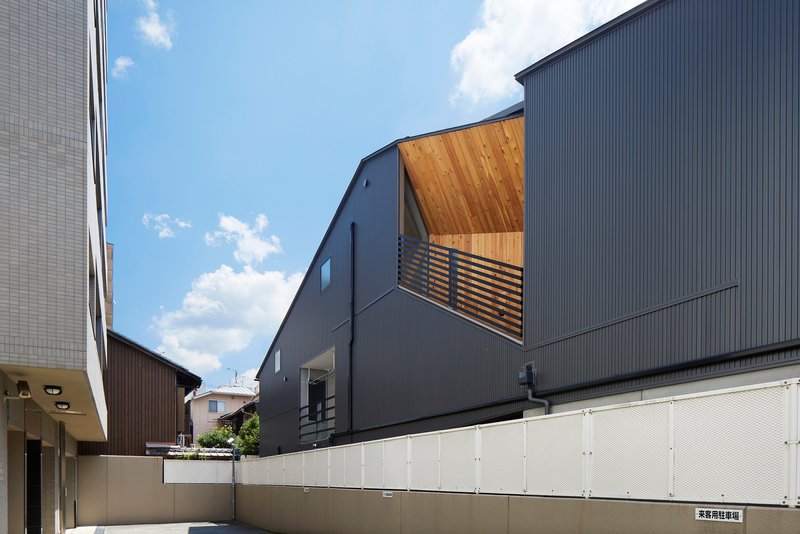
From the street, the house announces itself through a facade of vertical black timber slats topped by a tiled roof, reading as a deliberate nod to the machiya's restrained public face. Flanked by mid-rise apartment buildings, its two-storey street elevation feels almost modest, a quiet refusal to compete with its neighbors on height. The slats do practical work as well: they filter light, grant a degree of privacy, and let wind pass through to the interior and onward to Teramachi street behind.
At dusk, the timber screens glow faintly from within, revealing the life of the house in silhouette. The corrugated metal and timber-lined balcony above the perimeter wall hint at the spatial complexity waiting inside, but from the sidewalk, the house reads as a disciplined urban neighbor, its footprint locked into the same narrow lot pattern that has governed Kyoto building for centuries.
Diagonal Bracing as Spatial Choreography
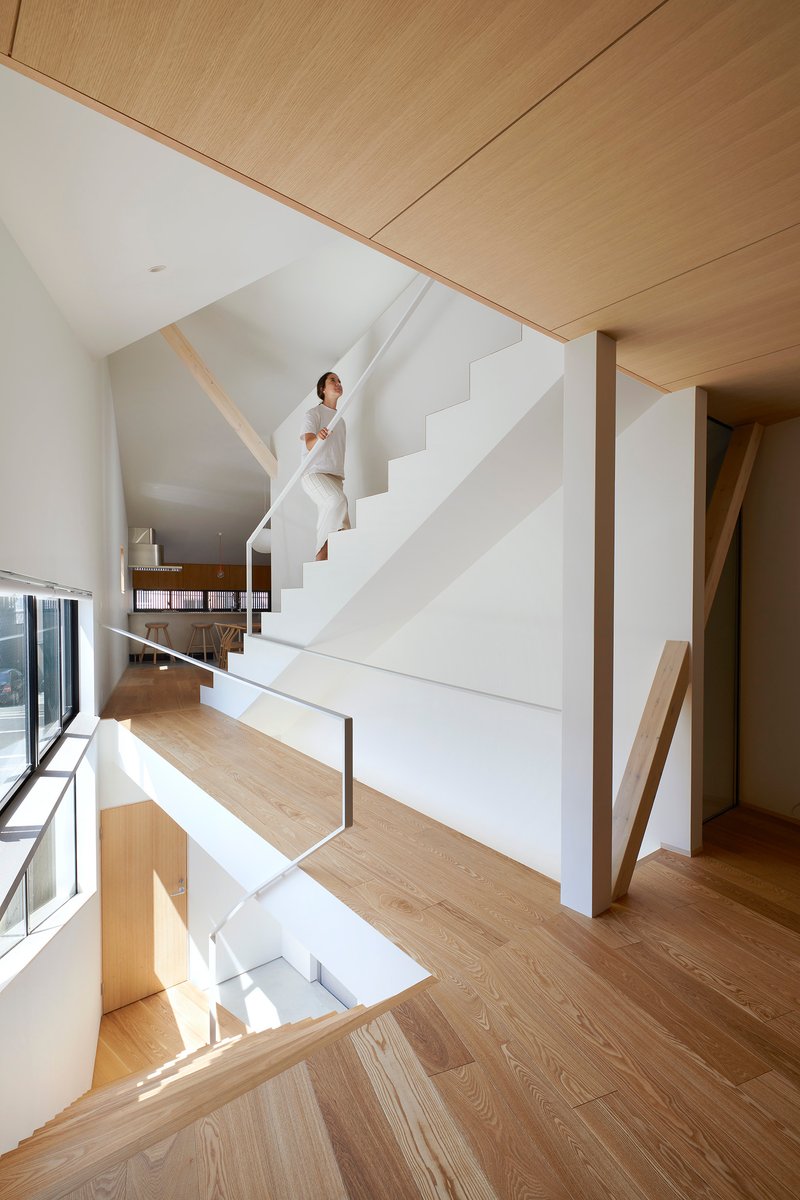
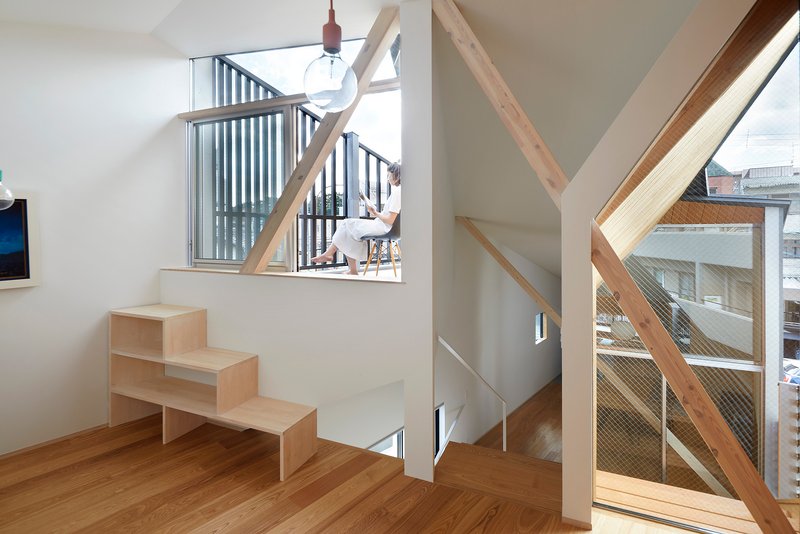
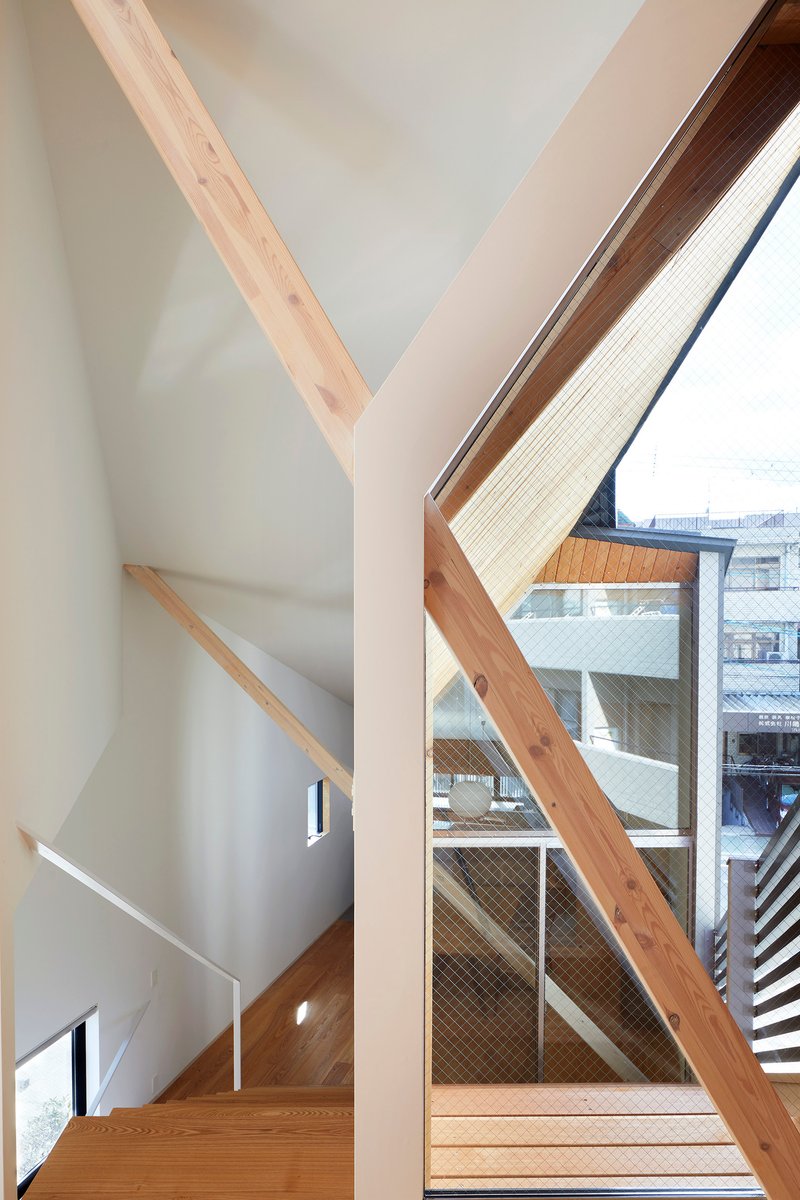
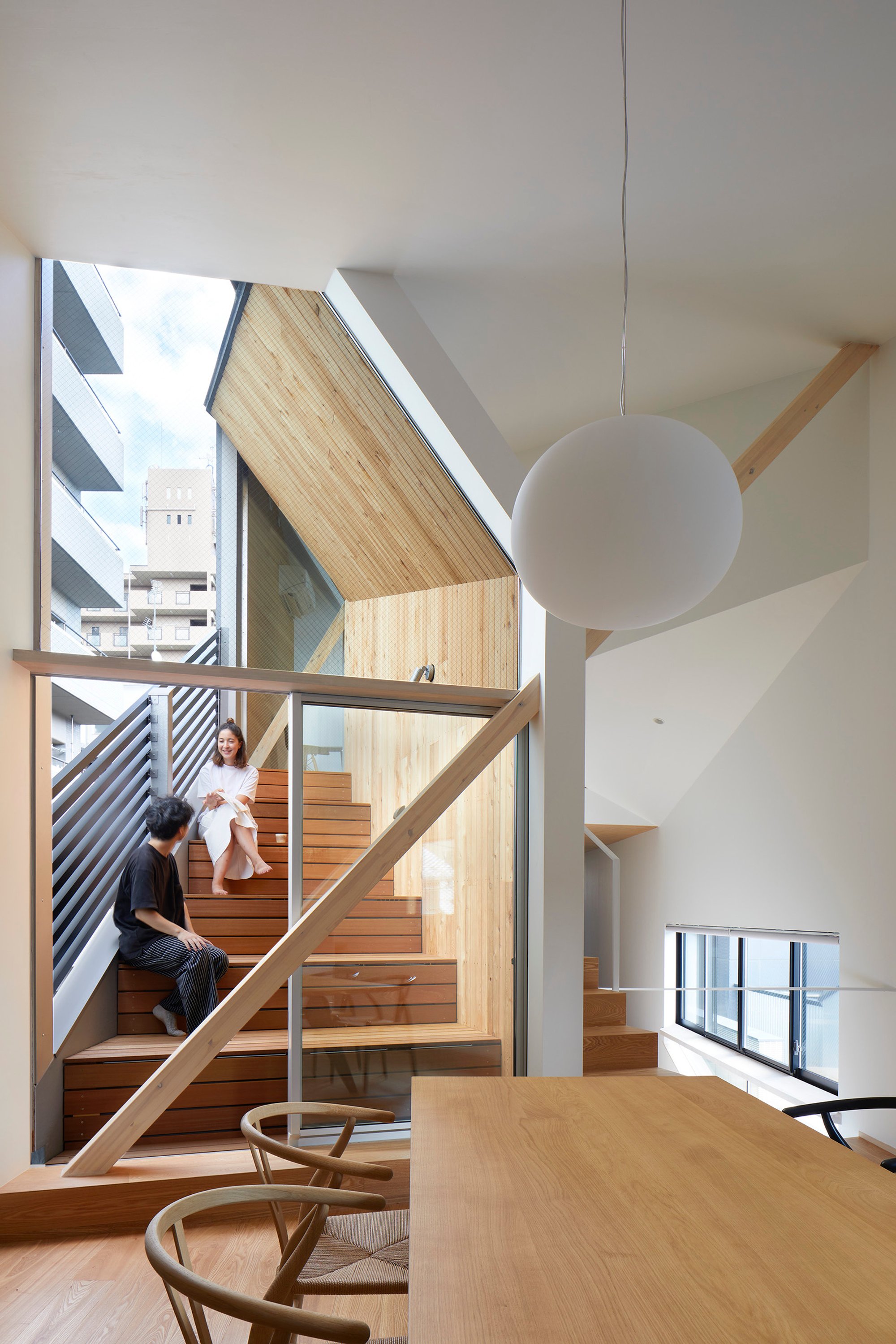
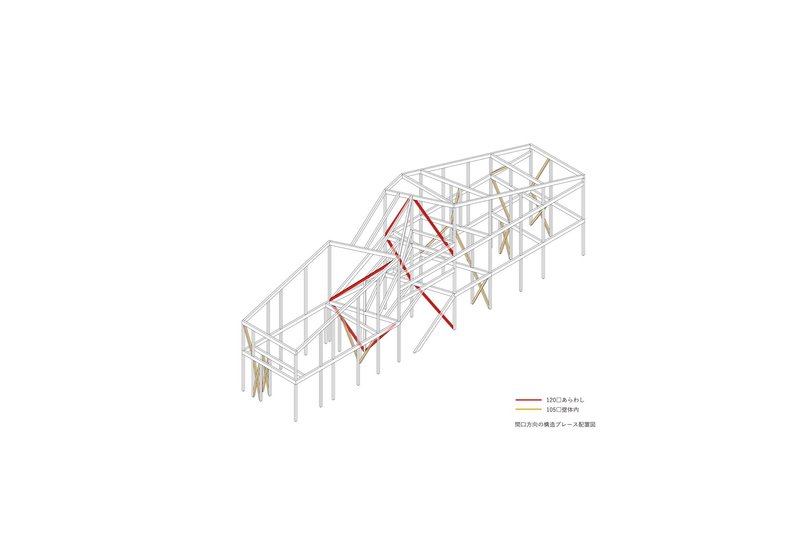
The one-sided bracing system that runs from the first floor to the third is the structural backbone of the house, but Alphaville deploys it with a second agenda. Arranged on a slanted axis rather than the orthogonal lines of the floor plates, the braces create triangular apertures through which people, light, and sight lines pass. Where conventional bracing walls off space, these diagonal members open it up, framing views of neighboring rooftops through large glazed walls and directing the eye along unexpected trajectories.
The exposed timber members double as an interior landscape of their own. Walking through the house, you are constantly reading them against the white walls and plywood ceilings, a rhythm of angles that makes the compact plan feel larger than it is. Wire mesh balustrades and open landings let the bracing remain visible across multiple levels, so the structural logic is legible from almost any point in the section.
The Staircase as Social Space
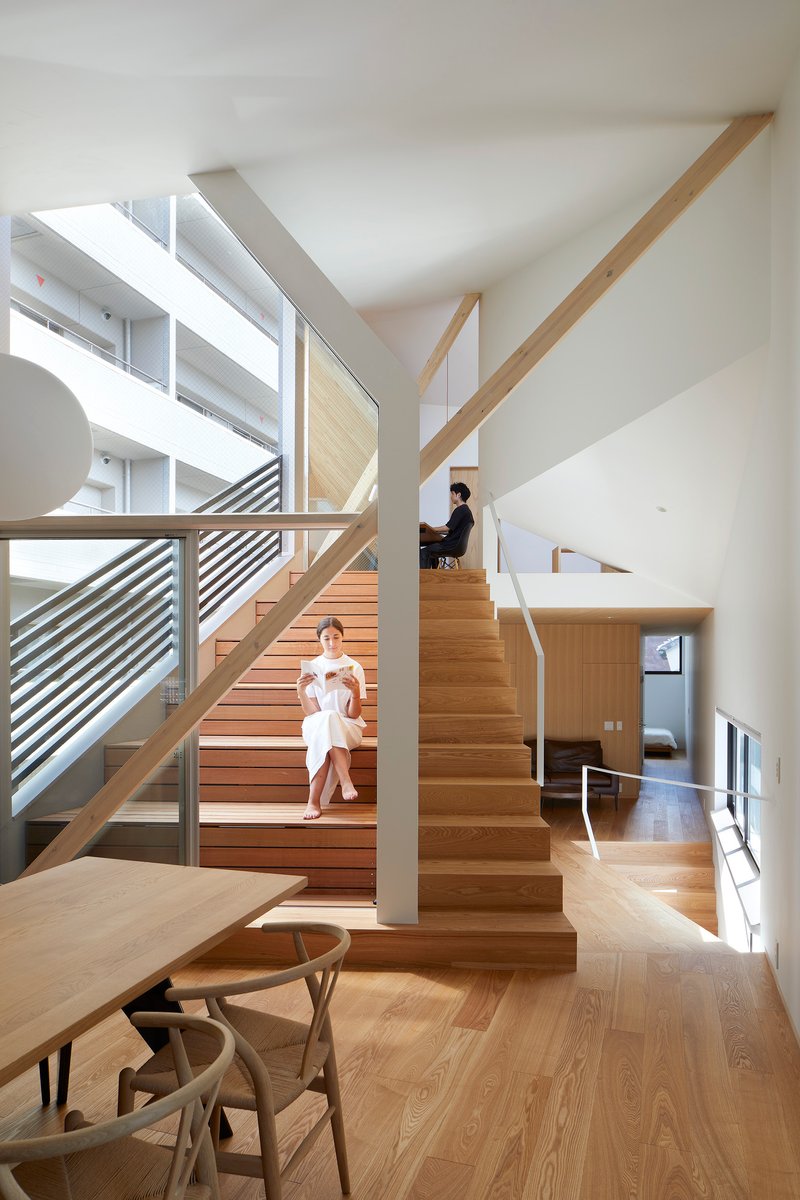
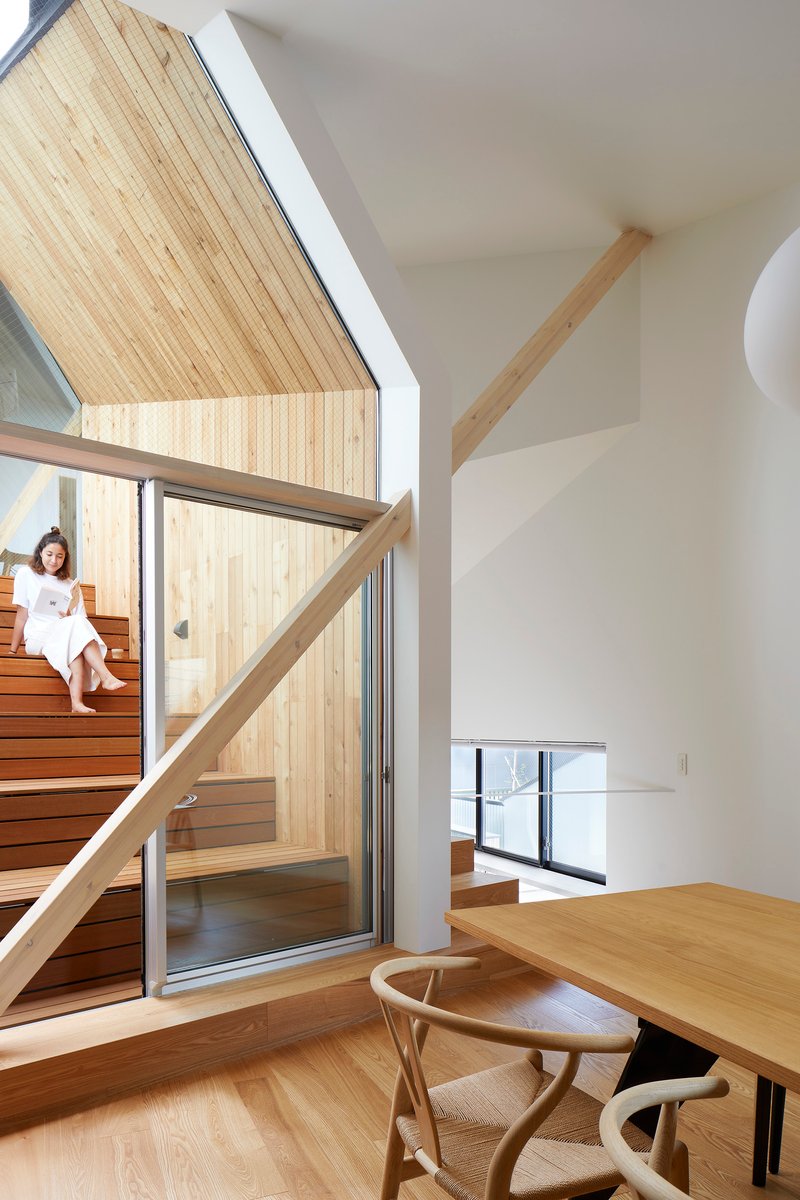
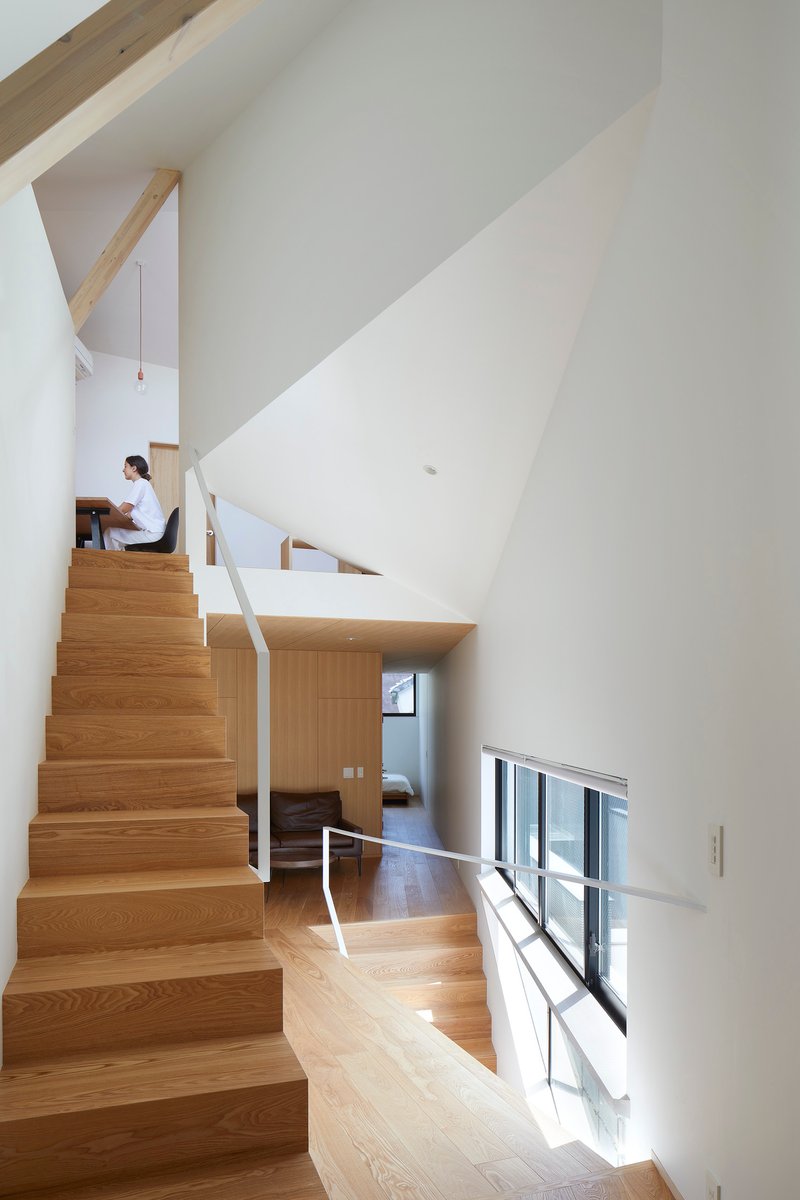
In a house this narrow, vertical circulation is not a service element to be hidden. It is the connective tissue of domestic life. Alphaville treats the staircase as a room in its own right, wide enough for two people to sit side by side on the treads, generous enough to accommodate pause and conversation. The diagonal striped railings echo the bracing system, reinforcing the visual language while keeping the stairwell open to the adjacent living and dining spaces.
Photographs show family members perched casually on different landings, a testament to the stair's success as something more than a way to get upstairs. The timber treads, white metal railings, and glazed partitions give each flight a different character depending on the light conditions, which shift dramatically as you ascend through the stacked courtyards toward the skylight above.
Layered Interiors and Light Wells
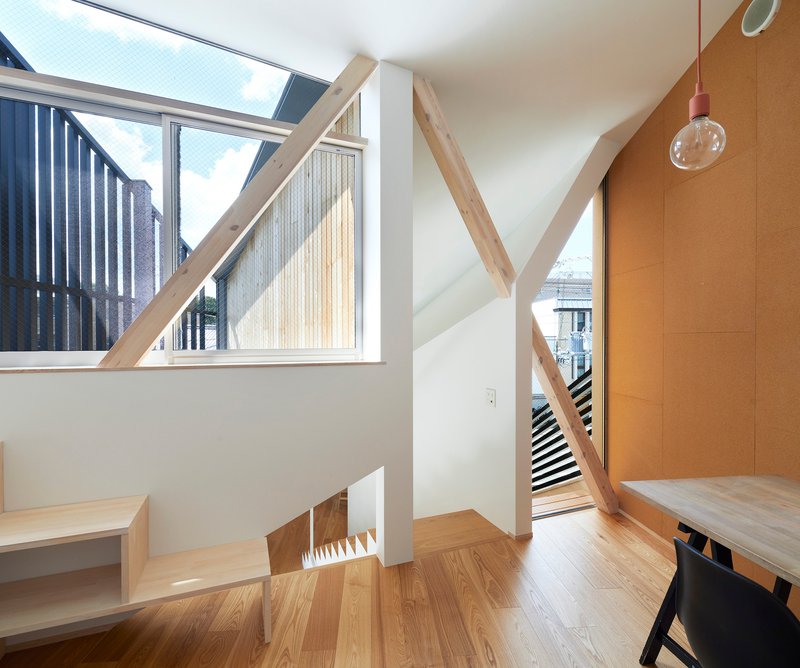
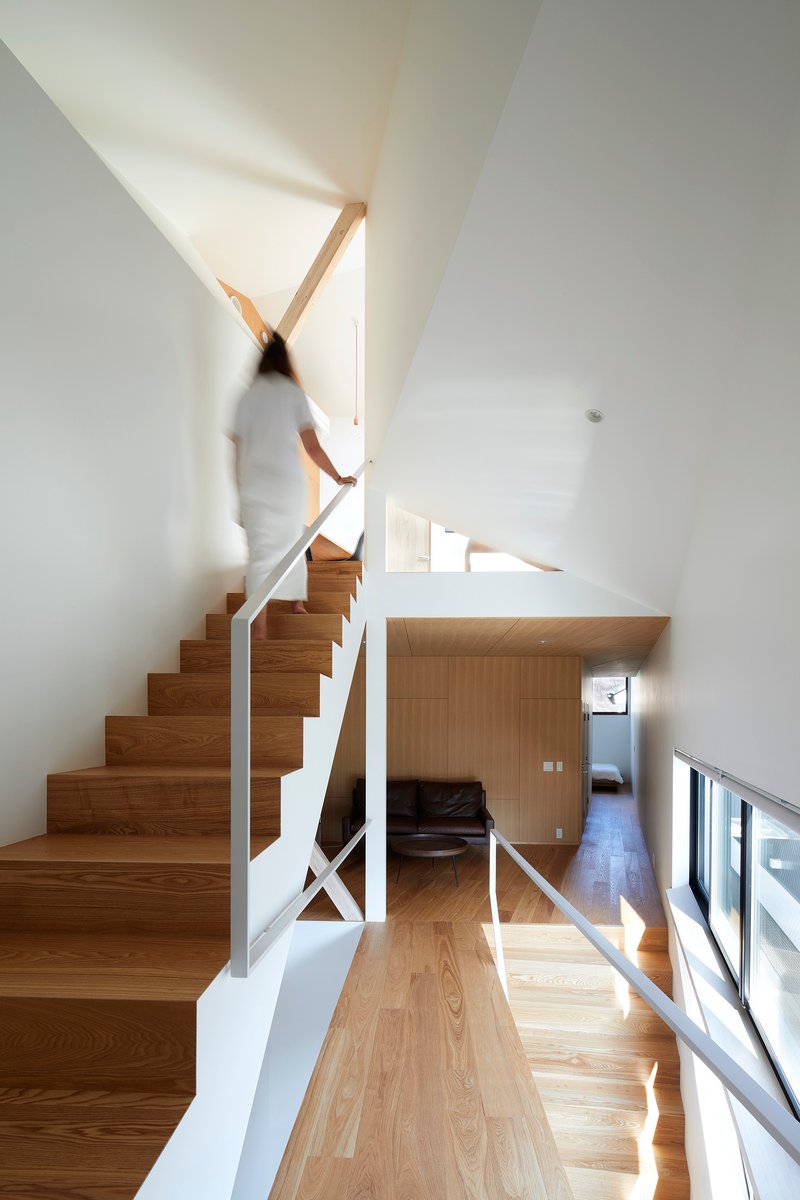
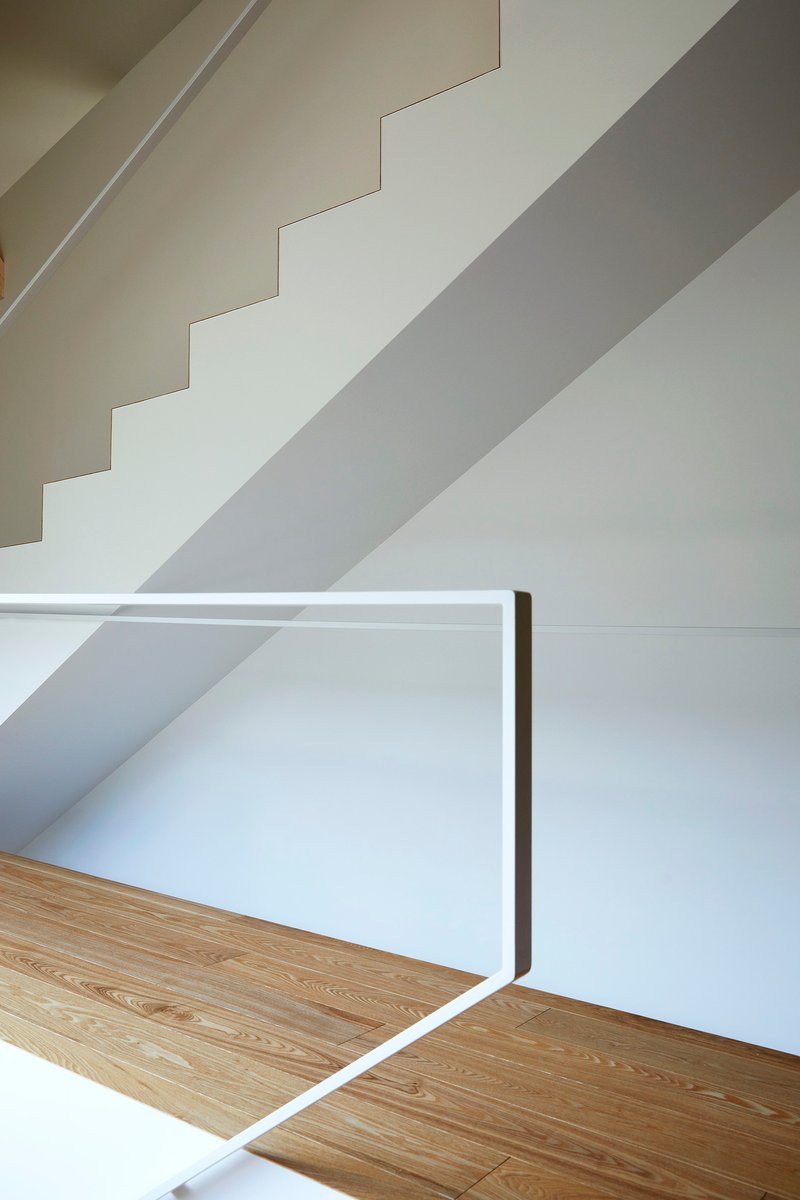
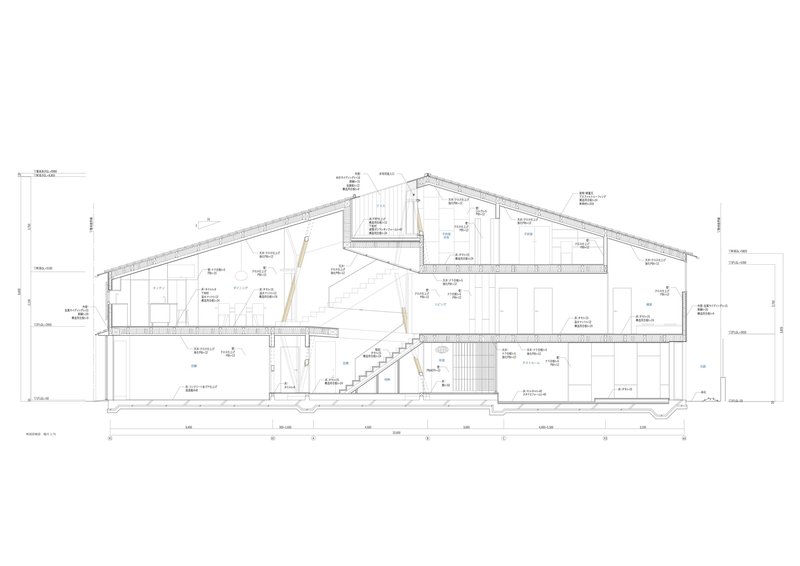
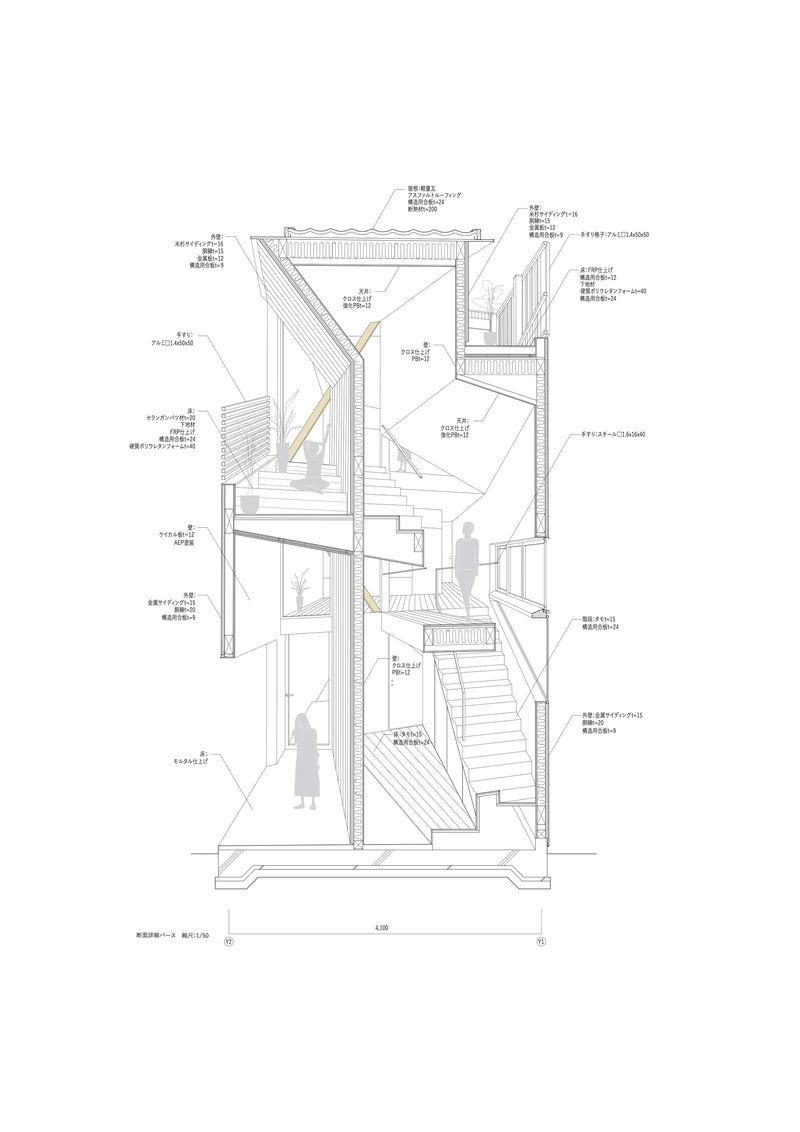
The section is where this house earns its keep. Each floor steps and shifts to create split-level conditions that carve out double-height voids above the stair. Skylights at the top of the house pour light down through these vertical channels, and the white-painted stair walls act as reflectors, bouncing daylight deep into the lower floors. The shadow patterns cast by the railings transform the walls into a sundial of sorts, marking the passage of the day with shifting geometric lines.
At the upper landing, a glazed skylight and diagonal timber beam frame an overhead view of the stairwell and courtyard below, collapsing several floors into a single glance. It is a moment of spatial generosity that would be impossible in a conventional stacked plan, and it justifies the complexity of the section.
Tatami, Shoji, and the Domestic Register
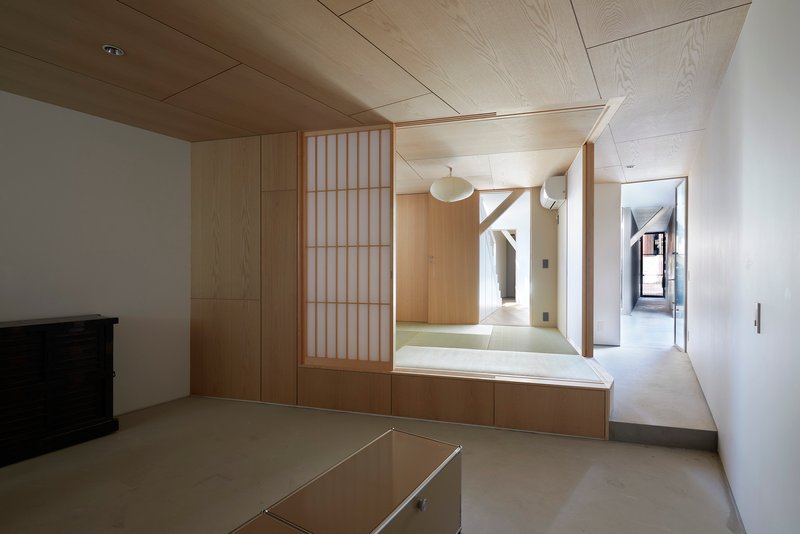
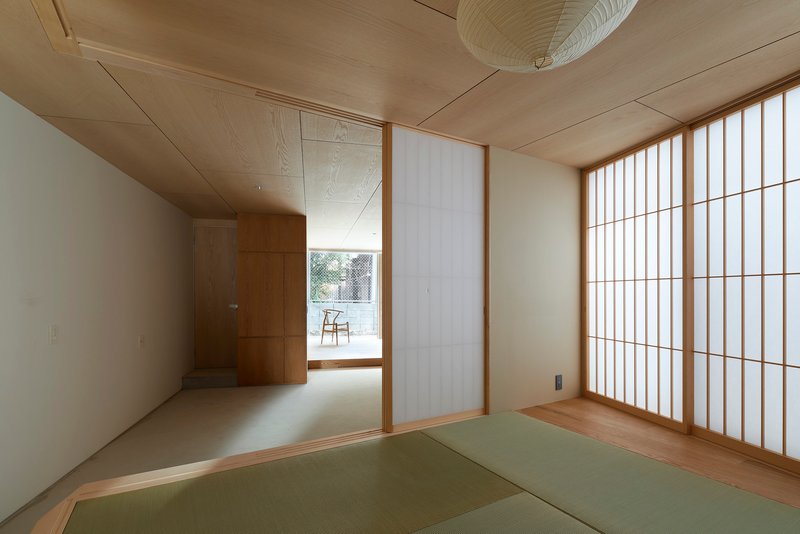
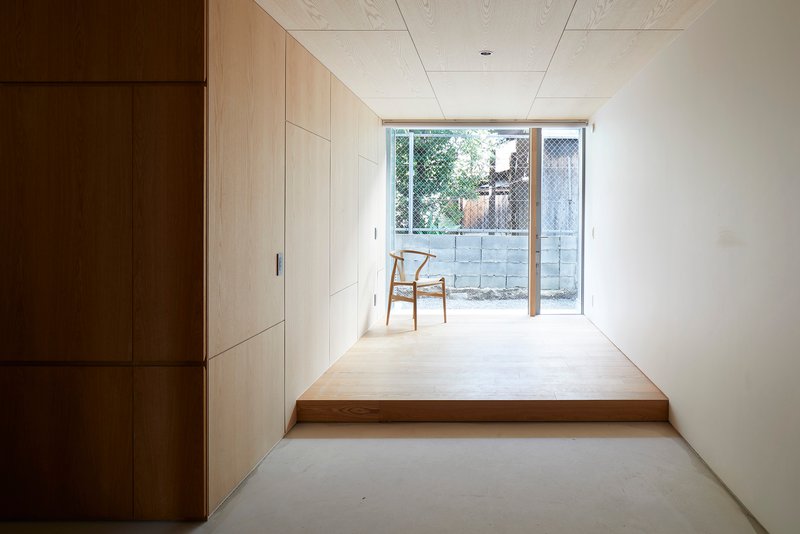
For all its structural invention, the house knows when to be quiet. A tatami room with translucent shoji screens and a paper pendant light offers a traditional register of domesticity that grounds the project. The plywood ceiling and raised platform recall the proportional restraint of historical Japanese interiors, and the shoji screens modulate light with a softness that the hard angles of the stairwell do not attempt.
Corridors lined with pale timber storage walls lead to mesh-screened courtyards, reinforcing the layered threshold condition that is central to traditional Kyoto living. You move from enclosed to semi-enclosed to open in short sequences, never more than a few steps from daylight or a glimpse of sky.
Kitchen, Dining, and the Courtyard Edge
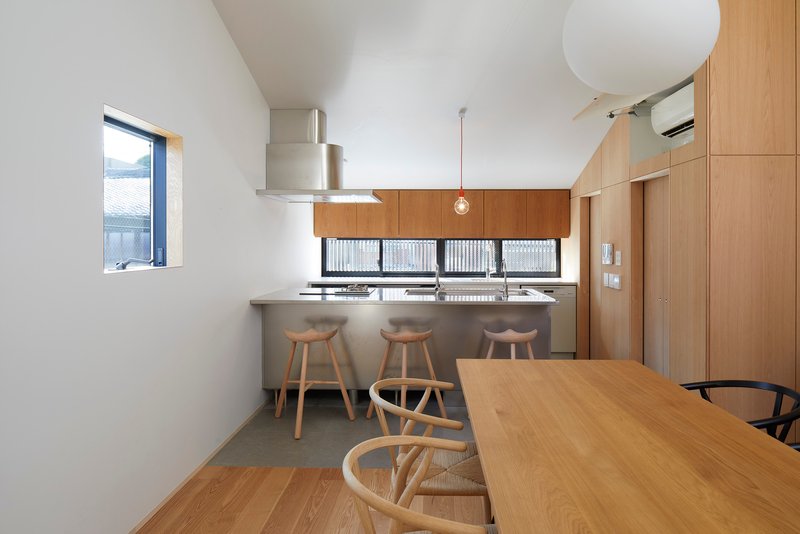
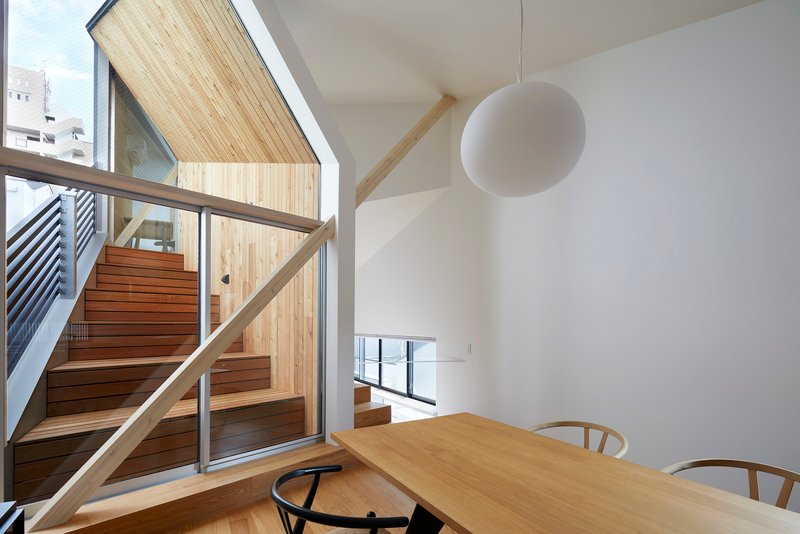
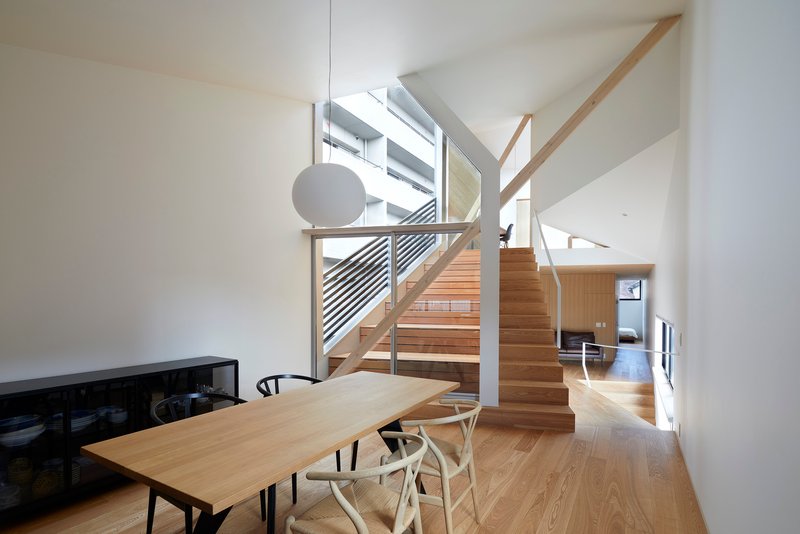
The kitchen and dining area sit at the threshold between interior and exterior, with glazed walls opening onto an external timber stair and metal balcony. Three wooden stools line the counter, and timber cabinetry keeps the palette consistent. The space is compact but not cramped, its proportions stretched by the adjacent void of the stairwell and the visual depth offered by the courtyard beyond the glass.
The open staircase connecting the dining level to the floors above turns the act of cooking and eating into a communal event visible from multiple levels. It is a deliberate inversion of the typical townhouse plan, where kitchens tend to be buried at the back. Here, the kitchen is central, exposed, and connected.
Roofscape Views and Upper Levels
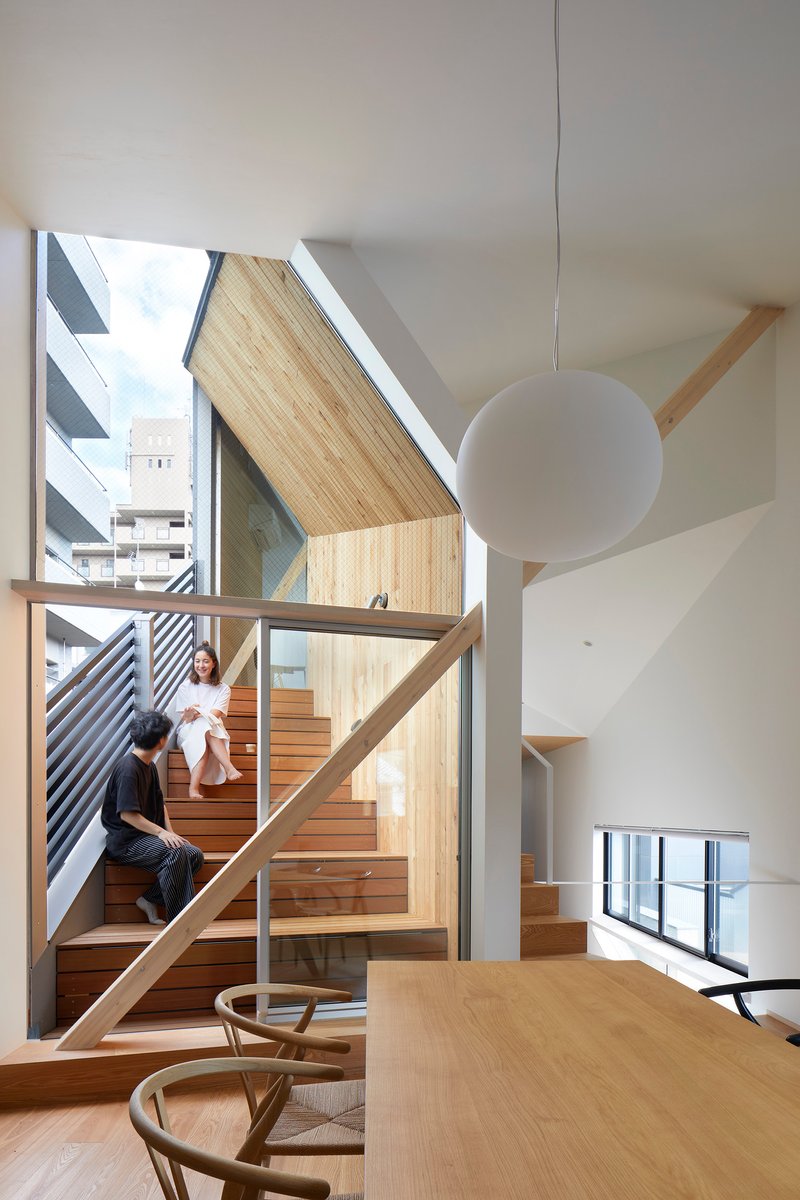
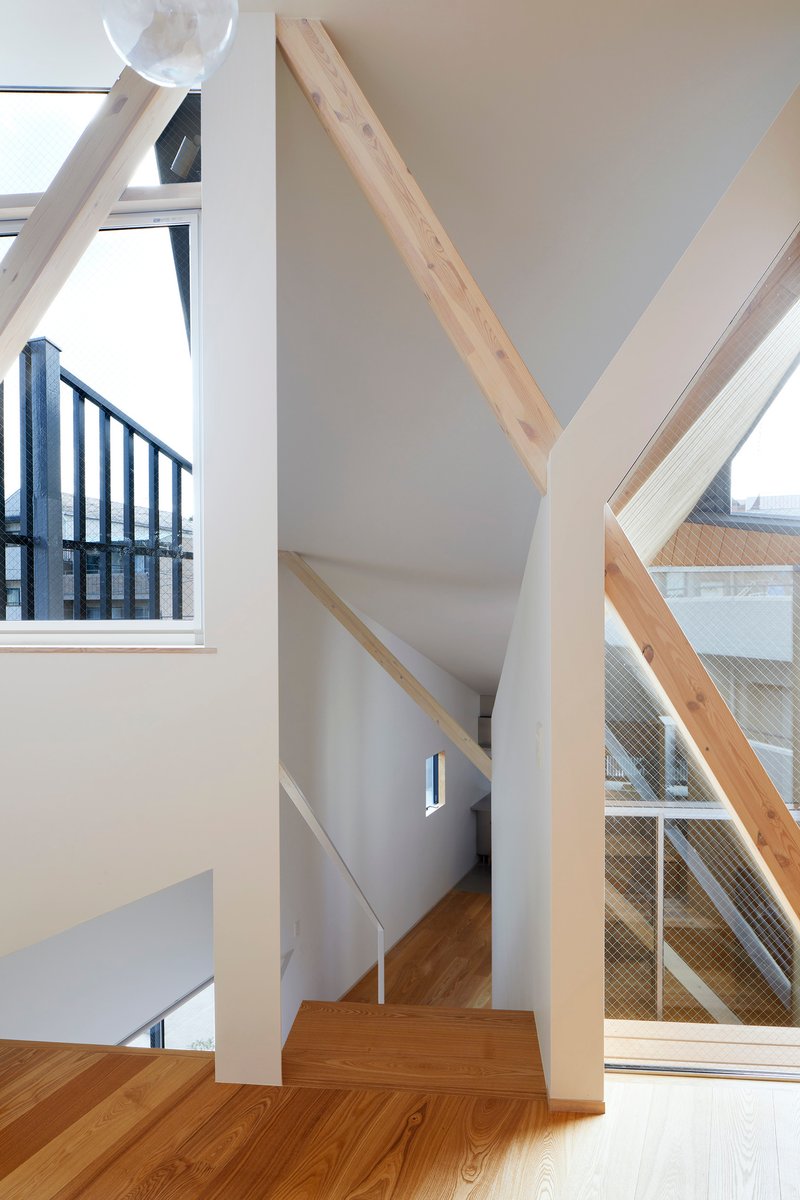
At the upper levels, the house opens outward. Large glazed walls in the stairwell frame panoramic views of Kyoto's low-rise roofscape, a field of tiled roofs and utility poles that reads as almost pastoral against the compressed scale of the street below. The diagonal timber beams in the foreground anchor these views, preventing the expansiveness from feeling unmoored.
The angular stairwell with its exposed timber rafters and faceted ceiling planes creates a compressed, almost cave-like quality at the topmost landing. It is a counterpoint to the openness just one flight below, and it gives the vertical journey through the house a satisfying narrative arc: from the dark, screened street level through the bright mid-section to the intimate attic at the top.
Plans and Drawings
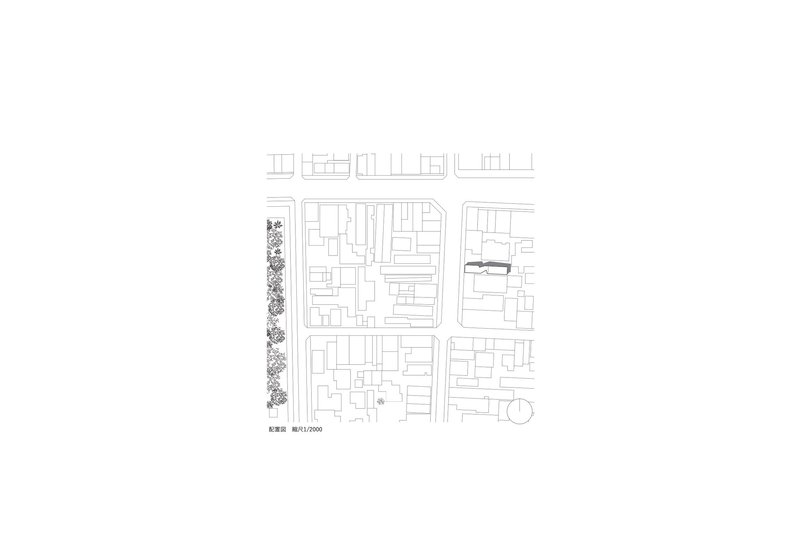
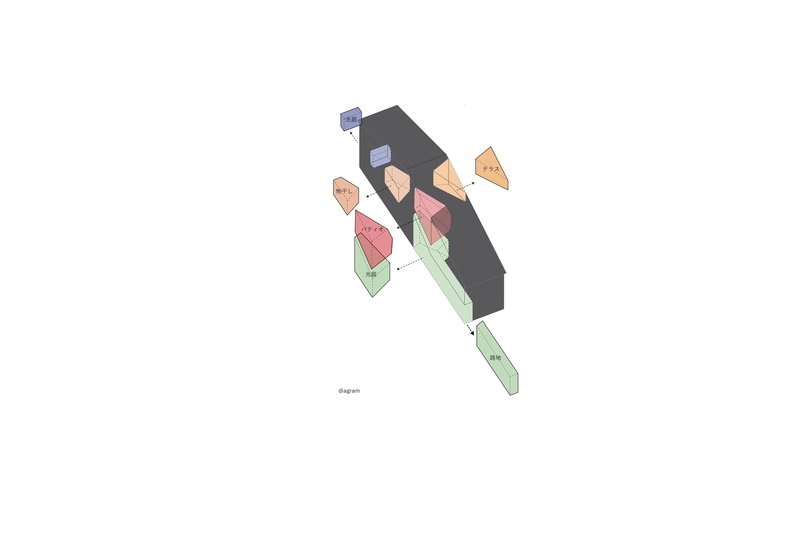
The site plan confirms what the photographs suggest: the building fills nearly the entire width of its lot, leaving only slivers of open space at the edges. The exploded axonometric drawing is the most revealing representation of the design, showing the stacked colored volumes that constitute the tsuboniwa voids carved from the building mass. These are not decorative gestures; they are the organizational logic of the entire project, each void calibrated to deliver light and air to specific rooms.
The structural axonometric highlights the red diagonal bracing against the tan vertical columns, making clear how the one-sided bracing system operates across three floors. The section drawings reveal the split-level strategy in full, with stairs connecting half-floor offsets that maximize the number of rooms served by each courtyard void. Two human figures drawn in the section offer a sense of scale and confirm that the vertical distances between levels are deliberately compressed, keeping the house intimate despite its three-storey ambition.
Why This Project Matters
New Kyoto Town House 4 matters because it demonstrates that a historical building type can absorb increased density without abandoning its core spatial ideas. The tsuboniwa is not a relic to be preserved in amber; it is a working principle that can be reimagined in section. Alphaville's contribution is to prove this with structure, not rhetoric. The diagonal bracing is not a stylistic choice layered on top of a conventional frame. It is the mechanism through which voids, views, and ventilation are produced. When structure and spatial ambition are this tightly coupled, the result tends to age well.
The project also offers a credible alternative to the glass-box urbanism that is rapidly replacing low-rise neighborhoods across Japanese cities. Rather than maximizing floor area at the expense of environmental quality, Alphaville accepts the boolean subtraction of livable square meters in exchange for light, air, and a tangible connection to the sky and the city. It is a trade-off that traditional Kyoto builders understood intuitively, and one that contemporary practice would do well to take seriously again.
New Kyoto Town House 4 by Alphaville Architects (Kentaro Takeguchi, Asako Yamamoto). Kyoto, Japan. 218 m². Completed 2022.
About the Studio
Share Your Own Work on uni.xyz
If projects like this are the kind of work you want to make, uni.xyz is a place to publish your own, find collaborators, and enter design competitions.




Popular Articles
Popular articles from the community

Milan Crossover: Sustainable Architecture for a New Fashion Culture in Milan
Milan Crossover transforms fashion culture through sustainable architecture, linking material libraries, remake studios, and public runways.
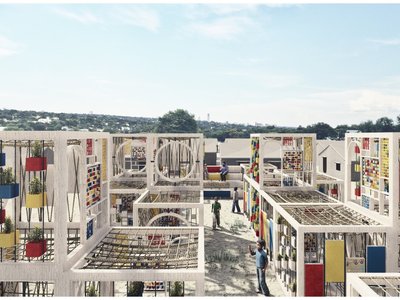
The Faith: Modular Architecture for Play, Learning, and Hope in Kutupalong Refugee Camp
A modular playground architecture project in Bangladesh where play, learning, safety, and hope rebuild childhood inside a refugee camp anew.

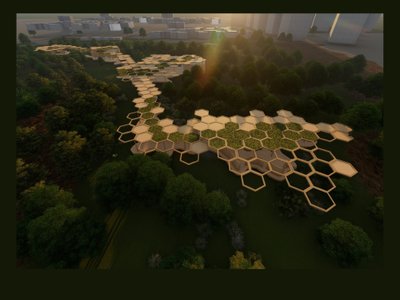
Eco Chapel: A Green Architecture Pavilion Designed in Symbiosis with the Forest
Eco Chapel uses green architecture to weave prayer, learning and reuse into a forest pavilion shaped by modular hexagonal canopies for life.
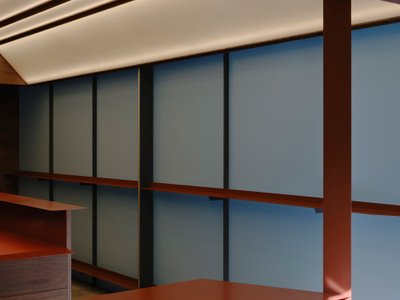
Kerry Kounnapis Packs 800 Daily Coffees into a 43-Square-Metre Melbourne Laneway Bar
Palace Coffee channels Pellegrini's and European standing bars through oxide-red steel and spotted gum timber in a Ridgway Place sliver.


Similar Reads
You might also enjoy these articles
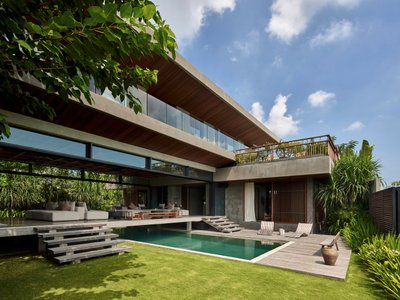
Freebird Residence by Alexis Dornier: A Tropical Modernist Sanctuary in Bali
Floating living pavilion above pool anchors H-shaped tropical villa, blending Japanese minimalism, sustainable strategies, lush landscape, and sculptural interiors.
127af Flips a Tiny Bagnolet Rowhouse Upside Down with a Handcrafted Roof Extension
A 55-square-meter terraced house on the edge of Paris gains a luminous upper living floor through lightweight timber and steel.
1.61 Design Workshop Wraps a 600-Square-Meter Café in Vietnam in Sculptural Burgundy Drama
Reden Café & Bistro pairs a helical staircase, mosaic floors, and deep red interiors to rethink Vietnamese hospitality space.

The Unbound Brain: A School Shaped by Cognitive Architecture
Cylindrical learning pods radiate like neurons from a central cortex, turning the floor plan into a spatial model of human thought.


Explore Residential Building Competitions
Discover active competitions in this discipline




The Global Benchmark for Architecture Dissertation Awards


Challenge to design mud housing for contemporary communities
Comments (0)
Please login or sign up to add comments
No comments yet. Be the first to comment!