

APTO Architecture Wraps Braga's 1956 Municipal Market in a Parametric Timber Canopy
A generative design process and 8,300 square meters of solid wood panels transform a dictatorial-era market into a civic landmark in northern Portugal.


Municipal markets are civic infrastructure at their most elemental: places where a city feeds itself, negotiates social contact, and expresses collective identity through the repetition of daily commerce. When the building housing that exchange dates from a 1956 dictatorial regime, the act of renovation becomes politically loaded. APTO Architecture took on precisely that challenge in Braga, converting a mid-century market block on the fringe of the city center into a 9,343 m² contemporary hall that keeps its vendors open, its accessibility universal, and its architectural DNA legible beneath a new parametric roof.
What makes the project worth studying is the collision between two design logics. The existing building sits on a site with a three-meter height difference and a rigid orthogonal grid. APTO's intervention layers a computationally generated timber canopy over that grid, using algorithms to find a form that balances structural performance with aesthetic coherence. The result is not a digital spectacle grafted onto an old box; it is a genuine hybrid where prefabricated wood panels, steel trusses, and generous ramps dissolve the building's original rigidity and produce a continuous, accessible interior landscape.
Reading the Legacy
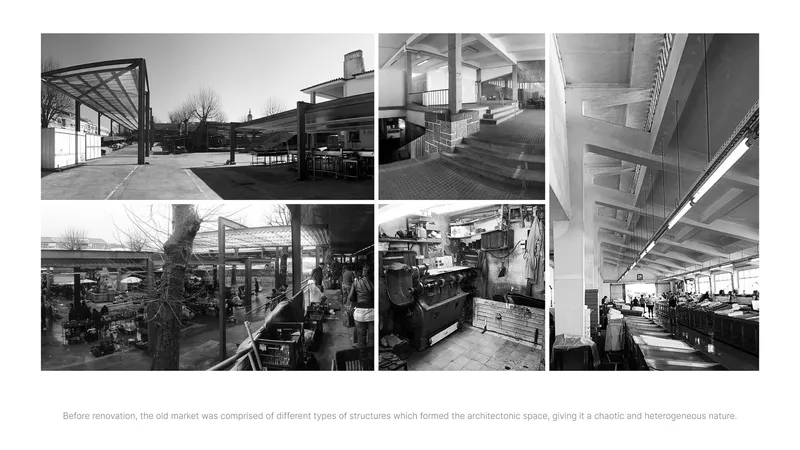
Braga's original market was a product of its era: utilitarian concrete frames, open-air canopies, and a functional austerity that carried the signature of Portugal's Estado Novo architectural vocabulary. APTO's first move was analytical rather than formal. Archival photographs reveal a courtyard building with simple vendor stalls arranged under lightweight canopies, a structure that served its purpose but offered no protection from the Atlantic weather that sweeps through northern Portugal's valleys.
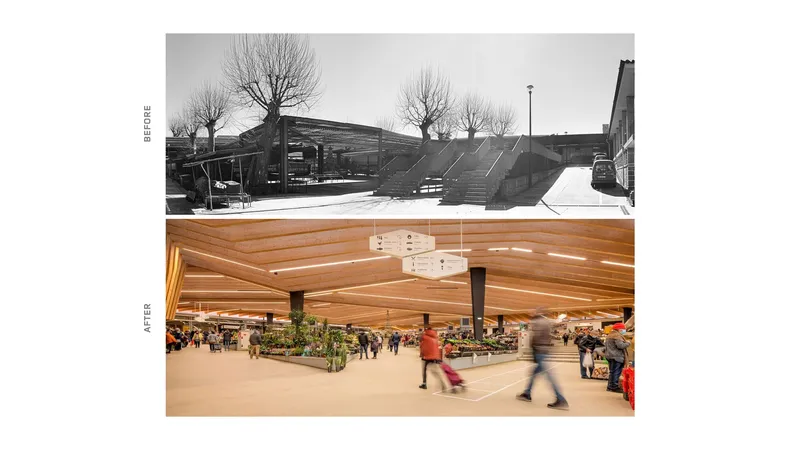
The before-and-after comparison shows the scope of transformation without erasing context. Perimeter colonnades and the building's block-scale urban presence remain intact. What changed is the interior atmosphere and the roof, which went from a series of modest covers to a single, continuous timber canopy that unifies the site. The approach treats preservation not as freeze-framing a moment but as sustaining a use while upgrading its physical envelope.
Timber Waves Overhead
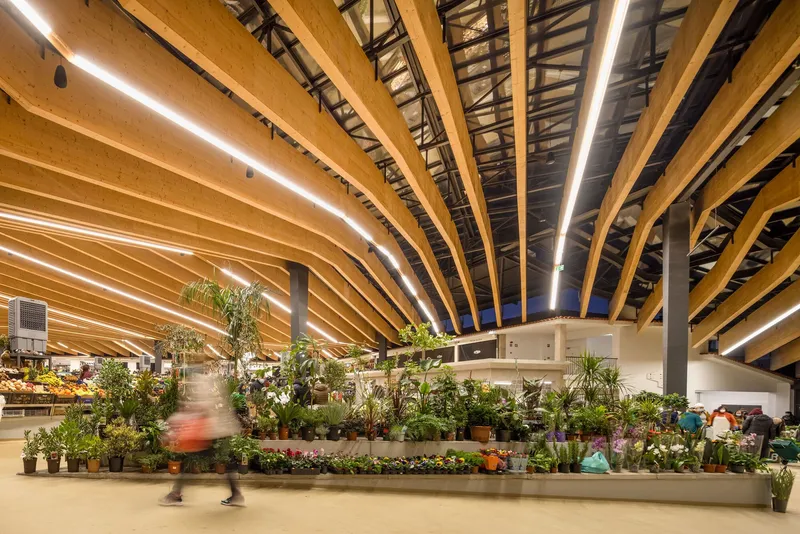
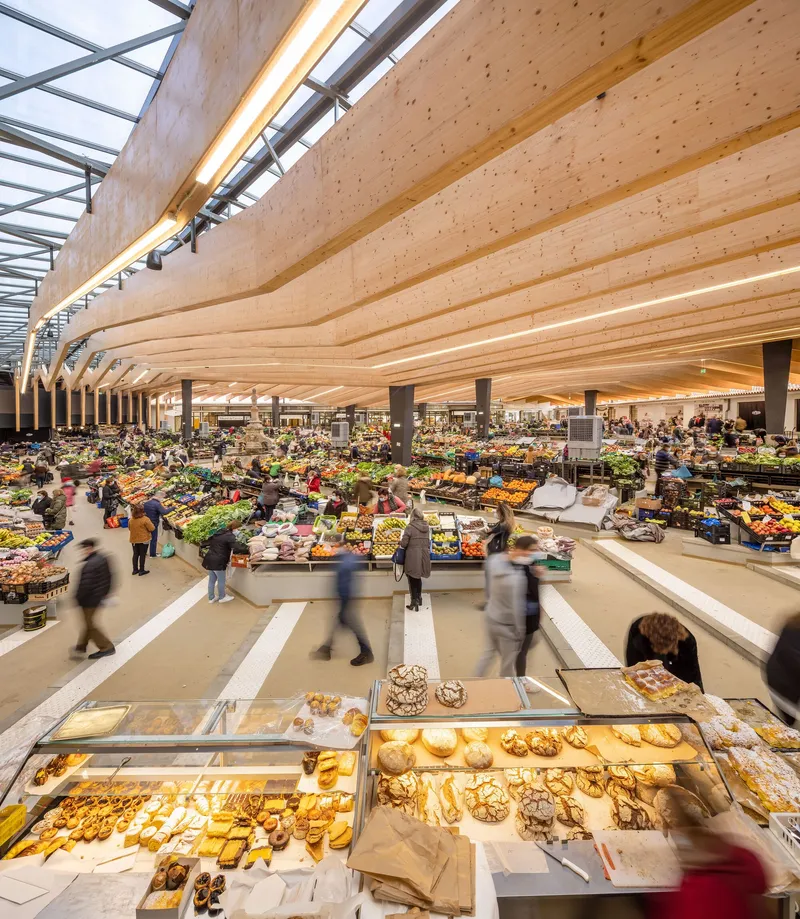
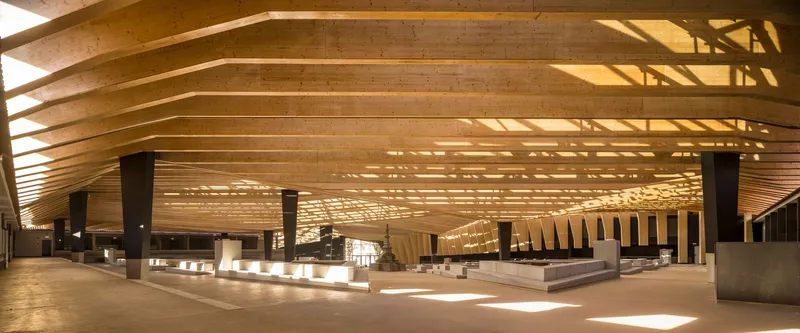
The undulating laminated timber ceiling is the project's defining spatial element. Curved glulam beams ripple across the market hall like a topographic surface frozen mid-motion, their profiles varying in depth and spacing according to the parametric logic that generated them. The effect is kinetic even when the structure is still: light strips embedded between ribs create linear constellations that guide the eye along the hall's length, and clerestory glazing between beam clusters brings daylight into zones that were previously dim.
Structurally, the system is a hybrid. Steel columns carry the primary loads, while the timber panels, totaling 7,000 m² of three-layer solid wood mounted to the steel frame, provide both finish and secondary structure. The decision to use wood in this volume is not cosmetic. It introduces acoustic warmth to a building type notorious for hard-surface reverb, and it reads as a legible, tactile material against the concrete bones of the 1956 frame.
Negotiating the Three-Meter Drop
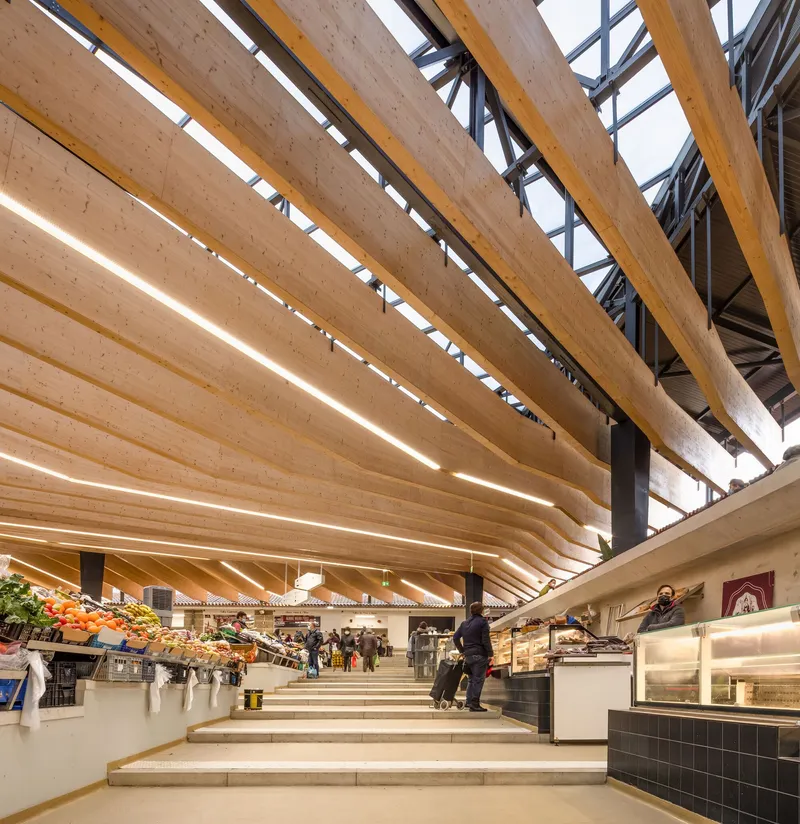
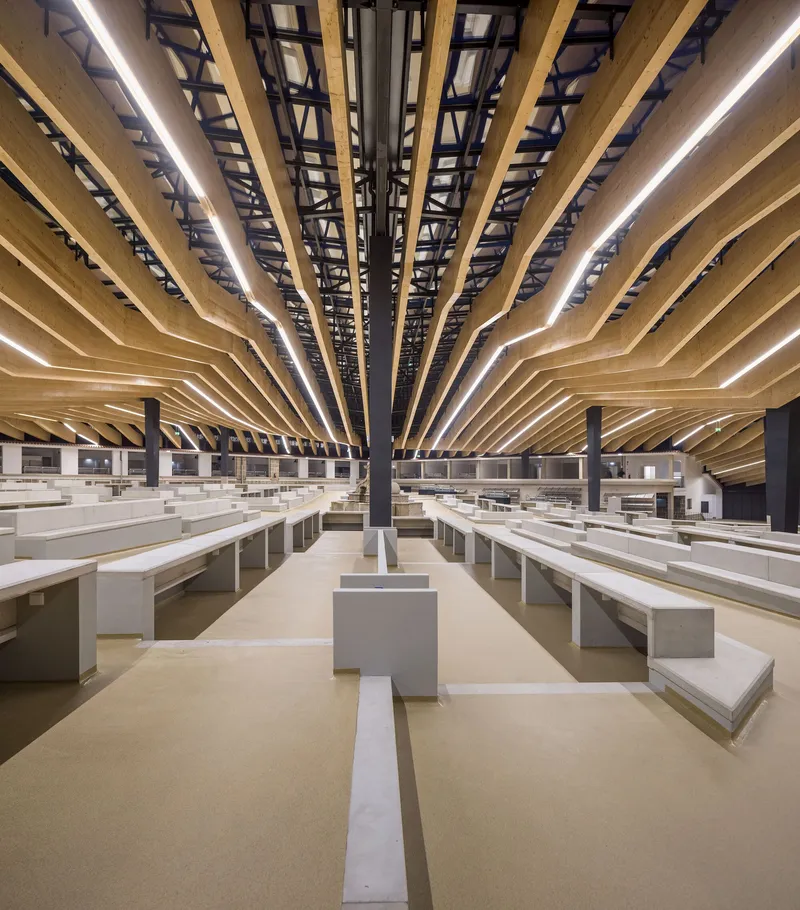
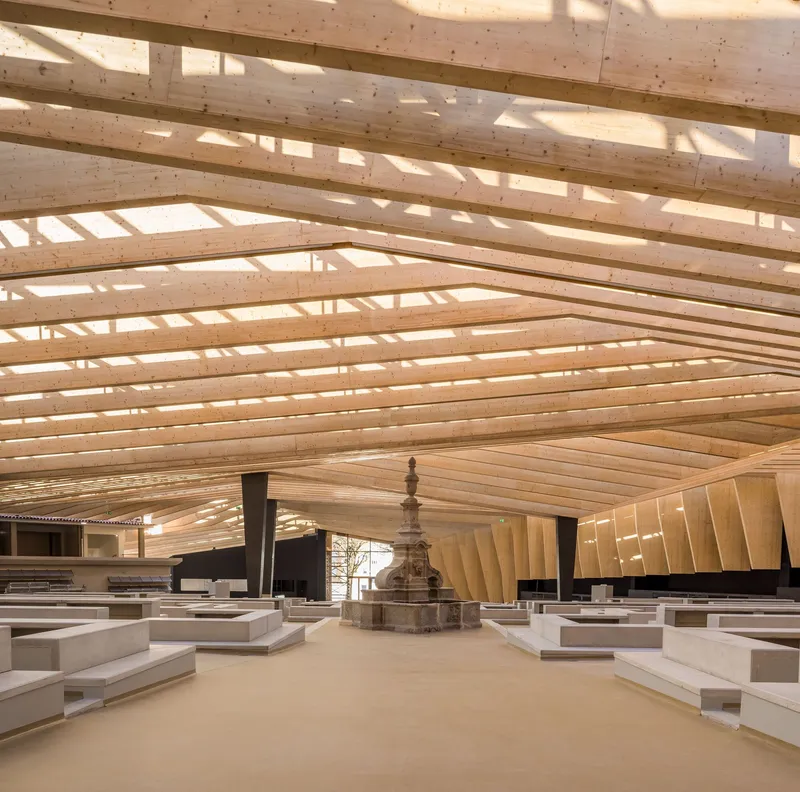
A three-meter height difference across the site is the kind of unglamorous constraint that determines whether a public building is genuinely accessible or merely nominally so. APTO eliminated most stairs and replaced them with a system of wide ramps and gentle slopes that connect two main entrances, threading between vendor cores along perimeter corridors. The result is a market you can navigate with a wheelchair, a loaded cart, or an aging set of knees without ever encountering a barrier.
Stepped concrete platforms double as display surfaces and informal seating, collapsing the distinction between circulation and program. A central stone monument, retained from the original building, anchors the composition beneath the timber vault. The spatial hierarchy is clear: wide corridors at the edges, denser vendor cores in between, and a public square at the heart. It is an urban strategy applied at an interior scale.
Color-Coded Programs
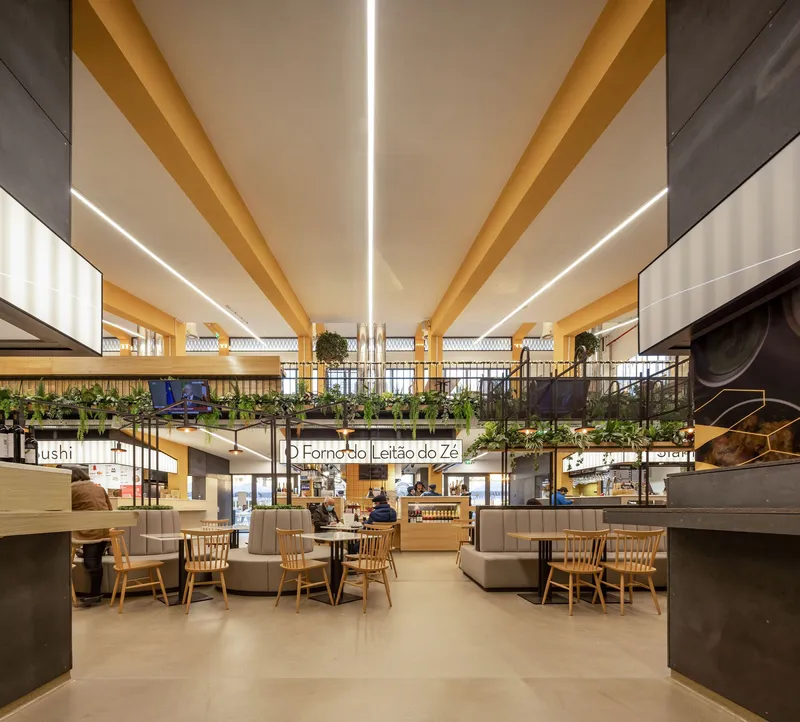
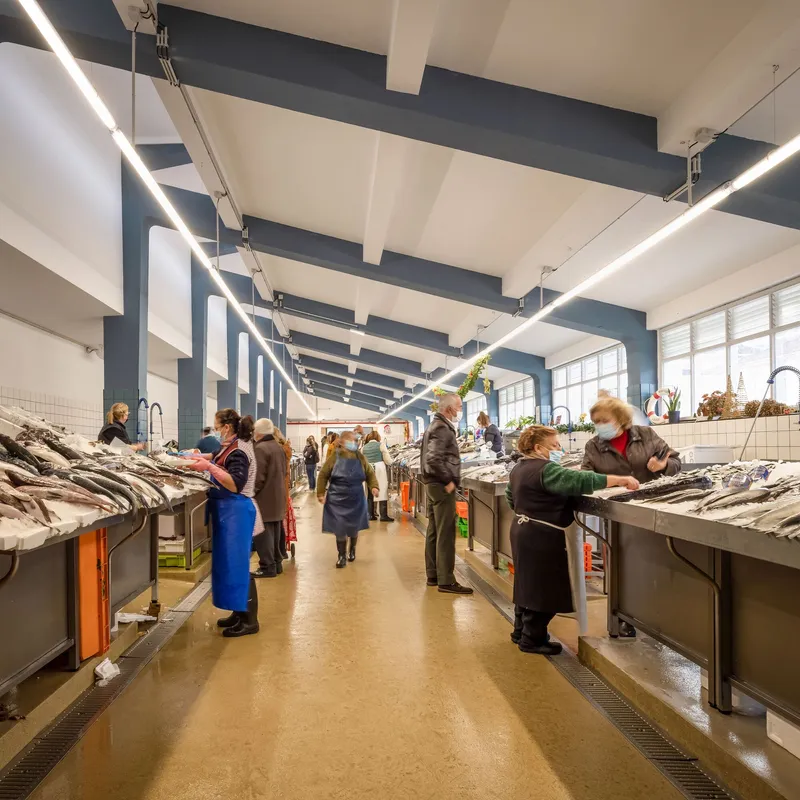
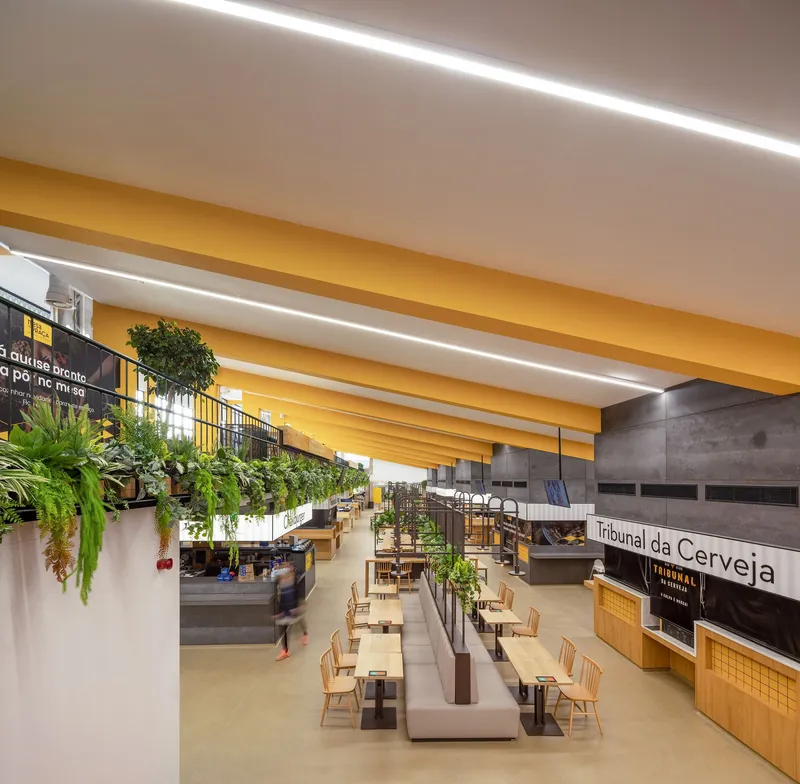
APTO introduces color as a wayfinding device rather than decoration. The food court, a new program element added to the market's original brief, is identified by yellow-tinted laminated beams and planters that hang from the mezzanine. The fish hall, by contrast, receives a cooler palette of blue and white painted beams above stainless steel counters, a nod to both hygiene and Portuguese ceramic traditions. These tonal shifts are subtle enough to avoid theme-park territory but strong enough to orient a first-time visitor without signage.
The food court seating area, with its polished concrete floor and hanging greenery, reads more like a contemporary hospitality space than a traditional market annex. This is deliberate: the market needed to attract a younger demographic alongside its loyal daily shoppers, and the food court serves as a social anchor that extends dwell time beyond a quick grocery run.
The Envelope from Outside
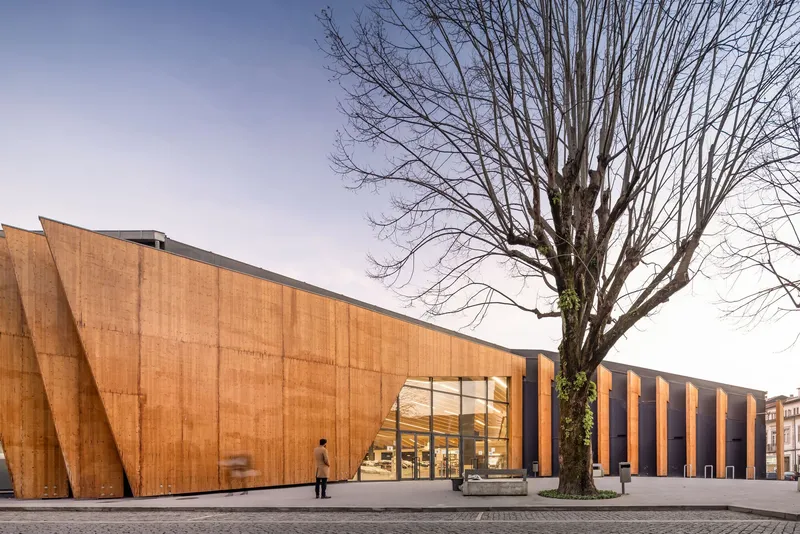
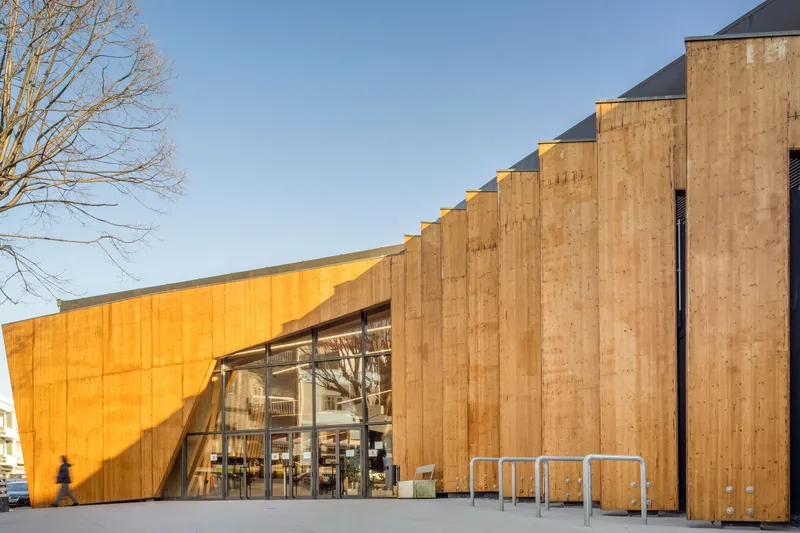
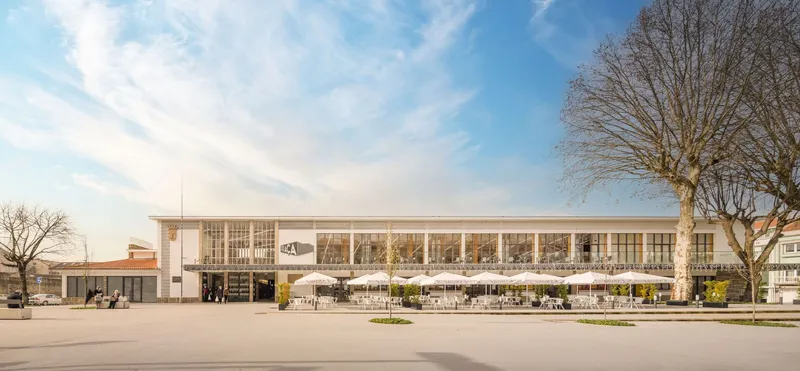
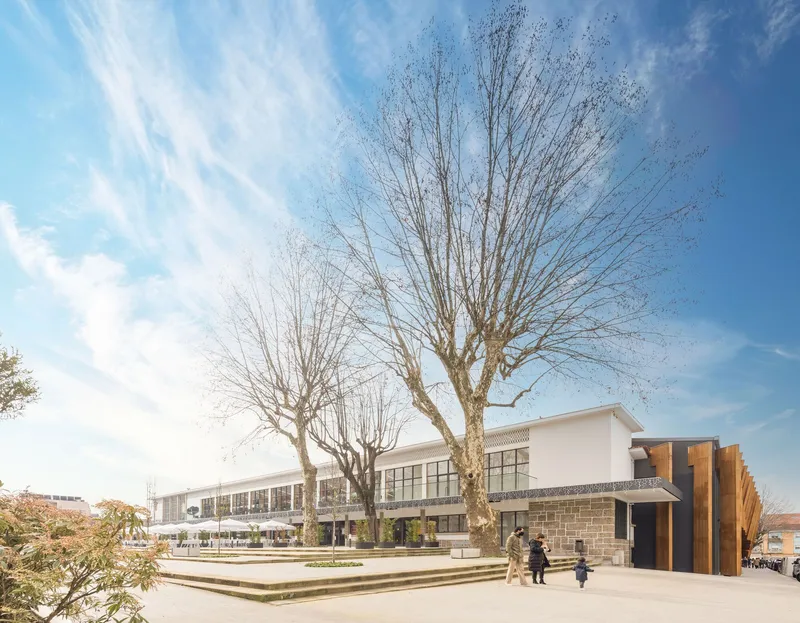
The exterior cladding deploys 1,300 m² of the same three-layer solid wood panels used inside, arranged as vertical fins that create a rhythmic facade modulated by shadow. At dusk, the glazed entries glow against the timber, and the building's civic presence registers from across the plaza. The vertical buttresses along the facade are not purely decorative; they provide solar shading for the curtain wall behind, which uses an N15000 system with thermal break to manage heat gain.
The aerial views reveal a faceted metal roof sitting above the timber canopy, with the original terracotta-toned perimeter colonnade preserved as a datum. The layered massing, visible in the west and south elevations, steps down toward the surrounding residential fabric, avoiding the monolithic profile that a 9,343 m² building could easily produce.
Roof and Terrace
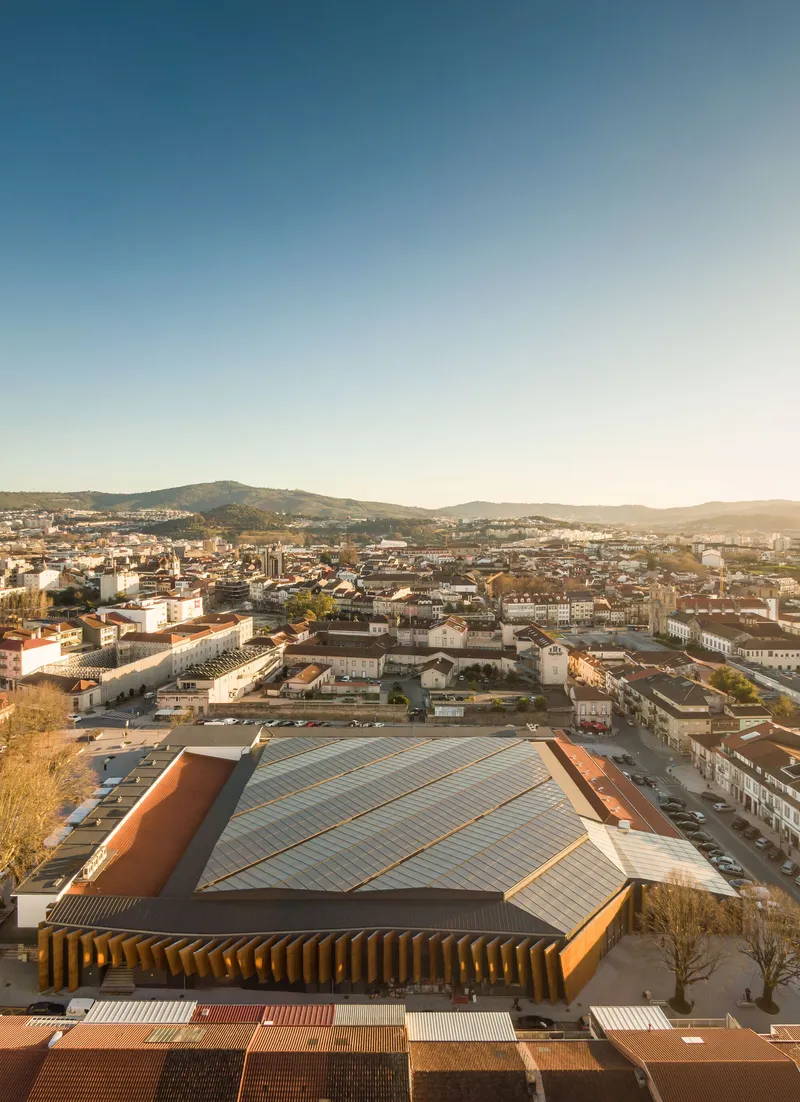
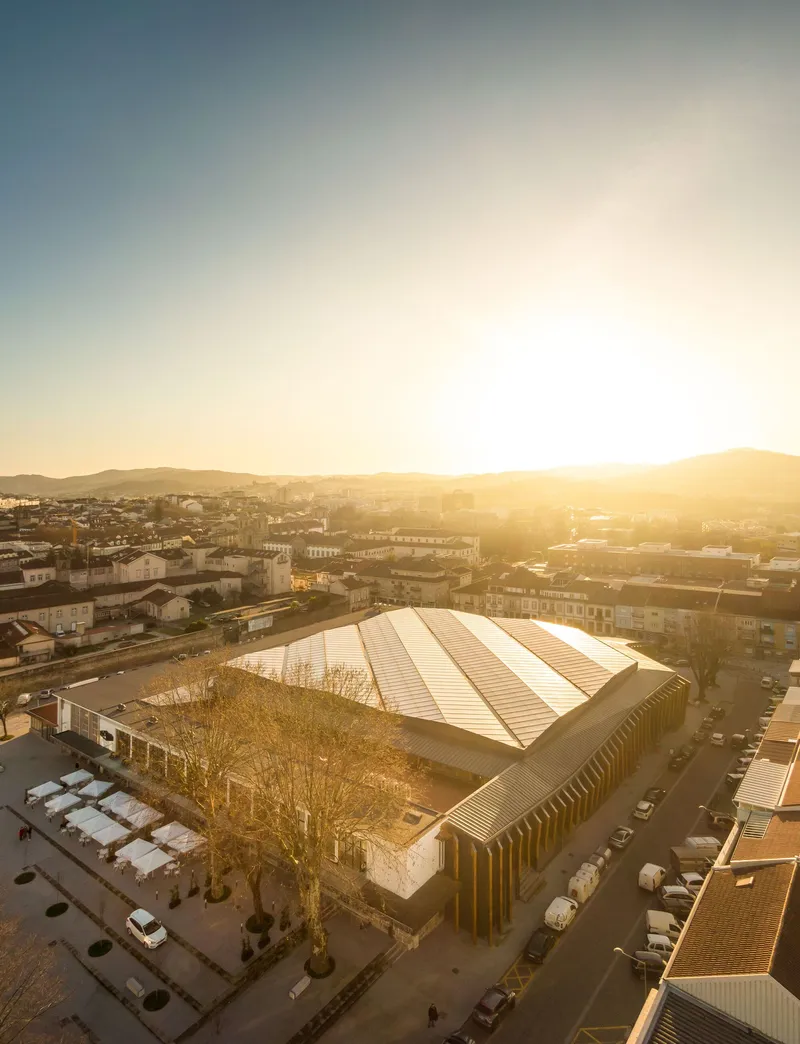
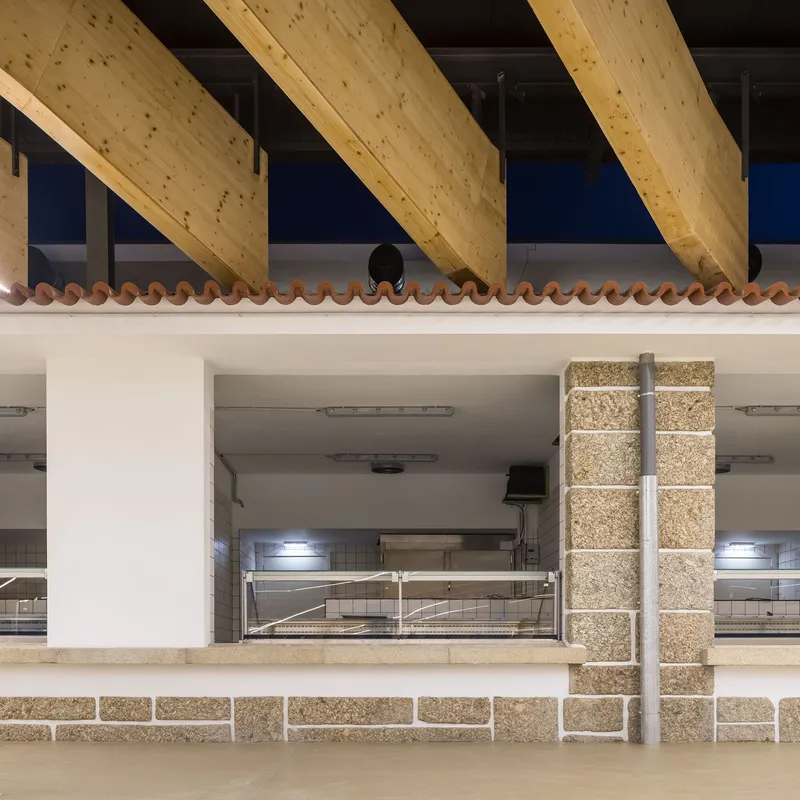
The roof is a two-layer system: an upper aluminum and glass skin that sheds rain and admits light, and a lower timber-clad soffit that visitors actually see. Between them, the parametric steel trusses span the hall. The glass portions use a regular tessellation that distributes loads evenly while creating a dappled interior light quality reminiscent of a forest canopy, a comparison that is overused in architecture writing but genuinely earned here.
An elevated terrace with cork-tiled planters and exposed glulam beams extends the public program to the roof level, offering views toward the mountains north of Braga. The terracotta tile parapet along the edge connects the new intervention to the original building's material palette, a small detail that keeps the two eras in dialogue.
Generative Process and Parametric Logic
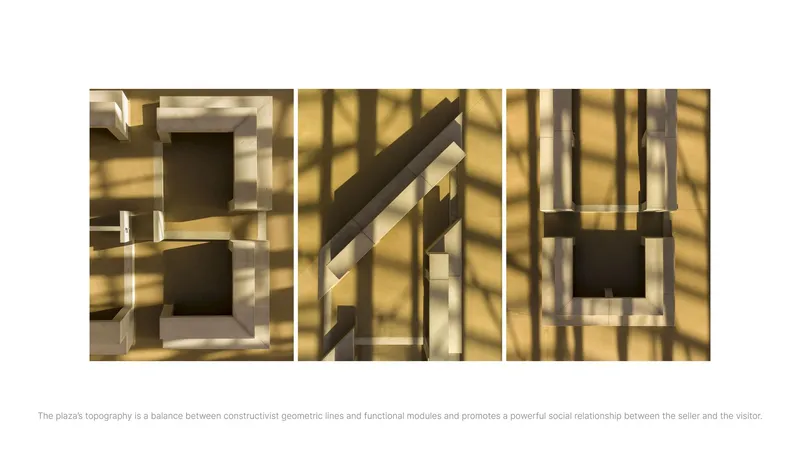
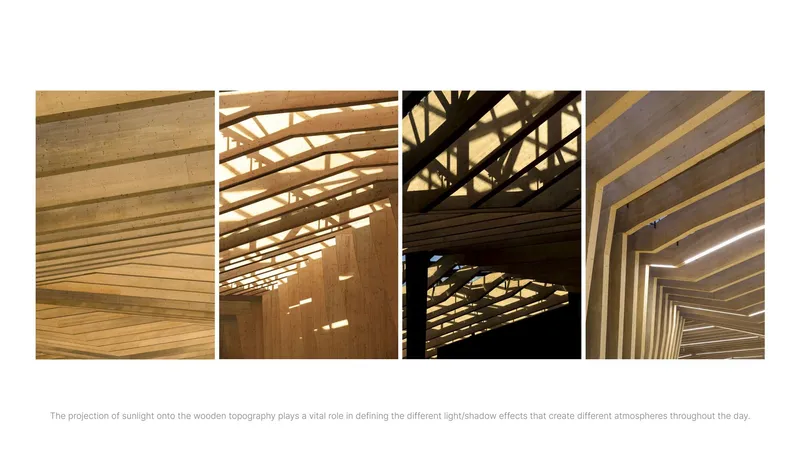
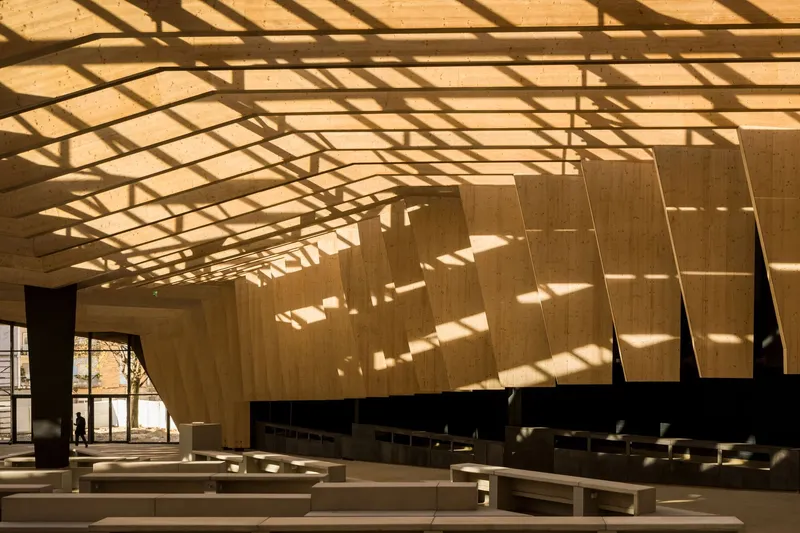
APTO used generative design principles during the form-finding phase, running algorithms that shaped the canopy's curvature according to structural performance, daylight distribution, and visual scale. A physical model photographed under natural light shows how the geometry casts dappled shadows across the interior, validating the computational studies. Timber slat ceiling details reveal how the parametric variation in profile produces different light-filtering patterns across the hall.
The acoustic wall panels with their diagonal shadow patterns demonstrate that the parametric approach extends beyond the roof. Every surface that could modulate sound or light was treated as a design variable, run through the BIM model to ensure precise coordination between steel, wood, and glass. The project makes a strong case that parametric design is most useful not as a formal generator but as a fabrication and coordination tool for complex hybrid structures.
Plans and Drawings
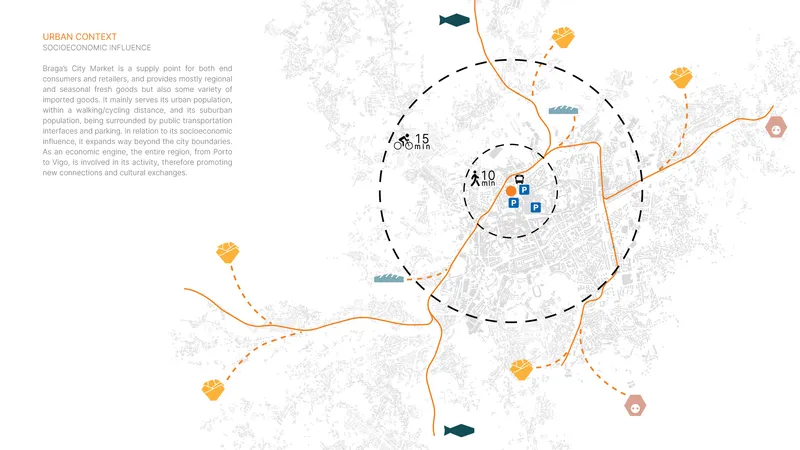
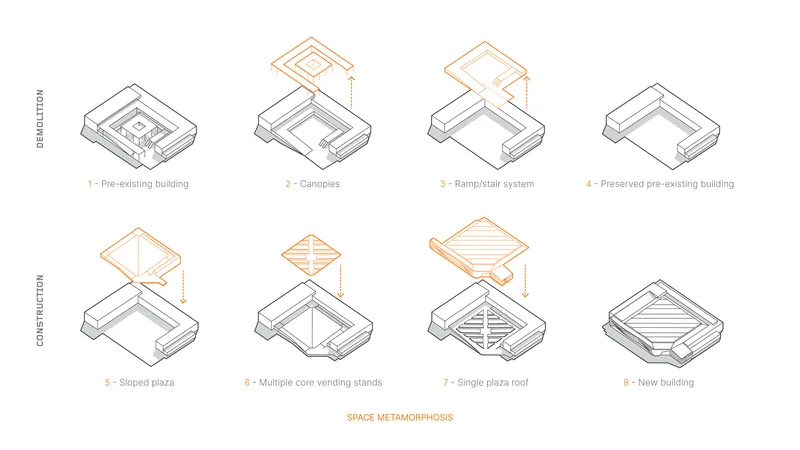
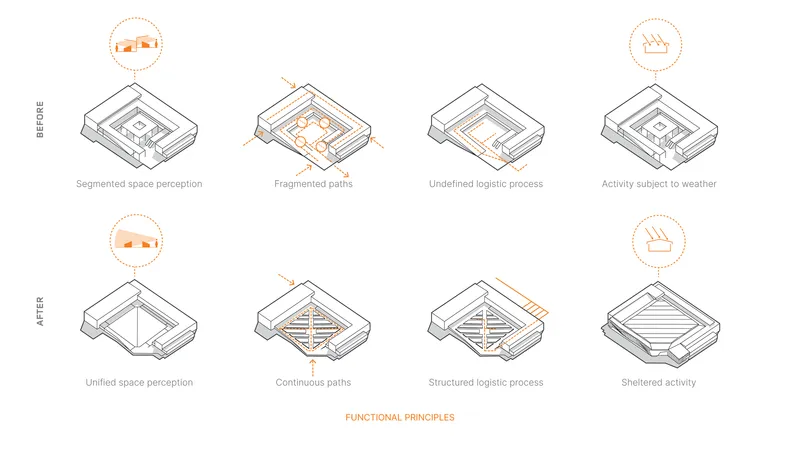
The site diagram locates the market within Braga's urban fabric, showing its relationship to transit connections and its position as a standalone block at the city center's edge. An axonometric construction sequence in eight phases documents the transformation from existing courtyard building to completed timber roof, revealing how the temporary roof construction allowed the market to remain open throughout the build. Isometric comparisons of the before-and-after spatial organization show how the rigid original circulation was replaced by a more fluid, ramped system.
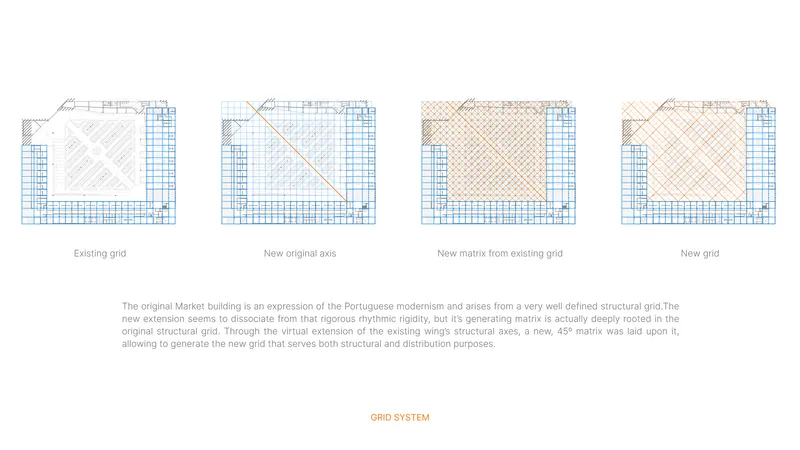
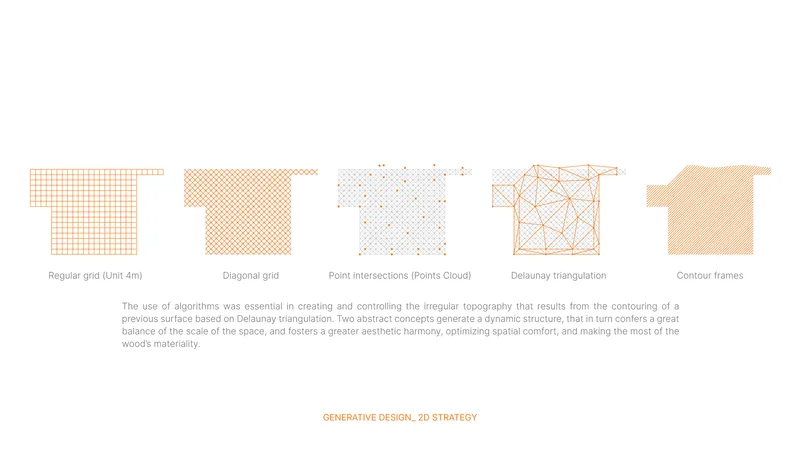
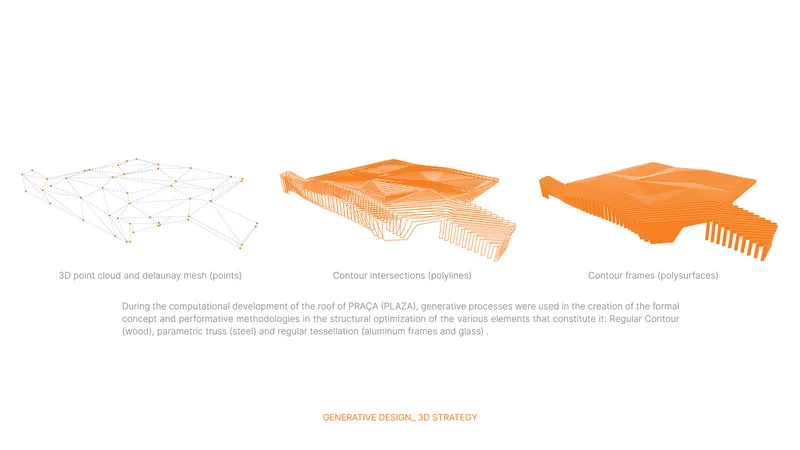
The plan evolution drawings track the structural grid's transformation from orthogonal to a triangulated mesh overlaid with diagonal matrices. The generative design sequence, from regular grid through five strategies to the final tessellation, makes the computational methodology transparent. A three-dimensional point cloud mesh morphing into the contoured roof geometry captures the moment where data becomes architecture.
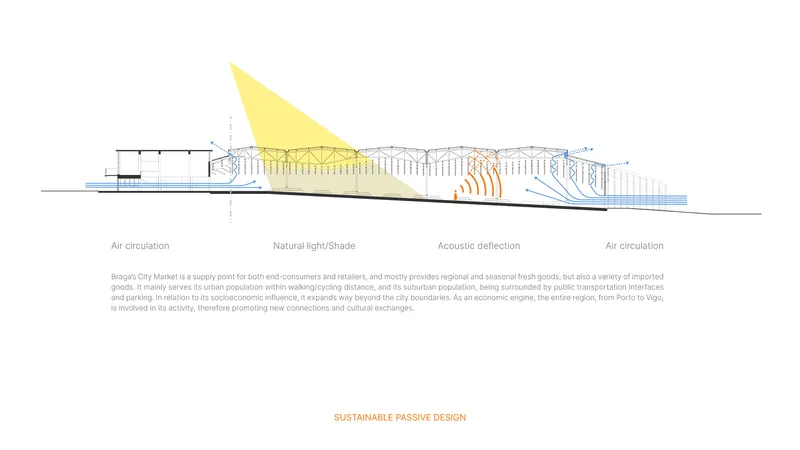
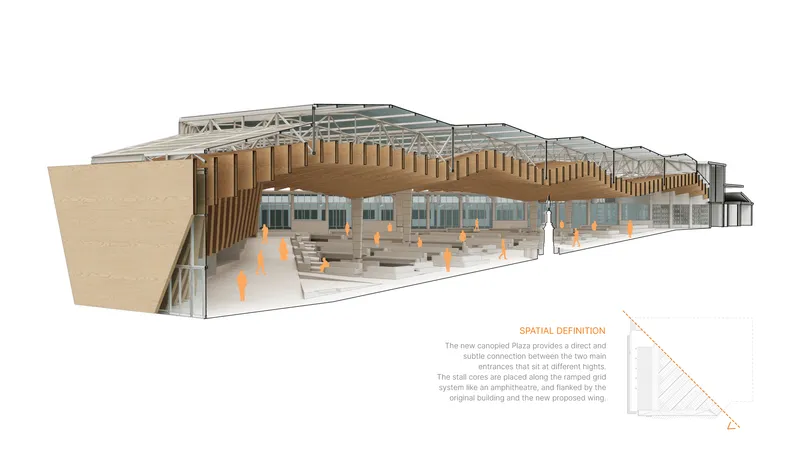
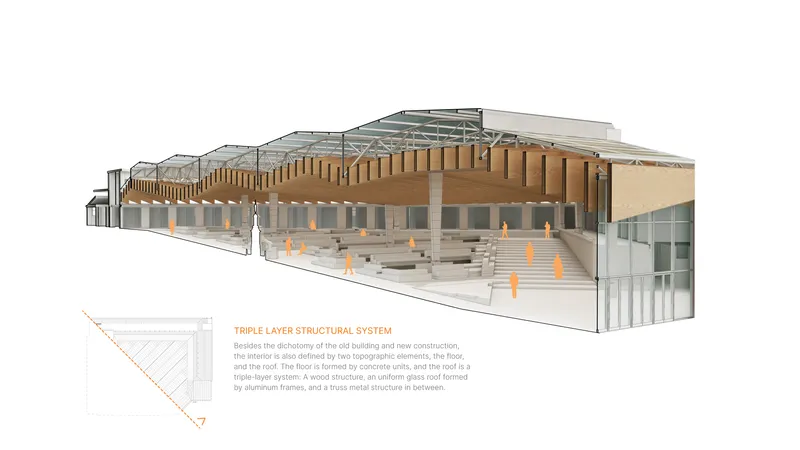
The section with its yellow sun diagram maps natural light penetration and air circulation zones, illustrating the passive strategy embedded in the canopy's geometry. Axonometric cutaways peel back the timber cladding to reveal occupants on stepped seating and expose the triple-layer structural system: concrete base, steel trusses, and timber soffit.
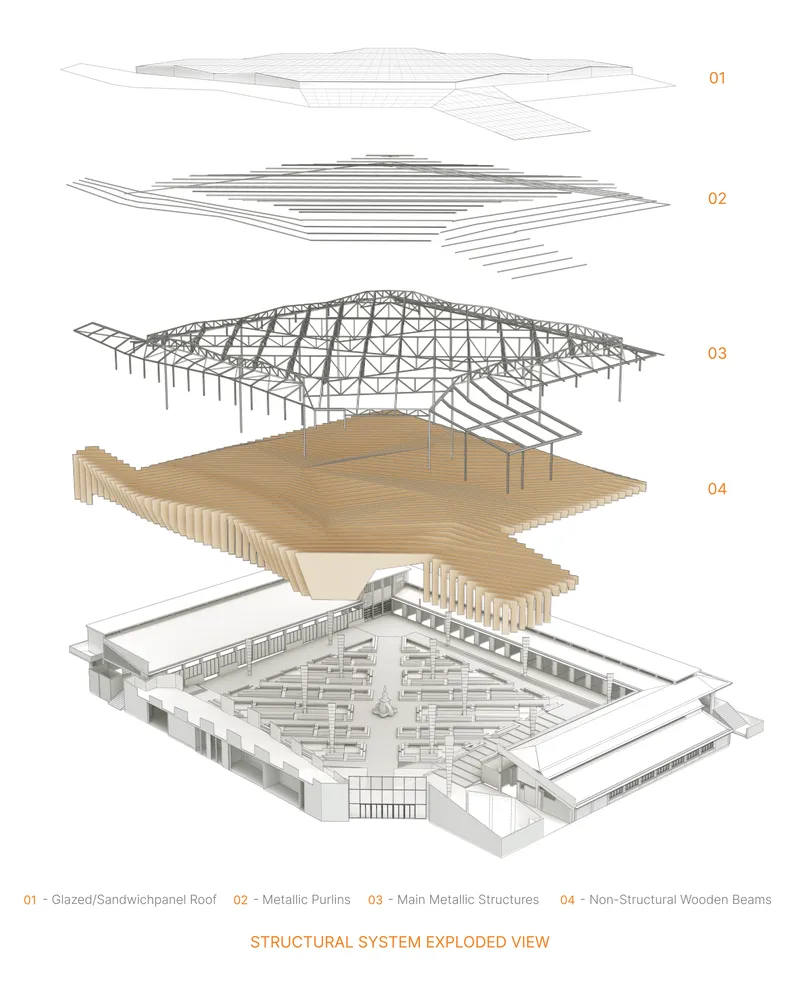
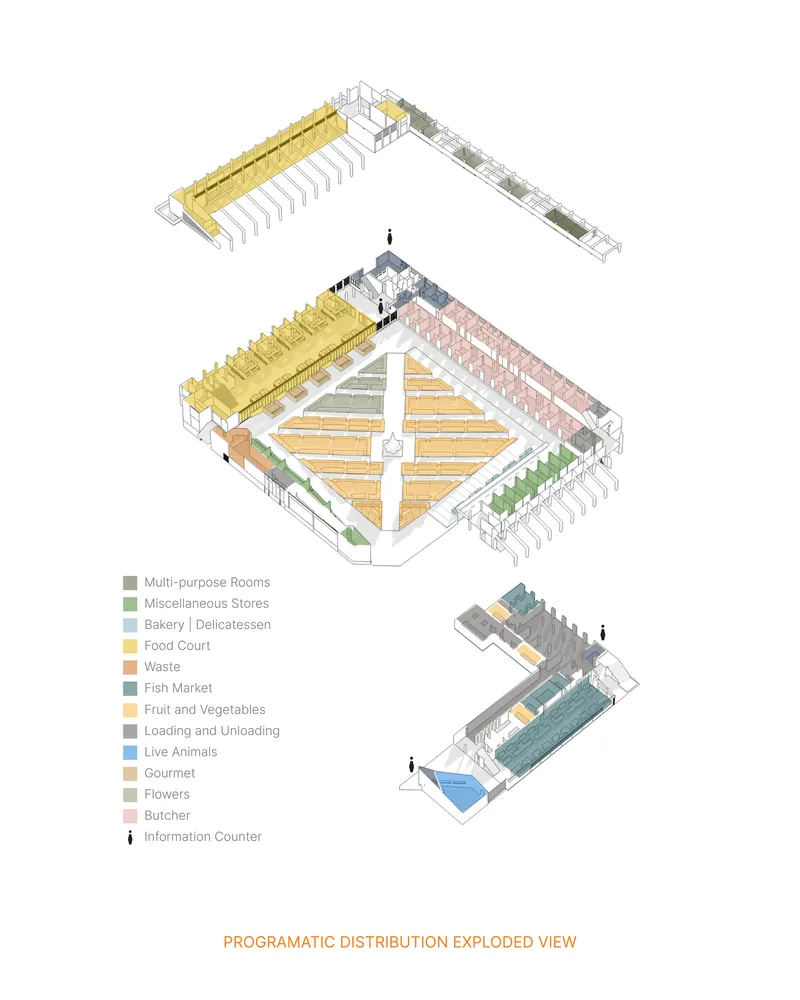
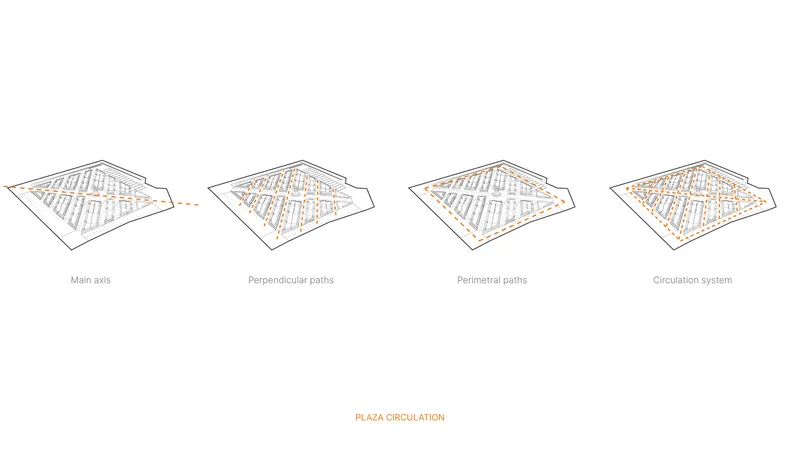
Exploded axonometrics separate the glazed roof, steel frame, timber panels, and floor plan into readable layers, while a color-coded programmatic diagram distributes functions across multiple levels. Circulation diagrams illustrate the hierarchical path system, from main axes to secondary routes, that gives the market its spatial legibility.
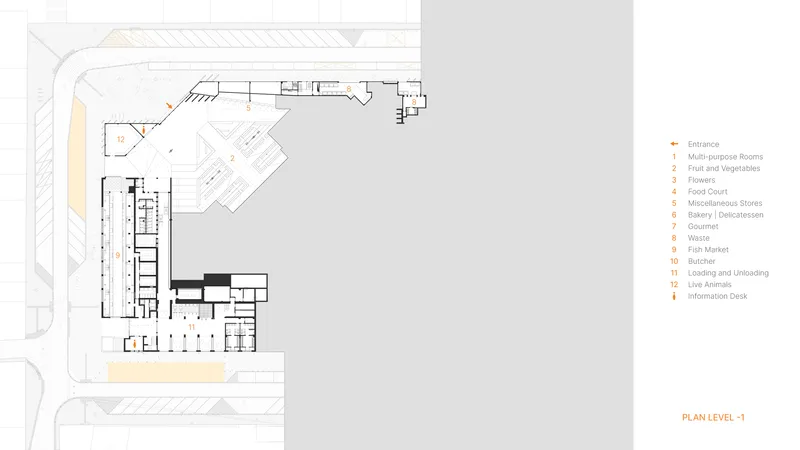
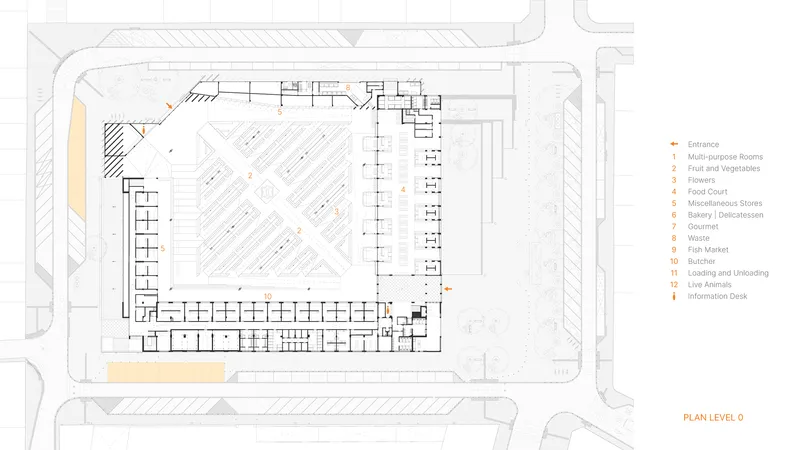
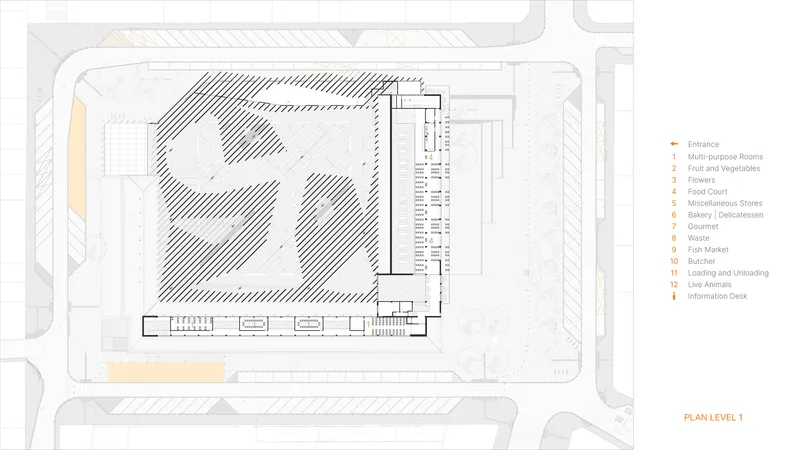
Floor plans at three levels detail the room layouts, diagonal circulation axes, and hatched courtyards that organize the expanded program. The ground floor plan is particularly instructive: the diagonal axes cut across the original orthogonal grid, creating visual corridors that pull visitors from one entrance through to the other.
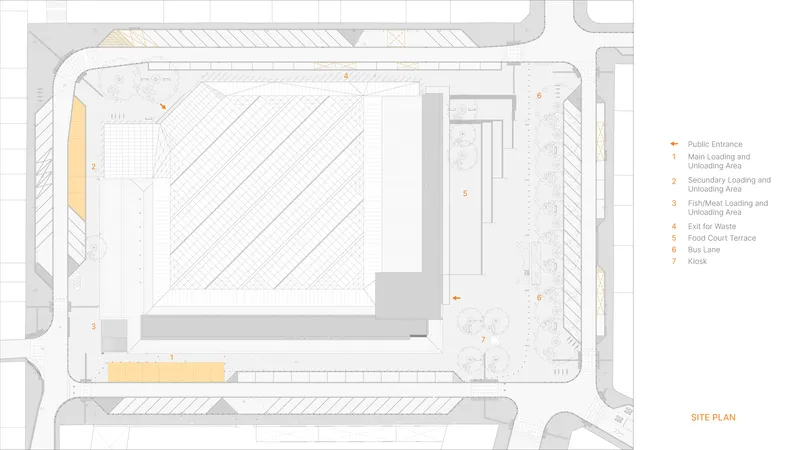
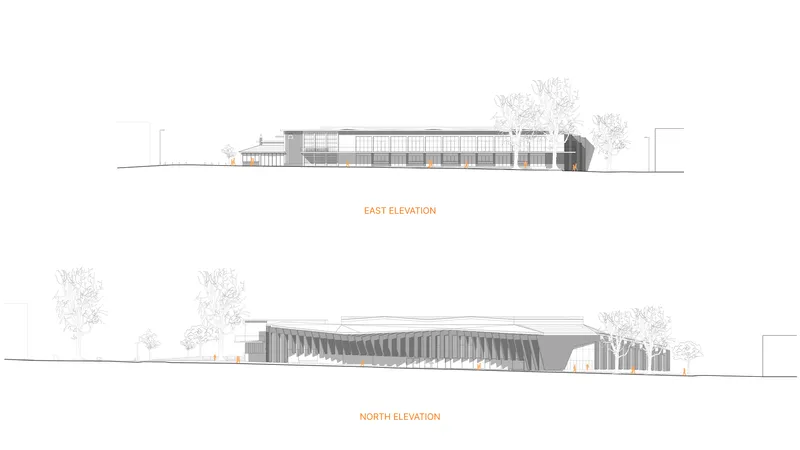
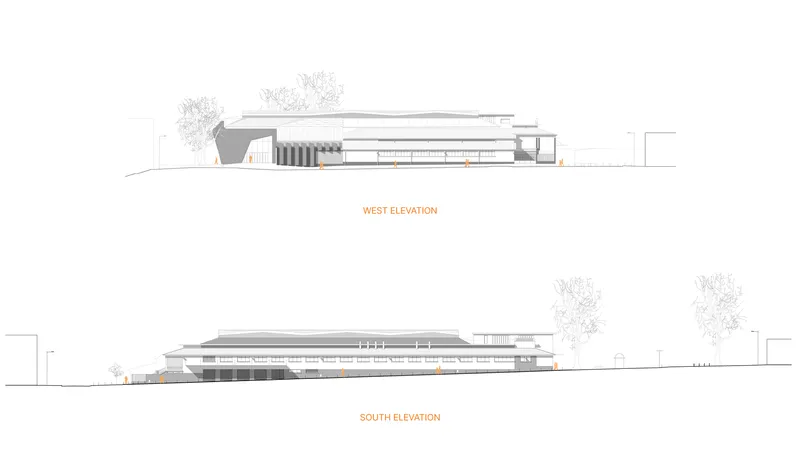
The site plan confirms the building's block-scale footprint and its relationship to adjacent streets and landscape. East, north, west, and south elevations show the low horizontal profile that the layered massing produces, with surrounding trees drawn to scale to emphasize the building's integration into its streetscape.
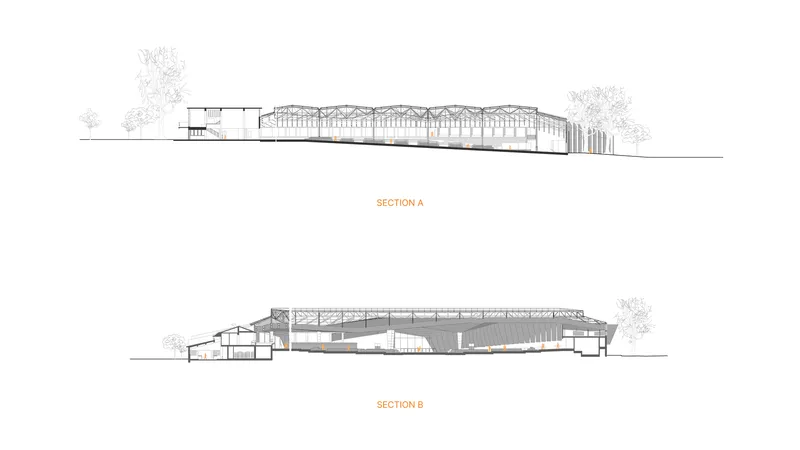
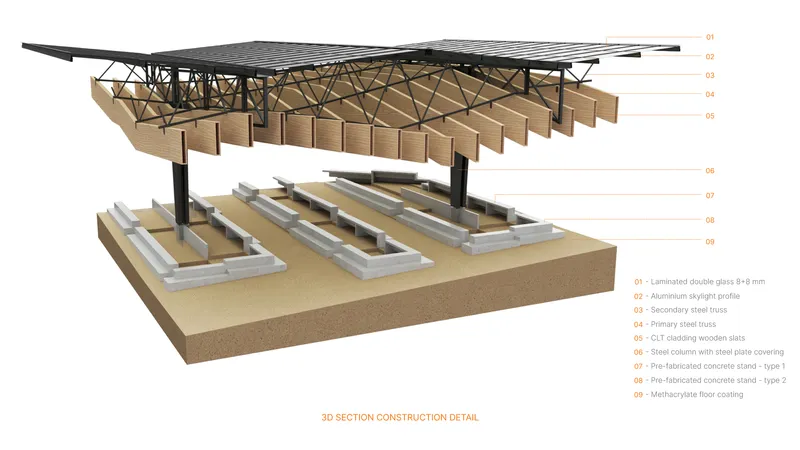
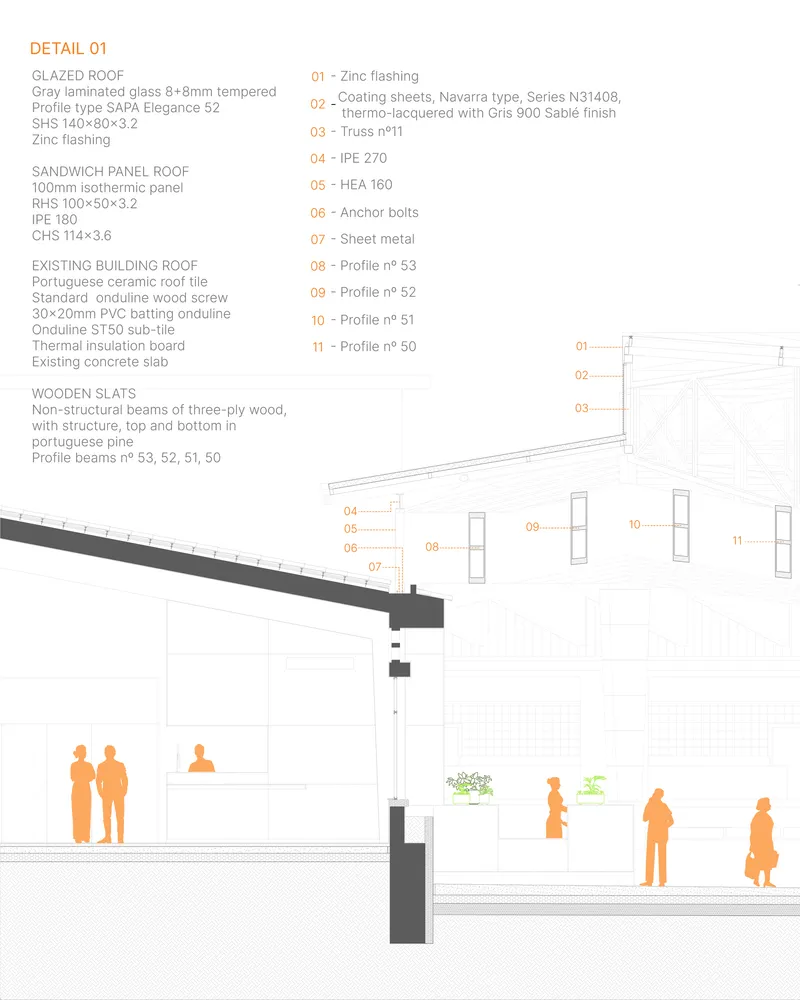
Building sections cut through the arched roof structure to reveal the interior volumes, while exploded construction details show how the steel truss roof, timber slats, and concrete foundation layers stack and interlock. A section through the roof assembly with orange silhouetted figures provides scale for the wooden slat ceiling's depth.
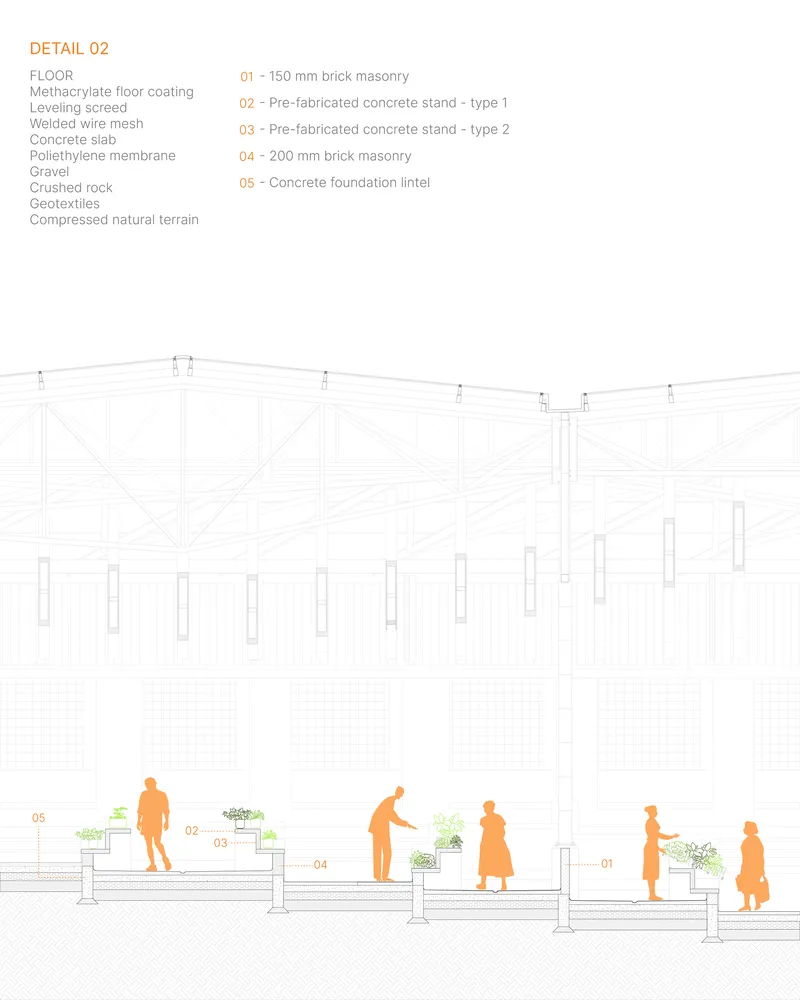
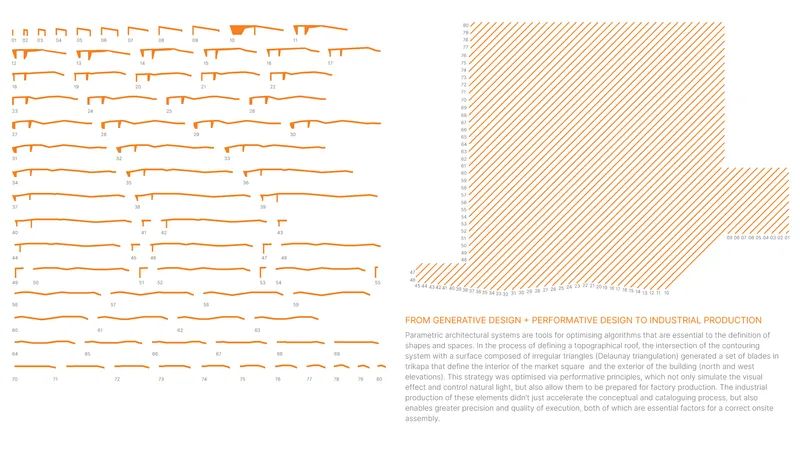
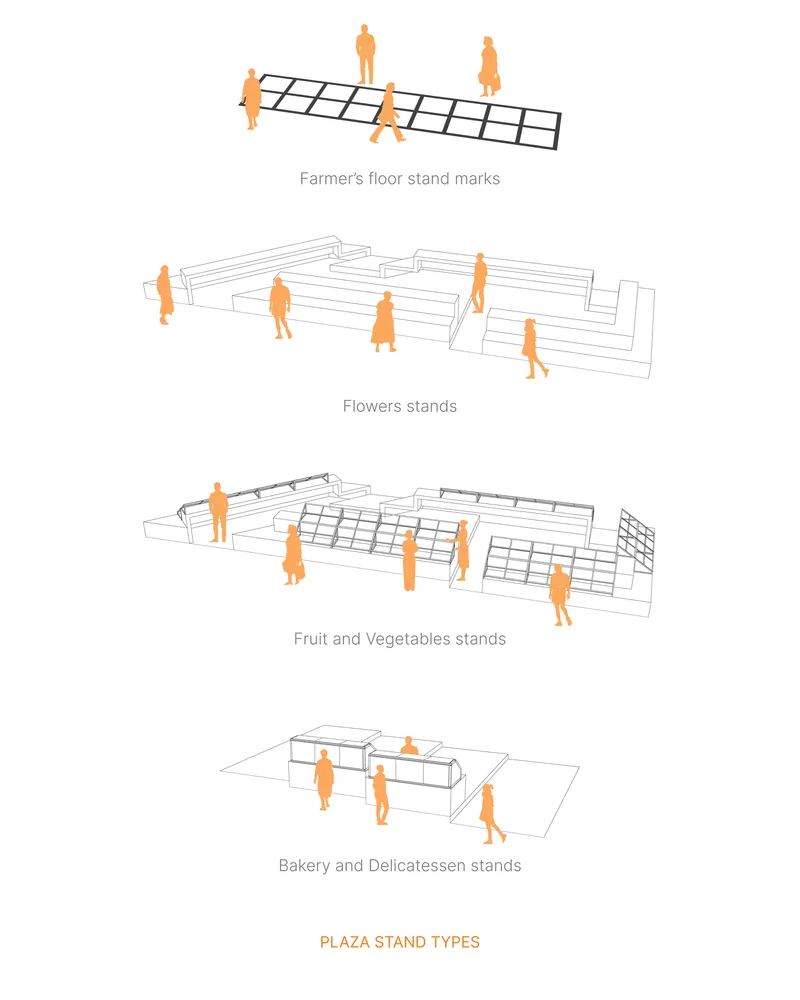
Floor construction layers, planter box integration, and pedestrian plaza sections round out the technical documentation. Parametric variations of wooden slat profiles show the range of geometries tested before the final selection, and an axonometric of four vendor stand types demonstrates how a modular kit of parts accommodates different commercial needs within a unified design language.
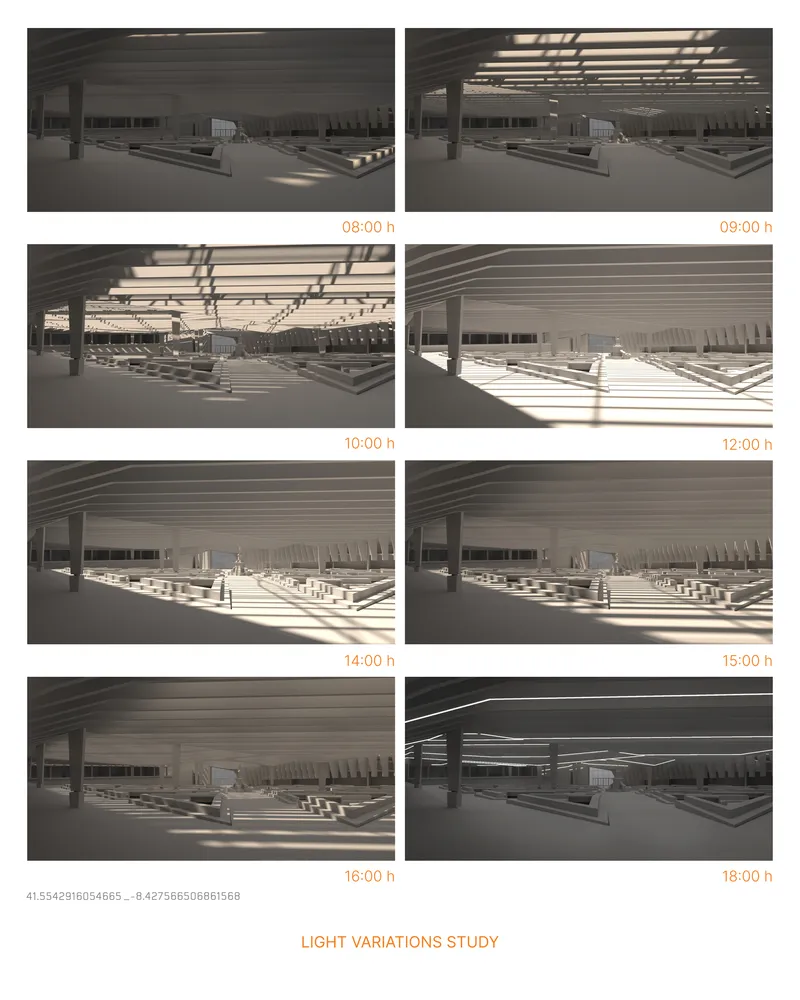
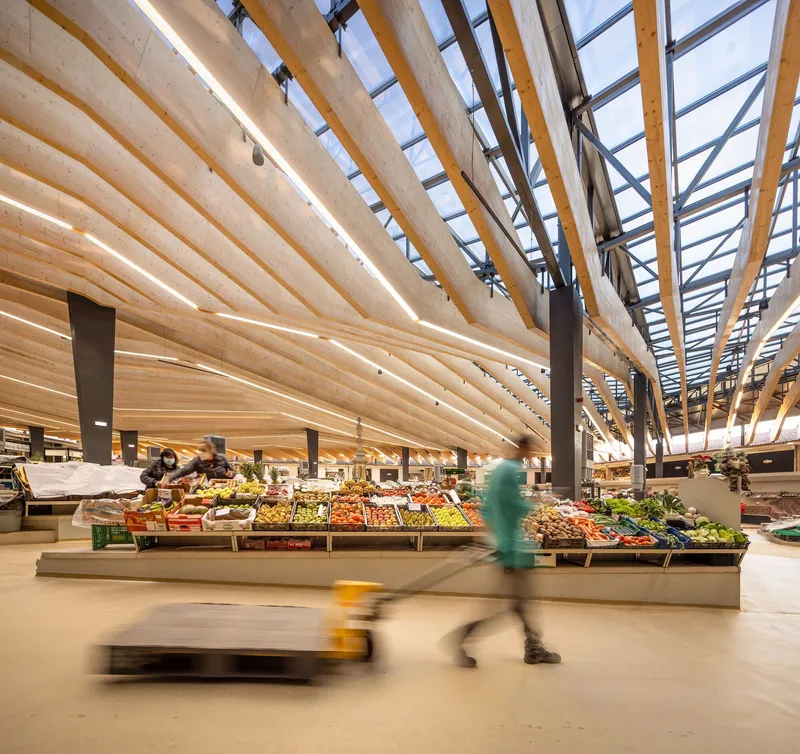
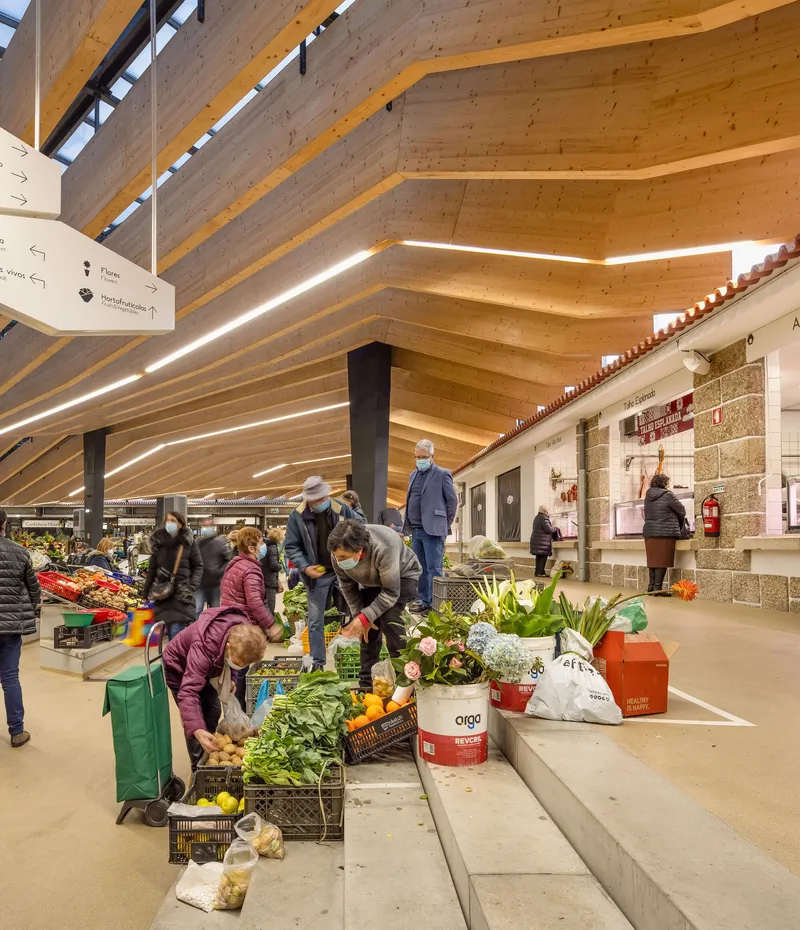
The light study rendering, tracking interior conditions from early morning through evening, confirms that the canopy geometry was tuned not just for structure but for atmosphere. The market floor, animated by shoppers and produce, is the final test of that calibration.
Why This Project Matters
The Braga Municipal Market matters because it demonstrates that parametric design tools are most powerful when deployed in the service of prosaic civic problems: accessibility on a sloped site, weather protection for outdoor vendors, acoustic comfort in a hard-surface hall. APTO did not use algorithms to produce novelty for its own sake. The generative process was subordinated to measurable performance criteria, light, structure, fabrication logic, and the resulting form is compelling precisely because it is legible as the product of those constraints rather than of arbitrary formal invention.
The project also offers a model for heritage intervention in buildings that lack protected status but carry cultural weight. The 1956 market was not a monument, but it was a place with memory. By keeping the vendor stalls open during construction, retaining the perimeter colonnades, and building the new canopy as an additive layer rather than a replacement, APTO ensured that the market's social continuity was never broken. The building proves that you can be radical in technology and conservative in civic responsibility at the same time.
Braga Municipal Market, by APTO Architecture. Braga, Portugal. 9,343 m². Completed 2020. Photography by Fernando Guerra | FG+SG.
About the Studio
Share Your Own Work on uni.xyz
If projects like this are the kind of work you want to make, uni.xyz is a place to publish your own, find collaborators, and enter design competitions.


Popular Articles
Popular articles from the community

Tsunami Convergenics: Turning Catastrophic Ocean Forces into Underwater Housing Infrastructure
A speculative underwater settlement off the coast of Onagawa, Japan, treats tsunamis and typhoons as energy sources rather than threats.
Extended Shell: Retrofitting Kolkata's Balconies as Living Urban Thresholds
A modular retrofit system recovers the social and environmental intelligence of Kolkata's historic verandas for contemporary Park Street residents.

Manzana Morphosis: Stretching Barcelona's Grid into a Living Landscape for 2050
A radical reworking of the Eixample manzana turns density into a tool for generous public space, vertical ecology, and environmental performance.

Opera by the Sea Estonia: Three Shells Dissolving Architecture into Tallinn's Coastline
A winning opera house proposal replaces monumental form with interconnected shells that blur the boundary between building, park and Baltic Sea.

Similar Reads
You might also enjoy these articles

Pixel Gardens: One Repeated Module Stacked Into a Terraced Social Housing Tower for Famagusta
Salem Bader's shortlisted housing tower builds a vertical neighbourhood from one repeated module, offsetting units to carve terraces, light and air.

Bao Huynh Watercolor Atelier: A Serene Art Retreat in Hội An
Bao Huynh Watercolor Atelier in Hội An blends multifunctional art spaces, sustainable design, local materials, and family-friendly living in a serene environment.

Atelier Macri Concept Store Interior Design by CASE-REAL
Atelier Macri store features a "ko" counter, walnut wood details, cork displays, blending retail, gallery, and seamless customer experiences.

Manuel Vargas Izquierdo Stadium and High-Performance Sports Center: Architectural Excellence in Jalpa de Méndez
The Manuel Vargas Izquierdo Stadium blends sustainable design, inclusive sports facilities, and cultural-inspired architecture, revitalizing Jalpa de Méndez’s public spaces.

Explore Open Air Market Competitions
Discover active competitions in this discipline

Challenge to reimagine the Iron Throne

Photograph architecture without architects

Illustrate the lost glory of Angkor Wat - Render Challenge

Design challenge to reuse E-waste
Comments (0)
Please login or sign up to add comments
No comments yet. Be the first to comment!