

Atelier MA Builds a Twisting Timber Pavilion at the Edge of a French Forest Pond
Split chestnut shingles and triangulated larch frames welcome visitors to the Mormal forest in northern France's Avesnois region.


There is something genuinely rare about a building that knows it is secondary to the landscape. Atelier MA's Forest Refuge, a 180 m² covered hall at the edge of the Pâture d'Haisne pond in Locquignol, exists to frame what is already there: a medieval forest, a body of still water, and a rolling pasture that would otherwise stay hidden behind the hilly terrain of the Avesnois region. The pavilion does not compete. It bends, rises, and opens in the direction the ground already tells you to look.
What makes the project worth studying is the way it treats timber not as a neutral structural commodity but as a system of regional signals. Rough-sawn larch posts, spruce glulam frames, Landes pine decking, and split chestnut shingles fastened with brass nails: every material choice belongs to the forestry culture the building is meant to celebrate. The structure earned a Fibois Hauts-de-France trophy and was a finalist for the Prix National de la Construction Bois 2022, and both recognitions feel deserved. The building performs the argument it makes.
A Single Gesture That Rises, Twists, and Embraces

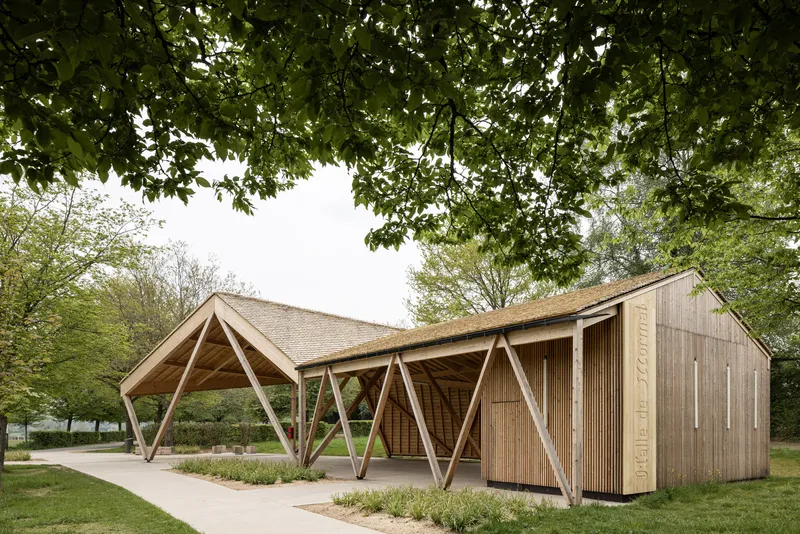
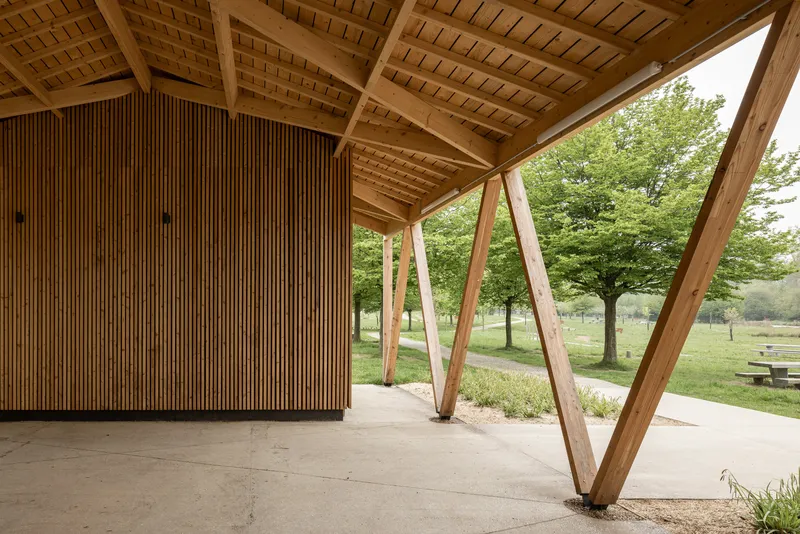
The pavilion reads as a single covered hall, but the roof geometry is anything but simple. Triangulated larch glulam gantries deform progressively along the length of the structure, producing a form that rises and twists as it moves from the car park toward the pond. The effect is less sculptural than it is navigational: the structural rhythm guides you physically from arrival to landscape, and the increasing openness of the frames rewards the walk with an expanding view.
This is not a freestanding object dropped onto a site. The hall follows the natural curve of the existing path that crosses the pasture, aligning its axis with the pedestrian circulation already worn into the ground. Screw pile foundations (the Technopieux system) keep the environmental footprint minimal, and the posts are elevated from the slab by strapping details so that the structure sits lightly, almost hovering above its footing.
Lattice and Slat: Two Kinds of Enclosure
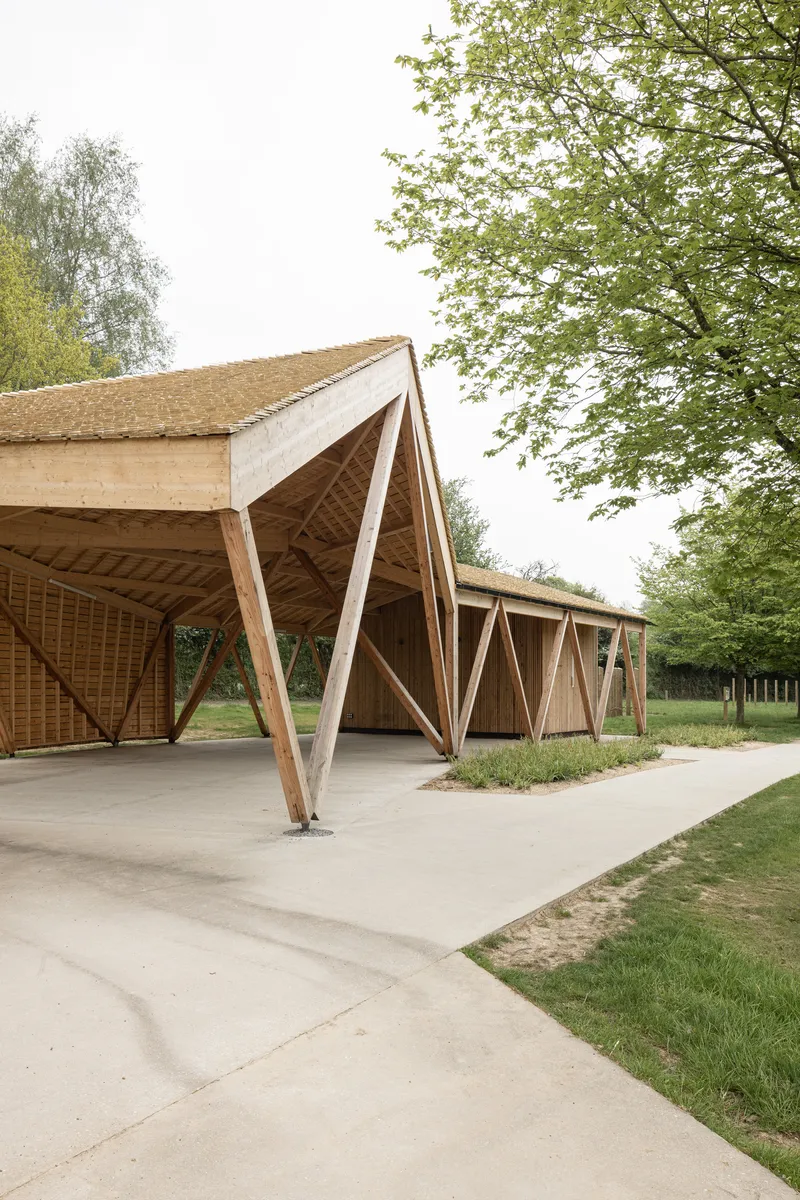
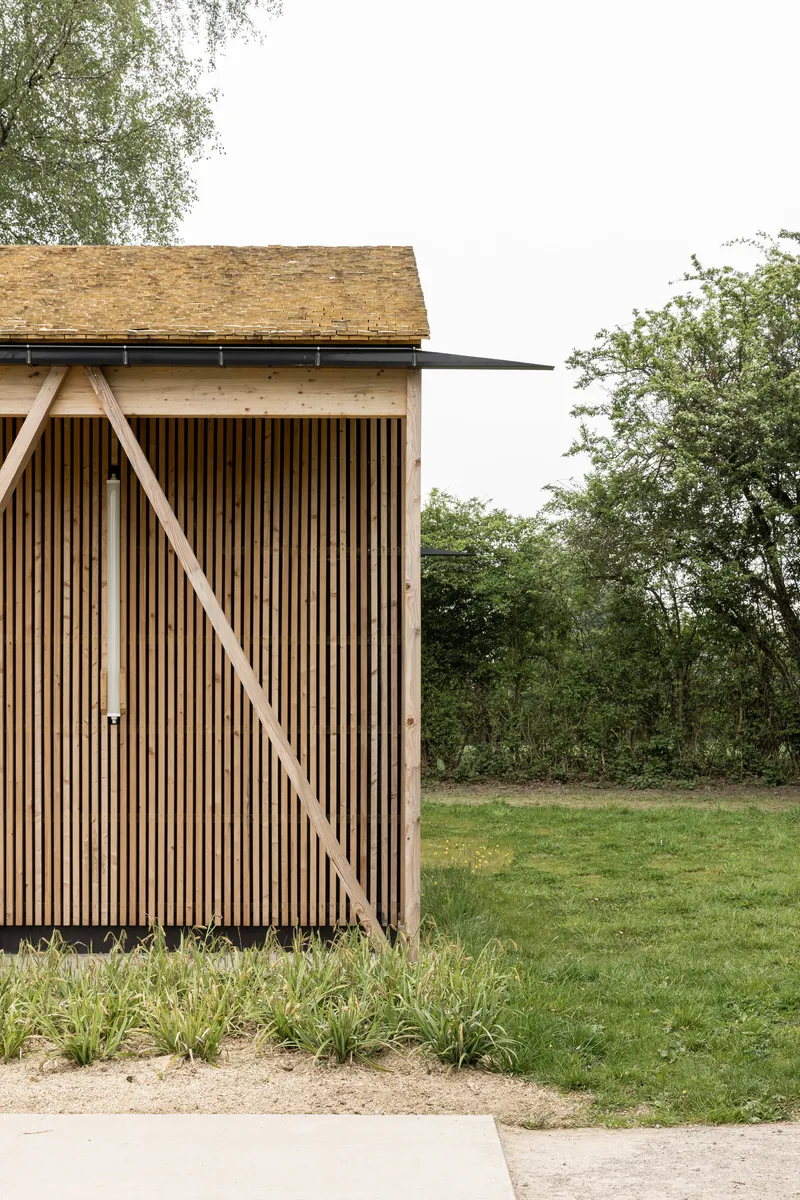
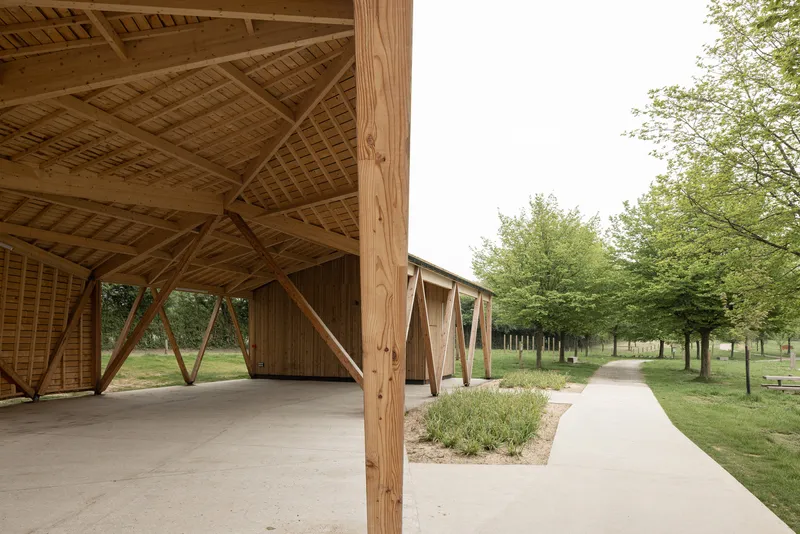
The facade oscillates between two cladding strategies. Woven lattice screens filter light and air while maintaining a sense of enclosure, and vertical larch slats provide a denser barrier where privacy or weather protection is needed. Neither treatment is opaque. Both allow the forest to remain legible behind the wall, preserving the pavilion's role as a threshold rather than a boundary.
The diagonal timber braces that stabilize the triangular frames become visible elements of the facade composition, so there is no false distinction between structure and skin. What holds the building up also defines what it looks like. The laminated larch GL 24 h members are left untreated, and over time they will weather to a gray and pink patina that blends into the forest edge.
The Chestnut Shingle Roof
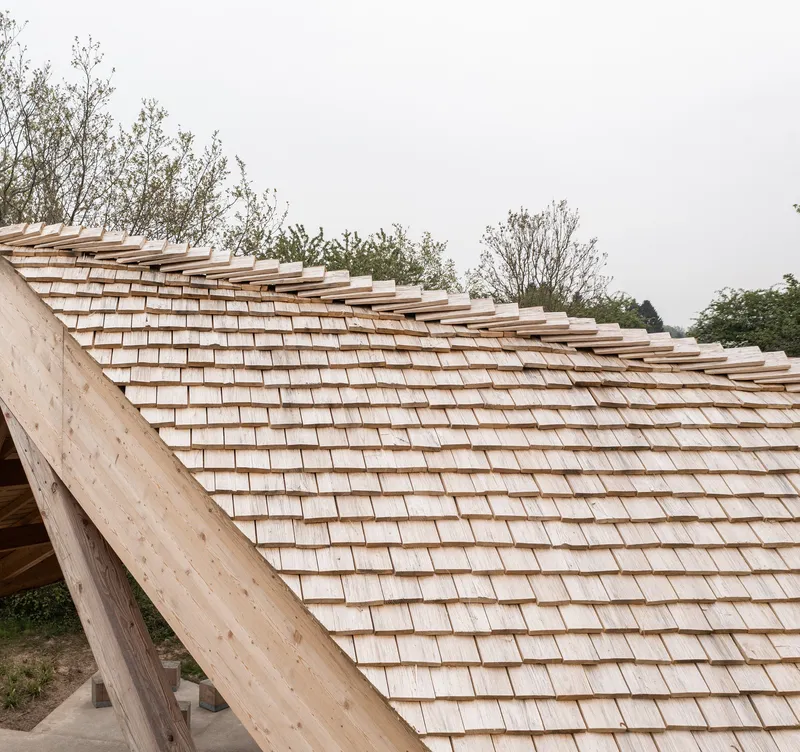

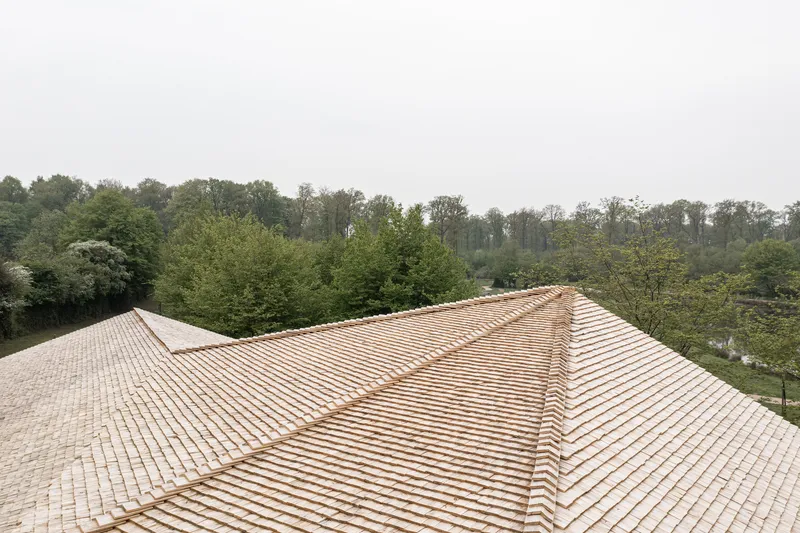
Split chestnut shingles, or tavaillons, are a traditional roofing material in French timber construction, and Atelier MA uses them here with precision. Each shingle is laid at a one-third overlap and fastened with brass nails, a detail that resists corrosion and allows the roof to breathe. The shingle surface continues from the roof plane down the wall, creating a continuous skin that wraps the angular volume and blurs the edge between shelter and cladding.
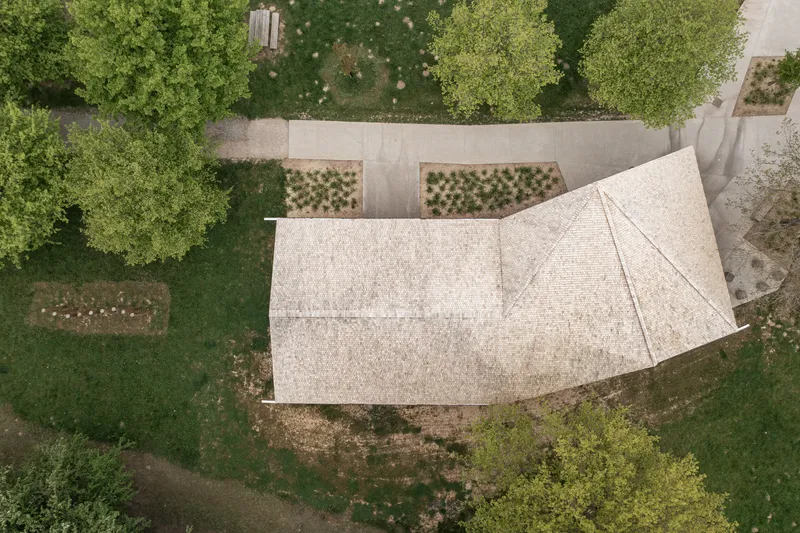
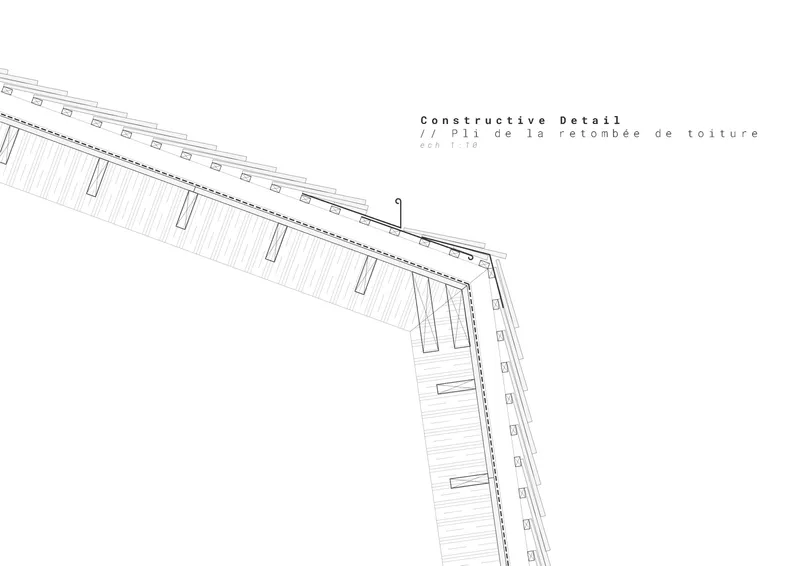
From above, the roof reveals its geometric logic: two angled planes meeting at a diagonal fold line, braced by the triangulated frame below. The primary spruce framework is protected from wetting by adapted banks, a quiet but critical detail that extends the life of the structure without requiring synthetic membranes or heavy maintenance cycles.
Inside the Frame
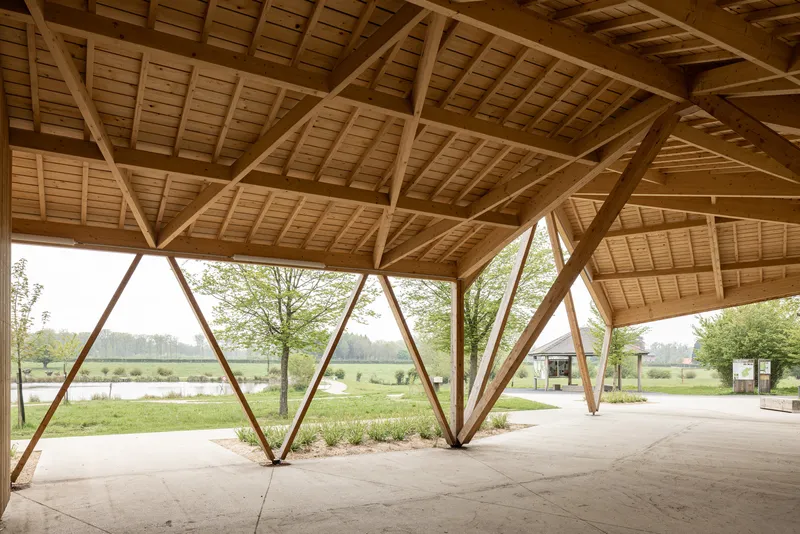
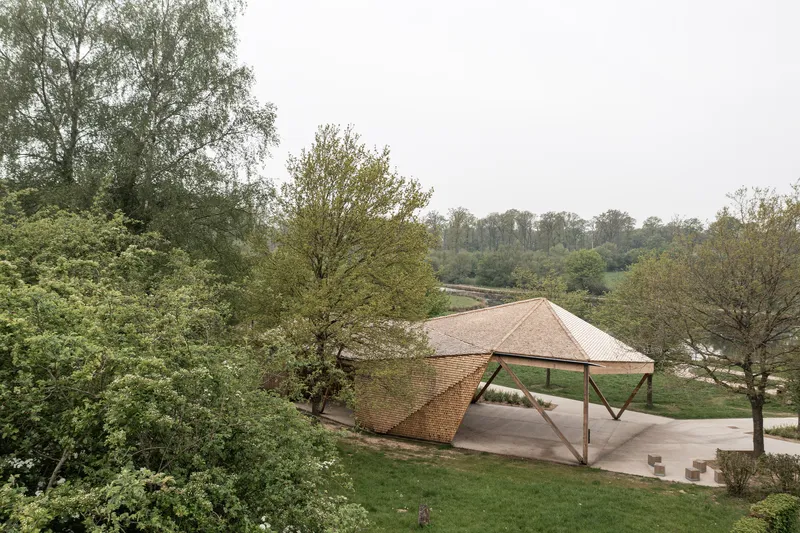
Standing inside the pavilion, the Landes pine planking overhead creates a characterized aesthetic ceiling. The orientation of the boards makes the roof structure legible from below, so the interior experience is one of honest construction rather than finished surface. Diagonal columns frame specific views of the landscape, and as you move through the hall the framed panorama shifts. The building orchestrates a sequence of seeing.
The aerial perspective confirms the pavilion's relationship with the broader site: planted beds and pathways radiate around the structure, and the pond sits just beyond the tree line. The pasture serves horse riders, walkers, and school groups, and the pavilion anchors those activities without formalizing them. It is a point of departure, not a destination.
Pond and Reflection
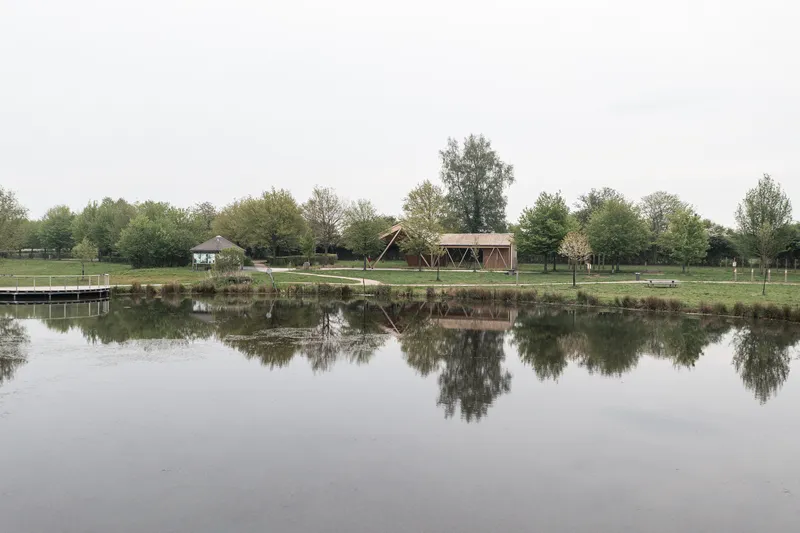
The most compelling photograph of the project may be the one in which the pavilion is reflected in the still surface of the Pâture d'Haisne pond. The image doubles the building's angular silhouette and sets it against the quiet horizontal of the water, revealing how deliberately the structure was positioned. Atelier MA understood that the building would be seen from the far bank as well as from beneath its own roof, and the form works at both scales: intimate canopy and distant landmark.
Plans and Drawings
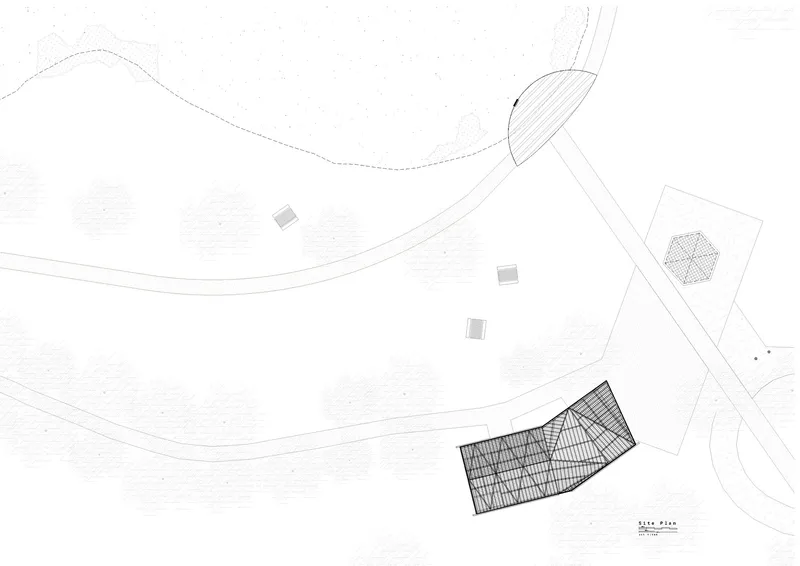
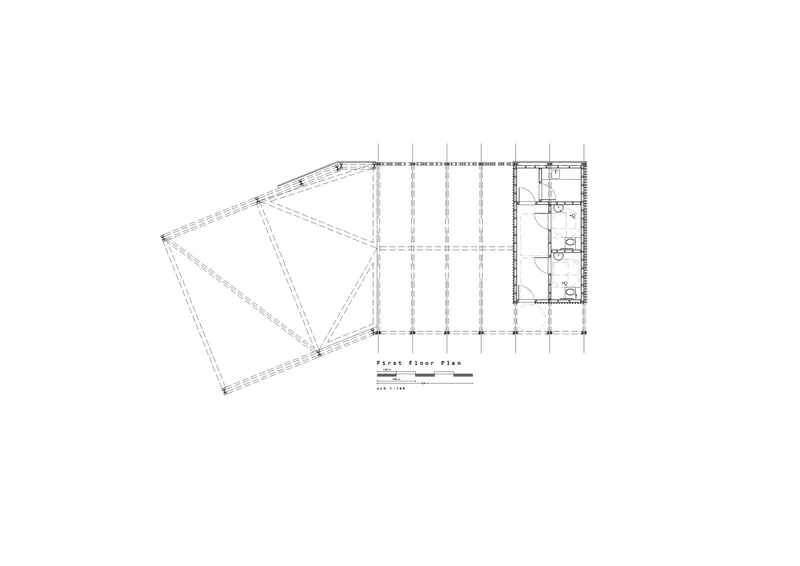

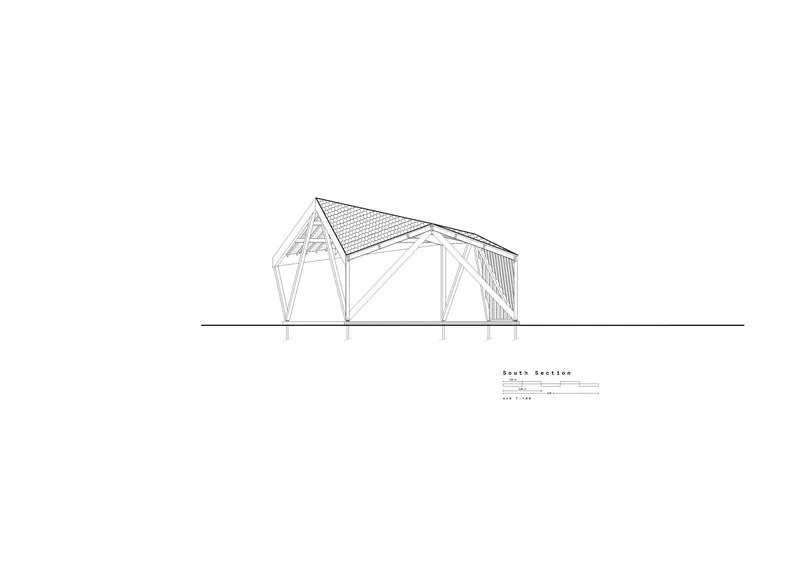


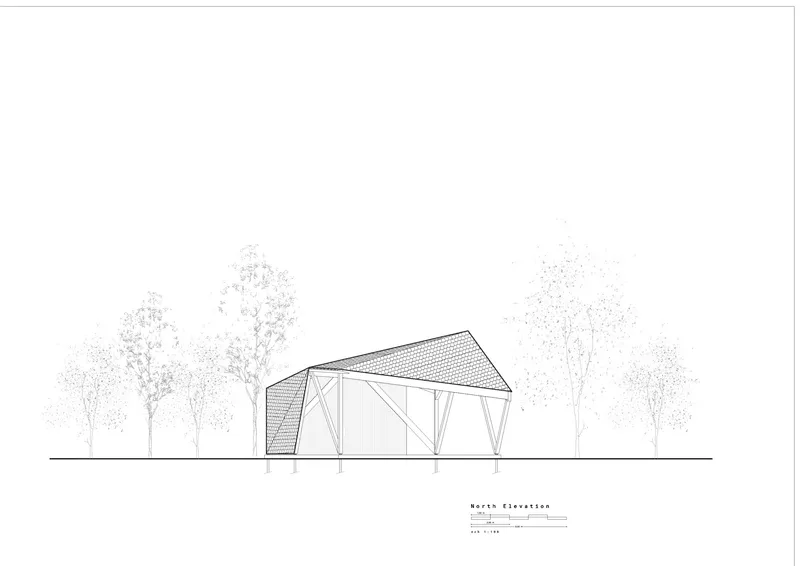
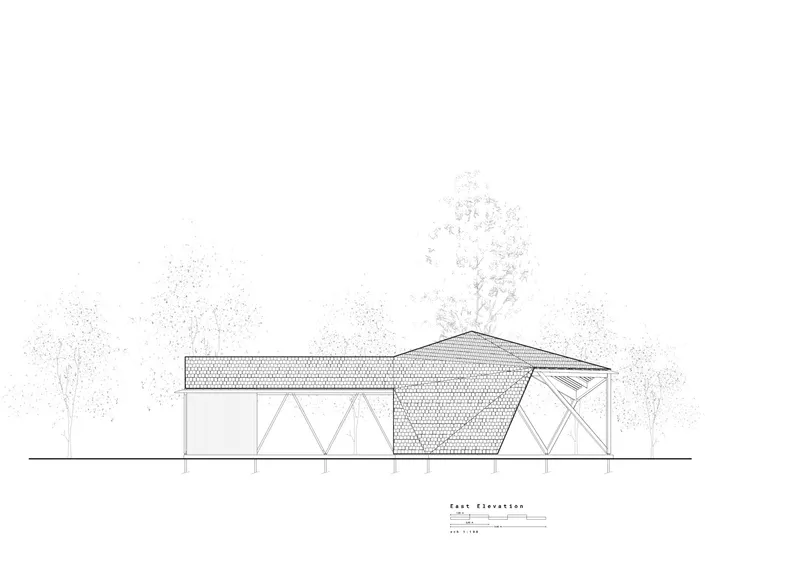
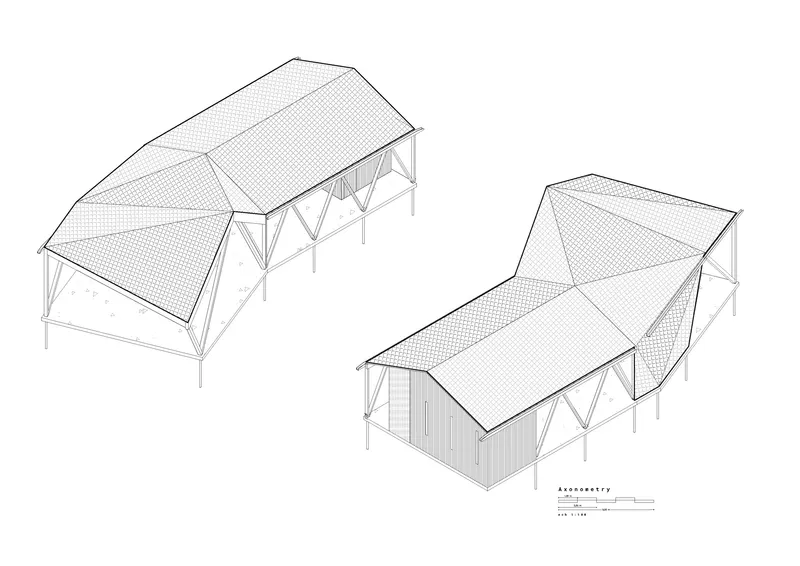
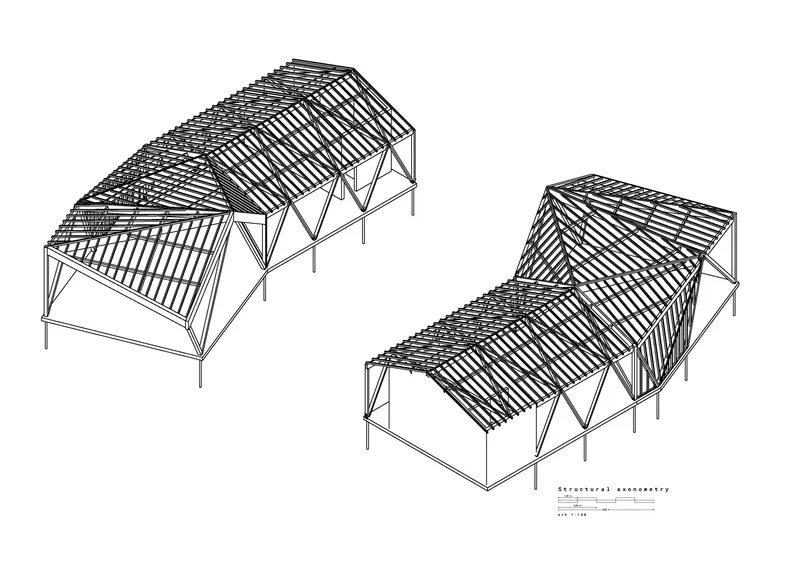
The drawings lay bare the structural logic that the photographs only hint at. The site plan shows the pavilion aligned with the curved path crossing the pasture, while the floor plan reveals the triangulated supports and a compact service block tucked within the open hall. Sections expose the progressive deformation of the triangular gantries, and the axonometric views isolate the roof framing from the cross-braced column system below, making it clear that the structure is an assembly of discrete timber elements joined by wood-metal connections.
The constructive detail drawing of the ridge assembly is particularly instructive. It shows the layered composition of structural member, planking, and shingle cladding, and it demonstrates how the roof's angular fold is achieved without complex joinery. The simplicity of the connection details is what makes the expressive form buildable, and it is the kind of drawing that other timber designers should spend time with.
Why This Project Matters
Forest Refuge is a useful corrective to the tendency in contemporary timber architecture toward spectacle. The building does not announce itself with a soaring cantilever or a computationally derived shell. Its drama is structural and sequential: triangulated frames that deform along a path, a roof that folds once, and a material palette sourced almost entirely from the regional timber economy. The result is a pavilion that could only exist in this particular forest, built from trees that might have grown nearby.
It also demonstrates that public infrastructure in rural settings does not need to be either invisible or monumental. Atelier MA found a middle register: a building that is clearly authored and carefully detailed, but that ultimately defers to the pond, the pasture, and the canopy beyond. For a 180 m² welcome pavilion, that restraint communicates more confidence than any formal excess could.
Forest Refuge by Atelier MA, Locquignol, France. 180 m², completed 2021. Photography by Nicolas Da Silva Lucas.
About the Studio
Share Your Own Work on uni.xyz
If projects like this are the kind of work you want to make, uni.xyz is a place to publish your own, find collaborators, and enter design competitions.


Popular Articles
Popular articles from the community


ETEH Reworks the Shared Spaces of São Domingos School in Brazil Around Timber, Color and Hanging Plants
At São Domingos School in Brazil, 436 m² of hall, refectory and library are recast with timber joinery, a yellow and blue code and trailing greenery.


Singing Woman: An Opera House That Performs Before the Curtain Rises
Ovidiu Cristian Pavel's conceptual opera house translates Estonia's choral identity into a sculpted waterfront landmark facing the Baltic Sea.

Aquadapt: An Underwater Habitat That Rewrites Its Rooms by the Hour
Curved modules ring the seabed while one shell shifts from breakfast room to cinema, farm and football pitch as residents' needs change.

David Ortega Stacks a Two-Story Mexico City Penthouse Around a Steel Stair and a Pergola-Shaded Roof Terrace
In Colonia Roma, a 300 m² penthouse uses oak joinery, a planted steel stair and a slatted roof pergola to make a new-build apartment feel like a house.

Similar Reads
You might also enjoy these articles

LAVA Architecten Gives Vocational Education a Sawtooth-Roofed Face on a Mechelen School Campus
In Mechelen, Belgium, a 2,053 m² STEM school on a 6×6 m grid turns workshops and classrooms into rooms that can be rearranged as teaching changes.

KEMA Studio Turns a Derelict Marvila Attic into a 60 m² Lighthouse Apartment Above Lisbon
In Lisbon's Marvila district, a rebuilt roof, four skylights and two plywood volumes turn an unlivable attic into a bright home facing the Tagus.

Pixel Gardens: One Repeated Module Stacked Into a Terraced Social Housing Tower for Famagusta
Salem Bader's shortlisted housing tower builds a vertical neighbourhood from one repeated module, offsetting units to carve terraces, light and air.

Bao Huynh Watercolor Atelier: A Serene Art Retreat in Hội An
Bao Huynh Watercolor Atelier in Hội An blends multifunctional art spaces, sustainable design, local materials, and family-friendly living in a serene environment.

Explore Natural Forest Competitions
Discover active competitions in this discipline

Challenge to design a portable theatre

Challenge to design a portable music platform

Challenge to design an open learning module for the elderly
Comments (0)
Please login or sign up to add comments
No comments yet. Be the first to comment!