
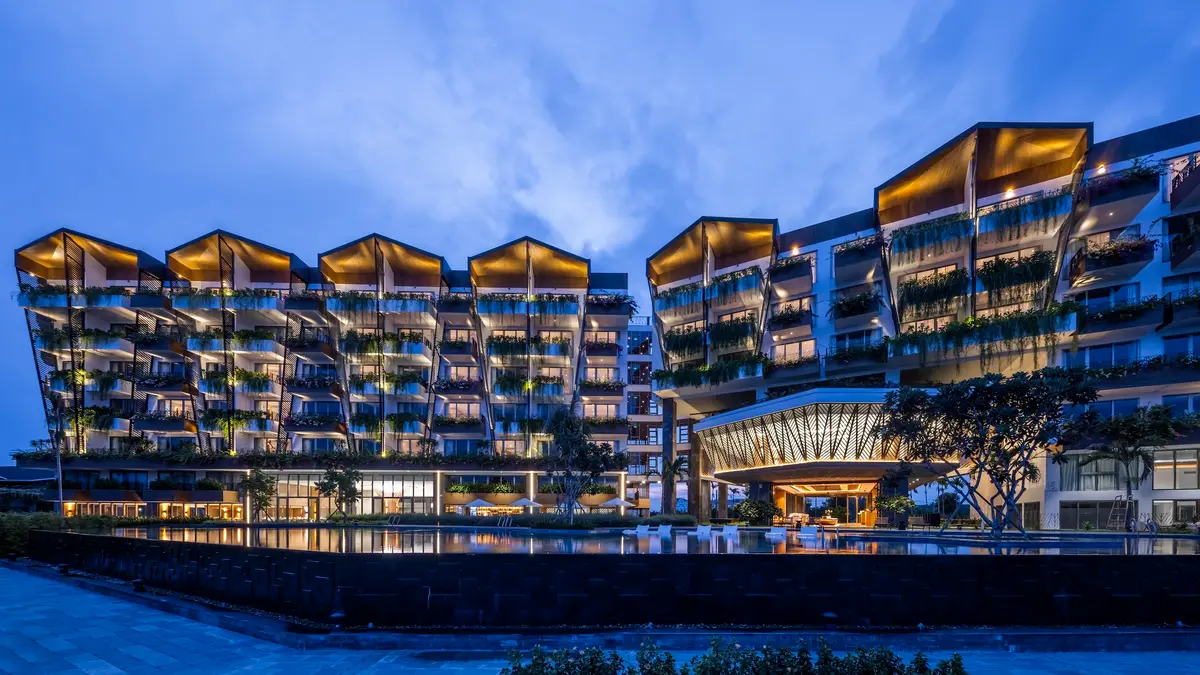
AVA Architects Shapes a Hoi An Resort Around Inverted Fishing Boats and Cast Nets
Bellerive Resort layers unfired brick, woven ceilings, and cascading greenery along the De Vong River in central Vietnam.


Resort architecture in Southeast Asia tends to swing between two poles: the international luxury template, blank and beige, or the heritage pastiche that borrows local motifs without earning them. AVA Architects, led by Nguyen Le Huy Vu, charts a more interesting course at Bellerive Resort in Hoi An. The 8,718 m² complex sits on a four-sided site bordered by roads, with the De Vong River to the east, and it turns those constraints into a clear organizational logic: a six-storey hotel block along the main road, a row of private villas to the south, and a central infinity pool that draws the eye toward the water.
What makes Bellerive worth studying is the way it translates specific fishing-village imagery into architectural form without becoming illustrative. The hotel's curved roofline reads as an inverted hull. The lounge bar ceiling is a woven diamond lattice recalling the cast nets of Quang fishermen. Unfired brick walls and local stone tie the project to Hoi An's ancient town materiality. None of these references demand explanation at the door; they register through proportion, texture, and the quality of light they admit. The result is a resort that feels rooted in its geography rather than dropped onto it.
A Facade That Grows


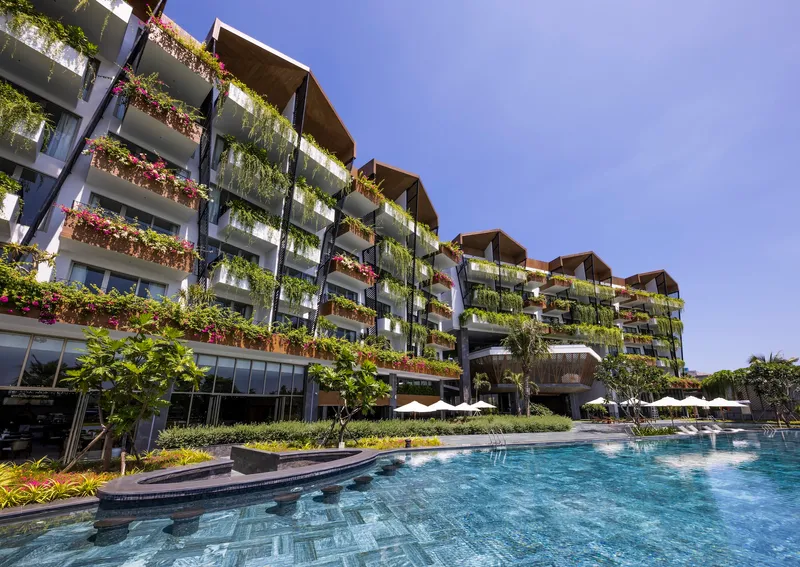
Bellerive's most immediate gesture is its planted facade. Every balcony is a planter, and the trailing greenery cascading down the hotel block softens what could be a relentless six-storey mass. Viewed across the pool, the building reads less like a wall and more like a terraced hillside. The staggered balconies break the elevation into a rhythm of shadow, foliage, and louvered timber, giving each room a degree of privacy without resorting to solid partitions.
The planting strategy is not cosmetic. In Hoi An's tropical heat and humidity, the vegetation acts as a biological screen, filtering direct sun and cooling air before it reaches interior spaces. Combined with louvered screens that allow cross-ventilation, the facade becomes an active climate device. It also ages well: as the plants mature, the building will look increasingly embedded in its site rather than freshly built.
Arrival and the Woven Canopy
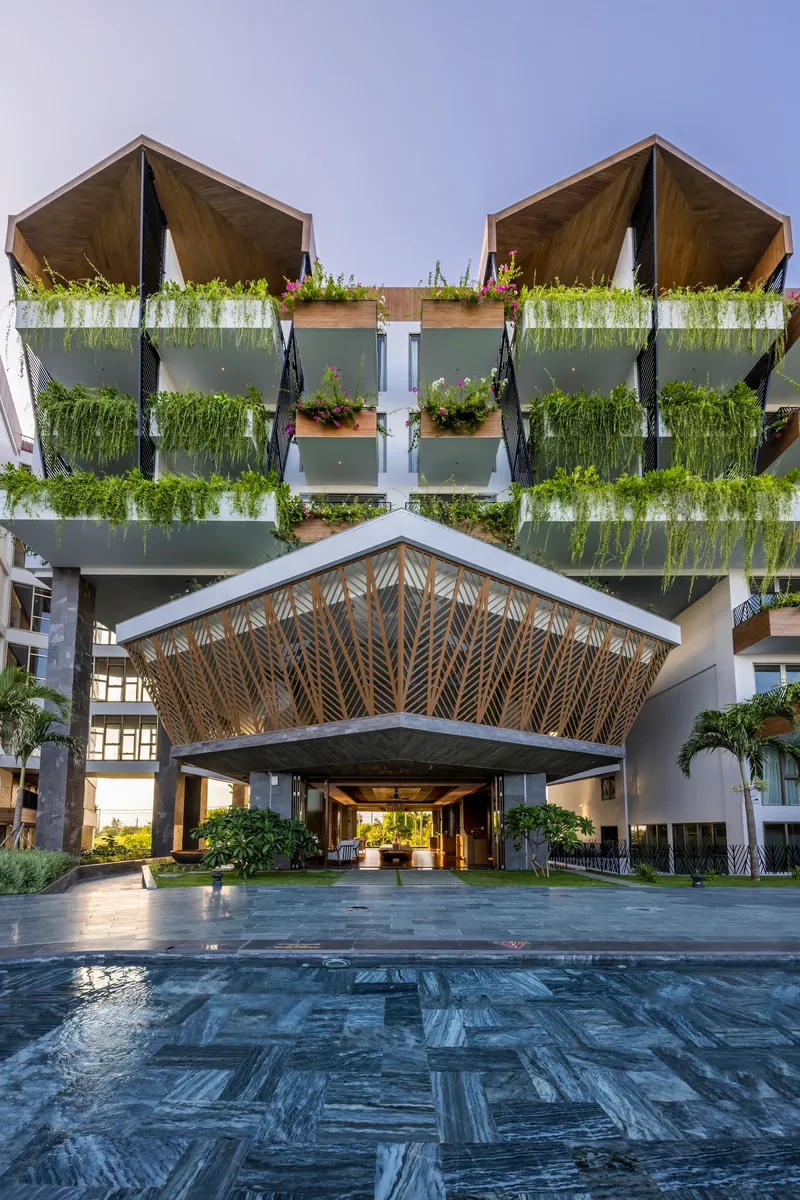

The entrance sequence sets up the resort's material argument. A cantilevered porte-cochère extends over dark paving and a shallow reflecting pool, its underside finished with a woven bamboo ceiling pattern that casts intricate shadows at dusk. Backlit chevron-patterned metal screens create a lantern effect at blue hour, marking the arrival point from the road without relying on signage or spectacle.
This is where the fishing-net motif first appears. The ceiling weave is not a decorative appliqué; it is a structural pattern that distributes light and establishes a spatial datum carried deeper into the building. You move from bright tropical daylight into filtered, textile-like illumination, and the transition slows you down. That deceleration is the entry's real achievement.
The Net-Cast Lounge
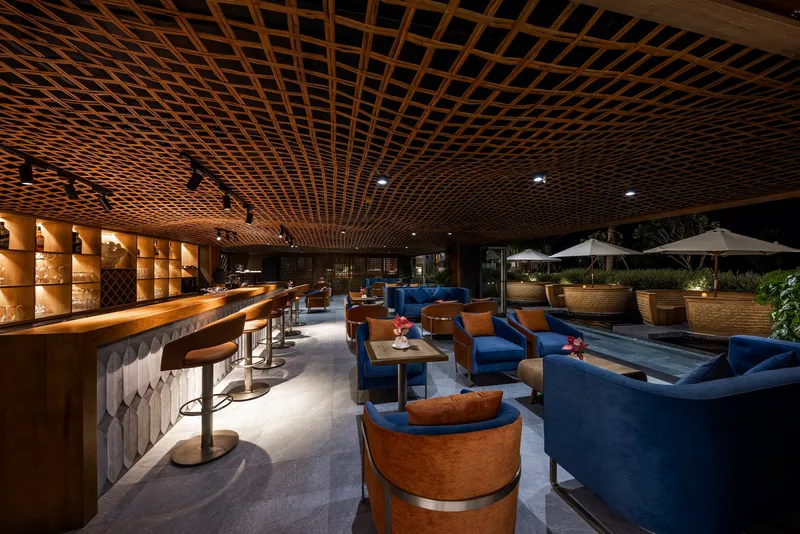


The lounge bar is the project's most confident interior. A diamond-pattern timber lattice stretches across the ceiling, referencing the cross-knit nets that Quang fishermen throw in a single arcing gesture. At night, warm light seeps through the lattice and spills onto the outdoor terrace, turning the space into a glowing volume visible from the pool deck. The pattern is consistent but not monotonous; its geometry shifts slightly as you move beneath it, creating a moiré effect that rewards lingering.
A branching timber column in the restaurant area supports a circular ceiling recess punched with skylights, bringing daylight into the dining floor in a controlled disk. The column's form is deliberately organic, an echo of the mangrove roots along the De Vong, and it doubles as a wayfinding landmark within the open plan.
Poolside and Ground Plane
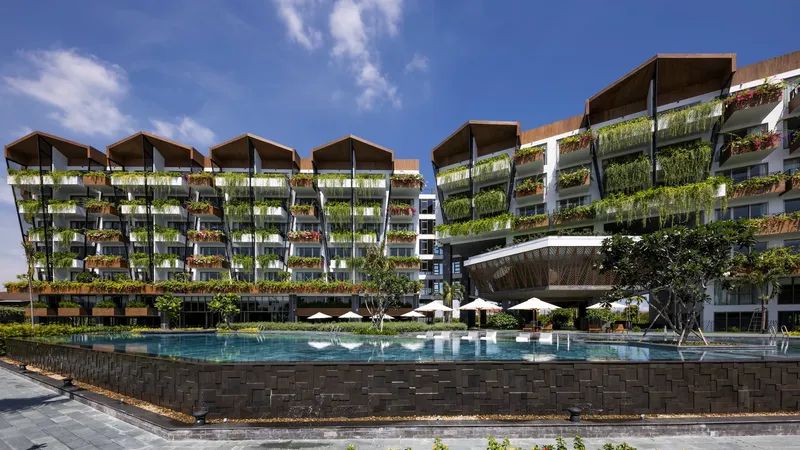


The infinity pool occupies the center of the site and is oriented to frame views of the De Vong River. Dark stone edging and a circular fountain in a reflecting pool bring mass and weight to what is otherwise a plane of water and sky. The pool deck is intentionally restrained: white umbrellas, lounge chairs, young palms. The planted facade of the hotel block rises behind, acting as a green backdrop rather than a competing visual element.
At ground level, the landscape strategy integrates pockets of garden between programmatic zones. A zen garden beneath a cantilevered volume uses stepping stones on raked gravel and timber lattice screens to create a compressed, meditative space within earshot of the pool. These interstitial gardens are not leftover spaces; they are part of the ventilation strategy, channeling breezes between buildings and maintaining permeable ground.
Guest Rooms and Material Warmth

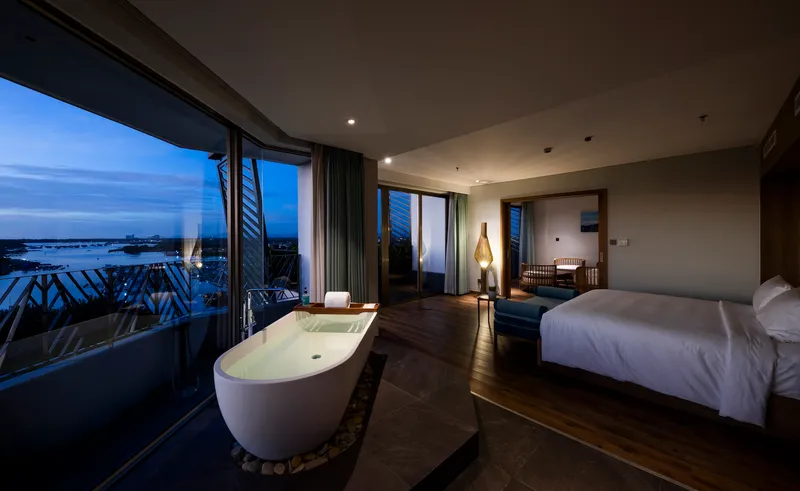
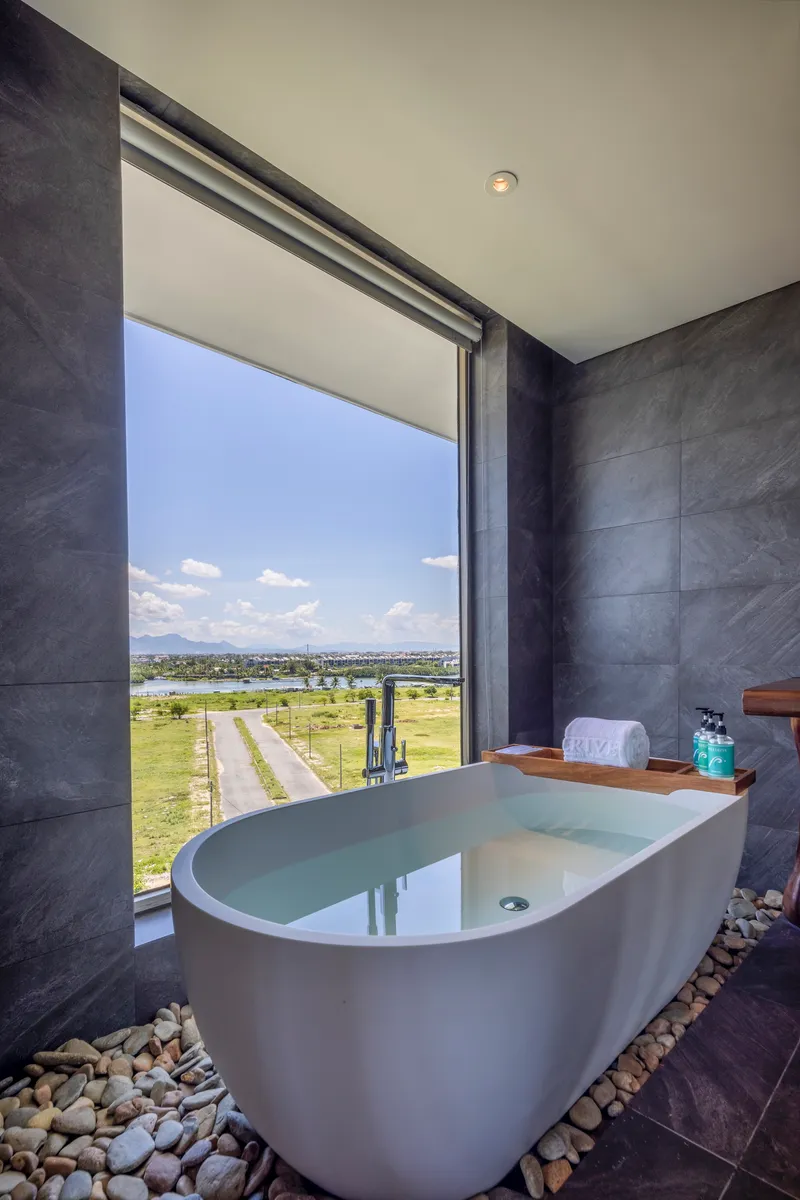
The hotel rooms default to a warm palette of beige timber, white surfaces, and floor-to-ceiling glazing that opens onto the planted balconies. Mountain views, river views, and garden views are distributed across the 178 rooms depending on orientation. The rooms are not remarkable for their furniture or finishes, which follow a competent contemporary idiom, but for the quality of the threshold between inside and outside. Each balcony is deep enough to sit in, planted enough to feel enclosed, and open enough to catch a breeze.
In the suites, freestanding bathtubs sit on beds of river stones against dark tile or volcanic stone walls, with full-height windows framing distant fields or water at dusk. The material contrast, smooth porcelain against rough stone, registers as tactile rather than merely visual. It is the kind of detail that works because it is specific to this climate and this landscape, not imported from a mood board.
The Villa Compound


To the south, five villas with curved roofs are arranged in a row, each paired with its own private pool. The curved roof profile picks up the inverted-hull motif from the hotel block and scales it down to a domestic register. Seen from above, the villas read as a small fleet pulled onto shore, their forms oriented to catch prevailing winds. Each villa contains two to three bedrooms, and the private pools are set within walled gardens that filter views and noise.
Between the villas and the hotel block, cantilevered upper floors with herringbone timber screens hover above lawns and palm trees. The screens serve both as sun shading and as a visual transition between the dense hotel mass and the low villa forms. The herringbone pattern appears again in the ballroom's chevron screens, creating a visual thread that ties the public and private zones together.
Waterfront Presence


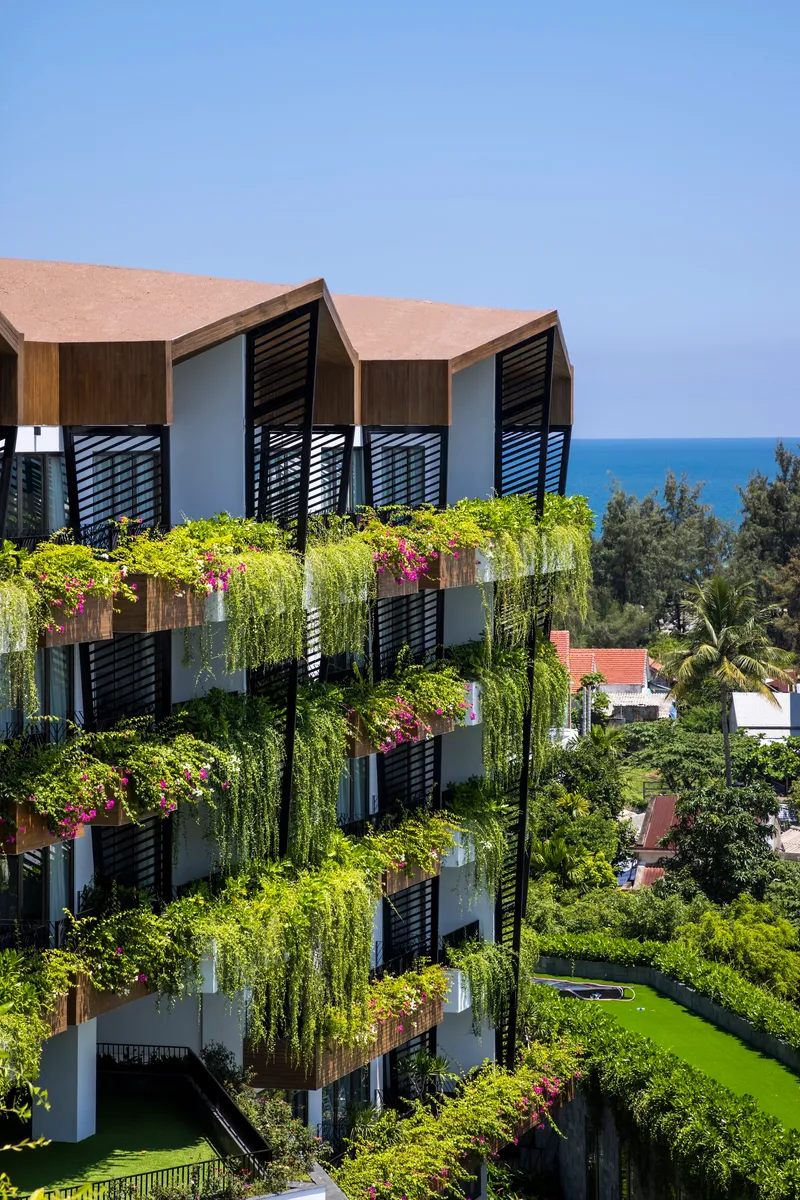
From the De Vong River side, Bellerive presents its most composed elevation. Stacked balconies, cantilevered pavilions, and the illuminated chevron screen canopy layer into a single image that is legible at a distance and textured up close. At dusk, the building becomes a lantern along the riverbank, its warm light reflected in the pool. The zigzag balconies on the corner elevation, with timber cladding and planted boxes, introduce an angular geometry that breaks the orthogonal grid and creates oblique views toward the ocean.
The waterfront facade is where the project's ambition is most visible. It must address the river, the road, and the sky simultaneously, and it does so by layering materials and geometries rather than choosing a single dominant gesture. Unfired brick, timber, glass, and planting each occupy a distinct band of the elevation, and their overlap produces depth.
Plans and Drawings
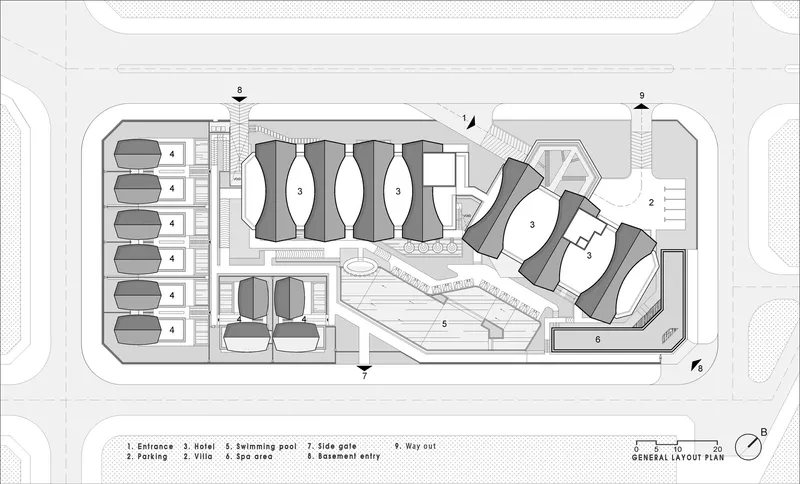

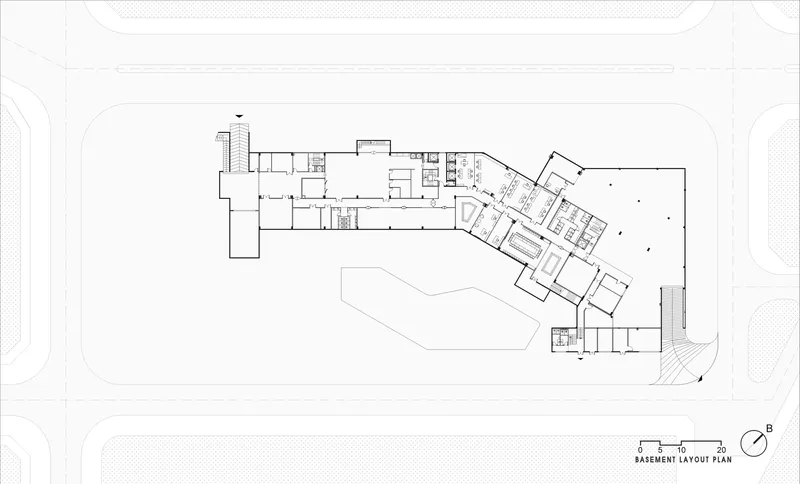
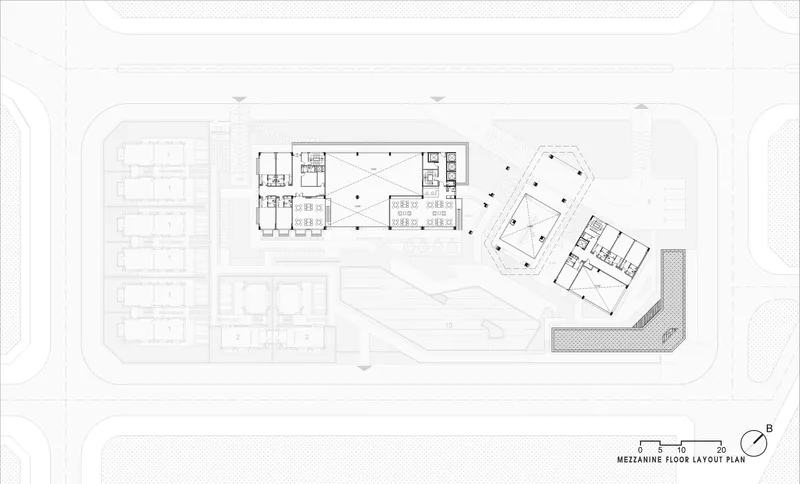
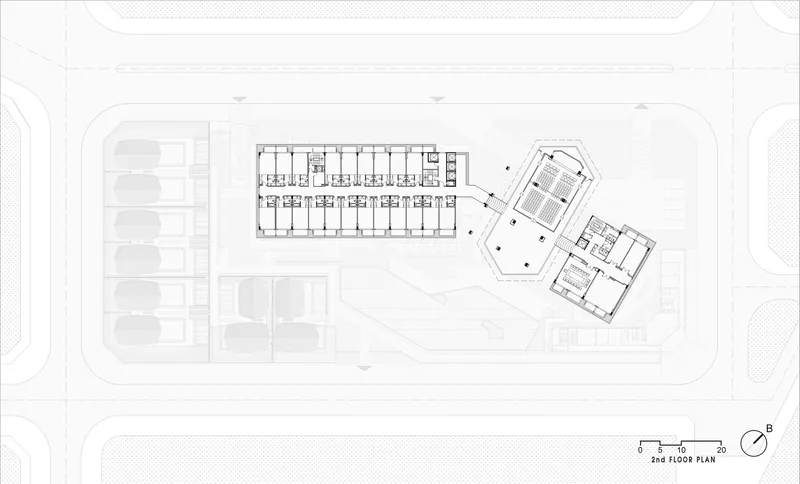

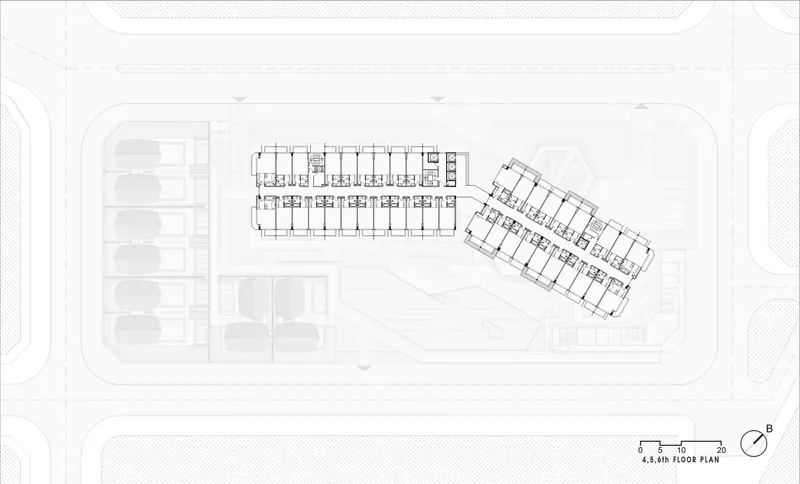

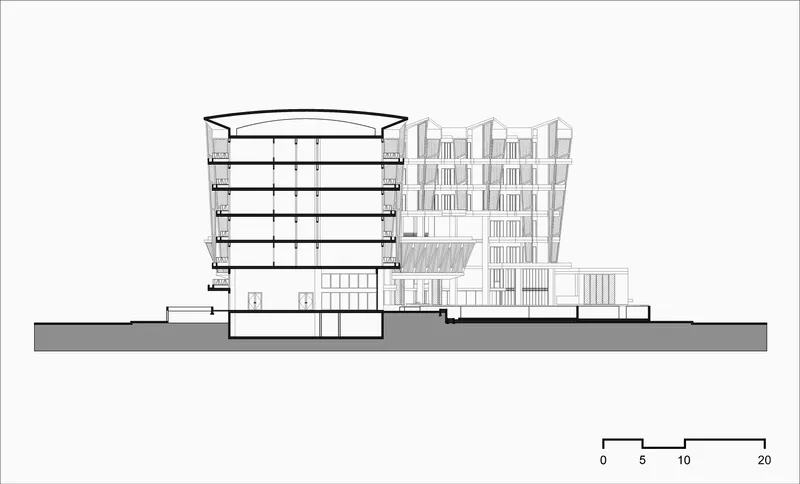


The site plan reveals the project's organizational clarity. The hotel tower, rotated slightly off the orthogonal grid, creates an angled circulation spine that connects service spaces at basement level and opens to the pool and river at grade. The pentagonal wing, visible in the upper floor plans, breaks from the rectangular bar to carve out a central void that brings light and air into the core of the building. Sections through the curved-roof tower show underground parking tucked beneath the landscape, keeping vehicles invisible from any public vantage point.
The construction details are worth noting: wall plate connections, balcony planter sections, and flowerbed profiles reveal the engineering required to support the green facade. Each planter is integrated into the balcony slab, with waterproofing and drainage detailed to prevent moisture damage to the structure below. The attic elevation drawings show how the curved roof profile is achieved through a series of tapered steel ribs, creating the hull-like form that defines Bellerive's silhouette.
Why This Project Matters
Bellerive Resort matters because it demonstrates that hospitality architecture in Vietnam's heritage cities can engage local building traditions without retreating into nostalgia. The unfired brick, the woven ceilings, the hull-shaped roofs: none of these elements are reproductions. They are translations, filtered through contemporary construction techniques and organized by a clear site strategy that prioritizes river views, natural ventilation, and landscape integration. In a market saturated with generic tropical resorts, that specificity counts.
AVA Architects have also made a quiet argument about scale. At six storeys and 178 rooms, Bellerive is not a boutique project. It carries real density. Yet the layered facade, the planted balconies, and the fragmented massing prevent it from reading as a monolith on the De Vong riverbank. The building earns its presence by giving something back to the street and the water, rather than simply extracting views from them. That reciprocity, between architecture and landscape, between resort and city, is what elevates the project beyond its type.
Bellerive Resort by AVA Architects, lead architect Nguyen Le Huy Vu. Hoi An, Vietnam. 8,718 m². Completed 2022. Photography by Hiroyuki Oki.
About the Studio
Share Your Own Work on uni.xyz
If projects like this are the kind of work you want to make, uni.xyz is a place to publish your own, find collaborators, and enter design competitions.


Popular Articles
Popular articles from the community


Manzana Morphosis: Stretching Barcelona's Grid into a Living Landscape for 2050
A radical reworking of the Eixample manzana turns density into a tool for generous public space, vertical ecology, and environmental performance.

The Amber Palace Opera: A Geological Fiction Surfaces on Tallinn's Baltic Waterfront
Pierre Brillard reimagines a Baltic legend as a public landscape, opera house, and waterfront promenade rooted in Tallinn's coastal identity.


FCC Arquitectura Expands a Portuguese Granite House with a Board-Marked Concrete Wing
In Portugal, JV House pairs a cleaned-up whitewashed and granite dwelling with a timber-shuttered concrete extension, courtyards and a garden pool.

Cube Design Draws an Ecological Corridor Between Two Shenzhen Hills with the Nankai Building
Beside Shenzhen's container docks, the Nankai Building pairs stacked balconies with a climbing green screen to connect two hillsides across its height.

Similar Reads
You might also enjoy these articles

LAVA Architecten Gives Vocational Education a Sawtooth-Roofed Face on a Mechelen School Campus
In Mechelen, Belgium, a 2,053 m² STEM school on a 6×6 m grid turns workshops and classrooms into rooms that can be rearranged as teaching changes.

KEMA Studio Turns a Derelict Marvila Attic into a 60 m² Lighthouse Apartment Above Lisbon
In Lisbon's Marvila district, a rebuilt roof, four skylights and two plywood volumes turn an unlivable attic into a bright home facing the Tagus.

Pixel Gardens: One Repeated Module Stacked Into a Terraced Social Housing Tower for Famagusta
Salem Bader's shortlisted housing tower builds a vertical neighbourhood from one repeated module, offsetting units to carve terraces, light and air.

Bao Huynh Watercolor Atelier: A Serene Art Retreat in Hội An
Bao Huynh Watercolor Atelier in Hội An blends multifunctional art spaces, sustainable design, local materials, and family-friendly living in a serene environment.

Explore Winery & Resort Competitions
Discover active competitions in this discipline

Challenge to design a barrier free sports center

Challenge to design an outdoor ice-rink and park
Comments (0)
Please login or sign up to add comments
No comments yet. Be the first to comment!