
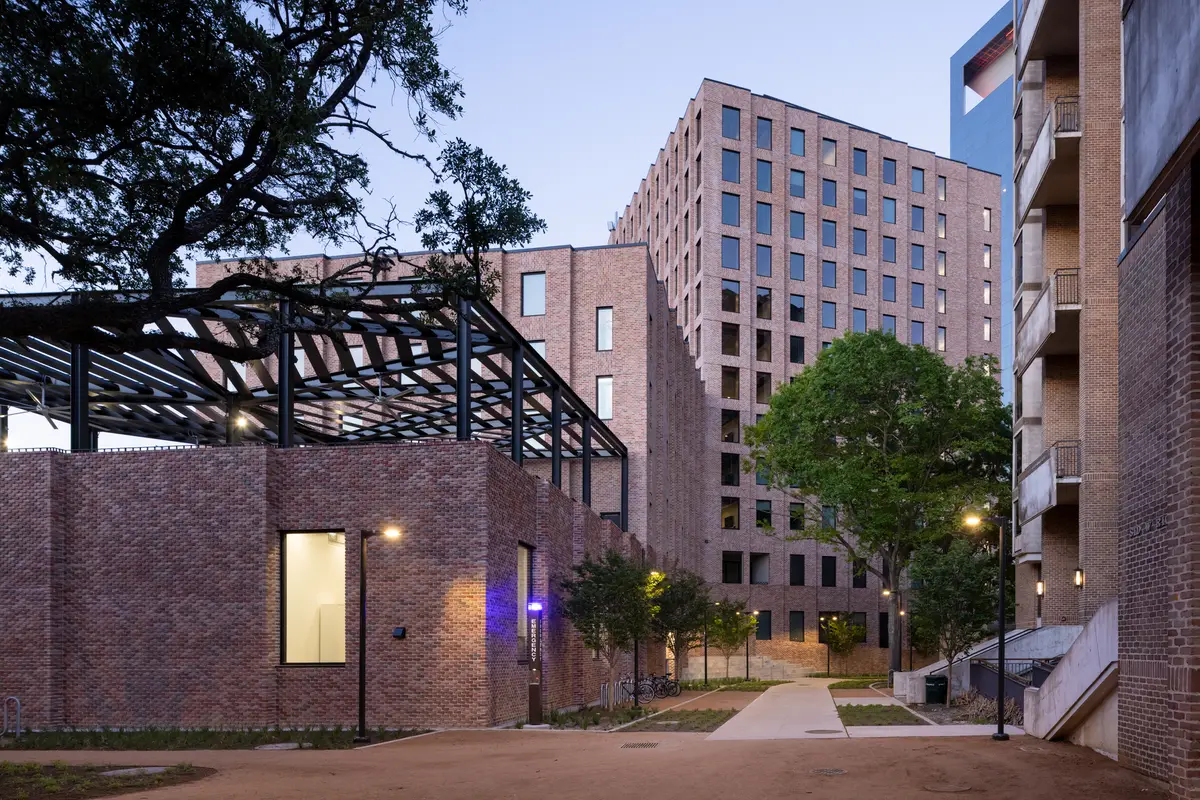
Barkow Leibinger Wraps a Brutalist Tower in Brick at Rice University's Sid Richardson College
A trio of linked buildings in Houston negotiates between Rice's oak-shaded campus and the vertical Medical District across Main Street.


Rice University's campus is one of the most self-assured in the American South: low-slung Mediterranean buildings tucked under live oaks, red tile roofs stepping across broad quadrangles. So when Barkow Leibinger, a Berlin-based firm with deep roots in material experimentation, was asked to supplement the 1971 Brutalist dormitory tower designed by Neuhaus & Taylor, the challenge was not simply to add beds. It was to reconcile a fourteen-story concrete slab with a campus that prefers to hug the ground, and to do so in a city where both the climate and the skyline press in from every side.
What makes the completed Sid Richardson Residential College genuinely interesting is its refusal to choose a single register. The project is not one building but three linked volumes, a two-story workshop pavilion, a five-story wing, and a twelve-story tower, that wrap around the existing Brutalist structure on two sides. The brickwork, sourced from the St. Joe kilns in New Orleans, shifts character floor by floor: zigzag and sawtooth patterns are most dramatic at eye level, then flatten as the facades climb. The result is a building that reads differently from the courtyard, the quad, and the Medical District skyline beyond Main Street.
A Campus of Oaks and Concrete
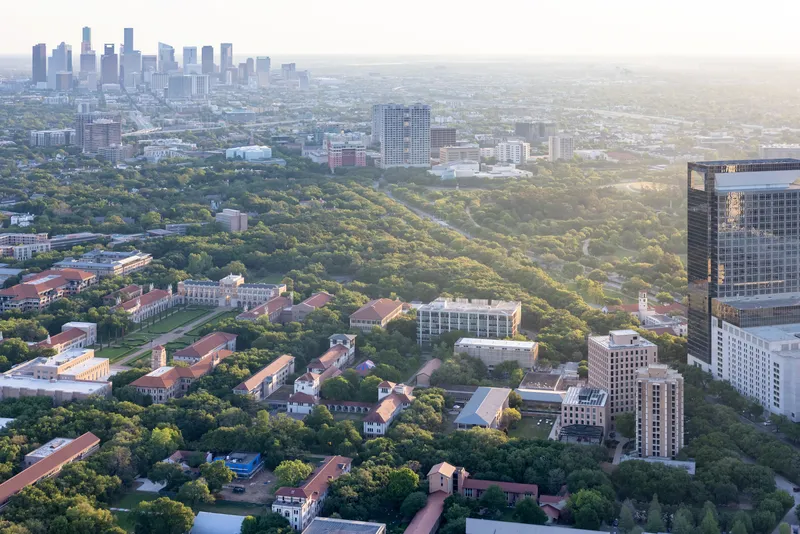
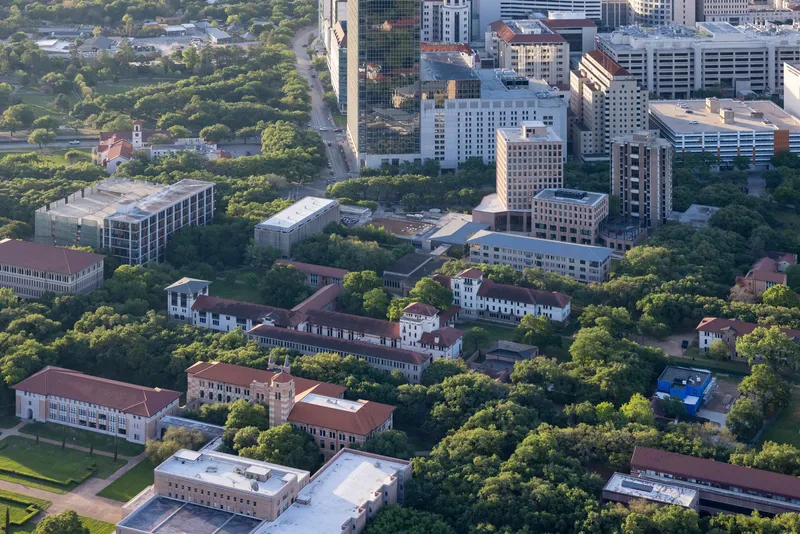
Seen from the air, the problem is legible immediately. Rice's campus is a dense canopy interrupted by red roofs; Houston's Medical District is a wall of towers one block east. The existing Sid Rich tower, a product of late-sixties confidence in vertical living, belongs more to the skyline than to the quads. Barkow Leibinger's response was to create a ground-hugging base that keeps faith with the campus scale while letting the new twelve-story tower acknowledge the city beyond.
The landscape, designed by The Office of James Burnett, knits young trees and open lawns into the composition. Rather than fortifying the perimeter, the complex opens multiple passageways at grade, making the courtyard a through-route rather than a cloister.
Brick as Argument
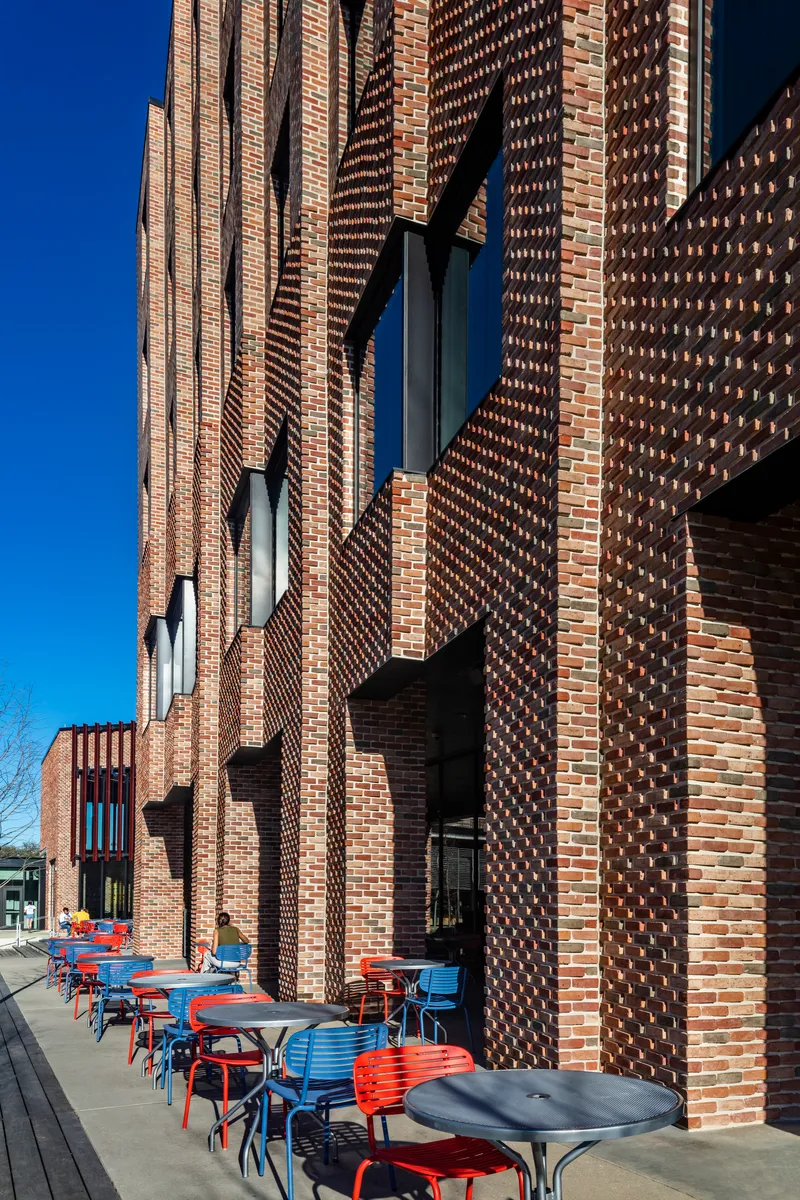
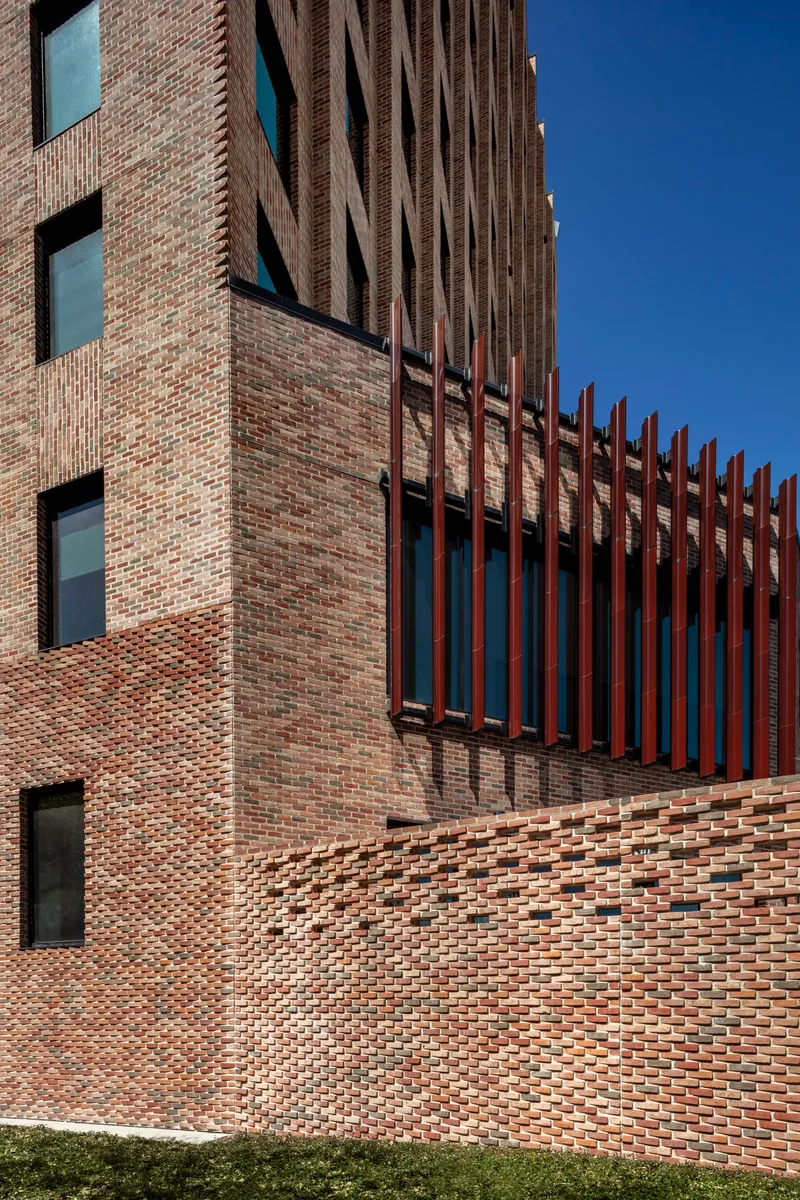
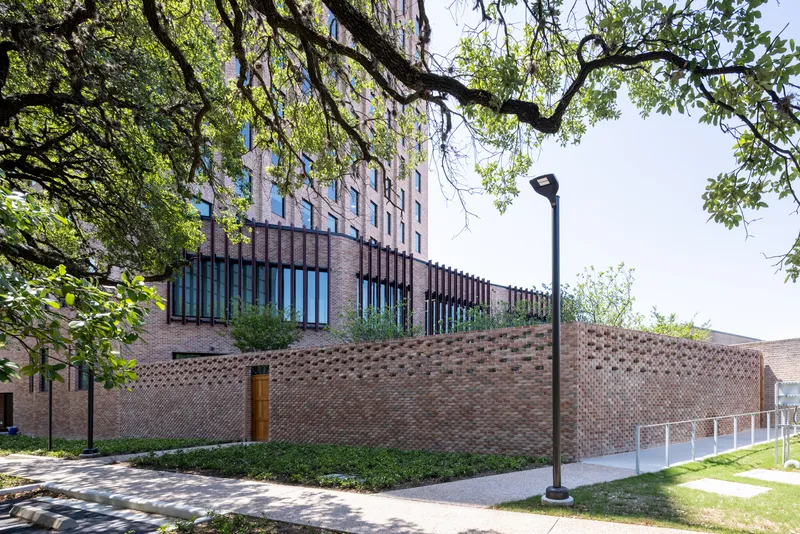
The brick facades are the project's most assertive gesture. St. Joe brick comes in a range of complementary colors, rose, red, orange, gray, and the masons, skilled Texas tradespeople working on-site, laid every module without prefabricated panels. Brick modules were designed to minimize cutting, which means the patterns are not decorative appliqué but genuine expressions of masonry logic.
At the lower levels, sawtooth and zigzag patterns cast real shadows, turning the wall surface into a relief that changes with the sun. Higher up, the patterns relax, and the facades become quieter punched-window grids. Combined with ceramic brise-soleil fins that shade the glass-fronted common areas, the envelope is working hard for its climate without resorting to the sealed-box default that dominates Houston construction.
The Courtyard and Pergola
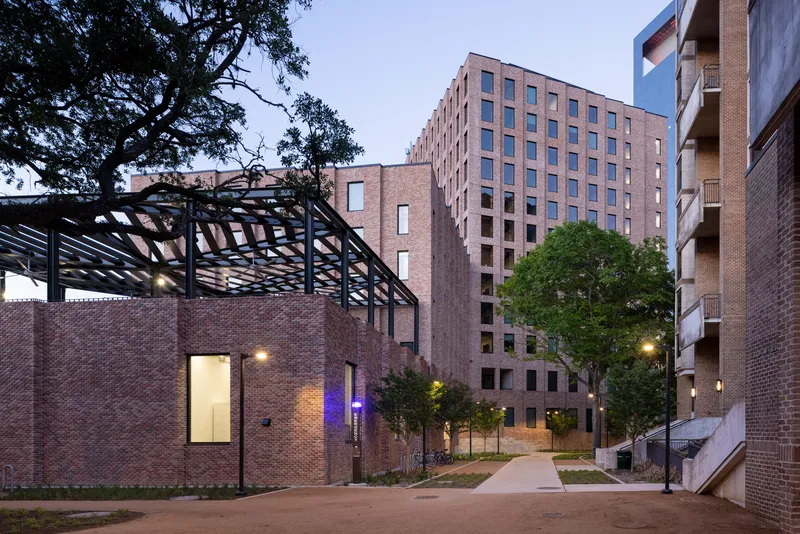
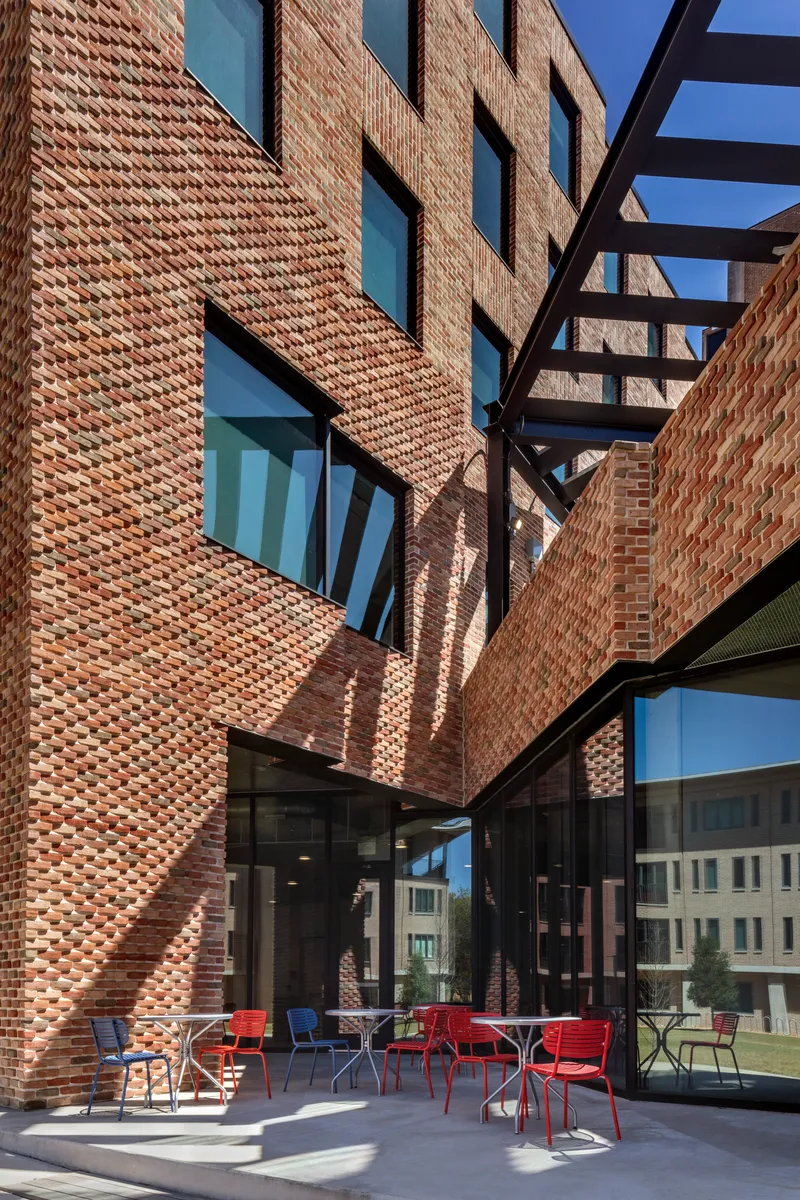
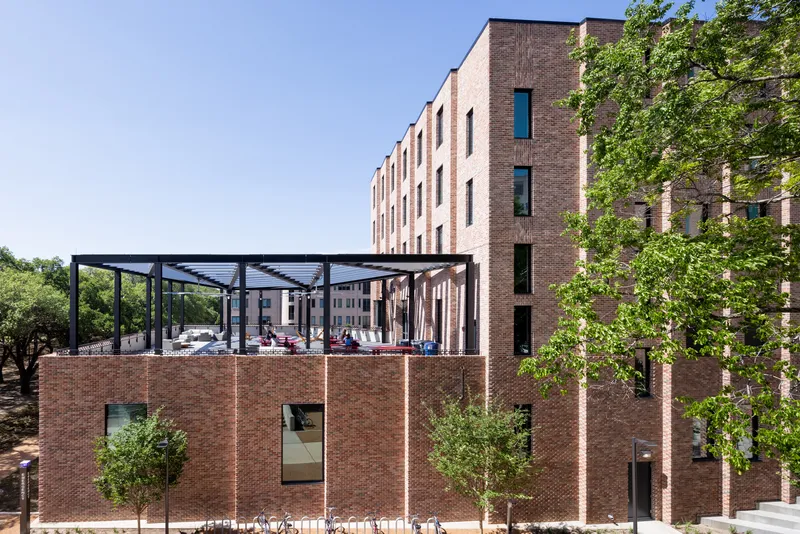
The courtyard is where the three linked volumes meet, and the blackened steel space-frame pergola is the element that ties them together. Its slats fan outward in a formation that recalls the lattice traditions of Southern porch architecture, but the material and geometry are unmistakably contemporary. At dusk the pergola's shadow pattern on the brick walls creates a second layer of texture over the masonry.
Bridge elements cross overhead at upper levels, connecting the residential wings and reinforcing the sense that this is a small neighborhood rather than a single monolith. Red seating cubes and chairs scattered through the courtyard signal that the space belongs to students, not to visitors with cameras.
Tower and Podium
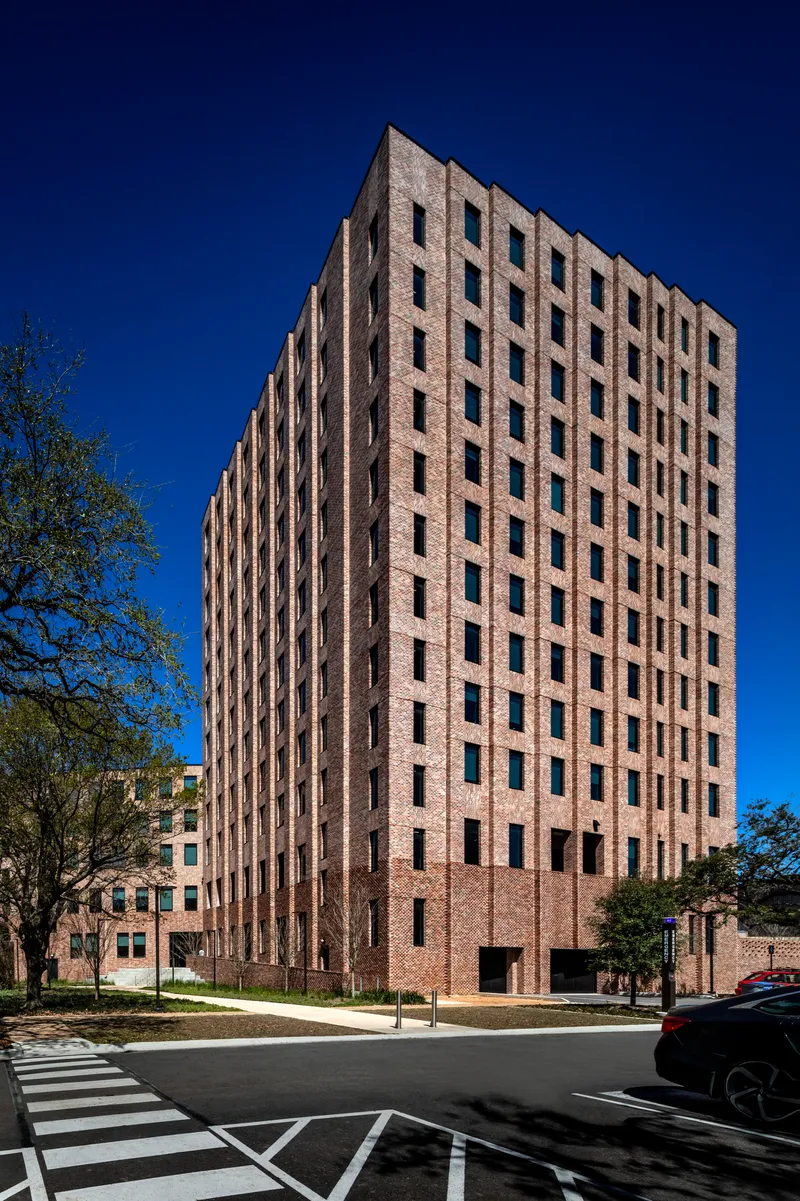
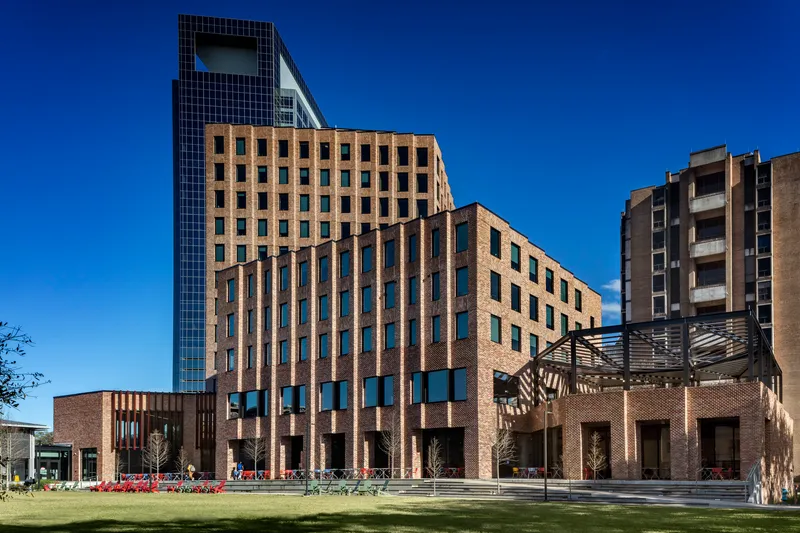
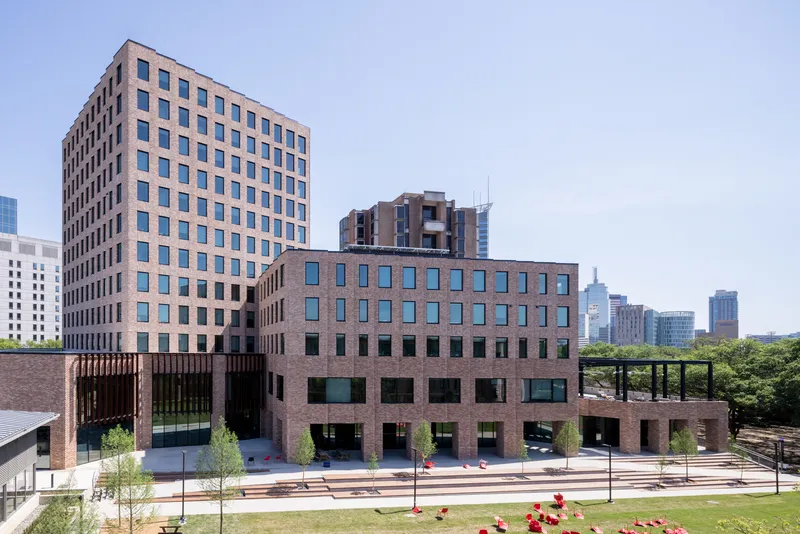
Barkow Leibinger originally envisioned the twelve-story structure as a pilot project in mass timber. Houston's building code killed that ambition, and a cast-in-place concrete post-and-beam system on drilled piers took its place. The loss is felt mostly in weight: these are heavy, grounded buildings, and the concrete ceilings in the dormitory rooms make that legible. But the brick cladding softens the mass, and the vertical window pattern on the tower gives the facade a rhythm that the original Brutalist slab never had.
The two-story podium houses workshops and makerspaces, its roof terrace serving as the college's primary social space. The five-story wing and the tower hold 97 double units, each with its own bathroom, along with 118 singles that share common facilities. A duplex magister's apartment and three advisor residences complete the program, embedding faculty into the residential fabric rather than segregating them.
Dining Hall and Interior Life
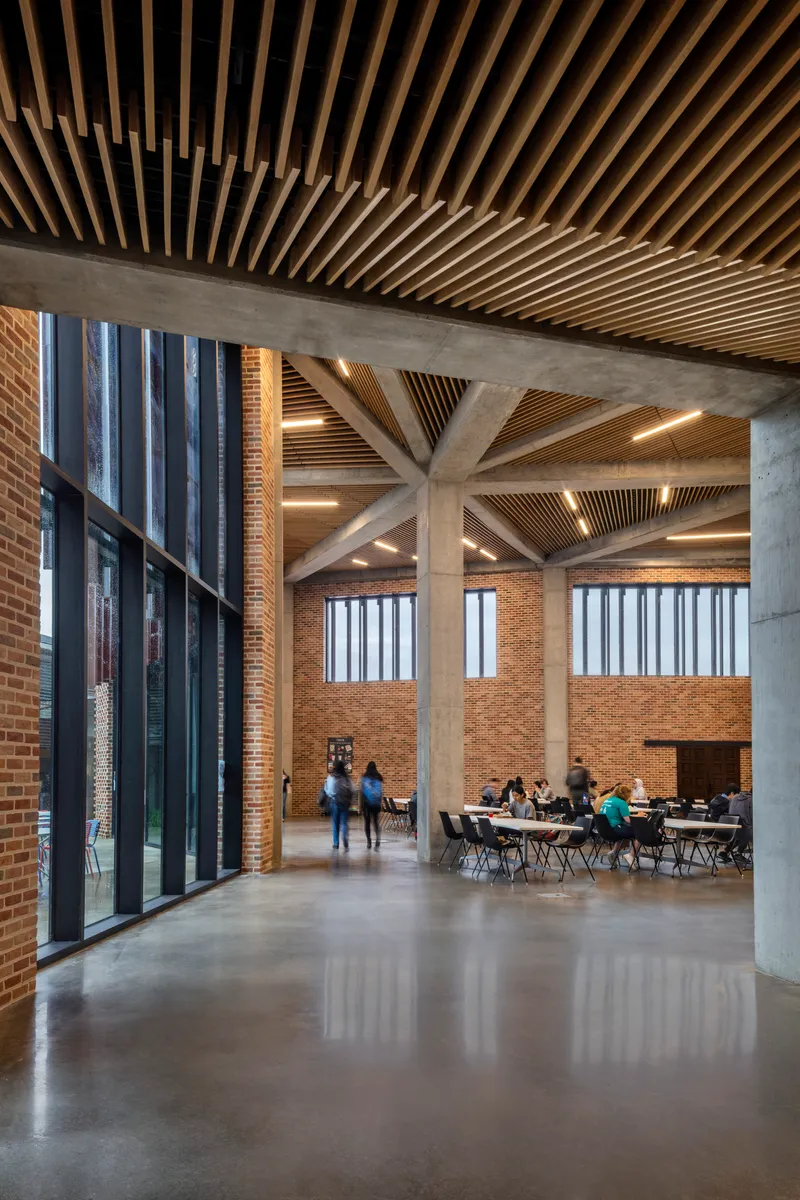
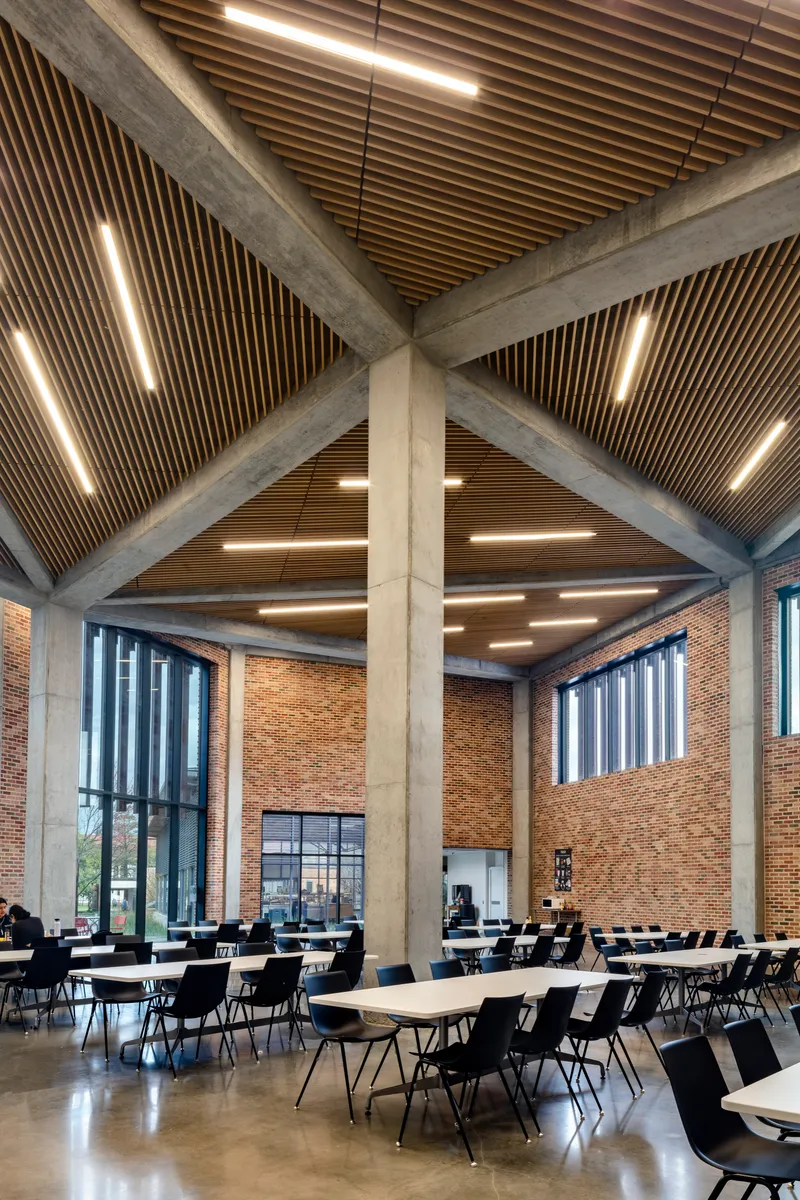
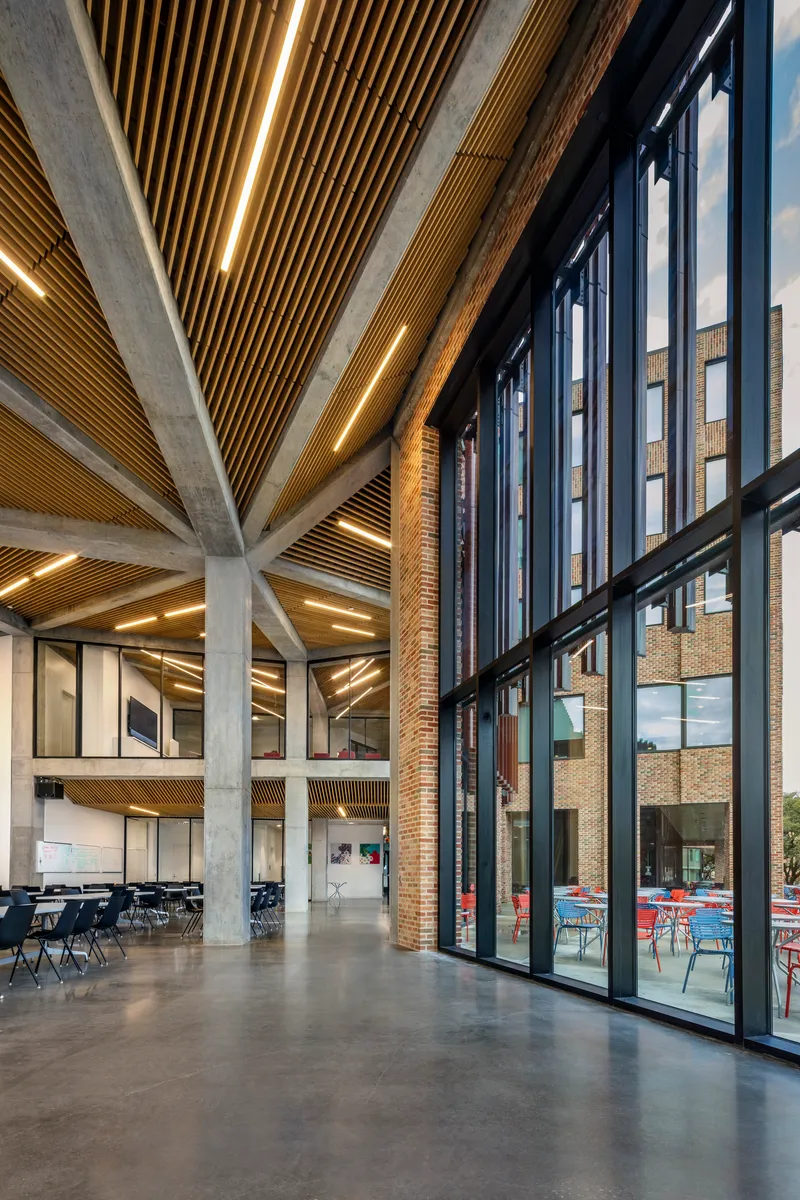
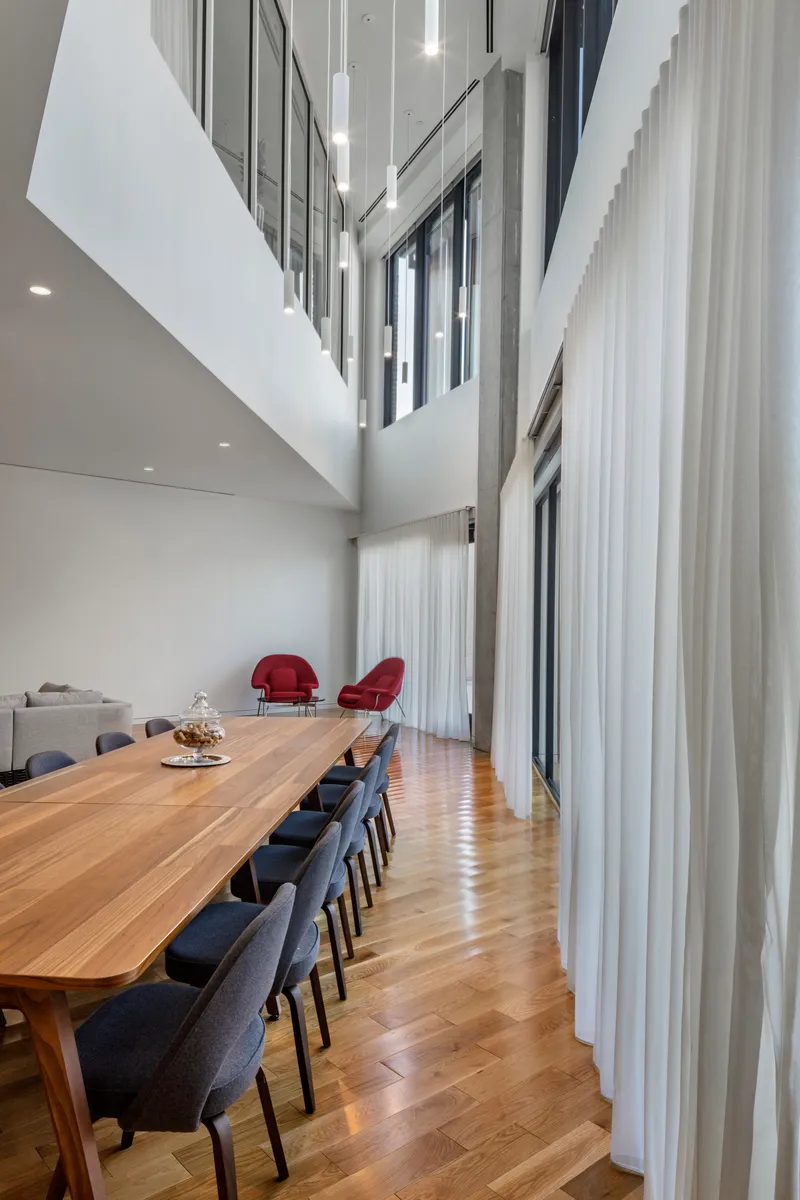
The 300-seat dining hall is the project's most spatially generous interior. A triangulated grid of concrete columns supports a ceiling of wood slat lattice threaded between exposed beams, a system that does double duty as acoustical dampening and visual warmth. The branching column visible in several views is a structural flex that Barkow Leibinger has explored in other projects, but here it earns its drama by organizing the ceiling geometry above it.
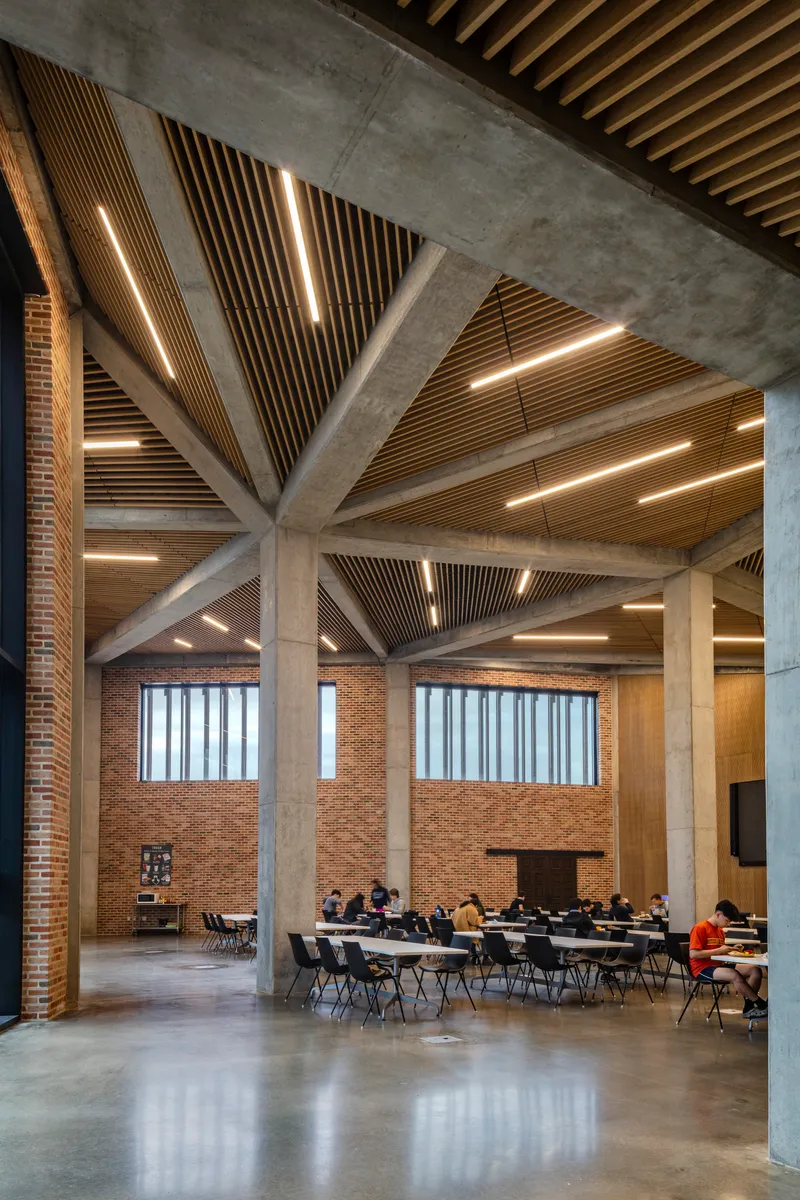
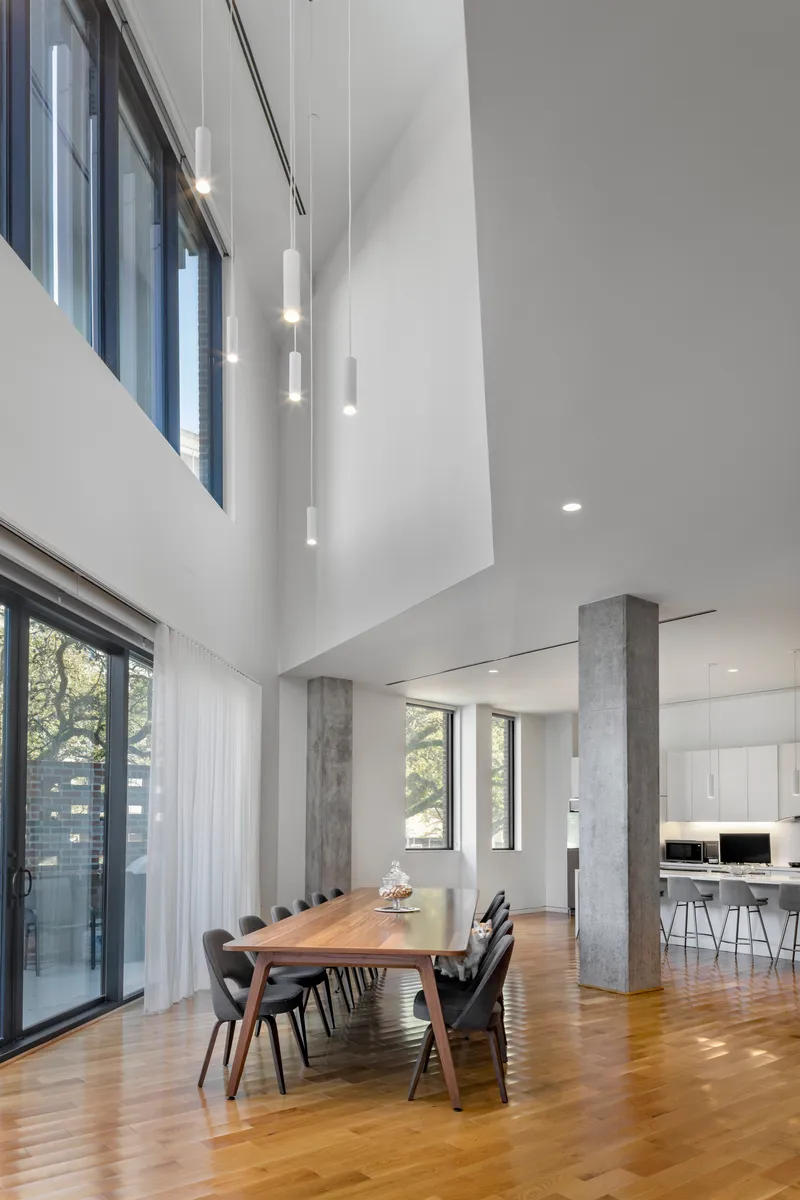
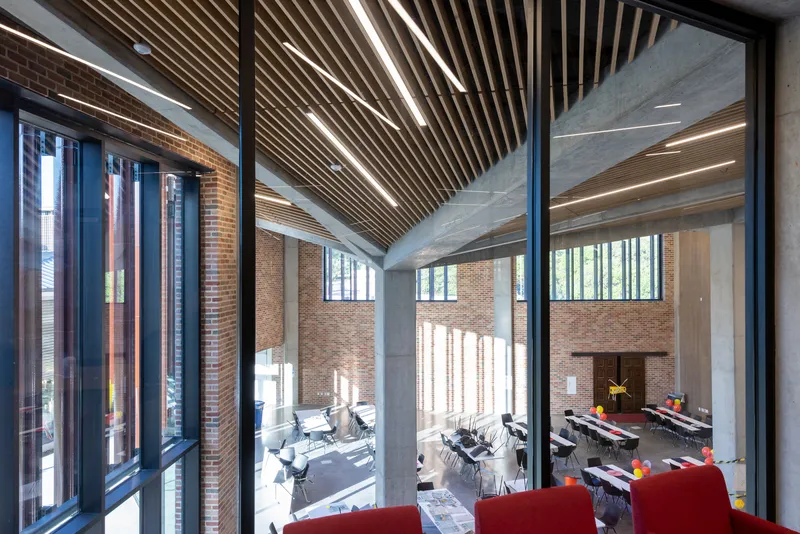
Throughout the common areas, polished concrete floors and exposed concrete ceilings establish a material honesty that rhymes with the Brutalist tower next door. The difference is in the light: floor-to-ceiling glazing and ceramic brise-soleil let the dining spaces glow outward at night while keeping solar gain manageable during Houston's long, punishing summers.
Living Spaces
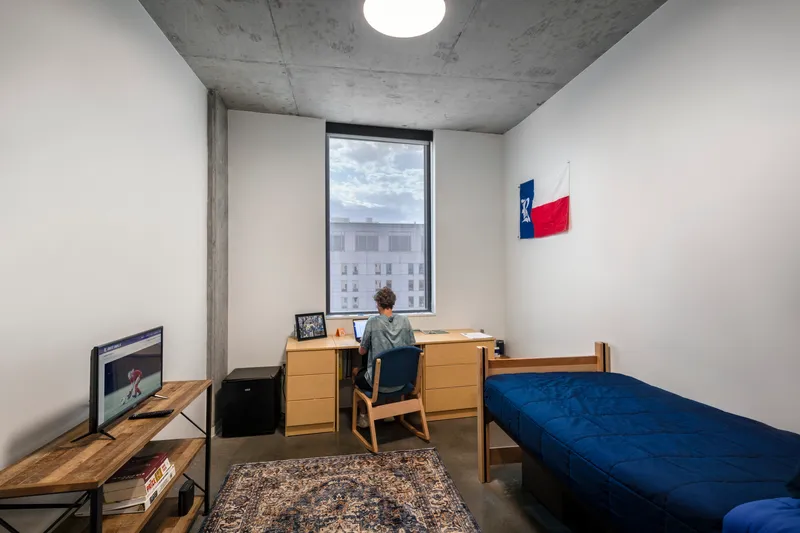
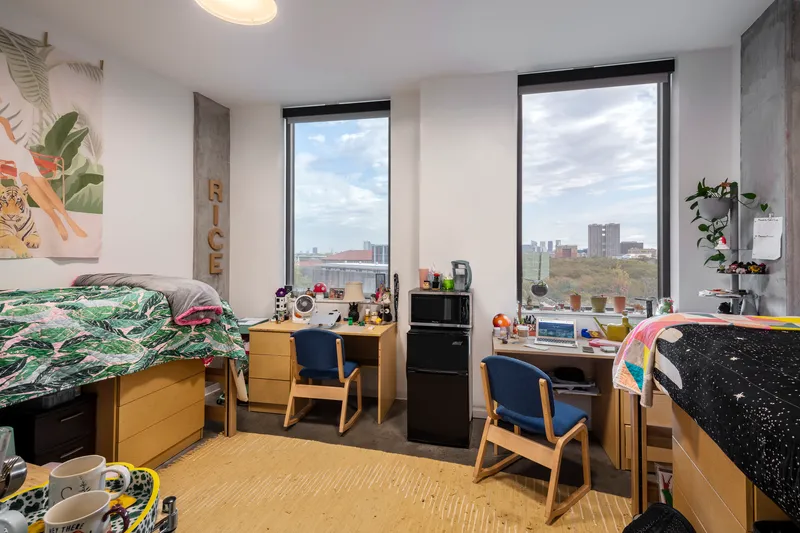
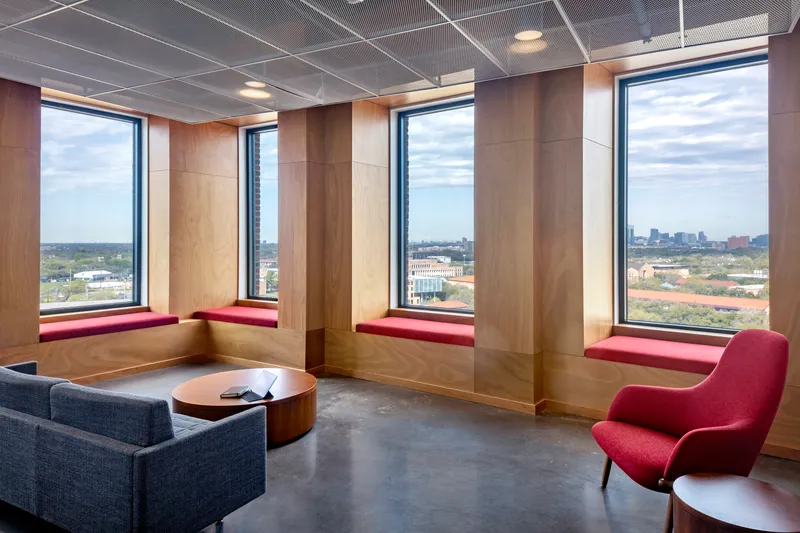
The dormitory rooms are compact and honest. Exposed concrete ceilings, narrow windows framing sky and neighboring buildings, built-in crimson window seats: these are not luxury apartments, and they do not pretend to be. The corner rooms with their tall triple windows and views to the Houston skyline are the real prize, offering students a direct visual connection to the city they are studying in.
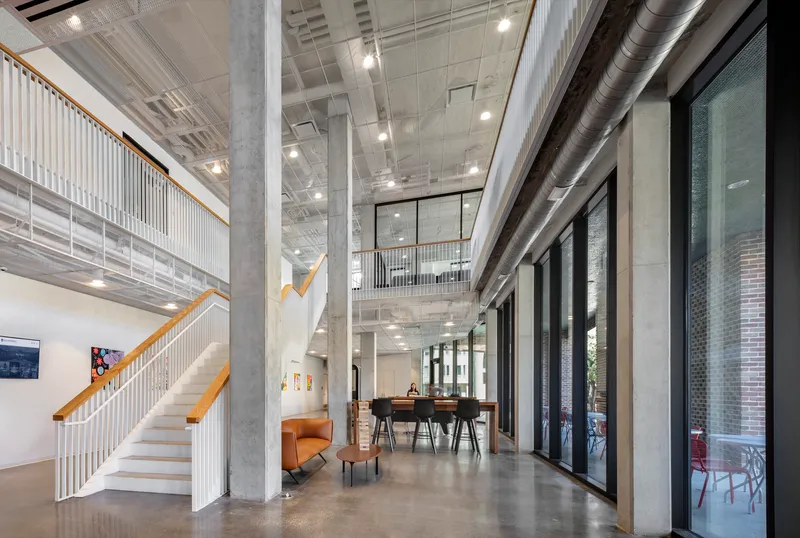
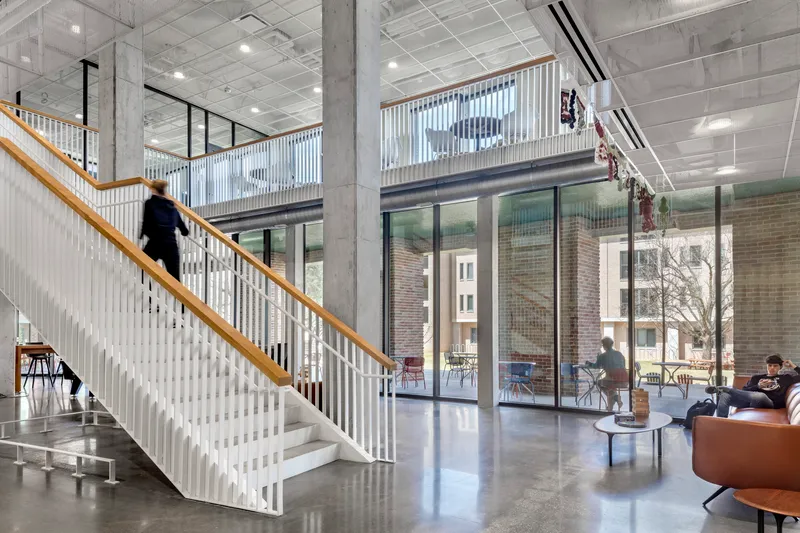
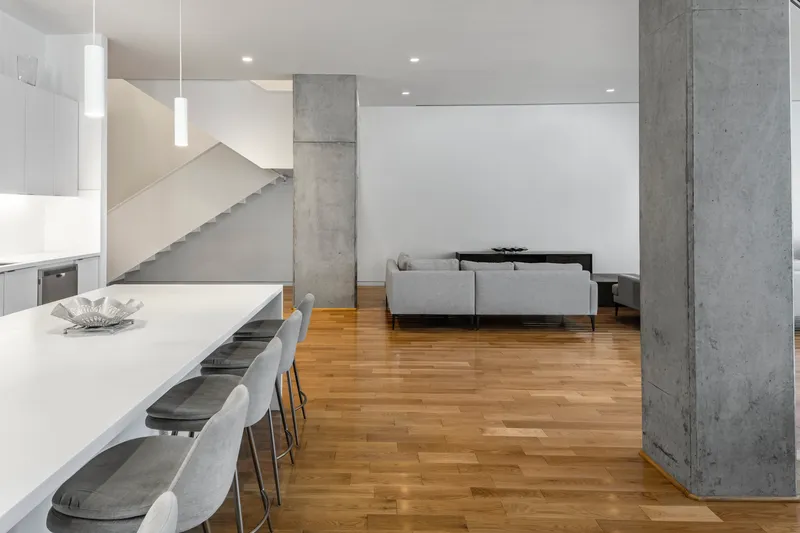
Circulation spaces are treated with equal care. The white steel staircase in the lobby, the sloped timber slat ceilings in corridors, and the glazed partitions overlooking classrooms all reinforce a culture of visibility. You see other people studying, eating, climbing stairs. The architecture insists on community without forcing it.
Rooftop Terrace
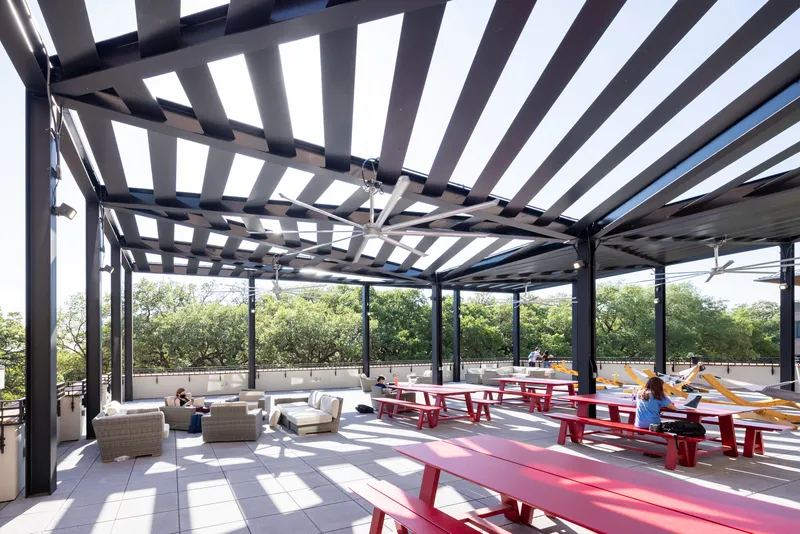
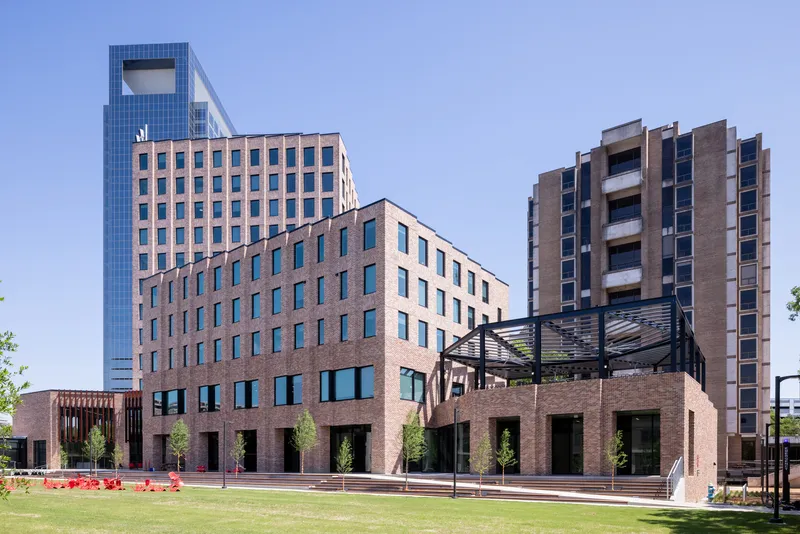
The roof of the two-story podium becomes an open-air terrace shaded by the steel pergola's fan-shaped slats. Red picnic tables and the kind of informal furniture that invites lingering fill the space. At midday the pergola throws a dense lattice of shadow across the deck, making the terrace usable in a climate where unshaded outdoor space is an oven for eight months of the year. It is a simple move, pergola plus furniture, but its success depends entirely on the precision of the steel structure, and that precision is convincing.
Passages and Thresholds
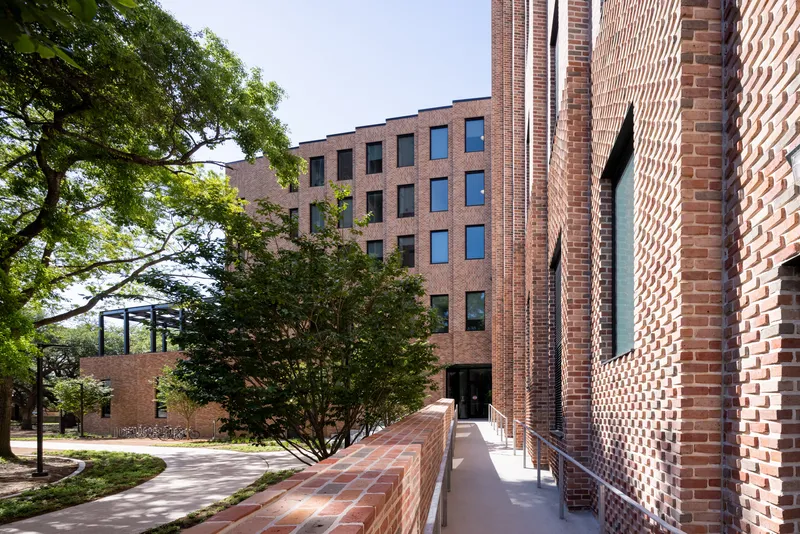
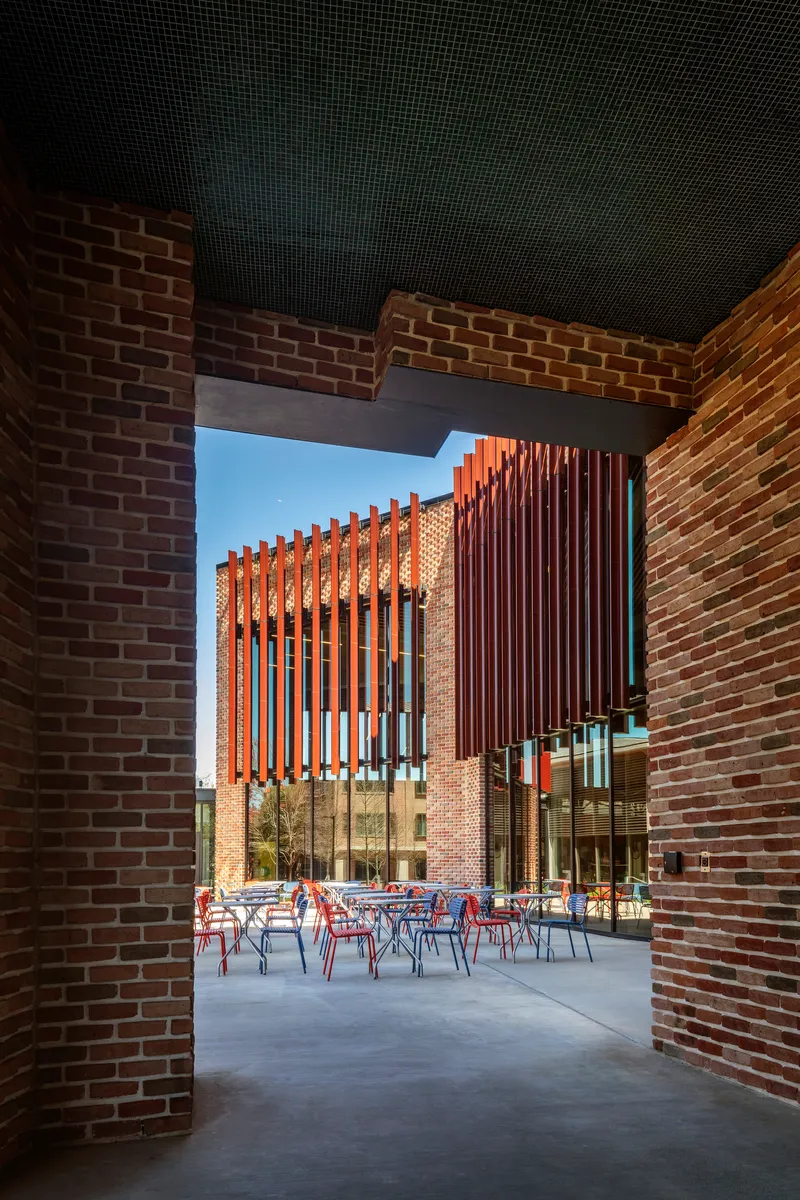
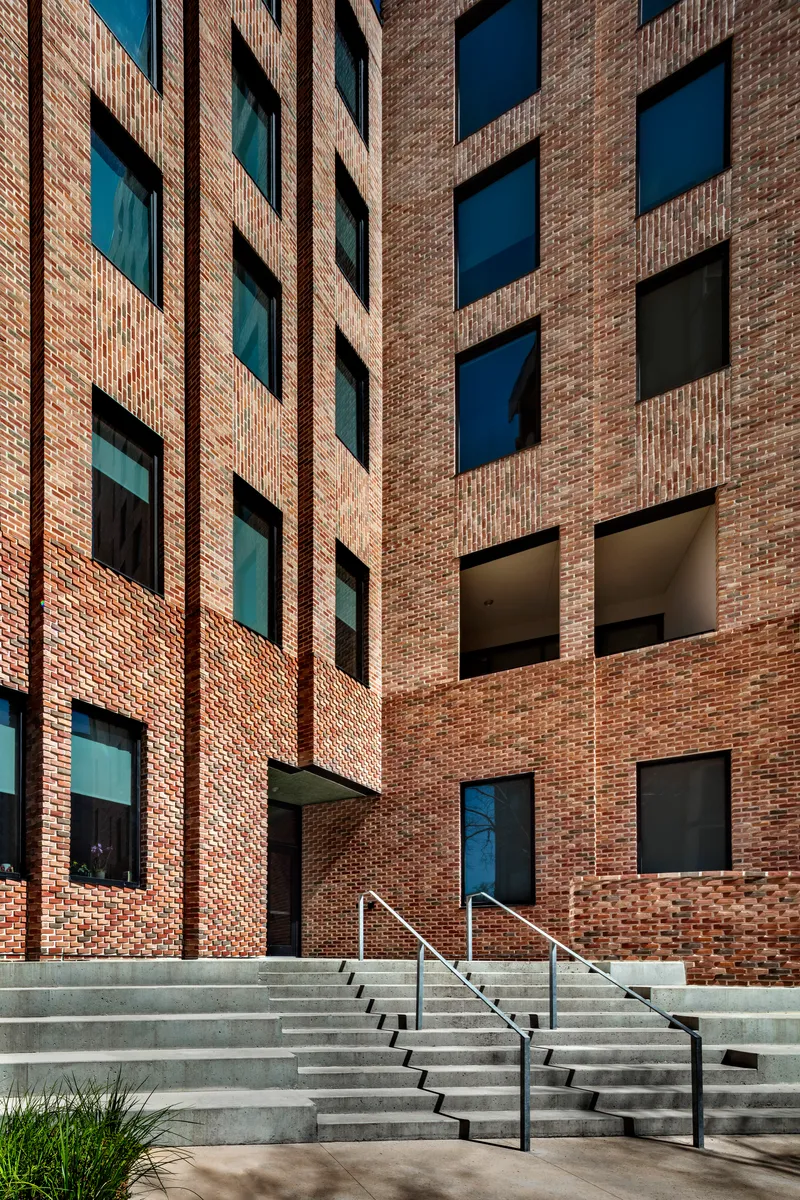
Some of the project's best moments happen in between: the shaded pathway beside a perforated brick screen, the brick-walled passageway opening onto a courtyard with red chairs, the concrete steps climbing to a punched-window facade. These transitional spaces are where the building's material palette reveals itself most clearly. You walk past zigzag brick, through a concrete colonnade, and into a timber-slatted interior, and each material transition marks a shift in program and atmosphere.
Plans and Drawings
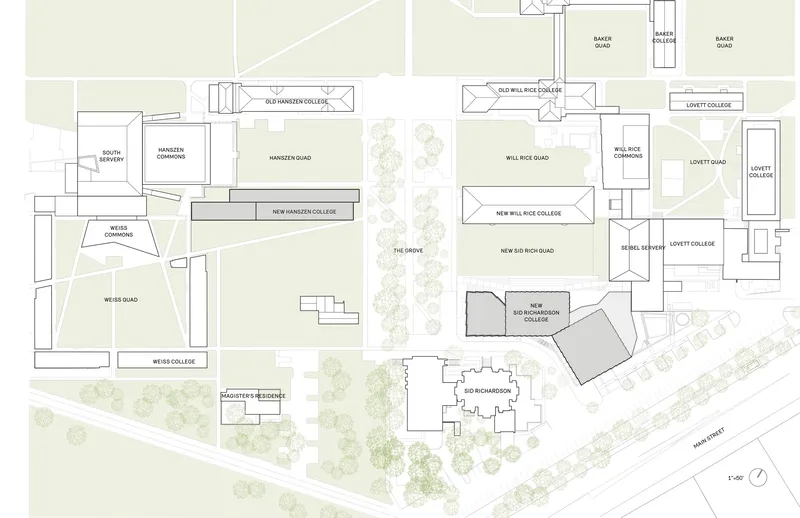
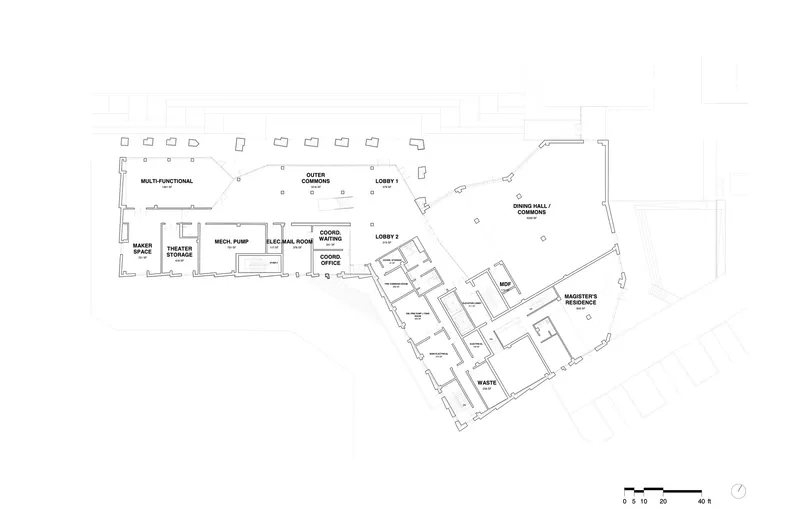
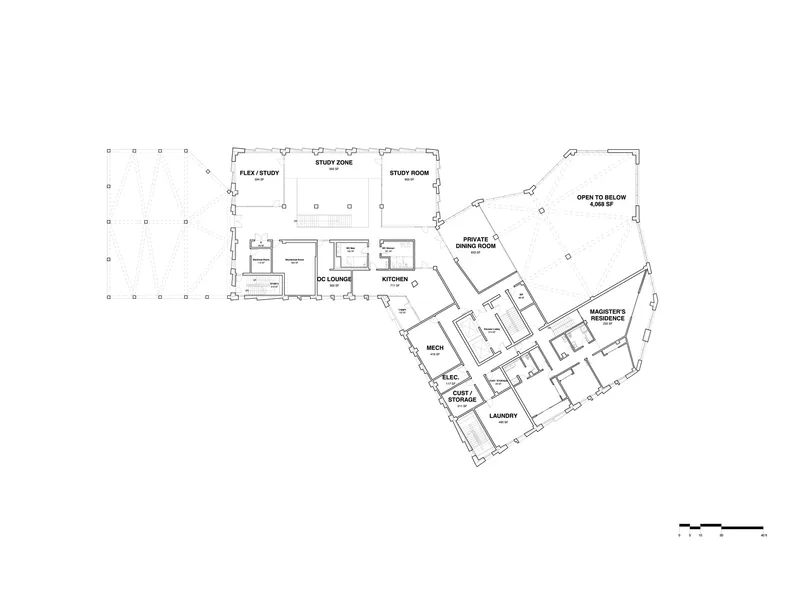
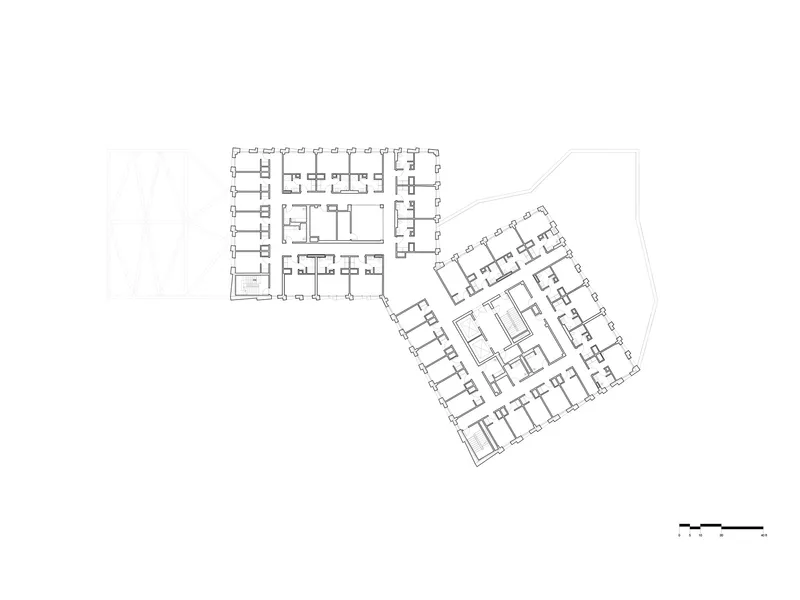
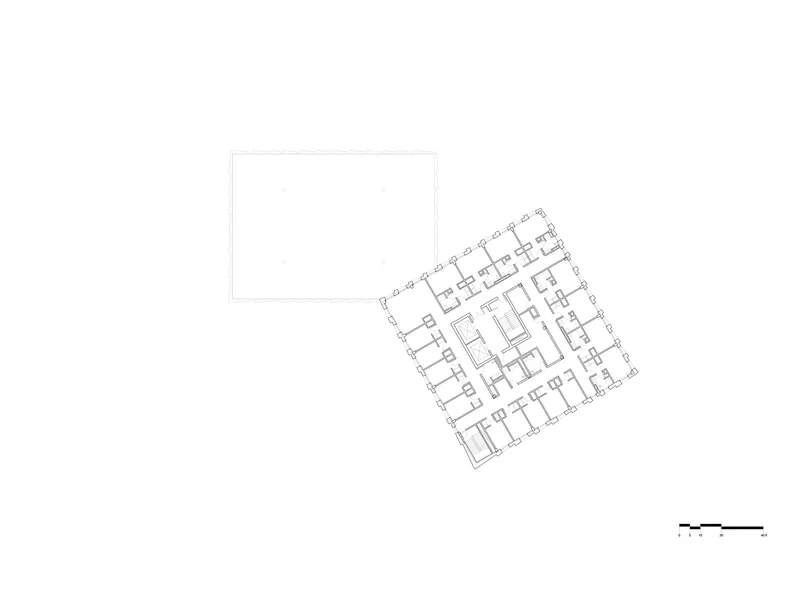
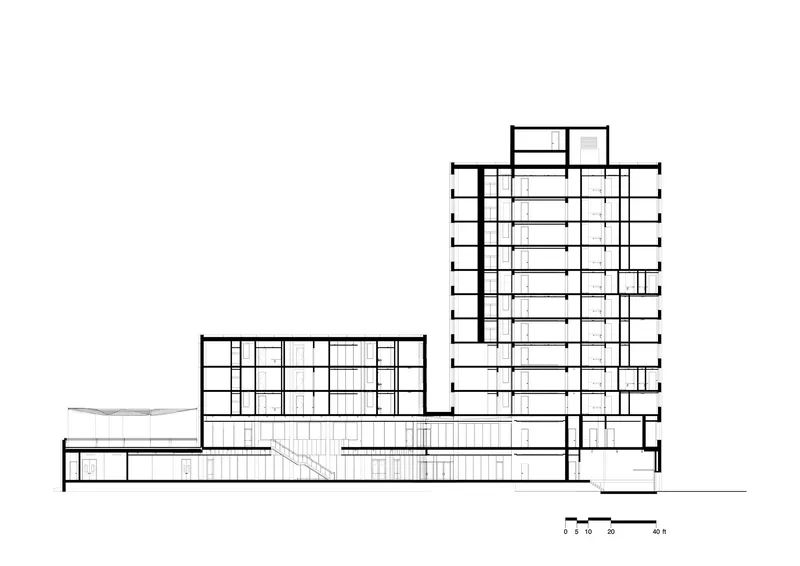
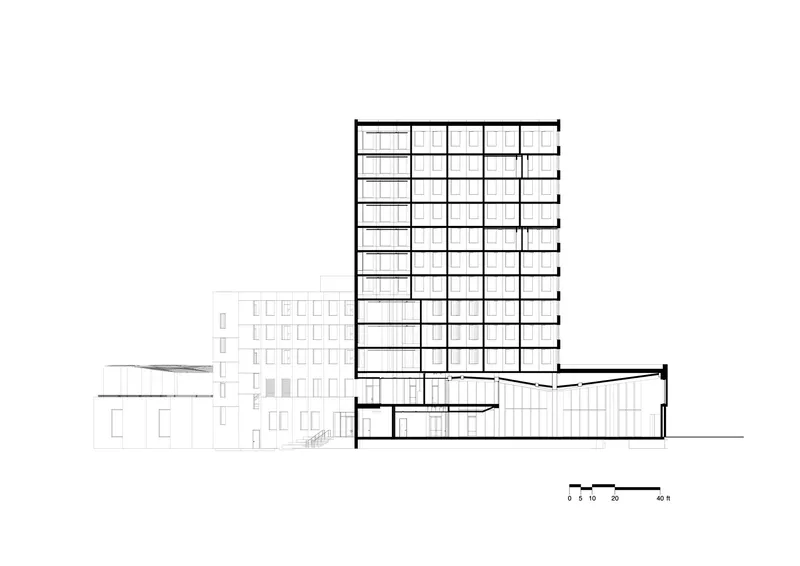
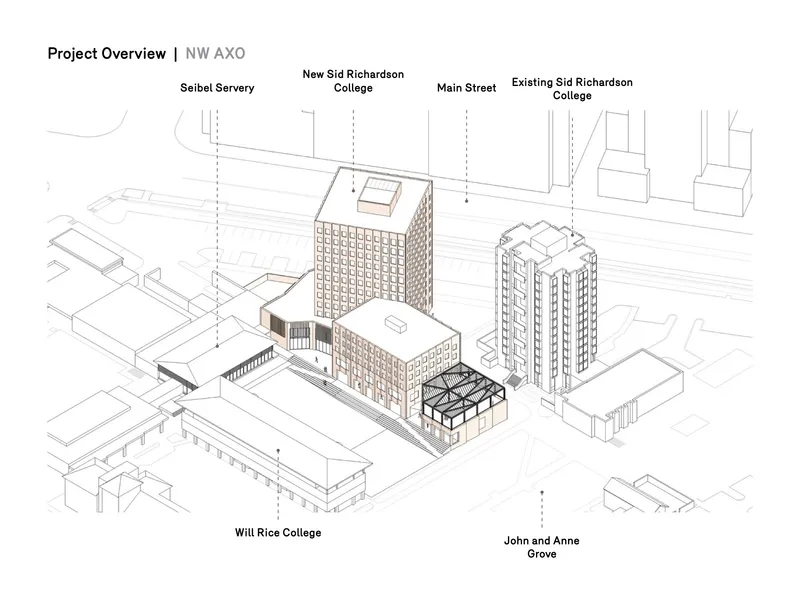
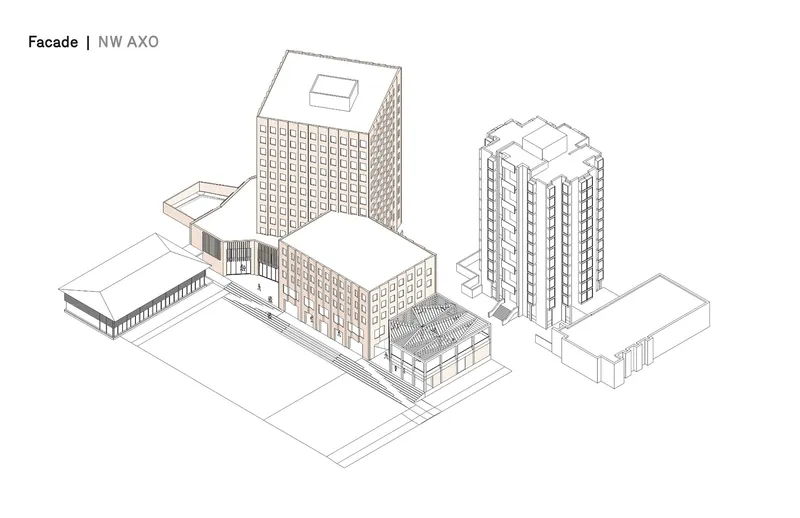
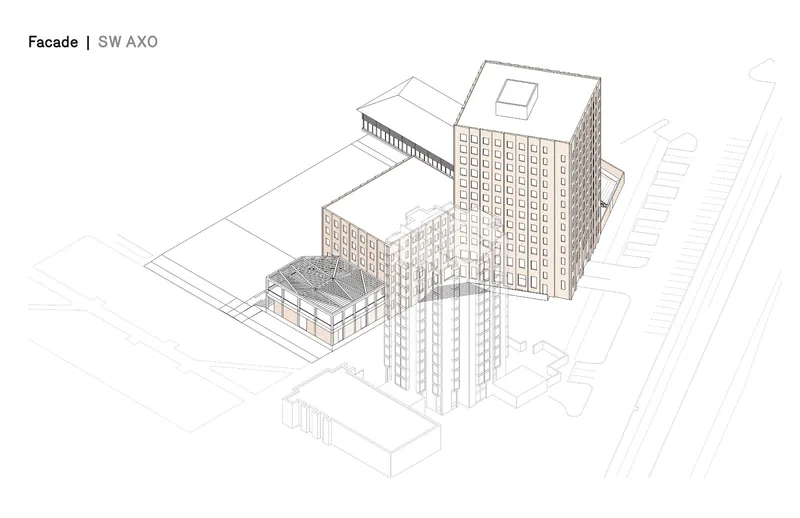
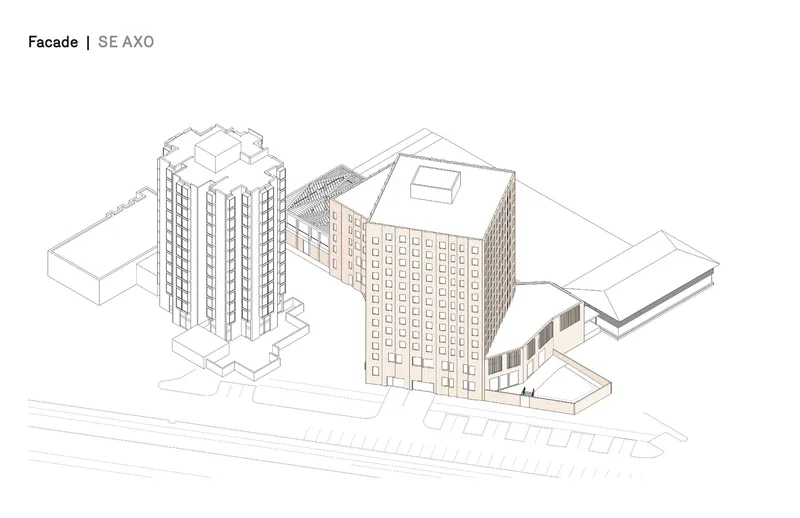
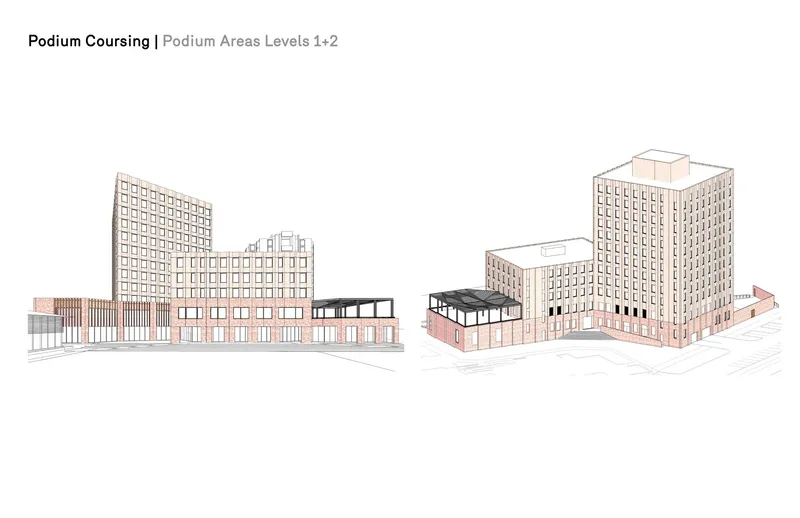
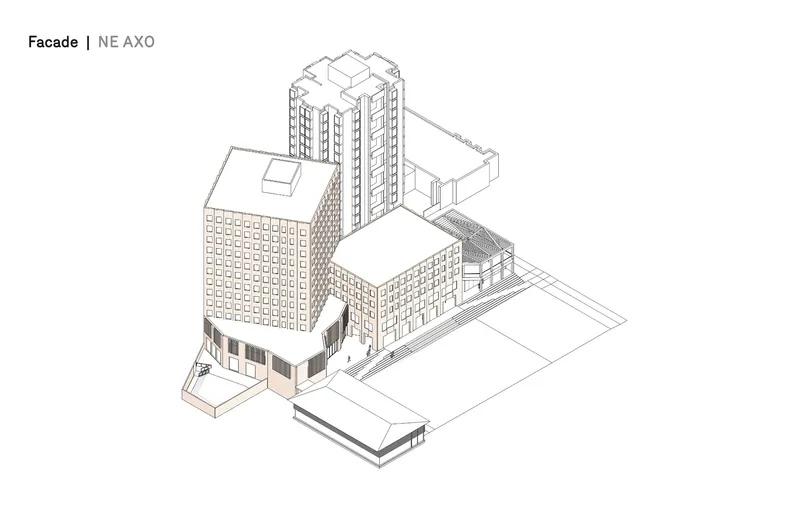
The plans and axonometrics make visible what the photographs only hint at: the diagonal relationship between the new residential wing and the existing tower, the way the courtyard space is carved out rather than enclosed, and the stepping of floor plates from the low podium through the five-story wing to the twelve-story tower. The sections are particularly revealing, showing how the sloped topography is absorbed into the ground-floor program and how the pergola structure reads as a datum line tying the composition together at its lowest roofline.
The axonometric studies trace the project's evolution from early massing concepts with curved glass pavilions and sawtooth roof profiles to the built scheme. What survived from the early iterations is the fundamental idea of a campus-scaled base supporting selectively vertical elements, a strategy that lets the new college belong simultaneously to two very different scales of urbanity.
Why This Project Matters
Sid Richardson Residential College matters because it demonstrates that a university dormitory can be architecturally ambitious without becoming a monument. The project's intelligence is distributed across its surfaces and thresholds rather than concentrated in a single heroic gesture. The brick patterning, the steel pergola, the concrete dining hall, the timber lattice ceilings: each element does specific work, and together they create a residential environment that takes the social mission of a college seriously. Students eat, study, and sleep in spaces that reward attention.
More broadly, the project offers a model for how a European-trained practice can engage with a deeply American building type and regional material culture. Barkow Leibinger brought their characteristic interest in material process and structural legibility, but the St. Joe brick from New Orleans, the Texas masons, and the Houston climate gave those interests local content. The result is a building that could not exist anywhere else, which is the most convincing thing any piece of architecture can claim.
Sid Richardson Residential College, designed by Barkow Leibinger. Located in Houston, United States, on the campus of Rice University. 148,000 square feet. Completed in 2021. Landscape by The Office of James Burnett. Photography by Joe Aker and Iwan Baan.
About the Studio
Share Your Own Work on uni.xyz
If projects like this are the kind of work you want to make, uni.xyz is a place to publish your own, find collaborators, and enter design competitions.


Popular Articles
Popular articles from the community


Cloaked Colonization: A Mobile Underwater Habitat That Moves Like a Fish
Micah Abaya's shortlisted EHC Pacific entry reimagines ocean settlement as a dispersed network of self-sustaining architectural organisms.
Manzana Morphosis: Stretching Barcelona's Grid into a Living Landscape for 2050
A radical reworking of the Eixample manzana turns density into a tool for generous public space, vertical ecology, and environmental performance.

Opera by the Sea Estonia: Three Shells Dissolving Architecture into Tallinn's Coastline
A winning opera house proposal replaces monumental form with interconnected shells that blur the boundary between building, park and Baltic Sea.
Extended Shell: Retrofitting Kolkata's Balconies as Living Urban Thresholds
A modular retrofit system recovers the social and environmental intelligence of Kolkata's historic verandas for contemporary Park Street residents.

Similar Reads
You might also enjoy these articles

Pixel Gardens: One Repeated Module Stacked Into a Terraced Social Housing Tower for Famagusta
Salem Bader's shortlisted housing tower builds a vertical neighbourhood from one repeated module, offsetting units to carve terraces, light and air.

Bao Huynh Watercolor Atelier: A Serene Art Retreat in Hội An
Bao Huynh Watercolor Atelier in Hội An blends multifunctional art spaces, sustainable design, local materials, and family-friendly living in a serene environment.

Atelier Macri Concept Store Interior Design by CASE-REAL
Atelier Macri store features a "ko" counter, walnut wood details, cork displays, blending retail, gallery, and seamless customer experiences.

Manuel Vargas Izquierdo Stadium and High-Performance Sports Center: Architectural Excellence in Jalpa de Méndez
The Manuel Vargas Izquierdo Stadium blends sustainable design, inclusive sports facilities, and cultural-inspired architecture, revitalizing Jalpa de Méndez’s public spaces.


Comments (0)
Please login or sign up to add comments
No comments yet. Be the first to comment!