

Beijing Shangzhuang Organic Farm Station by hyperSity Architects: A Modern Rural Timber Hub
Beijing Shangzhuang Organic Farm Station by hyperSity Architects uses modular timber design, flexible spaces, and sustainable construction to connect field, table, and community.


Located in the historic Shangzhuang area of Haidian District, Beijing, the Beijing Shangzhuang Organic Farm Station by hyperSity Architects redefines rural agricultural architecture through innovative timber construction and modular design. Once part of the Nalan family’s countryside estate and farmland, this project transforms a 400-square-meter field into a multifunctional agricultural hub, seamlessly connecting the land, food production, and community activities. Completed in 2022 under the leadership of architect Shi Yang, the farm station exemplifies a thoughtful integration of function, structure, and landscape.
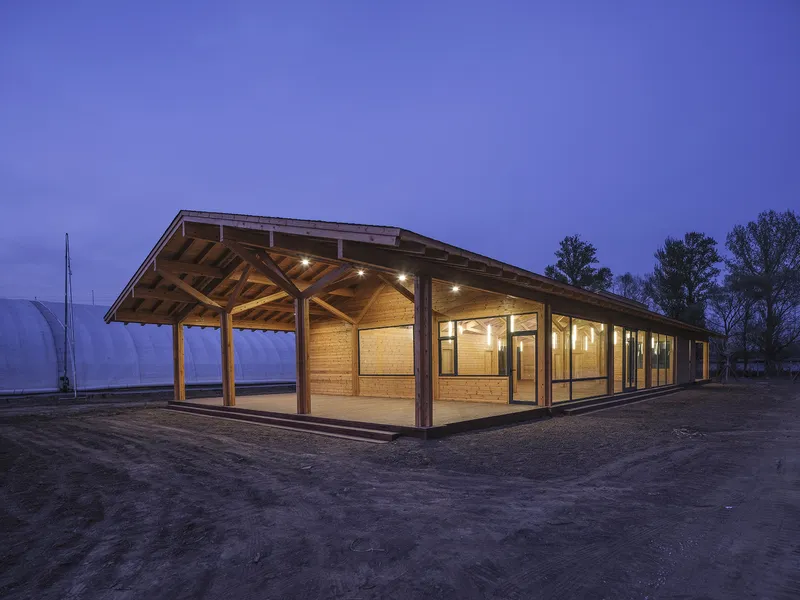
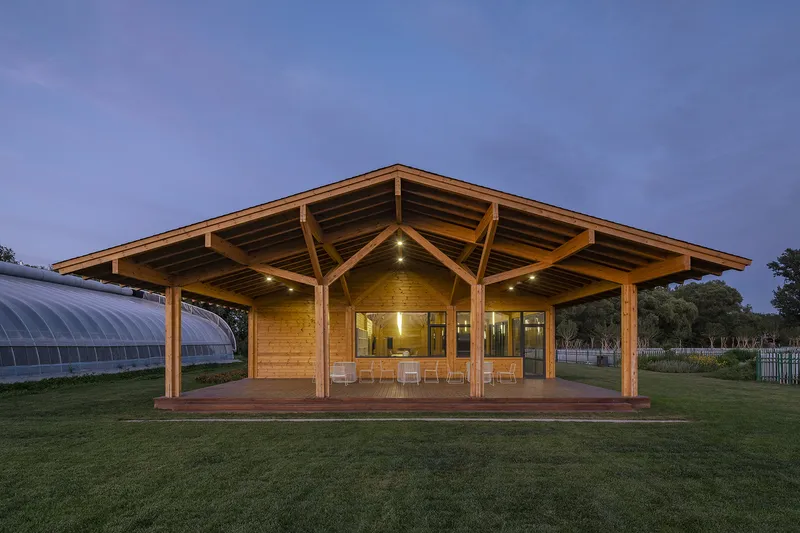
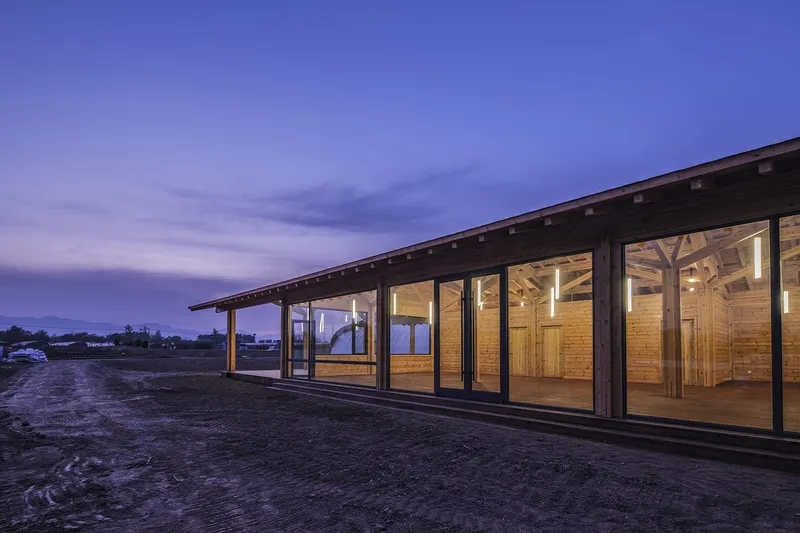
Integrating Functionality and Flexibility
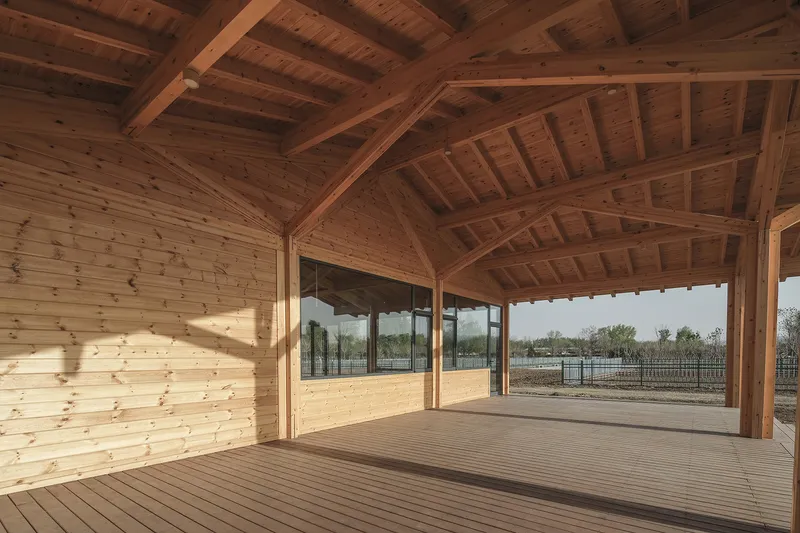
The design of the farm station emphasizes a comprehensive spatial approach, fulfilling all functional requirements from field to table. The building incorporates a kitchen, dining area, and multiple independent rooms designed for workshops and communal cooking activities. The interior spaces are highly adaptable, allowing partition walls to be removed to create a large, continuous open-plan area or subdivided into smaller, interconnected spaces based on user needs.
A semi-outdoor area on the west side connects the building with the surrounding farmland, offering direct views and functional interaction with the landscape. On the south, landscaped zones support adoptive agriculture, with floor-to-ceiling glazing blurring the line between interior and exterior. The north side is designed as a more enclosed space, responding to the local climate.
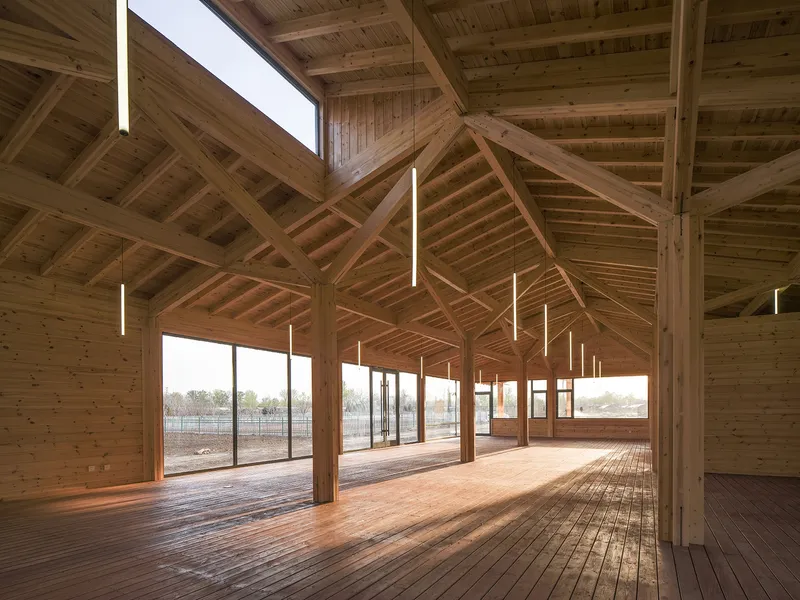
Modular Timber Structure and Material Innovation
The station’s spatial organization uses a column grid system with longitudinal dimensions of 5700mm and depth of 4700mm, assembled in a modular, flexible manner. This allows for variations in light, shade, and spatial divisions without compromising structural clarity.
Timber is the primary material, chosen not just for aesthetics but for its structural efficiency, flexibility, and industrialized assembly. The glued laminated timber (glulam) framework is shaped into umbrella-like forms, supporting a spatial roof system that enables expansion and versatile spatial arrangements. Steel plate components reinforce the structure, connecting timber columns through brackets while creating elegant visual edges and refined joints.
This approach allows for rapid on-site assembly within just two months using prefabricated timber elements. The design strategy supports cross-regional production, lowering costs and overcoming traditional construction barriers in rural areas.


Sustainable and Community-Centered Design
The Beijing Shangzhuang Organic Farm Station serves as a model of sustainable rural architecture, demonstrating how careful material selection and modular design can create functional, aesthetically engaging, and environmentally responsive spaces. It highlights the potential of timber architecture to provide flexible, durable, and scalable solutions for agricultural facilities.
By blending traditional structural logic with modern engineering, hyperSity Architects have created a space that fosters agricultural education, culinary workshops, and community engagement, all while maintaining a strong connection to the natural environment.



Popular Articles
Popular articles from the community


Hill & Cross Opera: Sculptural Opera House Architecture Shaped by Tallinn’s Landscape and Identity
Hill & Cross Opera reimagines opera house architecture in Tallinn through its sculptural hill, civic plaza, glass wave and a luminous cross.

Conexión: Biophilic Design Reimagines High-Rise Living in Hong Kong
Conexión reimagines high-rise living in Hong Kong through biophilic design, green facades, shared spaces, daylight, water and nature within.

Play: Fragments of Their World
Familiar architecture becomes modular playground design, creating safe spaces where displaced children can learn, connect, imagine and play.

The Ocean Hive: Sustainable Architecture for a Self-Sufficient Civilization at Sea
The Ocean Hive imagines sustainable architecture at sea, where modular habitats, algae, wave power and ocean waste sustain a growing colony.


Similar Reads
You might also enjoy these articles

FAMM Arquitectura Organizes Ten Villas Around Courtyards and Jungle in Nosara, Costa Rica
El Molino pairs two elongated volumes with deep overhangs and timber louvers to build a compact coastal community five minutes from the beach.
Oscar Niemeyer's Ibirapuera Park Pavilions Define São Paulo's Cultural Identity in Concrete and Curve
A constellation of modernist volumes set within São Paulo's most important urban park, conceived for the city's 400th anniversary in 1954.
How Henri Picq's 1889 Paris Pavilion Traveled 11,000 Kilometers to Become Santiago's Artequín Museum
A prefabricated iron and glass pavilion built for the Paris Universal Exposition found a second life as a children's art museum in Chile.
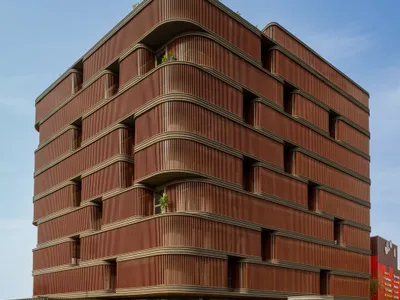
Sanjay Puri Architects Wraps a Jaipur Office Tower in Capsule-Shaped Green Buffers
A nine-level climate-responsive workplace near Jaipur Airport uses stacked planter terraces and aluminium screens to fight 40°C heat.


Explore Modular Farm Competitions
Discover active competitions in this discipline



Challenge to reimagine the Iron Throne


Photograph architecture without architects


Illustrate the lost glory of Angkor Wat - Render Challenge


Design challenge to reuse E-waste
Comments (0)
Please login or sign up to add comments
No comments yet. Be the first to comment!