
BHA Studio Plants Trees Inside a Vietnamese Dental Clinic to Calm Patients Before They Sit Down
A small-town clinic near Hue uses interior courtyards, reflecting pools, and biophilic design to redefine healthcare architecture in Vietnam.

Going to the dentist is not a relaxing experience. The fluorescent lighting, the antiseptic smell, the sound of a drill warming up behind a thin partition: everything about a typical dental clinic is designed for efficiency, not comfort. BHA Studio seems to have taken that universal dread as a design brief. Their Nha Khoa Nu Cuoi Viet Dental Clinic in Phu Bai, a small town near Hue in central Vietnam, is organized entirely around the idea that a medical space can feel like something other than a medical space. Trees grow through the floors. A koi pond sits beneath a staircase. Patients wait in rooms dappled with light filtered through bamboo. The 550-square-meter building is, in almost every respect, the opposite of the clinic you dread.
What makes this project genuinely interesting, rather than simply pleasant, is its refusal to treat biophilic design as decoration. The trees and water features are not ornamental additions bolted onto a conventional plan. They are the plan. The central courtyard, open to the sky, organizes circulation, structures sightlines from treatment chairs, and drives the building's passive ventilation and daylighting strategy. In a dense residential neighborhood where land is tight and budgets are modest, BHA Studio has managed to build a clinic that functions as infrastructure and garden simultaneously.
A Facade That Breathes
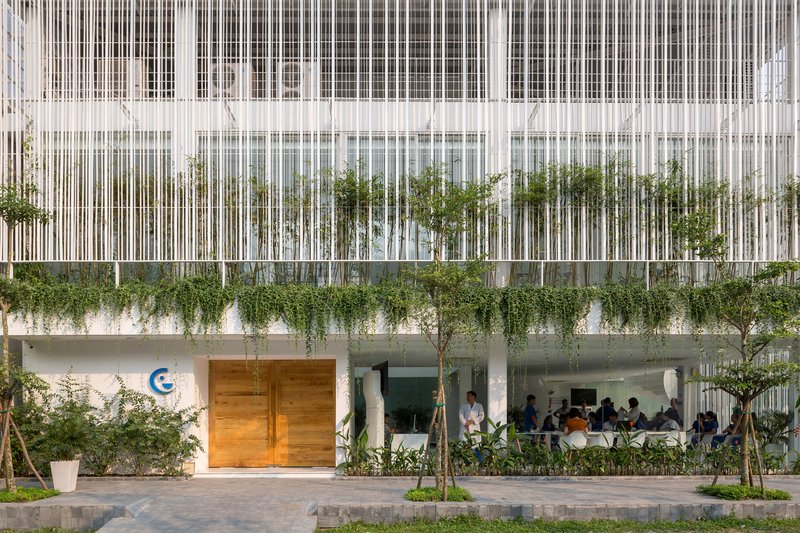
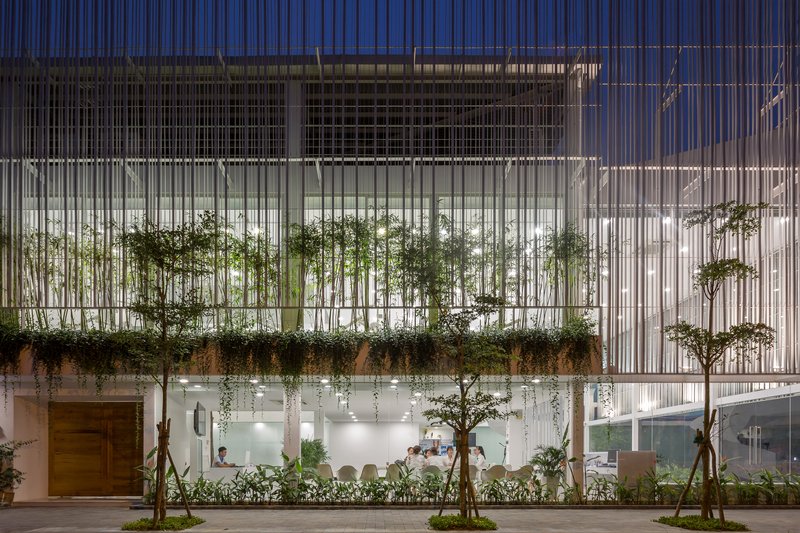
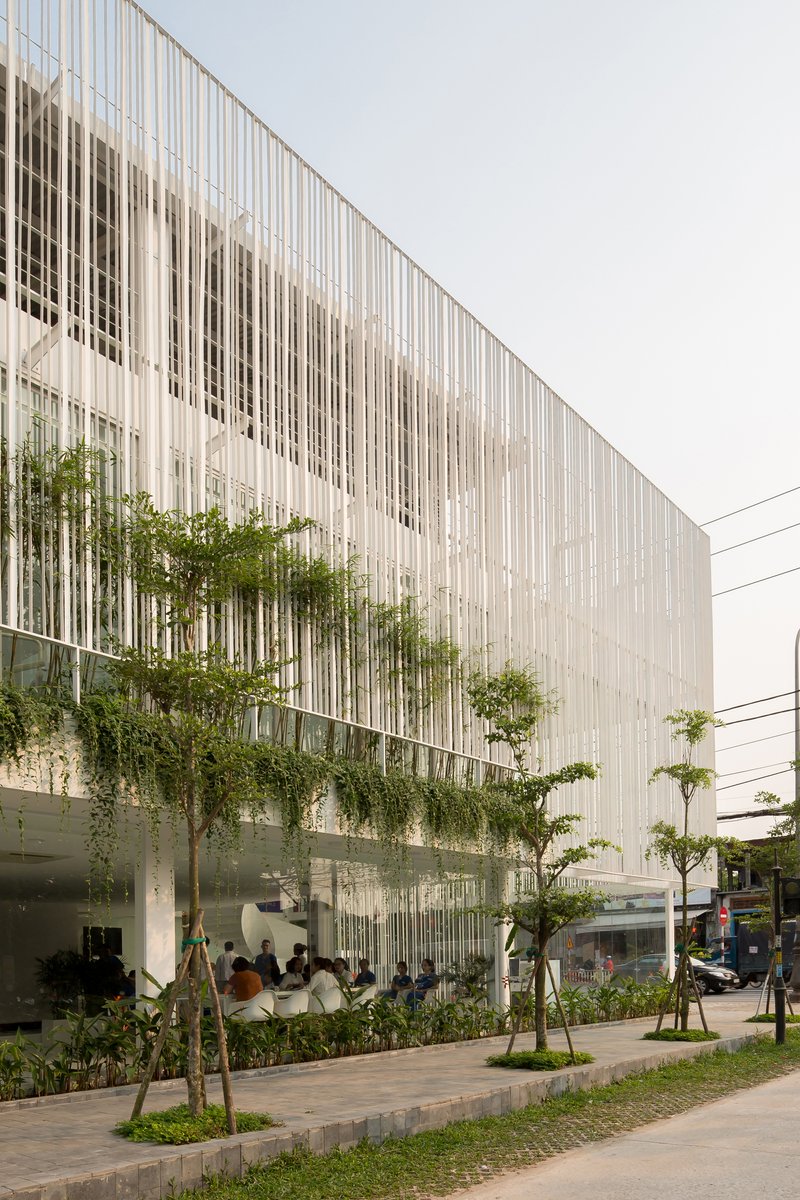
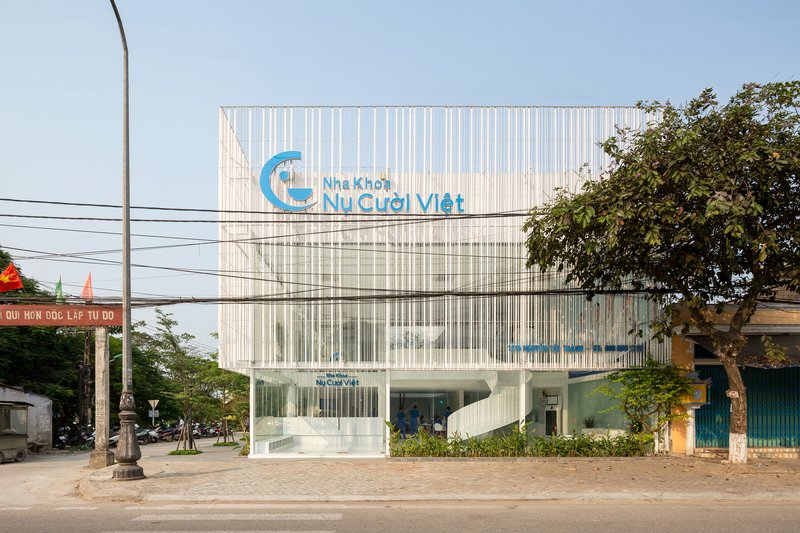
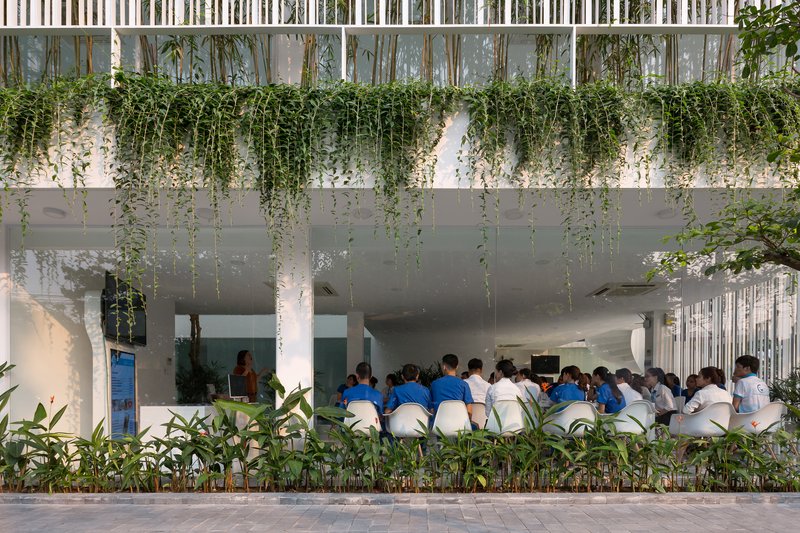
The street-facing elevation is a layered system of vertical white slats, planted terraces, and cascading vines. At dusk, the building glows softly through these screens, the greenery reading as silhouettes against warm interior light. The slats serve a double purpose: they filter the intense central Vietnamese sun while maintaining privacy for patients on the upper floors. Compared to the neighboring houses, which press flat facades hard against the sidewalk, the clinic's planted setback creates a micro-landscape that belongs as much to the street as to the building.
The choice of white for the louvers and structure is deliberate. Against the tropical foliage and the weathered tones of the surrounding neighborhood, the clinic reads as clean and clinical without being cold. Climbing vines are already beginning to soften the geometry, and in a few years the facade will be as much plant as architecture. That temporal dimension, designing for a building that looks better with age, is rare in healthcare buildings.
The Courtyard as Operating System
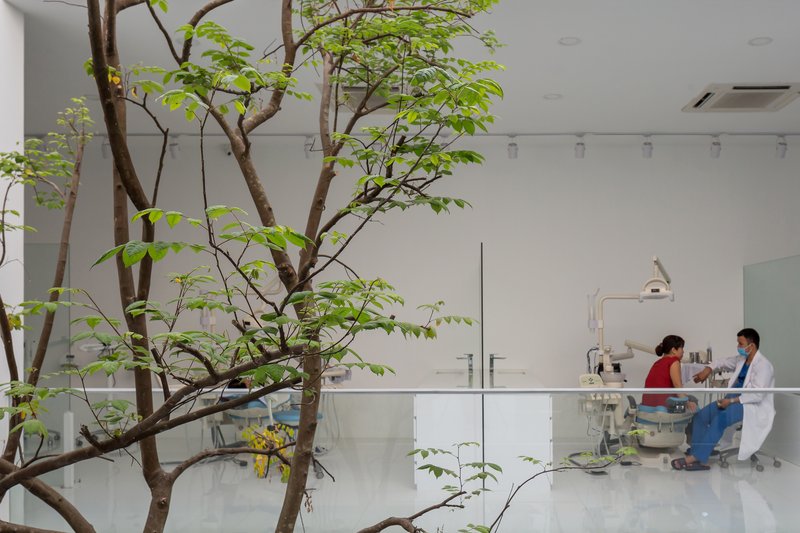
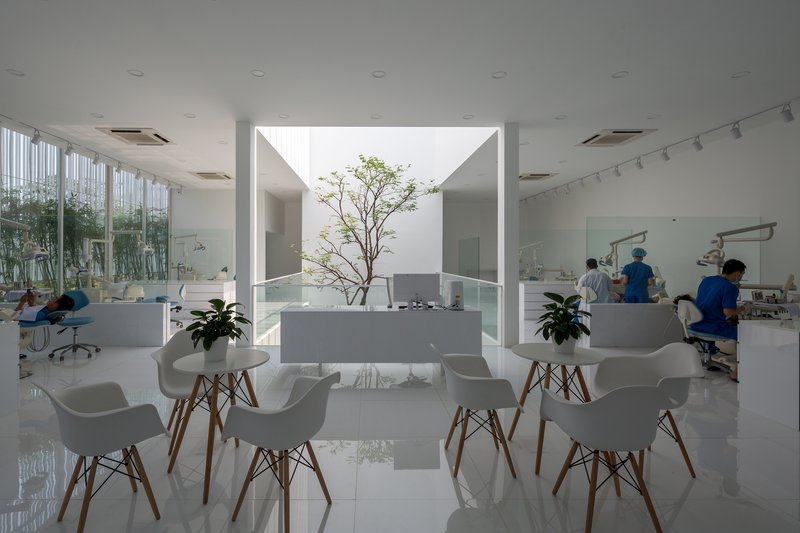
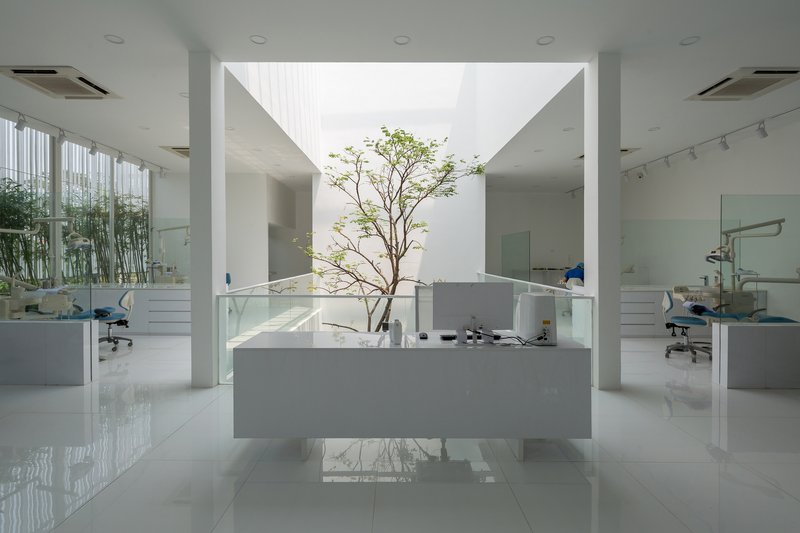
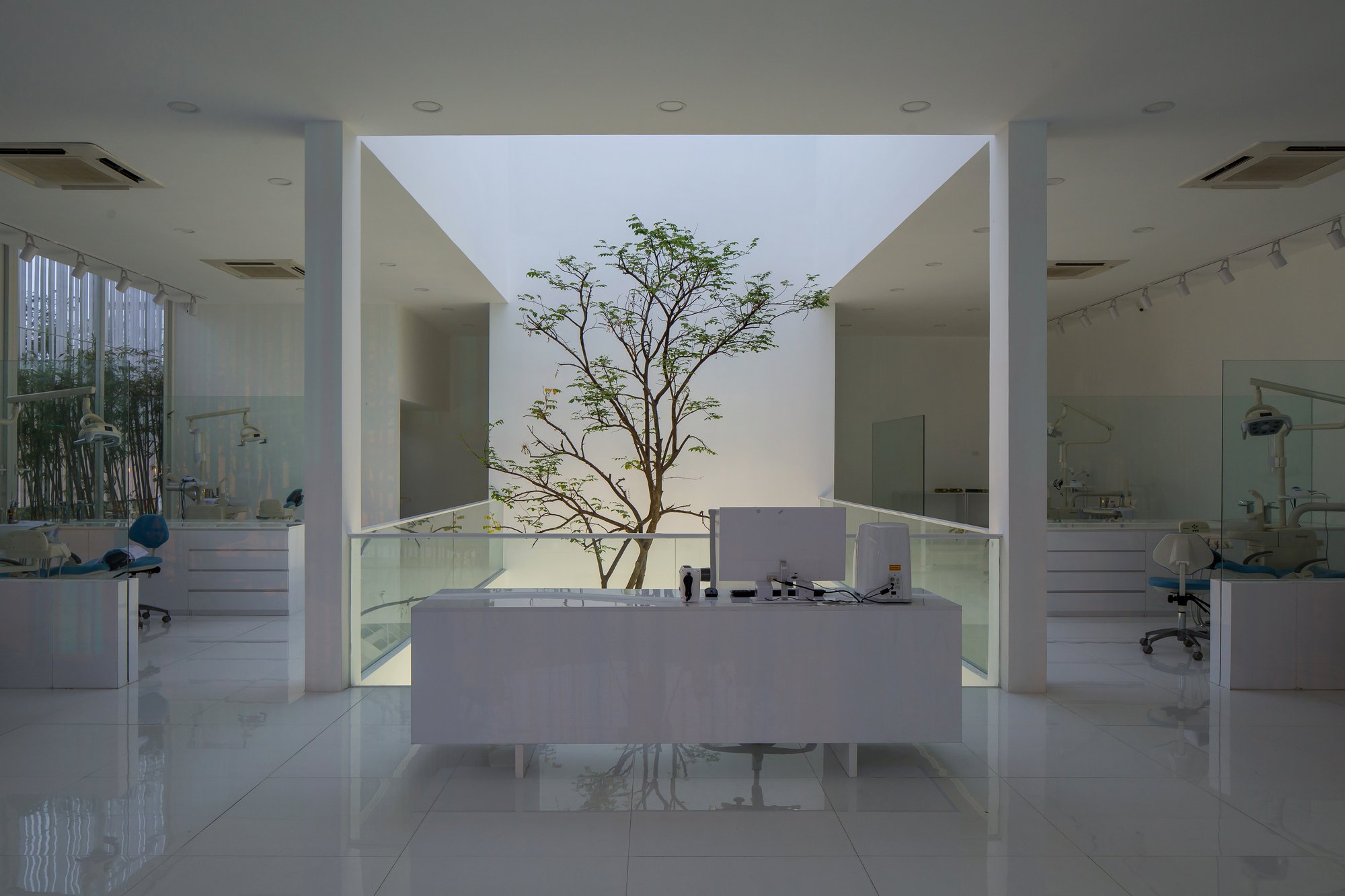
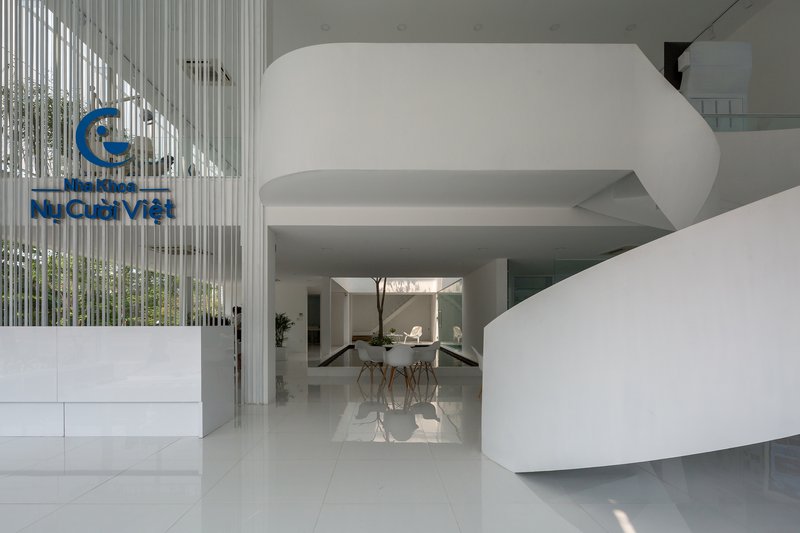
The entire building pivots around a central courtyard punched through the floor plates. A tree rises from the ground level, growing upward past balustrades and through a generous skylight. Treatment chairs are oriented to face this courtyard rather than a blank wall. Waiting areas ring it. The reception desk sits beneath it. Every moment spent inside the clinic, whether you are a patient, a dentist, or a receptionist, includes a view of sky, leaves, or both.
This is a smart spatial economy. In a compact footprint, the courtyard provides natural ventilation (hot air rises out through the skylight), daylight deep into the plan (eliminating the need for artificial lighting during working hours), and a psychological anchor that orients visitors without signage. It is doing the work of an HVAC system, a light well, and a wayfinding strategy all at once.
Water, Light, and the Anti-Clinic
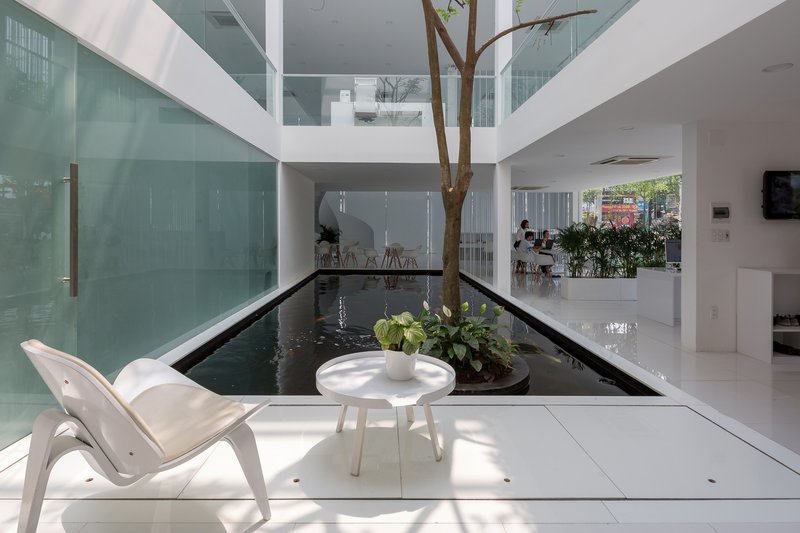
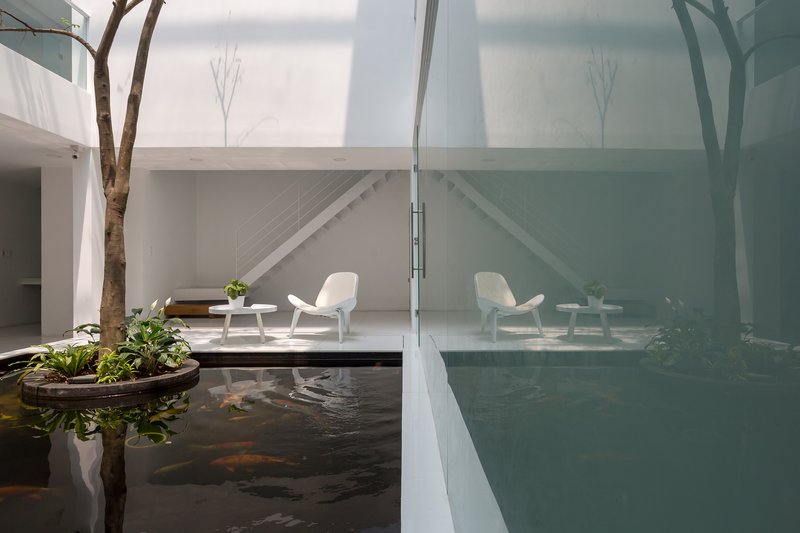
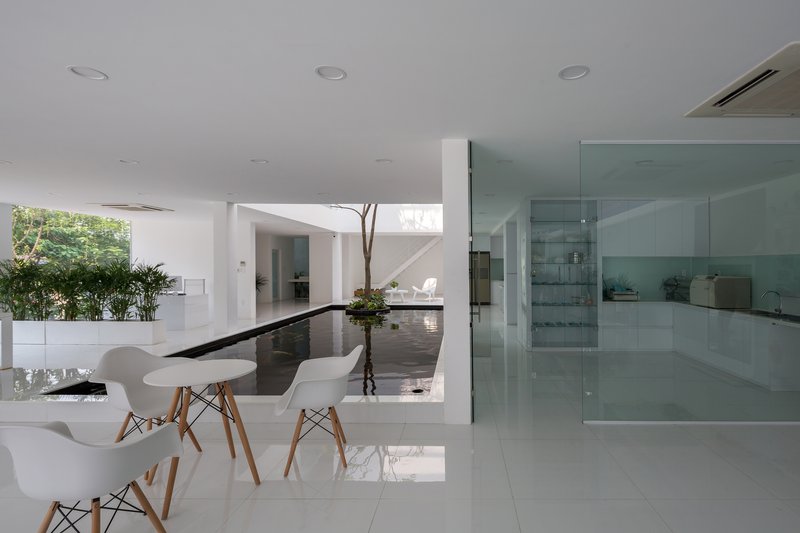
At ground level, a reflecting pool stretches alongside a lounge chair beneath the staircase, and a koi pond catches light from a frosted glass wall. These are not luxury spa gestures. They are calibrated elements of a strategy to lower anxiety. The sound of water, the movement of fish, the play of reflected light on polished white surfaces: all of it works to shift the patient's mental state before they encounter the drill.
The polished floors amplify this effect, bouncing light upward and creating a luminous, almost weightless atmosphere. BHA Studio has clearly studied how materials behave under natural light in this climate. The reflections double the greenery, making the interior feel larger and more garden-like than its 550 square meters would suggest.
Treatment Rooms with a View
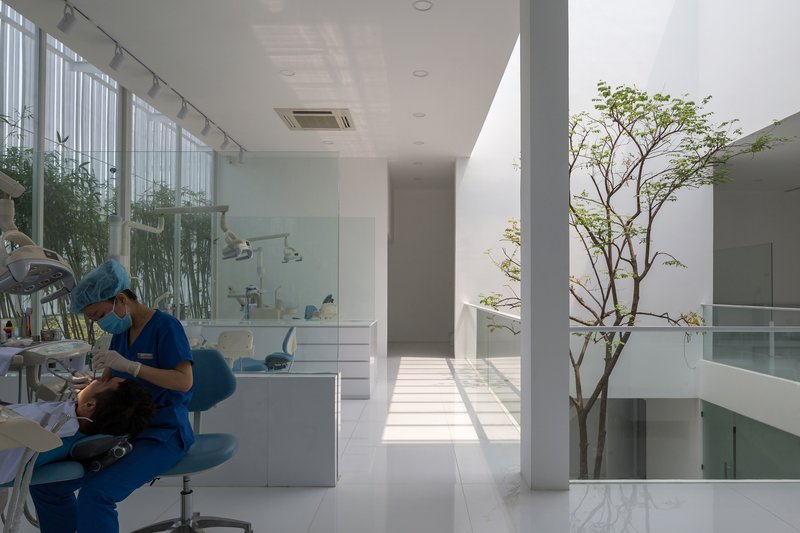
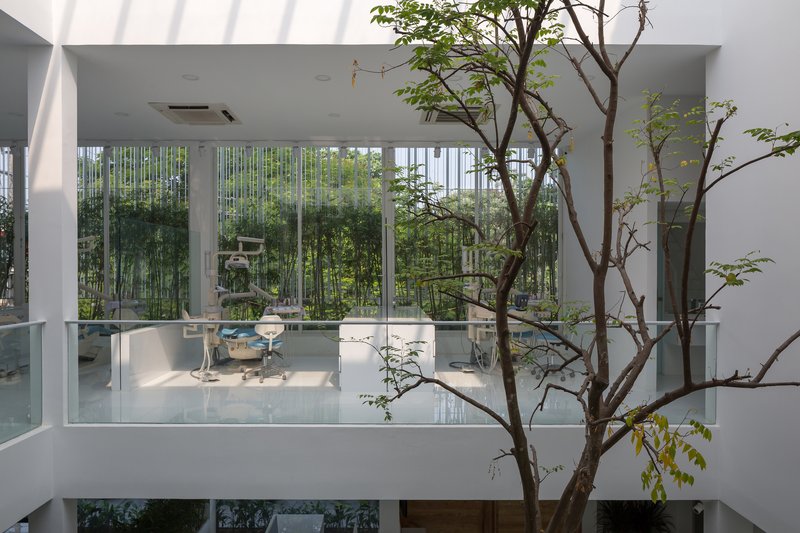
The most radical move here is positioning the dental chairs beside the interior courtyard. Patients reclined in treatment chairs look up at tree canopy and sky rather than acoustic ceiling tiles. There is growing evidence that views of nature reduce perceived pain and accelerate recovery, and BHA Studio has taken that research literally, placing the most stressful moments of the patient experience in direct contact with the building's most calming element.
A curved white sculptural volume wraps around the courtyard at the reception level, creating a soft boundary between the public waiting zone and the clinical areas behind glass partitions. The form is generous without being wasteful, guiding patients through the building with gentle curves rather than hard corridors.
Bamboo Screens and Filtered Light
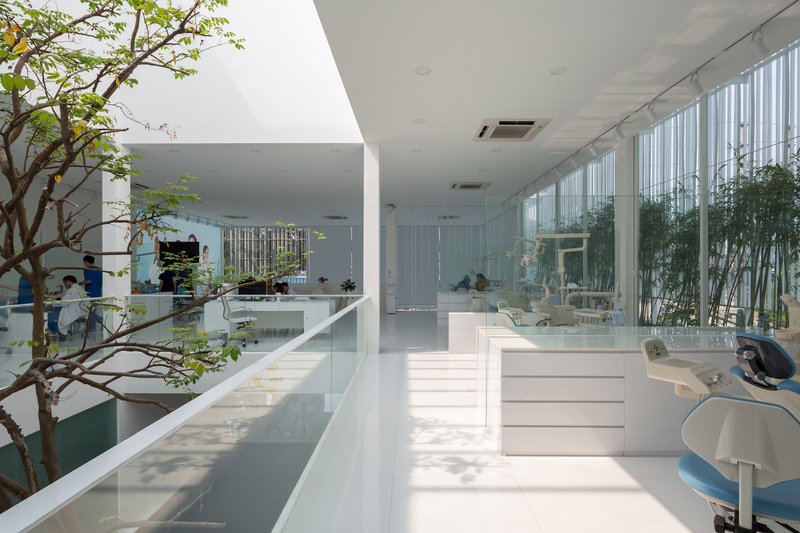
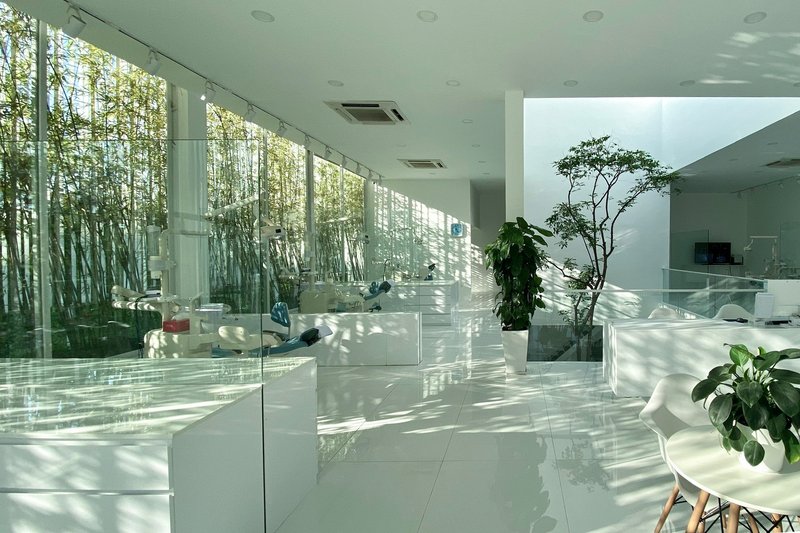
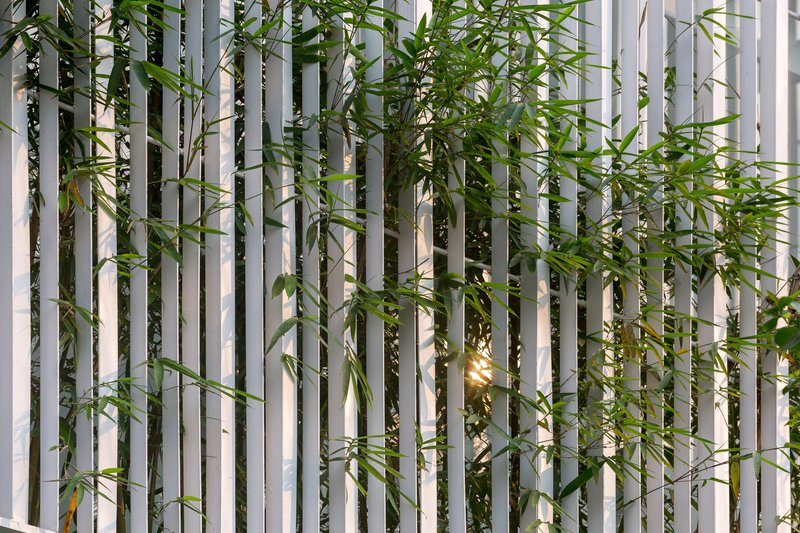
Beyond the white slats, bamboo plays a secondary but essential role in the building's light-filtering strategy. Along the facade, bamboo foliage casts dappled shadows across the polished interior floors, creating a constantly shifting pattern that changes with the sun's angle throughout the day. The workstation areas benefit most from this effect. Staff spend long hours at these desks, and the dynamic light quality keeps the space feeling alive without the distraction of a direct view to the street.
At the ground floor, vertical bamboo screens define a semi-outdoor zone where visitors can sit beneath planted concrete slabs. This threshold space, neither fully inside nor fully outside, is a common strategy in Vietnamese vernacular architecture, adapted here to a contemporary medical program.
Neighborhood Context
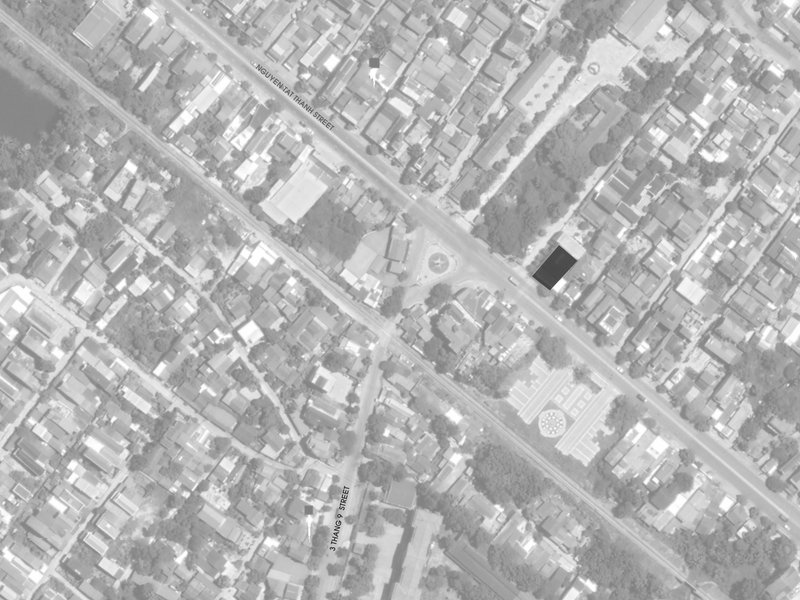
The aerial view reveals just how tightly packed the surrounding residential fabric is. The clinic sits within a dense grid of narrow lot houses, its rectangular volume conforming to the neighborhood's dimensional logic while its planted terraces and white screens distinguish it without shouting. Phu Bai is not a wealthy district; this is not a vanity project for an urban elite. The building is serving a local community that previously had limited access to quality dental care, and BHA Studio has delivered architecture that dignifies that mission without inflating the budget.
Plans and Drawings
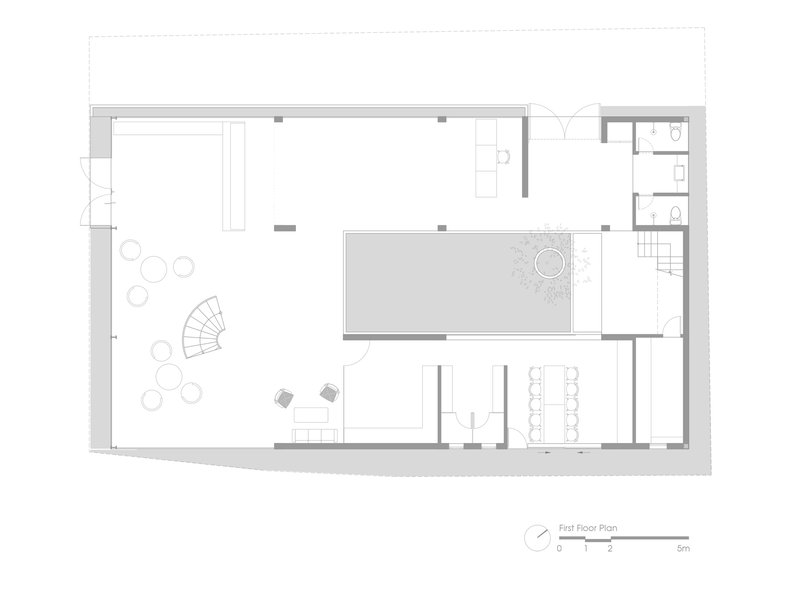
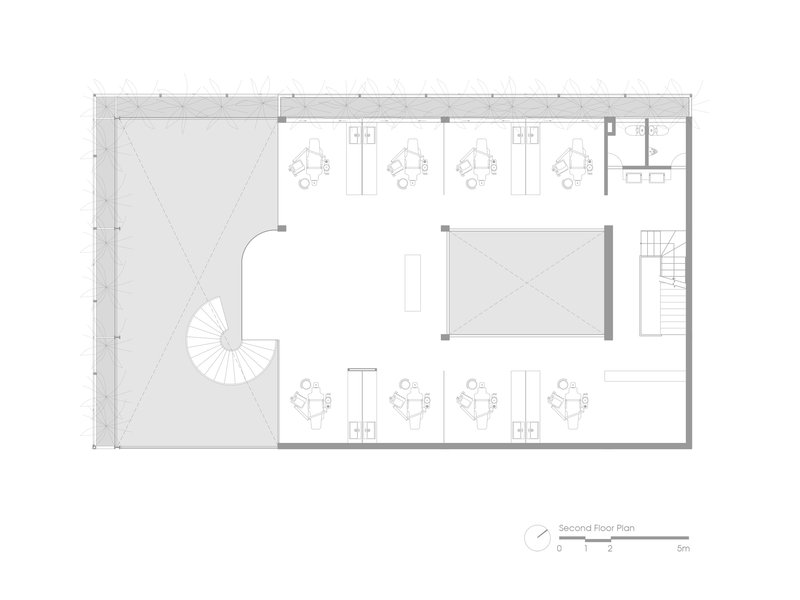
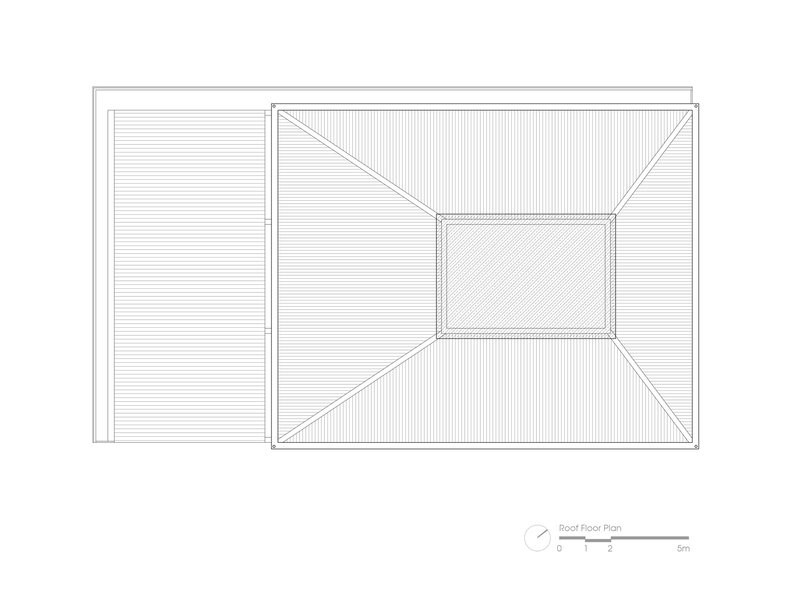
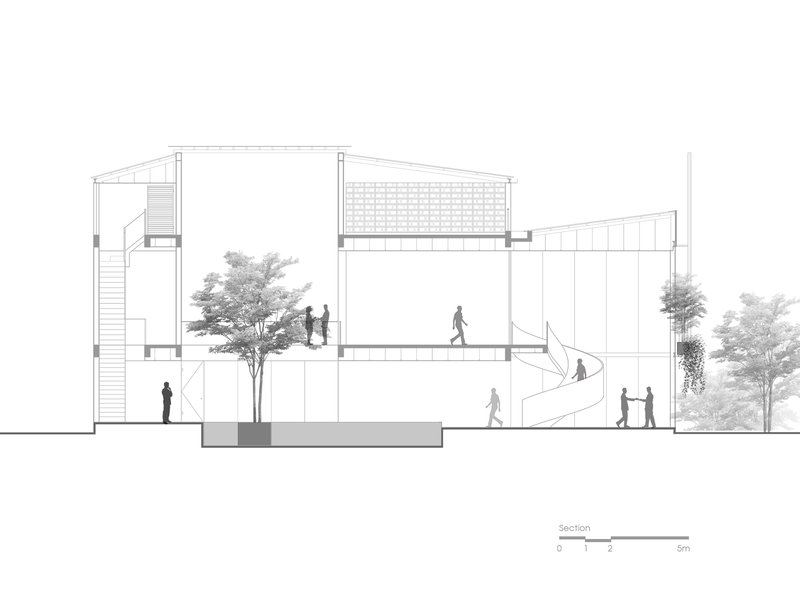
The floor plans confirm what the photographs suggest: the courtyard is truly central, punched through every level. The first floor plan shows an open reception zone wrapping around the void, with a spiral staircase providing vertical circulation. By the second floor, workstations and treatment rooms are arranged around a more enclosed central room, likely a private treatment suite. The section drawing is particularly revealing, showing the full height of the interior trees and the way figures move among them across multiple levels. The spiral stair threads through the building like a spine, compact enough to preserve floor area but generous enough to feel ceremonial.
The roof plan shows a hipped roof with diagonal slope lines directing rainwater away from the central courtyard opening. It is a practical detail that speaks to the building's awareness of Hue's heavy monsoon rains, a climate condition that could easily compromise an open courtyard strategy if not handled with care.
Why This Project Matters
Healthcare architecture in Southeast Asia too often defaults to two modes: the utilitarian government clinic or the glossy private hospital. BHA Studio's dental clinic in Phu Bai offers a third path. It proves that biophilic design is not a luxury reserved for corporate headquarters and boutique hotels. It can work in a 550-square-meter medical building in a small town, on a modest budget, using local plants and straightforward construction. The building does not perform sustainability; it simply performs well.
More broadly, this project challenges the assumption that medical environments must look and feel medical. By centering the plan on a living courtyard, BHA Studio has created a space where the architecture itself becomes part of the care. Patients arrive anxious and encounter water, trees, and sky before they encounter a dental chair. That sequence is not an accident. It is the design.
Nha Khoa Nu Cuoi Viet Dental Clinic by BHA Studio, located in Thị xã Hương Thủy (Phu Bai), Vietnam. 550 m². Completed in 2019. Photography by Hoang Le.
About the Studio
Share Your Own Work on uni.xyz
If projects like this are the kind of work you want to make, uni.xyz is a place to publish your own, find collaborators, and enter design competitions.




Popular Articles
Popular articles from the community

The Faith: Modular Architecture for Play, Learning, and Hope in Kutupalong Refugee Camp
A modular playground architecture project in Bangladesh where play, learning, safety, and hope rebuild childhood inside a refugee camp anew.

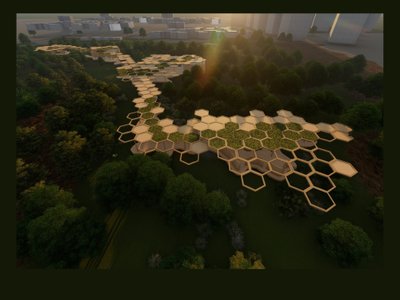
Eco Chapel: A Green Architecture Pavilion Designed in Symbiosis with the Forest
Eco Chapel uses green architecture to weave prayer, learning and reuse into a forest pavilion shaped by modular hexagonal canopies for life.
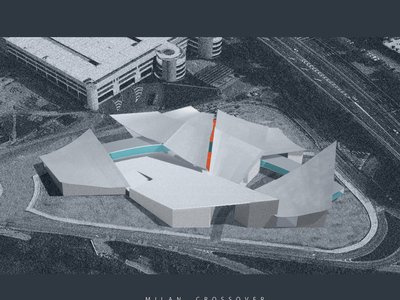
Milan Crossover: Sustainable Architecture for a New Fashion Culture in Milan
Milan Crossover transforms fashion culture through sustainable architecture, linking material libraries, remake studios, and public runways.
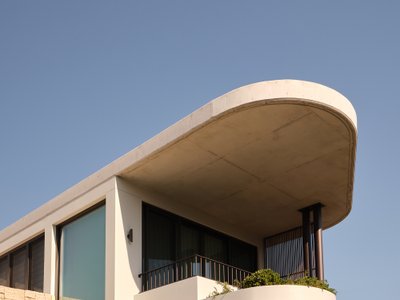
Stanton Architects Sculpts a Curving Family Home into Sydney's Inner West Fabric
Five Dock House uses cantilevers, curved concrete, and layered courtyards to carve out privacy on a tight suburban lot in Sydney.


Similar Reads
You might also enjoy these articles
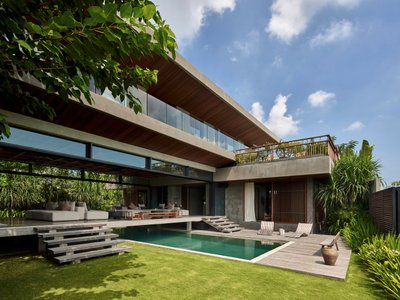
Freebird Residence by Alexis Dornier: A Tropical Modernist Sanctuary in Bali
Floating living pavilion above pool anchors H-shaped tropical villa, blending Japanese minimalism, sustainable strategies, lush landscape, and sculptural interiors.
127af Flips a Tiny Bagnolet Rowhouse Upside Down with a Handcrafted Roof Extension
A 55-square-meter terraced house on the edge of Paris gains a luminous upper living floor through lightweight timber and steel.
1.61 Design Workshop Wraps a 600-Square-Meter Café in Vietnam in Sculptural Burgundy Drama
Reden Café & Bistro pairs a helical staircase, mosaic floors, and deep red interiors to rethink Vietnamese hospitality space.

The Unbound Brain: A School Shaped by Cognitive Architecture
Cylindrical learning pods radiate like neurons from a central cortex, turning the floor plan into a spatial model of human thought.

Explore Public Building Competitions
Discover active competitions in this discipline




The International Standard for Design Portfolios


The Global Benchmark for Architecture Dissertation Awards


The Global Benchmark for Graduation Excellence


Challenge to design locus for the upliftment of human rights
Comments (0)
Please login or sign up to add comments
No comments yet. Be the first to comment!