
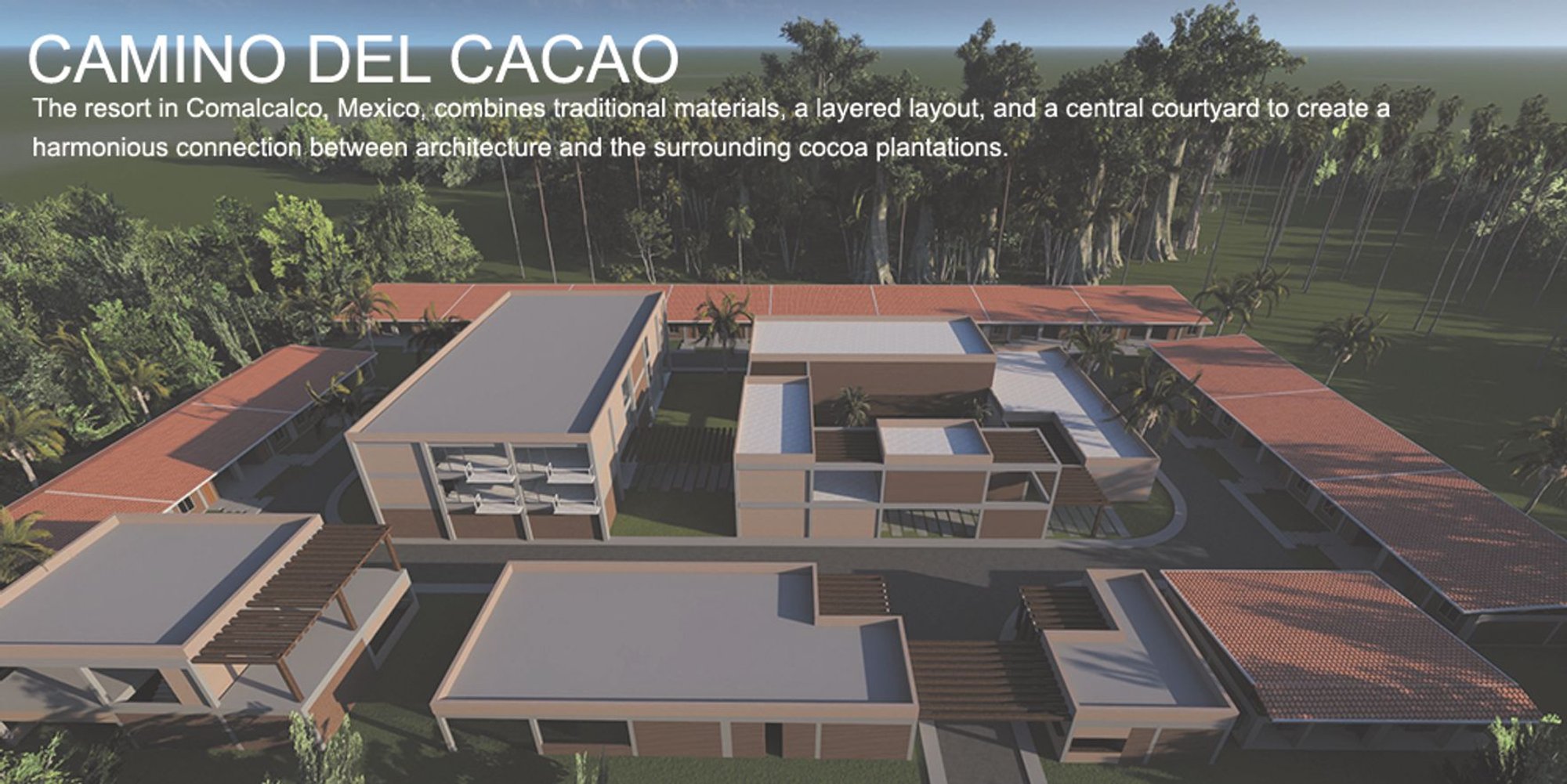
Camino del Cacao: A Resort Woven into Mexico's Cacao Plantations
In Comalcalco, Tabasco, a courtyard-centered hospitality concept dissolves the boundary between tropical resort and working cacao landscape.

What happens when a resort refuses to treat landscape as scenery and instead treats it as programme? Camino del Cacao answers that question by embedding its hospitality spaces directly within the cacao fields of Comalcalco, Mexico, turning the crop that defined the region's identity into the spatial logic of the entire complex. Rather than clearing land for architecture, the design positions low-slung volumes among existing plantations, so that the aroma, texture, and history of cacao production become inseparable from the guest experience.
Designed by Muge D, Camino del Cacao is a shortlisted entry in the Xocolatl competition. The brief called for an architectural response to cacao culture, and this proposal roots itself in Tabasco's humid tropical climate and the agricultural heritage of Comalcalco, one of the oldest cacao-producing zones in Mesoamerica. The result is a resort that doubles as a cultural retreat and an educational hub celebrating the legacy of cacao.
Flat Roofs and Palm Canopies: An Aerial Reading
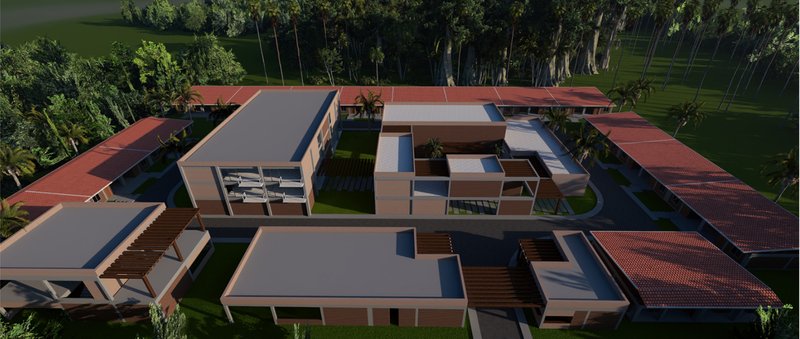
From above, the compound reads as a collection of flat-roofed volumes loosely arranged around courtyards, lawns, and clusters of palm trees. The buildings sit low, deferring to the tree canopy rather than competing with it. This deliberate restraint in scale means the resort never dominates its site; instead, the architecture operates at the height of the surrounding vegetation, blurring the line between built form and tropical landscape. The aerial view reveals how the courtyard layout generates a sequence of outdoor rooms, each shaded and ventilated by the gaps between volumes.
A Central Courtyard as Social and Spatial Engine
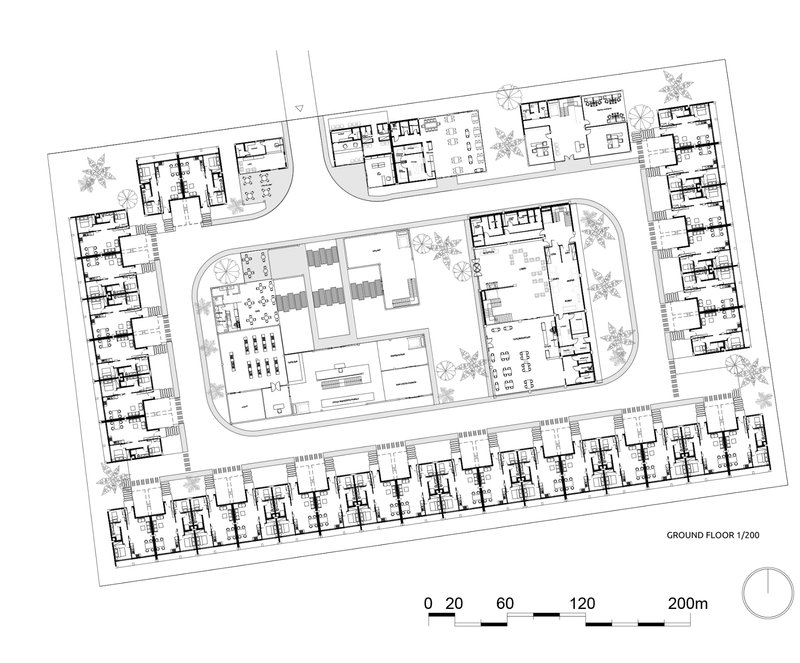
The ground floor plan makes the organizing principle explicit. A spacious central courtyard, anchored by a pool and community spaces, acts as the social and spatial core of the entire resort. Residential buildings radiate outward from this centre, creating a gradient from public gathering to private retreat. The plan shows how circulation works: guests move through shaded walkways that bridge indoor and outdoor zones, never forced into corridors but guided by landscape and shade.
This courtyard-centred approach does serious environmental work in Tabasco's humid climate. Natural cross-ventilation flows through the open core, reducing dependence on mechanical cooling. The pool and planted areas introduce evaporative cooling at the centre of the plan, while wide eaves and verandas visible in the drawing protect interiors from direct sun and tropical rain. It is spatial planning that performs as climate strategy.
Terra Cotta Volumes Among Tropical Greenery
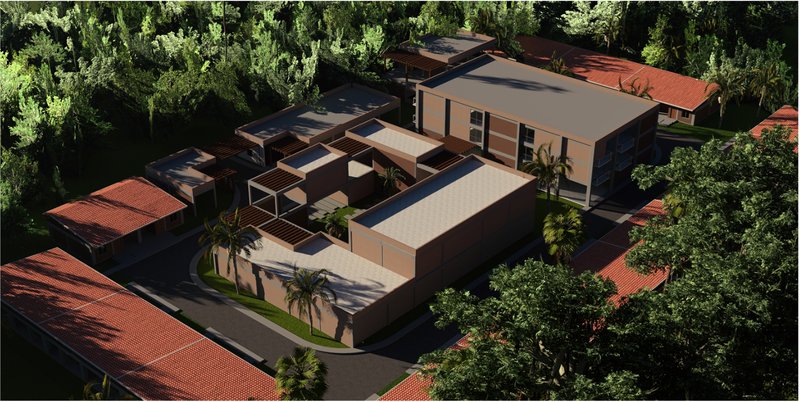
The oblique aerial view reveals the material palette at work: terra cotta tile roofs, earthy tones, and what appear to be clay and wooden surface treatments give the volumes a warmth that belongs to the land rather than to an imported aesthetic. These local materials ground the architecture in Tabasco's building traditions while the contemporary layout, with its clean geometries and open connections to the plantation, keeps the design firmly present-tense. Dense tropical vegetation fills the gaps between buildings, reinforcing the sense that the resort was inserted into the landscape, not imposed upon it.
The clustered massing is worth noting. By breaking the programme into discrete, human-scaled volumes rather than a single monolithic structure, the design ensures that every room maintains a direct relationship with the outdoors. Private residences extend toward the cocoa fields, and shared amenities open onto planted courtyards. Light and shadow play across the built surfaces throughout the day, producing an atmosphere of warmth and authenticity that no imported finish could replicate.
Why This Project Matters
Camino del Cacao makes a compelling case that hospitality architecture in agricultural regions should not merely reference local culture through decoration. It should be structured by it. By using the cacao plantation as the site's organizing landscape, and by building with local materials at a scale that respects the tree canopy, the design turns a resort stay into a form of cultural participation. Guests do not observe the narrative of cacao production from a distance; they move through it.
The project also demonstrates how courtyard typologies, often associated with arid climates, can be adapted to humid tropical conditions with the right combination of ventilation strategy, shading devices, and planted buffers. For Comalcalco, a town with deep agricultural roots and growing tourism potential, a project like this could serve simultaneously as a hospitality landmark and an educational platform. Muge D's design suggests that the most sustainable resort architecture is the kind that makes its region's heritage legible through every spatial decision.
View the Full Project
About the Designers
Designer: Muge D
Enter a Design Competition on uni.xyz
uni.xyz runs architecture and design competitions year-round that reward proposals with spatial conviction and real site intelligence.
Project credits: Camino del Cacao by Muge D Xocolatl (uni.xyz).




Popular Articles
Popular articles from the community

20 Most Popular Office Building Projects of 2025
From biophilic workspaces in India to net-positive energy offices in New Delhi, 20 office building projects that defined architecture in 2025.

Fausto Terán and Toro Fuse Japanese Craft with Mexican Tradition in a Lakeside Retreat
Nakamura House pairs Shou-Sugi-Ban charred pine with handmade clay tile at the foot of Atlangatepec Lagoon in Mexico.
Bernardes Arquitetura Stretches a Timber Roof Along a Reservoir's Edge in Minas Gerais
Dam House in Itaúna lets a sweeping wooden canopy dissolve the boundary between hillside terrain and open water.
3dor Concepts Wraps a Kerala Home in Mirrored Concrete Arcs Around a Courtyard Tree
In the Western Ghats foothills of Thamarassery, a 270 m² single-story house uses two curved volumes to frame nature as its center.

Similar Reads
You might also enjoy these articles

Mechanism of Memories: Adaptive Architecture Reimagines Offshore Structures as Living Cultural Machines
Floating adaptive architecture transforms abandoned offshore structures into cultural spaces that preserve memory, habitation, and human connection.
Wildlife Rehabilitation Architecture in Australia: A Regenerative Sanctuary for Koalas by Philip Skein and Keegan Mayber
A regenerative wildlife sanctuary in Queensland redefines sustainable architecture through habitat restoration, healing, and ecological awareness.
The Interfusion: Mobile Performance Architecture Reconnecting Art and Public Space
A mobile performance architecture project transforming Madrid’s streets into inclusive cultural spaces through adaptive urban design.
Biophilic Architecture and Regenerative Stadium Design: Biophilia Lagos by Rachel George
A regenerative stadium in Lagos transforms landfill into a living ecosystem through biophilic architecture, waste reuse, and environmental healing.






Comments (0)
Please login or sign up to add comments
No comments yet. Be the first to comment!