

CCDI Dongxiying Studio Transforms a Shenzhen Elementary School into a Terraced Nine-Year Campus
A cascading school complex along the Dasha River Ecological Corridor redefines the density of education in Shenzhen's urban fabric.


Shenzhen keeps building upward and outward, and its school infrastructure has to keep pace. The redevelopment of Pingshan Elementary School into a nine-year integrated campus by CCDI Dongxiying Studio is a 63,981 square meter exercise in making a single site serve twice the programmatic load it was designed for. Instead of the typical slab-and-courtyard typology that plagues Chinese school design, the studio chose to terrace the building mass into a cascading section that steps down toward the Dasha River Ecological Corridor on the site's western edge. The result reads less like a school and more like a planted hillside that happens to contain classrooms, a gymnasium, a swimming pool, and underground parking.
What makes the project genuinely interesting is the way it negotiates between civic generosity and institutional enclosure. The ground level is porous, colonnade-heavy, and visually connected to the surrounding neighborhood. As you move up, the terraces pull inward, creating progressively more sheltered environments for younger students. The bougainvillea that drapes the balcony planters is not decorative filler: in Shenzhen's subtropical climate, it is a fast-growing solar screen, a microclimate modifier, and a signal that this building was designed to be completed by time rather than at handover.
A Terraced Section Along the River
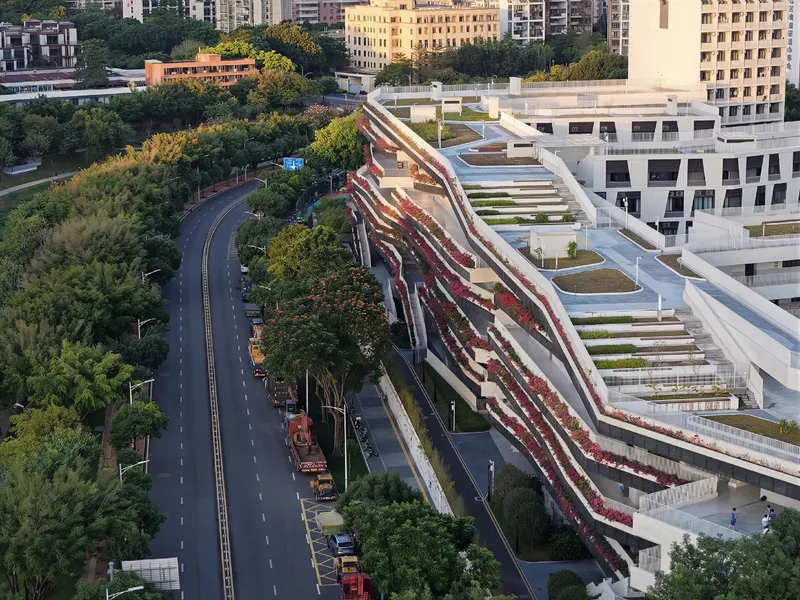

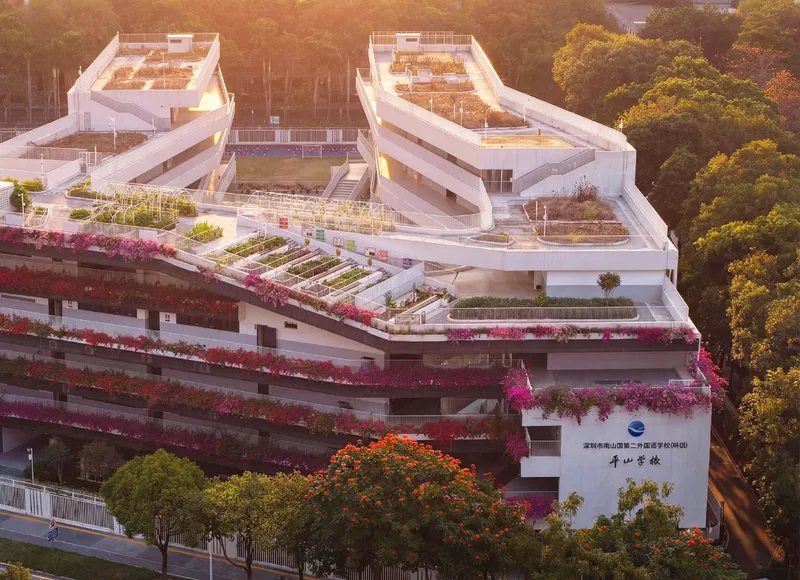
The aerial view makes the logic immediately legible. The building's massing steps down toward the Dasha River in broad terraces, each level pulling back to expose the one below it to sky and air. From the street, the cascading profile creates a monumental presence without the bluntness of a vertical wall. From the river corridor, the terraces merge with the tree canopy to soften the boundary between infrastructure and ecology.
The planted balconies are continuous horizontal bands of bougainvillea, and at golden hour the pink and red vines turn the white concrete into something almost geological: a planted cliff face. It is a deliberate strategy. The planters provide passive shading to the classrooms behind them, reduce glare off the concrete, and, critically, give each floor an outdoor threshold that is neither corridor nor courtyard but something in between.
Ground Level: Porosity and Public Life

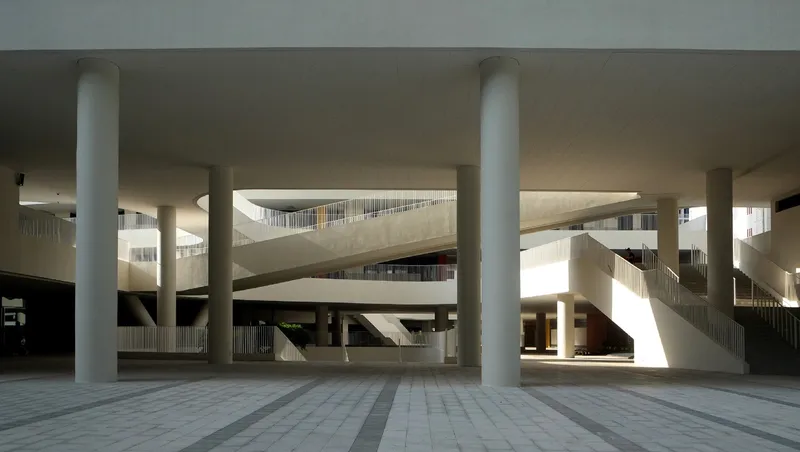
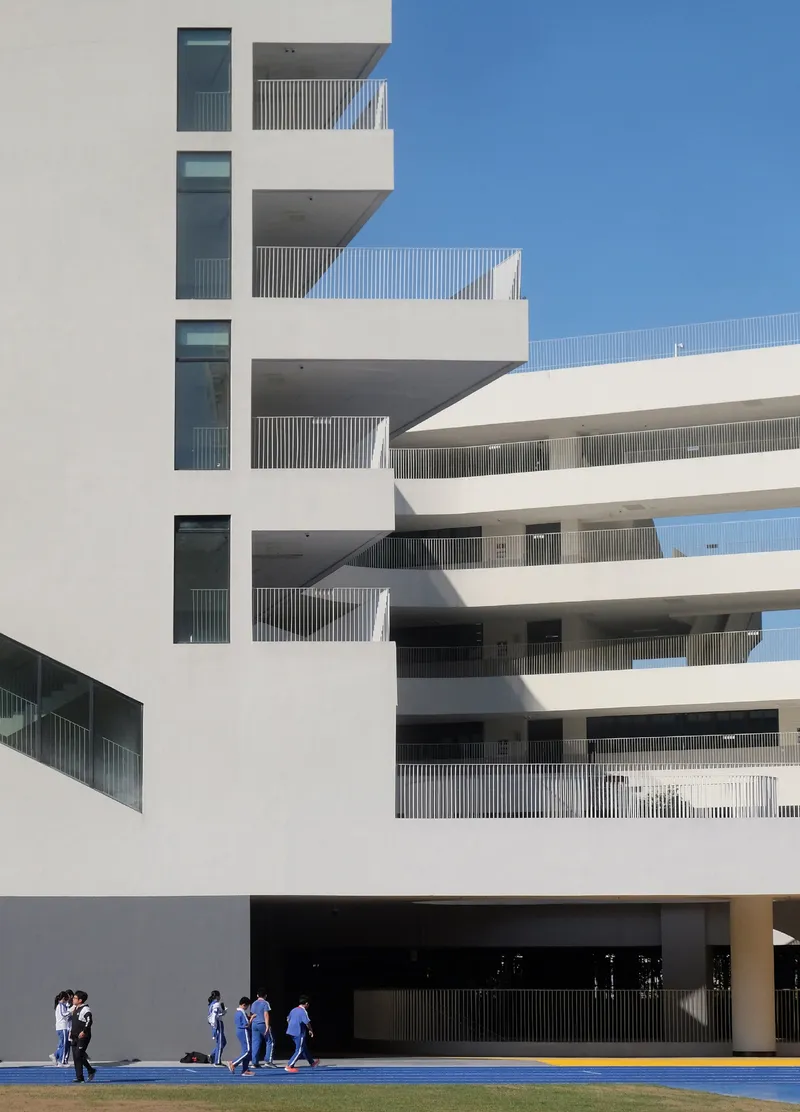
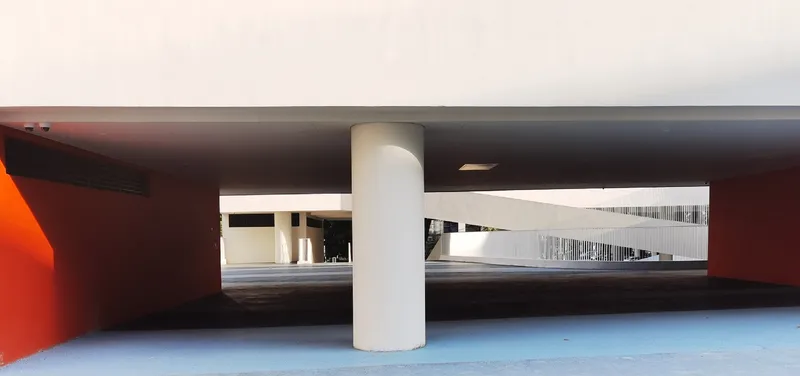
The ground plane is where CCDI Dongxiying Studio makes its strongest argument for the school as a piece of urban infrastructure rather than a walled compound. Colonnades of cylindrical columns create deep, shaded undercrofts that frame views through to the sports fields and courtyards within. Pedestrians and joggers share the perimeter lawn, and the blue-painted pavement beneath the vertical louvres doubles as an informal gathering zone before and after school hours.
The covered plazas are generous. Multilevel ramps and balconies are visible through the column grid, so the section of the building is always on display. You understand, from the sidewalk, that this is a complex, layered organism. The transparency is deliberate: it builds trust between school and city, something that matters in a district where public space is at a premium.
Interior Circulation and the Curved Atrium
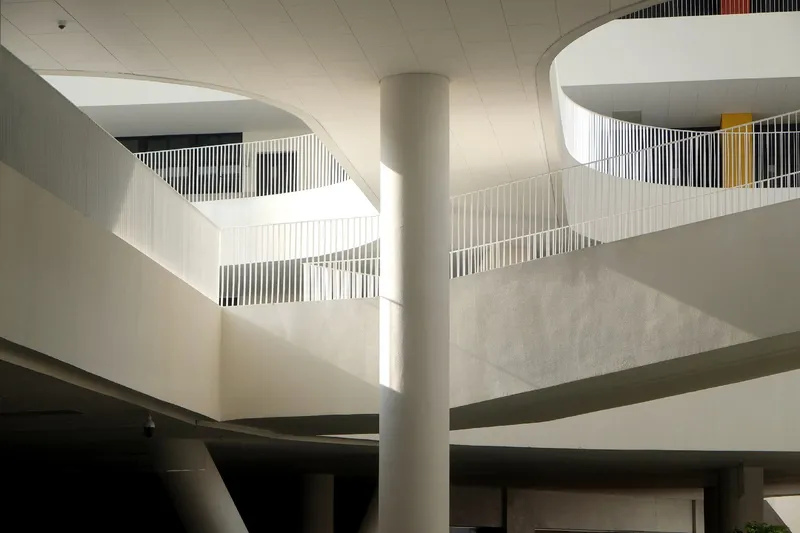


Inside, the circulation spaces are the most architecturally resolved part of the project. The central atrium uses curved balconies with vertical slat railings to create a warm, light-filled void that organizes movement across floors. Morning sunlight enters at a low angle and washes the interior faces of the balconies, producing a softness that the exterior's angular white planes do not suggest. The vertical timber slats recur at different scales: as balustrades, as light screens at the entry stair, and as facade elements on the exterior.
The covered walkway with its curved concrete soffit is a particularly strong moment. It functions as a breezeway connecting classroom wings, but its section is sculpted to accelerate natural ventilation and to create a sense of enclosure without claustrophobia. For a school that serves students from age six through fifteen, these transitional spaces do a lot of work. They are the places where casual interaction happens, where age groups mix, and where the building teaches spatial literacy by simply being well made.
Athletics Below Grade and Under Daylight


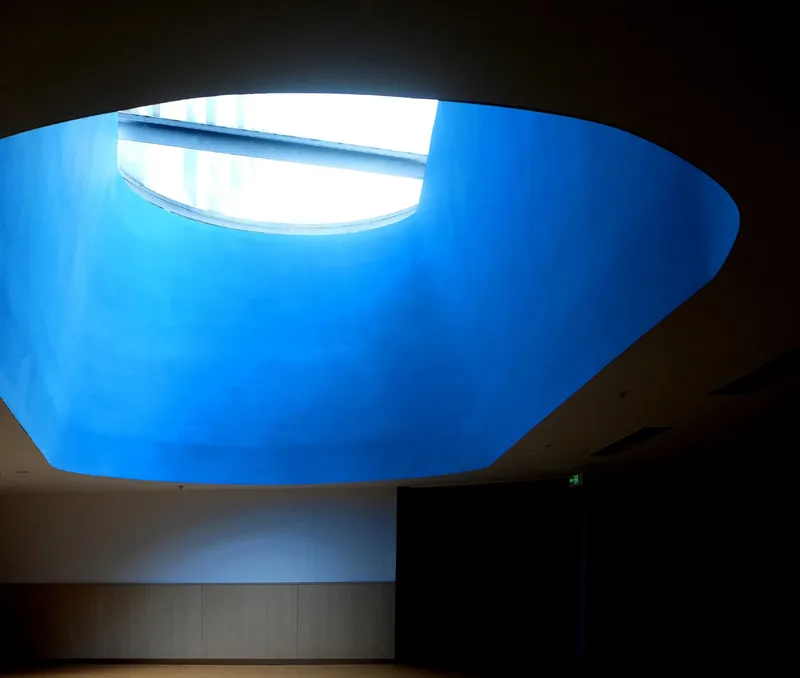
Burying the gymnasium and swimming pool below grade is a common density move, but the execution here is well above average. The gymnasium features a coffered concrete ceiling that gives the space structural depth and acoustic texture. The pool hall uses a waffle slab ceiling with clerestory windows that pull in greenery from the courtyard above, so the experience of swimming is not of being underground but of being in a protected garden room.
The oval skylight is a highlight. It punches through the section to bring a column of blue sky into the deep plan, turning a service floor into a moment of spatial delight. Combined with the orange-accented parking level visible in the basement, these underground spaces demonstrate that the architects treated every square meter of the 63,981 square meter program with equal seriousness, regardless of visibility.
Concrete, Bougainvillea, and Climate

The material palette is deliberately restrained: white and off-white concrete, vertical louvres, timber slats, and plants. In Shenzhen's humid subtropical climate, this restraint is functional. The white surfaces reflect solar radiation. The continuous planters provide evapotranspiration cooling. The deep balconies shade the glazing behind them. The staggered concrete balconies draped with pink bougainvillea, seen against the backdrop of distant hillside and industrial buildings, illustrate the contrast the school strikes with its urban context: soft where the city is hard, green where the city is grey.
The parking level, with its cylindrical columns and orange accent wall under a dark soffit, shows that the architects carried their design attention into the infrastructure. It is a small gesture, but it matters. Parents dropping off children will see it every morning. The quality of these ordinary moments is what distinguishes a good school from a great one.
Plans and Drawings

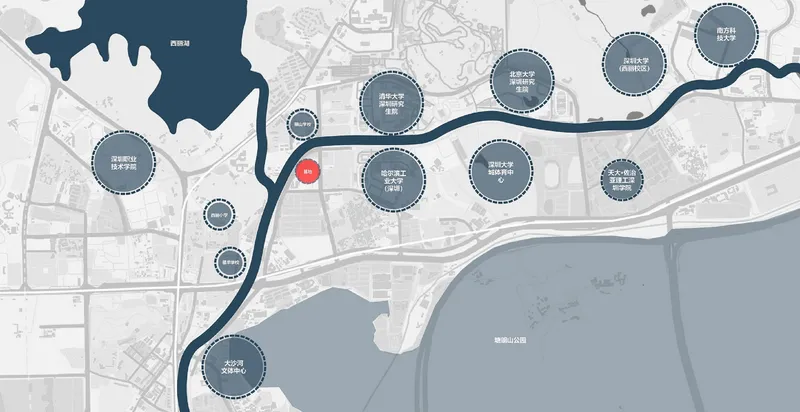


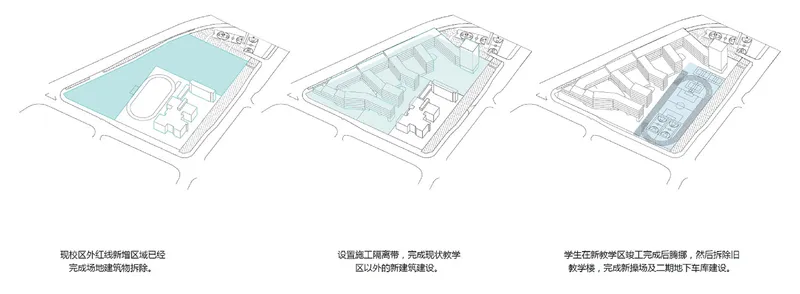

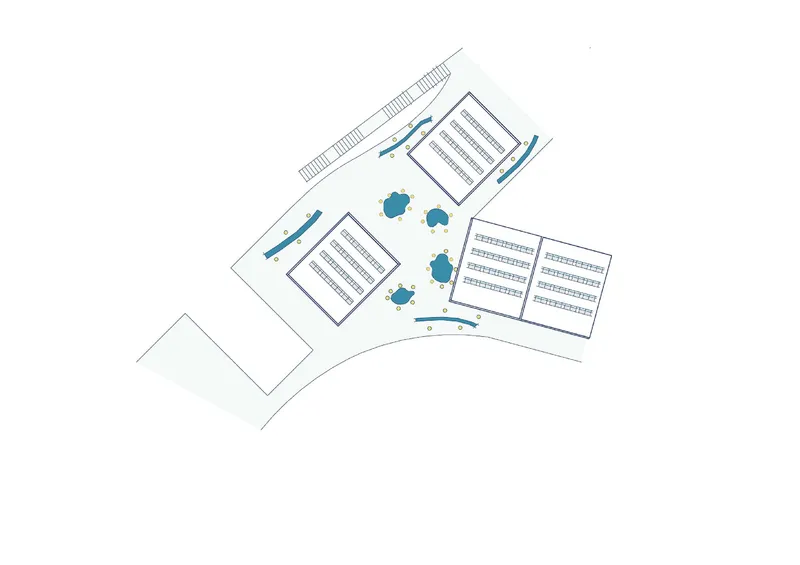


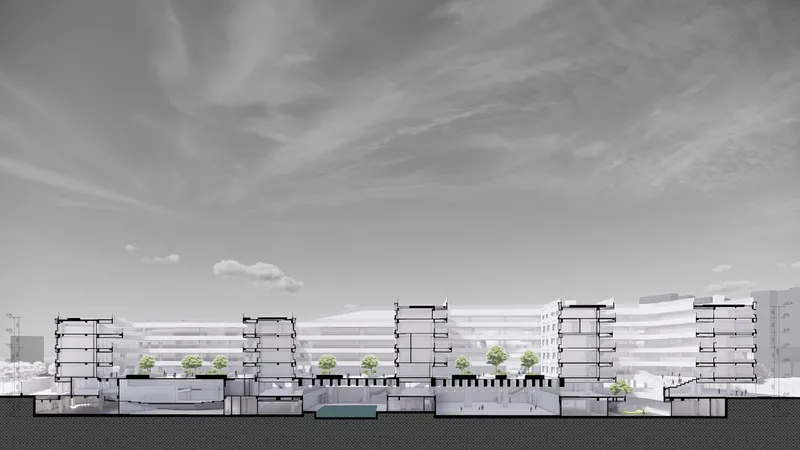

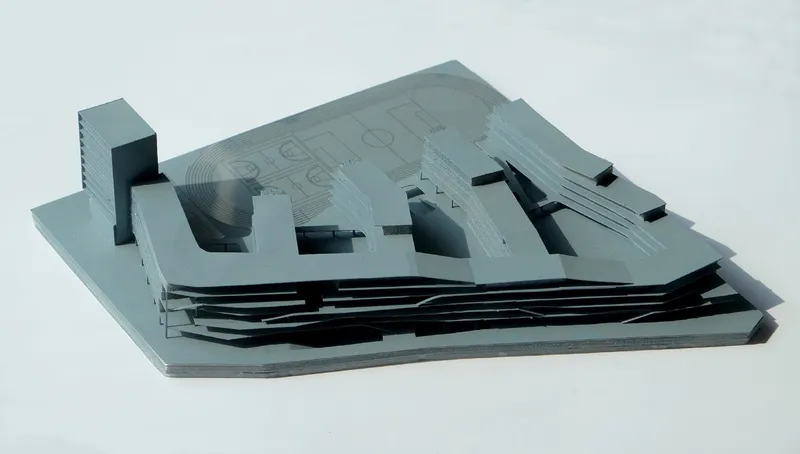
The drawings reveal the project's triangular footprint, an angular perimeter that wraps classrooms around three organic courtyards. The site plan situates the school as a critical node at the northern terminus of the Dasha River corridor, with the waterway diagram making the ecological connection explicit. The exploded axonometric color-codes the program vertically: classrooms on the perimeter, shared facilities at the core, athletics and parking below. The phased development axonometric is especially useful, showing how the design evolved from the existing water body to the completed structure.
The sections are the most telling drawings. They show the terraced volumes stepping down beside the waterway and make clear that the rooftop greenery is not cosmetic but structural to the building's thermal strategy. The section collage, combining a photograph of the surrounding high-rise towers with rendered volumes in red, honestly positions the school within its dense urban context. The physical model, with its grey and black layered volumes above a striated base, confirms that the underground program is as architecturally considered as the visible terraces above.
Why This Project Matters
China's nine-year integrated school model is a policy response to urban density. It consolidates elementary and middle school campuses onto single sites to free up land and reduce commute burdens on families. The architectural challenge is real: you have to serve a wider age range, fit more program into less area, and create distinct zones for six-year-olds and fifteen-year-olds within a unified building. CCDI Dongxiying Studio's terraced section is a genuinely smart answer to that challenge. The stepping form creates natural zoning by altitude while keeping the ground level generous and connected to the city.
The project also offers a counterargument to the increasingly slick, render-driven school designs emerging across Chinese first-tier cities. The strength here is in the section, in the climate response, in the quality of the underground spaces, and in the way bougainvillea will, over the next five years, transform the building's appearance. It is an architecture designed for accumulation rather than instant legibility, and in a city that builds as fast as Shenzhen, that patience is worth noticing.
Redevelopment of Pingshan Elementary School into a Nine-Year Integrated School, designed by CCDI Dongxiying Studio. Located in Shenzhen, China. 63,981 m². Completed in 2024. Photography by Zhaoming Wang, Xiongyi Zhu, and Yanjie Xu.
About the Studio
CCDI Dongxiying Studio
Share Your Own Work on uni.xyz
If projects like this are the kind of work you want to make, uni.xyz is a place to publish your own, find collaborators, and enter design competitions.


Popular Articles
Popular articles from the community


Tsunami Convergenics: Turning Catastrophic Ocean Forces into Underwater Housing Infrastructure
A speculative underwater settlement off the coast of Onagawa, Japan, treats tsunamis and typhoons as energy sources rather than threats.

The Amber Palace Opera: A Geological Fiction Surfaces on Tallinn's Baltic Waterfront
Pierre Brillard reimagines a Baltic legend as a public landscape, opera house, and waterfront promenade rooted in Tallinn's coastal identity.

Manzana Morphosis: Stretching Barcelona's Grid into a Living Landscape for 2050
A radical reworking of the Eixample manzana turns density into a tool for generous public space, vertical ecology, and environmental performance.

Singing Woman: Contemporary Architecture Inspired by Estonia’s Voice and the Sea
Singing Woman turns Estonia’s song culture into flowing opera house architecture, blending public life, landscape, sea, and national memory.

Similar Reads
You might also enjoy these articles

Bao Huynh Watercolor Atelier: A Serene Art Retreat in Hội An
Bao Huynh Watercolor Atelier in Hội An blends multifunctional art spaces, sustainable design, local materials, and family-friendly living in a serene environment.

Atelier Macri Concept Store Interior Design by CASE-REAL
Atelier Macri store features a "ko" counter, walnut wood details, cork displays, blending retail, gallery, and seamless customer experiences.

Manuel Vargas Izquierdo Stadium and High-Performance Sports Center: Architectural Excellence in Jalpa de Méndez
The Manuel Vargas Izquierdo Stadium blends sustainable design, inclusive sports facilities, and cultural-inspired architecture, revitalizing Jalpa de Méndez’s public spaces.
KAKR Buluh Awar Hall: Revitalizing Community and Ecology Through Bamboo Architecture
Community built bamboo hall revitalizes Buluh Awar village, empowering youth, restoring ecology, celebrating vernacular craftsmanship through sustainable architecture and culture.

Explore School Building Competitions
Discover active competitions in this discipline

Challenge to design a barrier free sports center

Challenge to design an outdoor ice-rink and park

Challenge to design public laboratory
Comments (0)
Please login or sign up to add comments
No comments yet. Be the first to comment!