

#1028 Arquitectura y Paisaje Turns a 12 m² Terrace in Quito into a Sacred Ceramics Workshop
A forgotten rooftop terrace in Ecuador's capital becomes a dome-shaped sanctuary for pottery, built from wood, fabric, and yellow steel.


Architecture rarely gets more personal than this. When a ceramist asked her brother and his partners at #1028 Arquitectura y Paisaje to convert a leftover 12 m² terrace into a workspace, the brief was disarmingly direct: make the room as beautiful as the objects it would help create. The result, completed in 2024 in Quito, Ecuador, is a micro-pavilion that punches far above its square footage, deploying spherical geometry, fabric sunshades, and a restrained palette of pine wood and yellow-painted steel to produce a space that feels closer to a chapel than a shed.
What makes this project genuinely interesting is not the scale but the commitment to spatial narrative at that scale. The architects treat a residual terrace the way a Renaissance builder might treat an apse: centering the potter's wheel under a dome-like enclosure formed by fabric stretched over a spherical radius, then letting that same curve ripple outward to shape the back wall and the semi-arched facade. It is a project that insists small interventions can carry big ideas, and it backs up that insistence with precise detailing and a coherent geometric logic.
A Sphere Disguised as a Pergola


From the outside, the workshop reads as a modest pavilion: a yellow steel frame supporting timber elements beneath an open sky. Look closer and the structure reveals its governing idea. A wooden pergola rests on existing walls, and metal frames branch upward from it to form a gentle gable. Between the pergola plane and the floor, the architects inscribe a sphere whose radius determines the curvature of the fabric sunshades overhead. The result is a soft dome that filters equatorial light into a warm, diffused glow, ideal for the slow focus that pottery demands.
The yellow steel angle brackets and column connections are deliberately exposed, even celebrated. Each joint between metal and timber is legible, letting you trace the load path from shade to beam to wall. In a project this small, every connection is ornament, and the architects seem to know it.
Light Through Layers
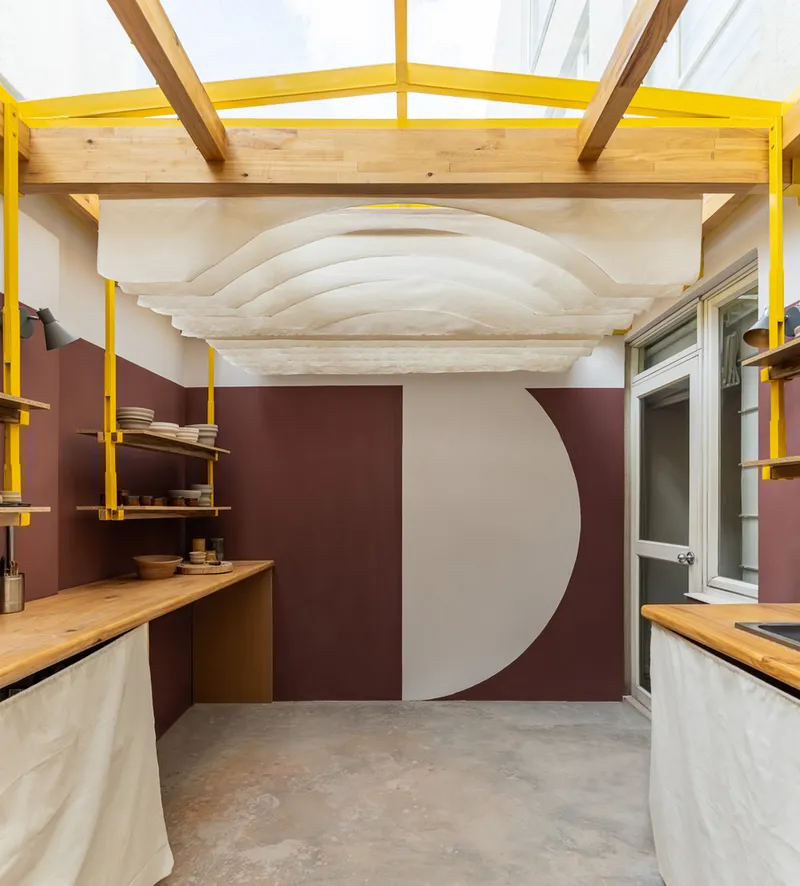
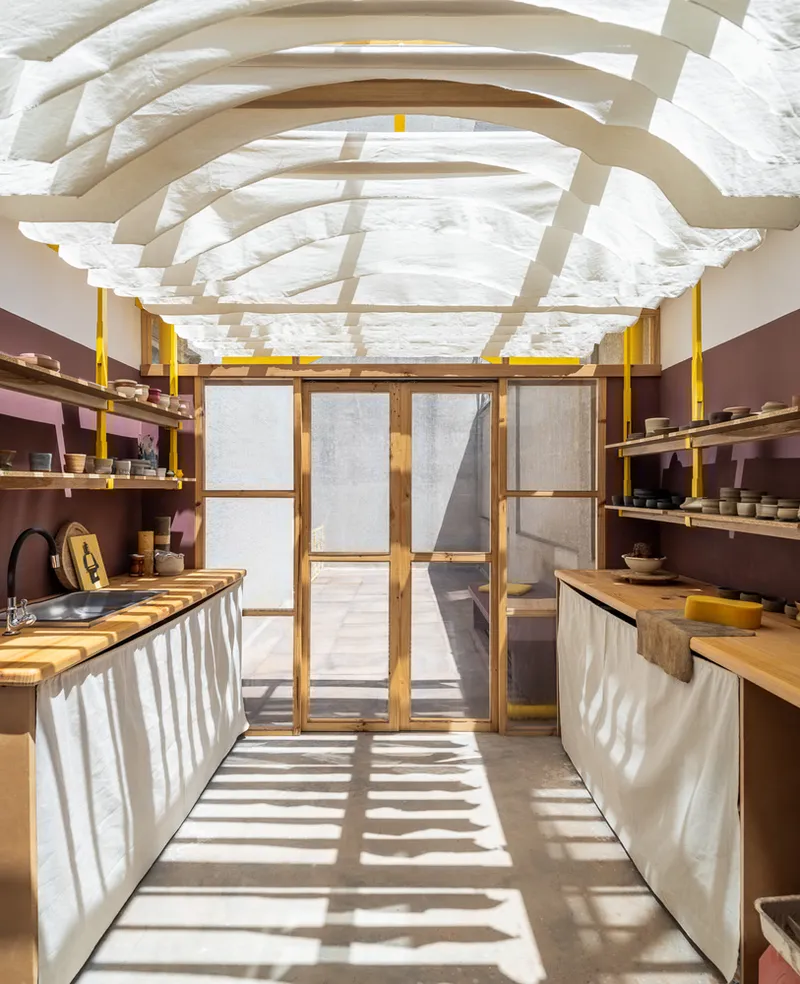
The layered plywood ceiling fins are the workshop's most photogenic move, but they also do serious environmental work. Set in parallel waves above the timber counters, they break direct sunlight into rhythmic stripes on the concrete floor. The effect changes throughout the day as the sun's angle shifts across Quito's nearly equatorial latitude, producing a constantly moving pattern that makes the small room feel alive rather than static.
Translucent panels sit between the fins, balancing openness and enclosure in a way that lets the ceramist work comfortably without needing heavy curtains or mechanical cooling. It is a low-tech climate strategy perfectly suited to Quito's temperate highland climate, where shading matters more than insulation.
Yellow Steel and Pine: A Material Dialogue
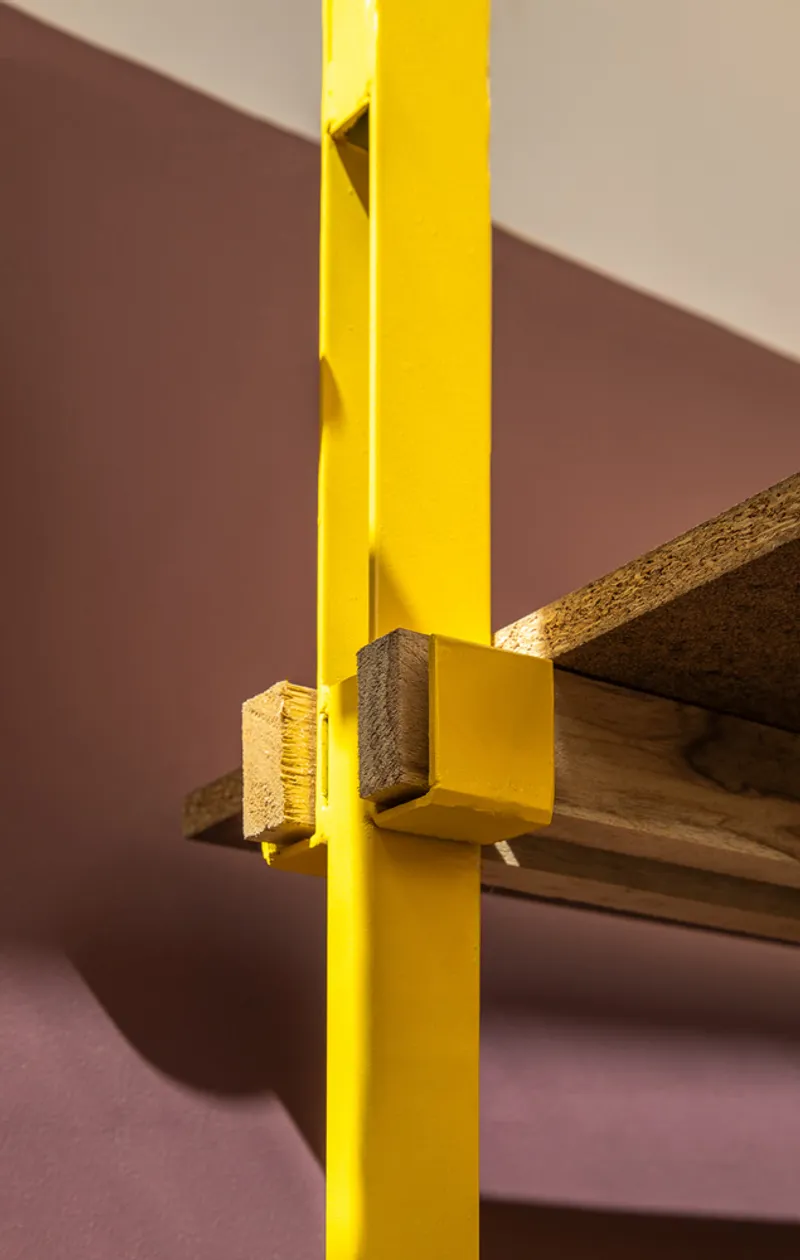
The material palette is deliberately limited to two voices: yellow-painted steel and raw pine wood, supplied by local manufacturer Indumadera. The contrast is tonal rather than dramatic. Pine provides warmth and grain; steel provides structure and color. Where the two meet, the architects leave the joint exposed, a bolted angle or a welded bracket that reads honestly against the softer timber.
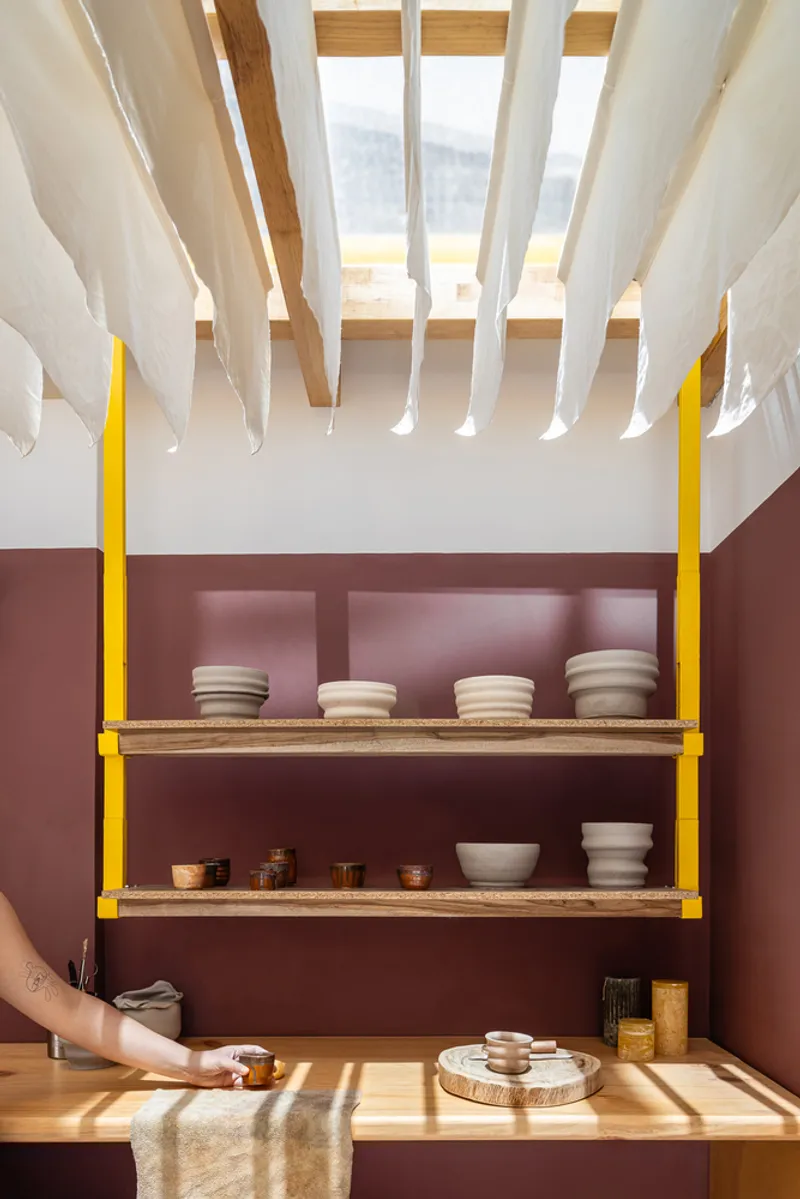
Along the facade, shelving brackets in yellow steel hold ceramic vessels against a rich maroon wall. The color pairing is unexpected and effective, giving the display area the quality of a curated gallery rather than simple storage. It is a small detail that signals the project's larger ambition: to treat every surface as an opportunity for care.
Inhabiting the Dome

A workshop lives or dies by how it feels during use, and the photograph of the ceramist pouring tea beneath the layered ceiling is telling. The space is intimate without being cramped, luminous without glare. The timber counters run parallel, organizing the narrow footprint into clear zones for making and storing. Overhead, the plywood waves create a canopy that lowers the perceived ceiling height just enough to foster concentration.
The architects describe ceramics as a practice balanced between design, craftsmanship, and mindfulness. The first two they could address directly through proportion and materiality. The third, they argue, emerges from the spatial conditions they set up: the filtered light, the curved enclosure, the quiet palette. Whether or not you buy the quasi-spiritual framing, the room clearly works. It feels like a place where you could sit at a wheel for hours and lose track of time.
Why This Project Matters
Twelve square meters is barely enough for a parking space, yet #1028 Arquitectura y Paisaje has extracted from it a coherent architectural proposition. The spherical geometry is not decorative whimsy; it organizes structure, shade, and facade into a unified system. The material restraint is not austerity; it focuses attention on joints, light, and the objects the room exists to produce. In a profession that often equates ambition with size, this workshop is a useful corrective.
Lead architects Paula Cárdenas, José Freire, and Alejandro Ramos have delivered something that feels genuinely generous: a room designed for one person's creative practice, but built with the spatial intelligence of a much larger commission. The project reminds us that architecture's real currency is not area but intention, and that even the smallest residual space can become, with enough care, a place worth inhabiting deeply.
Ceramics Workshop by #1028 Arquitectura y Paisaje (Lead Architects: Paula Cárdenas, José Freire, Alejandro Ramos). Quito, Ecuador. 12 m². 2024. Photography by Carlos Palacios.
About the Studio
Share Your Own Work on uni.xyz
If projects like this are the kind of work you want to make, uni.xyz is a place to publish your own, find collaborators, and enter design competitions.


Popular Articles
Popular articles from the community


Opera on the Sea: Driftwood Logic Shapes a Timber Opera House on Estonia's Coast
Trevor Orgill's opera house translates the entangled drift of floating timber into a civic building where wood, water, and music converge.

The Amber Palace Opera: A Geological Fiction Surfaces on Tallinn's Baltic Waterfront
Pierre Brillard reimagines a Baltic legend as a public landscape, opera house, and waterfront promenade rooted in Tallinn's coastal identity.

Aquadapt: An Underwater Habitat That Rewrites Its Rooms by the Hour
Curved modules ring the seabed while one shell shifts from breakfast room to cinema, farm and football pitch as residents' needs change.


ETEH Reworks the Shared Spaces of São Domingos School in Brazil Around Timber, Color and Hanging Plants
At São Domingos School in Brazil, 436 m² of hall, refectory and library are recast with timber joinery, a yellow and blue code and trailing greenery.

Similar Reads
You might also enjoy these articles


Hodi-Mandai Geram
Project Function: Preservation and revitalization of the Intangible heritage and socio-spatial identity of the Hodi by Housing, Cultural Memory Center, Sacred Grove, landscape, local tourism economy


Olio Towers: A Mid-Rise for Performers That Fuses Housing, Rehearsal, and Stage
Located blocks from Houston's Theater District, this modular tower stacks living units around a central performance atrium.

Oasis: Modular Green Housing Carved into Dhaka's Urban Fabric
A shortlisted Plugin Housing entry reclaims unauthorized settlements in Dhaka with stepped concrete volumes, green roofs, and ventilation-driven design.

Black Hole: A Floating Megastructure for the Post-Physical Era
Emiliano Mazzarotto envisions a spherical, self-scaling arena where e-sports, digital hotels, and holographic stadiums replace traditional public space.

Explore Sustainable Design Competitions
Discover active competitions in this discipline

Challenge to reimagine the Iron Throne

Photograph architecture without architects

Illustrate the lost glory of Angkor Wat - Render Challenge

Design challenge to reuse E-waste
Comments (0)
Please login or sign up to add comments
No comments yet. Be the first to comment!