
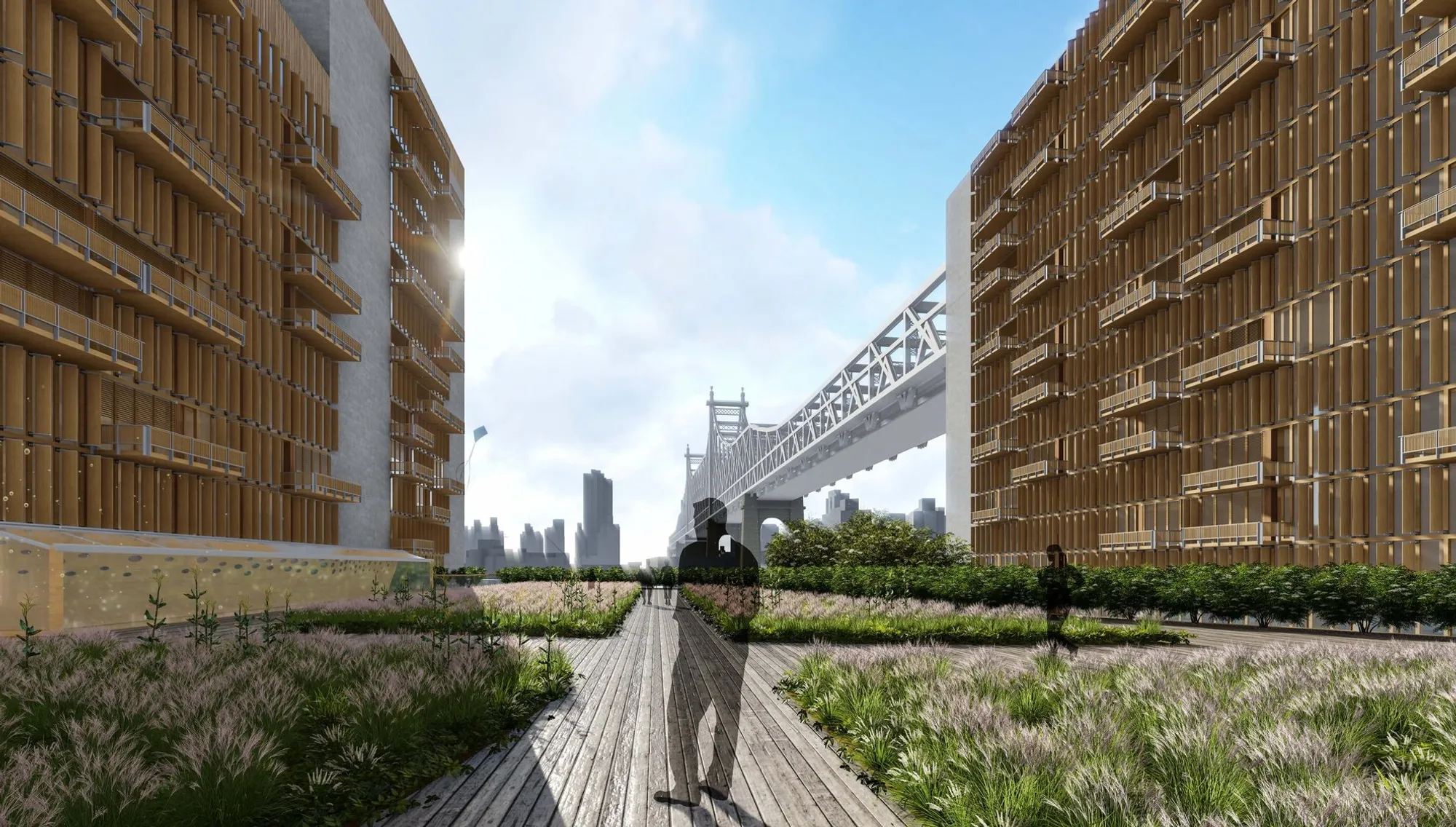
Civitas Nexum: A Model for Sustainable Timber Architecture in Urban Living
A sustainable timber architecture project merging housing, wellness, and education into a connected urban ecosystem along the waterfront


Civitas Nexum project by Rachel George,Rania Mohamed emerges as a forward-thinking exploration of sustainable timber architecture, positioning itself at the intersection of ecological responsibility, social infrastructure, and contemporary urban living. As a shortlisted entry in Habitats '20, the project proposes a mid-rise, mixed-use development that redefines how cities can integrate housing, education, and wellness within a cohesive, environmentally responsive framework.
At its core, Civitas Nexum is not simply a building. It is an urban system designed to foster connection between people, nature, and infrastructure. By leveraging the structural and environmental potential of timber construction, the project addresses pressing challenges of urban density, affordability, and sustainability.
A Holistic Urban Program
The project integrates three primary programmatic components:
- Affordable residential housing
- A large-scale community wellness facility
- An early childhood education center
These functions are not treated as isolated entities. Instead, they are interwoven through shared circulation systems, public interfaces, and layered spatial relationships. This interconnectedness enhances social cohesion while optimizing spatial efficiency.
The inclusion of a public waterfront space further extends the project beyond its built footprint, transforming it into a civic anchor that encourages interaction, recreation, and ecological awareness.
Timber as a Structural and Ecological Strategy
A defining feature of Civitas Nexum is its reliance on engineered timber systems, including cross-laminated timber (CLT) and hybrid assemblies. This approach serves multiple purposes:
- Reduced carbon footprint compared to conventional concrete and steel construction
- Prefabrication potential, enabling faster and more efficient construction processes
- Warm, human-centric spatial quality, enhancing interior environments
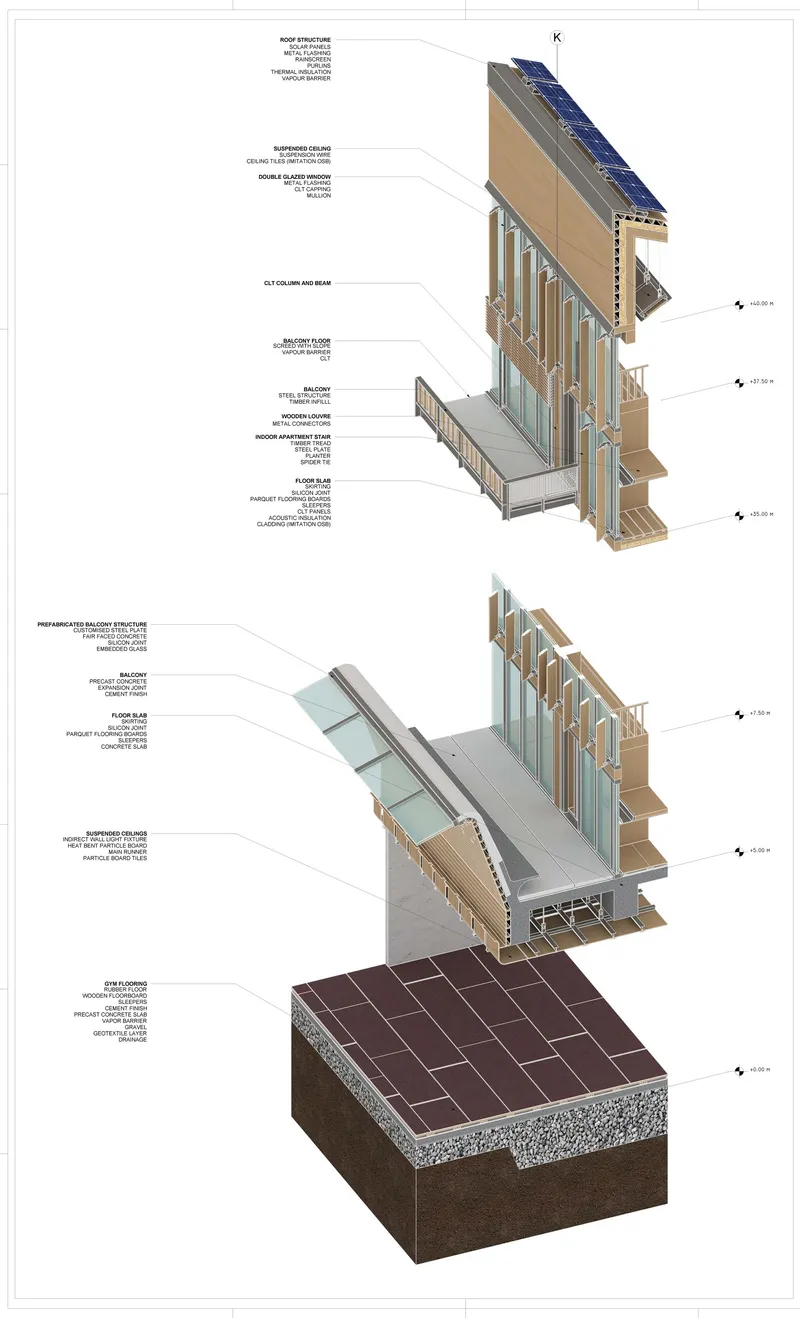
The detailed sectional drawings reveal a sophisticated layering of materials, including double-glazed facades, insulated panels, and integrated vapor barriers. These elements collectively contribute to high-performance building envelopes.
Timber is not used merely as an aesthetic choice but as a critical component of the building’s environmental logic.
Passive Design and Energy Efficiency
Civitas Nexum incorporates a range of passive and active sustainability strategies:
- Solar panels positioned on inclined roof surfaces to maximize energy generation
- Terraced building forms that optimize solar exposure and daylight penetration
- Louvers that regulate heat gain while maintaining visual connectivity
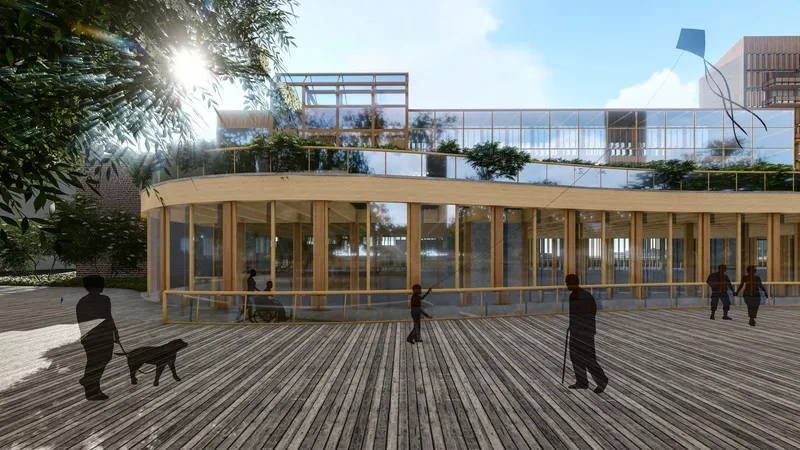
- Green roofs that improve thermal performance and support urban biodiversity
- Naturally ventilated atrium spaces that reduce reliance on mechanical systems
These strategies collectively position the project within the broader discourse of net-zero and low-energy architecture.
Public Realm and Circulation
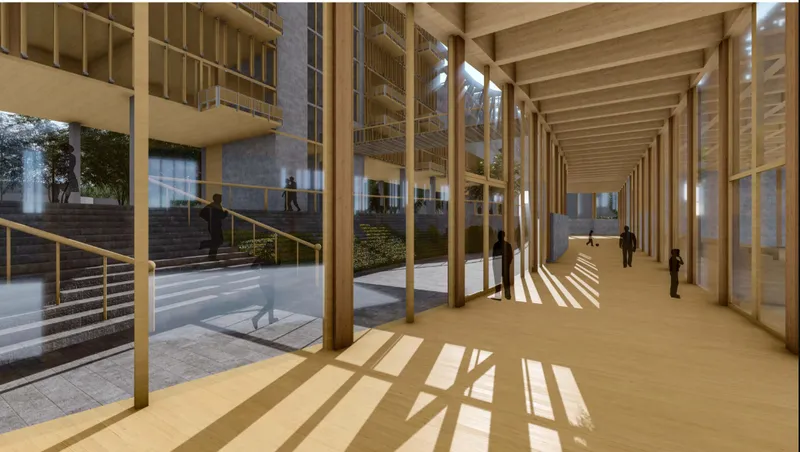
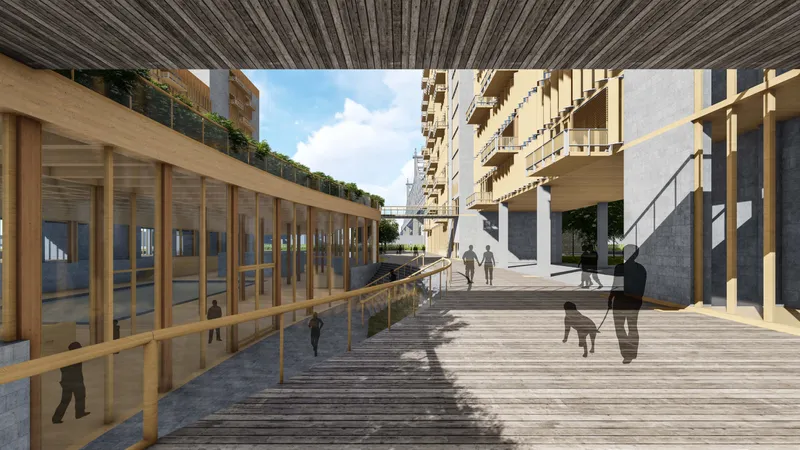
One of the most compelling aspects of the project is its emphasis on public connectivity. Elevated walkways, ramps, and open corridors create a continuous pedestrian network that links different programmatic zones.
The waterfront interface acts as a social condenser, where residents, visitors, and users of the wellness and educational facilities intersect. This spatial openness contrasts with the density of the residential blocks, creating a balanced urban experience.
The design also prioritizes accessibility, ensuring that movement across the site is inclusive and fluid.
Interior Spatial Quality
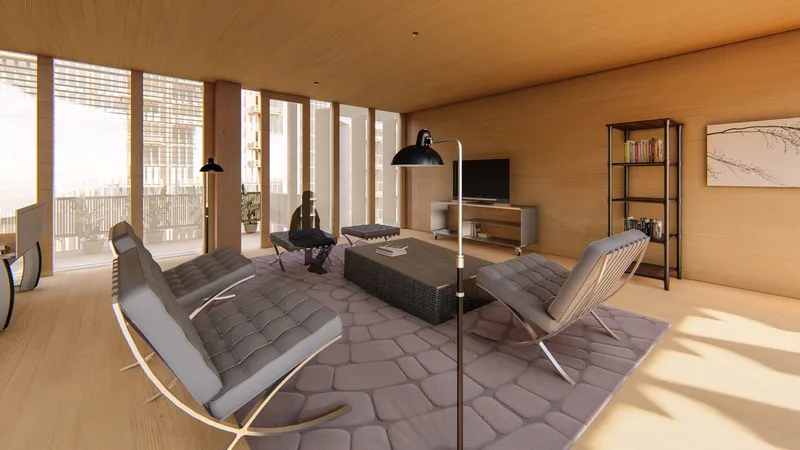
Interior renderings highlight the warmth and tactility of timber construction. Natural light filters through large glazed openings, creating dynamic shadow patterns and enhancing spatial depth.
Living spaces are designed to be flexible and adaptable, accommodating a range of lifestyles while maintaining a consistent material language. The use of timber surfaces contributes to improved indoor environmental quality, including thermal comfort and acoustic performance.
Construction Logic and Detail Resolution
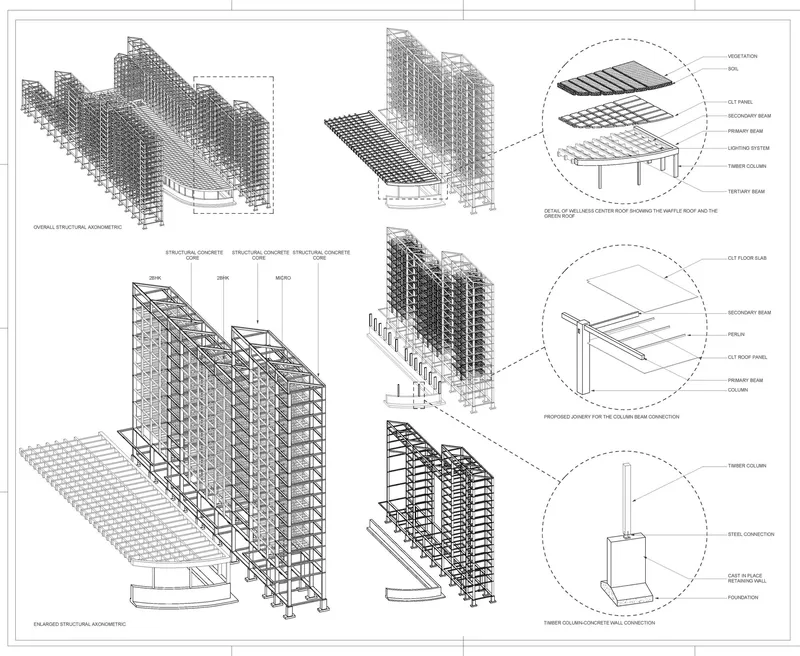
The exploded axonometric drawings demonstrate a rigorous approach to construction detailing. Key features include:
- Layered floor assemblies with acoustic and thermal insulation
- Prefabricated balcony systems for efficiency and precision
- Integrated structural and facade systems
- Clear separation of load-bearing and envelope components
This level of detail underscores the project’s feasibility and its alignment with contemporary construction practices in timber architecture.
Reframing Urban Sustainability
Civitas Nexum positions itself within a growing movement toward sustainable urban architecture that prioritizes resilience, adaptability, and human well-being. By combining mixed-use programming with advanced timber construction techniques, the project offers a scalable model for future urban developments.
It challenges conventional approaches to city building by demonstrating that density and sustainability are not mutually exclusive. Instead, they can be mutually reinforcing when approached through integrated design thinking.
Civitas Nexum represents a compelling vision for the future of cities. Through its emphasis on sustainable timber architecture, integrated programming, and public connectivity, it redefines the role of architecture as a catalyst for social and environmental transformation.
As urban populations continue to grow, projects like Civitas Nexum provide critical insights into how we can build more inclusive, sustainable, and resilient environments.
Shortlisted Entry – Habitats '20


Popular Articles
Popular articles from the community


Hill & Cross Opera: Sculptural Opera House Architecture Shaped by Tallinn’s Landscape and Identity
Hill & Cross Opera reimagines opera house architecture in Tallinn through its sculptural hill, civic plaza, glass wave and a luminous cross.

The Musturak Paradise: Senior Living Architecture for a Connected Future in Temara, Morocco
The Musturak Paradise reimagines senior living architecture in Temara via private homes, social spaces, culture, community, and shared care.

The Earth Pod: 3D Printed Homes for Resilient Refugee Communities
The Earth Pod reimagines refugee housing through 3D printed homes made from clay, combining resilience, self-sufficiency, and rapid shelter.

Co-Life: Senior Housing Design That Reconnects Older Adults With the City
Co-Life reimagines senior housing design through healing gardens, shared streets, workshops, and a sustainable community across generations.

Similar Reads
You might also enjoy these articles

Eco Chapel: A Green Architecture Pavilion Designed in Symbiosis with the Forest
Eco Chapel uses green architecture to weave prayer, learning and reuse into a forest pavilion shaped by modular hexagonal canopies for life.
Kaffeebühnen: Coffee Shop Architecture Designed as a Civic Stage Between Vienna’s City and Park
Kaffeebühnen turns coffee shop architecture into a civic stage, linking Vienna’s park edge, urban life, warm timber yards, and coffee craft.
Healing Façade: Sustainable Architecture for Reforestation, Community, and Sacred Ecology in Ethiopia
Healing Façade reimagines sustainable architecture as a living wall that restores soil, catches water and renews Ethiopia's forest churches.

Urban Forest: A Vertical Ecosystem for 5,000 Workers in Singapore's Changi Business Park
Radially stacked pods and layered green decks turn a 7-acre plot into 47 acres of ecological workspace projected for 2040.

Explore Architecture Competitions
Discover active competitions in this discipline



Challenge to reimagine the Iron Throne


Photograph architecture without architects


Illustrate the lost glory of Angkor Wat - Render Challenge


Design challenge to reuse E-waste
Comments (0)
Please login or sign up to add comments
No comments yet. Be the first to comment!