

Community Based Development for Annually Flood Affected People of Jamuna Riverbank, Sirajganj
Flood resilient architecture for Jamuna River communities proposing bamboo stilt housing, shared courtyards, and adaptive settlement design.


Flood resilient architecture has become an essential design approach for communities living along unstable riverbanks and floodplains. In regions where seasonal flooding is a recurring reality, architecture must move beyond static structures and evolve into adaptive systems capable of protecting livelihoods, housing, and social infrastructure.
The project Community Based Development for Annually Flood Affected People of Jamuna Riverbank, Sirajganj addresses this urgent condition through a community centered architectural strategy. Designed by তরিকুল ইসলাম অপু, the proposal focuses on developing resilient housing and settlement patterns for fishermen and seasonal farmers living along the Jamuna River in Bangladesh.
Each year these communities face devastating floods that submerge homes, damage belongings, and disrupt livelihoods for months. The project proposes an affordable, sustainable, and locally adaptable architectural model that strengthens both housing resilience and community life.
Context: Life Along the Jamuna River
The project site is located on the eastern bank of the Jamuna River in Sirajganj, Bangladesh. This region functions as an important gateway connecting northern districts to Dhaka through the Bangabandhu Bridge. Despite its strategic importance, the riverbank settlements remain extremely vulnerable to climate related flooding and river erosion.
The existing settlement spreads across approximately twenty acres and is divided into two main communities: traditional fishermen who have lived in the region for generations, and seasonal fishermen who were originally farmers displaced by river erosion. The area includes important economic and social nodes such as the Motin Shaheber Ghat and a bamboo and fish wholesale market.
During the monsoon season, large parts of the site remain underwater for two to six months. Families are forced to temporarily relocate onto embankments or dams while their houses remain submerged. This cycle repeats annually, placing enormous economic and social pressure on the community.
Understanding the Community
Designing effective flood resilient architecture requires a deep understanding of how communities live, work, and interact with their environment. The project therefore began with extensive on site surveys and observations of daily life.
The two main user groups have distinct but interconnected livelihoods. Fishermen rely on river access, boat storage, and net repairing spaces, while seasonal farmers depend on small scale agriculture and crop processing areas. Both groups require flexible domestic spaces that support household activities, livestock management, and income generation.
Instead of imposing a rigid architectural solution, the project studies traditional settlement patterns and builds upon existing social structures. Shared courtyards, clustered housing, and productive landscapes become key spatial elements that reinforce community relationships.
Design Strategy: Flood Resilient Housing
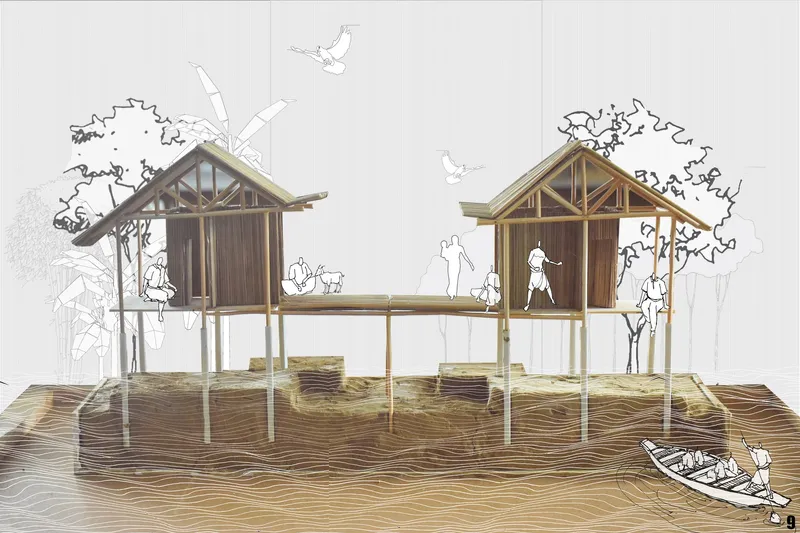
The central architectural strategy focuses on elevated housing structures designed to remain functional even during flood periods. Houses are raised above ground level using concrete pillars and bamboo structural systems that resist water damage while remaining affordable for local communities.
The elevated plinth ensures that the living spaces remain above the highest recorded flood levels. The space below the house remains usable for cattle shelter, storage, and temporary activities during dry seasons.
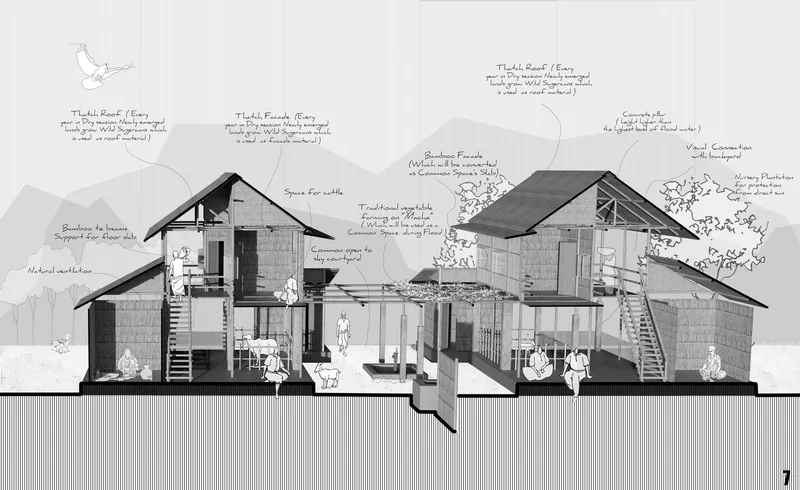
Lightweight materials such as bamboo framing, thatch roofing, and locally sourced organic materials form the main construction system. These materials are not only affordable but also culturally familiar, allowing residents to maintain and repair structures using local skills.
The roof and façade systems incorporate thatch and sugarcane based materials harvested from newly emerged lands during dry seasons. This approach reduces construction costs and strengthens the connection between architecture and local ecological cycles.
Cluster Based Settlement Planning
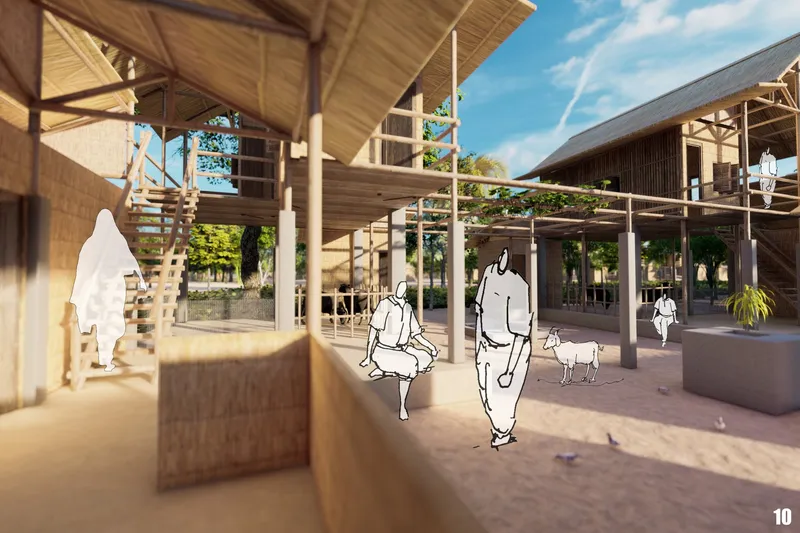
Rather than designing isolated houses, the project organizes homes into clustered settlement units. Each cluster contains multiple dwellings connected through shared courtyards and semi open platforms.
These courtyards function as social and economic spaces where daily activities such as cooking, net repairing, vegetable gardening, and small scale processing can occur. The spatial arrangement promotes cooperation among families while maintaining individual household privacy.
Between clusters, ponds are introduced as multifunctional landscapes. These water bodies support fish farming, provide irrigation sources, and help regulate water flow during heavy rains.
Separate cluster configurations are developed for fishermen and farmer communities. Fishermen clusters prioritize river access and net repair areas, while farmer clusters incorporate spaces for vegetable farming and crop processing.
Community Infrastructure
In addition to housing, the project introduces community scale infrastructure that supports long term resilience and development.
A multipurpose school building functions as an educational facility during normal periods and transforms into a flood shelter during emergencies. This dual use strategy ensures that essential infrastructure remains active throughout the year.
Other community facilities include training centers, community clubs, shared markets, and small retail spaces that connect the settlement with nearby urban areas.
These facilities are located along the embankment to strengthen the relationship between the rural community and the larger urban network.
Material Strategy and Structural System
The architectural system combines durability with local craftsmanship. The primary structural framework consists of bamboo columns and beams supported by reinforced concrete foundations. This hybrid system improves structural stability while preserving the lightweight characteristics necessary for flood prone regions.
Key construction materials include:
Bamboo frame structure Thatch roof and façade panels Concrete pillar foundations Mud plinths and natural ground treatments Bamboo lattice flooring systems
These materials are locally available and can be assembled using traditional construction techniques familiar to the community.
Environmental and Social Sustainability
The project demonstrates how flood resilient architecture can also support environmental sustainability. By using renewable materials such as bamboo and thatch, the buildings maintain a low environmental footprint while remaining economically viable.
The integration of vegetable gardens, fish ponds, and crop processing areas promotes self sufficiency and diversified income opportunities for residents.
Equally important is the strengthening of social resilience. Shared spaces encourage cooperation, collective maintenance, and mutual support during disaster periods.
Long Term Impact
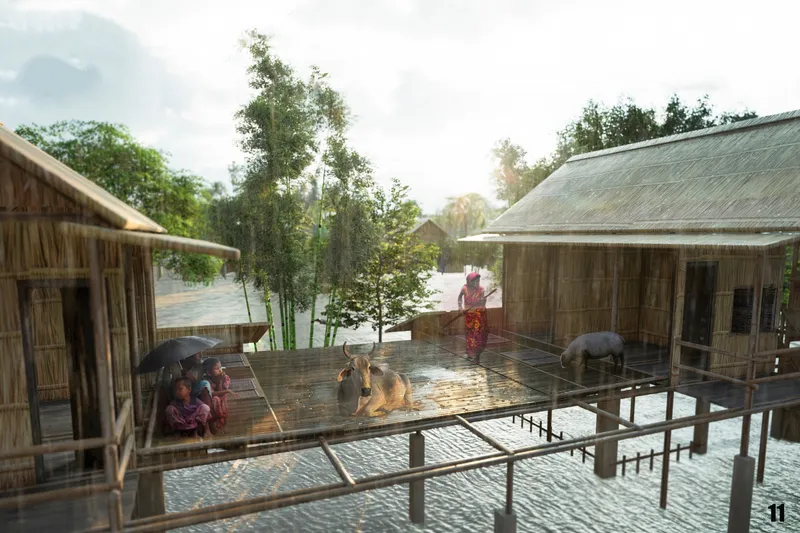
The short term impact of the project lies in reducing the need for seasonal displacement. Families can remain within their homes even during floods rather than relocating to temporary shelters on dams.
In the long term, the project establishes a sustainable settlement model for flood prone regions across South Asia. By combining community based planning, locally sourced materials, and adaptive architectural strategies, the proposal demonstrates how architecture can actively support vulnerable populations.
Flood resilient architecture is not simply about raising buildings above water levels. It requires a comprehensive understanding of ecological cycles, social structures, and local economies.
The Community Based Development project for the Jamuna Riverbank illustrates how architecture can empower communities living in extreme environmental conditions. Through elevated housing, clustered settlement planning, and integrated community infrastructure, the project proposes a resilient future for the flood affected people of Sirajganj.


Popular Articles
Popular articles from the community


Manzana Morphosis: Stretching Barcelona's Grid into a Living Landscape for 2050
A radical reworking of the Eixample manzana turns density into a tool for generous public space, vertical ecology, and environmental performance.

Opera on the Sea: Driftwood Logic Shapes a Timber Opera House on Estonia's Coast
Trevor Orgill's opera house translates the entangled drift of floating timber into a civic building where wood, water, and music converge.

Tsunami Convergenics: Turning Catastrophic Ocean Forces into Underwater Housing Infrastructure
A speculative underwater settlement off the coast of Onagawa, Japan, treats tsunamis and typhoons as energy sources rather than threats.

Extended Shell: Retrofitting Kolkata's Balconies as Living Urban Thresholds
A modular retrofit system recovers the social and environmental intelligence of Kolkata's historic verandas for contemporary Park Street residents.

Similar Reads
You might also enjoy these articles

Eco Chapel: A Green Architecture Pavilion Designed in Symbiosis with the Forest
Eco Chapel uses green architecture to weave prayer, learning and reuse into a forest pavilion shaped by modular hexagonal canopies for life.
Kaffeebühnen: Coffee Shop Architecture Designed as a Civic Stage Between Vienna’s City and Park
Kaffeebühnen turns coffee shop architecture into a civic stage, linking Vienna’s park edge, urban life, warm timber yards, and coffee craft.
Healing Façade: Sustainable Architecture for Reforestation, Community, and Sacred Ecology in Ethiopia
Healing Façade reimagines sustainable architecture as a living wall that restores soil, catches water and renews Ethiopia's forest churches.


Urban Forest: A Vertical Ecosystem for 5,000 Workers in Singapore's Changi Business Park
Radially stacked pods and layered green decks turn a 7-acre plot into 47 acres of ecological workspace projected for 2040.

Explore Flood Risk Competitions
Discover active competitions in this discipline

Challenge to reimagine the Iron Throne

Photograph architecture without architects

Illustrate the lost glory of Angkor Wat - Render Challenge

Design challenge to reuse E-waste
Comments (0)
Please login or sign up to add comments
No comments yet. Be the first to comment!