
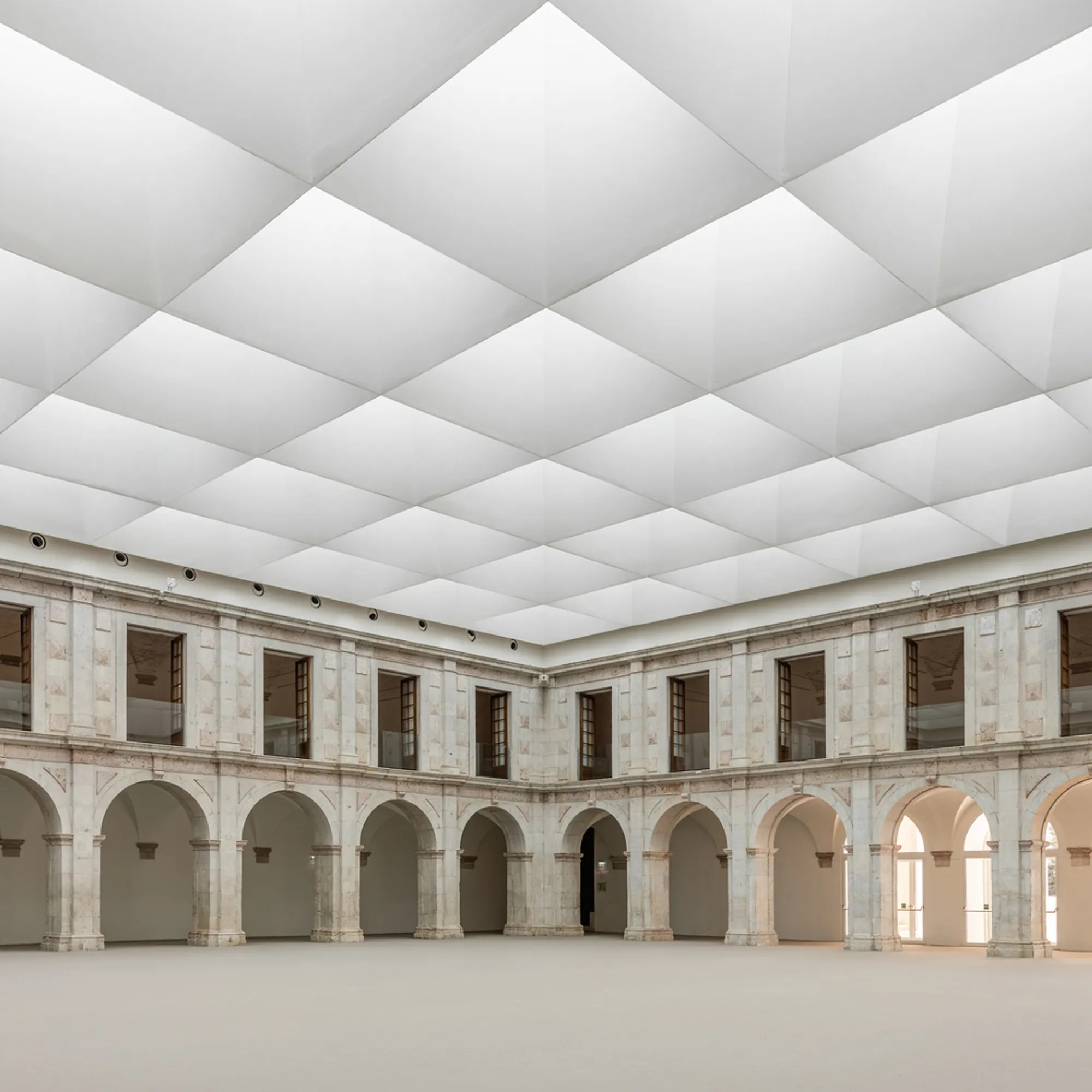
RISCO Transforms a 15th-Century Lisbon Convent into a Contemporary Event Center
At Convento do Beato, a honeycomb ceiling and careful restoration give a layered Portuguese landmark a viable second life.


The Convento do Beato has been accumulating architectural layers since the 15th century. Earthquakes, expulsions, industrial repurposing, and a questionable 1980s acrylic roof have each left their mark on the complex, which today contains remnants of the original convent, an old church, and industrial buildings from the turn of the 20th century. The site is even notable for hosting the first steam engine operated in Portugal. Turning a place with that much history into a functioning contemporary events venue is not a simple matter of new lighting and fresh paint.
RISCO's intervention, completed in March 2022 and spanning 5,574 square meters, does something genuinely difficult: it adds legible modern elements to a complex historic fabric without defaulting to either reverent minimalism or showy contrast. The firm's strategy varies room by room, sometimes concealing new systems within historic structure, sometimes letting them sit proudly as compositional elements. That dual logic, applied consistently across the cloister, library, refectory, chapter room, and new courtyards, gives the project a coherence that a single aesthetic approach could not.
The Cloister Reimagined
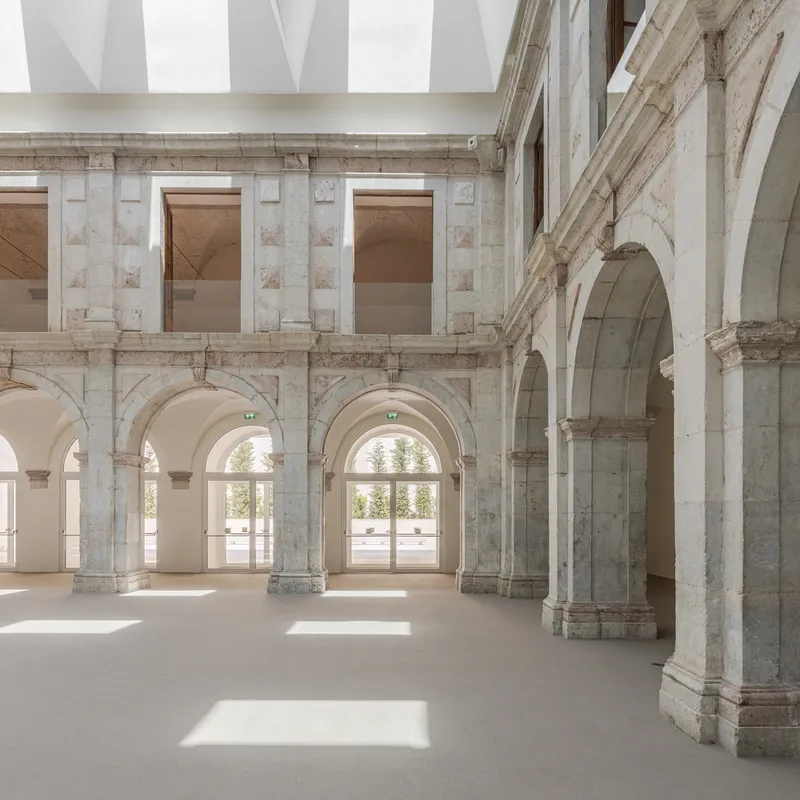

The cloister is the centerpiece of the renovation and its most ambitious move. For decades, this two-story high space sat under a pyramid-shaped acrylic roof that offered neither insulation, ventilation, nor fire protection. RISCO replaced it with an orthogonally arranged truss system forming a honeycomb pattern, clad in sound-absorbent material and threaded with air-conditioning ducts. Skylights set above the trusses flood the space with natural light while also serving as mechanically operable smoke vents in the event of fire.
What makes the ceiling work as architecture, rather than merely as engineering, is its relationship to the stone arcades below. The smooth, white geometry of the honeycomb reads as unmistakably contemporary against the textured stone columns and arched openings. Yet the proportions are calibrated to enhance, not compete with, the cloister elevations. The result is a room that can host large-scale events while still feeling like a cloister, not a convention hall.
Stone, Timber, and the Weight of Layers

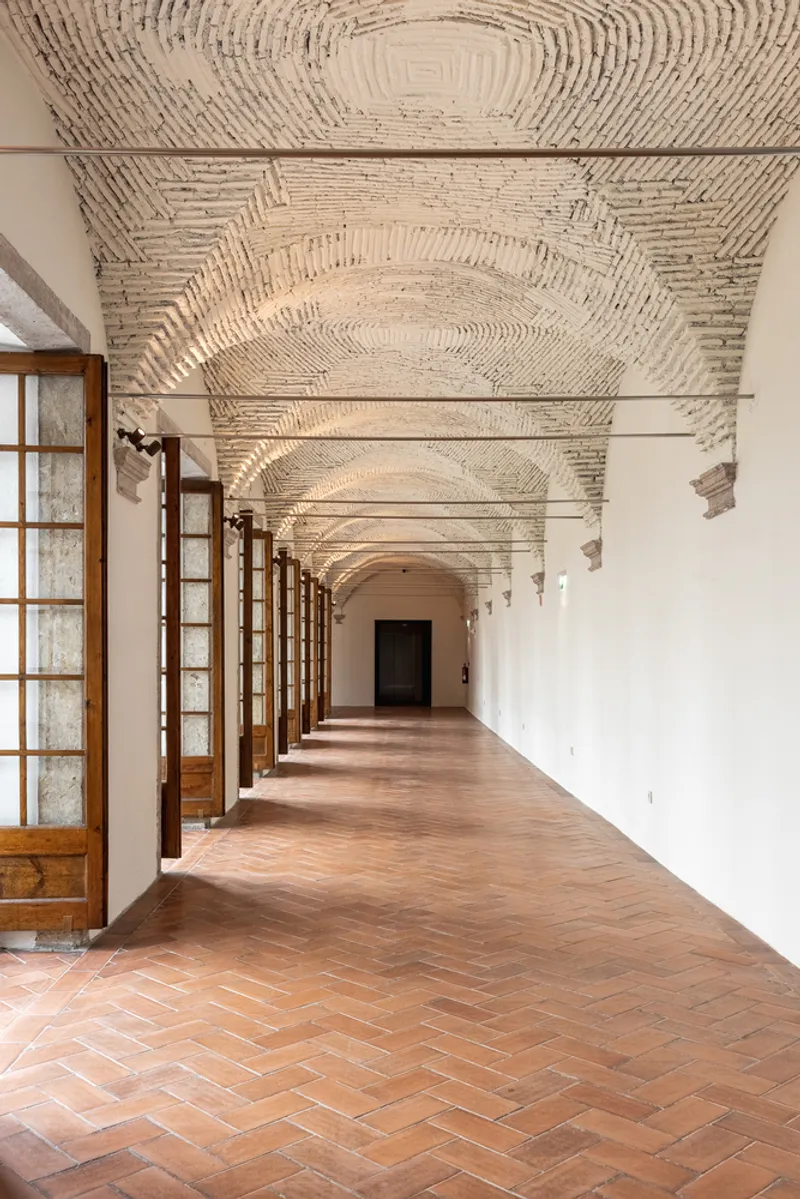
Walk through the arcaded galleries and corridors surrounding the cloister and you encounter the project's archaeological character. Vaulted brick ceilings sit above herringbone terracotta floors. Stone columns frame views into adjacent spaces. Glazed timber doors punctuate long axes. White marble and red jasper, both of Portuguese origin, surface throughout the original fabric. RISCO conserved these materials with traditional construction techniques, and where alterations were needed to window and door openings, they were executed as what the firm calls "surgical operations," discreet enough to avoid disrupting the reading of the original structure.
The vaulted gallery, with its exposed stone and clean white walls, demonstrates the firm's restraint. Nothing has been added that the space does not need. The interventions that do exist, better lighting, improved circulation, upgraded safety systems, are folded into the architecture rather than appliqued onto it.
Timber Ceilings and Acoustic Refinement
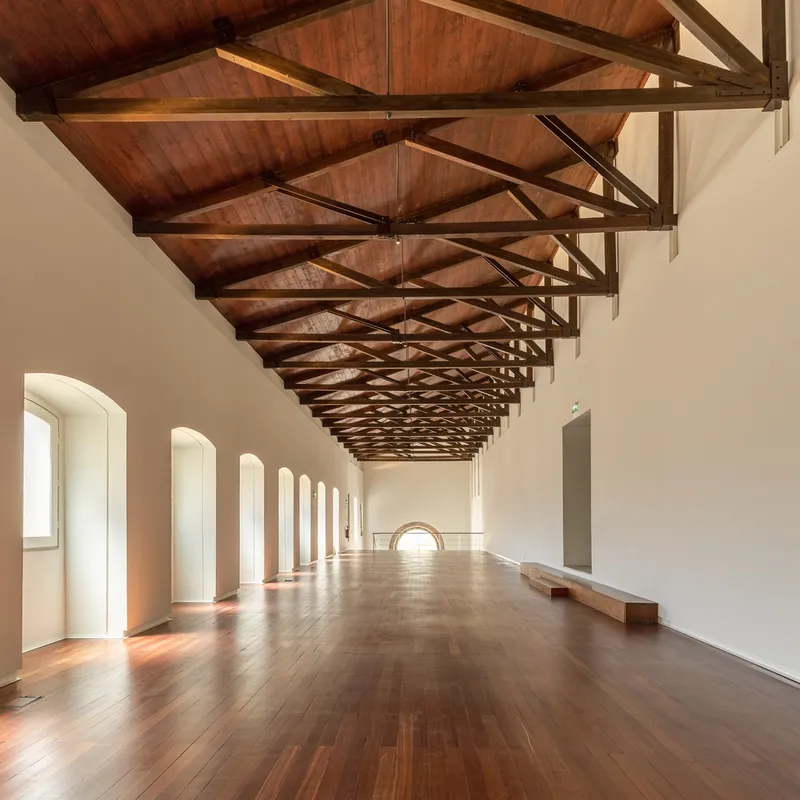
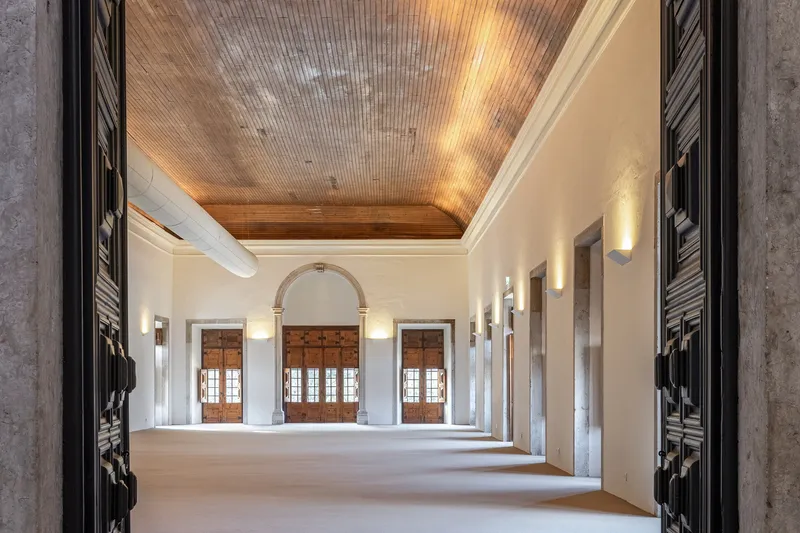
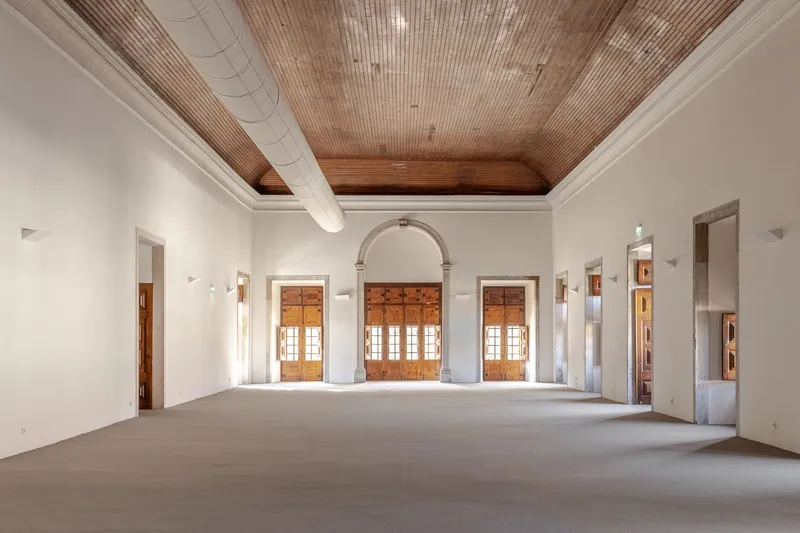
In the library, foyer, refectory, and chapter room, RISCO doubled the number of roof support trusses to carry the added load of acoustic cladding and climate systems. The exposed timber work in these rooms is among the project's most visually compelling elements. Timber slat ceilings in the gallery rooms filter light and modulate sound, while exposed beams above triple arched openings give rhythm to the larger halls. The arched window alcoves and herringbone wood flooring create interiors that feel both warm and spatially precise.
The decision to expose rather than conceal the trusses in these rooms follows a clear logic: where the ceiling is the dominant architectural surface, it should participate in the design rather than merely perform a technical role. The timber reads as a material bridge between the convent's historic carpentry traditions and the contemporary language of the intervention.
Courtyards as Connective Tissue
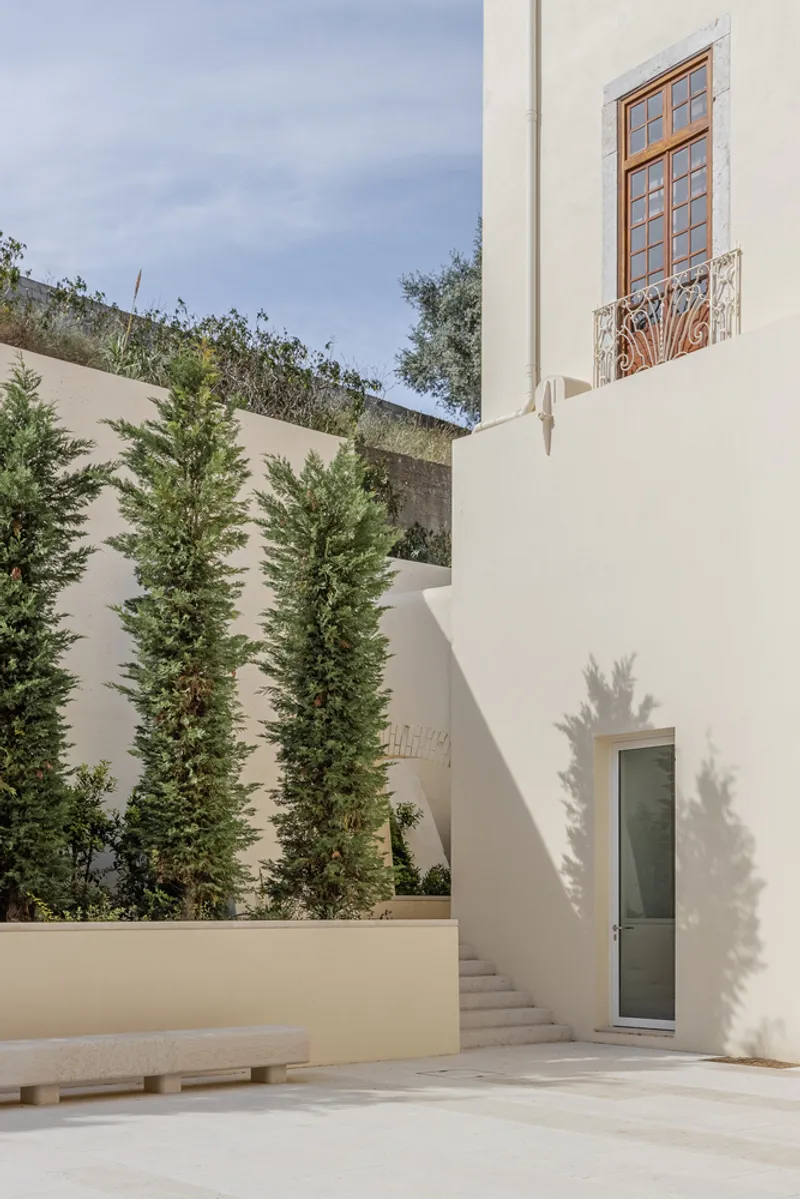
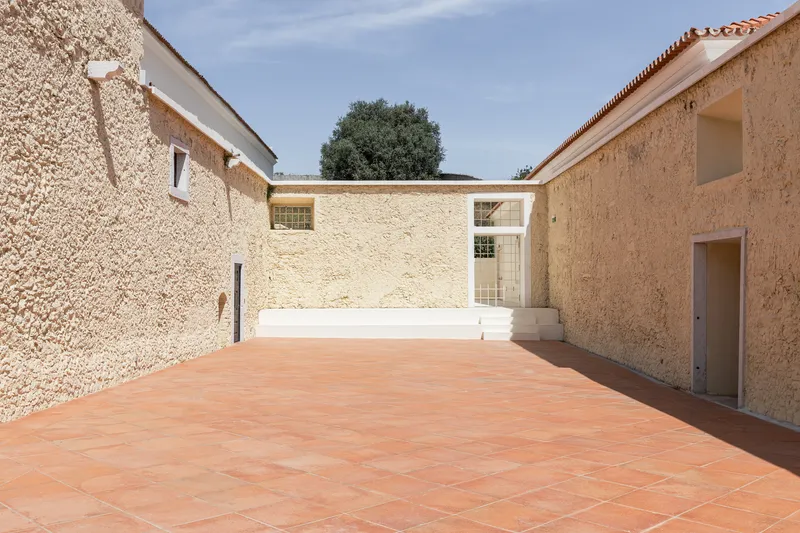
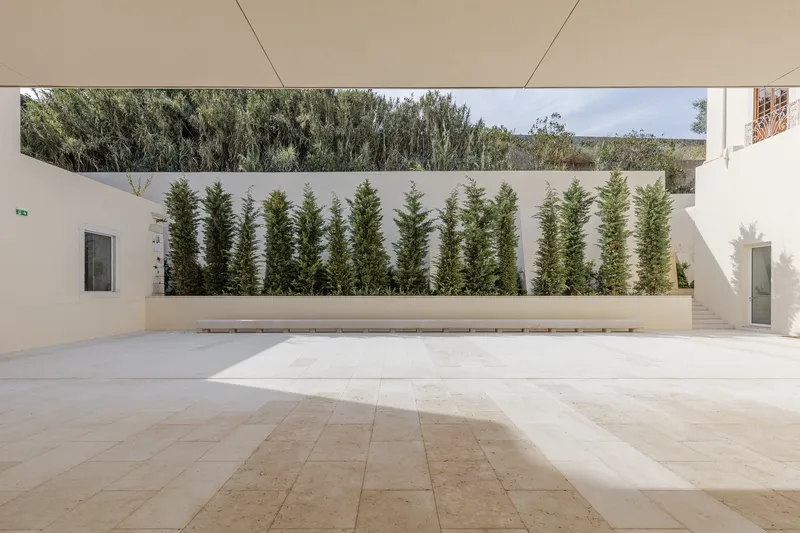
The complex's U-shaped plan wraps around the central cloister, but several smaller courtyards punctuate the wings. RISCO redesigned these outdoor rooms with a palette of white stucco, terracotta paving, and carefully placed planting. A single cypress tree in one courtyard, a raised bed of vertical green shrubs in another: the landscaping is spare, almost monastic, which feels exactly right given the context. Textured stone walls establish visual continuity with the convent's original masonry, while the clean lines of new planters and benches declare the present tense.
These courtyards serve a practical role, too. They bring light and air deep into the plan, provide overflow space for events, and orient visitors within a complex that could easily become disorienting. The rooflines visible from within the courtyards give a sense of the site's accumulated scale, a reminder that you are standing inside a place shaped by five centuries of building and rebuilding.
Plans and Drawings
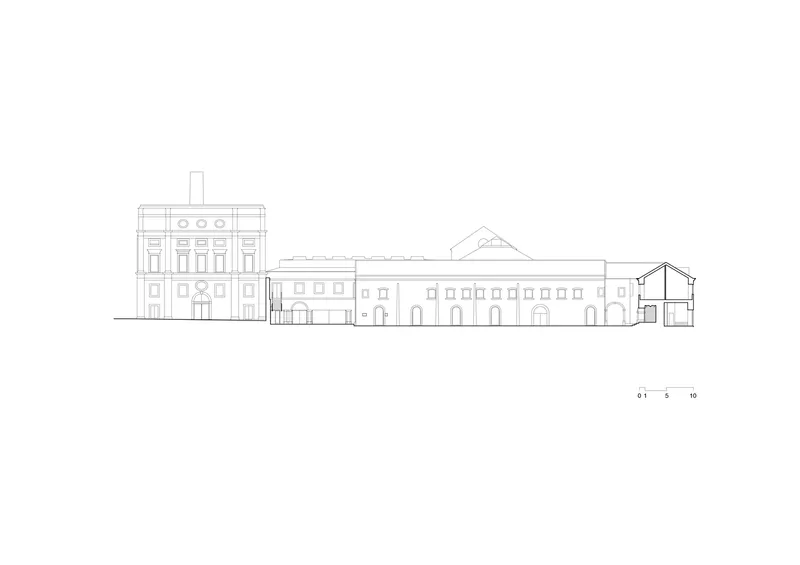
The elevation drawing reveals the full compositional range of the complex: a tower element, an arcaded wing, and a gabled end pavilion sit side by side, each from a different era yet held together by a shared material logic of stone and tile. The drawing makes legible what the photographs only suggest, that the project's coherence comes not from stylistic uniformity but from a disciplined approach to proportion and surface. RISCO's additions slot into this sequence without attempting to mimic any single historical moment.
Why This Project Matters
Adaptive reuse of historic buildings is now common enough to be its own genre, complete with clichés: the obligatory Corten steel insertion, the glass box hovering above old stone. What distinguishes the Convento do Beato project is RISCO's refusal to settle on a single strategy. The firm moves between concealment and exposure, between replication and invention, calibrating each decision to the specific room and its specific history. The honeycomb ceiling in the cloister is a bold, legibly modern gesture. The conserved brick vaults in the corridors are exercises in restraint. Both approaches coexist because both are justified by their context.
The project also demonstrates that heritage preservation and technical performance are not competing ambitions. Natural daylighting through the skylights, integrated climate control, fire safety mechanisms, acoustic treatment: all of this has been embedded in the architecture without turning the convent into a decorated machine. For any practice working on complex historic sites, especially those accumulating centuries of divergent programs, the Convento do Beato offers a persuasive model for how to proceed with intelligence and specificity rather than ideology.
Convento do Beato Event Center by RISCO. Lisbon, Portugal. 5,574 m². Completed 2022. Photography by Carolina Delgado.
About the Studio
Share Your Own Work on uni.xyz
If projects like this are the kind of work you want to make, uni.xyz is a place to publish your own, find collaborators, and enter design competitions.




Popular Articles
Popular articles from the community


Conexión: Biophilic Design Reimagines High-Rise Living in Hong Kong
Conexión reimagines high-rise living in Hong Kong through biophilic design, green facades, shared spaces, daylight, water and nature within.

Co-life: Sustainable Architecture for Age-Friendly Community Living
Co-life reimagines sustainable architecture for seniors through courtyards, rammed earth, shared gardens, and spaces designed for belonging.

AL-JANNAH: Sustainable Architecture and Permaculture for Afghan Widows
AL-JANNAH uses sustainable architecture and permaculture to create resilient oasis of housing, learning, work and renewal for Afghan widows.
EW PARK: Sustainable Architecture Reimagines the Future of Urban Parking
EW PARK reimagines city parking as a modular wooden tower combining automation, solar energy, electric mobility, and adaptable urban design.


Similar Reads
You might also enjoy these articles


Hodi-Mandai Geram
Project Function: Preservation and revitalization of the Intangible heritage and socio-spatial identity of the Hodi by Housing, Cultural Memory Center, Sacred Grove, landscape, local tourism economy


Olio Towers: A Mid-Rise for Performers That Fuses Housing, Rehearsal, and Stage
Located blocks from Houston's Theater District, this modular tower stacks living units around a central performance atrium.

Oasis: Modular Green Housing Carved into Dhaka's Urban Fabric
A shortlisted Plugin Housing entry reclaims unauthorized settlements in Dhaka with stepped concrete volumes, green roofs, and ventilation-driven design.

Black Hole: A Floating Megastructure for the Post-Physical Era
Emiliano Mazzarotto envisions a spherical, self-scaling arena where e-sports, digital hotels, and holographic stadiums replace traditional public space.

Explore Sustainable Design Competitions
Discover active competitions in this discipline



Challenge to reimagine the Iron Throne


Photograph architecture without architects


Illustrate the lost glory of Angkor Wat - Render Challenge


Design challenge to reuse E-waste
Comments (0)
Please login or sign up to add comments
No comments yet. Be the first to comment!