
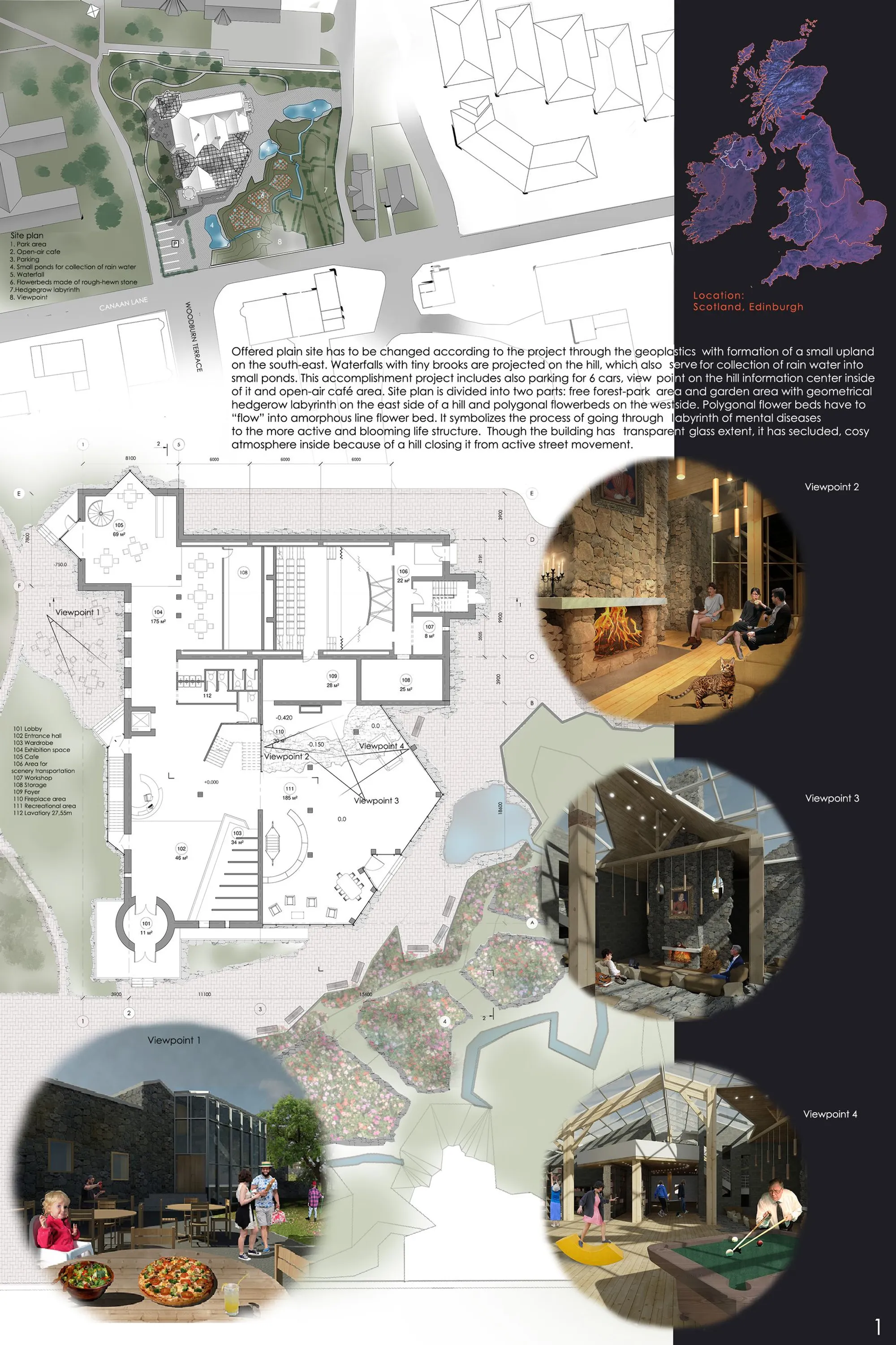
Converter: Healing Through the Dialogue of Stone and Glass
A community center in Scotland that pairs rough-hewn masonry with transparent volumes to guide residents through phases of therapeutic recovery.


What if a building could chart the emotional arc of recovery? Converter takes that question literally, organizing its entire spatial sequence around a phased journey from isolation to community integration. The programme serves two distinct groups: individuals with mental health disorders and mentally healthy residents seeking connection. Both move through tailored stages of interaction, beginning with introspection and guided therapy, progressing to independent cohabitation, and arriving at active collaboration. The architecture does not merely accommodate these phases; it narrates them through material, enclosure, and transparency.
Designed by Margarita Zykova, Converter was shortlisted in the Live Laugh Love 2020 competition. Set against the backdrop of Scottish vernacular construction, the project merges traditional stone masonry with a modern glass and steel structure to create a community center that doubles as a space of therapeutic transformation. Juror Eleena Jamil praised the approach, noting that "the use of vernacular forms and materials in the making of a contextual building suggest familiarity and friendliness," while fellow juror Juanjo Otero highlighted its "materiality very respectful of the tradition of the place."
An Exploded Programme of Recovery
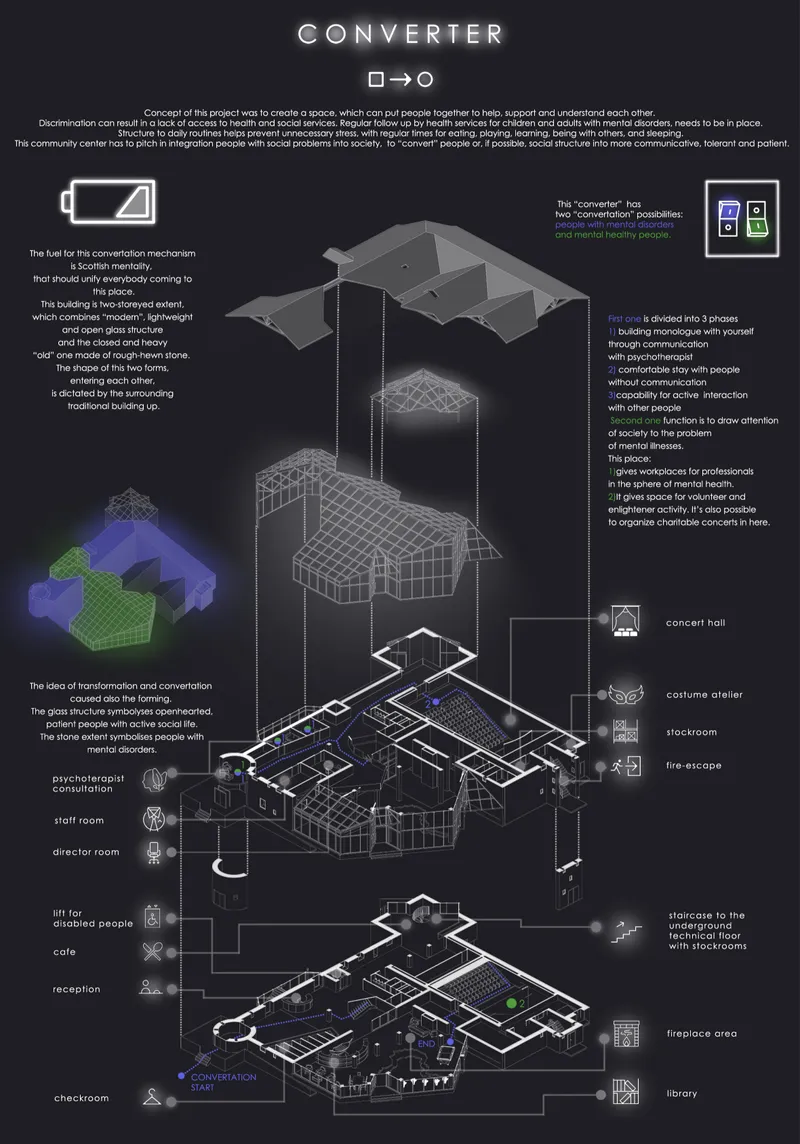
The axonometric diagram breaks the building apart to reveal how each floor contributes to the therapeutic narrative. Wireframe roof forms hover above labeled zones: psychotherapist consultation rooms, workspaces for mental health professionals, volunteer areas, event zones, a concert hall, and a costume atelier for expressive therapy. Cafés, libraries, and recreation rooms populate the plan as sites of casual social interaction, deliberately placed to encourage unplanned encounters between the two user groups. The ground floor anchors the experience with a circular entrance hall that branches into an audience hall, a winter garden, and game areas. Each room occupies a deliberate position along a spatial metaphor that runs from "Conversion Start" to "End," mapping personal progress onto architectural sequence.
Stone Weight, Glass Openness

The section rendering exposes the project's central material argument. Rough-hewn stone masonry volumes, heavy and enclosed, sit alongside a transparent steel and glass structure that floods interiors with daylight. The stone symbolizes the weight of mental struggle: solid, protective, introverted. The glass represents social openness and the possibility of recovery. This is not ornamental contrast. The two materials define different experiential conditions within the building, guiding occupants from sheltered, private spaces into exposed, communal ones as they progress through the programme. The juxtaposition also roots the project in its Scottish context, reading as an extension of the local built landscape rather than an import.
The Auditorium as a Threshold Between Private and Public Life
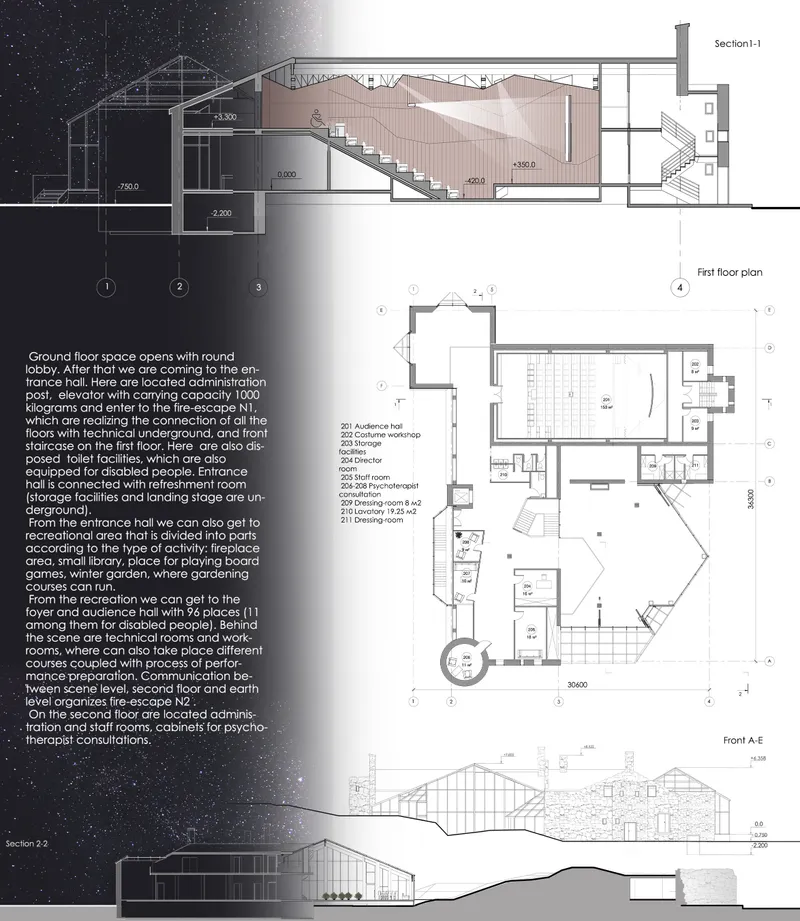
The section drawing and first floor plan zero in on one of the building's most programmatically charged spaces: the auditorium hall with stepped seating and its adjacent entrance foyer. This is where charitable concerts, community events, and expressive therapy sessions take place, making it the point of maximum social overlap between residents and the wider public. Stepped seating creates a natural amphitheatre condition, encouraging collective attention and shared experience. The foyer acts as a decompression zone, a space where occupants can prepare for public engagement or retreat from it. Inclusive features like lifts and accessible toilets are woven throughout, ensuring the space functions as a truly universal gathering point.
Upper levels house private offices and therapy rooms, positioned above the public programme to reinforce the vertical separation between contemplation and communal activity. The layering is deliberate: more intimate functions sit higher, while the ground plane remains porous and socially active.
Why This Project Matters
Converter treats architecture as an active agent of social rehabilitation rather than a passive container. By structuring its entire plan around a phased therapeutic journey, the project gives spatial form to a process that is usually invisible: the slow, nonlinear work of rebuilding connection and self-sufficiency. The decision to design for two parallel user groups, those with mental health challenges and those without, rejects the institutional model of segregation in favour of guided integration.
Margarita Zykova's command of material symbolism elevates what could have been a purely diagrammatic exercise into something architecturally persuasive. The stone and glass duality is simple enough to read immediately but rich enough to sustain the full experiential arc of the building. In a competition field asking designers to consider wellbeing, Converter stands out for refusing to treat happiness as a surface condition. It locates it instead in the harder, slower work of converting exclusion into belonging.
View the Full Project
About the Designers
Designer: Margarita Zykova
Enter a Design Competition on uni.xyz
uni.xyz runs architecture and design competitions year-round that reward proposals with spatial conviction and real site intelligence.
Project credits: Converter by Margarita Zykova Live Laugh Love 2020 (uni.xyz).



Popular Articles
Popular articles from the community


Co-life: Sustainable Architecture for Age-Friendly Community Living
Co-life reimagines sustainable architecture for seniors through courtyards, rammed earth, shared gardens, and spaces designed for belonging.

Riyadh For All: Intergenerational Urban Design for Active Aging in Rabat
Riyadh For All reimagines urban design in Rabat with intergenerational co-living, adaptive courtyards, and Moroccan cultural exchange today.

The Earth Pod: 3D Printed Homes for Resilient Refugee Communities
The Earth Pod reimagines refugee housing through 3D printed homes made from clay, combining resilience, self-sufficiency, and rapid shelter.

Conexión: Biophilic Design Reimagines High-Rise Living in Hong Kong
Conexión reimagines high-rise living in Hong Kong through biophilic design, green facades, shared spaces, daylight, water and nature within.

Similar Reads
You might also enjoy these articles

Day and Night Park: A Time-Based Urban Newsstand in Beijing
A temporary urban newsstand in Beijing blending travel, light, and reading through poetic colors, compact form, and community-focused design.

Modernist Patio Renovation in El Masnou, Barcelona by Oliver Segura Arquitectura + Cebrià Arquitectura
Modernist patio renovation blending tradition and innovation with a movable pool, leveled floors, and Catalan materials in El Masnou.

Alto Residencial Coop: Cooperative Housing Development in Santiago de Compostela by Carbajo Barrios Arquitectos
A linear cooperative housing complex blending white volumes and perforated metal façades, enhancing community living, natural light, privacy, and urban integration.
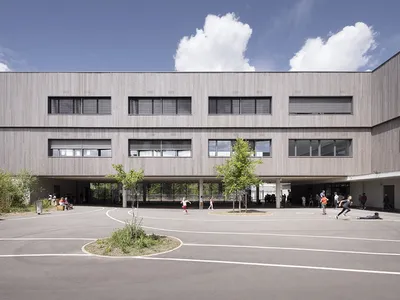
Vil Genis School by BPA ARCHITECTURE – Massy, France
Vil Genis School in Massy, France, features sustainable design, south-facing classrooms, community integration, accessible spaces, and modern educational architecture.
Explore Urban Design Competitions
Discover active competitions in this discipline



Challenge to reimagine the Iron Throne


Photograph architecture without architects


Illustrate the lost glory of Angkor Wat - Render Challenge


Design challenge to reuse E-waste
Comments (0)
Please login or sign up to add comments
No comments yet. Be the first to comment!