
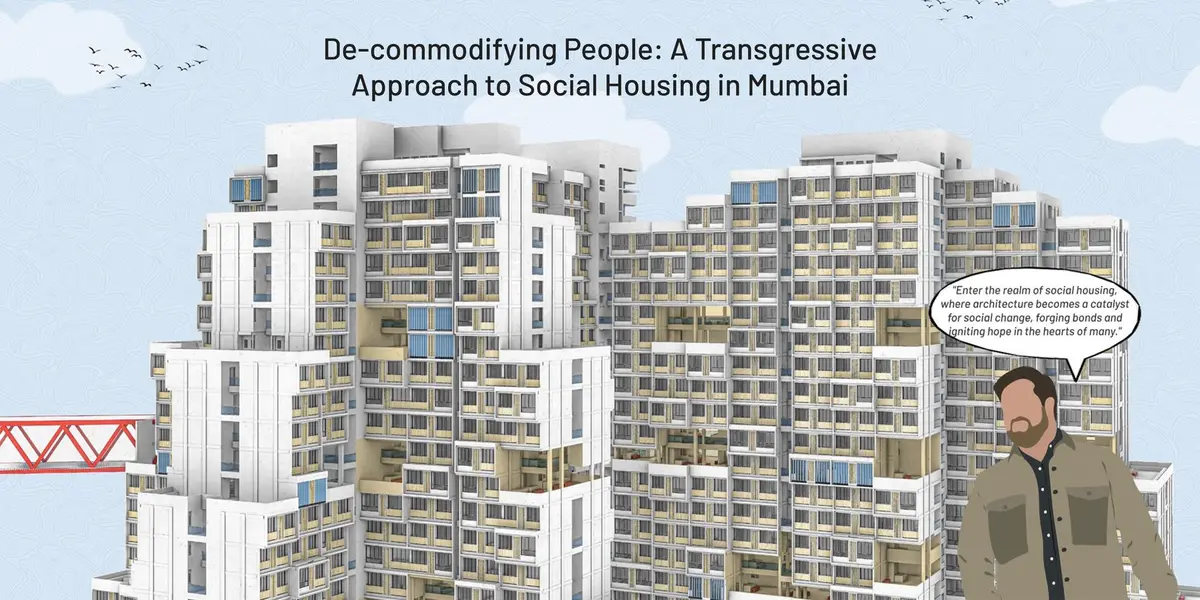
De-commodifying People: A Transgressive Approach to Social Housing in Mumbai
Redefining Housing as a Right, Not a Commodity: Creating Communities with Dignity and Equity in Mumbai.


Mumbai, a bustling metropolis, is often characterized by its glaring contrast between luxury high-rises and densely populated slum settlements. The city is home to one of the highest proportions of slum dwellers in India, illustrating the sharp social inequalities in access to housing. The ongoing housing crisis, driven by soaring property prices and profit-focused real estate developments, has exacerbated issues of overcrowding and inadequate living conditions for a substantial portion of the population. In response to this crisis, architect Vardhan Arora’s project, De-commodifying People: A Transgressive Approach to Social Housing in Mumbai, proposes a radical shift in perspective: to view housing not as a commodity, but as a basic human right that fosters dignity, community, and belonging.
Arora’s proposal, a Runner-Up in the Sustainable & Regenerative Design Awards, challenges conventional housing solutions through what he calls a "transgressive" architectural approach. This design philosophy aims to dismantle established norms and create spaces that address the real needs of residents, advocating for inclusive, sustainable, and humane environments. This article delves into the key elements of Arora’s project, exploring its design principles, comparative analysis of Mumbai’s housing landscape, and innovative proposals to address housing inequalities.
Mumbai’s Housing Crisis: A Snapshot
Mumbai’s housing dilemma is marked by several interlinked issues: a high prevalence of slum settlements, an insufficient supply of affordable housing, and a pervasive profit-oriented mentality among developers. As housing prices soar, a significant portion of the population is either pushed into informal settlements or forced to compromise on basic living standards. According to recent statistics, Maharashtra alone has nearly 10 million people living in slums, with Mumbai having one of the largest slum populations in the country. This crisis is compounded by the stark inequality in urban planning and real estate development.
While high-end developments such as Lodha World Towers and Runwal Greens offer ample space, luxurious amenities, and high living standards, government and affordable housing projects like Century Mills and MHADA lack comparable quality and infrastructure. In fact, open space per person in luxury complexes can be as much as 32 square meters, while in affordable housing, it dwindles to as low as 0.6 square meters. This disparity underscores the urgency for more equitable housing solutions in Mumbai.
A Critical Analysis of Current Social Housing Solutions
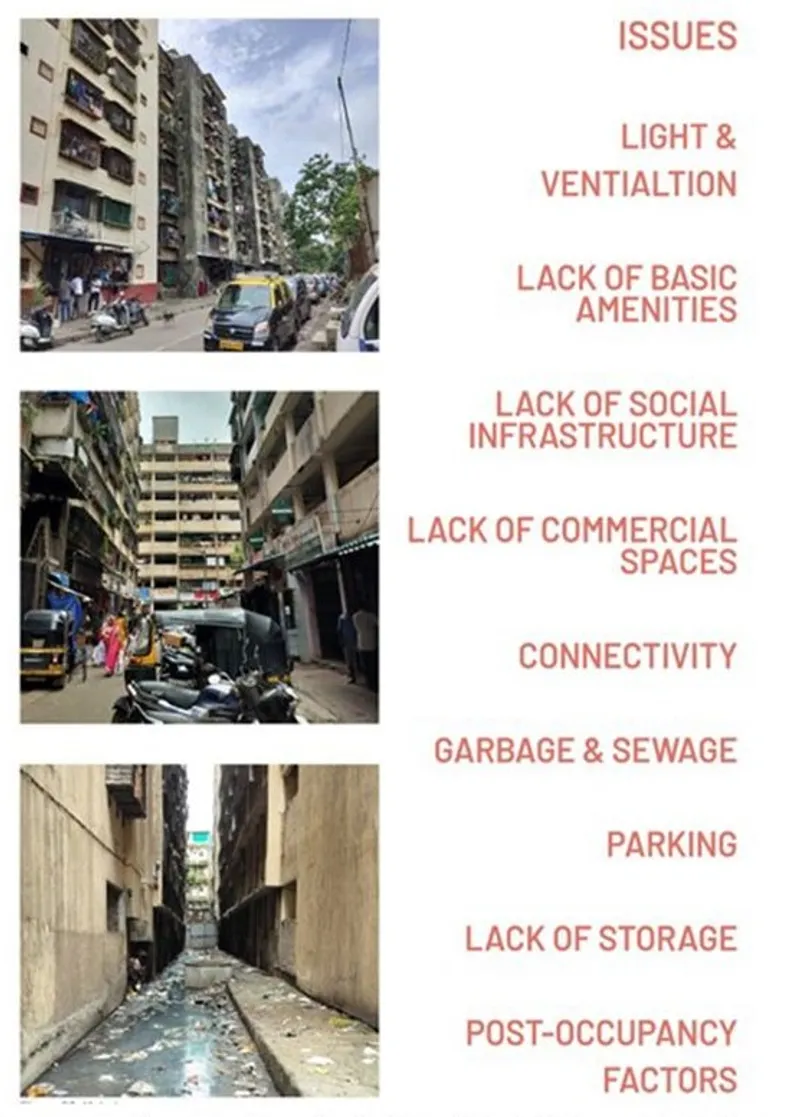
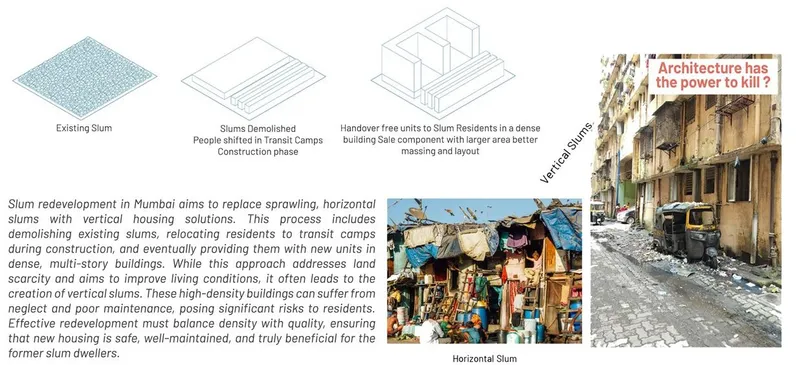
The conventional approach to social housing in Mumbai often fails to address fundamental needs. Many redevelopment projects aimed at slum rehabilitation involve relocating residents to high-density, vertical housing structures. These new constructions, while increasing land use efficiency, frequently suffer from design flaws that impact the quality of life for their residents. Common issues include poor light and ventilation, lack of basic amenities, insufficient open spaces, and inadequate infrastructure for waste and sewage management.
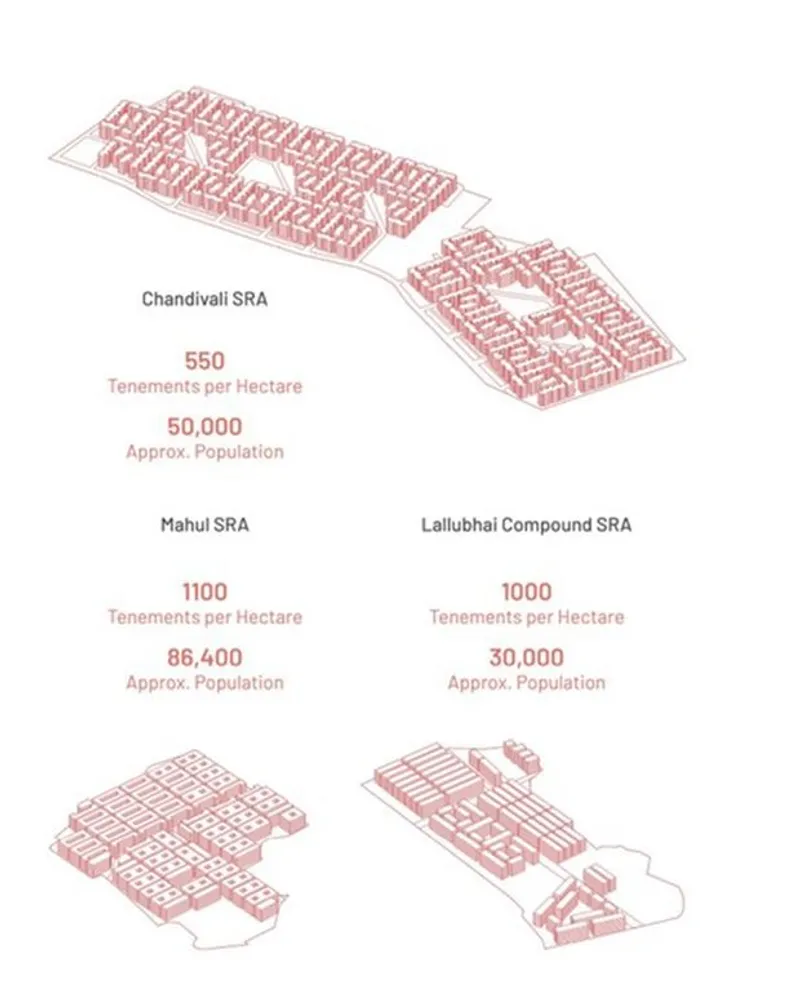
For instance, three case studies of Slum Rehabilitation Areas (SRAs) in Mumbai—Chandivali, Mahul, and Lallubhai Compound—highlight these systemic shortcomings. These SRAs, characterized by high tenement densities, fail to provide essential social infrastructure, commercial spaces, or adequate connectivity. The result is a series of isolated, overcrowded communities that struggle with the same challenges as the slums they were meant to replace. Such developments, rather than uplifting residents, often replicate the very issues of neglect, isolation, and poor living conditions that they were intended to resolve.
De-commodifying Housing: The Transgressive Architectural Approach
Arora’s concept of “de-commodifying” housing rests on the premise that housing should be a right, not a luxury. His project challenges the status quo by proposing a "transgressive" design philosophy that goes beyond conventional architectural boundaries. Transgressive architecture, as Arora describes, involves breaking or surpassing established spatial and social limits to create engaging and thought-provoking spaces. This approach shifts the focus from meeting numerical targets, such as maximum density or profit margins, to enhancing the quality of life for residents.
Key Design Goals:
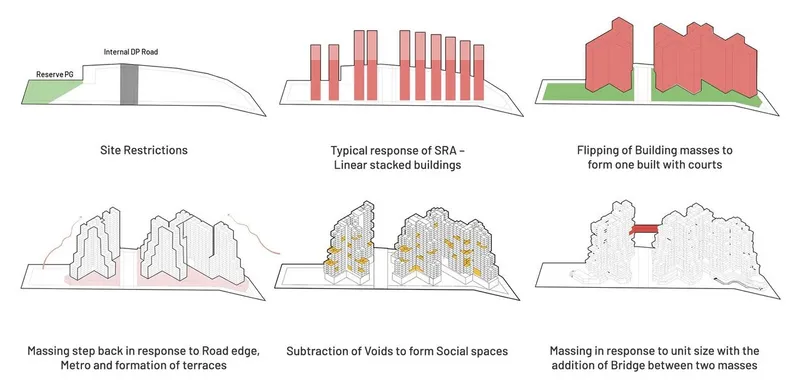
Human-Centric Spaces: The project prioritizes the well-being of residents by creating spaces that promote social interaction, community engagement, and a sense of belonging. Communal areas are designed not only for utility but to inspire connection, helping to bridge the social gap that is often prevalent in densely populated urban areas.. Sustainability: Sustainable practices are embedded into the design through the use of eco-friendly materials, efficient spatial planning, and infrastructure that minimizes the environmental impact. By maximizing space efficiency and incorporating green practices, the project aims to create a model of sustainable urban living.. Transgressive Spatial Relationships: The design rethinks conventional spatial arrangements by balancing public and private spaces in ways that encourage interaction while respecting individual privacy. This creates an environment that is inclusive, accessible, and reflective of the diverse needs of the community.. Flexible and Adaptive: The architecture is designed to adapt to future needs and demographic shifts, ensuring that the space remains relevant and functional over time.. Breaking the Mold of Vertical Slums: Rather than creating dense, isolated towers, the design integrates communal spaces and open areas within the buildings, reducing the isolating effects of vertical slums and fostering a healthier living environment.
Proposed Design and Programmatic Features
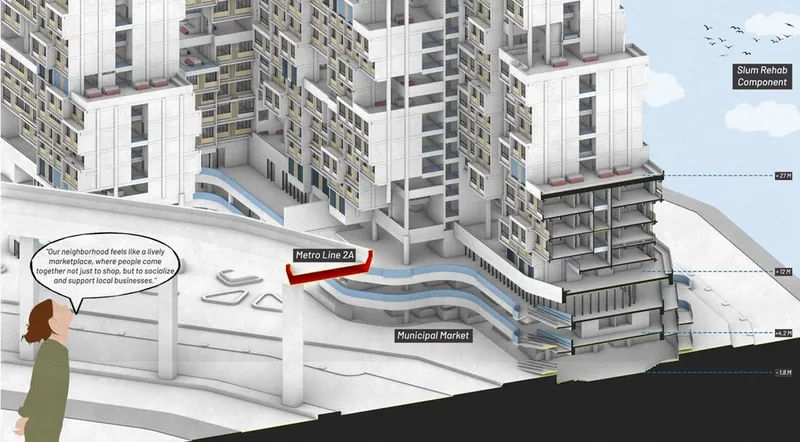
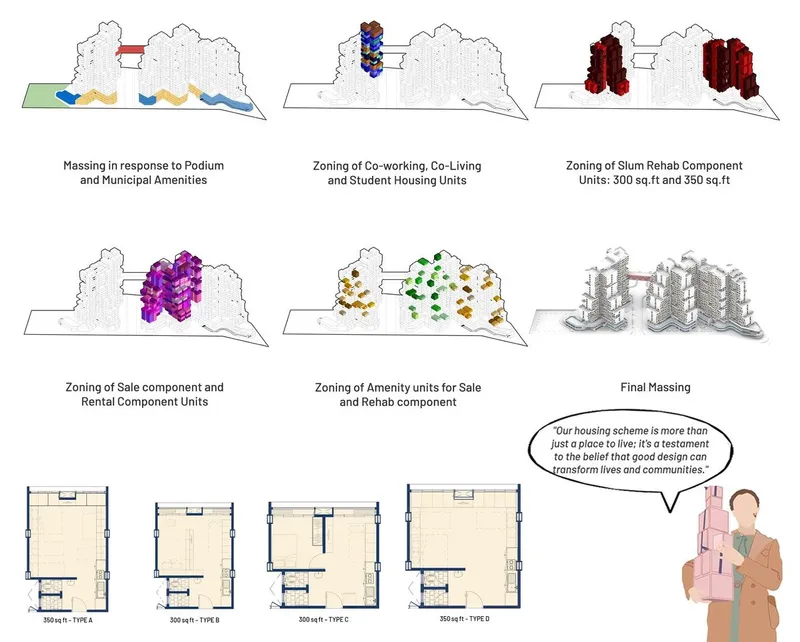
The proposed design diverges significantly from typical SRA or affordable housing layouts. It includes a mix of residential, commercial, and community spaces within a single site, transforming the housing complex into an urban node. This mixed-use approach ensures that residents have access to essential amenities within walking distance, reducing dependence on external infrastructure.
Key components of the program include:
- Residential Units: Various unit types cater to different family structures, including co-living units for students and shared spaces for single residents and couples. This diversification ensures that the complex meets the varied needs of Mumbai’s demographic.
- Community and Recreational Spaces: From playgrounds and community halls to yoga centers and libraries, the design emphasizes areas that support social activities, mental well-being, and physical health.
- Essential Services: The inclusion of a municipal primary school, maternity home, and market within the complex ensures that basic services are readily accessible to all residents, fostering a more self-sufficient and resilient community.
- Sustainable Waste and Water Management: By implementing advanced systems for waste recycling and water conservation, the project minimizes its ecological footprint, setting a standard for future developments in sustainable urban housing.
Materiality and Construction: Embracing Sustainability
The project utilizes sustainable materials, notably Glass Fiber Reinforced Gypsum (GFRG) panels and steel, to achieve both durability and efficiency. GFRG panels are fire-resistant, lightweight, and require minimal plastering, making them a cost-effective and eco-friendly alternative to traditional construction materials. The use of these materials aligns with the Indian Green Building Council (IGBC) criteria, allowing the project to achieve a Gold Rating for sustainability.
The construction methodology is designed to minimize environmental impact and speed up the building process. The use of pre-cast concrete panels and rapid installation techniques helps in reducing waste and optimizing resources, which is crucial for a project of this scale and social significance.
A Vision for Inclusive Urban Transformation
De-commodifying People: A Transgressive Approach to Social Housing in Mumbai is more than just a housing project—it’s a call for a paradigm shift in urban development. By challenging the commodification of housing, Arora’s design advocates for a model where every individual has access to safe, affordable, and dignified shelter. The project sets a new benchmark for social housing in Mumbai, demonstrating that it’s possible to create inclusive, sustainable, and humane living environments without sacrificing architectural innovation or economic viability.
In a city where the housing landscape is shaped by a relentless "number war" of maximizing density and profit, Arora’s transgressive approach offers a hopeful alternative. It envisions a future where architecture reclaims its role as a catalyst for social change, fostering communities that are resilient, connected, and empowered. By rethinking the fundamentals of social housing, this project aspires to transform not only the physical landscape but also the lives of Mumbai’s residents, ensuring that housing remains a fundamental human right, not a privilege.


Popular Articles
Popular articles from the community


The Musturak Paradise: Senior Living Architecture for a Connected Future in Temara, Morocco
The Musturak Paradise reimagines senior living architecture in Temara via private homes, social spaces, culture, community, and shared care.

The Ocean Hive: Sustainable Architecture for a Self-Sufficient Civilization at Sea
The Ocean Hive imagines sustainable architecture at sea, where modular habitats, algae, wave power and ocean waste sustain a growing colony.

Co-Life: Senior Housing Design That Reconnects Older Adults With the City
Co-Life reimagines senior housing design through healing gardens, shared streets, workshops, and a sustainable community across generations.

ALGAL REALM: A Bio-Integrated Lunar Habitat Design for Life Beyond Earth
ALGAL REALM reimagines lunar habitat design with algae-powered life support, 3D-printed regolith, and vertical living for a lunar future.

Similar Reads
You might also enjoy these articles

Day and Night Park: A Time-Based Urban Newsstand in Beijing
A temporary urban newsstand in Beijing blending travel, light, and reading through poetic colors, compact form, and community-focused design.

Modernist Patio Renovation in El Masnou, Barcelona by Oliver Segura Arquitectura + Cebrià Arquitectura
Modernist patio renovation blending tradition and innovation with a movable pool, leveled floors, and Catalan materials in El Masnou.

Alto Residencial Coop: Cooperative Housing Development in Santiago de Compostela by Carbajo Barrios Arquitectos
A linear cooperative housing complex blending white volumes and perforated metal façades, enhancing community living, natural light, privacy, and urban integration.
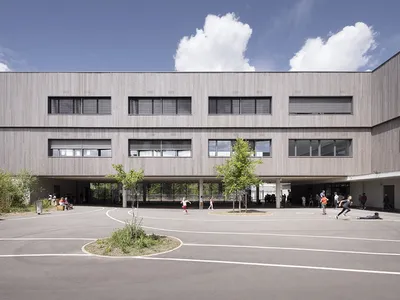
Vil Genis School by BPA ARCHITECTURE – Massy, France
Vil Genis School in Massy, France, features sustainable design, south-facing classrooms, community integration, accessible spaces, and modern educational architecture.


Comments (0)
Please login or sign up to add comments
No comments yet. Be the first to comment!