
Dissolve: Where Concrete Topography Meets a Suspended Steel Grid in Boa Vista
A shortlisted Live Green entry layers sculpted landforms beneath modular lodging to create a new cultural ecosystem on Cape Verde.


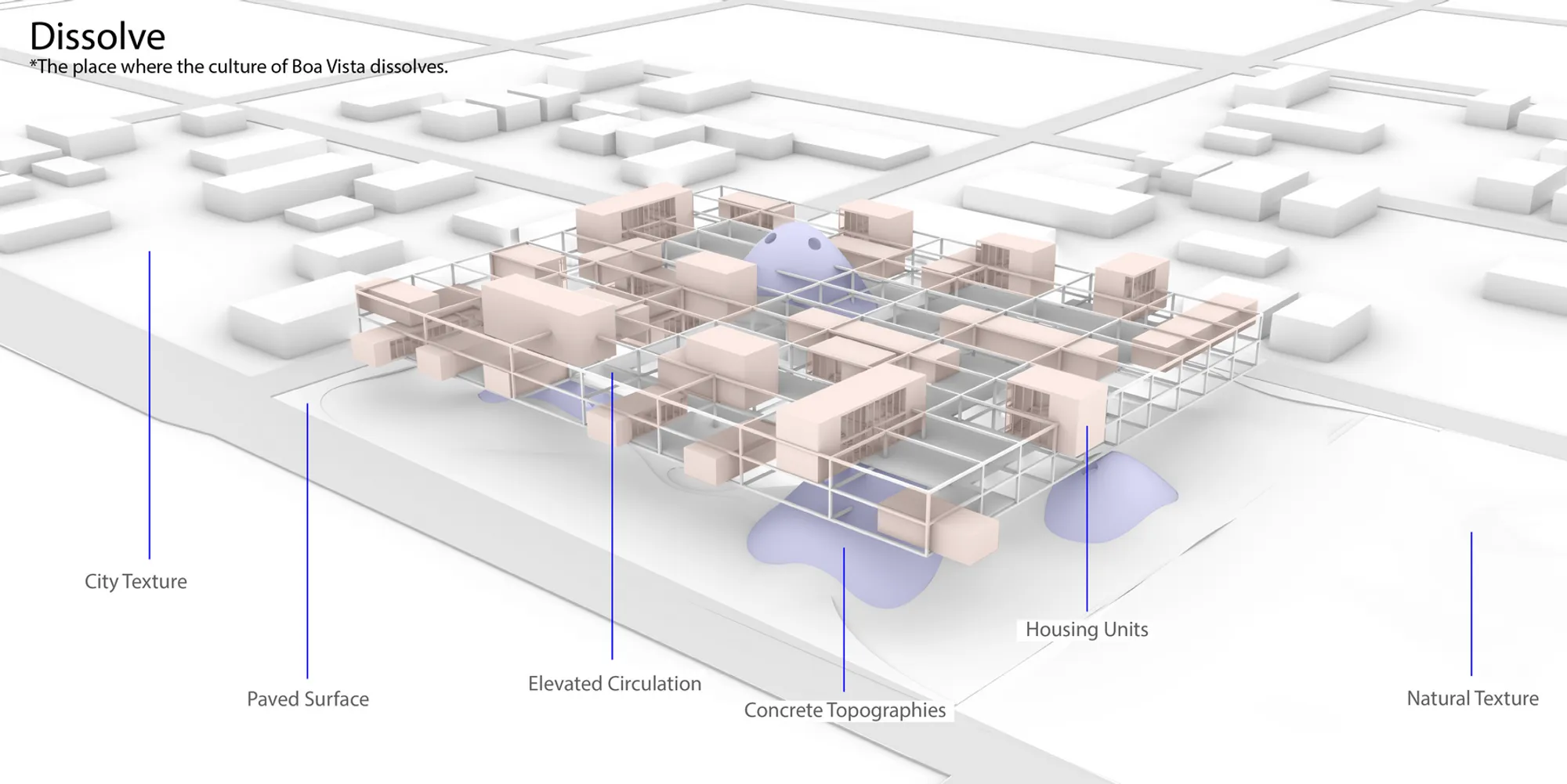
What if a building didn't sit on a site but grew out of it? In Boa Vista, Cape Verde, Dissolve proposes a concrete topography that rises from the terrain like sculpted ground, hosting markets, workshops, and performance spaces beneath a suspended steel grid of modular artist lodgings. The result is a hybrid organism: part landscape, part infrastructure, entirely resistant to the usual binary of building versus ground.
Designed by Naz Dilsiz and Demir Dikmenoglu, the project was shortlisted in the Live Green competition. Set in the tropical context of Boa Vista, Dissolve confronts a fundamental question about sustainable architecture: how to create resilient community space without imposing a rigid footprint on delicate island ecology. The answer, here, is to dissolve the boundary between structure and landscape altogether.
Two Systems in Productive Tension
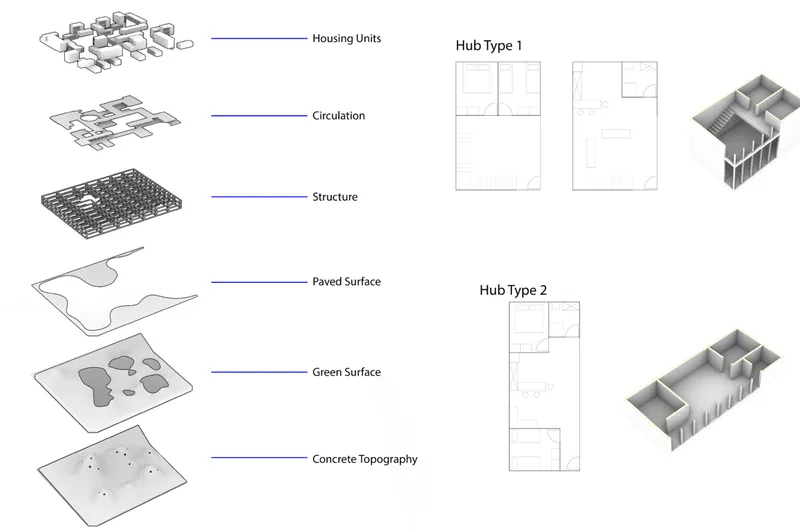
The exploded axonometric makes the design logic legible at a glance. At the base, a sculpted concrete landform provides thermal mass, natural insulation, and shaded public territory. Above it, a structural steel grid holds modular residential units aloft, introducing geometric rhythm against the organic fluidity below. These two systems coexist without competing: the heavy, earth-born base moderates temperature while the elevated grid ensures cross-ventilation and shade. In a tropical climate, this interplay of mass and lightness is not decorative but performative.
The diagram also reveals the project's two hub typologies. A compact, vertical hub accommodates temporary artist studios and short-stay lodging. A longer, horizontal hub houses communal living and collaborative workspaces. Both are threaded through a layered circulation system that encourages chance encounters between residents, visitors, and the broader public. Because the grid is modular, future expansion can respond to shifting cultural programmes without demolishing what already exists.
An Organic Footprint Woven into Existing Trees
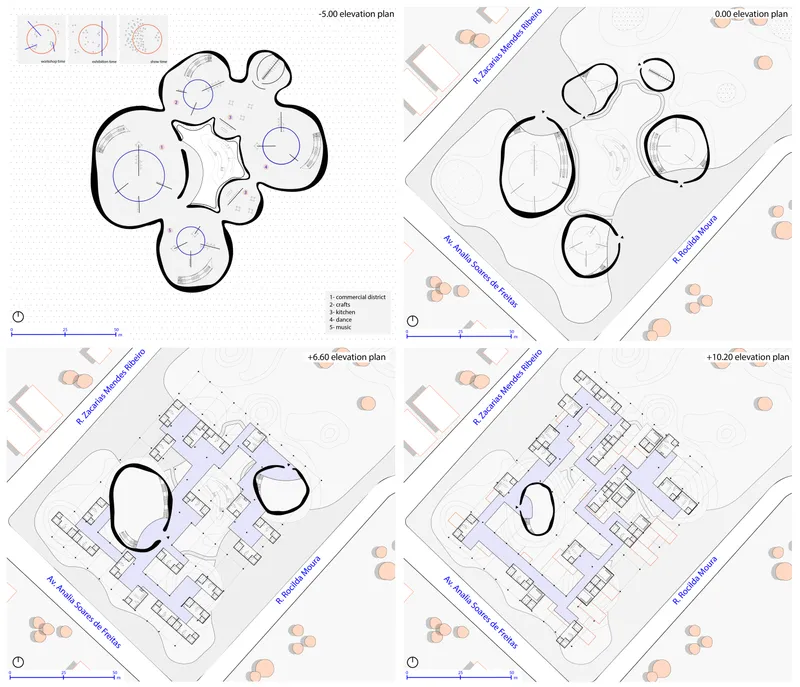
The multi-elevation site plans show how Dissolve negotiates its ground. Organic pod forms, almost cellular in plan, sit alongside more rectilinear residential blocks. Crucially, existing trees are preserved and integrated into the composition rather than cleared. Paved pathways guide circulation through the site while green surfaces soften the transition between architecture and soil. Seen from above, the arrangement reads less like a masterplan and more like a woven network, a cultural ecosystem shaped by the island's natural morphology rather than imposed upon it.
Material Honesty in Miniature
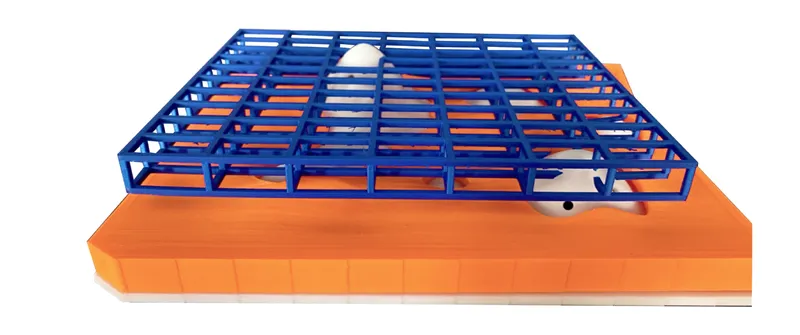
The physical model strips the concept to its essentials. A blue structural grid sits atop an orange foundation slab, making the dual-system logic tactile and immediate. There is no attempt to hide the relationship between frame and base; the design prioritizes material honesty over surface finish. The contrast in color and geometry between the two elements underscores the project's central argument: architecture can be simultaneously grounded and lightweight, permanent in its base and adaptable in its superstructure.
Undulating Sections That Breathe with the Landscape
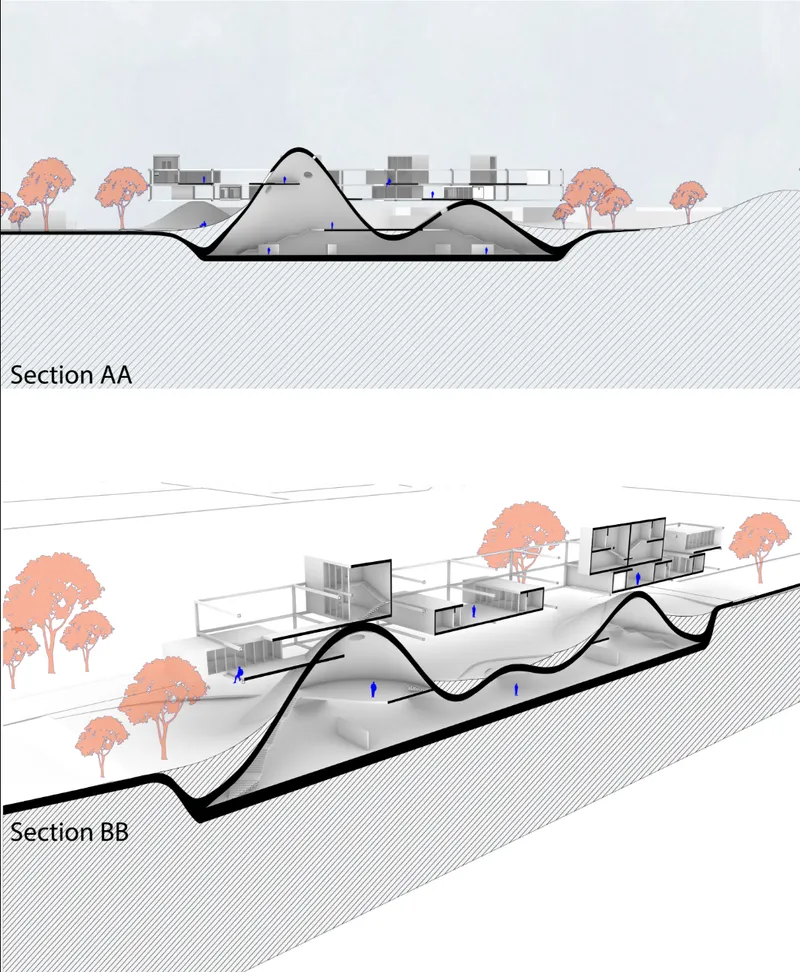
The section drawings confirm what the plans suggest: the roof forms undulate, embedding themselves in the landscape rather than crowning it. Coral-toned trees populate the section, reinforcing the continuity between built and natural elements. The gentle masses of concrete are neither buildings nor ground in the conventional sense. They are thresholds, mediating between shaded interior programmes and the open terrain of Boa Vista. Passive environmental strategies are legible in every line: airflow paths, shaded voids, and the thermal buffer of the concrete base all contribute to a climatic balance suited to the island's heat and humidity.
Why This Project Matters
Dissolve is compelling because it refuses to treat sustainability as a checklist of technologies bolted onto a conventional building. Instead, Dilsiz and Dikmenoglu embed environmental performance into the fundamental architectural proposition: the concrete landform insulates and shades, the steel grid ventilates and adapts, and the modular programme evolves without waste. Every design decision serves double duty, spatial and ecological, which is exactly the kind of thinking the Live Green brief demands.
More broadly, the project offers a model for community architecture in fragile island contexts. By dissolving the hard edges between structure and terrain, between cultural programme and residential life, it proposes a place that can breathe, adapt, and grow alongside its inhabitants. It values process over permanence and collaboration over isolation. For a pair of young designers working in Boa Vista, that is a sophisticated and timely position.
View the Full Project
About the Designers
Designers: Naz Dilsiz, Demir Dikmenoglu
Enter a Design Competition on uni.xyz
uni.xyz runs architecture and design competitions year-round that reward proposals with spatial conviction and real site intelligence.
Project credits: Dissolve by Naz Dilsiz, Demir Dikmenoglu Live Green (uni.xyz).



Popular Articles
Popular articles from the community


The Musturak Paradise: Senior Living Architecture for a Connected Future in Temara, Morocco
The Musturak Paradise reimagines senior living architecture in Temara via private homes, social spaces, culture, community, and shared care.

Co-life: Sustainable Architecture for Age-Friendly Community Living
Co-life reimagines sustainable architecture for seniors through courtyards, rammed earth, shared gardens, and spaces designed for belonging.

The Ocean Hive: Sustainable Architecture for a Self-Sufficient Civilization at Sea
The Ocean Hive imagines sustainable architecture at sea, where modular habitats, algae, wave power and ocean waste sustain a growing colony.

Co-Life: Senior Housing Design That Reconnects Older Adults With the City
Co-Life reimagines senior housing design through healing gardens, shared streets, workshops, and a sustainable community across generations.


Similar Reads
You might also enjoy these articles

Lunar Spiral: Space Architecture Shaped by the Mathematics of the Universe
Lunar Spiral reimagines space architecture through Fibonacci geometry, lunar regolith, levitating habitats, and self-sustaining Moon living.
The Main Dream: Modular Architecture for Play, Learning, and Community
A modular playground turns recycled plastic into adaptable spaces where refugee children can play, build, learn, and reconnect.

Play: Fragments of Their World
Familiar architecture becomes modular playground design, creating safe spaces where displaced children can learn, connect, imagine and play.

Wadi Rum Observatory: Desert Architecture Designed for the Night Sky
Wadi Rum Observatory turns desert architecture into a quiet instrument for astronomy, hiding research spaces under Jordan's starlit terrain.
Explore Hospitality Building Competitions
Discover active competitions in this discipline



Challenge to design locus for the upliftment of human rights


Design challenge to reuse E-waste
Comments (0)
Please login or sign up to add comments
No comments yet. Be the first to comment!