
DTR_studio Threads Arab Courtyards and Mediterranean Light Through a Dense Estepona Street
A Norwegian family's second home in downtown Estepona turns a U-shaped plot into a sequence of light-filled patios and timber-lined rooms.


In the tight residential fabric of downtown Estepona, a town on Malaga's Costa del Sol, a Norwegian family from Oslo asked DTR_studio to do something counterintuitive: build a house that disappears from the street and explodes inward. Lead architects Jose Maria Olmedo and Jose Miguel Vázquez took a U-shaped plot, one that wrapped around an existing building, and produced two independent units, a main house and a guest apartment, each presenting a deliberately understated facade while concealing a rich interior choreography of courtyards, skylights, and double-height voids.
What makes the Wiik House genuinely interesting is not just its debts to Arab and Mediterranean precedent but how literally it operationalizes those references. Light is not a metaphor here; it is the organizing system. Every major space in the 534-square-meter house is shaped by where and how sunlight enters: through patios cut into the plan, through staircases reimagined as vertical light wells, through clerestory slots that track along ceilings. The result is a house that reads as calm and almost monastic from the outside yet thrums with material warmth and spatial surprise inside.
Courtyards as Rooms


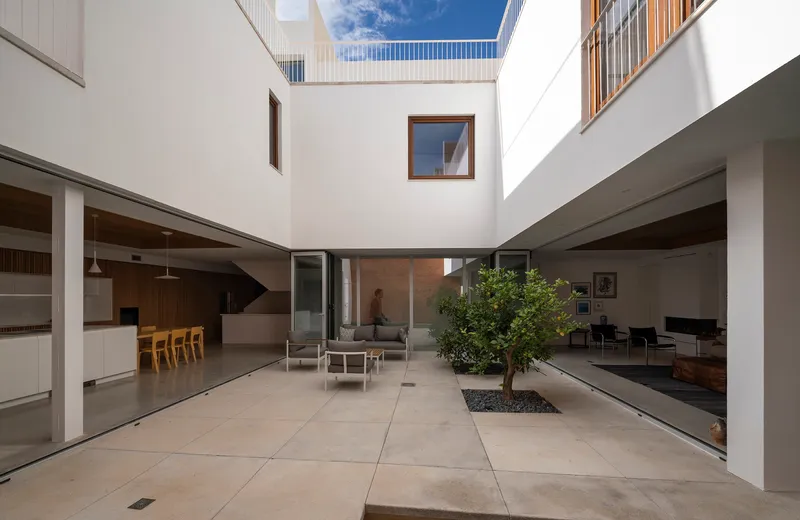
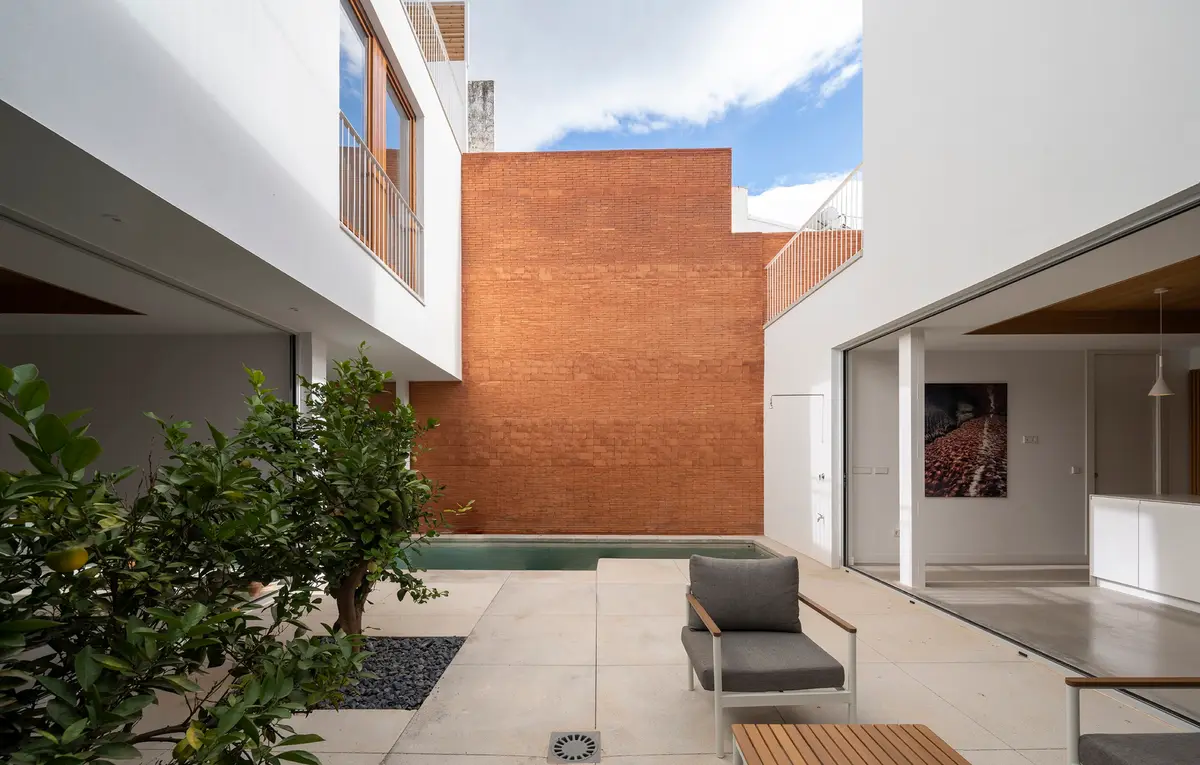
The courtyards are the real rooms of this house. A narrow pool runs alongside a red brick wall, planted tree beds break the concrete paving, and white rendered volumes rise around them to create vertical outdoor chambers open only to the sky. These are not leftover spaces between buildings; they are the primary spatial events. The brick, used selectively against the surrounding white stucco, acts as a material anchor, a reference to terracotta traditions in Andalusian construction and a way to give each patio its own identity.
The plan operates like a traditional Arab medina house turned sideways. You move from compressed, shaded thresholds into sudden volumes of light and air. The fact that the plot wraps around a pre-existing structure forced DTR_studio to think of circulation not as corridors but as a continuous negotiation between inside and outside, between the house's own mass and the gaps where sky pours in.
The Threshold Condition
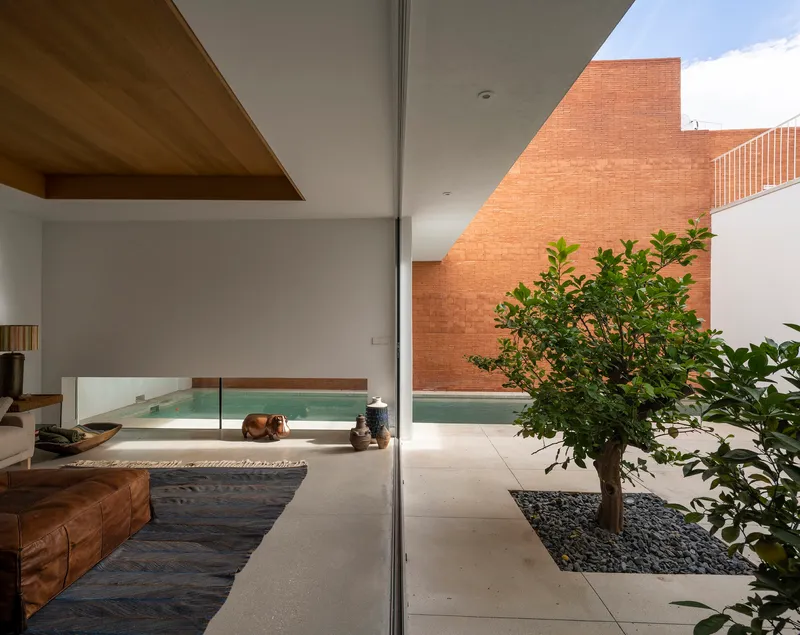
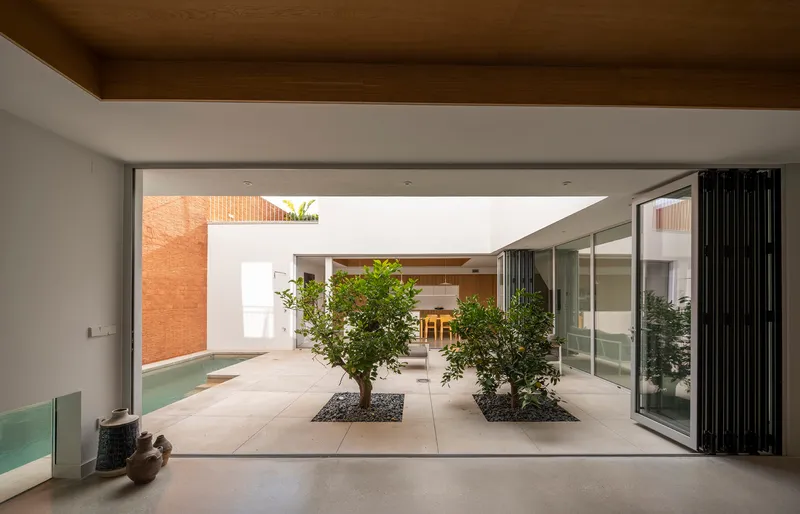

Floor-to-ceiling folding glass doors appear at nearly every junction between interior and courtyard. When fully opened, they collapse the boundary entirely: the polished concrete floor runs straight through to the planted paving outside, and the timber ceiling panels overhead read as continuous canopies whether you are standing in the living room or in the open air. This is the Costa del Sol strategy taken seriously, not as a lifestyle amenity but as a climate response. Mild winters and long dry summers mean that the house can spend most of the year functionally open.
Upper-level passages and balconies with simple metal railings reinforce the sense that you are always partly exposed to the sky. Even in the most enclosed corridor, a skylight or clerestory keeps the ceiling from ever feeling sealed off.
Timber as a Fifth Surface
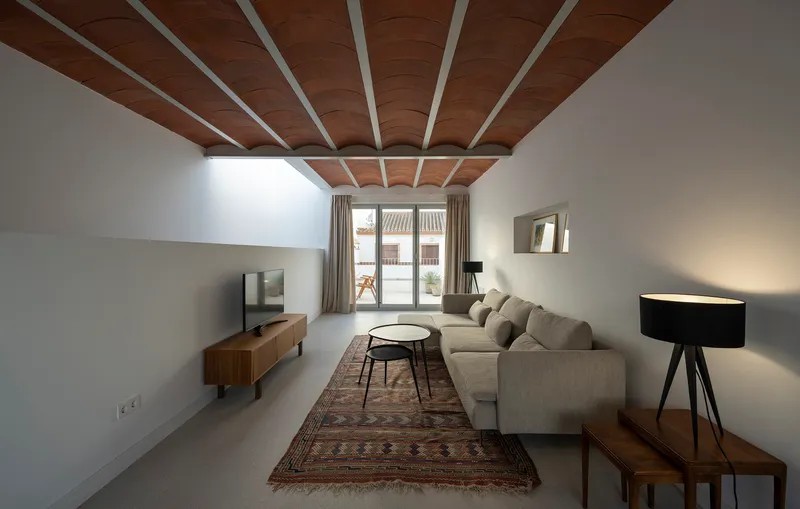
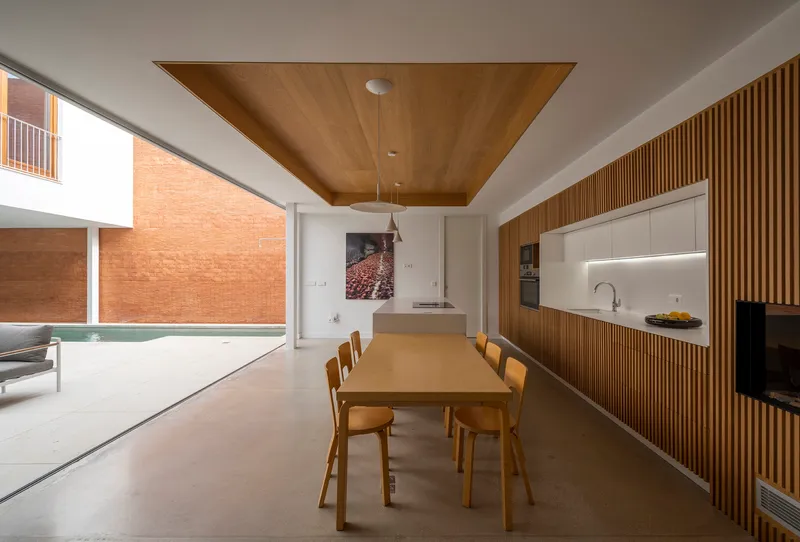
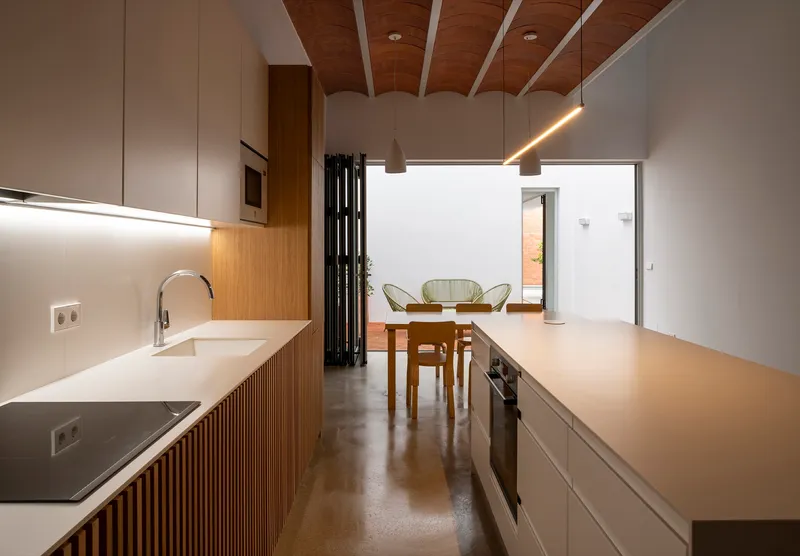
DTR_studio describes the ceiling as a fifth facade, and the timber work throughout the Wiik House makes that claim legible. In the living room, warm wood beams span overhead with clerestory windows cut just above the wall line so that light washes down onto the sofa below. In the kitchen, ribbed timber cabinetry echoes a vaulted wood ceiling that gives the cooking area an almost chapel-like compression. These are not decorative veneers. The wood panels define zones within the open plan, marking the dining area, the kitchen island, and the main seating group as distinct territories under one continuous roof.
The commitment to prefabrication shows up most clearly in these ceiling elements. Their precision, the tight fit of slat to slat, suggests components manufactured off-site and installed as finished assemblies. In a project of this scale, prefab isn't about speed; it's about controlling craft in tight urban conditions where site work is constrained.
Vertical Light Wells
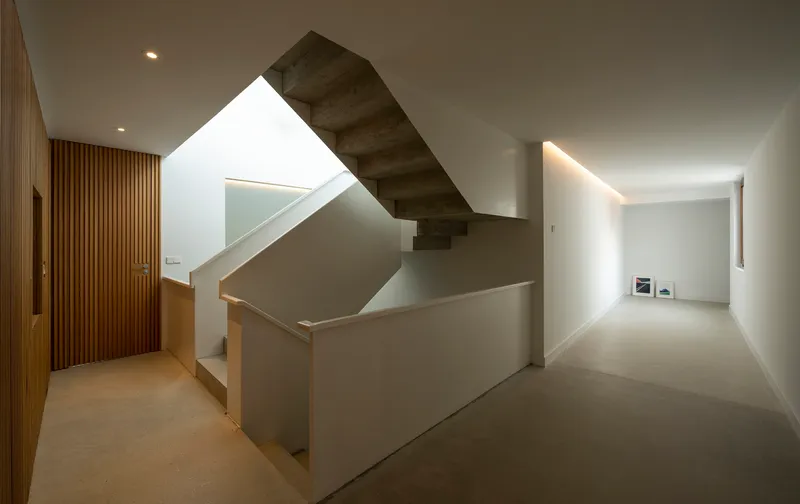
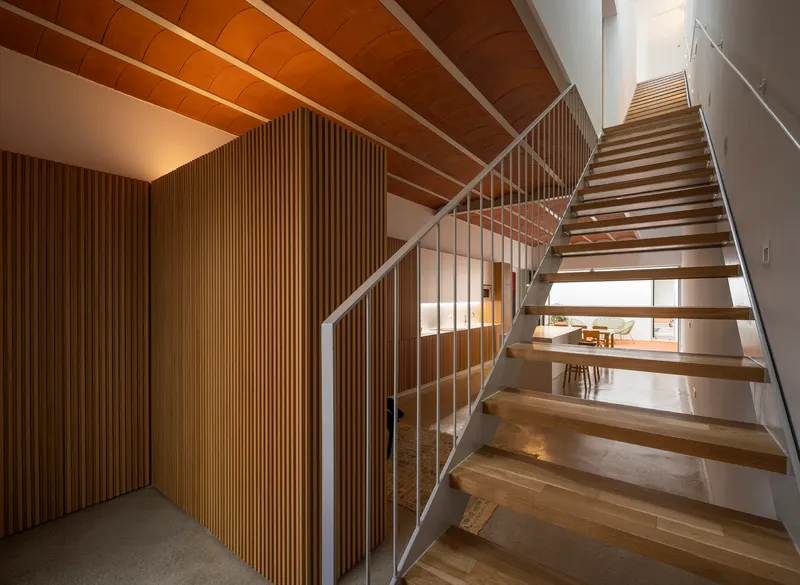
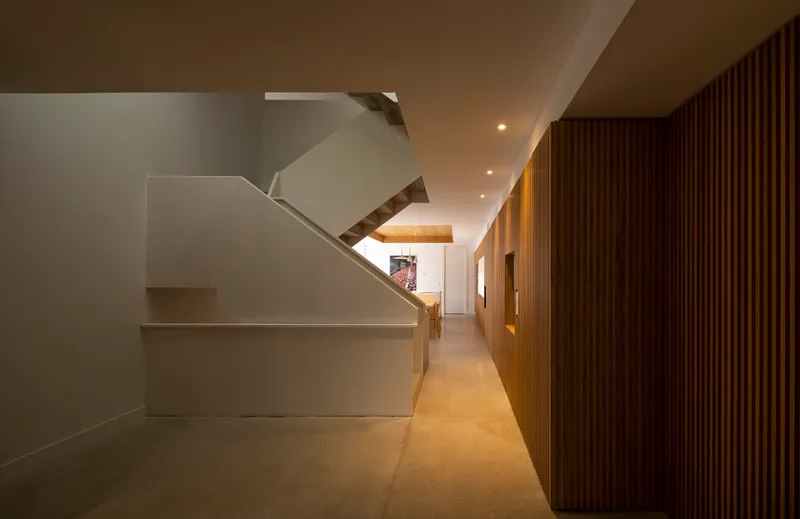
The staircases do double duty. Cantilevered concrete steps rise through a double-height void capped by a generous skylight, turning what could be mere circulation into the brightest moment in the house. In the guest unit, a timber staircase with glass railings and vertical wood slat partitions filters light laterally, creating a layered effect that shifts with the time of day. These are the "stairs-skylights" the architects reference, and they are among the project's strongest moves.
Ground-floor hallways pick up the same logic on a subtler register: vertical timber slat walls catch raking light from above, and recessed ceiling fixtures supplement what the skylights cannot provide after sunset. The effect is that every vertical transition in the house also functions as a light event.
Private Quarters and the Rooftop
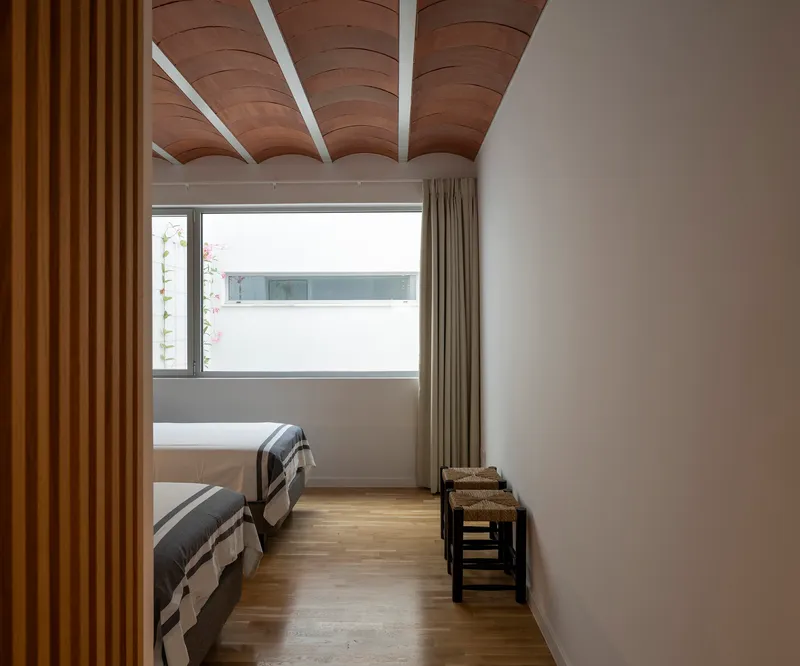
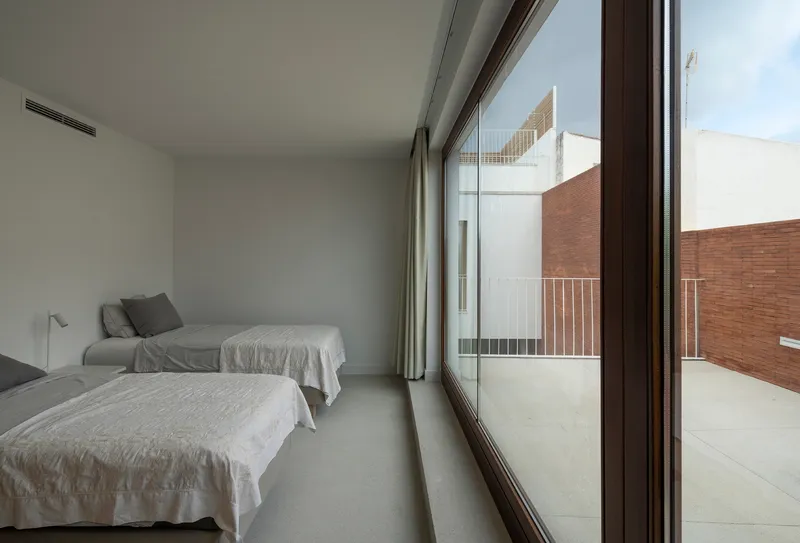
Bedrooms are quieter in their ambitions but no less considered. Curved timber ceiling beams arc over sleeping areas, horizontal windows frame views of neighboring rooftops rather than the sky, and floor-to-ceiling glazing opens onto private terraces bounded by brick walls. These are rooms designed for a family that lives primarily in Oslo; the framing of southern light, the warmth of oak surfaces, and the openness to outdoor air are deliberate inversions of a Nordic domestic norm.
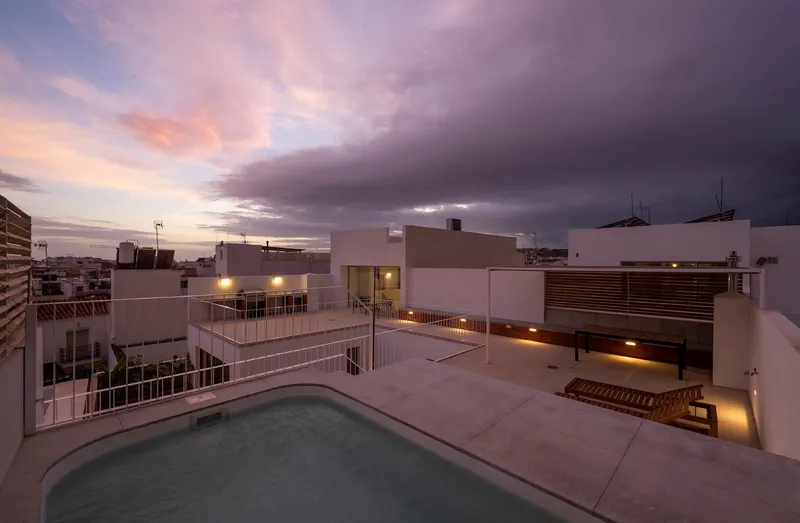
At the top of the house, a rooftop terrace with a plunge pool and timber screening looks out toward the mountains behind Estepona. Aerial views reveal how neatly the angled terrace decks and timber platforms slot into the surrounding patchwork of white roofs. The house does not dominate its block; it occupies it surgically.
Interior Details
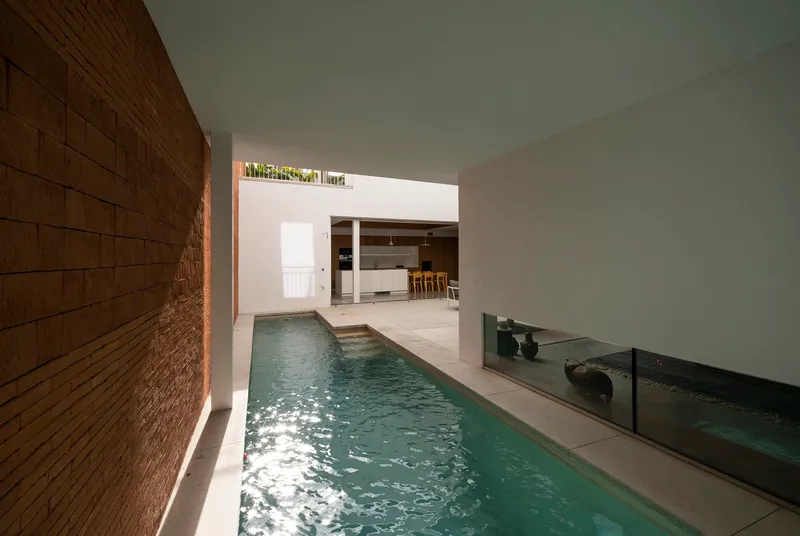
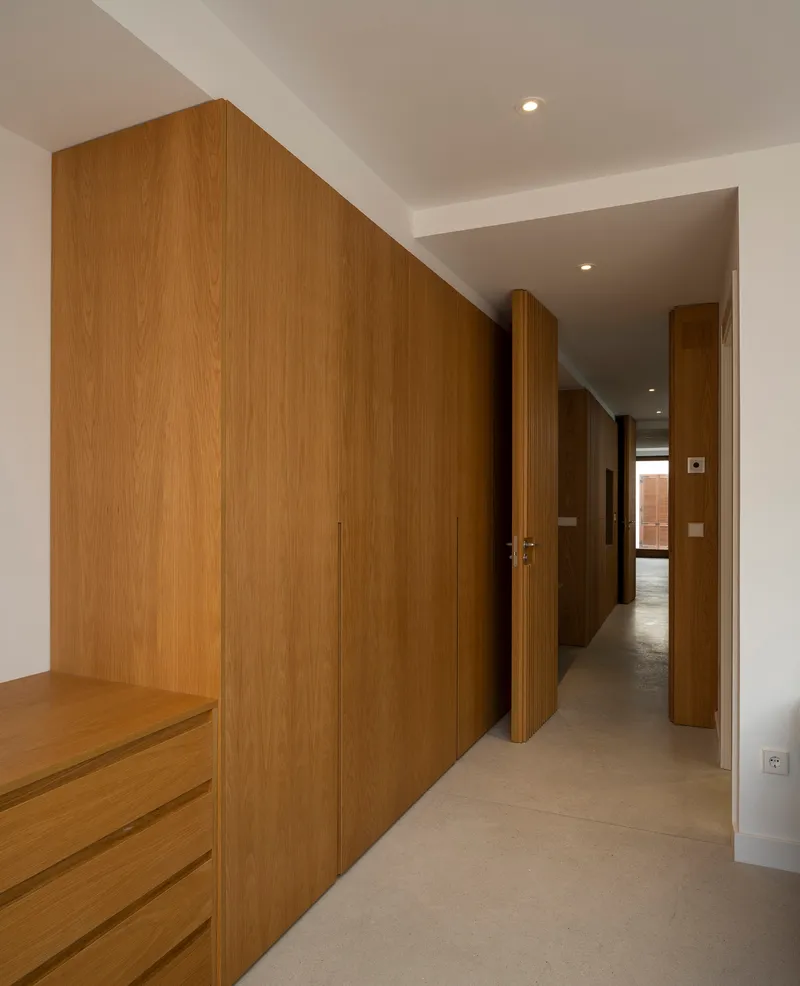
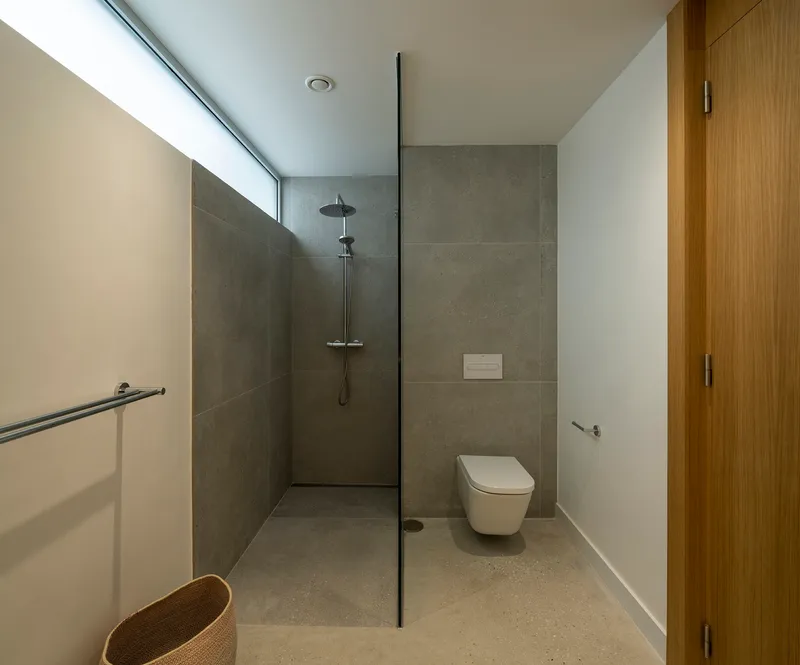
An indoor lap pool lined with timber cladding on one wall captures reflected sunlight from above, turning a utilitarian wellness feature into one of the house's most atmospheric spaces. Corridors are lined with built-in oak veneer wardrobes that form continuous linear passages, their flush doors reducing the hallway to a warm timber tube. Bathrooms deploy grey tile and continuous clerestory windows to maintain the house-wide strategy of top-lit enclosure.
The material palette, polished concrete on the floors, timber on ceilings and storage walls, white stucco on vertical planes, and terracotta brick as a punctuation mark, never wavers. That consistency is what holds together a house that could easily feel fragmented given its split program and complex plot geometry.
Plans and Drawings
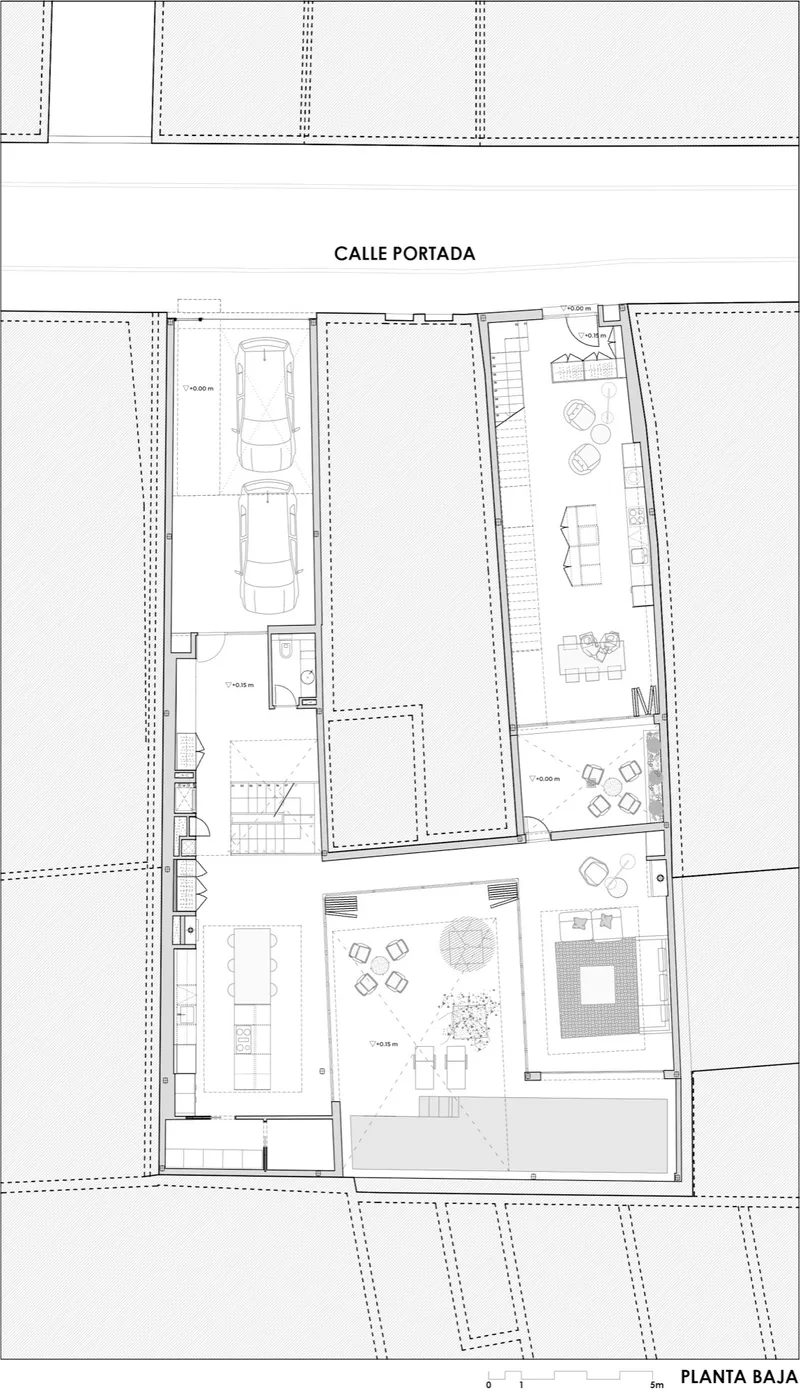
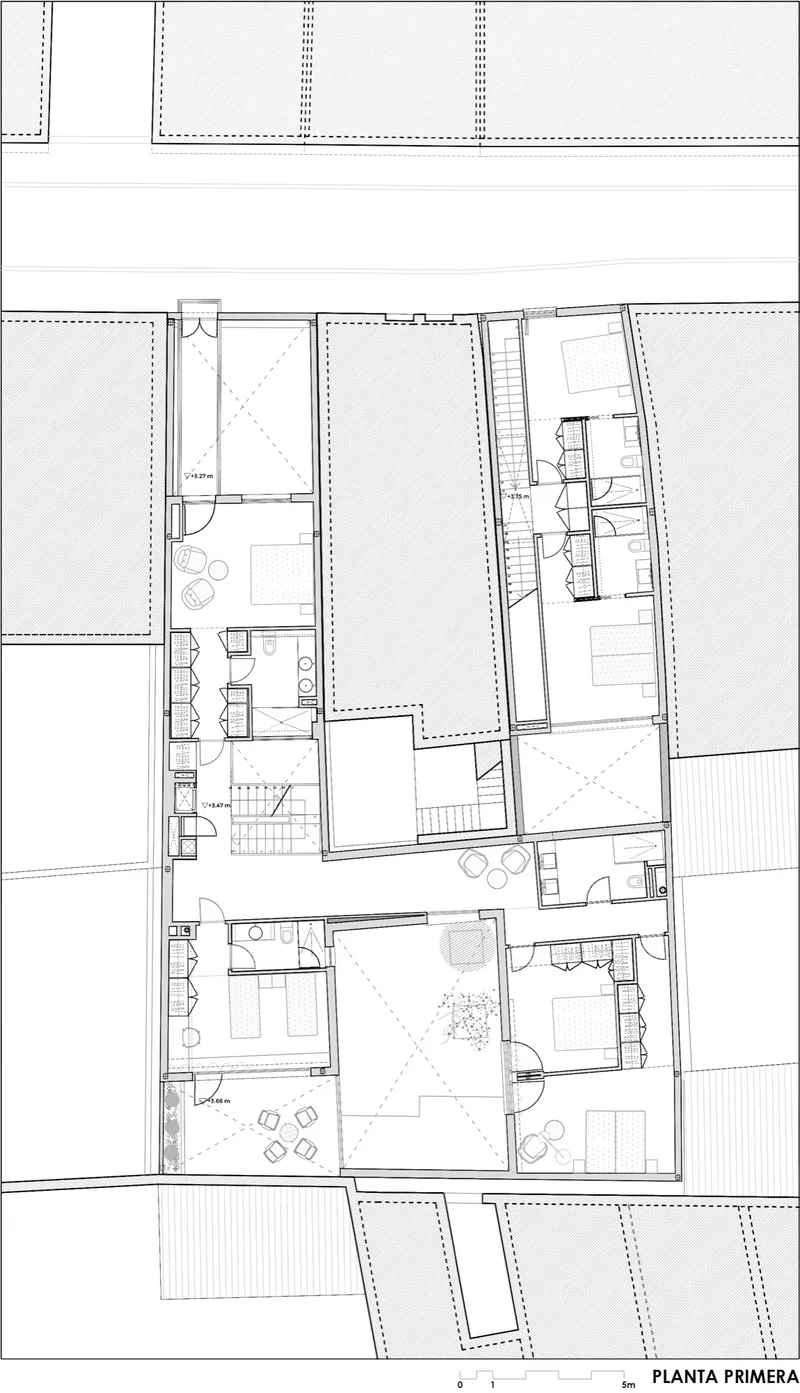
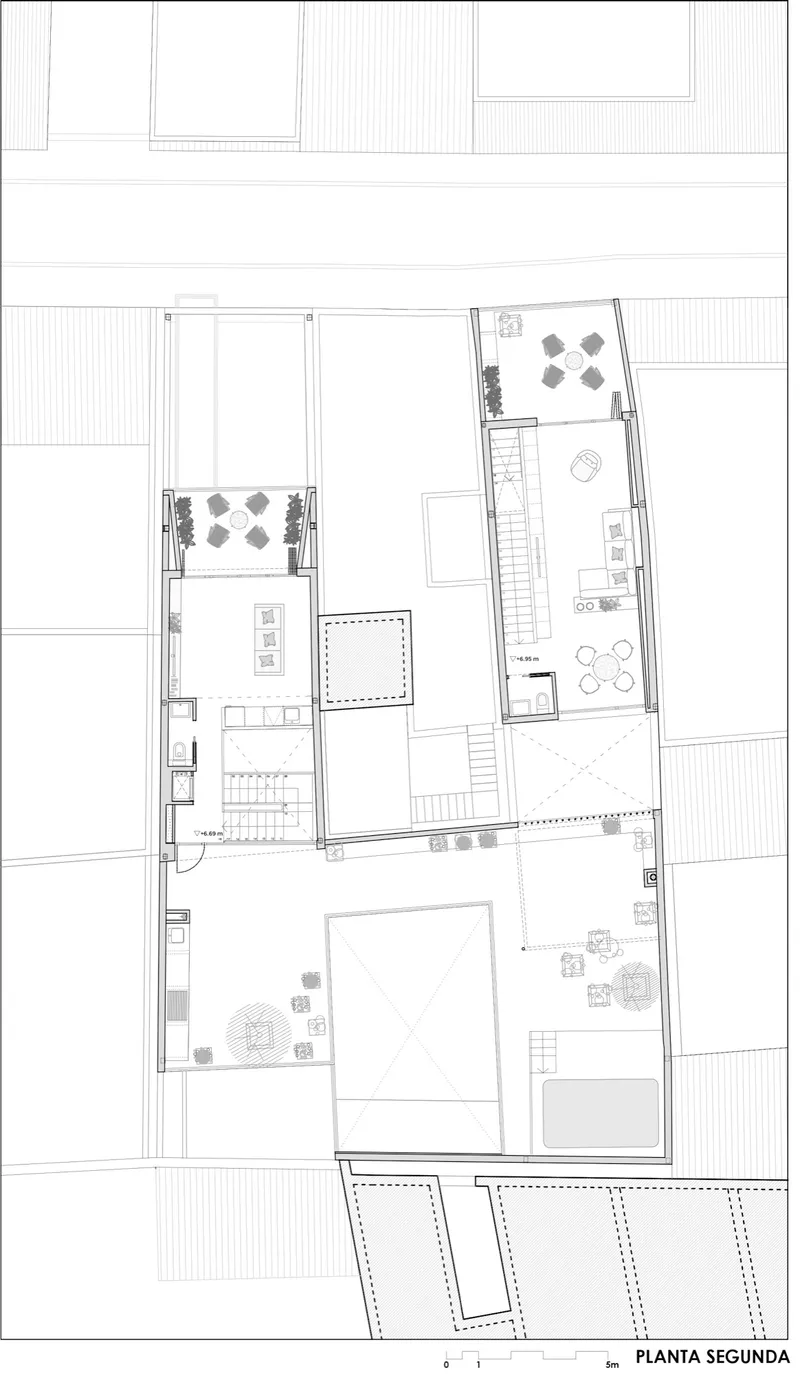
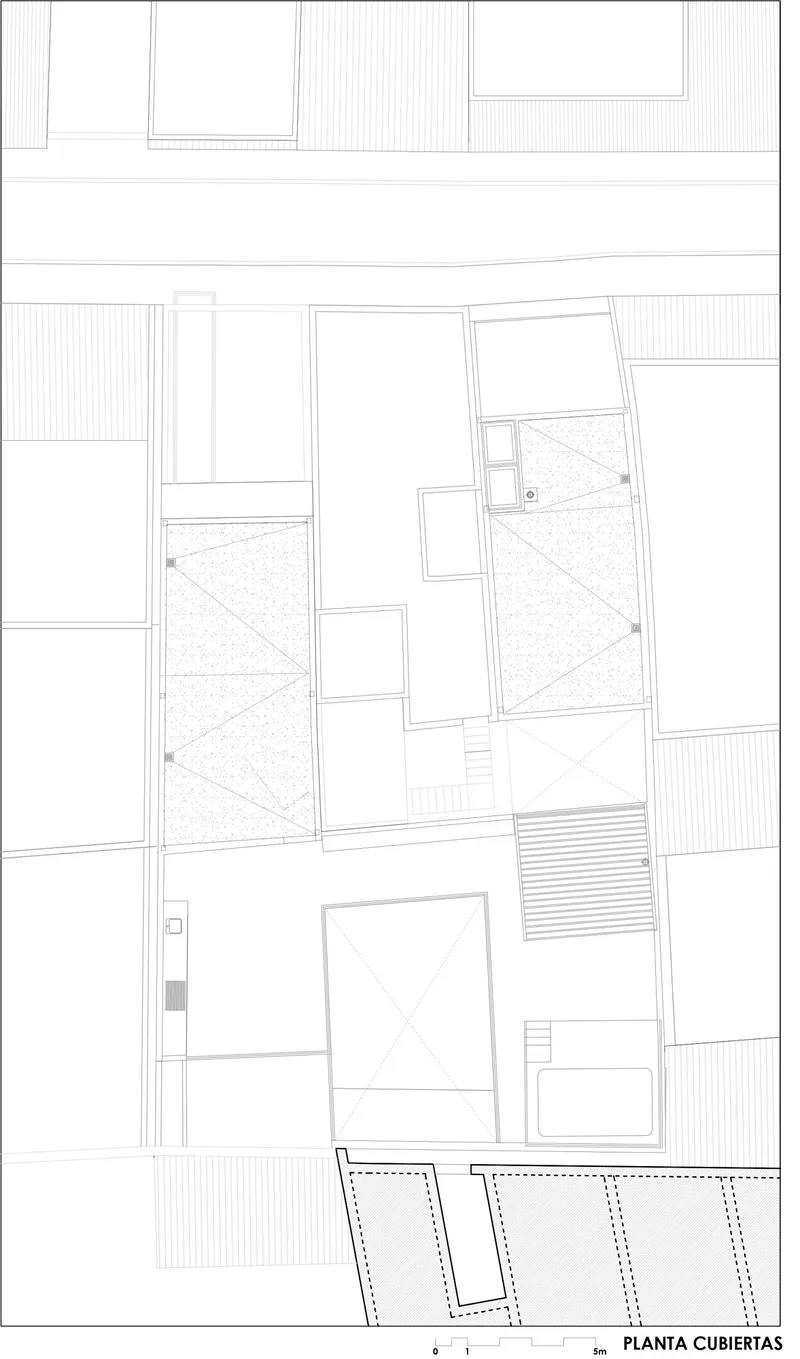
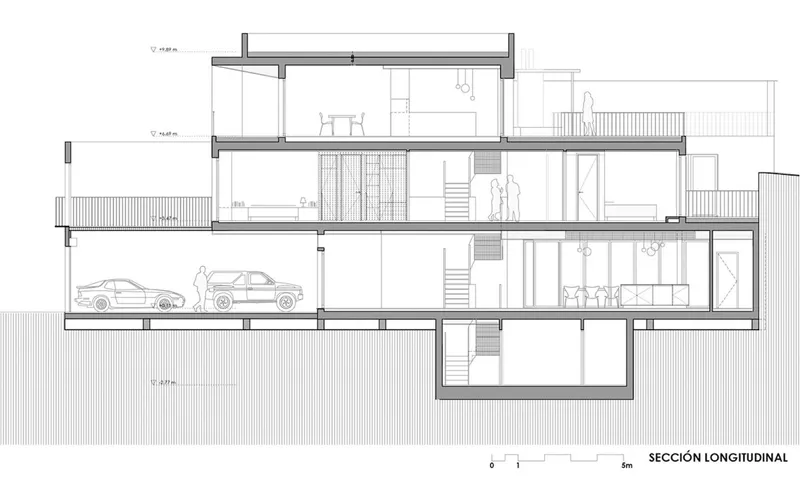


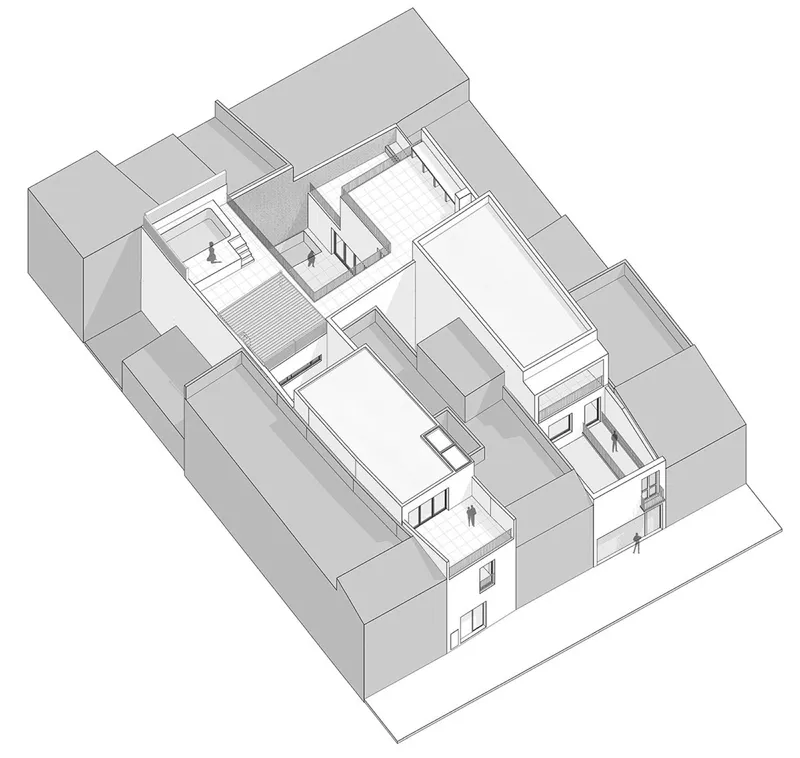
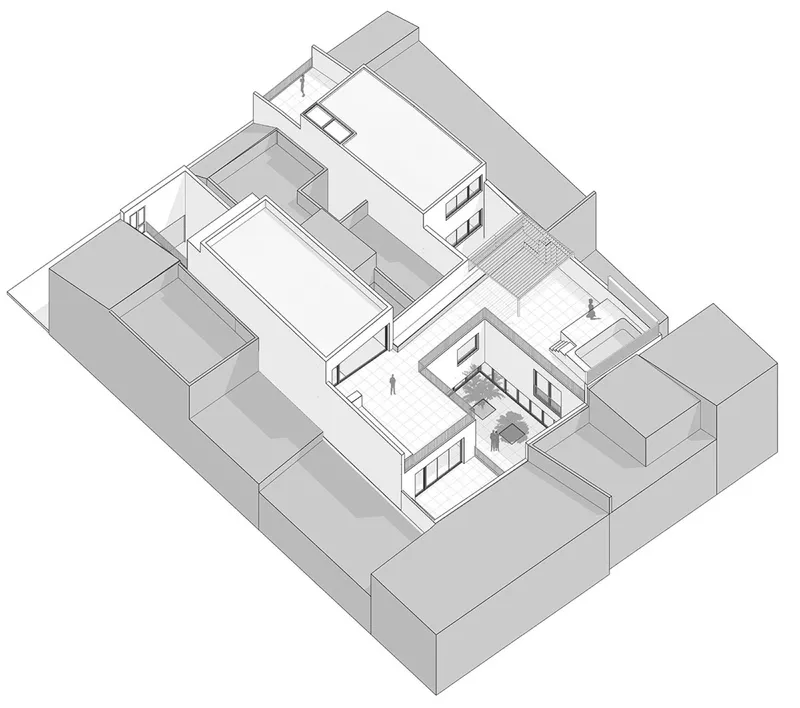
The floor plans reveal the ingenuity of the U-shaped plot strategy. At ground level, the garage, main courtyard, and living zones wrap around the existing neighboring structure without touching it. Upper floors redistribute the program: bedrooms cluster around the central void on the first floor, while the second floor gives over most of its area to roof terraces with only compact interior living spaces remaining. The longitudinal sections make the staircase-as-skylight strategy explicit, showing diagonal runs of steps punctuating multi-level volumes flooded with overhead light.
The axonometric drawings are perhaps the most revealing. They peel back the white street facade to expose the courtyard system buried within the urban block: tiled outdoor rooms, planted areas, and figures moving between volumes that would be invisible to any passerby. The street elevation, calm, three-story, balconied, deliberately unremarkable, confirms DTR_studio's commitment to an architecture of interiority over spectacle.
Why This Project Matters
The Wiik House is a disciplined exercise in building within constraints. A U-shaped plot, an existing structure you cannot remove, two separate dwelling units sharing one street, and the dense grain of a Mediterranean town: these are the kind of conditions that force specificity. DTR_studio did not arrive with a preformed object and shoehorn it into Estepona. They let the plot, the climate, and the vernacular traditions of Andalusian and Arab courtyard architecture generate the form. The result feels inevitable, which is the highest compliment you can pay a house this complex.
There is also a quiet lesson here about what a second home can be. For a family based in Oslo, it would have been easy to commission a glass box on a hilltop with panoramic views. Instead, the Wiik House turns inward, privileges shade and filtered light over exposure, and embeds itself in the social and physical texture of its town. That is a more generous relationship between client, architect, and place than most vacation houses ever achieve.
Wiik House by DTR_studio (Jose Maria Olmedo and Jose Miguel Vázquez). Located in Estepona, Malaga, Spain. 534 m². Completed in 2022. Photography by Juanan Barros.
About the Studio
Share Your Own Work on uni.xyz
If projects like this are the kind of work you want to make, uni.xyz is a place to publish your own, find collaborators, and enter design competitions.


Popular Articles
Popular articles from the community


Singing Woman: An Opera House That Performs Before the Curtain Rises
Ovidiu Cristian Pavel's conceptual opera house translates Estonia's choral identity into a sculpted waterfront landmark facing the Baltic Sea.

Cloaked Colonization: A Mobile Underwater Habitat That Moves Like a Fish
Micah Abaya's shortlisted EHC Pacific entry reimagines ocean settlement as a dispersed network of self-sustaining architectural organisms.

Tsunami Convergenics: Turning Catastrophic Ocean Forces into Underwater Housing Infrastructure
A speculative underwater settlement off the coast of Onagawa, Japan, treats tsunamis and typhoons as energy sources rather than threats.
Faces of the Soviet Avant-Garde: Turning Moscow's Street Names into an Open-Air Museum
A network of sculptural installations across a Moscow residential district transforms forgotten architect names into spatial encounters with cultural memor

Similar Reads
You might also enjoy these articles

Pixel Gardens: One Repeated Module Stacked Into a Terraced Social Housing Tower for Famagusta
Salem Bader's shortlisted housing tower builds a vertical neighbourhood from one repeated module, offsetting units to carve terraces, light and air.

Bao Huynh Watercolor Atelier: A Serene Art Retreat in Hội An
Bao Huynh Watercolor Atelier in Hội An blends multifunctional art spaces, sustainable design, local materials, and family-friendly living in a serene environment.

Atelier Macri Concept Store Interior Design by CASE-REAL
Atelier Macri store features a "ko" counter, walnut wood details, cork displays, blending retail, gallery, and seamless customer experiences.

Manuel Vargas Izquierdo Stadium and High-Performance Sports Center: Architectural Excellence in Jalpa de Méndez
The Manuel Vargas Izquierdo Stadium blends sustainable design, inclusive sports facilities, and cultural-inspired architecture, revitalizing Jalpa de Méndez’s public spaces.


Comments (0)
Please login or sign up to add comments
No comments yet. Be the first to comment!