
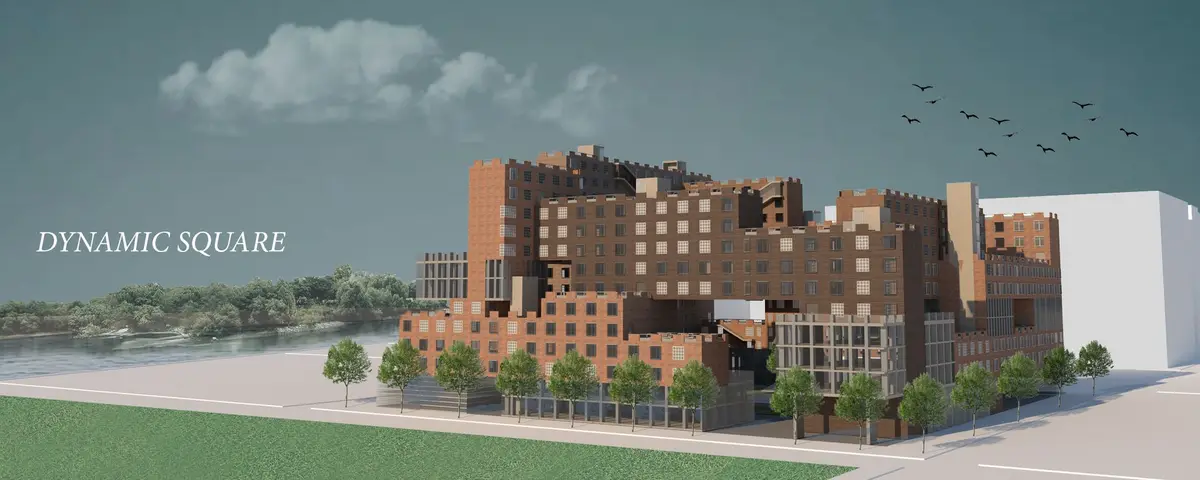
DYNAMIC SQUARE: Redefining Urban Architecture for Young Generations
Dynamic Square: Affordable, sustainable, and creative urban living spaces for the next generation of young professionals.


Moscow has two strong architectural traditions. The old one is the perimeter block, a courtyard surrounded by buildings, derived from centuries of European urban housing. The new one is the isolated tower, a standalone slab surrounded by grass. Dynamic Square, designed by PARK CheolGu and Yunjeong GU, proposes a third: a perimeter block reinvented for co-living, with sky-bridges instead of corridors, a shared courtyard instead of a lobby, and a rooftop street instead of a rooftop garden.
Shortlisted in the Hustle Hub '19 competition on uni.xyz, the project argues that what young professionals in Moscow need is not cheaper rooms. They need a better block. The project's answer is the square: a grid that is not a cage but a scaffold, with the housing, the studios, the shops, and the shared spaces all hung from it in rearrangeable ways.
The Block: Old Typology, New Logic
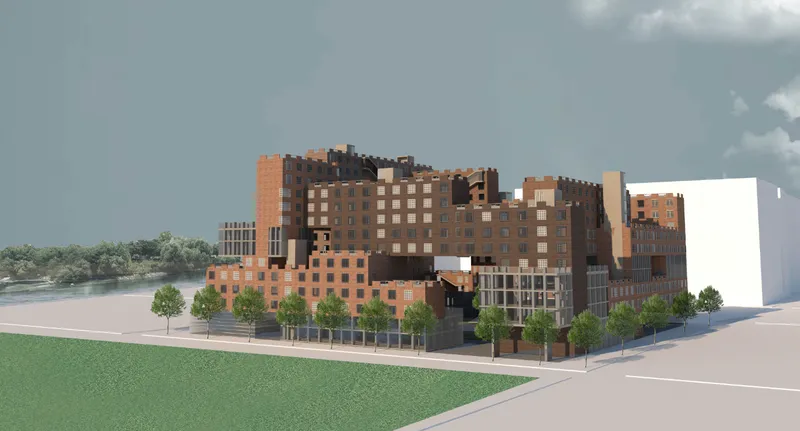

The two exterior renders establish the project's first move. From the street, Dynamic Square reads as a traditional Moscow brick block. Stepped massing, small windows, a solid perimeter, a shaded ground floor lined with trees. The dusk silhouette confirms the scale: this is a city within a city, the size of a full Moscow urban block, with the familiar brick language that Moscow's pre-revolutionary apartments used for a hundred years.
The choice to stay with brick is deliberate. Most co-living competition entries reach for polished metal panels, glass atria, or CLT cladding. Dynamic Square uses the material the city already trusts. That trust matters because the project is proposing a new type of housing to a conservative market. Leading with a familiar exterior lets the radical ideas on the inside feel less like an imposition and more like an extension of what the block always did.
The Courtyard: A Square Held Together by Bridges
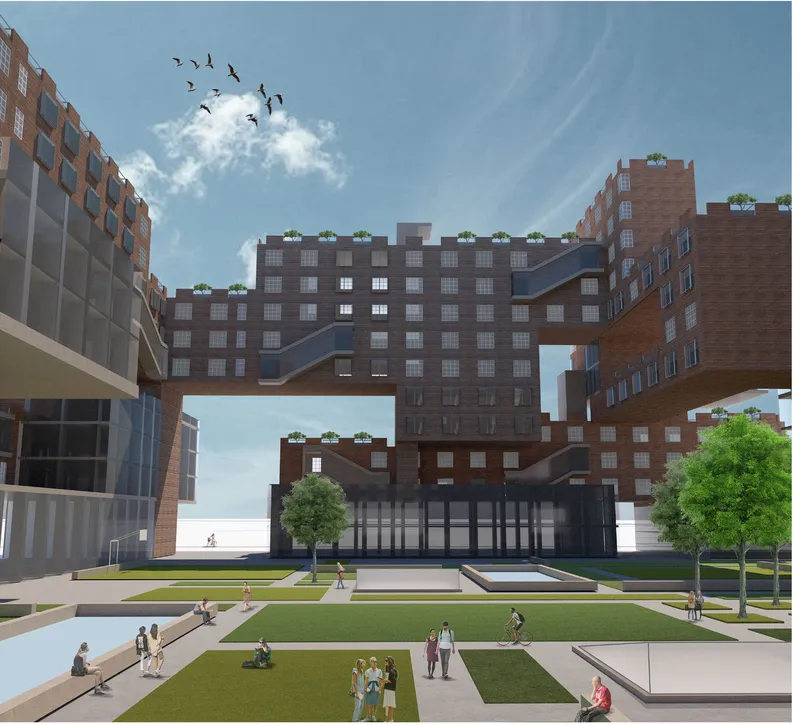
The central courtyard is the project's most ambitious drawing. Brick volumes wrap around a tiled plaza. Residents gather. Trees line the edges. And overhead, horizontal sky-bridges link the surrounding blocks across the open air. The sky-bridges are the innovation. In a traditional Moscow courtyard you had to go downstairs, cross the plaza, and go upstairs again. Here you just walk across the sky.
This changes what a courtyard does. It is no longer a void that the buildings happen to face. It is a central room that every floor of every block is connected to through the bridges. Residents from any part of the block can meet in the middle without touching the street. The courtyard becomes the lobby, the corridor, and the social hall at once. One square, many paths across it.
The Roof: A Street You Can Live On
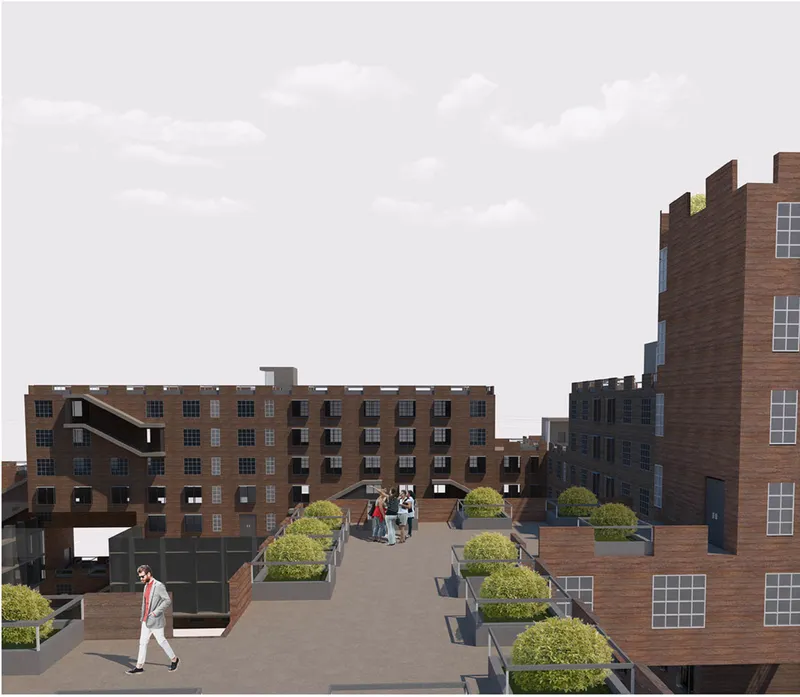
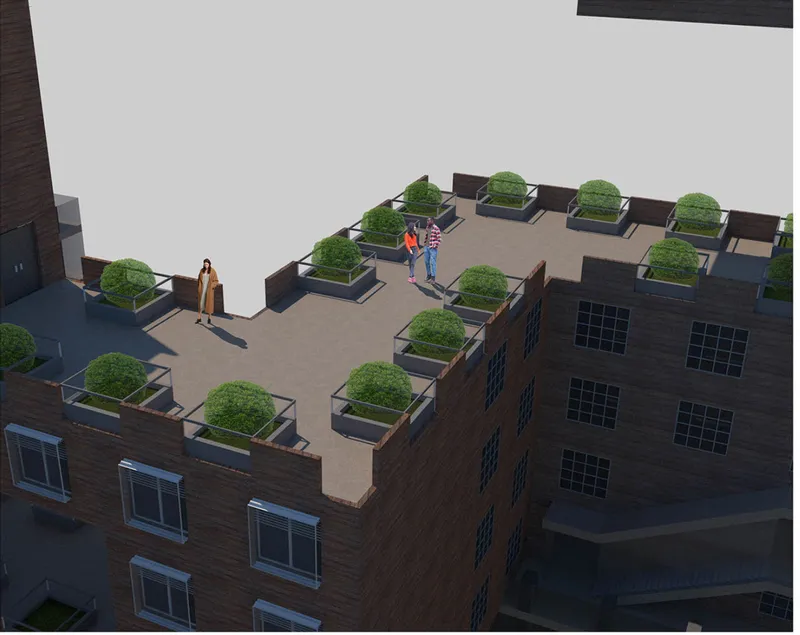
The rooftop renders show the project's second major move. A planted pedestrian street runs across the top of the block, linking the upper floors of the different volumes. Residents stroll between rows of clipped shrubs, pass other rooftop terraces, and emerge onto shared garden decks with planter borders and benches. The roof is not a capped lid. It is a second ground floor.
This matters because Moscow's winters push everyone indoors for long stretches, and the outdoor life of a traditional courtyard block collapses for half the year. A rooftop street at least gives residents an elevated outdoor walk that catches whatever sun is available, away from the salt and slush below. The garden decks become the warm-weather social spaces. The sky-bridges become the cold-weather ones. Between them, the block is walkable in any season.
The Winter: Moscow from Above
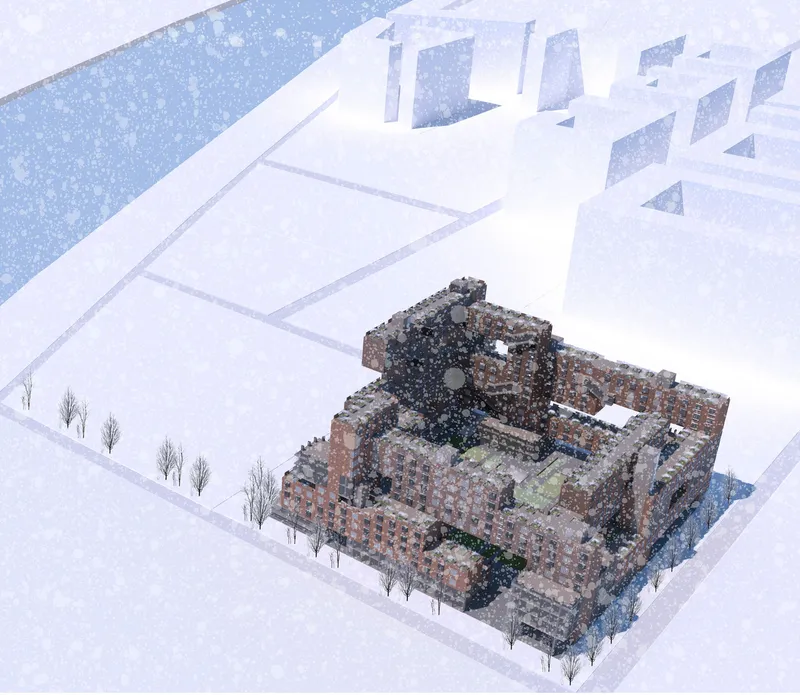
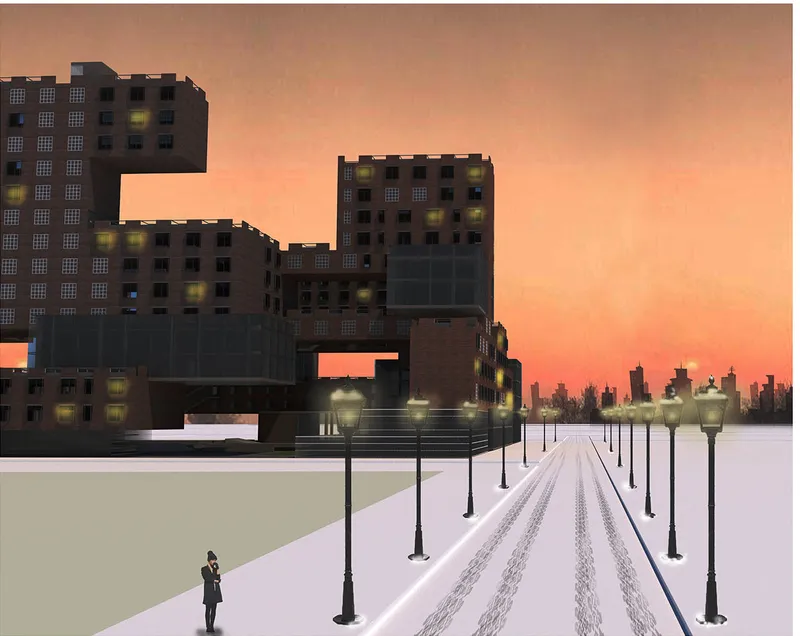
The snow-covered axonometric and the nighttime render are the project's acknowledgement of the climate it belongs to. Moscow is cold, dark, and snowy for half the year, and any housing proposal that ignores that fact is not serious. In the axonometric, the full massing sits under a blanket of snow. The stepped roofs shed. The courtyard collects. The block still reads clearly, because brick and mass behave the same way in every weather.
The night render shows the opposite case: the warm glow of windows along the multi-volume composition, seen from a tree-lined boulevard. This is the view a resident walking home in December sees. The block is alive, even when the street is empty. That night atmosphere is what sells co-living to a Moscow audience more than any drawing of summer plazas.
Why This Project Matters
Most Hustle Hub entries focused on individual unit plans, shared amenities, and density. Dynamic Square focused on the block. That scale choice is what separates it from the rest of the competition. Housing for young people is not just a problem of how many bedrooms you can fit on a floor. It is a problem of what the block does when you close your apartment door and walk out. If the block offers a sky-bridge, a courtyard, and a rooftop street, every resident's daily life includes three public spaces without ever leaving the property.
For anyone studying perimeter-block housing, co-living urbanism, or cold-climate architecture, Dynamic Square is a useful reference. It takes a conservative Moscow typology and rearranges it so that the circulation network is as social as the apartment itself. The grid is the scaffold. The life is hung from it. And the whole thing is still, recognisably, a Moscow block.
View the Full Project
About the Designers
Designers: PARK CheolGu, Yunjeong GU
Enter a Design Competition on uni.xyz
If perimeter-block housing, co-living typologies, or cold-climate urban design is the kind of work you want to explore, uni.xyz runs competitions year-round that reward proposals with real urban intelligence.
Project credits: Dynamic Square by PARK CheolGu and Yunjeong GU. Shortlisted, Hustle Hub '19 (uni.xyz).


Popular Articles
Popular articles from the community


Lunar Spiral: Space Architecture Shaped by the Mathematics of the Universe
Lunar Spiral reimagines space architecture through Fibonacci geometry, lunar regolith, levitating habitats, and self-sustaining Moon living.

The Musturak Paradise: Senior Living Architecture for a Connected Future in Temara, Morocco
The Musturak Paradise reimagines senior living architecture in Temara via private homes, social spaces, culture, community, and shared care.

Hill & Cross Opera: Sculptural Opera House Architecture Shaped by Tallinn’s Landscape and Identity
Hill & Cross Opera reimagines opera house architecture in Tallinn through its sculptural hill, civic plaza, glass wave and a luminous cross.

Little Red Riding Hood: Architectural Design as a Journey Through Fear, Light, and Storytelling
Little Red Riding Hood reimagines the fairy tale through architectural design shaped by fear, light, scale, memory, uncertainty, and choice.

Similar Reads
You might also enjoy these articles

ALGAL REALM: A Bio-Integrated Lunar Habitat Design for Life Beyond Earth
ALGAL REALM reimagines lunar habitat design with algae-powered life support, 3D-printed regolith, and vertical living for a lunar future.

Cinema Futurismo: Futuristic Architecture Reimagining the Future of Cinema
Cinema Futurismo merges futuristic architecture, holographic projection, intimate seating, and landscape into a new social cinema.
Little Red Riding Hood: Architectural Design as a Journey Through Fear, Light, and Storytelling
Little Red Riding Hood reimagines the fairy tale through architectural design shaped by fear, light, scale, memory, uncertainty, and choice.
Playducation: Modular Architecture That Turns Play Into a Space for Learning
Playducation transforms modular architecture into a flexible world of play, learning, and healing for children in refugee settlements.


Comments (0)
Please login or sign up to add comments
No comments yet. Be the first to comment!