
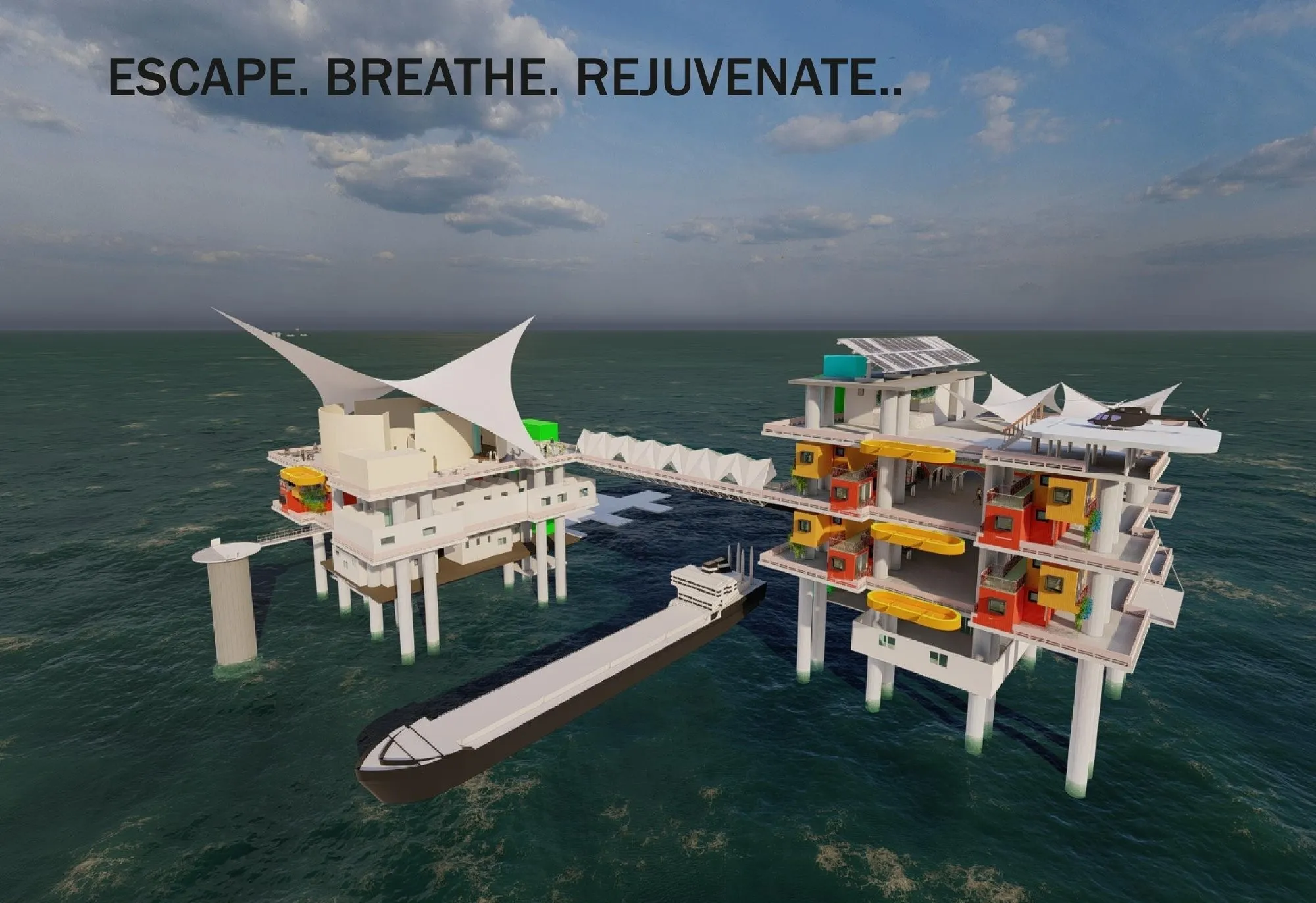
Escape. Breathe. Rejuvenate.
An adaptive reuse architecture proposal transforming abandoned oil rigs into floating hubs for marine research, tourism, and learning.


In the growing discourse around adaptive reuse architecture, designers are increasingly exploring how abandoned industrial structures can be transformed into meaningful public environments. “Escape. Breathe. Rejuvenate.” presents a visionary approach to repurposing decommissioned offshore oil rigs into a sustainable floating architecture proposal that merges marine research, tourism, environmental awareness, and experimental learning.
Designed by Karan Misal, Atharva Sakore, Shreya Kankaria, and Vaishnavi Kolhe, the project reimagines the forgotten presence of oil rigs within territorial waters as active ecological and social infrastructure. Rather than treating these offshore structures as obsolete industrial remnants, the proposal transforms them into artificial islands that reconnect people with the sea while addressing marine conservation, sustainability, and offshore habitation.
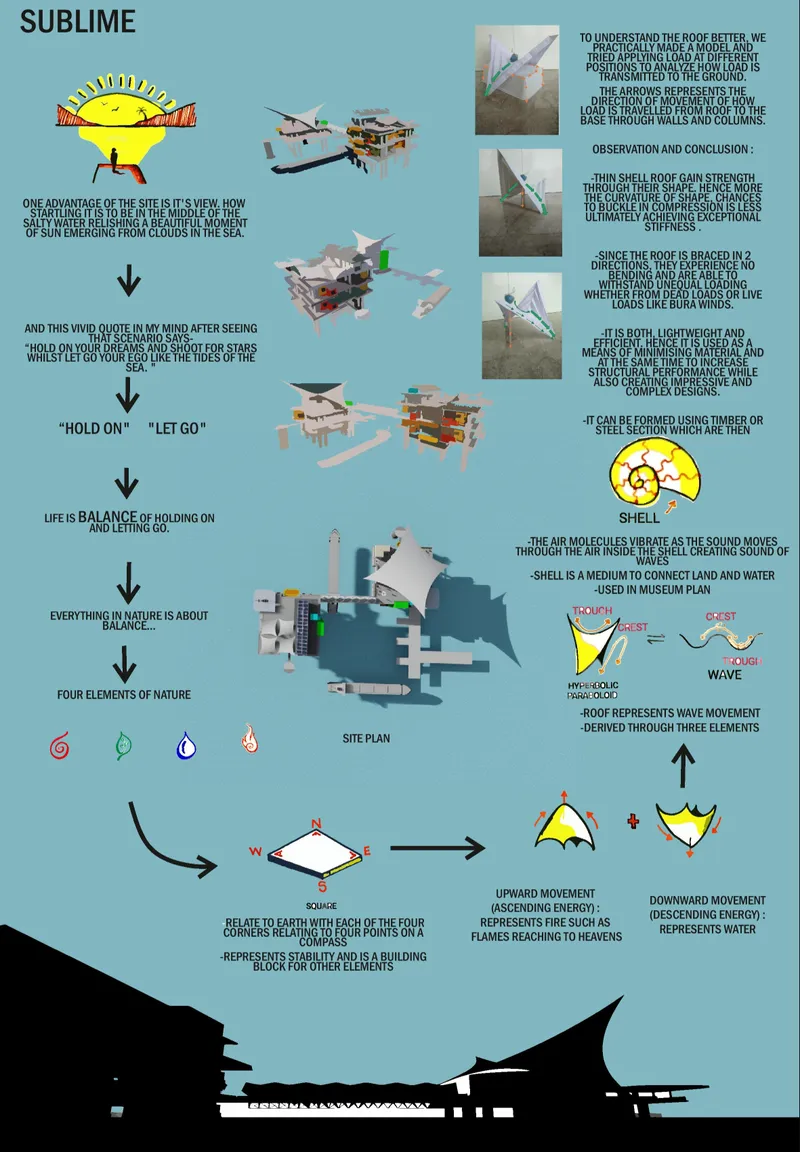
The project emerges from a powerful observation of the ocean landscape. Positioned in the middle of expansive saltwater environments, the site offers uninterrupted views of the horizon where sunlight emerges through clouds and reflects upon the sea. This atmospheric condition became central to the conceptual development of the architecture. The designers interpret the ocean as a metaphor for balance, movement, and coexistence, leading to a spatial narrative built around the duality of “holding on” and “letting go.”
This philosophy translates into a fluid architectural language inspired by natural forces and marine wave formations. The roof structures derive from shell geometries and wave movements, creating lightweight tensile forms that respond efficiently to structural loads while visually echoing the rhythms of the sea. The use of hyperbolic paraboloid surfaces allows the roof to achieve both stability and flexibility, reducing bending stress while improving load distribution through compression-based structural behavior.
The architectural form also references the four natural elements of earth, water, air, and fire. These symbolic relationships are integrated into spatial organization and circulation strategies across the floating platform. Upward movements within the architecture represent energy and aspiration, while downward movements symbolize calmness and connection with water. Through these transitions, the project creates an experiential journey that immerses visitors within the environmental narrative of the ocean.
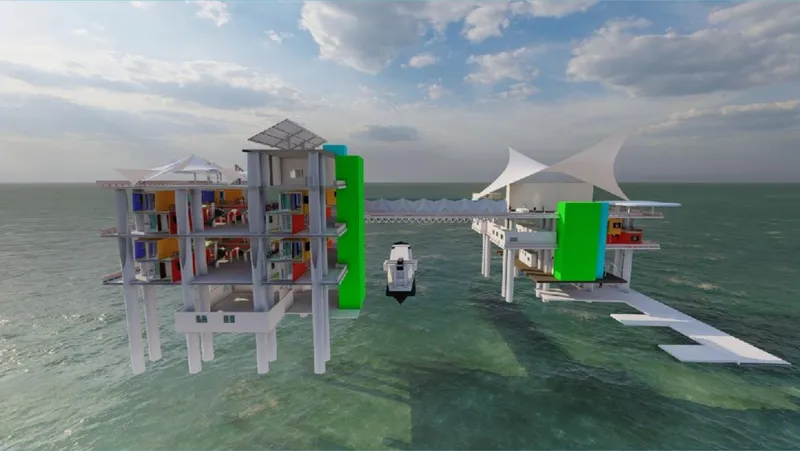
At an urban and ecological scale, the proposal functions as a floating marine campus that accommodates scientific research, tourism, hospitality, and educational activities. The intervention aims to create a new typology of offshore architecture where industrial relics evolve into public knowledge spaces. Research laboratories dedicated to marine habitat studies coexist alongside scuba diving facilities, learning workshops, temporary residential units, cafés, and public gathering areas.
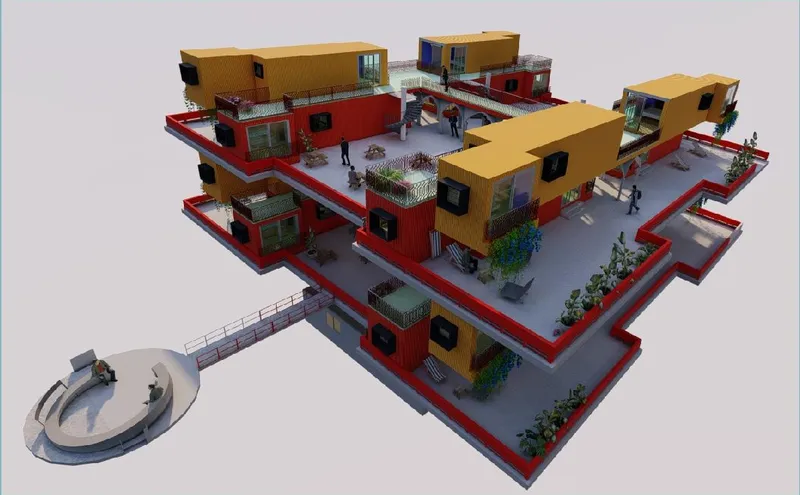
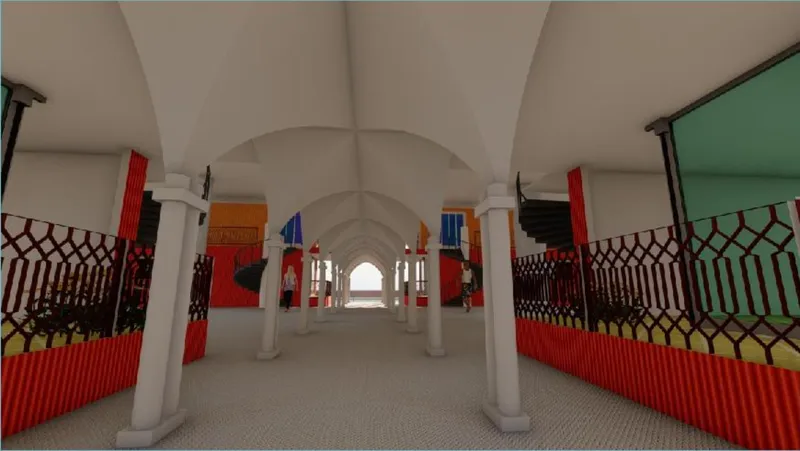
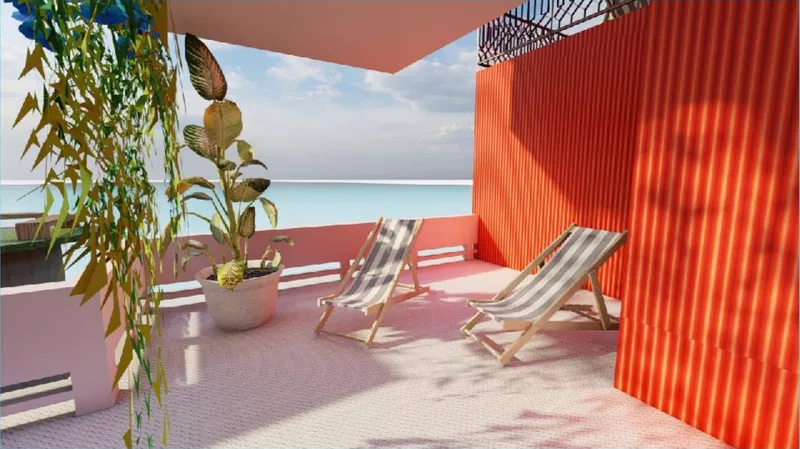
One of the most notable aspects of the proposal is its use of sustainable architecture strategies and modular construction systems. Lodging units are developed using reused shipping containers, emphasizing cost efficiency, flexibility, and environmental responsibility. These modular units reduce construction waste while allowing adaptability in offshore conditions. The containers are combined with open terraces, vaulted corridors, creeper-lined walkways, and viewing decks to create spatial environments that feel welcoming rather than industrial.
The project further integrates emerging construction technologies through the use of 3D-printed materials derived from recycled marine and plastic waste. This approach minimizes material wastage while promoting circular construction methodologies. Solar energy systems, passive cooling strategies, water recycling systems, and sustainable waste management techniques collectively support the self-sustaining vision of the artificial island.
Spatial circulation throughout the project is intentionally fluid and exploratory. Rather than relying on direct linear pathways, the design encourages gradual discovery through interconnected decks, transitional platforms, and layered spatial experiences. This movement strategy enhances human interaction with both architecture and the surrounding marine environment. The circulation becomes an experiential device that reveals shifting views of water, sky, and offshore structures while reinforcing the emotional qualities of isolation, calmness, and reflection.
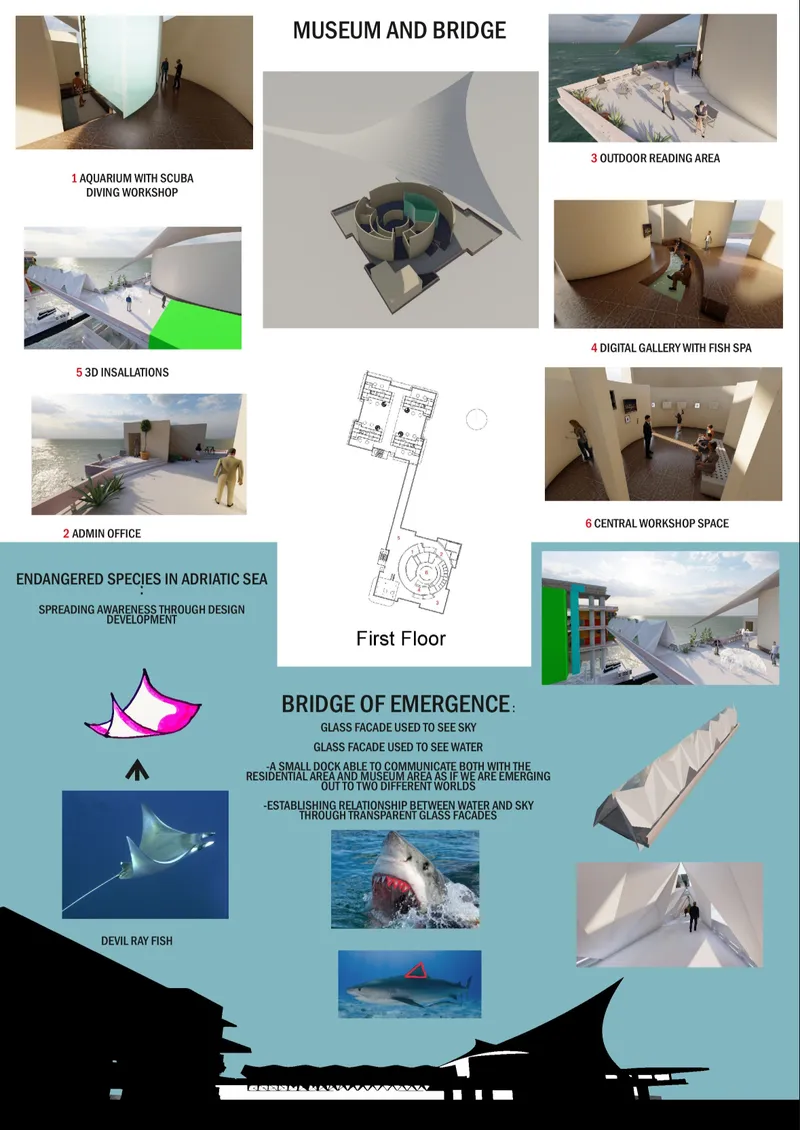
Beyond its architectural ambition, the proposal addresses broader environmental and social concerns associated with marine ecosystems. Historically, offshore oil rigs contributed heavily to industrial extraction and ecological disruption. This adaptive reuse architecture project proposes an alternative future where these structures become tools for ecological restoration and environmental education. By introducing marine plantation initiatives, research facilities, and awareness programs, the design transforms industrial infrastructure into platforms for conservation and collective learning.
The project also explores the economic and cultural potential of offshore adaptive reuse. Through tourism, experimental learning programs, scuba diving activities, and collaborative workshops, the artificial island becomes a destination that generates both knowledge exchange and sustainable economic activity. In this sense, the architecture operates simultaneously as infrastructure, public space, ecological intervention, and cultural landmark.
Visually, the floating structures maintain a delicate relationship with the sea horizon. Lightweight roofs appear suspended above the platforms, while bridges and decks connect individual programmatic zones into one cohesive floating environment. The result is an architectural composition that balances monumentality with openness, creating a futuristic yet environmentally grounded identity within the ocean landscape.
“Escape. Breathe. Rejuvenate.” demonstrates how adaptive reuse architecture can move beyond preservation alone and become a catalyst for ecological innovation and social transformation. By redefining the role of offshore oil rigs within contemporary architecture, the proposal introduces a compelling vision for the future of floating architecture and sustainable marine infrastructure.
In an era where climate awareness and environmental resilience are shaping architectural discourse, the project offers an optimistic model for transforming industrial scars into regenerative spaces that reconnect humanity with the natural world.



Popular Articles
Popular articles from the community


Hill & Cross Opera: Sculptural Opera House Architecture Shaped by Tallinn’s Landscape and Identity
Hill & Cross Opera reimagines opera house architecture in Tallinn through its sculptural hill, civic plaza, glass wave and a luminous cross.

Riyadh For All: Intergenerational Urban Design for Active Aging in Rabat
Riyadh For All reimagines urban design in Rabat with intergenerational co-living, adaptive courtyards, and Moroccan cultural exchange today.

The Musturak Paradise: Senior Living Architecture for a Connected Future in Temara, Morocco
The Musturak Paradise reimagines senior living architecture in Temara via private homes, social spaces, culture, community, and shared care.

Co-Life: Senior Housing Design That Reconnects Older Adults With the City
Co-Life reimagines senior housing design through healing gardens, shared streets, workshops, and a sustainable community across generations.

Similar Reads
You might also enjoy these articles

Eco Chapel: A Green Architecture Pavilion Designed in Symbiosis with the Forest
Eco Chapel uses green architecture to weave prayer, learning and reuse into a forest pavilion shaped by modular hexagonal canopies for life.
Kaffeebühnen: Coffee Shop Architecture Designed as a Civic Stage Between Vienna’s City and Park
Kaffeebühnen turns coffee shop architecture into a civic stage, linking Vienna’s park edge, urban life, warm timber yards, and coffee craft.
Healing Façade: Sustainable Architecture for Reforestation, Community, and Sacred Ecology in Ethiopia
Healing Façade reimagines sustainable architecture as a living wall that restores soil, catches water and renews Ethiopia's forest churches.


Urban Forest: A Vertical Ecosystem for 5,000 Workers in Singapore's Changi Business Park
Radially stacked pods and layered green decks turn a 7-acre plot into 47 acres of ecological workspace projected for 2040.





Comments (0)
Please login or sign up to add comments
No comments yet. Be the first to comment!