

Fabric Builds a 10-Square-Meter Glowing Shed by Hand in New Zealand's Kānuka Belt
A translucent polycarbonate and timber pavilion in Akaroa doubles as workspace, bathroom, and beacon among the native bush.


Ten square meters is barely a room. It is the footprint of a parking space, or a walk-in closet in a generous house. Yet Fabric's Nightlight Shed on Banks Peninsula packs a toilet, workbench, outdoor shower, sink, and storage into that sliver of floor area, then transforms the whole assembly into a lantern that glows through the kānuka trees at dusk. The project sits in a historic clearing on steep land above Akaroa, where every bag of concrete aggregate had to be wheelbarrowed up a 4WD-only track and mixed on site by the architects themselves.
What makes the shed worth paying attention to is not the program, which is utilitarian, but the proposition it tests: that a service building made almost entirely by hand from polycarbonate, LVL pine, and locally sourced macrocarpa can achieve negative embodied carbon, reference Japanese architectural traditions, and still feel generous. Fabric designed the shed as the first permanent structure in a long-term plan to regenerate the land and eventually build a home. It is a seed building, and a remarkably precise one.
A Lantern in the Bush


The name gives away the conceit. At night, the polycarbonate shell turns the shed into a soft, diffuse light source that reads as a single glowing volume among the dark trunks of the surrounding kānuka. The vertical timber slats, carefully aligned with the internal LVL framing, break that glow into a rhythmic screen of warm bars, casting the silhouettes of anyone inside into the landscape. It is unapologetically theatrical for a utility building.
By day the effect reverses. Sunlight filters through the canopy and then through the translucent walls, filling the interior with an even, greenhouse-like brightness. The building is legible from both sides at all hours, a quality that connects it to the shoji screen tradition Fabric explicitly references, channeling the Japanese influence on Christchurch's regional architecture.
Polycarbonate as Primary Skin
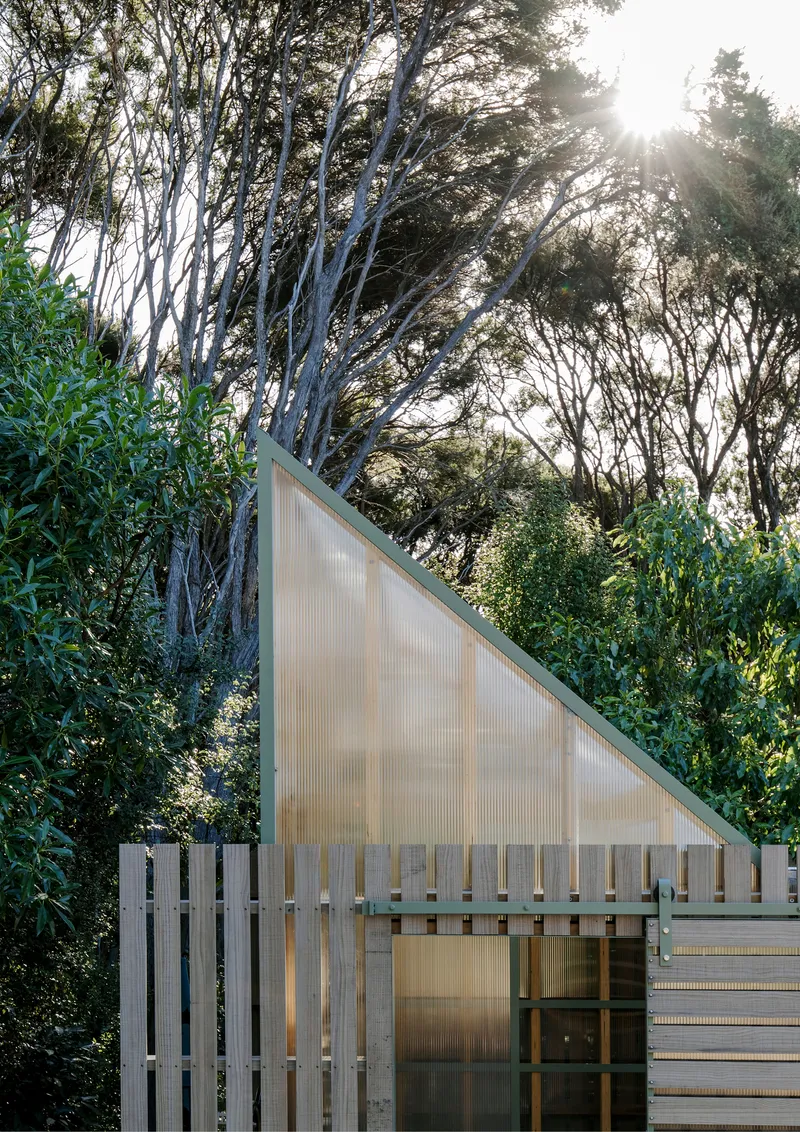
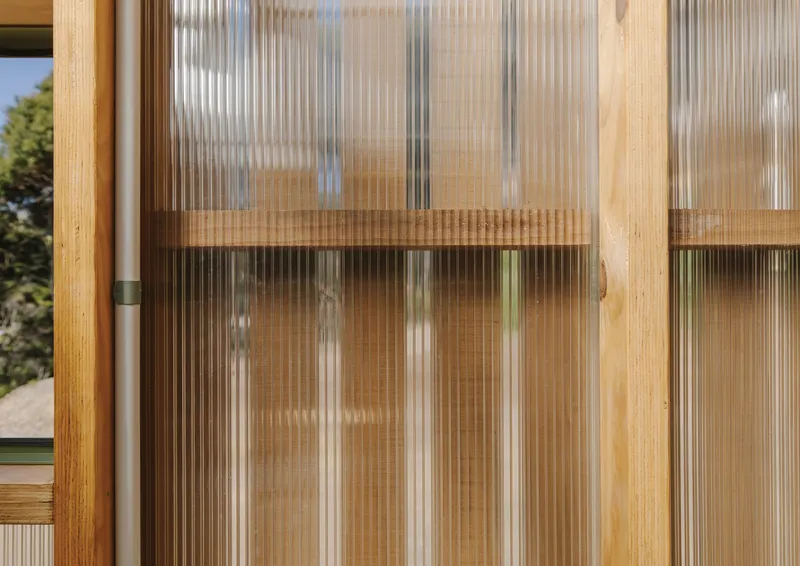

The corrugated polycarbonate cladding was chosen for two practical reasons: it is light enough to carry up a steep hillside, and it can be cut and fixed with hand tools. That pragmatism does not diminish its architectural performance. The fluted profiles catch raking light in ways that give the surface texture and depth, and the translucency creates a spatial ambiguity between interior and exterior that a building this small desperately needs.
Close detailing matters here. The sliding door panel, framed in timber with a horizontal rail at hand height, reads as a scaled-down version of a traditional sliding screen. Fabric has treated the junctions between polycarbonate, timber, and mist green steel as visible, celebrated connections rather than hidden ones. Every fixing is expressed, a decision that gives the shed a density of craft unusual for its scale and budget.
Timber Screens and Silvered Skin
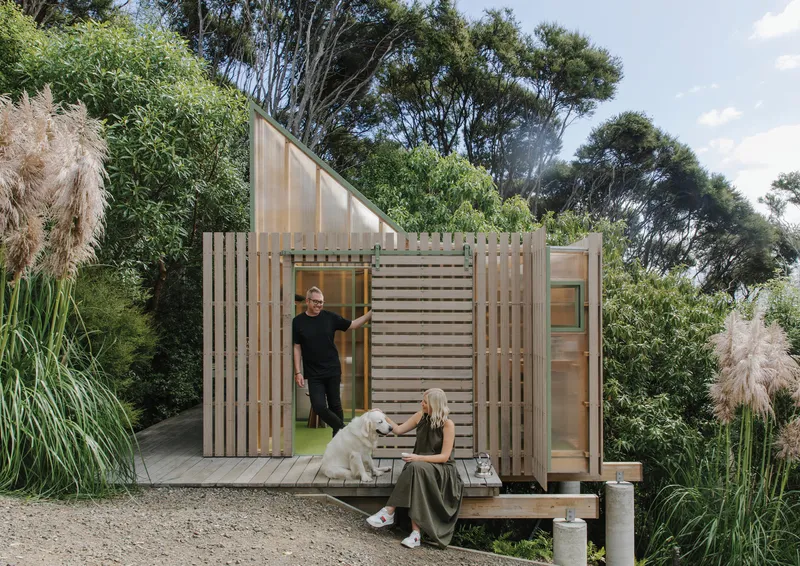
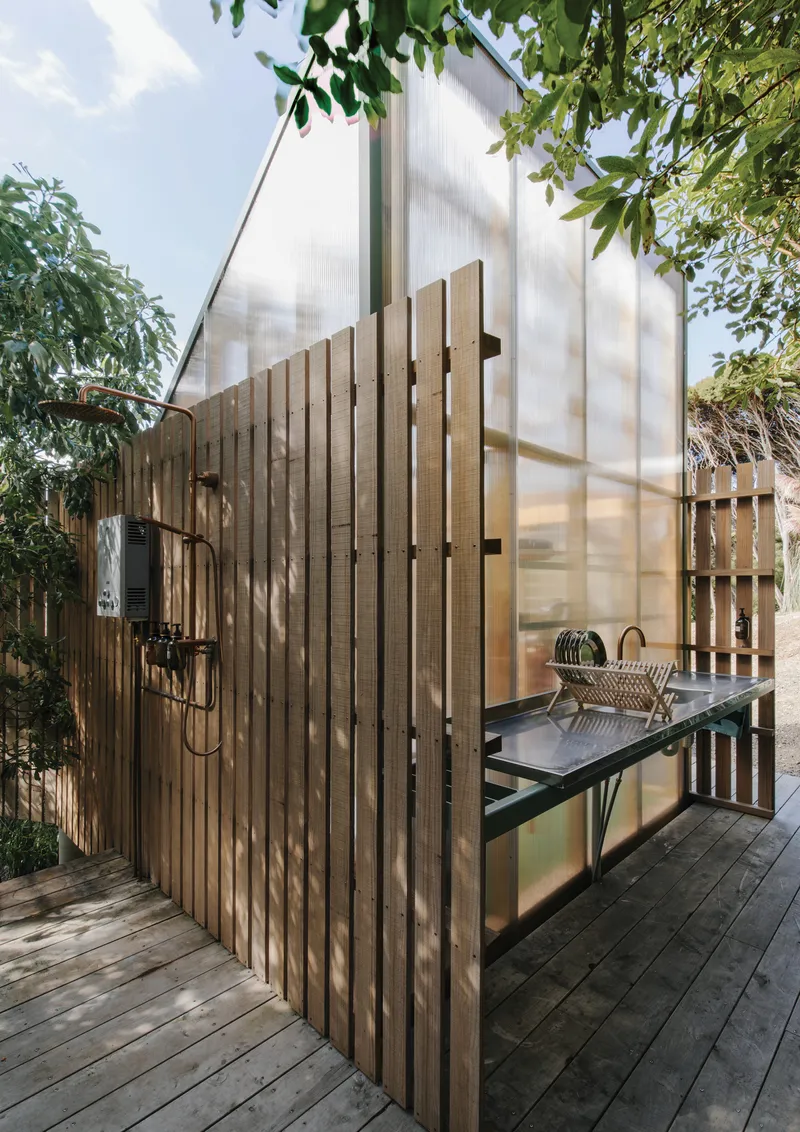

The Abodo Vulcan cladding wraps parts of the exterior in two configurations: coated screening that retains a warm tone and uncoated slats left to silver naturally over time. The silvering is deliberate. As the timber weathers, it converges in color with the pale, peeling bark of the surrounding kānuka trunks, embedding the building into its context without camouflaging it entirely. The polycarbonate panels ensure it will always read as something other than forest.
On the deck side, the slatted screen wall filters views to the bush while offering privacy. Two people can sit on the macrocarpa deck and look through the timber bars at the native grasses below, a framing device that turns a 10-square-meter shed into a kind of outlook pavilion. The locally sourced macrocarpa, like the silvering Abodo, roots the palette in the specific materials of Banks Peninsula.
Inside 10 Square Meters
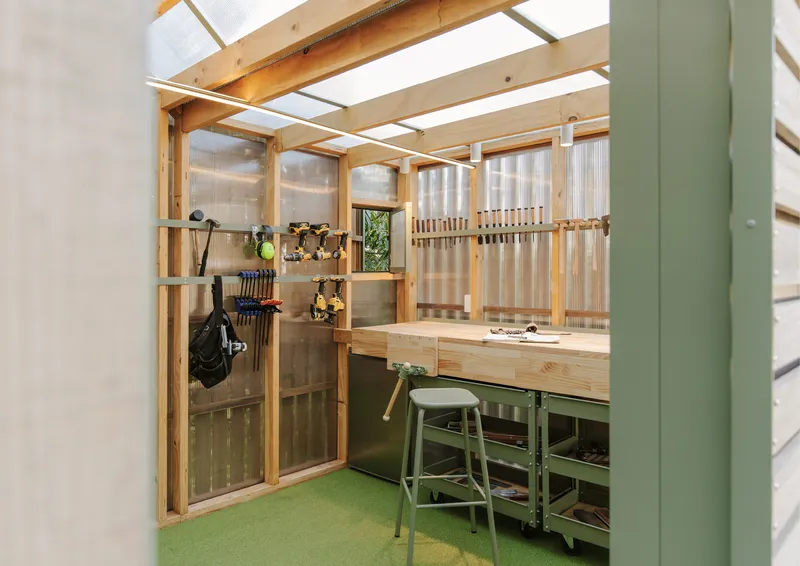

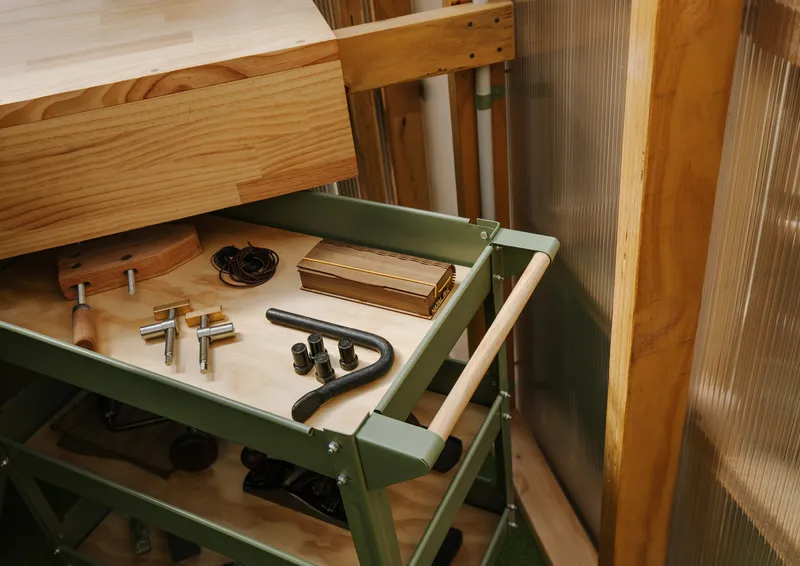
The interior is disciplined and oddly charming. A workbench runs along one wall beneath the exposed LVL rafters. A green linoleum floor and matching tubular steel stools inject color into what could have been an entirely timber palette. A rolling tool cart, its drawers loaded with hardware, makes the workspace functional for the ongoing land regeneration and construction work.
The translucent walls mean no part of the interior is dark, even without electric light during the day. There is no plasterboard, no false ceiling, no casing around the structure. Every rafter, every fixing screw, every corrugation is visible. The result feels honest to the point of being pedagogical: you can look at any wall and understand exactly how the building was assembled.
Lifted From the Slope
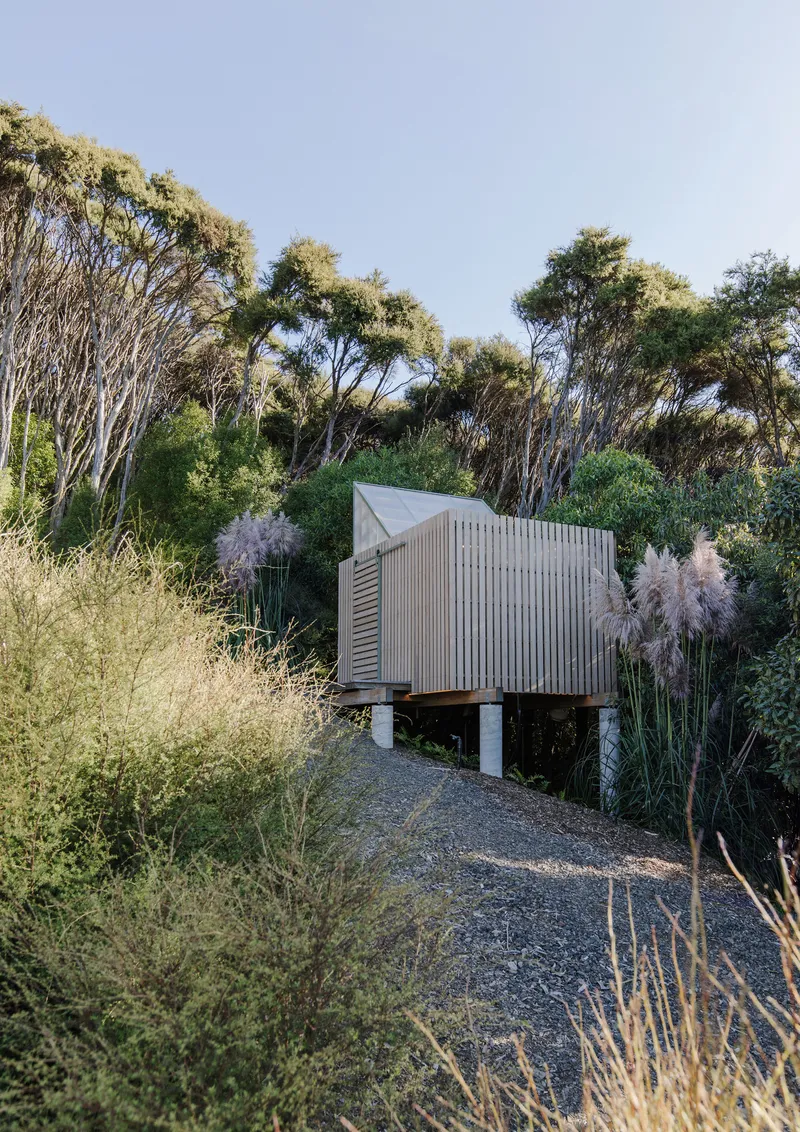
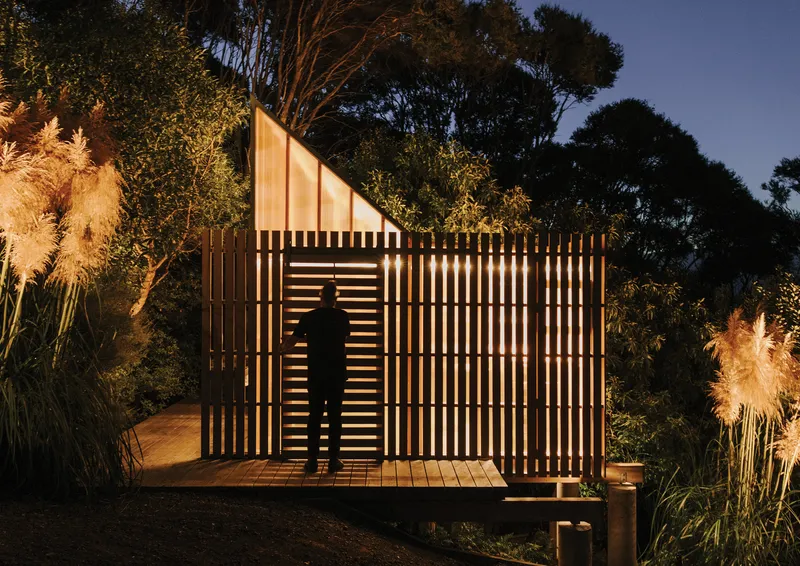
The shed is raised on hand-poured concrete piles, lifting it above the steep, uneven terrain and preserving the root zone of the surrounding vegetation. A gravel path through native grasses leads visitors up to the deck, reinforcing the sense of approach. The mono-pitched roof sheds rainwater downhill and gives the interior a modest sense of height at one end.
Raising the building also does something less obvious: it separates the timber cladding from the damp ground plane, extending the life of the Abodo and macrocarpa without chemical treatment. For a project claiming negative embodied carbon, details like this matter. Longevity is a carbon strategy.
Plans and Drawings


The site plan reveals the shed's position within a treed plot between the harbour and the hillside, nested in the clearing like a found object. The floor plan shows how the compact program, shower, kitchen zone, workspace, and central room, wraps around the perimeter, leaving the center open enough to stand and turn. Every wall does double duty as storage, screen, or workbench. The economy is total.
Why This Project Matters
Nightlight Shed is a useful corrective to the idea that small buildings are simple buildings. At 10 square meters, every decision is magnified. The wrong cladding, the wrong proportion, a single lazy joint would collapse the project into a garden shed from a hardware store. Fabric's investment in handcraft, material specificity, and cross-cultural reference gives this tiny structure an intellectual weight that many projects ten times its size never achieve.
It also models a different timeline for building. Rather than arriving on site with a finished house, Fabric started with the humblest possible program, a bathroom, a workbench, a place to store tools, and embedded in that program a set of values (hand construction, negative embodied carbon, native landscape regeneration) that will inform everything built on the site afterward. The shed is not a finished project. It is the first argument in a longer conversation with the land.
Nightlight Shed by Fabric, Akaroa, New Zealand. 10 m², completed 2022. Photography by Nancy Zhou.
About the Studio
Share Your Own Work on uni.xyz
If projects like this are the kind of work you want to make, uni.xyz is a place to publish your own, find collaborators, and enter design competitions.


Popular Articles
Popular articles from the community

Tsunami Convergenics: Turning Catastrophic Ocean Forces into Underwater Housing Infrastructure
A speculative underwater settlement off the coast of Onagawa, Japan, treats tsunamis and typhoons as energy sources rather than threats.

Faces of the Soviet Avant-Garde: Turning Moscow's Street Names into an Open-Air Museum
A network of sculptural installations across a Moscow residential district transforms forgotten architect names into spatial encounters with cultural memor

Singing Woman: Contemporary Architecture Inspired by Estonia’s Voice and the Sea
Singing Woman turns Estonia’s song culture into flowing opera house architecture, blending public life, landscape, sea, and national memory.

Opera on the Sea: Driftwood Logic Shapes a Timber Opera House on Estonia's Coast
Trevor Orgill's opera house translates the entangled drift of floating timber into a civic building where wood, water, and music converge.

Similar Reads
You might also enjoy these articles

Bao Huynh Watercolor Atelier: A Serene Art Retreat in Hội An
Bao Huynh Watercolor Atelier in Hội An blends multifunctional art spaces, sustainable design, local materials, and family-friendly living in a serene environment.

Atelier Macri Concept Store Interior Design by CASE-REAL
Atelier Macri store features a "ko" counter, walnut wood details, cork displays, blending retail, gallery, and seamless customer experiences.

Manuel Vargas Izquierdo Stadium and High-Performance Sports Center: Architectural Excellence in Jalpa de Méndez
The Manuel Vargas Izquierdo Stadium blends sustainable design, inclusive sports facilities, and cultural-inspired architecture, revitalizing Jalpa de Méndez’s public spaces.

KAKR Buluh Awar Hall: Revitalizing Community and Ecology Through Bamboo Architecture
Community built bamboo hall revitalizes Buluh Awar village, empowering youth, restoring ecology, celebrating vernacular craftsmanship through sustainable architecture and culture.

Explore Natural Light Competitions
Discover active competitions in this discipline

Challenge to design a portable theatre

Challenge to design a portable music platform

Challenge to design an open learning module for the elderly

Challenge to reimagine the Iron Throne
Comments (0)
Please login or sign up to add comments
No comments yet. Be the first to comment!