

Farming for All: Closing the Food Loop in London's Nine Elms District
An edible park weaves vertical greenhouses, community gardens, and housing into a self-sustaining agricultural cycle for urban London.


What if a city could feed itself? Not through industrial agriculture on its fringes, but through a continuous loop embedded directly in its streets, courtyards, and rooftops. Farming for All proposes exactly that: a regenerative food cycle where growing, harvesting, transforming, consuming, and recycling happen within one interconnected urban district. The result is a landscape where architecture does not merely contain activity but actively produces food, composts waste, and distributes fresh produce to residents within walking distance.
Designed by Fanny Rozé, the project received an Honorable Mention in the Urban Meal Mine competition. Sited in the Nine Elms district of London, a rapidly developing area south of the Thames, the scheme positions an "Edible Park" as a green corridor that stitches together fragmented housing, businesses, and cultural facilities. Rather than treating agriculture as an add-on amenity, the design makes it the organizing principle of the entire neighborhood.
A Perpetual Cycle, Not a Linear Supply Chain

The project's infographic diagram lays out its central argument with clarity. Urban agriculture here is not a single gesture, a rooftop garden or a weekend farmers' market, but a closed-loop system. Neighborhood residents, growers, green workers, and city citizens each occupy a defined role within the cycle: cultivating crops, processing harvests, distributing food through local markets, consuming it, and recycling organic waste back into the soil. Every stage feeds the next. The diagram makes visible a metabolism that most cities keep hidden, exposing the connections between food production and daily urban life.
By decentralizing the food economy, the project reduces dependence on long supply chains and their associated carbon footprints. Rainwater harvesting systems and renewable energy technologies support the park's self-sufficiency. This is not utopian speculation; it is a logistical framework that identifies real actors, real processes, and real spatial demands, then gives each one a place in the neighborhood.
Green Corridors That Reconnect a Fragmented District


The site plan reveals the Edible Park as a linear green corridor threaded through Nine Elms. Three strategy diagrams on the left of the drawing break down the design logic: reconnecting fragmented urban fabric, establishing new pedestrian alignments, and layering productive landscapes between existing buildings. Tree-lined pathways run continuously through the district, tying housing blocks to community gardens, composting facilities, and food markets. The corridor is not a decorative buffer. It is infrastructure.
The axonometric view develops this strategy into three dimensions. Residential blocks alternate with agricultural plots, and tree-lined pedestrian routes weave between them at ground level. The drawing makes clear that farming and living are not separated into distinct zones; they overlap, creating a daily interface between residents and the food they eat. Walking to the bus stop means passing through a working landscape.
Housing Flanked by Productive Ground

The section drawing cuts through two residential buildings with a generous ground-level landscape stretching between them. Scattered trees punctuate the space, and the overcast London sky presses down on the scene, grounding the project in its real climatic context. What stands out is the scale of the gap between buildings: this is not a narrow courtyard but a wide, breathable public landscape where agriculture, recreation, and transit coexist. The residential blocks frame the productive land rather than crowding it out.
The section also hints at how the project integrates educational and cultural programming. Schools, workshops, and cultural spaces sit alongside the agricultural zones, forming what Rozé describes as an integrated ecosystem. Educational farms empower future generations to learn about cultivation, sustainability, and healthy diets, turning the space between buildings into a classroom without walls.
A Market Plaza Where Agriculture Meets Daily Life
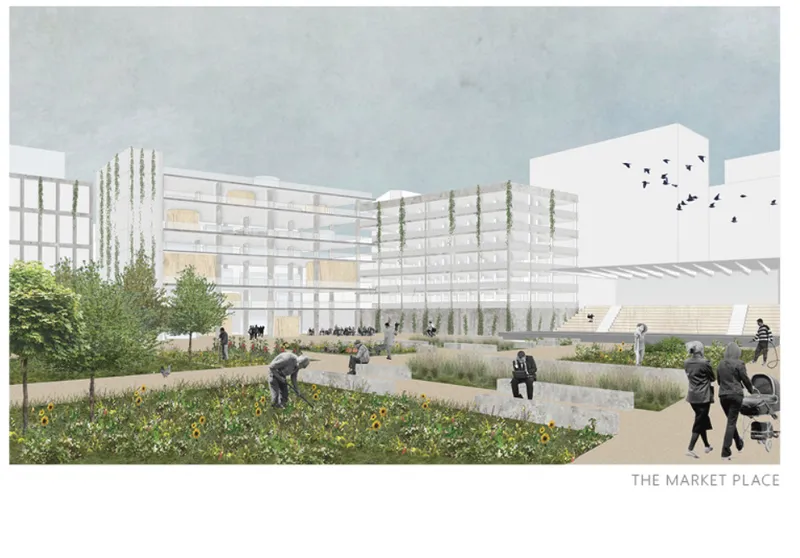
The rendering of the market plaza captures the project's ambition in human terms. Raised planting beds filled with flowering groundcover occupy the center of a public square. Residents gather beneath a simple white building facade, shopping, socializing, and eating in direct proximity to the plants that produced their food. The scene is neither pastoral fantasy nor high-tech laboratory; it reads as a believable urban condition where commerce, cultivation, and community overlap without strain.
This is where the Edible Park's social proposition becomes tangible. Cooking workshops, food markets, outdoor theaters, and flower markets create a calendar of public life organized around agriculture. Local businesses collaborate with growers to supply restaurants and households, building a decentralized food economy that keeps money and nutrients circulating within the neighborhood.
Greenhouses, Crop Rows, and Water Features at Neighborhood Scale

The final axonometric drawing zooms into the working heart of the scheme: shared agricultural fields interspersed with greenhouses, organized crop rows, and water features, all nestled among residential structures. Vertical greenhouses extend the growing season and increase yields per square meter, while open fields allow for community gardening and composting. The water features are not ornamental; they support irrigation and rainwater harvesting systems that make the park's food production viable year-round in London's climate.
What this drawing communicates most effectively is density. The agricultural infrastructure is compact and precisely organized, fitting within the gaps and margins of an existing urban neighborhood. It suggests that productive landscapes do not require vast rural acreage. They require careful spatial choreography and a willingness to treat food systems as seriously as housing or transport.
Why This Project Matters
Farming for All does not propose a single building or a single technology. It proposes a systemic redesign of how a neighborhood relates to food. By treating agriculture as a continuous cycle rather than a supply chain, and by weaving that cycle into housing, education, commerce, and public space, the project reframes urban architecture as an active participant in ecological regeneration. The framework is replicable: its logic of green corridors, localized food networks, and community participation could apply to any rapidly developing urban district.
Fanny Rozé's contribution to the Urban Meal Mine competition stands out for its clarity of vision and its refusal to treat urban farming as a novelty amenity. The Edible Park at Nine Elms is not a garden bolted onto a building; it is the organizing principle of an entire neighborhood. As cities worldwide grapple with food insecurity, climate change, and the social fragmentation of rapid growth, this kind of thinking offers a concrete, spatially grounded alternative to business as usual.
View the Full Project
About the Designers
Designer: Fanny Rozé
Enter a Design Competition on uni.xyz
uni.xyz runs architecture and design competitions year-round that reward proposals with spatial conviction and real site intelligence.
Project credits: Farming for All by Fanny Rozé Urban Meal Mine (uni.xyz).


Popular Articles
Popular articles from the community


FCC Arquitectura Expands a Portuguese Granite House with a Board-Marked Concrete Wing
In Portugal, JV House pairs a cleaned-up whitewashed and granite dwelling with a timber-shuttered concrete extension, courtyards and a garden pool.


Opera on the Sea: Driftwood Logic Shapes a Timber Opera House on Estonia's Coast
Trevor Orgill's opera house translates the entangled drift of floating timber into a civic building where wood, water, and music converge.

ETEH Reworks the Shared Spaces of São Domingos School in Brazil Around Timber, Color and Hanging Plants
At São Domingos School in Brazil, 436 m² of hall, refectory and library are recast with timber joinery, a yellow and blue code and trailing greenery.

Singing Woman: An Opera House That Performs Before the Curtain Rises
Ovidiu Cristian Pavel's conceptual opera house translates Estonia's choral identity into a sculpted waterfront landmark facing the Baltic Sea.

Similar Reads
You might also enjoy these articles

Cube Design Draws an Ecological Corridor Between Two Shenzhen Hills with the Nankai Building
Beside Shenzhen's container docks, the Nankai Building pairs stacked balconies with a climbing green screen to connect two hillsides across its height.

Praksis A and Studio Sted Bend a Red Timber Cabin Across the Granite of Norway's Southern Coast
On the southern Norwegian coast, a 105 m² cabin follows the rock on slender posts, pairing red cladding outside with pine, brick and plywood within.

David Ortega Stacks a Two-Story Mexico City Penthouse Around a Steel Stair and a Pergola-Shaded Roof Terrace
In Colonia Roma, a 300 m² penthouse uses oak joinery, a planted steel stair and a slatted roof pergola to make a new-build apartment feel like a house.

PARALELA and LB2 Thread a Public Walkway Through the Base of a Las Condes Residential Tower
In Las Condes, Santiago, the Hamlet Building gives its fenceless ground floor to a 70-metre wooded passage linking two streets and the metro.

Explore Urban Farm Competitions
Discover active competitions in this discipline

Challenge to reimagine the Iron Throne

Photograph architecture without architects

Illustrate the lost glory of Angkor Wat - Render Challenge

Design challenge to reuse E-waste
Comments (0)
Please login or sign up to add comments
No comments yet. Be the first to comment!