

feld72 Designs a Kindergarten in Brixen Where Rooms Flow Like a Village Street
A two-story timber building in South Tyrol treats space as the third educator, connecting every room to the outdoors and to each other.


The pedagogical idea that space itself educates children is not new, but it rarely survives the journey from brief to built form. At the Kindergarten and Nursery Rosslauf in Brixen, feld72 has produced one of those rare cases where the architectural logic and the educational philosophy are genuinely the same thing. The building is organized as a linear sequence of rooms that can be opened into one continuous landscape or closed off into discrete, intimate worlds. For the 50 or so children who use it daily, three nursery groups and two kindergarten groups, the architecture offers not a single fixed environment but a shifting field of possibilities.
Completed in 2024 for the Municipality of Brixen at a cost of roughly 5.9 million euros, the 1,310 square meter building sits alongside the existing Kindergarten Zinggen-Rosslauf on a long, narrow site backed by the wooded mountains of South Tyrol. The rectangular form is deceptively simple. What makes Rosslauf compelling is the way feld72 has used section, materiality, and color to turn a modest program into something spatially rich, a building where a corridor is never just a corridor and a rooftop is never just a roof.
A Southern Face That Does Real Work
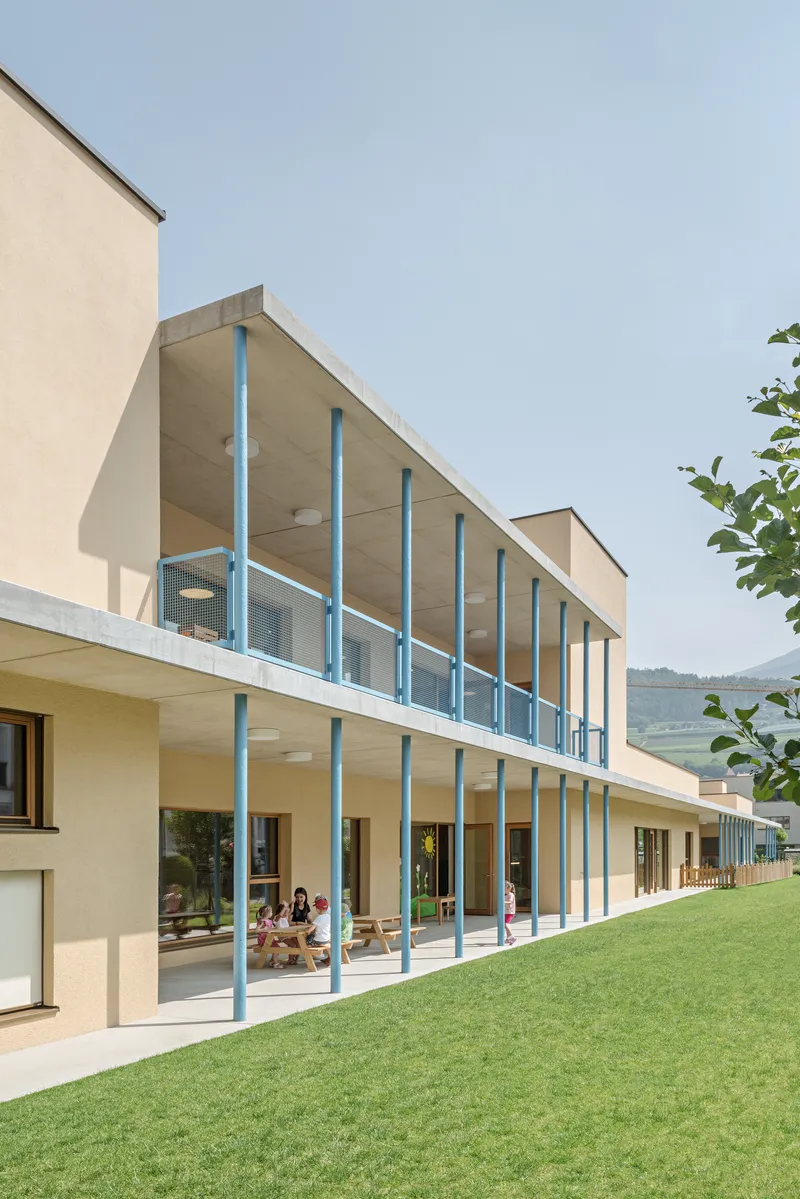
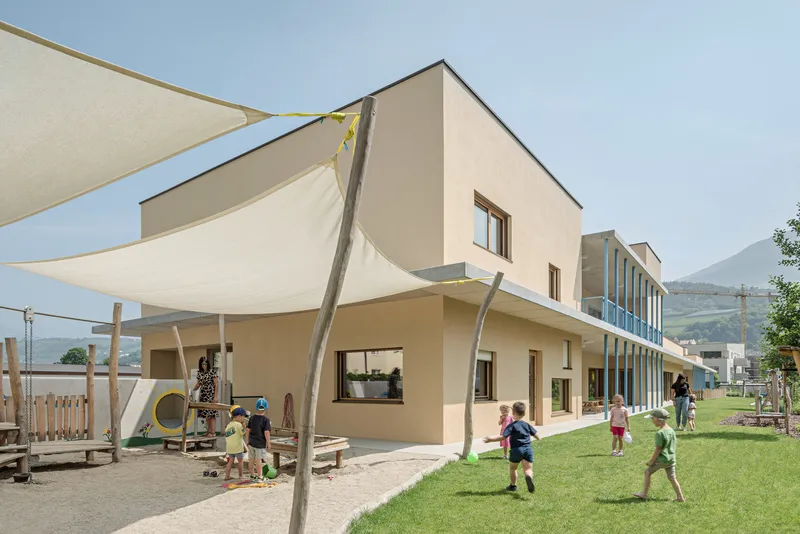

The south facade is the building's defining gesture: a generous two-story glass colonnade held up by slender blue steel columns. It is not merely glazing for the sake of light. Every group room and common room has direct access to the outdoor areas through this facade, collapsing the boundary between inside and outside in a way that matters practically, not just photographically. Children can move from table to lawn without negotiating a lobby or a threshold.
A projecting cornice runs the length of the south elevation, preventing the deep glazing from turning the interiors into greenhouses. It is a passive strategy that avoids the need for mechanical shading in most conditions, though fabric canopies supplement the fixed overhang at the ground-level play terrace. The low profile of the building, combined with green entry gates and the mountain backdrop, keeps the scale domestic and legible to a child.
Rooms That Talk to Each Other

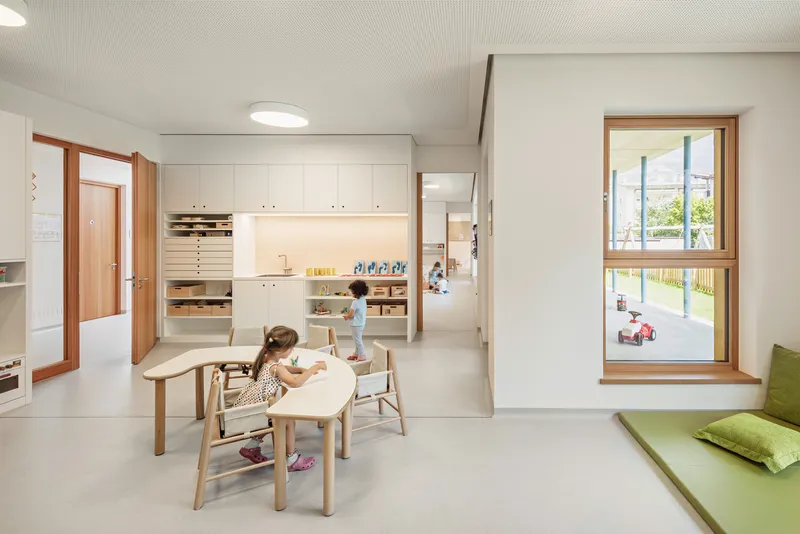
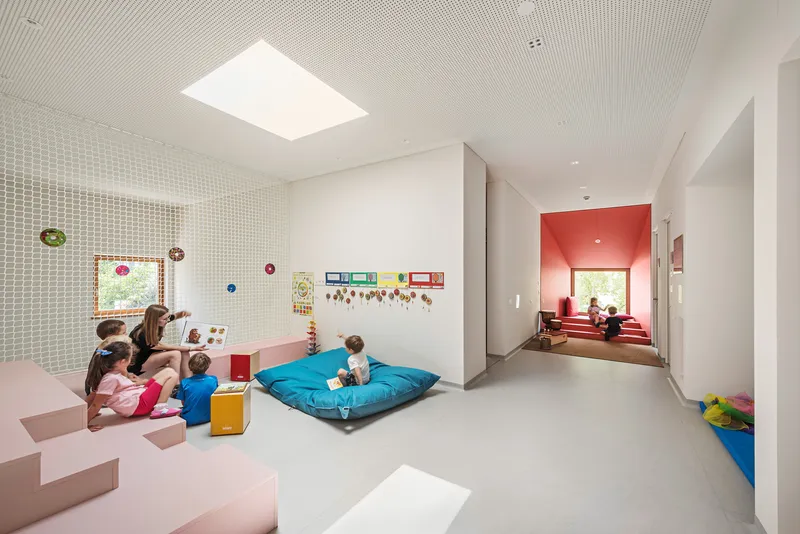
Inside, the plan reads as a sequence of rooms connected by wide openings rather than corridors. Different areas can be linked to form a single open-space structure or used individually, depending on the moment. This is the spatial manifestation of "space as the third educator": children are given agency over how they occupy the building, choosing to cluster in one room for a group activity or drift through openings into a quieter zone.
Cork flooring, light timber millwork, and ribbed ceilings give each room a consistent material warmth, but feld72 has carefully deployed color, a red alcove here, a perforated wall panel there, to distinguish spaces from one another without labeling them. The result is that children navigate the building through sensory cues rather than signage. A window seat framed in warm timber becomes a destination in itself, not merely a place to wait.
Color as Architecture, Not Decoration
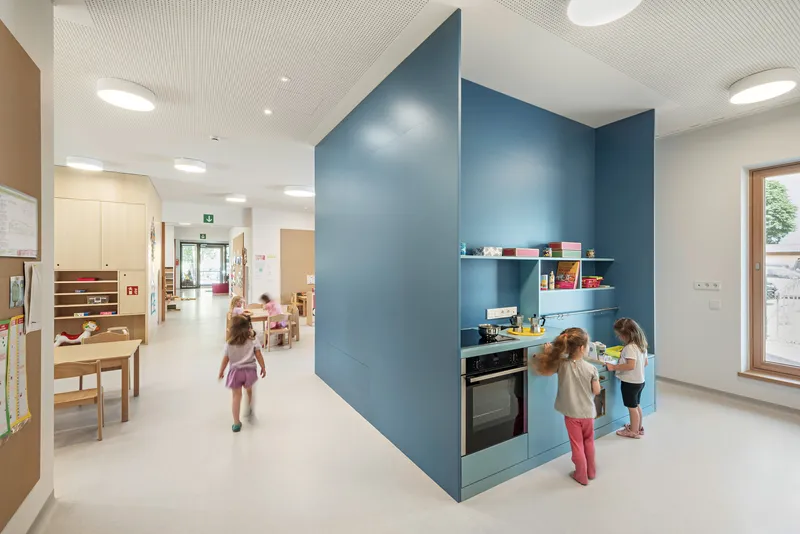
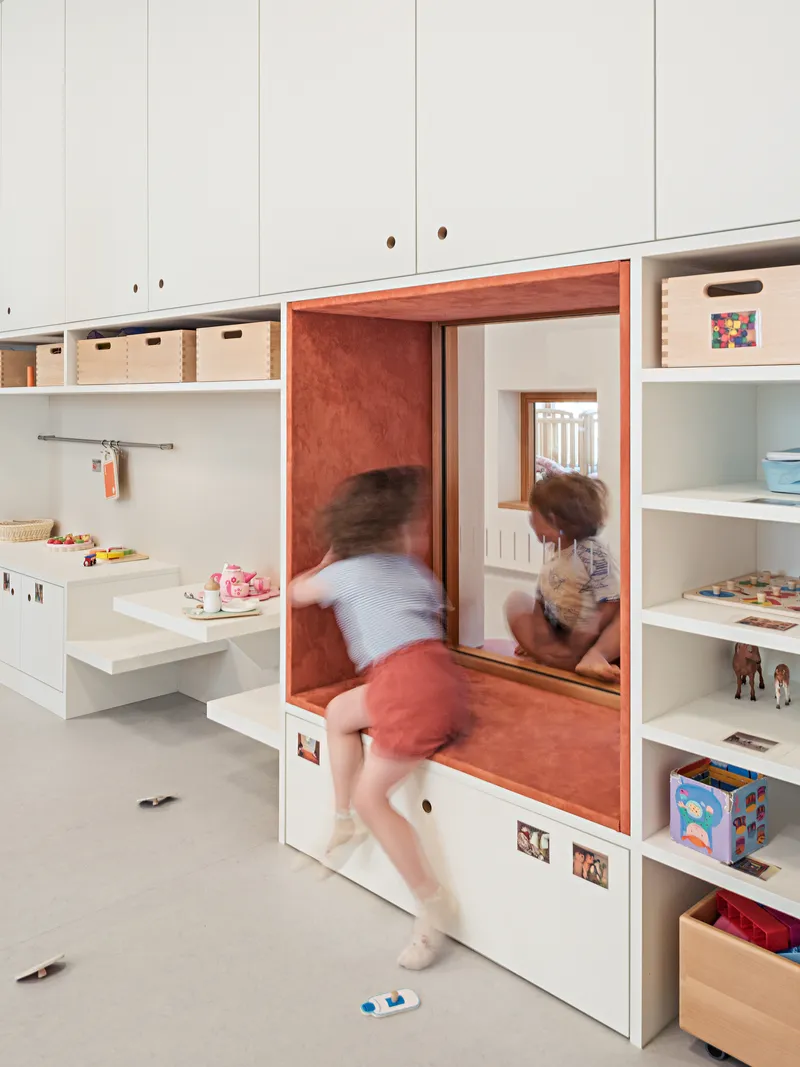

One of the most convincing moves in the project is the treatment of freestanding and built-in furniture volumes as architectural elements in their own right. A blue kitchen block, complete with integrated shelving, sits in a room like a small building within the building. Storage niches lined in orange plywood double as climbing structures, their openings scaled precisely for a three-year-old body. In the double-height entrance hall, green storage cubbies stack vertically, turning the prosaic business of coat hooks and shoe bins into a wall of color that signals arrival.
These moments are not applied decoration. They are functional components that also serve as wayfinding, play infrastructure, and spatial markers. The distinction matters. When color is structural rather than cosmetic, it ages well and continues to work even as surfaces wear.
Interior Landscapes at Child Scale
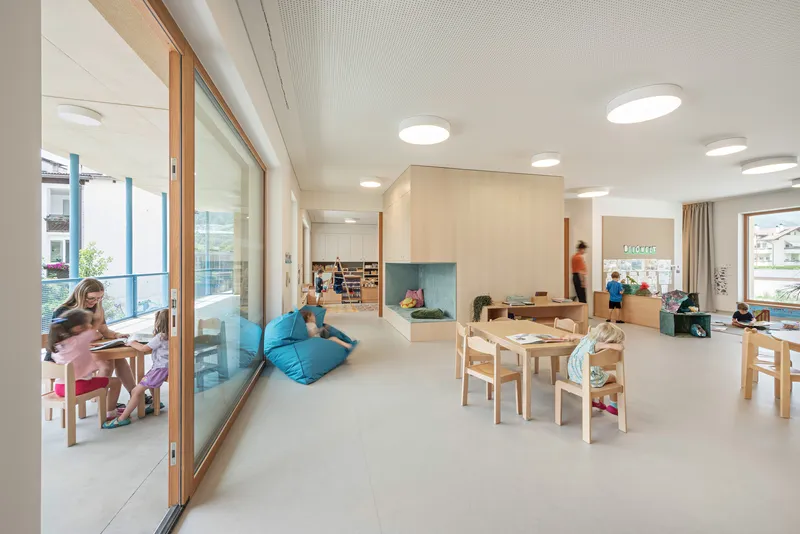
The interiors are deliberately scaled to the bodies of their primary users. Tables and counters sit low. Round ceiling fixtures provide even, soft light without glare. Horizontal windows at low heights frame views of the landscape for someone standing three feet tall, a simple decision that radically reorients the experience of the building. Adults feel slightly oversized here, which is exactly the point.
The varied building heights along the length of the site break the monotony of the linear plan and create distinct spatial zones within the section. Some rooms feel compressed and cozy, others open upward. For children who are learning to read space before they learn to read text, this sectional variety provides a much richer vocabulary than a uniform ceiling height ever could.
The Roof as a Fifth Facade and a Playground

The rooftop play terrace is perhaps the project's most inventive spatial move. A circular path loops across a sedum green roof with views to the distant hills of the Isarco valley. It is not a token gesture toward outdoor space but a genuine extension of the building's usable area, adding play capacity to a compact footprint without consuming more of the ground-level site.
The green roof also contributes to the building's passive climate strategy, insulating the upper floor and managing stormwater. From the surrounding neighborhood, the planted surface reduces the visual impact of the building's 1,310 square meters, letting the kindergarten sit quietly among its residential neighbors rather than announcing itself as an institution.
Plans and Drawings


The axonometric drawing makes the building's organizational logic immediately legible: nursery groups on one end, kindergarten on the other, with shared spaces in between. The ground floor plan reveals the linear arrangement of rooms around a central courtyard, with every group room opening directly to the south-facing outdoor areas. The angular site boundary forces a slight pinch in the plan that feld72 has used to create the courtyard, turning a constraint into the building's primary spatial event.
The upper floor plan shows a more compact arrangement, with living spaces pushed to one side and a large terrace occupying the remainder. The economy of the plan is notable: at 4,839 cubic meters of total volume for a program serving five groups, the building wastes almost nothing. Circulation space is absorbed into the rooms themselves, a direct consequence of the flowing, open-plan strategy.
Why This Project Matters
Kindergarten design is one of those typologies where good intentions frequently outrun spatial intelligence. Buildings for children are too often either miniaturized adult environments or overstimulating playgrounds that confuse excitement with education. Rosslauf avoids both traps. Its intelligence lies in the way it structures choice: children can find enclosure or openness, solitude or company, interior or exterior, all within a building small enough to comprehend in a single visit.
feld72 has delivered a project that treats its modest budget and compact footprint as design opportunities rather than limitations. The passive climate strategies, the flowing plan, the rooftop playground, and the precise use of color and scale all serve the same argument: that architecture for children should be as spatially ambitious as architecture for anyone else. Rosslauf is proof that it can be, and that the best educational environments are the ones that trust their youngest users to navigate complexity.
Kindergarten and Nursery Rosslauf by feld72, Brixen, Italy. 1,310 m². Completed 2024. Photography by Hertha Hurnaus.
About the Studio
Share Your Own Work on uni.xyz
If projects like this are the kind of work you want to make, uni.xyz is a place to publish your own, find collaborators, and enter design competitions.


Popular Articles
Popular articles from the community


The Amber Palace Opera: A Geological Fiction Surfaces on Tallinn's Baltic Waterfront
Pierre Brillard reimagines a Baltic legend as a public landscape, opera house, and waterfront promenade rooted in Tallinn's coastal identity.
Tsunami Convergenics: Turning Catastrophic Ocean Forces into Underwater Housing Infrastructure
A speculative underwater settlement off the coast of Onagawa, Japan, treats tsunamis and typhoons as energy sources rather than threats.
Extended Shell: Retrofitting Kolkata's Balconies as Living Urban Thresholds
A modular retrofit system recovers the social and environmental intelligence of Kolkata's historic verandas for contemporary Park Street residents.

Opera on the Sea: Driftwood Logic Shapes a Timber Opera House on Estonia's Coast
Trevor Orgill's opera house translates the entangled drift of floating timber into a civic building where wood, water, and music converge.

Similar Reads
You might also enjoy these articles

Bao Huynh Watercolor Atelier: A Serene Art Retreat in Hội An
Bao Huynh Watercolor Atelier in Hội An blends multifunctional art spaces, sustainable design, local materials, and family-friendly living in a serene environment.

Atelier Macri Concept Store Interior Design by CASE-REAL
Atelier Macri store features a "ko" counter, walnut wood details, cork displays, blending retail, gallery, and seamless customer experiences.

Manuel Vargas Izquierdo Stadium and High-Performance Sports Center: Architectural Excellence in Jalpa de Méndez
The Manuel Vargas Izquierdo Stadium blends sustainable design, inclusive sports facilities, and cultural-inspired architecture, revitalizing Jalpa de Méndez’s public spaces.
KAKR Buluh Awar Hall: Revitalizing Community and Ecology Through Bamboo Architecture
Community built bamboo hall revitalizes Buluh Awar village, empowering youth, restoring ecology, celebrating vernacular craftsmanship through sustainable architecture and culture.


Comments (0)
Please login or sign up to add comments
No comments yet. Be the first to comment!