

FGR Architects Folds a Concrete Curtain Around a Layered Toorak Residence
In Melbourne's leafy east, rippling concrete fins wrap a split-level dwelling that trades suburban spectacle for slow, private revelation.


Toorak is Melbourne's wealthiest suburb and, architecturally, one of its most chaotic. Within a single block you can find faux-Tuscan villas shouldering up against French Provincial confections and the occasional glass box. The Concrete Curtain House by FGR Architects refuses to play any of those games. Instead, it takes a deliberately monolithic approach: a tightly wrapped envelope of rippling vertical concrete fins that gives the street almost nothing while reserving everything for the inhabitants behind it.
The metaphor is literal and effective. Where most houses in this neighbourhood deploy curtains, blinds, and hedges to carve out privacy, FGR has cast the curtain itself in concrete. The fins serve triple duty: they screen views into bedrooms and living spaces, act as a brise soleil that modulates sun and shade across the day, and contribute thermal mass that quietly improves the building's energy performance. It is a house conceived as a slow reveal, a sequence of thresholds and courtyards that unfold only once you step past the pleated facade and into the split-level interior.
A Facade That Works for a Living
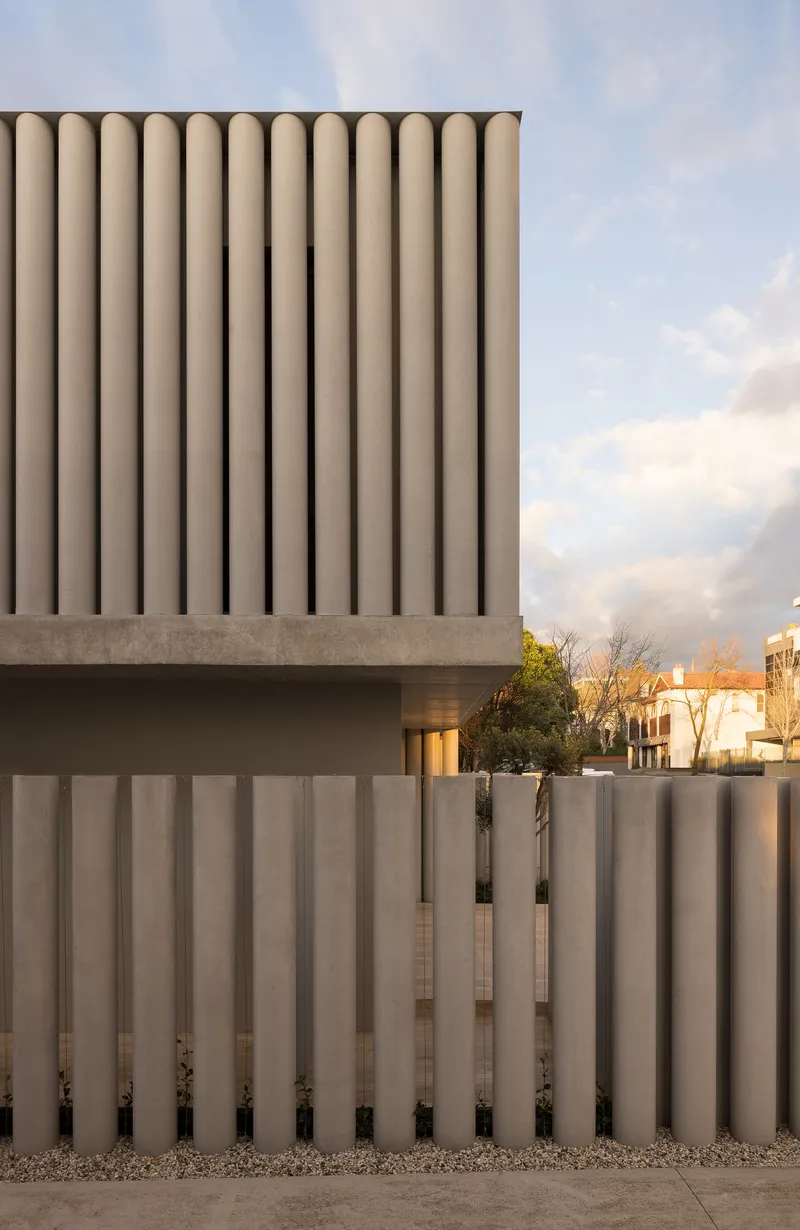


Eighty percent of this house is concrete and glass, and the facade makes that ratio tangible. Closely spaced vertical fins wrap the cantilevered upper volume, catching raking light at golden hour and dissolving into a rhythm of deep shadow lines after dark. Up close the fins reveal their sculptural precision: each one is knife-edged and slightly angled so that the entire surface appears to ripple, an effect that shifts as you walk along the street.
The decision to extend the same concrete language down to the perimeter wall is a smart one. It grounds the upper volume and eliminates the visual break that a conventional fence would introduce. A single olive tree planted between dwelling and footpath softens the composition without diluting it. Compared to the costumed neighbours on either side, the house reads as an object that knows exactly what it is.
Entry and the Choreography of Arrival
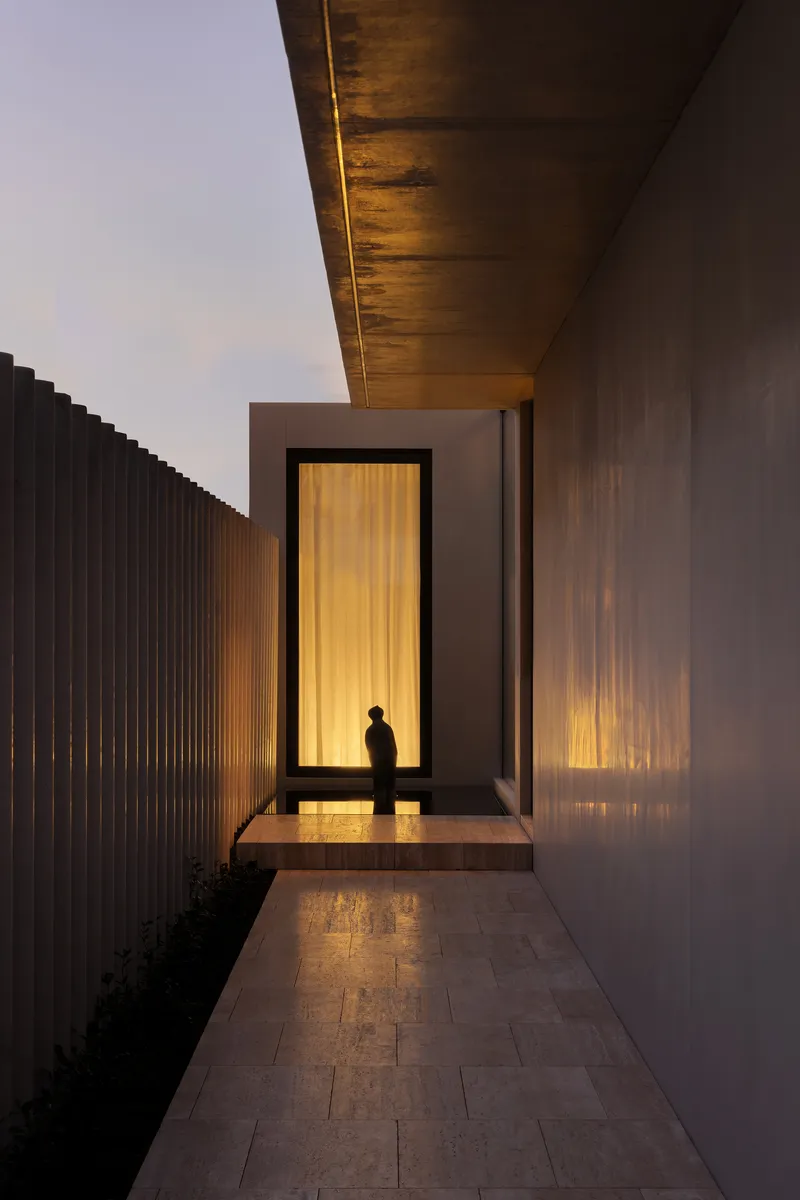

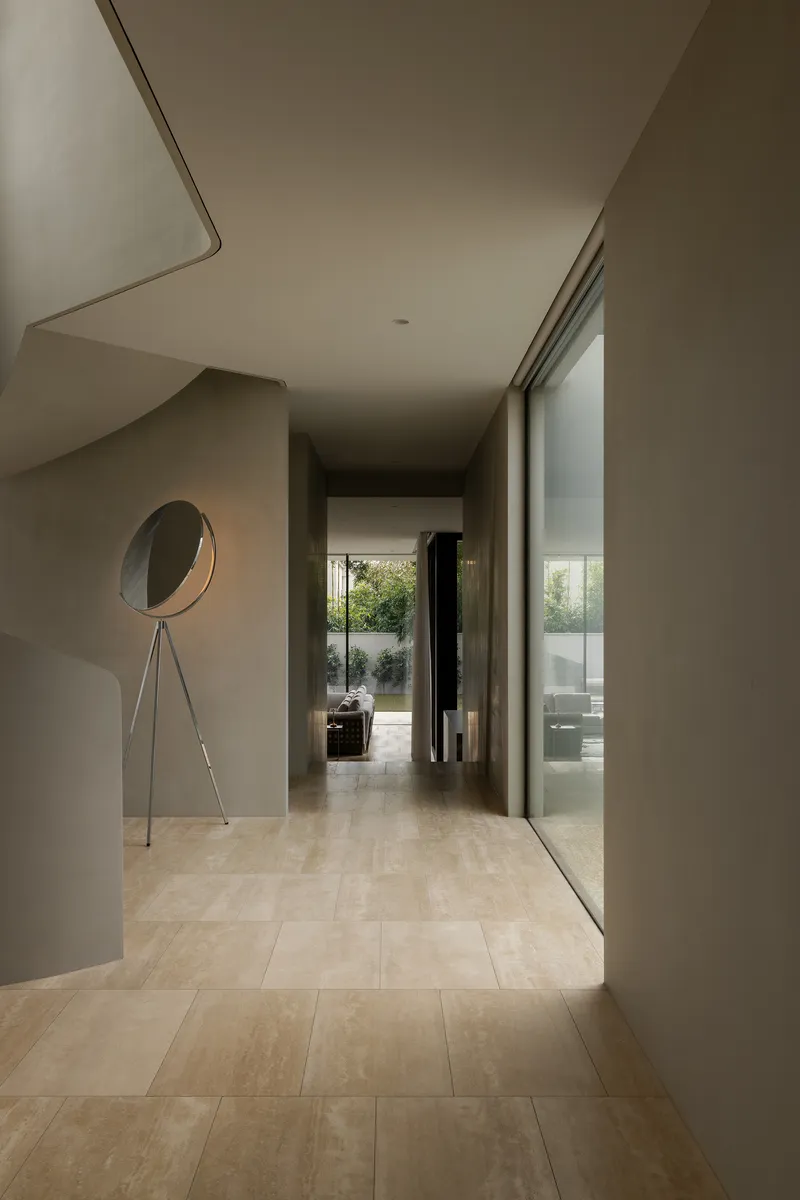
Arrival is deliberately compressed. The entry corridor is lined with vertical timber slats that echo the concrete fins outside, filtering twilight into a narrow, backlit passage. You are squeezed before you are released. From the garage, a secondary view opens through to a sunlit courtyard, hinting at the depth of the plan before you reach it. It is a technique borrowed from Japanese residential architecture, and FGR has acknowledged the debt without aping the aesthetic.
Litzio travertine flooring runs continuously from the corridor through the living spaces and out onto the terrace, erasing the threshold between inside and out. The pale stone reflects daylight upward and gives the circulation spine a calm, luminous quality that carries through the entire ground floor.
The Central Courtyard as Light Engine


A tight allotment in Toorak is still a generous site by most cities' standards, but FGR has treated light as a limited resource worth designing around. The central courtyard is the house's primary light well, pulling sun deep into the split-level ground floor and ventilating the kitchen and living zones through operable glazed doors. A bonsai Juniper Squamata sits at its centre, a deliberate miniaturisation that keeps the courtyard feeling like a room rather than a garden.
An existing lilly pilly tree was salvaged and repositioned so that it falls within the sightline of the master bedroom above. These are quiet gestures, easy to miss in photographs, but they reveal a design team thinking about what each room sees, not just how it is lit.
The Green Stone Kitchen
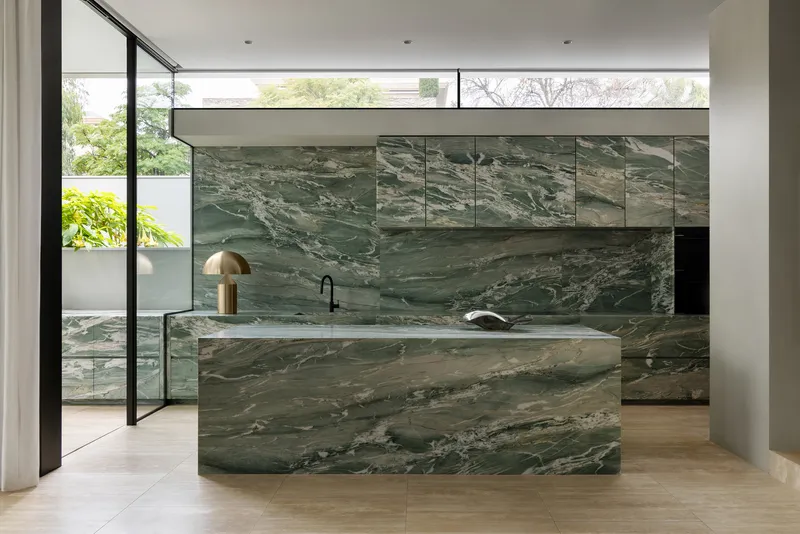
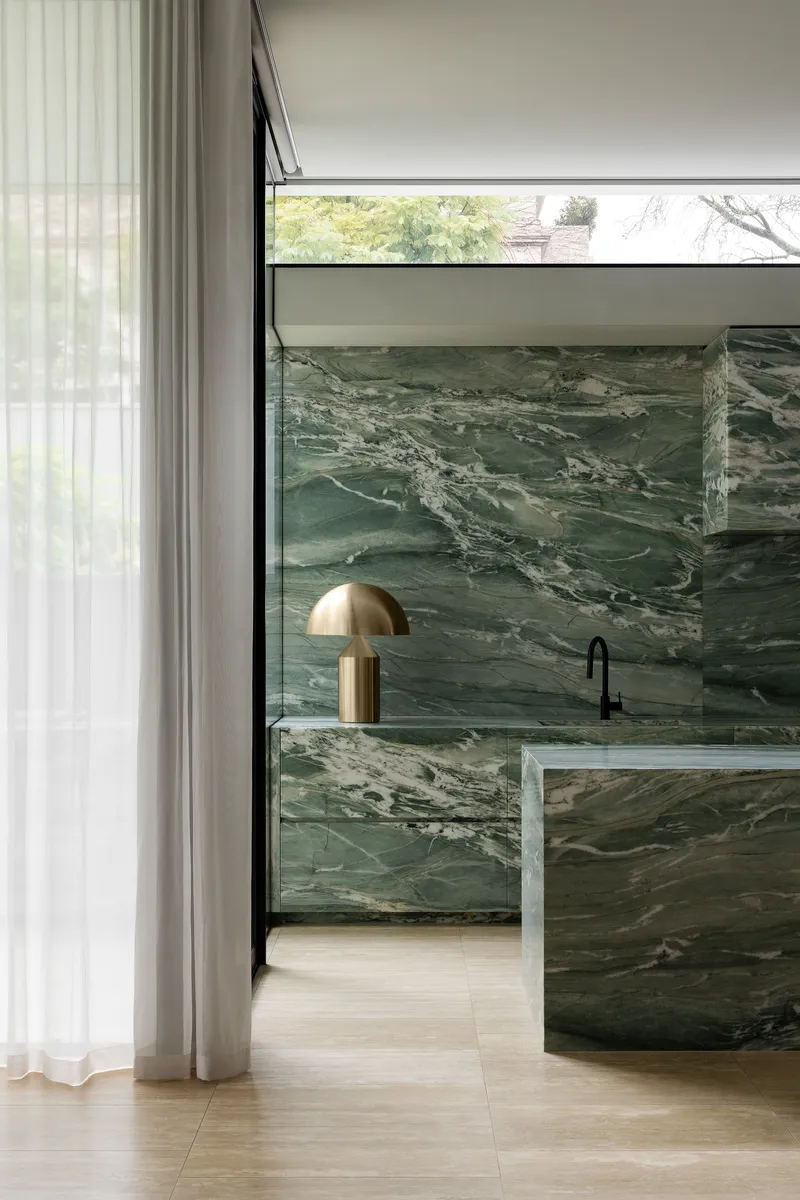
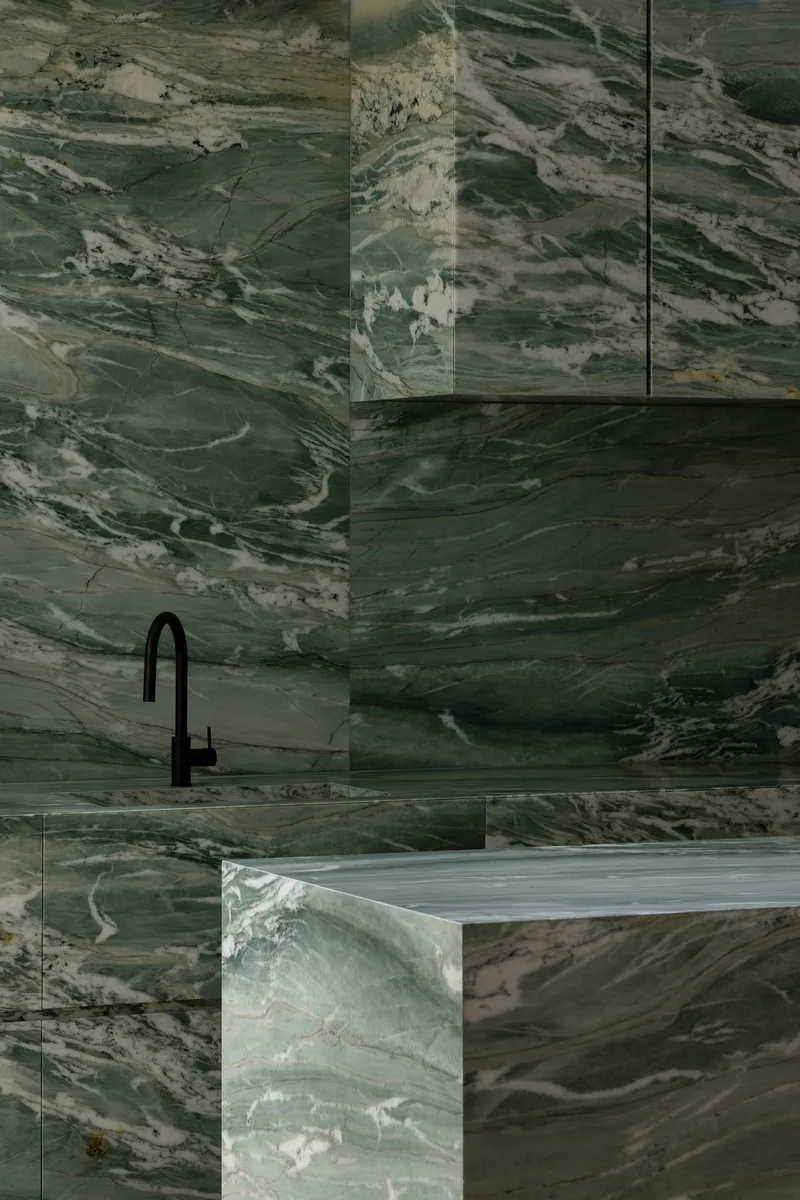
If the concrete facade is the house's public face, the kitchen is its private one. The island and backsplash are clad in Seafoam Ocean-Waves quartzite, a veined green and white stone that introduces a chromatic intensity that nothing else in the house attempts. Brass dome lamps sit on the counter like still-life objects, and sheer curtains on the courtyard side repeat the pleated motif of the exterior in fabric.
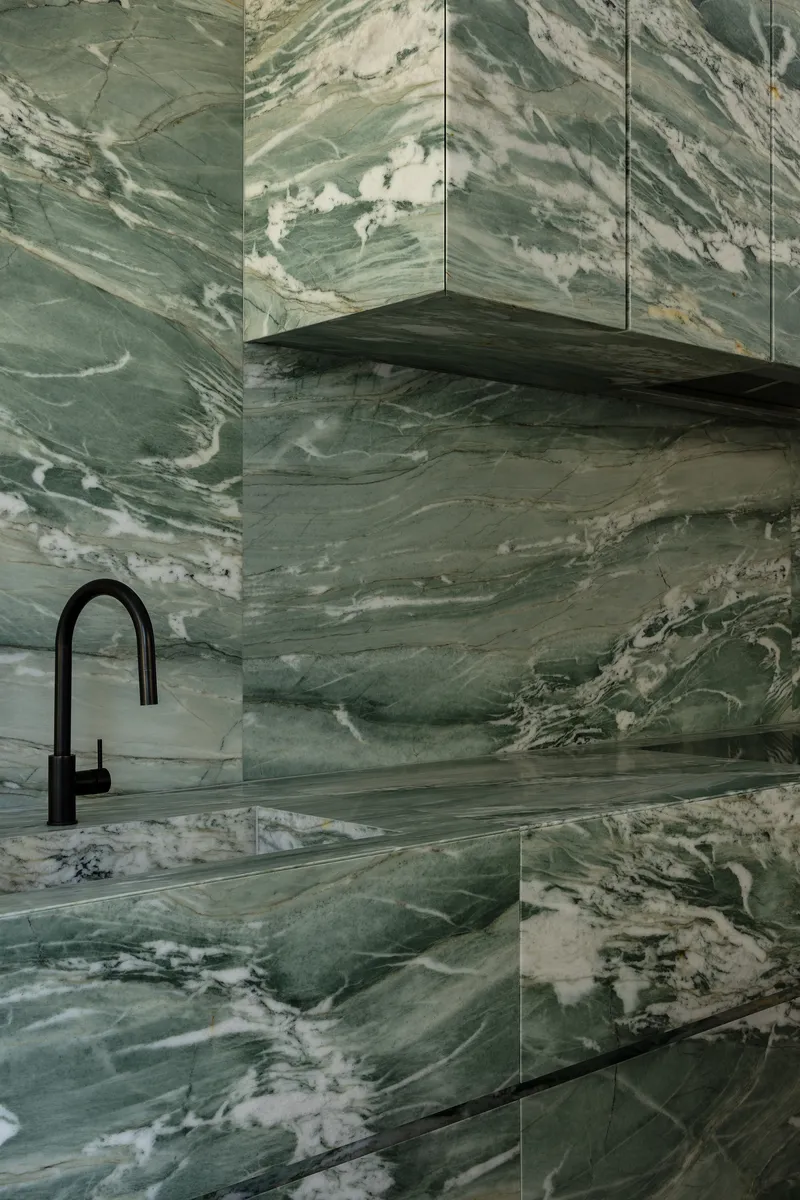
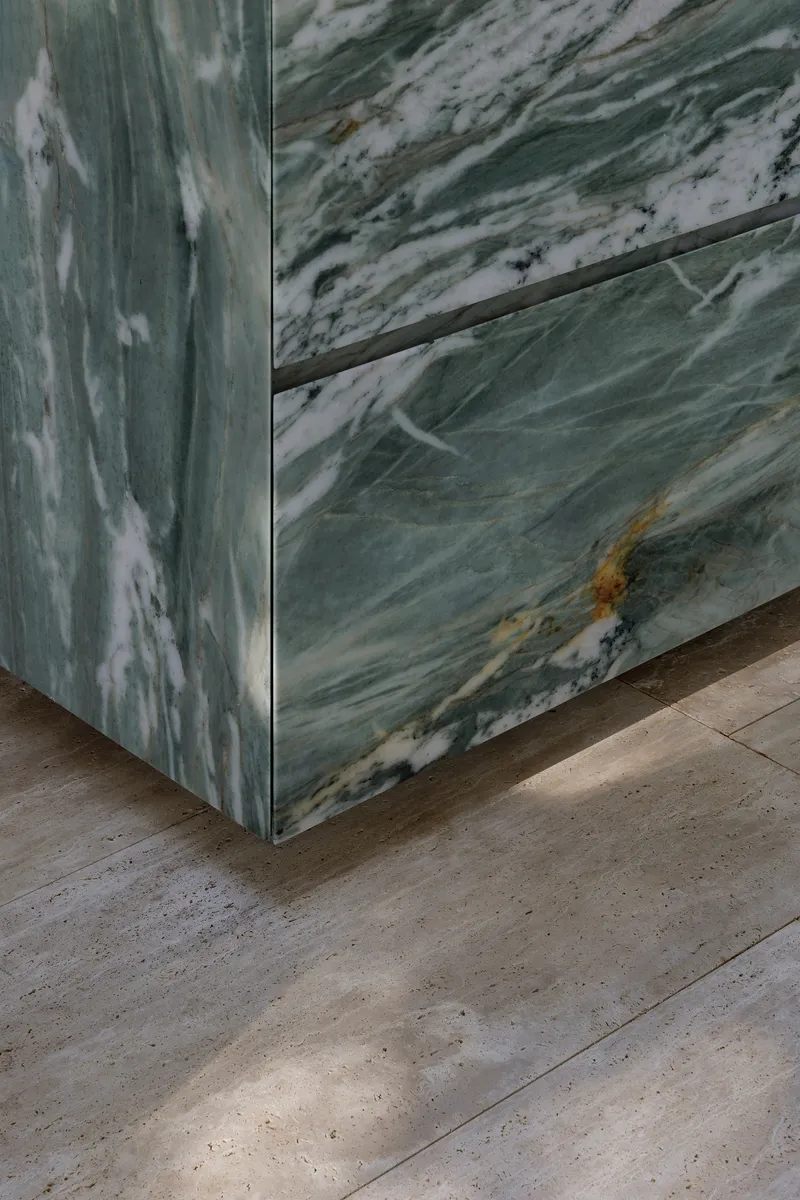

The material detailing here is precise. Black gooseneck taps meet the quartzite at clean butt joints, and the stone panels wrap corners without exposed edges or visible substrate. Where the quartzite meets the travertine floor, a flush shadow joint separates the two surfaces cleanly. It is the kind of work that costs time and money to get right, and FGR has clearly spent both.
Sculptural Circulation
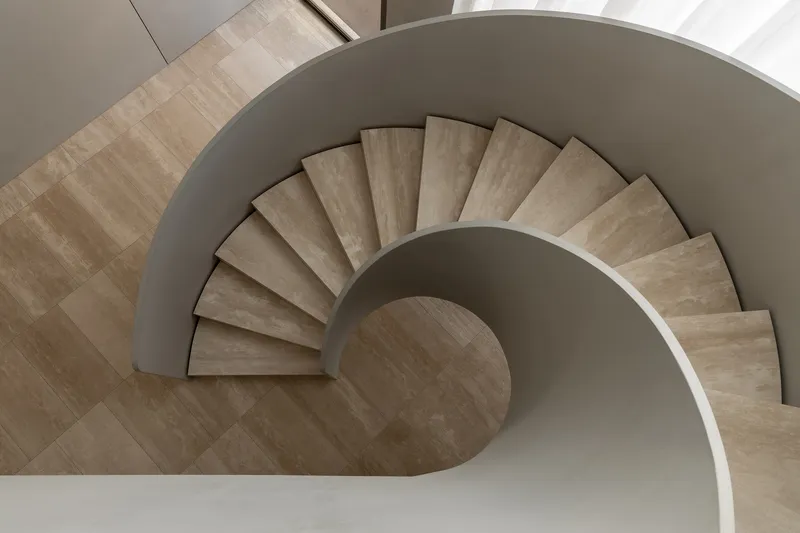

The spiral staircase connecting the split-level ground floor to the bedrooms above is one of the most photographed elements in the house, and it earns the attention. Travertine treads wrap around a curved white balustrade, and the taupe-painted stringer follows the helix with a consistency that speaks to careful formwork. Seen from above, the spiral reads as a nautilus shell; from below, the treads appear to float away from the core.
Stairs are often treated as connective tissue between the real rooms. Here they are a room in their own right, a moment of vertical compression between the expansive living spaces below and the private quarters above.
Living Toward the North
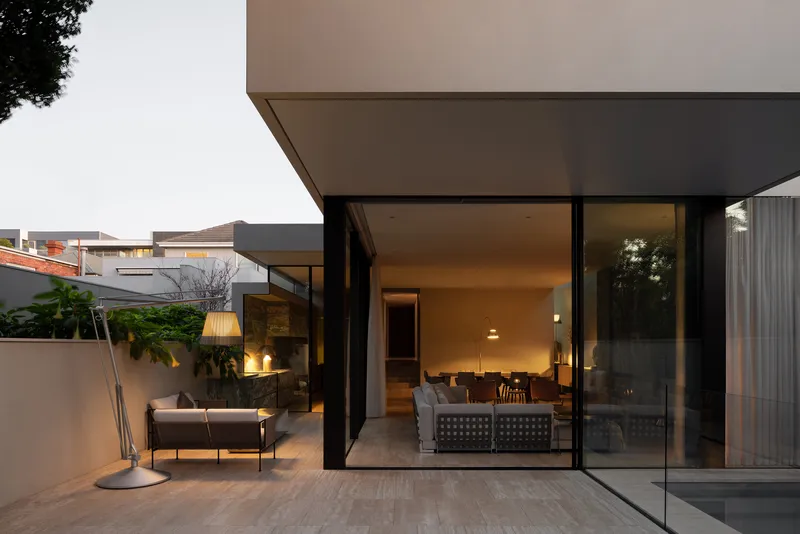

The split-level ground floor steps down from the entry and study into a sunken living area that opens through full-height glazing onto a north-facing terrace and pool. The orientation is textbook Melbourne: maximising winter sun and enabling crossflow ventilation through operable double-glazed panels. A floor-to-ceiling fireplace clad in the same green quartzite as the kitchen anchors the living room and gives the space a focal point that is not the television.
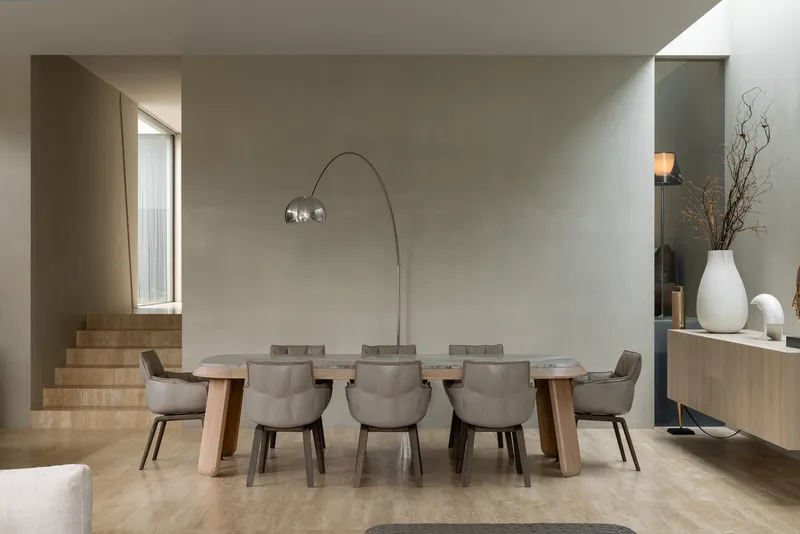
The dining zone, slightly elevated on a stepped platform beside the living room, reinforces the split-level logic. A stone-topped table with upholstered chairs sits at the intersection of two volumes, borrowing height from the double-glazed wall on one side and intimacy from the lower ceiling on the other. The spatial layering here is the domestic equivalent of a section drawing come to life.
Private Quarters Above
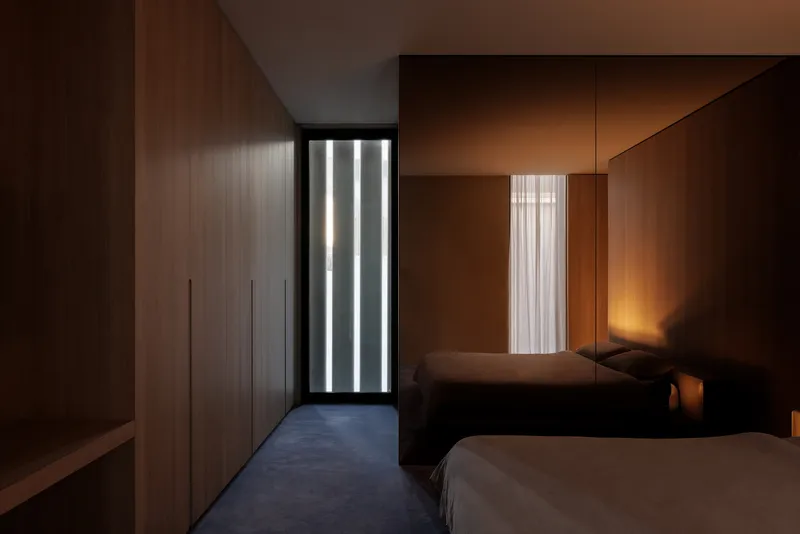
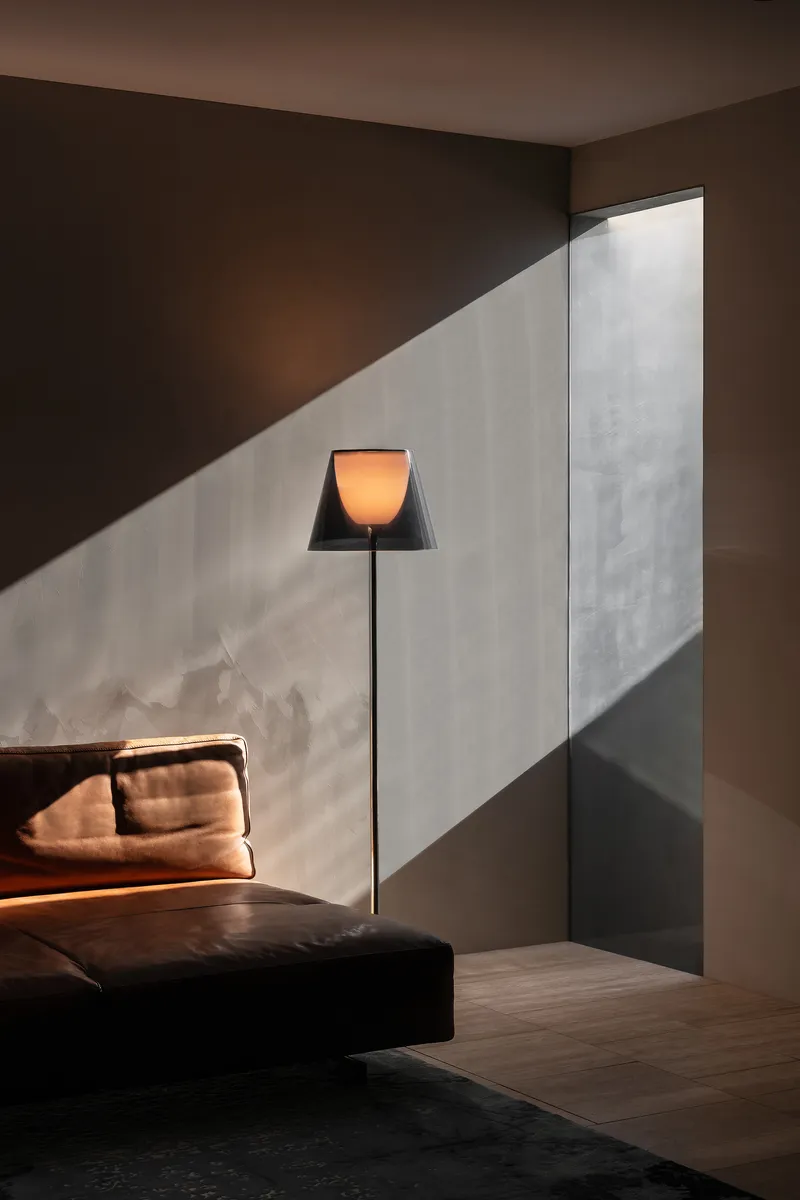

Upstairs, the programme shifts to bedrooms, en-suites, and a library. The concrete fins do their most important work here, filtering street-level noise and sightlines so that bedrooms can have generous glazing without sacrificing privacy. A vertical strip window in the twin bedroom throws a blade of light across the carpet, a controlled aperture that would be impossible on a conventional open facade.
The home office, tucked beside timber built-in shelving, is one of the more restrained rooms in the house. A glass desk and black leather chair sit on a deep green rug, and the material palette is reduced to wood, glass, and fabric. After the quartzite and travertine of the floors below, the simplicity is welcome.
Night Reading
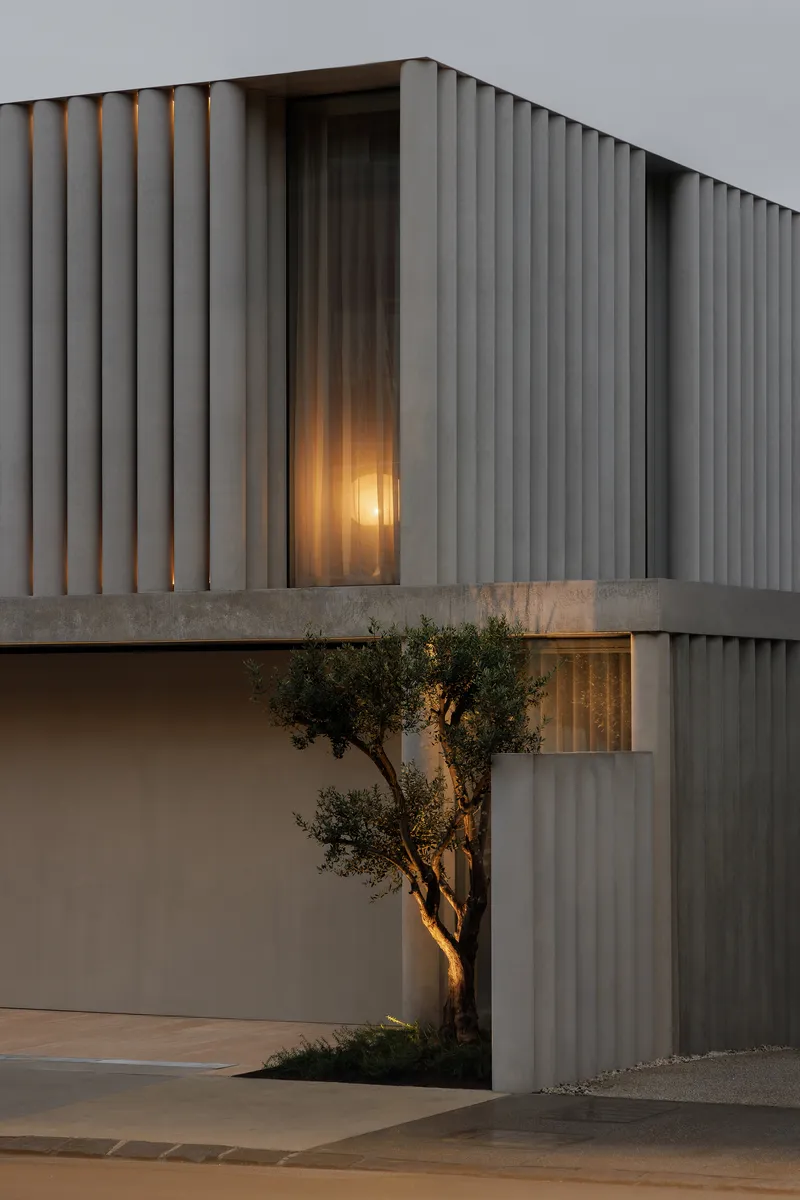


At dusk the building inverts. The concrete fins, which during the day absorb and deflect sunlight, become a scrim through which warm interior light leaks outward. The cantilevered upper volume appears to glow from within, and the olive tree in the foreground catches the spill. The timber-screened garage and entry volume at street level read as a solid plinth, grounding the composition and keeping the illuminated upper level visually stable.
The travertine detail at ground level deserves a second look.

Flush shadow joints and honed edges give the stone a precision that echoes the concrete formwork above. It is a house where the macro gesture, the pleated facade, and the micro detail, a corner joint, speak the same language.
Why This Project Matters
Concrete Curtain House matters because it demonstrates that privacy and generosity are not opposites. In a suburb where most expensive houses either hide behind hedges or announce themselves with overwrought facades, FGR has found a third option: a building that is fully present on the street, visually striking and unapologetic, yet reveals nothing of its interior life until you are invited in. The concrete fins are not decoration. They regulate light, manage thermal loads, muffle traffic noise, and define the building's identity. That convergence of performance and expression is what separates architecture from styling.
More broadly, the project is a convincing argument for material commitment. When eighty percent of your building is concrete and glass, every joint, every shadow line, every formwork mark is on display. There is nowhere to hide. FGR has leaned into that exposure with a level of craft, from the spiral staircase to the quartzite kitchen to the travertine thresholds, that rewards close looking. In an era when residential architecture is increasingly clad in composite panels and rendered foam, a house that is genuinely made of what it appears to be made of carries a quiet authority.
Concrete Curtain House by FGR Architects. Toorak, Australia. 500 m². Completed 2023. Photography by Timothy Kaye and Peter Bennetts.
About the Studio
Share Your Own Work on uni.xyz
If projects like this are the kind of work you want to make, uni.xyz is a place to publish your own, find collaborators, and enter design competitions.


Popular Articles
Popular articles from the community


Opera on the Sea: Driftwood Logic Shapes a Timber Opera House on Estonia's Coast
Trevor Orgill's opera house translates the entangled drift of floating timber into a civic building where wood, water, and music converge.

Faces of the Soviet Avant-Garde: Turning Moscow's Street Names into an Open-Air Museum
A network of sculptural installations across a Moscow residential district transforms forgotten architect names into spatial encounters with cultural memor

The Amber Palace Opera: A Geological Fiction Surfaces on Tallinn's Baltic Waterfront
Pierre Brillard reimagines a Baltic legend as a public landscape, opera house, and waterfront promenade rooted in Tallinn's coastal identity.
Extended Shell: Retrofitting Kolkata's Balconies as Living Urban Thresholds
A modular retrofit system recovers the social and environmental intelligence of Kolkata's historic verandas for contemporary Park Street residents.

Similar Reads
You might also enjoy these articles

Pixel Gardens: One Repeated Module Stacked Into a Terraced Social Housing Tower for Famagusta
Salem Bader's shortlisted housing tower builds a vertical neighbourhood from one repeated module, offsetting units to carve terraces, light and air.

Bao Huynh Watercolor Atelier: A Serene Art Retreat in Hội An
Bao Huynh Watercolor Atelier in Hội An blends multifunctional art spaces, sustainable design, local materials, and family-friendly living in a serene environment.

Atelier Macri Concept Store Interior Design by CASE-REAL
Atelier Macri store features a "ko" counter, walnut wood details, cork displays, blending retail, gallery, and seamless customer experiences.

Manuel Vargas Izquierdo Stadium and High-Performance Sports Center: Architectural Excellence in Jalpa de Méndez
The Manuel Vargas Izquierdo Stadium blends sustainable design, inclusive sports facilities, and cultural-inspired architecture, revitalizing Jalpa de Méndez’s public spaces.

Explore Container House Competitions
Discover active competitions in this discipline

Challenge to design mud housing for contemporary communities

Challenge to reimagine the Iron Throne

Photograph architecture without architects

Illustrate the lost glory of Angkor Wat - Render Challenge
Comments (0)
Please login or sign up to add comments
No comments yet. Be the first to comment!