
Praeger Richter Architekten Builds a Berlin Housing Block Designed for Its Own Disassembly
A timber-concrete hybrid in Schöneberg applies cradle-to-cradle thinking to collective housing, with every screw placed for future removal.


Most residential buildings are designed with a single lifespan in mind. Praeger Richter Architekten's Fit-Out House, known locally as Ausbauhaus Südkreuz, was designed with several. Completed in 2022 on a former municipal recycling yard in Berlin-Schöneberg, the seven-storey collective housing project treats every material choice as a contract with the future: concrete where permanence is needed, timber where change is expected, and composites nowhere at all. The building's components are screwed, laid, and plugged rather than glued or welded, so that walls, floors, and even the facade can be dismantled, reused, or reconfigured without generating demolition waste.
What makes the project genuinely interesting is not just its environmental ambition but how that ambition shapes the experience of living in it. The 2,200-square-metre building holds 13 owner-occupied flats, 3 subsidized rental apartments, and 2 neighbourhood-oriented spaces across units ranging from 38 to 130 square metres. Won through Berlin's "Schöneberger Linse" concept competition in 2019, the project is part of a new generation of Baugruppen developments where the residents are co-clients, and the architecture must answer to both collective ideals and individual domestic life. The result is a building that feels deliberate in every joint, honest about its materials, and quietly radical in its refusal to treat housing as disposable.
A Ground Floor That Declares Intent
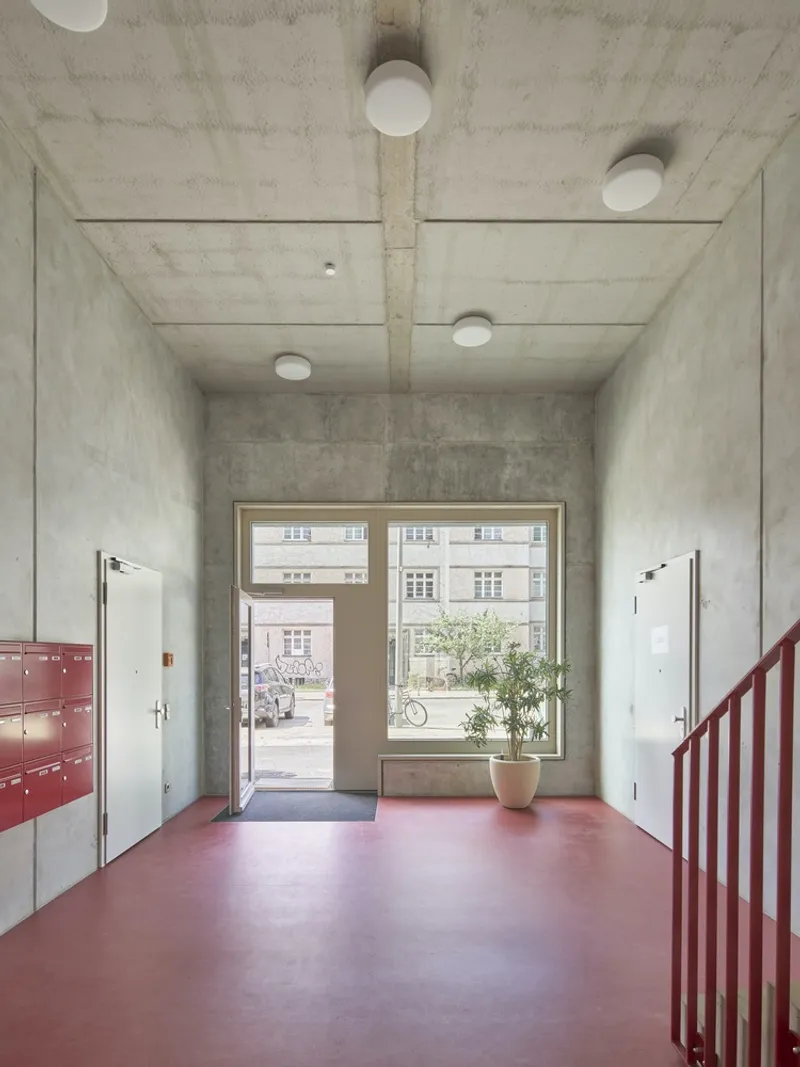
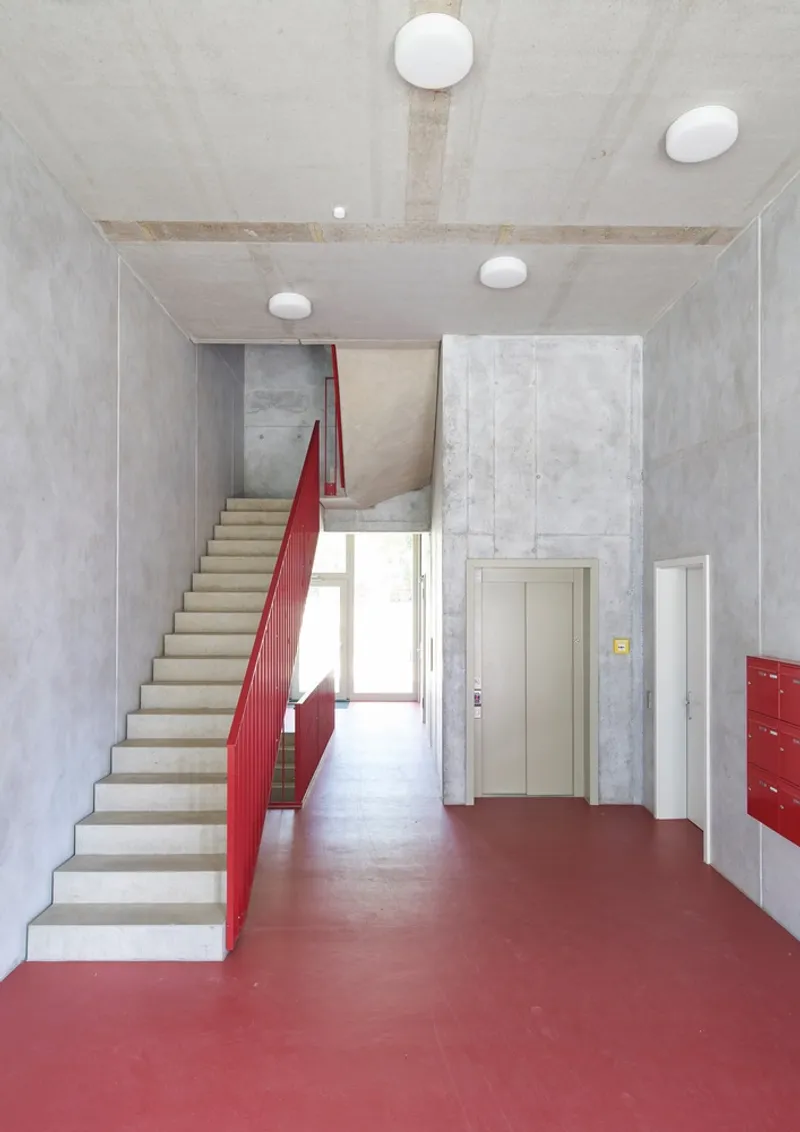
The entrance hall sets the tone immediately. Exposed concrete surfaces meet a pink resin floor that punches colour into what could otherwise read as raw austerity. Circular ceiling lights punctuate the slab above, and generous street-facing glazing pulls daylight deep into the ground level. The 4.5-metre ceiling height here is no accident: the ground floor is programmed for community activities, cultural exchange, and start-up incubation, not private apartments. It belongs to the neighbourhood as much as to the residents.
The central staircase, framed by a red metal balustrade against the same pink floor, reinforces the idea that the shared circulation is not leftover space but a designed social infrastructure. The concrete core handles fire protection and structural loads, freeing the upper floors from columns and giving units the flexibility to be reconfigured over decades. It is a smart distribution of permanence: the skeleton is fixed, the flesh is loose.
Plywood, Clay, and the Art of Visible Assembly
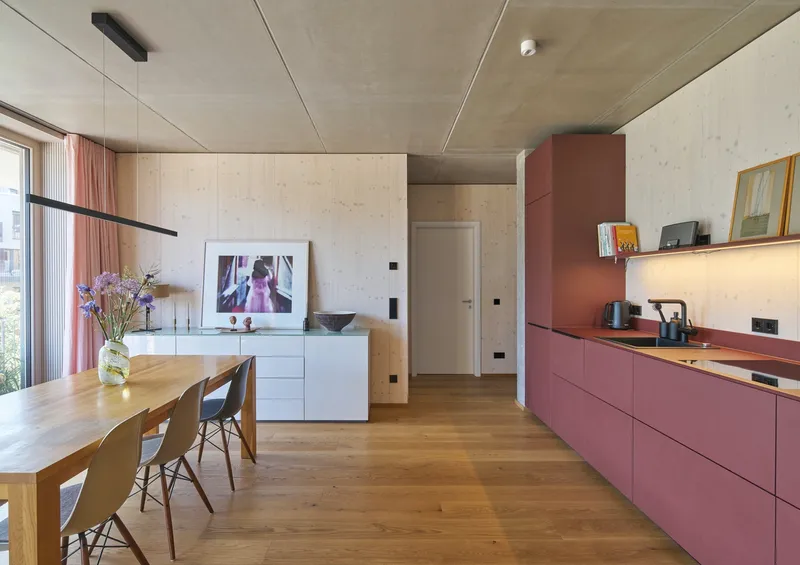
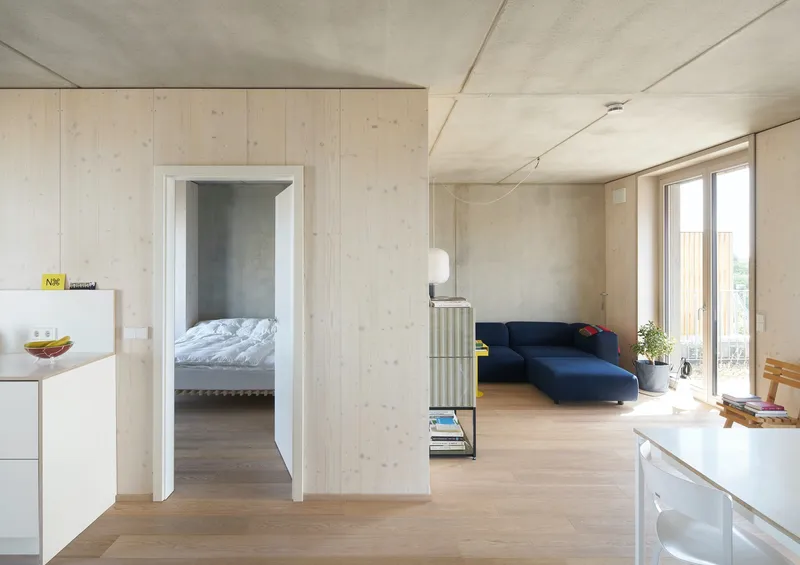
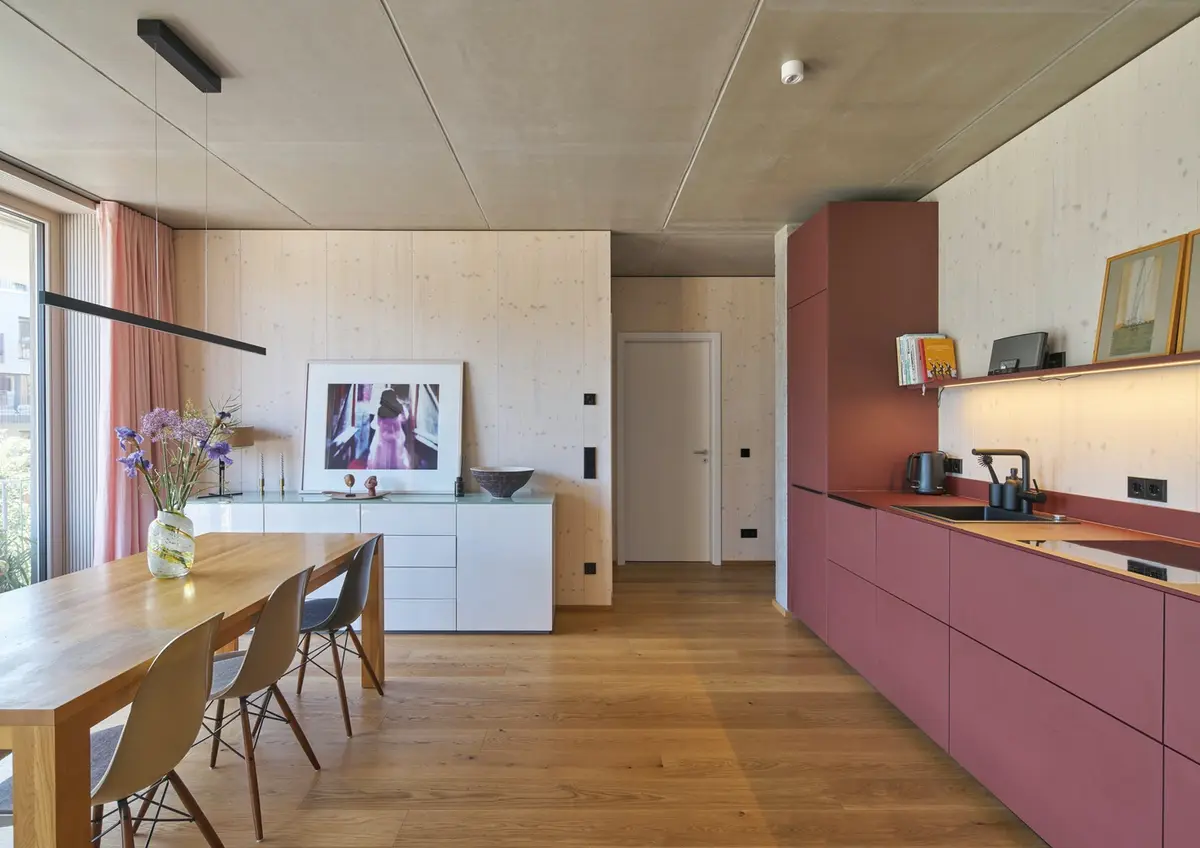
Inside the apartments, the material logic becomes tactile. Plywood partition walls, timber stud frames, and clay panels replace conventional drywall. Surfaces are left untreated or finished with healthy-living stains, so the building reads as honestly indoors as it does structurally. Pink kitchen cabinets in the open-plan living area shown here are a resident's own choice, layered onto the architect's neutral shell. That layering is the whole point: the fit-out is the occupant's territory, while the structure remains the building's.
The partition between living room and bedroom is a plywood wall that could, in theory, be unscrewed and relocated. Floors use a dry-mounted system with unbound wood-chip levelling fill, meaning no wet trades, no chemical adhesives, and no irreversible decisions. Every component has been documented in a BIM model so that future owners or recyclers know exactly what is where and how to take it apart. It is an architecture of legibility, not just sustainability.
Living Behind Larch and Mesh
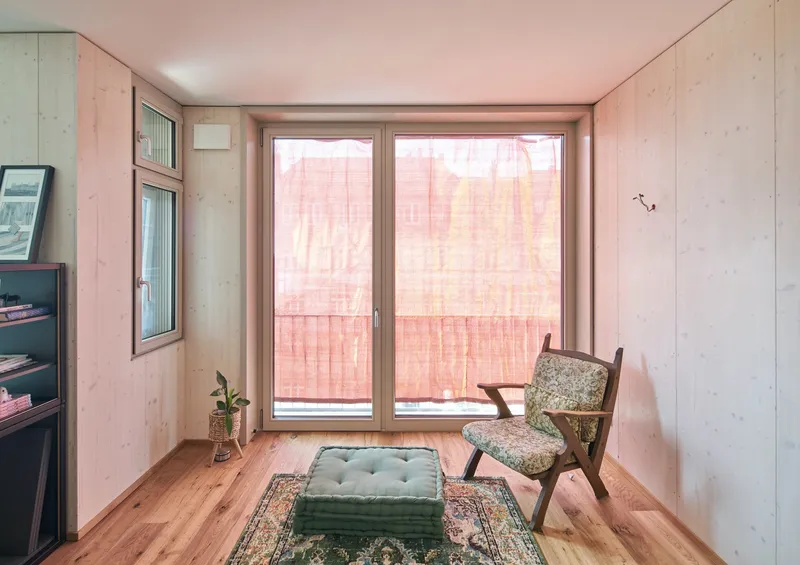
The apartments' relationship to the exterior is mediated through full-width French balconies, wooden French windows, and, in at least one unit, pink mesh curtains that filter the Schöneberg light into something warm and diffuse. The rear-ventilated facade, built from a demountable timber framework with wood-fibre insulation and pre-aged larch cladding, is designed to be replaced panel by panel as boards weather or standards change. Bird breeding boxes are integrated directly into this system, turning a technical assembly into an ecological one.
The site sits between the Ringbahn railway line and Sachsendamm, a context that demanded serious acoustic performance from those wooden windows. Achieving KfW 40 energy standard with biogas heating on a tight 550-square-metre plot, while also maintaining a green roof for beekeeping, suggests a design team that treated constraints as productive rather than limiting.
Plans and Drawings
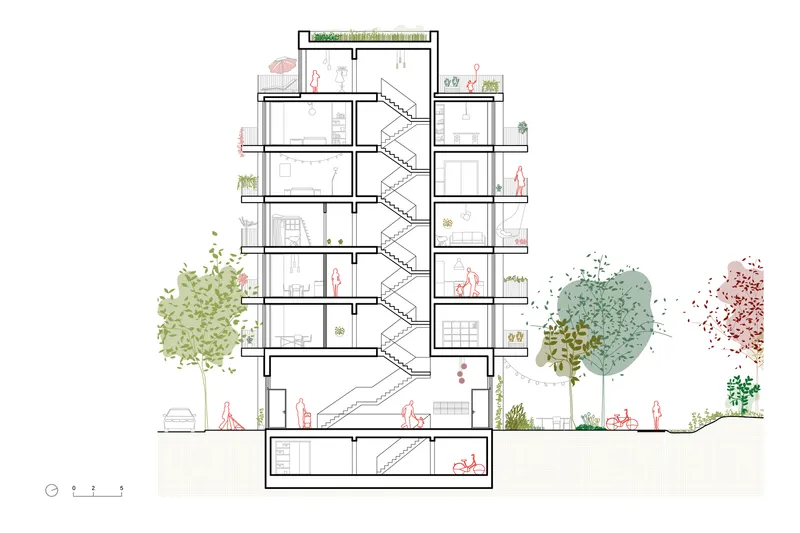
The section drawing reveals the building's organizational clarity. A central scissor stair serves two or four units per floor across seven levels, with flanking trees suggesting the landscape strategy at ground level. The top floor pulls back to accommodate a small guest flat and shared roof terrace, giving the collective a space that is neither fully private nor fully public. At a construction cost of 2,600 euros per square metre, the project sits within a range that makes its material ambitions replicable rather than exceptional.
Why This Project Matters
The Fit-Out House matters because it treats circularity not as a certification checkbox but as a design discipline that touches everything from the floor fill to the facade brackets. In a city where Baugruppen have long been testing alternatives to speculative development, Praeger Richter Architekten have pushed the model further by asking what happens after the first generation of residents moves on. The answer, built into every reversible connection and documented in a comprehensive BIM model, is that the building adapts rather than demolishes.
It also demonstrates that cradle-to-cradle principles do not require sacrificing domestic atmosphere. The interiors here are warm, colourful, and personal, precisely because the architecture gives residents a legible kit of parts to inhabit rather than a finished product to accept. At 2,200 square metres on a dense urban infill site, it is proof that circular construction works at the scale of the apartment block, not just the pavilion. Berlin's housing crisis needs more buildings like this: buildings that are planned to outlast their first brief.
Fit-Out House (Ausbauhaus Südkreuz) by Praeger Richter Architekten. Gotenstraße 45, Berlin-Schöneberg, Germany. 2,200 m². Completed 2022. Photography by Lindsay Webb and Andreas Friedel.
About the Studio
Share Your Own Work on uni.xyz
If projects like this are the kind of work you want to make, uni.xyz is a place to publish your own, find collaborators, and enter design competitions.


Popular Articles
Popular articles from the community


Singing Woman: An Opera House That Performs Before the Curtain Rises
Ovidiu Cristian Pavel's conceptual opera house translates Estonia's choral identity into a sculpted waterfront landmark facing the Baltic Sea.


graciastudio Turns a Viewless Tijuana Lot Inward Around a Courtyard of Concrete, Timber and Trees
In Tijuana, Jorge Gracia's GA2 House stacks a timber-clad private floor over exposed concrete and replaces a missing view with a planted interior patio.

FCC Arquitectura Expands a Portuguese Granite House with a Board-Marked Concrete Wing
In Portugal, JV House pairs a cleaned-up whitewashed and granite dwelling with a timber-shuttered concrete extension, courtyards and a garden pool.

Cube Design Draws an Ecological Corridor Between Two Shenzhen Hills with the Nankai Building
Beside Shenzhen's container docks, the Nankai Building pairs stacked balconies with a climbing green screen to connect two hillsides across its height.

Similar Reads
You might also enjoy these articles


Hodi-Mandai Geram
Project Function: Preservation and revitalization of the Intangible heritage and socio-spatial identity of the Hodi by Housing, Cultural Memory Center, Sacred Grove, landscape, local tourism economy


Olio Towers: A Mid-Rise for Performers That Fuses Housing, Rehearsal, and Stage
Located blocks from Houston's Theater District, this modular tower stacks living units around a central performance atrium.

Oasis: Modular Green Housing Carved into Dhaka's Urban Fabric
A shortlisted Plugin Housing entry reclaims unauthorized settlements in Dhaka with stepped concrete volumes, green roofs, and ventilation-driven design.

Black Hole: A Floating Megastructure for the Post-Physical Era
Emiliano Mazzarotto envisions a spherical, self-scaling arena where e-sports, digital hotels, and holographic stadiums replace traditional public space.
Explore New Bauhaus Competitions
Discover active competitions in this discipline

Challenge to reimagine the Iron Throne

Photograph architecture without architects

Illustrate the lost glory of Angkor Wat - Render Challenge

Design challenge to reuse E-waste
Comments (0)
Please login or sign up to add comments
No comments yet. Be the first to comment!