
Flat6 Architects and aestudiooo Carve Light and Life into a Vietnamese Tube House
A 280-square-meter tower in Vietnam uses internal courtyards, polycarbonate screens, and living trees to redefine narrow urban housing.


The tube house is a fact of Vietnamese urbanism. Plots are narrow, party walls are shared, and daylight is something you negotiate for rather than assume. Most architects working within this typology treat it as a constraint to mitigate. With HH House, completed in 2020, Flat6 architects and aestudiooo treat it as an opportunity to engineer connection: between family members, between floors, between interior life and the sky overhead.
What makes the project genuinely interesting is not the thinness of the plan but the vertical choreography within it. The architects open the section with double-height voids, plant living trees that puncture through floor slabs, and wrap the entire front face in translucent polycarbonate and perforated steel. The result is a house that breathes vertically, pulling natural light and air deep into what would otherwise be a dark column of stacked rooms.
A Glowing Skin on a Dense Street
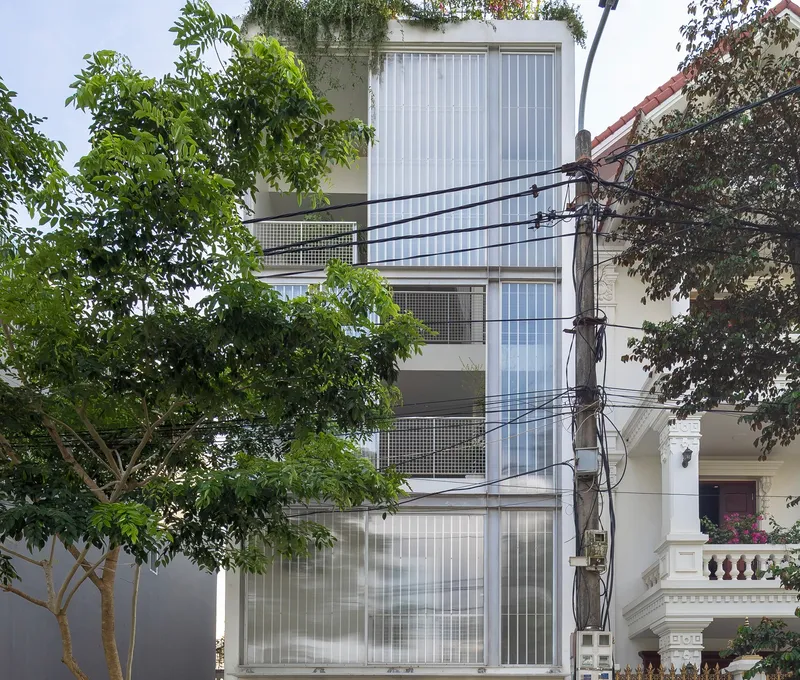


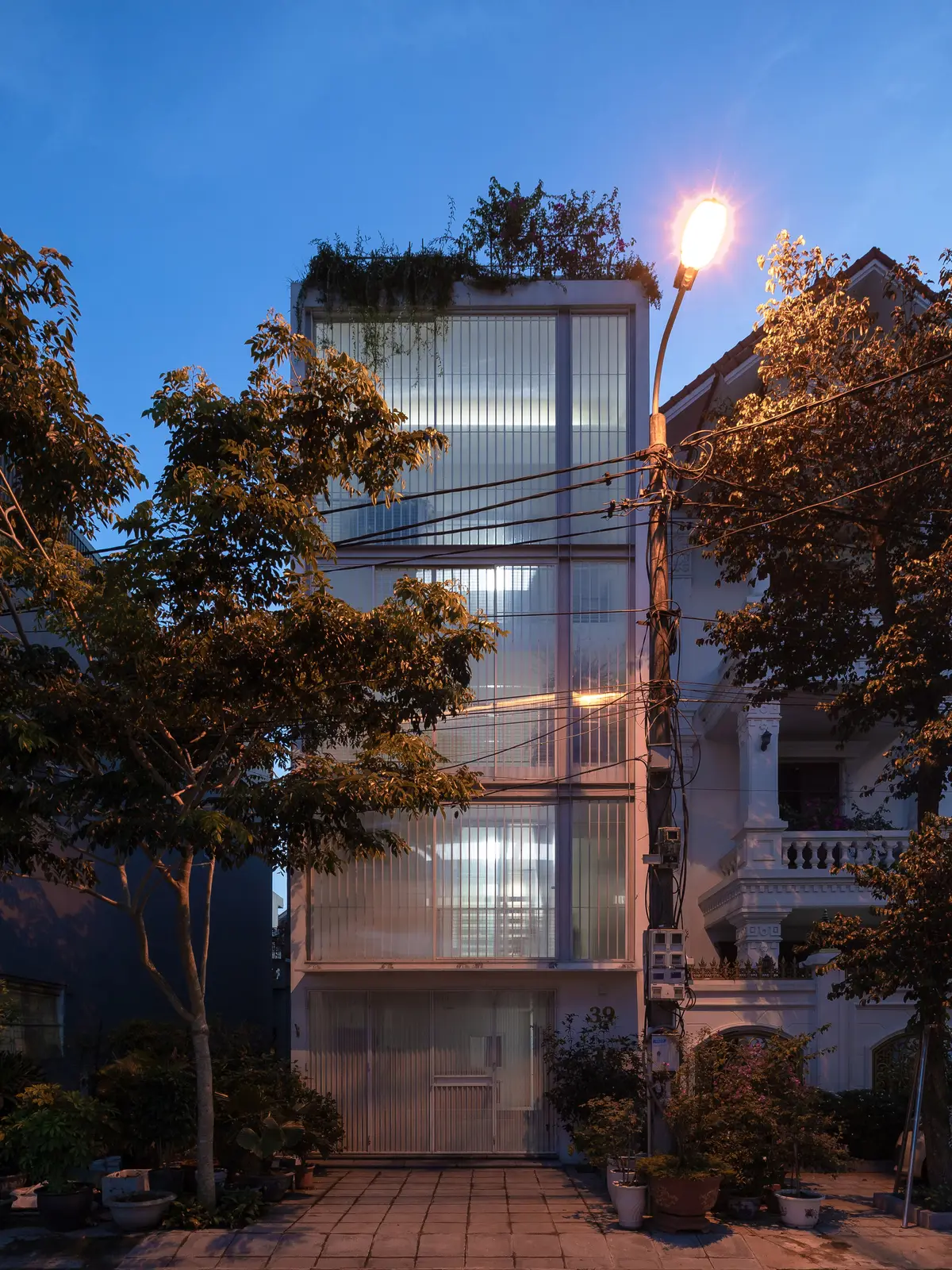
From the street, HH House reads as a lantern. Corrugated polycarbonate panels span the full height of the facade, backed by a steel structure that holds perforated metal balconies at each level. During the day the cladding filters harsh tropical sun into soft, even light. At dusk the relationship inverts: interior illumination transforms the tower into a translucent column glowing against a backdrop of tangled overhead wires and dense tree canopies.
The materiality is deliberately industrial. Steel framing, corrugated sheeting, and mesh screens are not dressed up to look precious. They do their job, aging with the climate rather than against it. Potted plants along the balcony edges soften the grid and signal that this is a home, not a warehouse. The choice to let greenery colonize the facade over time is a small but effective acknowledgment that the building is unfinished without its occupants.
Trees That Stitch the Section Together
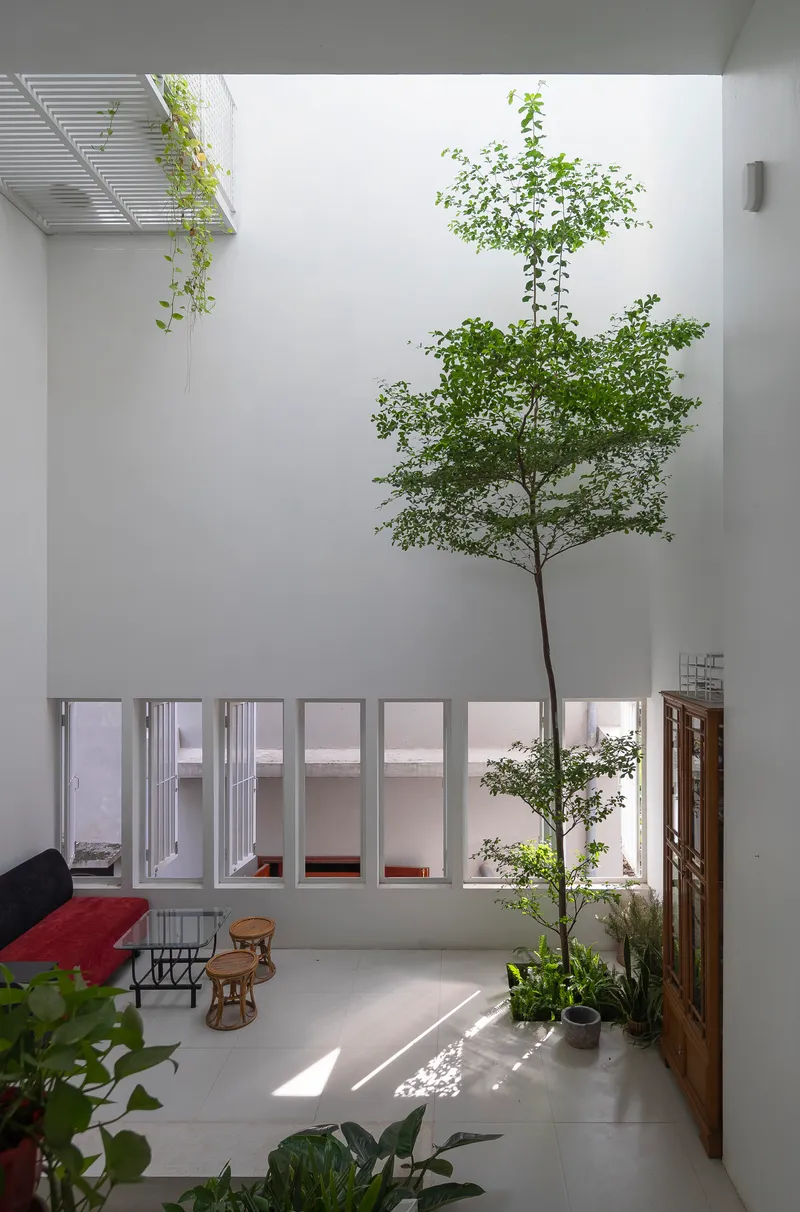
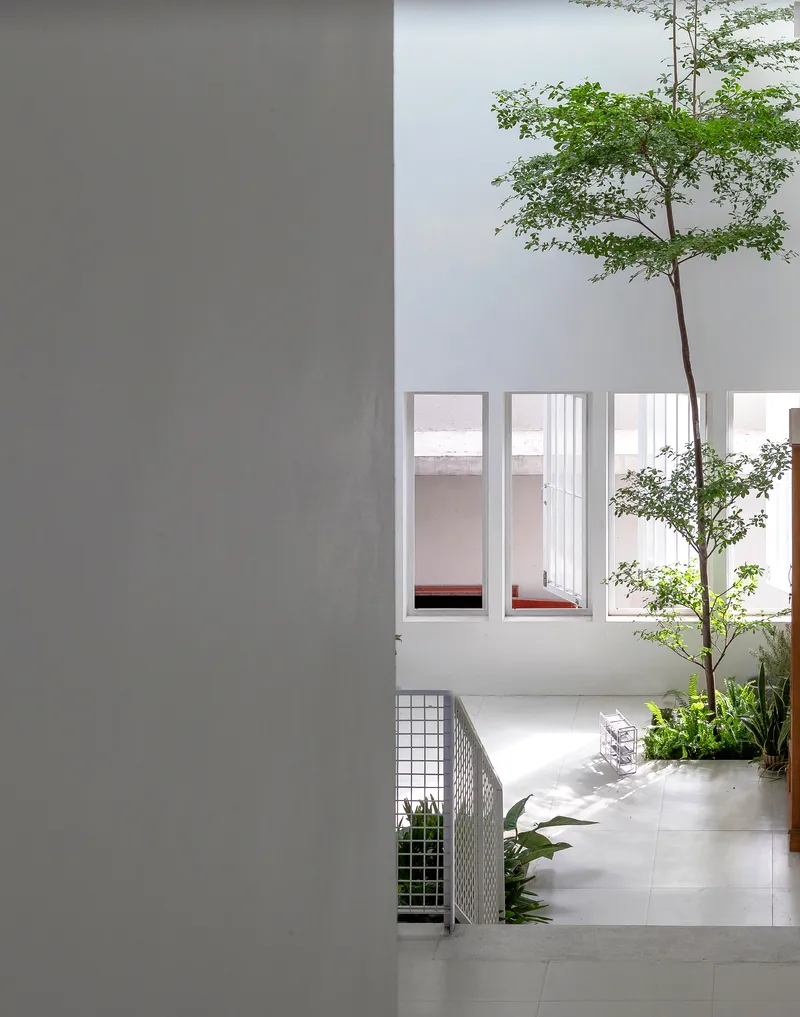
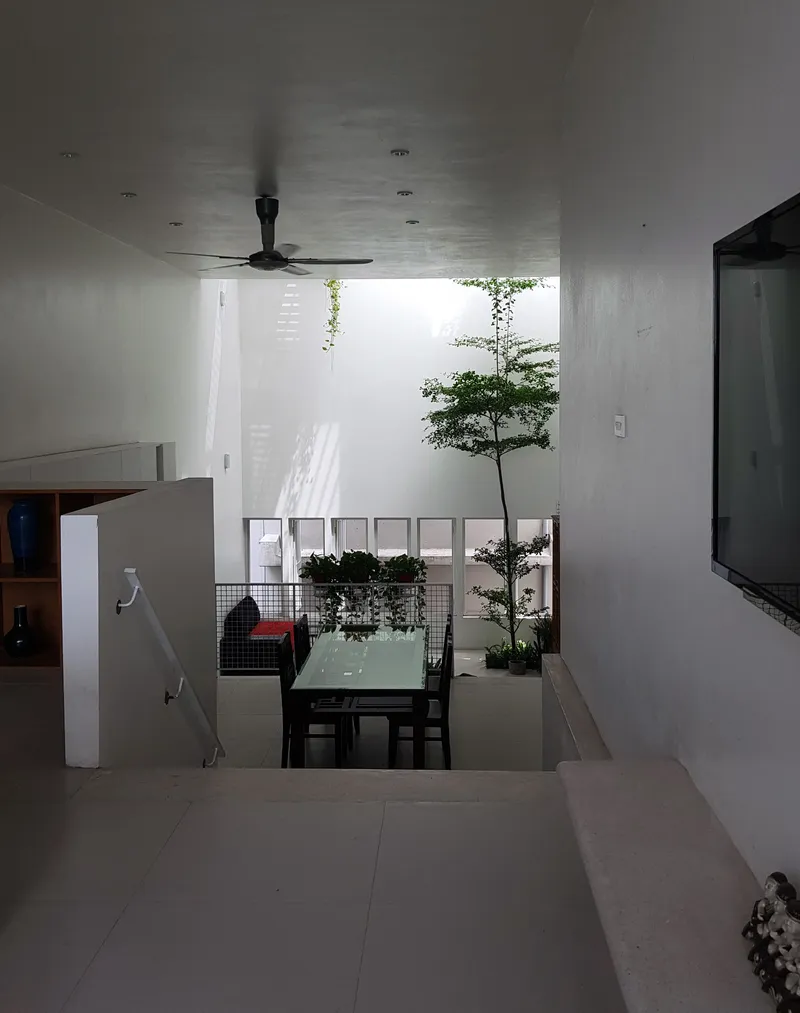
The most striking spatial move in HH House is the placement of slender trees that grow upward through openings in the floor slabs. These are not decorative gestures confined to a planter box. They physically connect the ground level to the upper floors, creating vertical continuity that the eye follows instinctively. Standing in the double-height dining area, you look past a glass table and up through branches that reach toward clerestory windows, collapsing the sense of being inside a narrow tube.
The internal courtyards where these trees are rooted serve a dual purpose. They bring diffuse light into the plan's center, and they act as thermal chimneys, drawing warm air upward and out. In a climate where mechanical cooling is the default, this passive strategy reduces the energy load without sacrificing comfort. The trees also introduce something harder to quantify: a sense of seasonal change and biological time that counters the static nature of concrete walls.
Filtered Light and Layered Screens
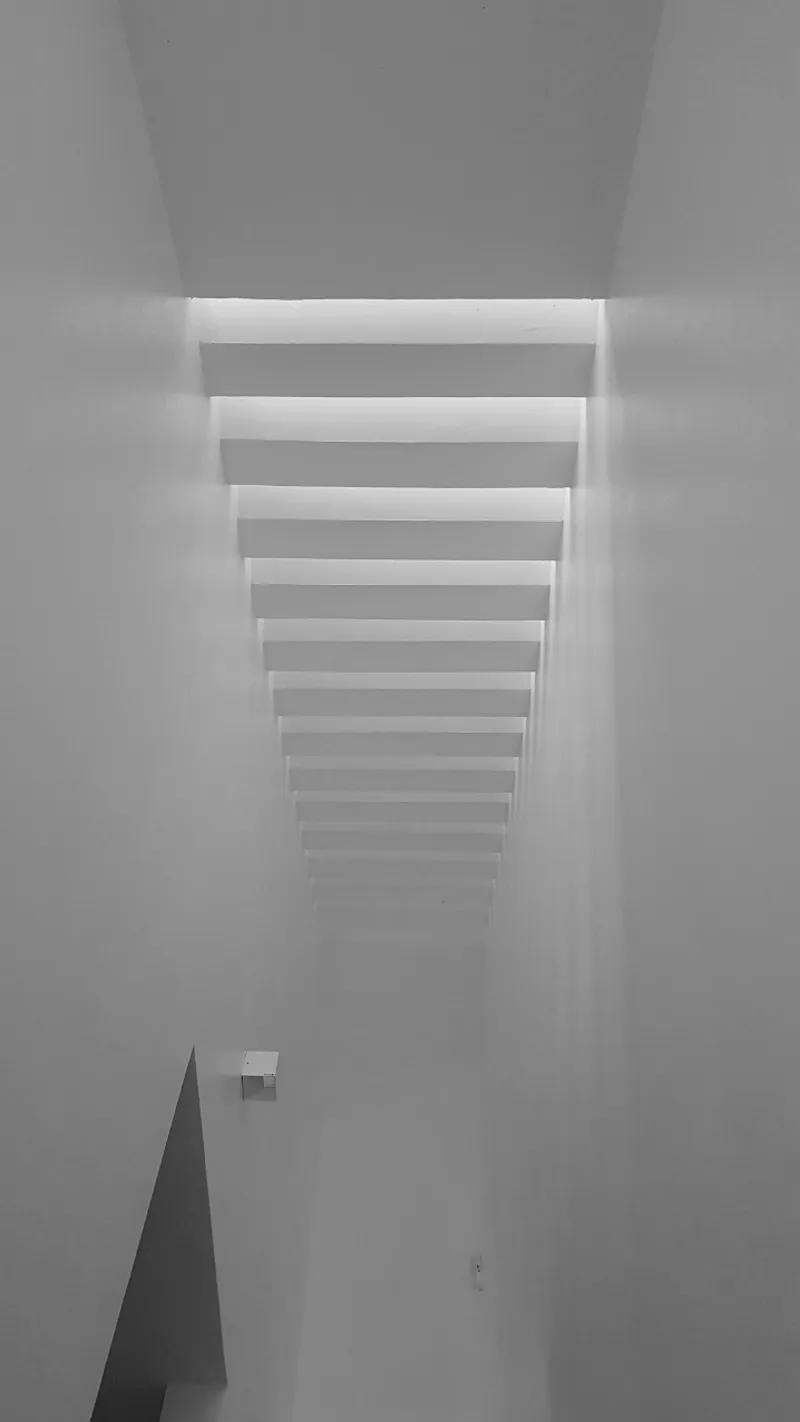
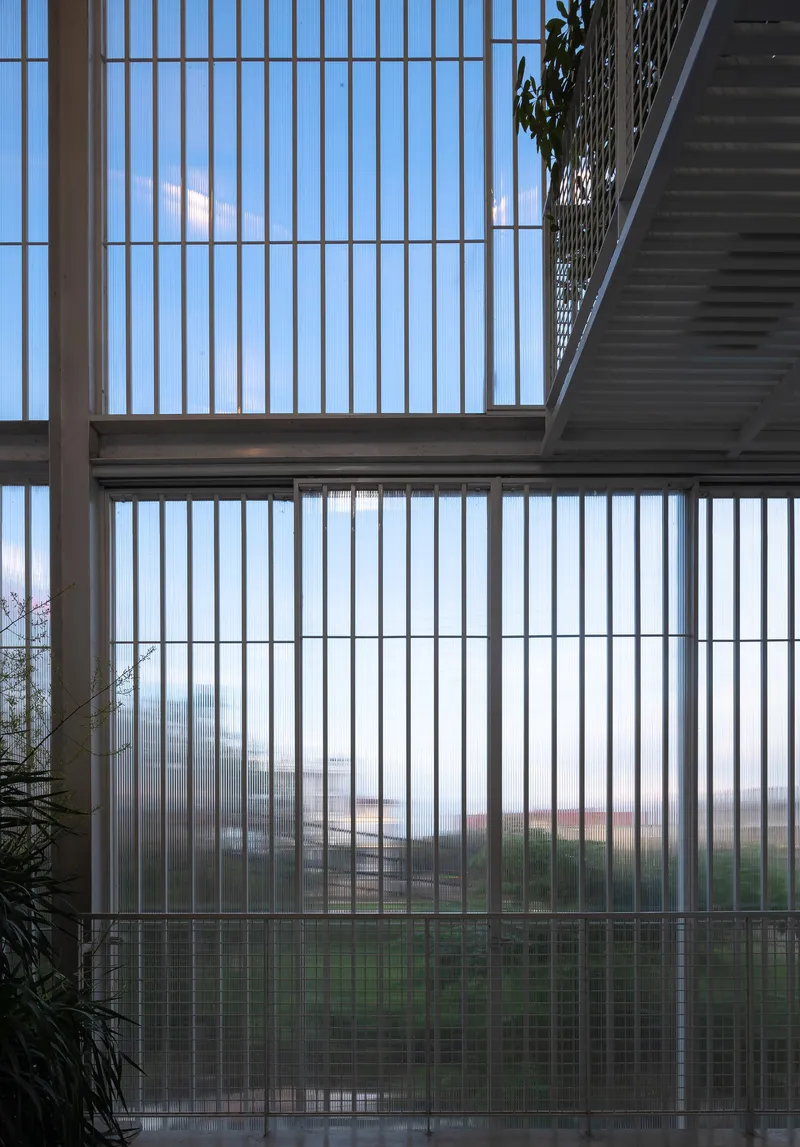
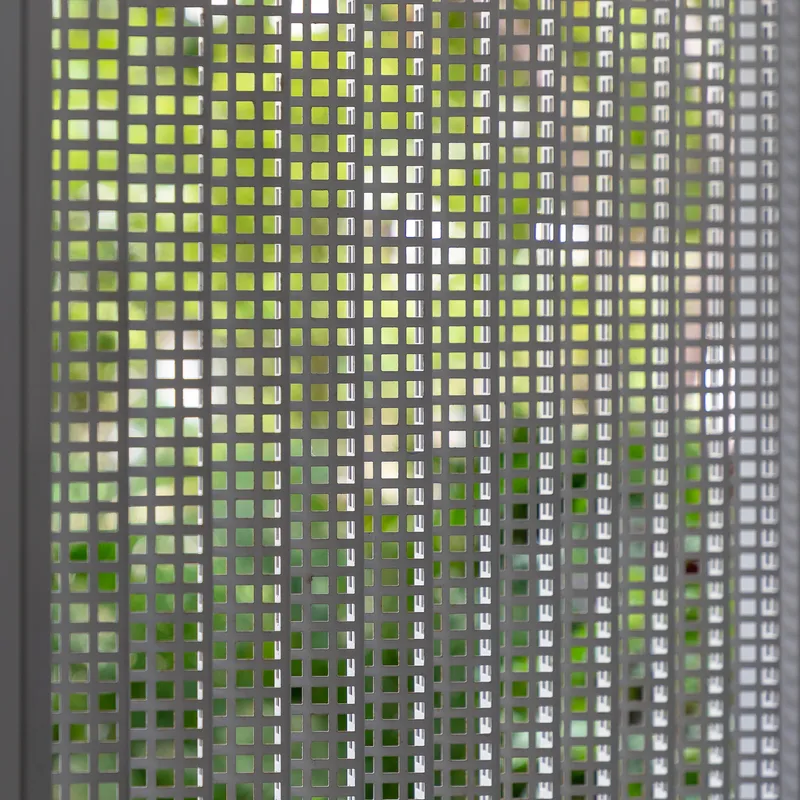
Throughout the house, the architects deploy a vocabulary of screens and louvers to modulate daylight. Horizontal louvers slice light into parallel bands across white plaster ceilings. Vertical polycarbonate louvres along balcony edges allow occupants to see the sky while blocking direct solar gain. Perforated metal panels create a moiré effect when viewed at an angle, turning a flat surface into something optically rich.
The layering is deliberate and precise. At no point in the house are you exposed to unmediated sunlight or left in total shade. Every room exists in a middle condition: bright enough to read, cool enough to rest, open enough to feel connected to the outdoors without the full thermal penalty. It is a lesson in environmental control achieved through geometry rather than machinery.
Vertical Circulation as Shared Space
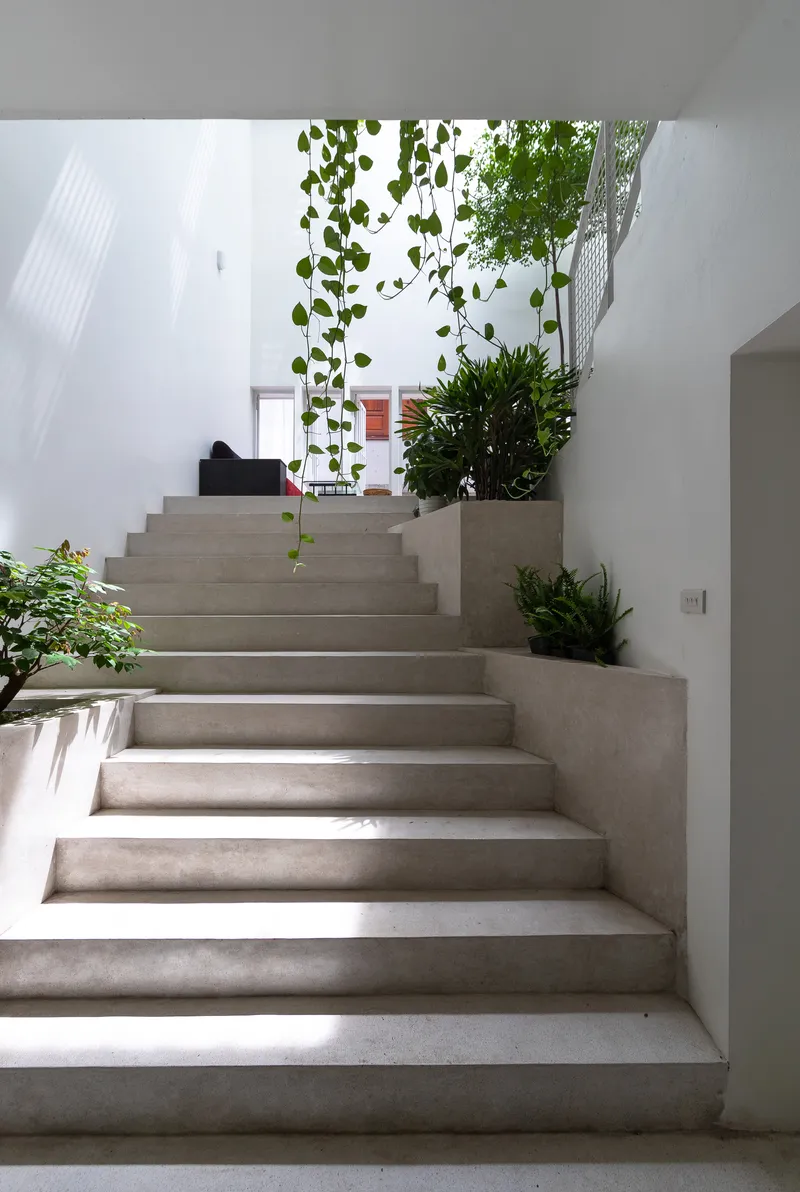
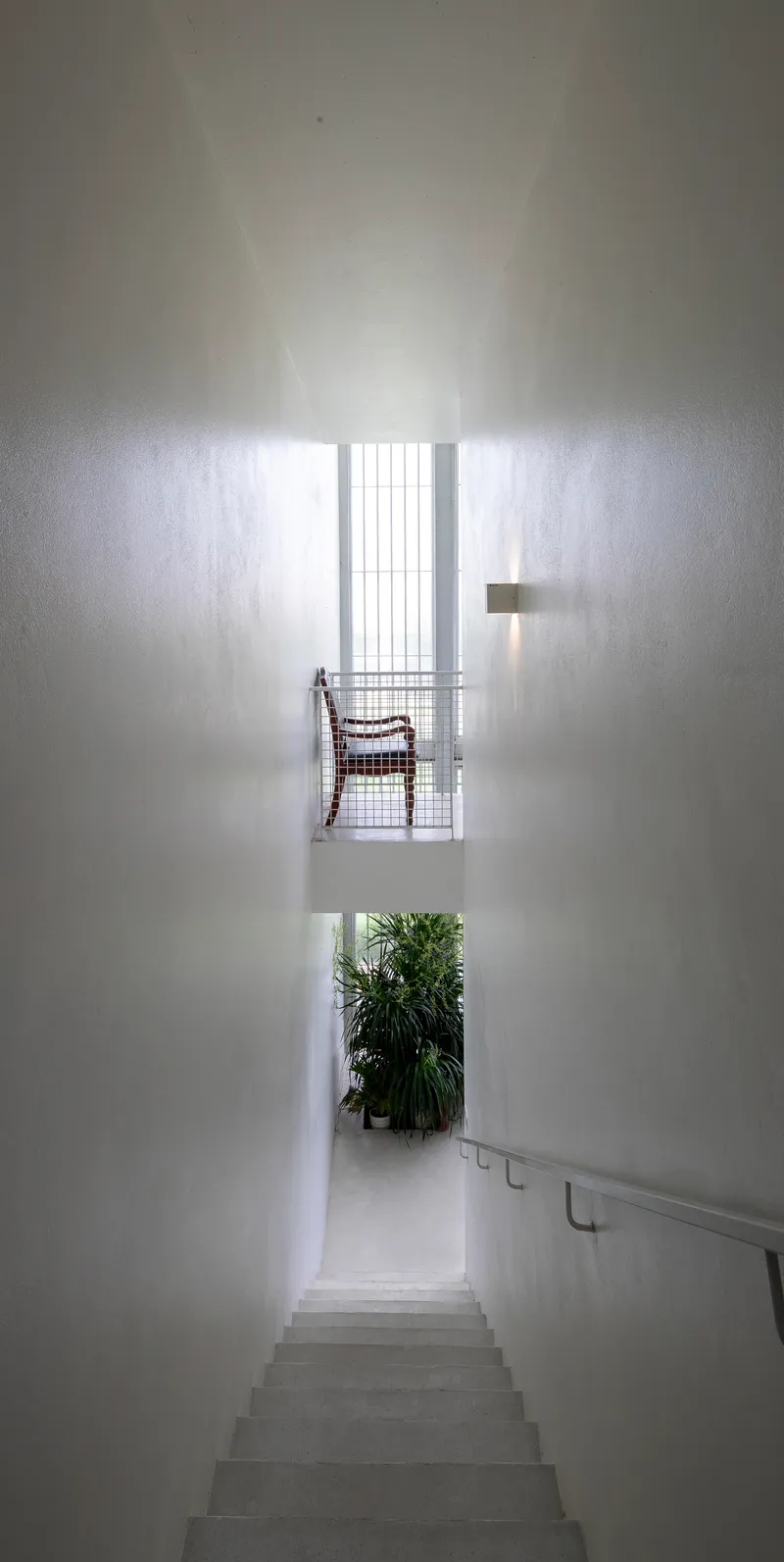
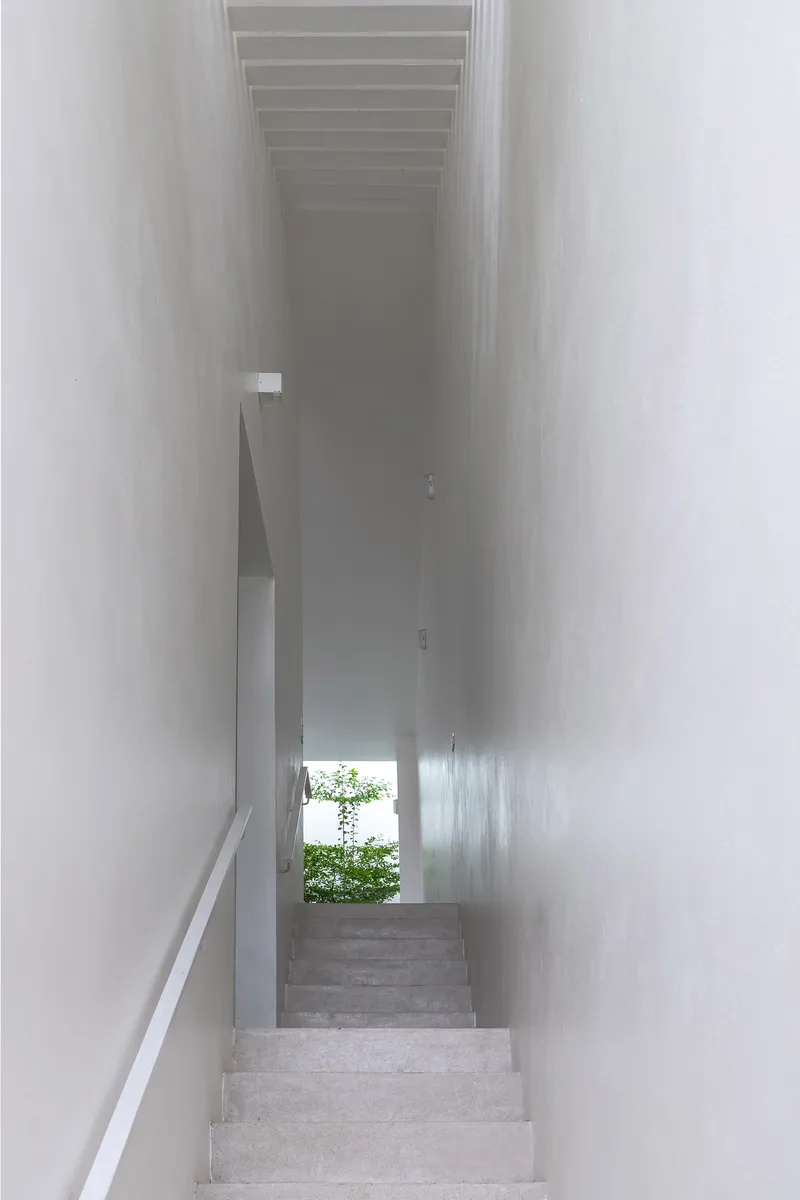
In a typical tube house, the staircase is an afterthought crammed into one corner. Here it becomes the social spine of the building. Concrete stairs wind past planted landings, wire mesh balustrades, and hanging vines, creating moments of pause and encounter on every half-level. A chair positioned on an upper landing, visible through the stairwell, suggests that these thresholds are inhabited, not merely traversed.
The decision to make the stairs generous, well-lit, and green turns the most utilitarian element of the house into its most communal one. Family members moving between floors are not hidden in a closed shaft. They are visible, audible, and connected to one another through open sightlines. For a house that set out to facilitate interaction between its occupants, this is the single most effective design decision.
Private Rooms Behind the Glow
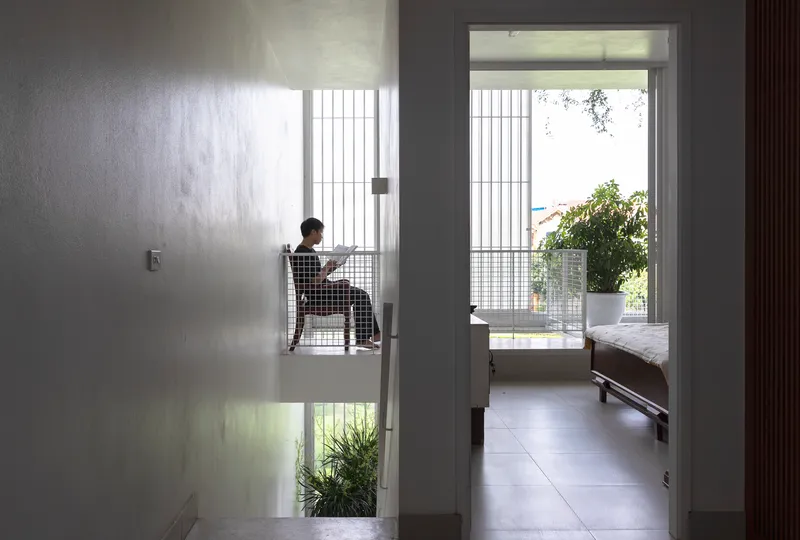
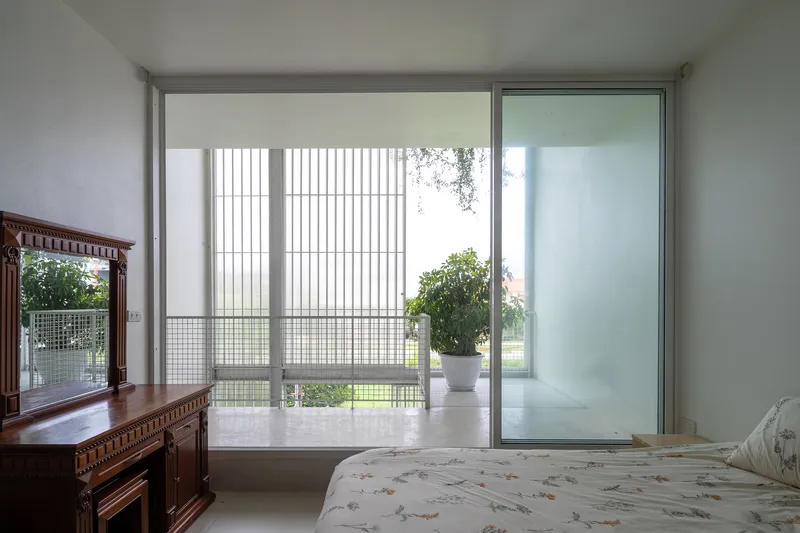
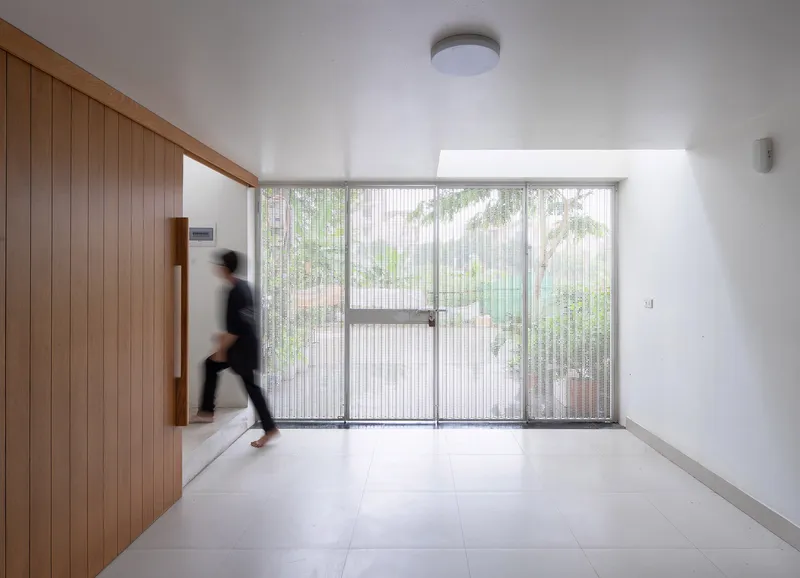
Behind the translucent facade and communal voids, the bedrooms maintain a quieter register. Sliding glass doors open onto screened balconies where greenery softens the view. A translucent partition in one room allows borrowed light to pass through without compromising privacy. The foyer, with its vertical timber wall and fluted glass entrance doors, establishes a threshold between the public street and the house's interior world.
The material palette in these private zones shifts from exposed steel and polycarbonate to warmer tones of timber and plaster. It is a deliberate transition: the public, performative face of the house gives way to intimate spaces that prioritize rest. The balance works because neither register overwhelms the other. You are always aware that you are inside the same building.
The Tower at Dusk
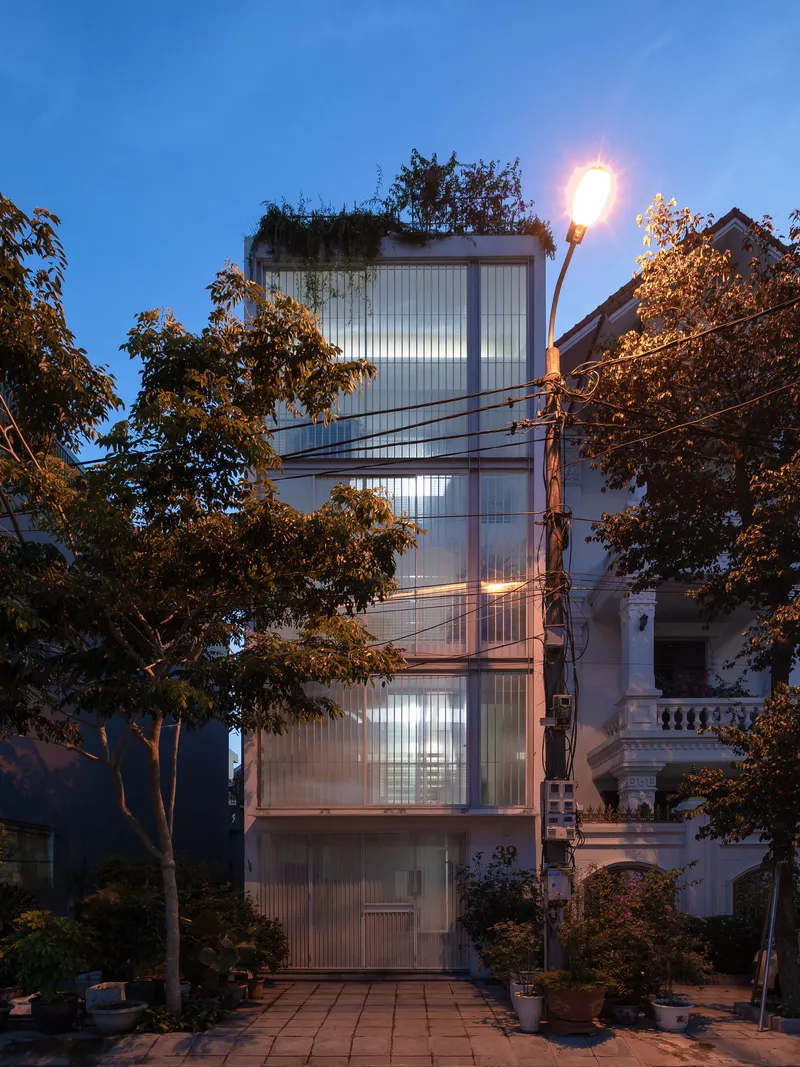
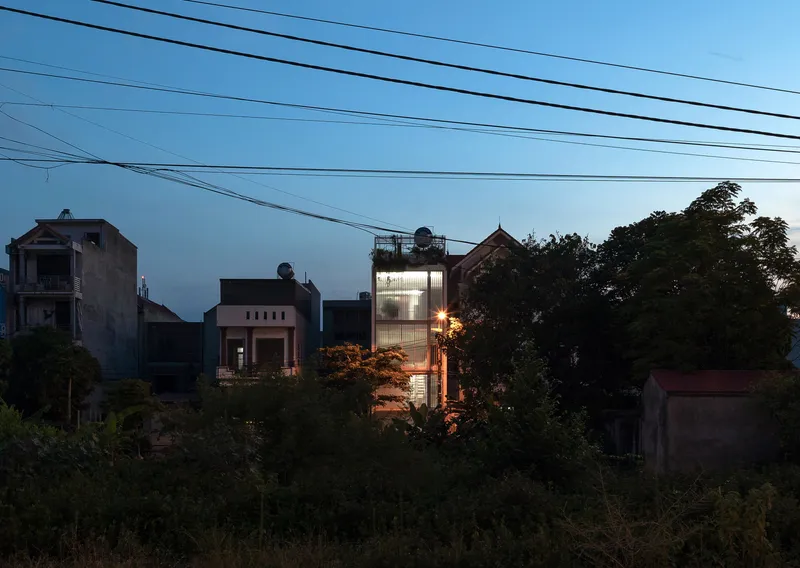

Seen from a distance at twilight, HH House reveals its full urban impact. The illuminated polycarbonate tower rises above neighboring rooftops and dense vegetation, marking the house's presence without shouting. Overhead cables and the silhouettes of surrounding trees frame it as part of the city's texture rather than an object dropped into it. A single figure on a balcony reinforces the scale: this is a home for people, not a monument.
The nighttime image is the one that stays with you. It captures everything the project is trying to do: transform a constrained urban lot into a vertical landscape of light, air, and greenery that is unmistakably alive. The glow is not theatrical. It is simply the byproduct of a family going about their evening with the lights on, visible through a skin designed to let that life show through.
Plans and Drawings
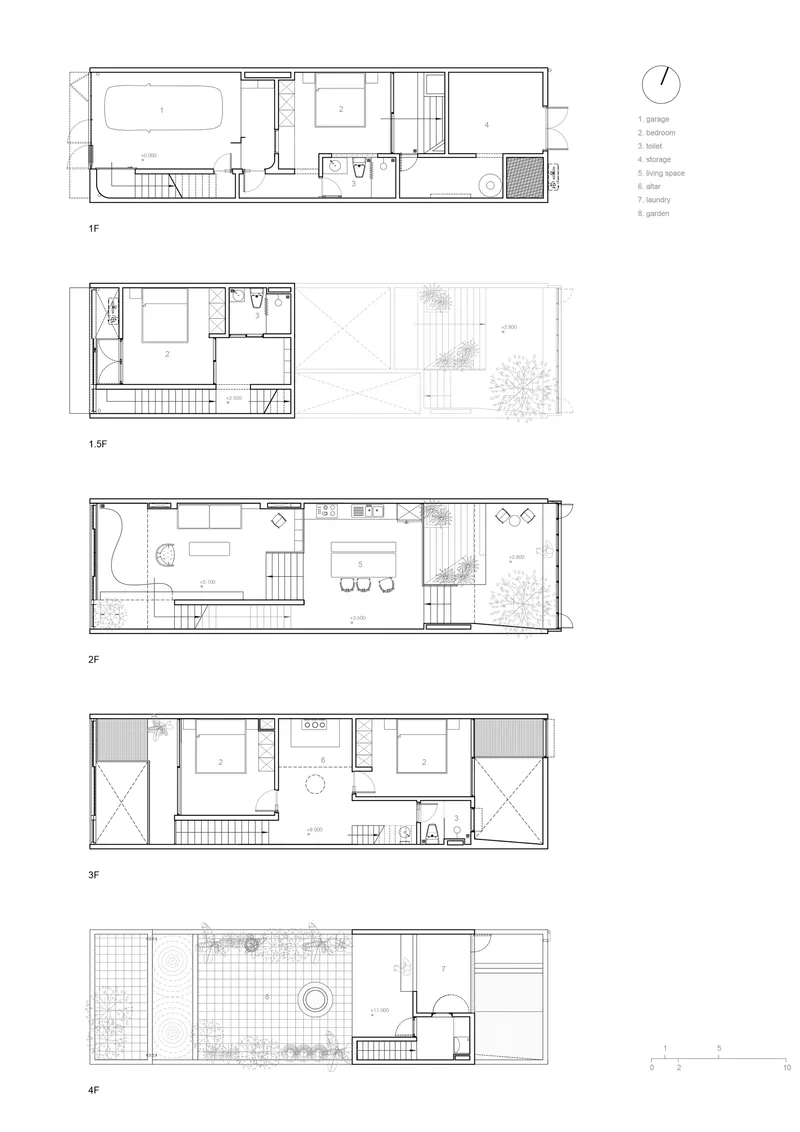
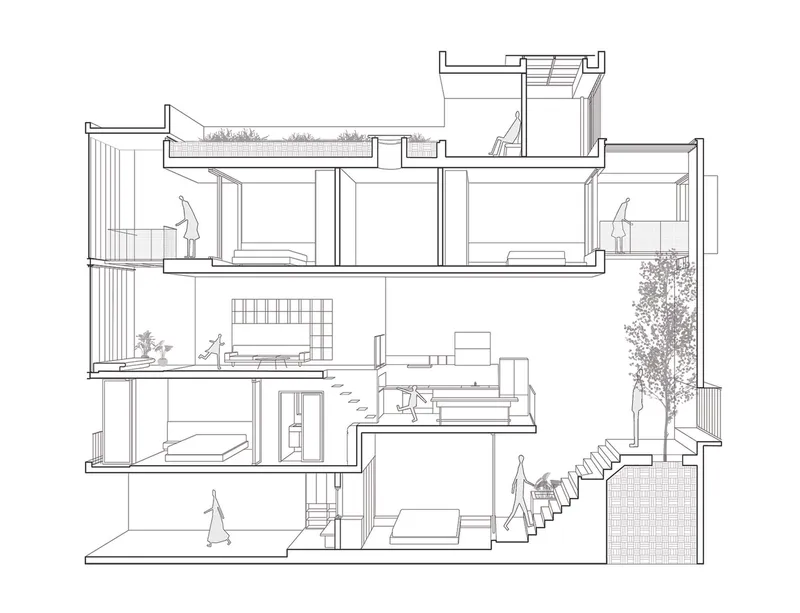
The floor plans confirm what the photographs suggest: five stacked levels organized around central voids and planted terraces that step back as the building rises. Living and dining spaces occupy the lower floors, bedrooms are pushed to the middle levels, and a rooftop terrace crowns the top. The section drawing is especially revealing. Split-level volumes stagger across the width of the narrow plot, creating vertical relationships that a conventional stacking of floors would never permit. Human figures in the drawing reinforce the sense that every space was dimensioned around occupation, not abstraction.
Why This Project Matters
Tube houses are not going away. Vietnam's cities will continue to densify on narrow lots, and the pressure to stack rooms vertically inside party walls will only intensify. What HH House demonstrates is that the typology does not have to produce dark, disconnected interiors. By cutting voids, planting trees through slabs, and wrapping the facade in a breathable screen, Flat6 architects and aestudiooo have created a prototype for livable density that is specific to its climate and culture.
The project also makes a quiet argument for low-tech environmental strategy. No elaborate mechanical systems are on display. The cooling comes from stack ventilation, shading, and thermal mass. The light comes from carefully sized openings and translucent materials. The greenery is not cosmetic; it participates in the building's performance. In a moment when sustainable design is often equated with expensive technology, HH House reminds us that geometry, orientation, and material intelligence can do most of the work.
HH House by Flat6 architects and aestudiooo. Located in Vietnam. 280 m². Completed in 2020. Photography by Trieu Chien.
About the Studio
Share Your Own Work on uni.xyz
If projects like this are the kind of work you want to make, uni.xyz is a place to publish your own, find collaborators, and enter design competitions.


Popular Articles
Popular articles from the community


Singing Woman: An Opera House That Performs Before the Curtain Rises
Ovidiu Cristian Pavel's conceptual opera house translates Estonia's choral identity into a sculpted waterfront landmark facing the Baltic Sea.

The Amber Palace Opera: A Geological Fiction Surfaces on Tallinn's Baltic Waterfront
Pierre Brillard reimagines a Baltic legend as a public landscape, opera house, and waterfront promenade rooted in Tallinn's coastal identity.
Manzana Morphosis: Stretching Barcelona's Grid into a Living Landscape for 2050
A radical reworking of the Eixample manzana turns density into a tool for generous public space, vertical ecology, and environmental performance.

Aquadapt: An Underwater Habitat That Rewrites Its Rooms by the Hour
Curved modules ring the seabed while one shell shifts from breakfast room to cinema, farm and football pitch as residents' needs change.

Similar Reads
You might also enjoy these articles

LAVA Architecten Gives Vocational Education a Sawtooth-Roofed Face on a Mechelen School Campus
In Mechelen, Belgium, a 2,053 m² STEM school on a 6×6 m grid turns workshops and classrooms into rooms that can be rearranged as teaching changes.

KEMA Studio Turns a Derelict Marvila Attic into a 60 m² Lighthouse Apartment Above Lisbon
In Lisbon's Marvila district, a rebuilt roof, four skylights and two plywood volumes turn an unlivable attic into a bright home facing the Tagus.

Pixel Gardens: One Repeated Module Stacked Into a Terraced Social Housing Tower for Famagusta
Salem Bader's shortlisted housing tower builds a vertical neighbourhood from one repeated module, offsetting units to carve terraces, light and air.

Bao Huynh Watercolor Atelier: A Serene Art Retreat in Hội An
Bao Huynh Watercolor Atelier in Hội An blends multifunctional art spaces, sustainable design, local materials, and family-friendly living in a serene environment.

Explore House Competitions
Discover active competitions in this discipline

Challenge to design mud housing for contemporary communities

Challenge to reimagine the Iron Throne

Photograph architecture without architects

Illustrate the lost glory of Angkor Wat - Render Challenge
Comments (0)
Please login or sign up to add comments
No comments yet. Be the first to comment!