

Tropical Boat House: A Kindergarten Where Monsoon Wind Shapes Every Room
In Sanya, China, Li minority boat house vernacular meets computational simulation to create a school that breathes with its climate.


What if a school building could teach children about ecology before a single lesson begins? In Sanya, on China's tropical southern coast, monsoon humidity and relentless solar gain make mechanical cooling the default response. The Tropical Boat House refuses that default. It takes the vernacular intelligence of the Li minority's traditional boat houses, elevated bamboo structures with breathable envelopes and deep roof overhangs, and recasts those principles as a contemporary kindergarten where every spatial decision serves both environmental comfort and childhood development.
Designed by Xiaowen Xu, Zhenyu Yang, and Zhang Zhongsheng, the project was a shortlisted entry in Form Follows Climate 2020 on uni.xyz. The team used Grasshopper for solar calculations and Phoenics for computational fluid dynamics, validating every design move through environmental simulation. The result is a kindergarten that operates as much as an ecosystem as it does a school: raised floors circulate air beneath occupied rooms, a 45-degree rotated massing strategy reduces direct solar exposure on the upper level, and shaded alleys between building volumes function as natural ventilation tunnels.
Dining Tables Under Bamboo Trusses
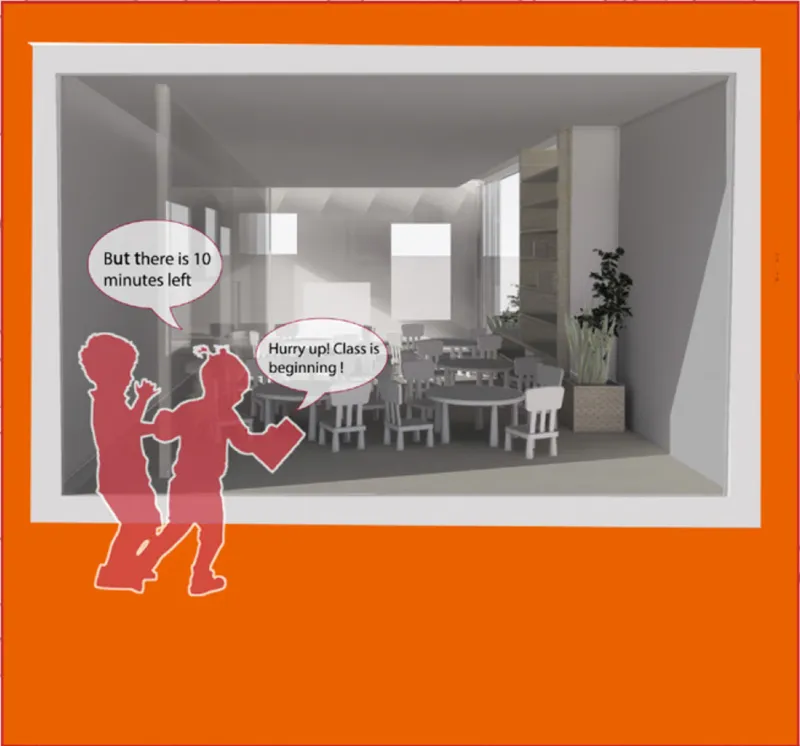
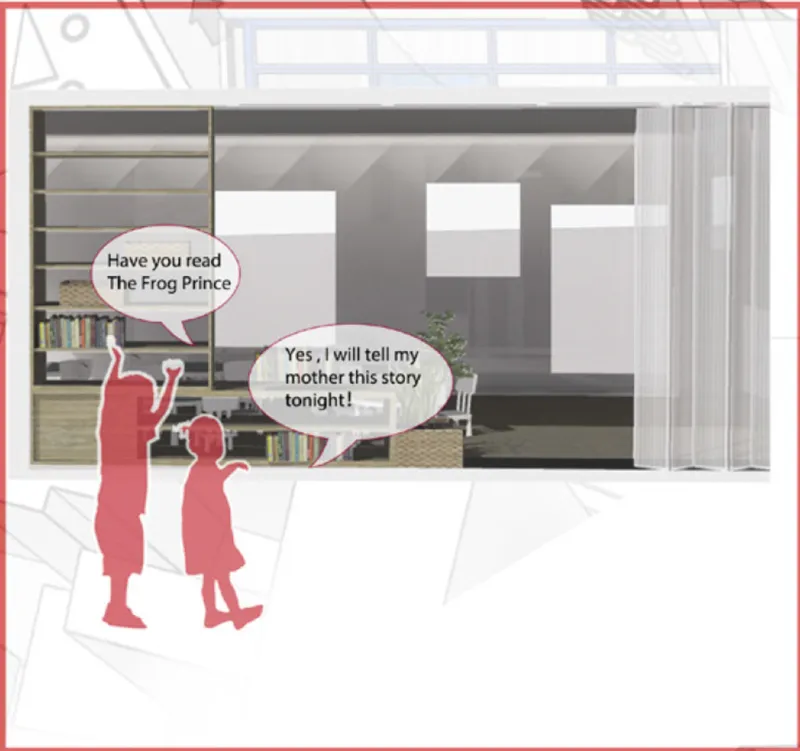
The sectional views make the building's interior logic immediately legible. Classrooms are not sealed boxes but layered environments where child-scaled dining tables, low bookshelves, and potted plants coexist under overhead bamboo truss structures drawn directly from the Li boat house lineage. Gray geometric wall panels modulate the library wall, creating visual rhythm while preserving the narrow room proportions that accelerate cross ventilation. The material palette, timber, bamboo, and muted tones, is deliberately restrained, keeping attention on spatial porosity rather than decoration.
What makes these sections compelling is their honesty about double duty. Raised flooring systems allow air to circulate beneath occupied spaces, while overhead timber frames provide structural resilience during monsoon seasons. Bookshelves define activity zones. Plants regulate humidity. The structural frame itself becomes the shading device. There is no ornamental layer to peel back; the climate strategy is the architecture.
Windows Calibrated as Environmental Thresholds
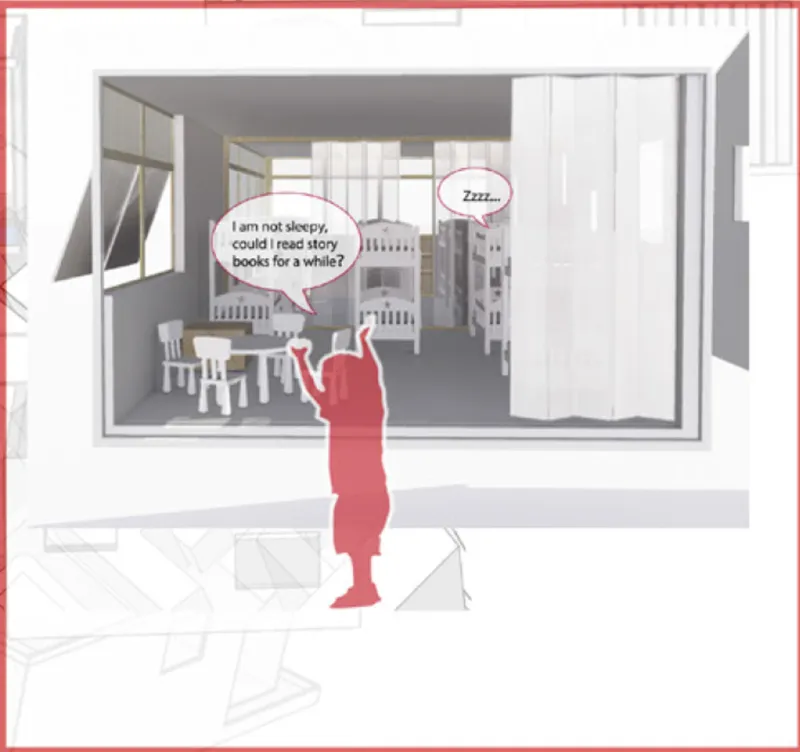
From the exterior, classrooms reveal themselves through large glazed openings that dissolve the boundary between indoor learning and outdoor landscape. Cribs, small tables, and folding screens populate the interior, all scaled for early childhood use, while the generous window proportions push natural light deep into the plan. The folding screens deserve particular attention: flexible wall panels that enable a nap room to become a play area or group workspace without permanent partitions. Spatial adaptability is built into the furniture strategy, not retrofitted.
The relationship between inside and outside is not merely visual. These openings are calibrated to work with the building's 45-degree rotated massing, which reduces direct solar exposure on the second level. Narrow rooms channel air from the shaded alleys between building volumes through the interior and out the breezeway. The window wall becomes the precise point where the building's airflow strategy is most perceptible to its smallest occupants: a threshold where climate, light, and pedagogy converge.
Striped Shadows and the Outdoor Classroom
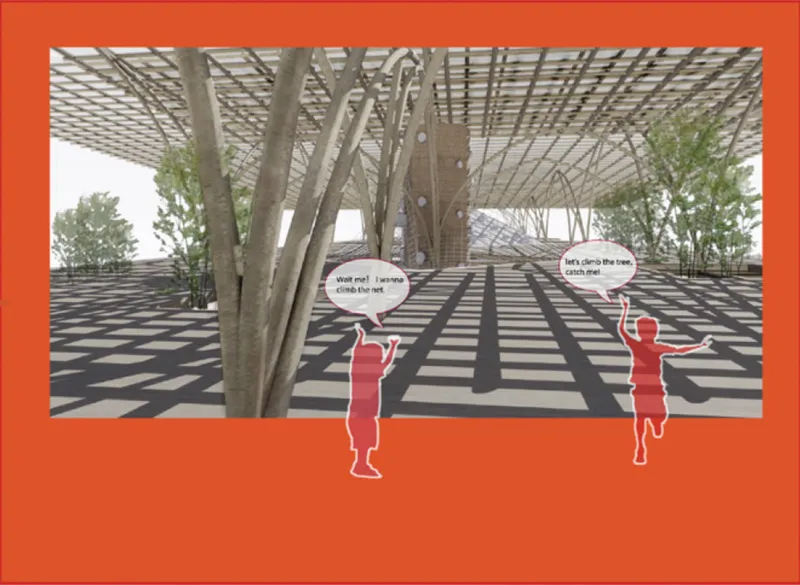
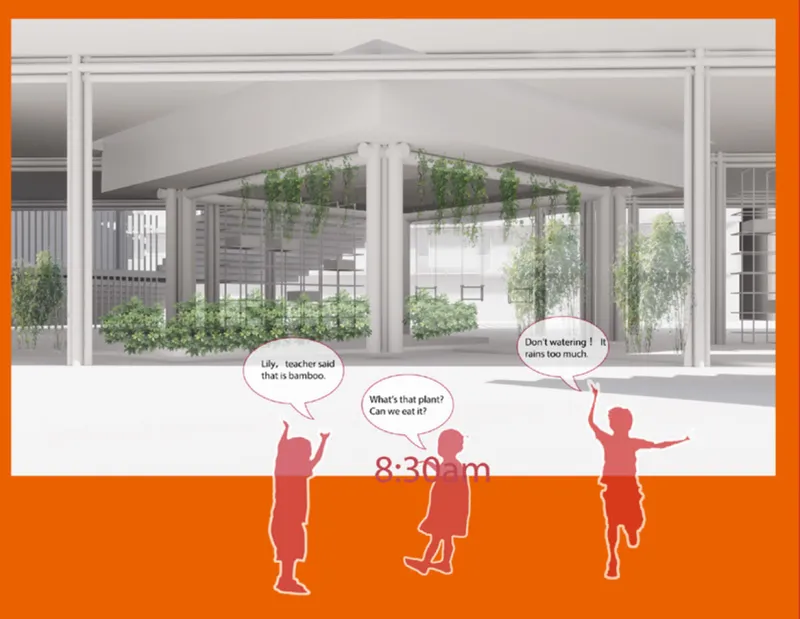
Two of the project's most evocative images capture the covered outdoor spaces where climate strategy becomes a sensory experience. A timber pergola casts rhythmic striped shadows across the deck, turning solar protection into spatial pattern. Children moving through this space do not encounter shade as a static condition; they encounter it as texture, changing with the sun's angle throughout the day. Nearby, a covered walkway defined by white columns and a shallow pitched roof supports hanging planters that contribute to a plant-based microclimate moderation system.
These are not leftover circulation zones. They are outdoor classrooms in the fullest sense, spaces where children can gather, play, and observe the behavior of light, wind, and water firsthand. The pergola and the corridor treat environmental performance as something visible and tactile, reinforcing the project's core thesis: that a building shaped by climate can communicate ecological awareness without relying on a textbook.
A Courtyard That Organizes Everything
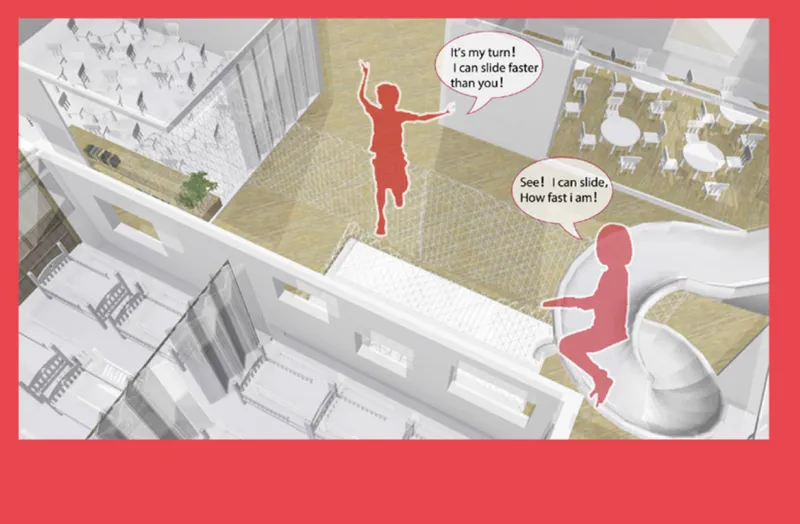
The aerial axonometric view pulls the entire scheme into focus. Building volumes frame a central courtyard punctuated by play structures and bright yellow ground surfaces that signal zones of activity. The 45-degree rotation of the massing, visible here in plan, is not a formal gesture; it is the mechanism that generates the shaded alleys and ventilation corridors running between volumes. From above, the logic of the scheme reads as a series of interlocking climate strategies: roof overhangs, breezeway gaps, planted surfaces, and raised decks, all organized around an open-air center that gives children direct contact with sky, wind, and rain.
The yellow ground surfaces mark play zones with material clarity, but they also reflect light upward into the shaded underbellies of the elevated classrooms. Every element operates on at least two registers: spatial organization and environmental performance. It is a compact demonstration of what happens when computational simulation and vernacular intuition work in tandem.
Why This Project Matters
The Tropical Boat House matters because it refuses to treat climate-responsive design as a technical overlay. Too many competition entries acknowledge climate in their diagrams and then design sealed envelopes anyway. Xu, Yang, and Zhang do the opposite: they let monsoon wind, solar geometry, and the material traditions of the Li minority generate the architecture from the inside out. The result is a kindergarten where raised floors, bamboo trusses, rotated massing, and planted walkways are not features to be listed in a sustainability checklist but the fundamental moves that define every room and corridor.
For a kindergarten, this approach carries an additional layer of significance. Children in this building would learn about ecology not through posters on the wall but through the striped shadows on the deck, the breeze moving through narrow classrooms, the plants hanging from the walkway overhead. The building becomes the curriculum. That pedagogical ambition, grounded in validated simulation data and vernacular precedent, is what elevates the project beyond a clever climate diagram into a convincing argument for how schools in tropical climates should be conceived.
About the Designers
Designers: Xiaowen Xu, Zhenyu Yang, Zhang Zhongsheng
Enter a Design Competition on uni.xyz
uni.xyz runs architecture and design competitions year-round that reward proposals with spatial conviction and real site intelligence.
Project credits: Tropical Boat House: A Kindergarten Where Monsoon Wind Shapes Every Room by Xiaowen Xu, Zhenyu Yang, Zhang Zhongsheng Form Follows Climate 2020 (uni.xyz).


Popular Articles
Popular articles from the community


Opera on the Sea: Driftwood Logic Shapes a Timber Opera House on Estonia's Coast
Trevor Orgill's opera house translates the entangled drift of floating timber into a civic building where wood, water, and music converge.

Faces of the Soviet Avant-Garde: Turning Moscow's Street Names into an Open-Air Museum
A network of sculptural installations across a Moscow residential district transforms forgotten architect names into spatial encounters with cultural memor

Cloaked Colonization: A Mobile Underwater Habitat That Moves Like a Fish
Micah Abaya's shortlisted EHC Pacific entry reimagines ocean settlement as a dispersed network of self-sustaining architectural organisms.

Opera by the Sea Estonia: Three Shells Dissolving Architecture into Tallinn's Coastline
A winning opera house proposal replaces monumental form with interconnected shells that blur the boundary between building, park and Baltic Sea.

Similar Reads
You might also enjoy these articles

Play: Fragments of Their World: Remembered Architecture Rebuilt as a Modular Playground for Refugee Camps
Tom Gardner abstracts domes, arches and towers from the homelands of displaced families into a kit of child-scaled play parts for camp settlements.
REBIRTH: A Circular Settlement Where Afghan Widows and Their Children Rebuild Life Together
A shortlisted Resile entry turns the circle into a protective ring of timber and brick, gathering homes, classrooms and gardens around a shared landscape.
The Main Dream: A Recycled Plastic Kit That Lets Refugee Children Build Their Own Playground
Thirty-centimetre interlocking cubes that connect on three axes turn play into construction, letting children author the spaces they occupy.

Lunar Spiral: A Fibonacci-Driven Moon Settlement Rising from Shackleton Crater
Golden-spiral geometry organises buried infrastructure and orbiting habitable spheres into a lunar base designed to grow as life on the Moon expands.

Explore Form Follows Climate Competitions
Discover active competitions in this discipline

Challenge to reimagine the Iron Throne

Photograph architecture without architects

Illustrate the lost glory of Angkor Wat - Render Challenge

Design challenge to reuse E-waste
Comments (0)
Please login or sign up to add comments
No comments yet. Be the first to comment!