
Future of Memory: A Circular Square Rebuilds Civic Life Around a War-Scarred Citadel
Bomb craters become sites of reflection as adaptive reuse architecture reinterprets lost bathhouses, mosques, and markets in post-conflict Aleppo.


What if the craters left by bombs were not erased but absorbed into the architecture of recovery? "Future of Memory" begins with that question and builds an entire urban strategy around it. Rather than reconstructing a war-scarred city block by block in faithful replica, the project proposes a generative perimeter: a new building line that traces a circular square around a historic Citadel, creating a connective landscape where fragments of the past and visions for the future coexist. Bomb craters become foundations. Lost typologies return as abstractions. The circle itself acts as both memorial and threshold.
Designed by Justyna Bartnikowska and Ewelina Wiciak, this shortlisted entry for the Memory competition on uni.xyz reimagines post-conflict urbanism through adaptive reuse architecture. The site is a Citadel laden with centuries of cultural significance, now fractured by destruction. Instead of proposing a blank-slate masterplan, Bartnikowska and Wiciak define curated urban quarters along the circular perimeter, each one programmed with a specific civic function lost during the war: bathhouses, markets, mosques, madrasas, and hotels. The result is a choreography of memory embedded in the city's physical fabric.
The Circular Square as Generative Framework
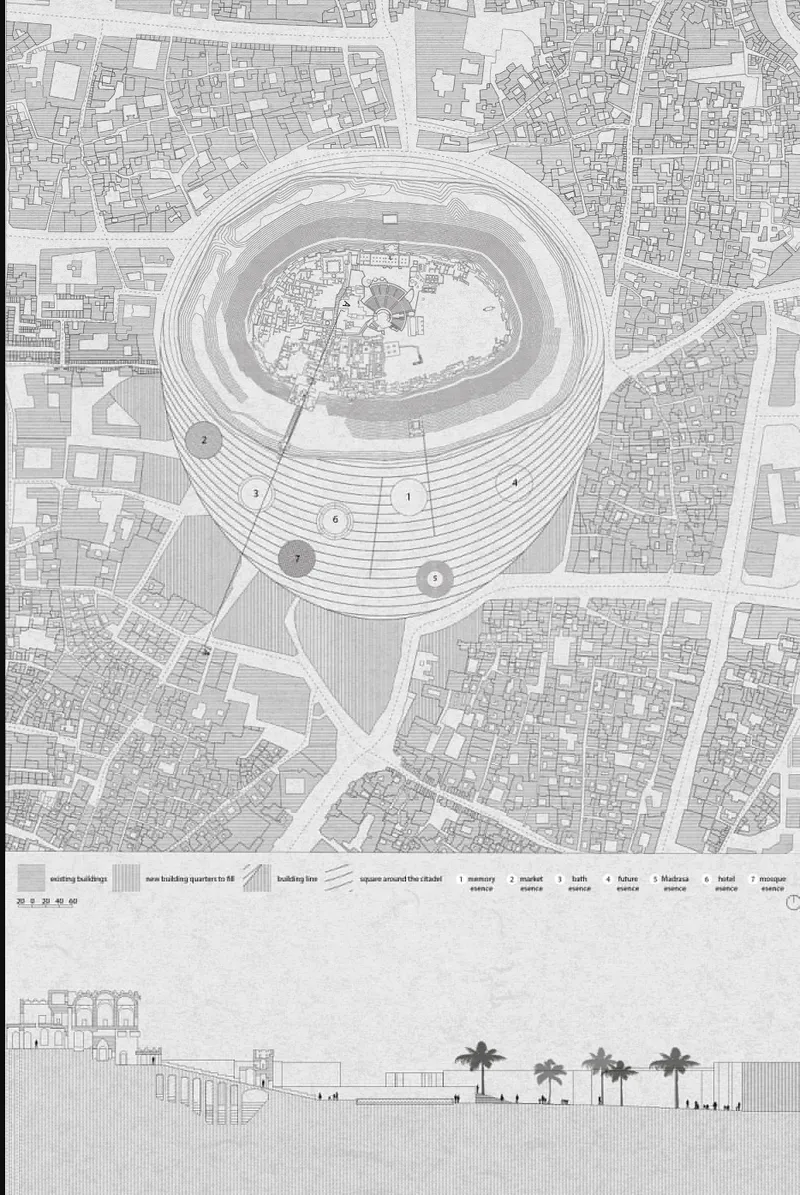
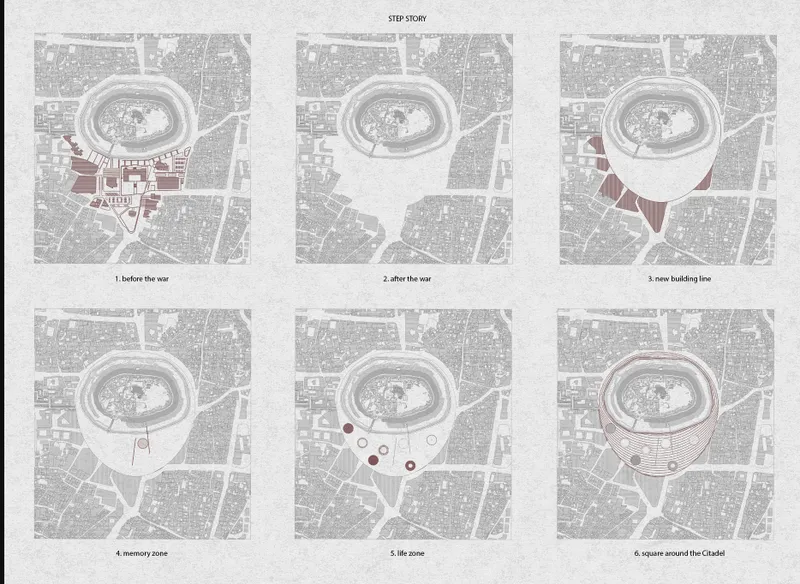
The site plan reveals the project's central organizing move: a terraced circular volume that encircles the Citadel, establishing a new building line from which the city's regeneration radiates outward. This is not a decorative gesture. The perimeter defines future urban quarters intended to be filled with reimagined structures, each zone integrating the spirit of the old city with the demands of contemporary life. The six-panel phasing diagram charts this transformation in sequence, from dense pre-war morphology through devastation to the careful emergence of spatial zones marked by memory and vitality. A central amphitheater anchors the sequence, while surrounding blocks develop incrementally, resisting the logic of wholesale replacement.
What distinguishes this masterplan from conventional post-conflict reconstruction is its refusal to treat the destroyed fabric as a problem to be solved. The outlined quarters are not blank parcels awaiting generic development. They are curated zones that anticipate a fusion of culture, economy, and social interaction. The circular geometry reclaims coherence in a chaotic urban context, directing the city's rebirth through design rather than erasure.
Reinterpreting Sacred and Communal Typologies
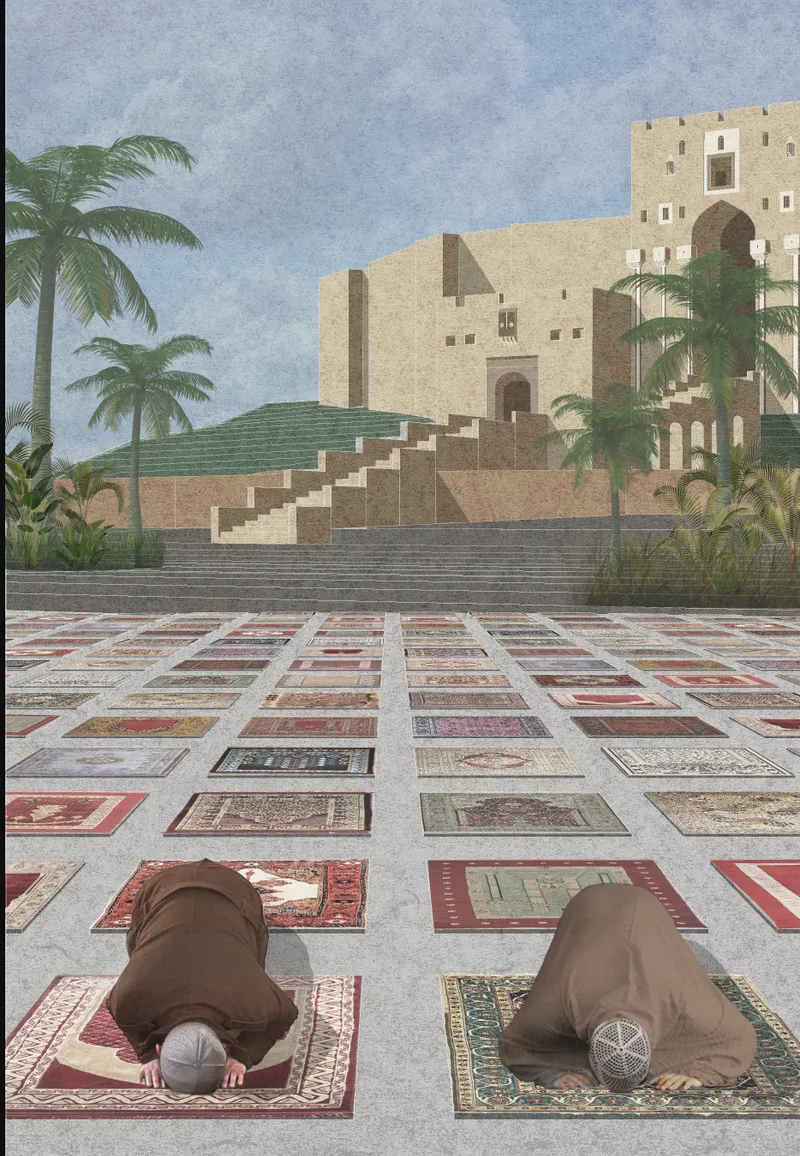
Two rendered views demonstrate how specific civic functions return to the site as abstracted yet recognizable forms. In one, two figures pray on patterned rugs before a fortified stone complex flanked by palm trees, a spatial reinterpretation of the prayer space of Djamia'al-Otrush. There is no attempt at exact historical reconstruction here. The architecture captures cultural atmosphere and embodies intangible heritage, allowing people to reconnect with what once stood without pretending that destruction never occurred.
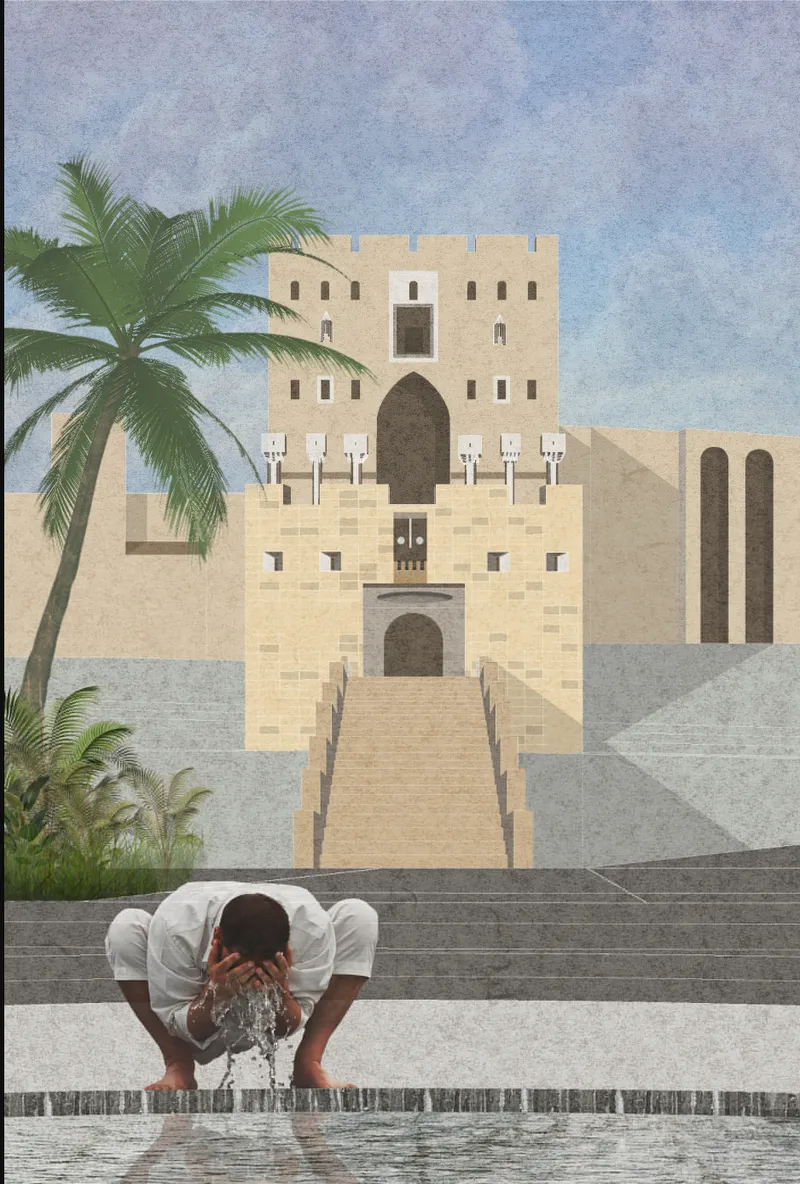
The second rendering shows a figure performing ablutions at a reflecting pool that faces a stepped sandstone facade. This is the reimagined Hammam Yalbougha al-Nasri, where water rituals and communal bathing traditions are honored through contemporary spatial interpretation. The palette of sandstone, water, and planted palms grounds these interventions in material continuity with the region's architectural traditions. These spaces are not simply placeholders for lost buildings. They are active participants in a renewed urban dialogue, encouraging interaction, belonging, and the coalescence of individual and collective memory.
The Sunken Courtyard as Civic Commons
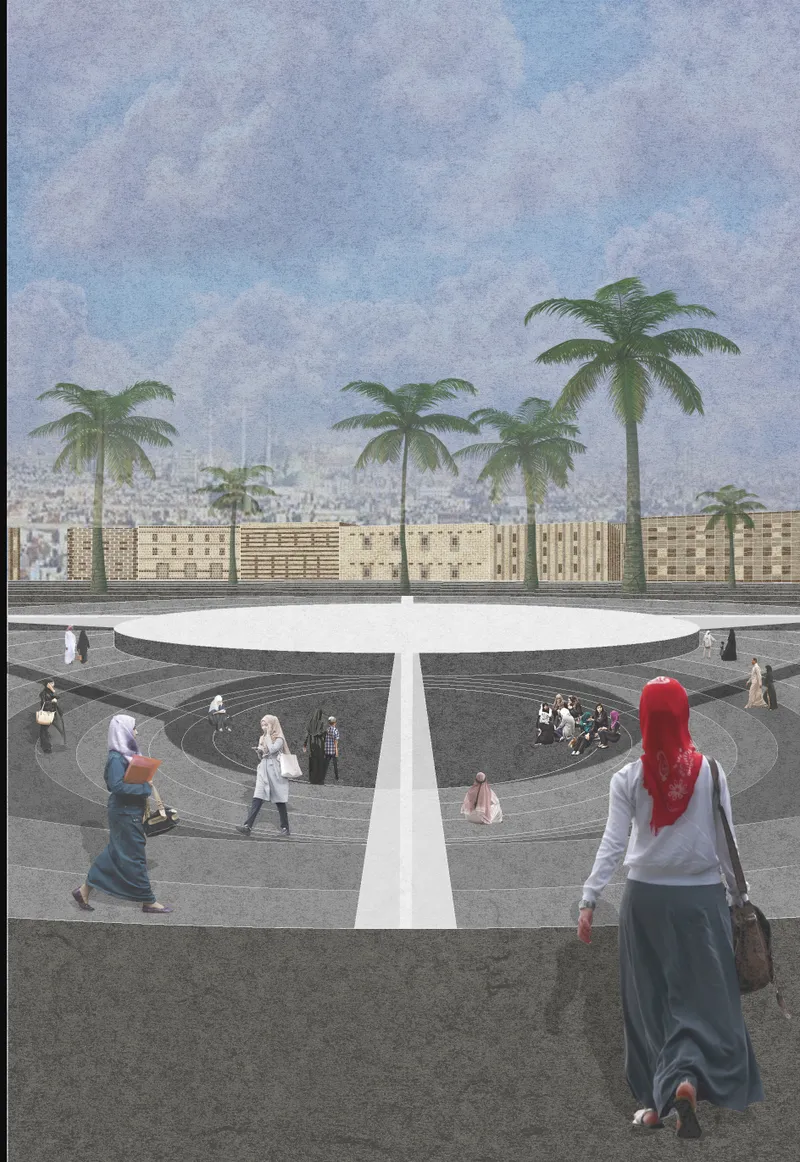
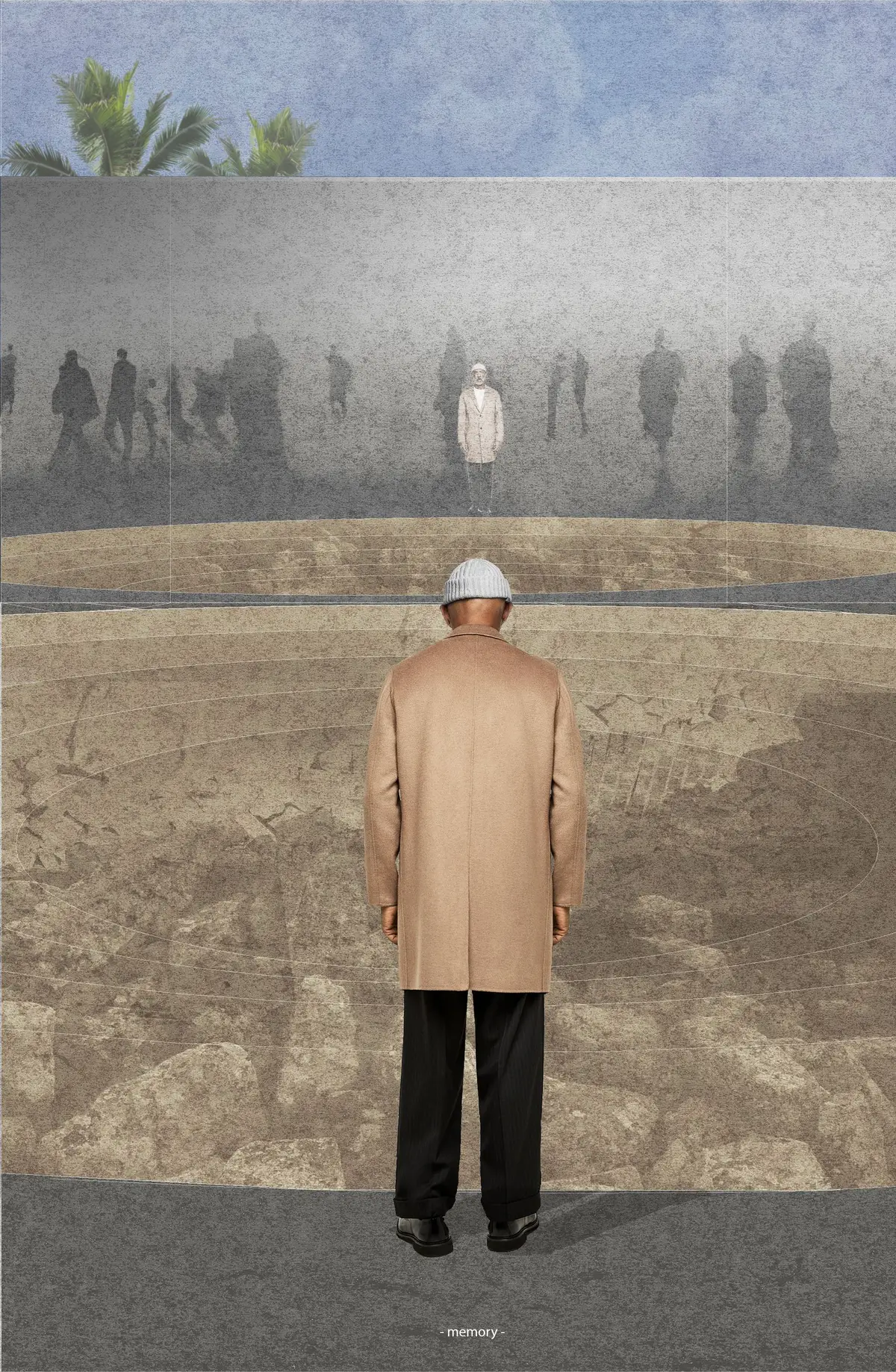
The final rendered view pulls back to reveal the circular sunken courtyard at street level, where pedestrians walk along a white pathway toward the depressed gathering space. Palm trees line the perimeter, and the scene reads as simultaneously a tribute and a threshold: a place for remembrance, daily rituals, and civic gatherings. The sunken form recalls the project's strategy of embracing voids rather than filling them, turning absence into a spatial condition that invites inhabitation.
This is where the project's layered strategy of meaning and spatial function becomes most legible. The open meeting grounds, referencing the New Serai, accommodate the public life that knits a fractured community back together. From market exchange to quiet contemplation, the circular square serves as connective tissue between architectural insertions, ensuring that no single programmatic element operates in isolation. The city rebuilds itself through relation, not repetition.
Why This Project Matters
Post-conflict reconstruction tends to oscillate between two poles: nostalgic replication of what was lost and tabula rasa modernization that ignores what came before. Bartnikowska and Wiciak chart a third path. By defining a circular perimeter as a generative framework and programming it with abstracted civic typologies, they demonstrate that adaptive reuse architecture can operate at the scale of an entire urban masterplan, not just individual buildings. The bomb crater is not a scar to be concealed but a datum from which new spatial meaning can emerge.
The strength of "Future of Memory" lies in its disciplined restraint. Every architectural insertion serves a specific civic function rooted in the site's pre-war life, yet none pretends to be a facsimile. The project trusts the inhabitants to navigate their way through trauma and transformation, providing spatial conditions for that navigation without scripting the outcome. In a landscape where memory is contested and the future is uncertain, that generosity of approach is itself a form of resilience.
View the Full Project
About the Designers
Designers: Justyna Bartnikowska, Ewelina Wiciak
Enter a Design Competition on uni.xyz
uni.xyz runs architecture and design competitions year-round that reward proposals with spatial conviction and real site intelligence.
Project credits: uni.xyz by Justyna Bartnikowska, Ewelina Wiciak Memory (uni.xyz).


Popular Articles
Popular articles from the community


Cube Design Draws an Ecological Corridor Between Two Shenzhen Hills with the Nankai Building
Beside Shenzhen's container docks, the Nankai Building pairs stacked balconies with a climbing green screen to connect two hillsides across its height.

graciastudio Turns a Viewless Tijuana Lot Inward Around a Courtyard of Concrete, Timber and Trees
In Tijuana, Jorge Gracia's GA2 House stacks a timber-clad private floor over exposed concrete and replaces a missing view with a planted interior patio.


Manzana Morphosis: Stretching Barcelona's Grid into a Living Landscape for 2050
A radical reworking of the Eixample manzana turns density into a tool for generous public space, vertical ecology, and environmental performance.

FCC Arquitectura Expands a Portuguese Granite House with a Board-Marked Concrete Wing
In Portugal, JV House pairs a cleaned-up whitewashed and granite dwelling with a timber-shuttered concrete extension, courtyards and a garden pool.

Similar Reads
You might also enjoy these articles

Vereda Arquitetos Renovates a 40-Square-Meter Apartment Inside Niemeyer's Copan Building
A compact unit in São Paulo's most iconic residential tower gets a material overhaul that pairs exposed concrete with bold blue Formica.

Shakur's House: Exposed Brick as an Interior Organiser in a 168 m² Mashhad Residence
Brick moves indoors in this Mashhad residence, where masonry walls, glass partitions and teal planes sequence a compact home without closing it off.

Day and Night Park: A Time-Based Urban Newsstand in Beijing
A temporary urban newsstand in Beijing blending travel, light, and reading through poetic colors, compact form, and community-focused design.

Modernist Patio Renovation in El Masnou, Barcelona by Oliver Segura Arquitectura + Cebrià Arquitectura
Modernist patio renovation blending tradition and innovation with a movable pool, leveled floors, and Catalan materials in El Masnou.


Comments (0)
Please login or sign up to add comments
No comments yet. Be the first to comment!