

Mixed-Use Skyscraper: A Cactus-Inspired Tower That Stacks a Neighborhood Vertically
A 29-story hybrid tower uses a biomorphic structural skin and layered programming to reimagine vertical urban life in a single form.


What if a skyscraper could work like a cactus: storing resources, minimizing waste, and thriving in harsh conditions? That question drives this 29-story mixed-use tower, which derives its structural logic from one of nature's most resilient organisms. A tensioned exoskeleton pulls the façade toward the core, reducing material use while creating deep, thermally regulated elevations. The entire massing grows from a 30-60 degree grid aligned to the site's boundaries, producing a form that reads as both organic and precise.
Shortlisted in the Hybrid Futures competition, the project was designed by Rabah Saoud, Bayan Abduljalil Isa Hasan Ali, Shahed Khaled Al Marouf, and Dana Ahmed Sabri Ahmed Shoman. The team's ambition is explicit: build a vertical neighborhood where commerce, work, residence, and communal life don't just coexist but actively reinforce one another.
From Cactus to Core: A Massing Strategy Rooted in Biology
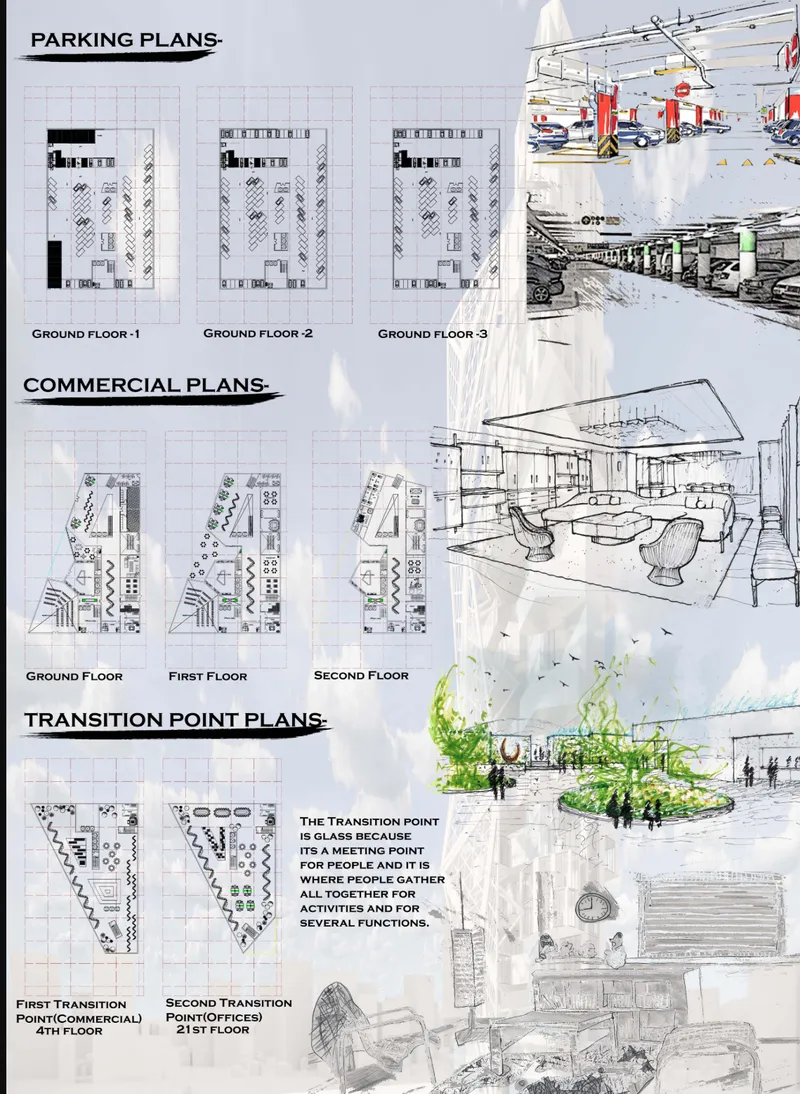

The massing evolution diagram makes the design's genesis legible. Starting from a rectangular volume, the tower undergoes a series of subtractive and rotational operations guided by the 30-60 degree site grid. Cactus illustrations sit alongside the transformation sequence, clarifying the biological parallel: just as a cactus concentrates its mass to conserve water and resist sun exposure, this tower pulls its skin inward around a compact core to optimize structural performance and thermal behavior. The presentation boards below detail the parking, commercial, and transition floor plans, revealing how the biomorphic envelope translates into functional, efficiently organized floor plates at every level.
Four Zones, One Vertical Community
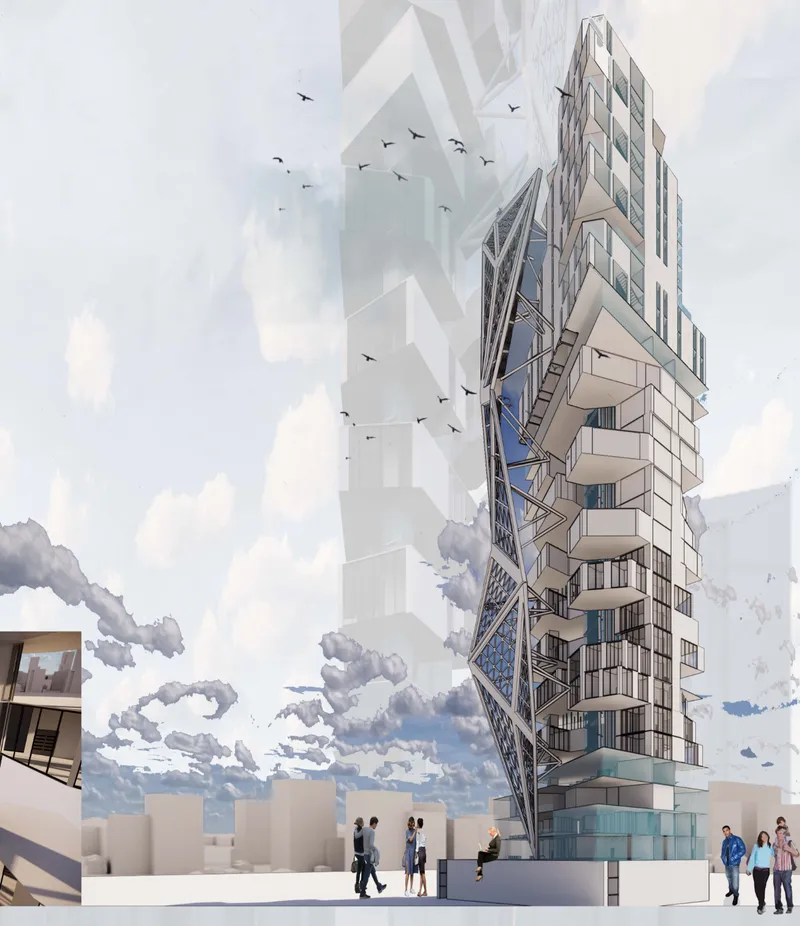
The tower's program is stacked with deliberate logic. Commercial floors occupy the ground through second levels, housing retail, cafes, collaborative spaces, and business lounges that pull pedestrians into the building's base. Office floors span the 5th to 19th stories, progressing from open coworking layouts at lower levels to compact, private workspaces higher up. Residential floors from the 21st to the 29th include one- and two-bedroom apartments alongside duplexes, with layouts that separate living and service zones for both individuals and families.
Two transition floors, at levels 4 and 21, act as community condensers. Wrapped in glass and greenery, these intermediate levels break the vertical stack with multipurpose hubs for recreation, events, and collective workspaces. They function as green rooftops embedded within the building, contributing to passive cooling and improved air quality while providing psychological relief from the density above and below.
The Skeletal Skin: Structure as Environmental Strategy

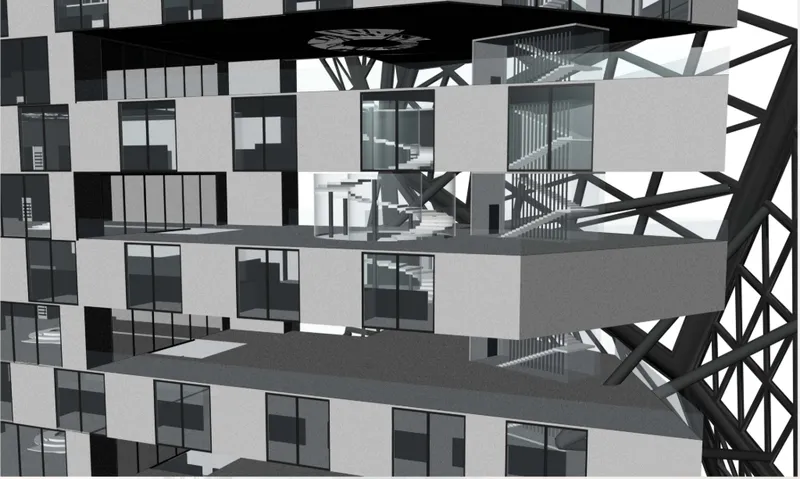
The digital model reveals the diagonal structural exoskeleton wrapping the upper residential floors, a system of tensioned columns that gives the tower its distinctive triangulated depth. This skeletal framework is not decorative. It reduces heat gain through self-shading, supports vertical green walls, and channels wind through optimized voids. Photovoltaic panels embedded in the structural skin and water harvesting systems further push the tower's sustainability credentials beyond gesture into measurable performance. The interior perspective sketch, showing a curved spiral staircase surrounded by planted areas, illustrates how the green agenda penetrates the building's interior as well, with vertical gardens and planted zones integrated into circulation spaces.
Orientation-based glazing and shaded balconies complete the passive design strategy. Each façade responds differently to solar exposure, with deeper overhangs and denser exoskeleton members on sun-facing elevations. The result is a tower that regulates its own microclimate, reducing dependence on mechanical systems while creating genuinely habitable outdoor spaces at height.
Adaptive Interiors for Post-Pandemic Living and Working
The office floors change typology as they ascend, a subtle but important decision. Lower office levels prioritize open-plan collaborative layouts with meeting rooms and tech integration zones. Higher floors shift toward private pods and compact workspaces, accommodating diverse corporate cultures within a single tower. The residential levels respond directly to post-pandemic demands: flexible layouts support work-from-home configurations, wellness routines, and even urban gardening. The principle of "more planning for less" runs through every floor plate, squeezing maximum programmatic variety from a compact footprint.
Why This Project Matters
Many competition entries invoke biomimicry as a styling exercise. What sets this tower apart is the consistency with which the cactus analogy operates across scales. It informs the massing, generates the structural skin, drives the environmental strategy, and even shapes the interior landscape. The 30-60 degree grid anchors these moves to a specific site condition rather than letting the biomorphic ambition float free of context.
The layered program, with its transition floors acting as social and environmental mediators between zones, demonstrates a mature understanding of what mixed-use means beyond simply stacking different functions. Saoud, Hasan Ali, Al Marouf, and Shoman have produced a tower that argues for vertical density not as a compromise but as an opportunity to build richer, more interconnected communities within a single structural frame.
View the Full Project
About the Designers
Designers: Rabah Saoud, Bayan Abduljalil Isa Hasan Ali, Shahed Khaled Al Marouf, Dana Ahmed Sabri Ahmed Shoman
Enter a Design Competition on uni.xyz
uni.xyz runs architecture and design competitions year-round that reward proposals with spatial conviction and real site intelligence.
Project credits: mixed-use Building by Rabah Saoud, Bayan Abduljalil Isa Hasan Ali, Shahed Khaled Al Marouf, Dana Ahmed Sabri Ahmed Shoman.


Popular Articles
Popular articles from the community


Tsunami Convergenics: Turning Catastrophic Ocean Forces into Underwater Housing Infrastructure
A speculative underwater settlement off the coast of Onagawa, Japan, treats tsunamis and typhoons as energy sources rather than threats.

Faces of the Soviet Avant-Garde: Turning Moscow's Street Names into an Open-Air Museum
A network of sculptural installations across a Moscow residential district transforms forgotten architect names into spatial encounters with cultural memor

The Amber Palace Opera: A Geological Fiction Surfaces on Tallinn's Baltic Waterfront
Pierre Brillard reimagines a Baltic legend as a public landscape, opera house, and waterfront promenade rooted in Tallinn's coastal identity.
Cloaked Colonization: A Mobile Underwater Habitat That Moves Like a Fish
Micah Abaya's shortlisted EHC Pacific entry reimagines ocean settlement as a dispersed network of self-sustaining architectural organisms.

Similar Reads
You might also enjoy these articles

Day and Night Park: A Time-Based Urban Newsstand in Beijing
A temporary urban newsstand in Beijing blending travel, light, and reading through poetic colors, compact form, and community-focused design.

Modernist Patio Renovation in El Masnou, Barcelona by Oliver Segura Arquitectura + Cebrià Arquitectura
Modernist patio renovation blending tradition and innovation with a movable pool, leveled floors, and Catalan materials in El Masnou.
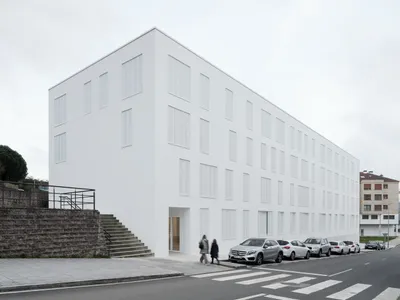
Alto Residencial Coop: Cooperative Housing Development in Santiago de Compostela by Carbajo Barrios Arquitectos
A linear cooperative housing complex blending white volumes and perforated metal façades, enhancing community living, natural light, privacy, and urban integration.
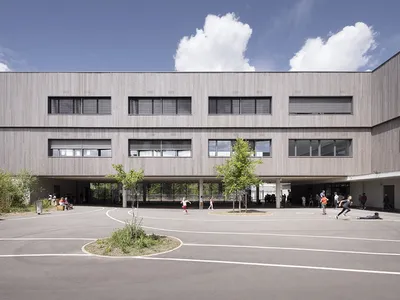
Vil Genis School by BPA ARCHITECTURE – Massy, France
Vil Genis School in Massy, France, features sustainable design, south-facing classrooms, community integration, accessible spaces, and modern educational architecture.

Comments (0)
Please login or sign up to add comments
No comments yet. Be the first to comment!