

Coolstock Builds a Layered Garden Pavilion from Concrete, Steel, and Wood in Slovakia
A 106 m² open-air retreat in Bernolákovo stacks three honest materials to frame garden life south of the family house.


There is a particular kind of ambition in the small project. A garden pavilion does not need to justify itself with a complex program or a city block of context. It needs only to answer the question: how should a family spend time outdoors? Bratislava-based studio Coolstock took that question seriously in Bernolákovo, Slovakia, producing a 106 m² structure that sits just south of an existing family house and transforms its garden into a fully furnished open-air room.
What makes this pavilion worth studying is its material logic. Concrete, steel, and wood are not simply combined; they are sequenced vertically like geological strata. Polished concrete anchors the ground, steel carries the load, and glued timber profiles form the ceiling plane. Each material does its job visibly, without cladding or concealment. The result reads less like a decorative garden folly and more like a compact piece of infrastructure designed to age gracefully alongside the trees around it.
Three Materials, One Clear Hierarchy
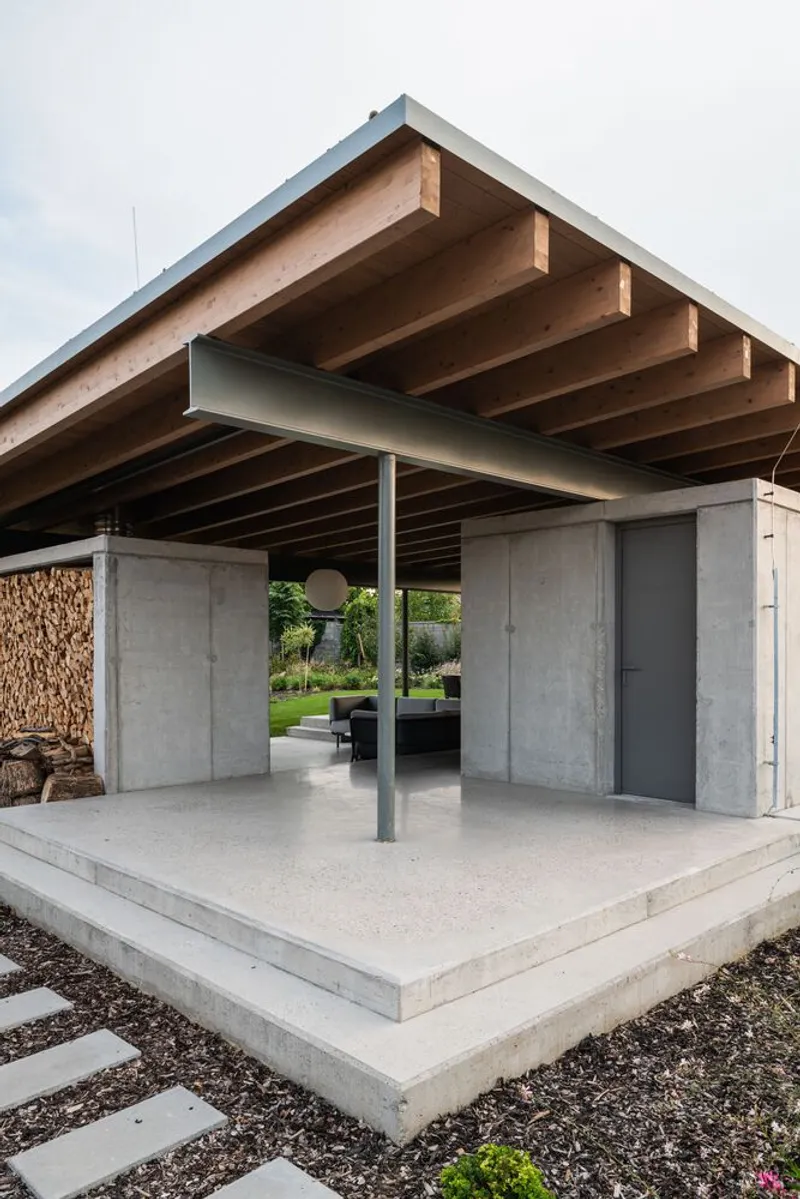
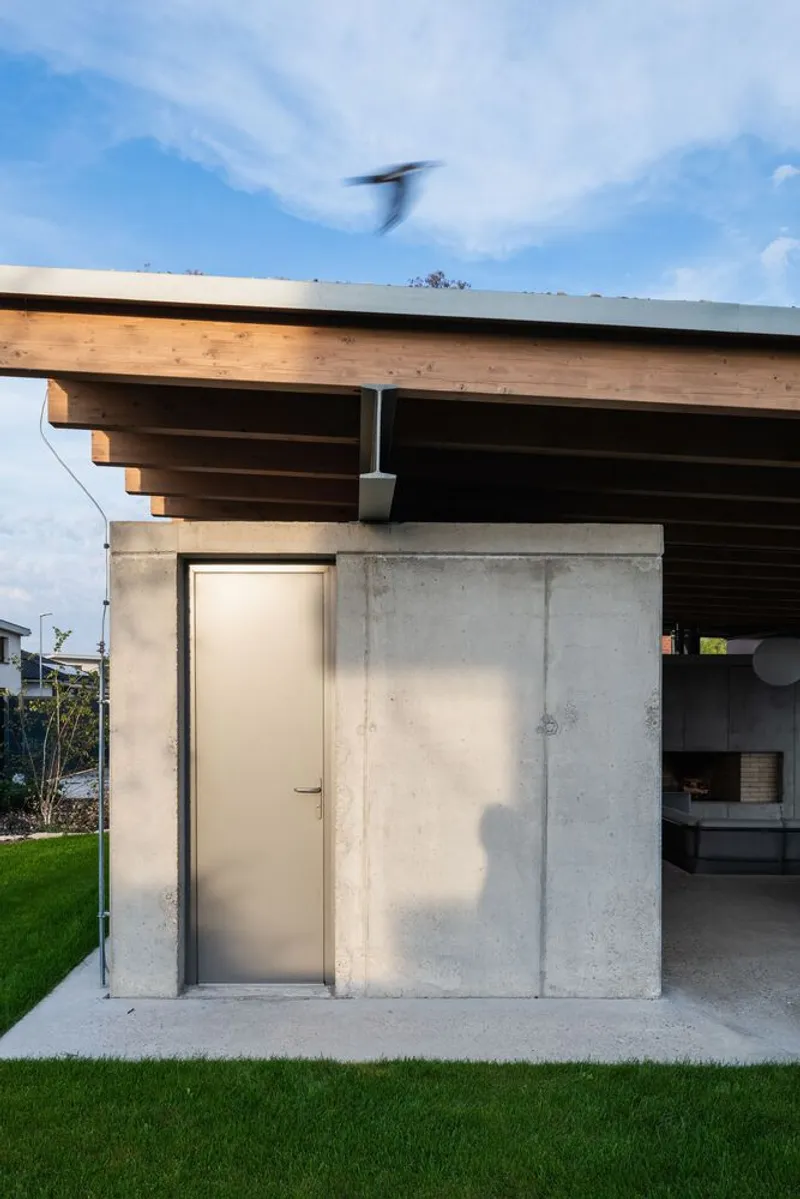
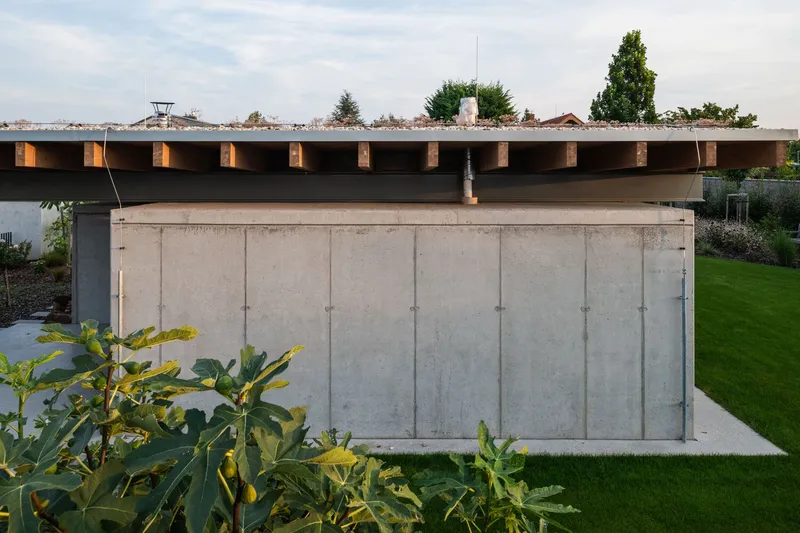
The pavilion's structural honesty is its defining trait. Board-formed concrete cubes rise from a monolithic slab, their rough textures telegraphing the formwork process to anyone who looks closely. Steel columns and beams slot in above, transferring roof loads with minimal visual mass. And then the timber: long glued profiles run in parallel overhead, their warm grain softening what could otherwise feel like a purely industrial composition. The layering is not decorative. Each material occupies a distinct zone in the section, so the eye understands immediately what is holding up what.
Coolstock uses the two concrete volumes strategically. They act as buffers, screening the pavilion from the access road to the north and the underground garage ramp to the east. Privacy arrives without fences, and the open south and west faces are left free to engage the garden. It is a smart plan move that turns a service problem into a spatial asset.
The Fireplace as Anchor
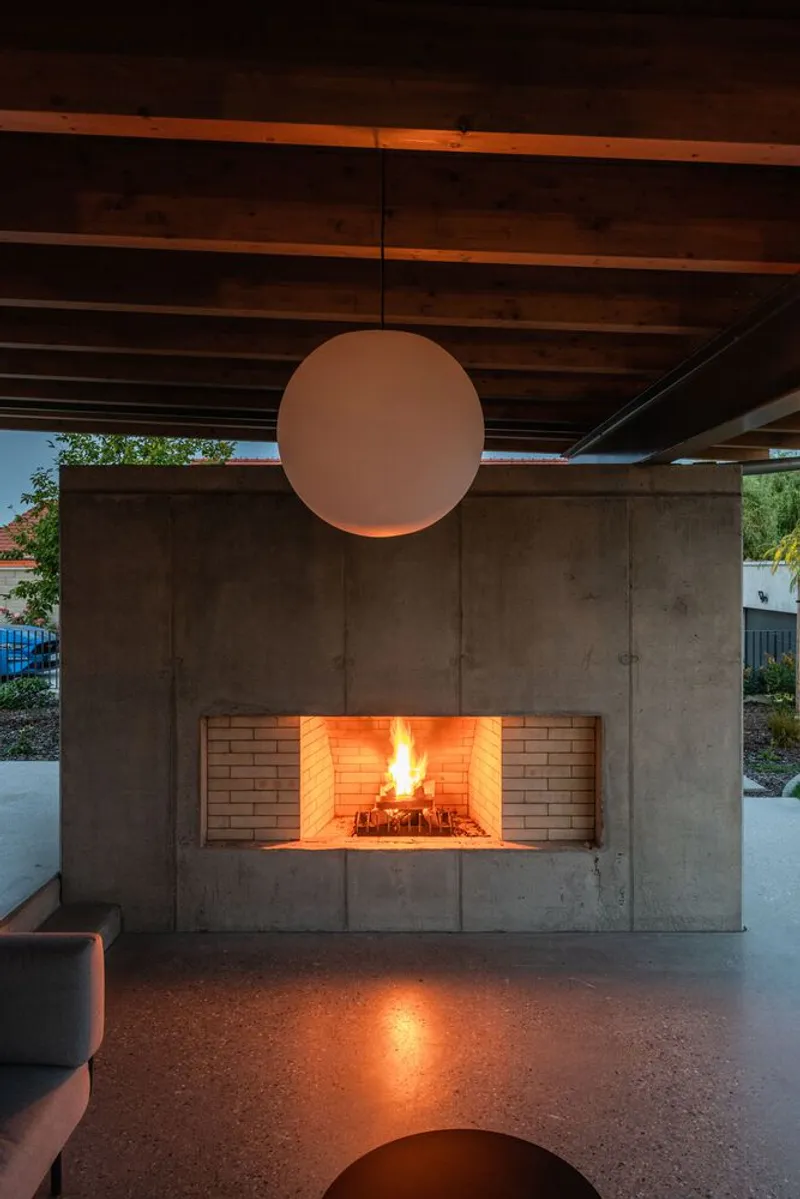
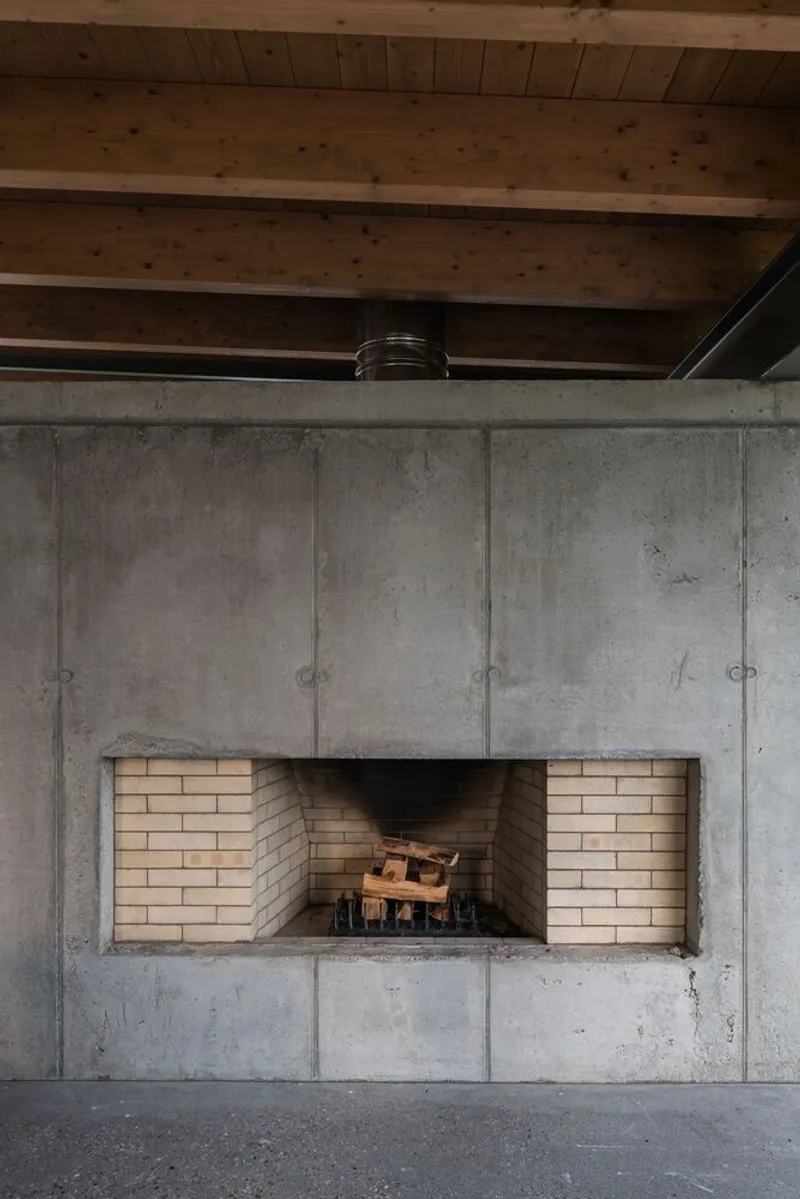
Every good outdoor room needs a focal point, and here it is a concrete fireplace wall with a recessed brick-lined firebox. At night, the fire draws the eye and pulls the family inward, turning the open pavilion into something closer to a living room. A spherical pendant light hangs nearby, its soft glow reinforcing the domestic atmosphere without competing with the flames. The brick lining is a considered detail: it introduces a fourth material only where thermal performance demands it, keeping the palette disciplined everywhere else.
Open Living Between Kitchen and Lounge
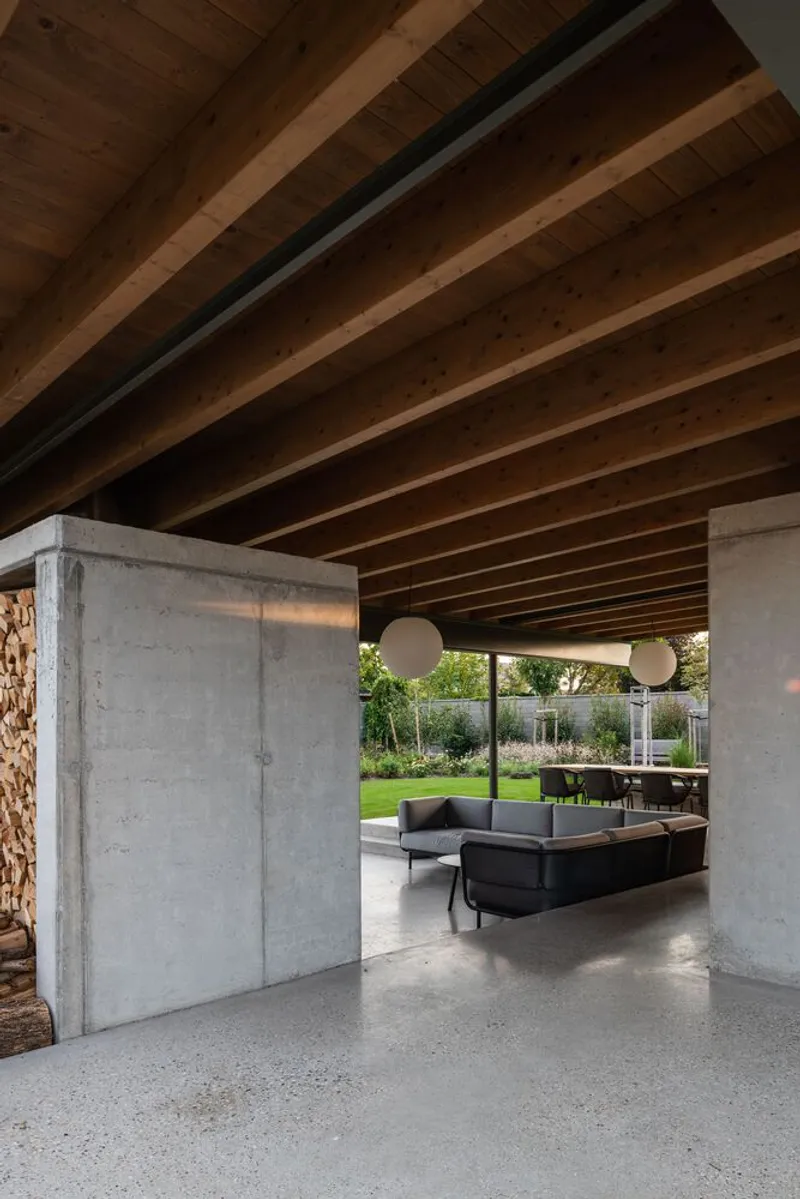
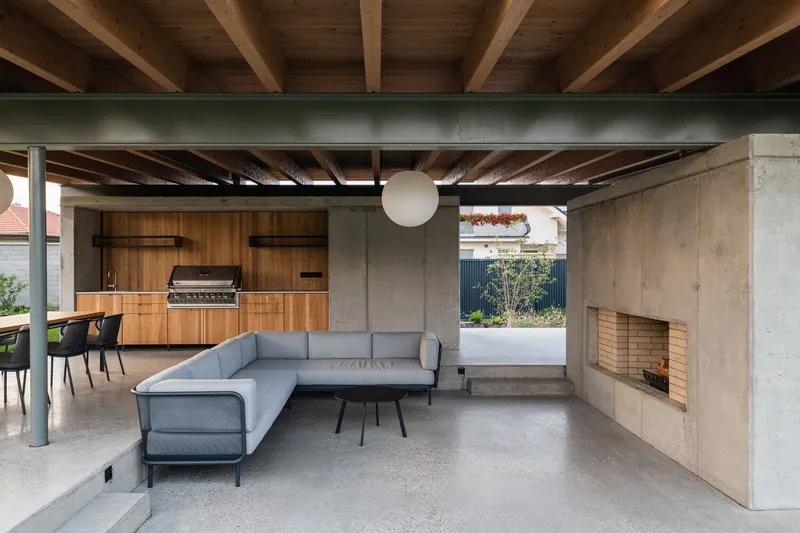
The 106 m² floor plate is divided into two distinct levels. A slight change in elevation separates the lounge zone from the summer kitchen and dining area, giving each activity its own territory without walls. Timber cabinetry lines the kitchen side, while a deep sectional sofa occupies the lower living platform. The multi-level floor is a small move with an outsized effect: it creates the sensation of moving through rooms even though the space is entirely open to the garden on two sides.
Overhead, the exposed timber joists maintain a continuous rhythm across both levels, unifying what the floor separates. Steel beams span the wider openings, and their dark profiles punctuate the warm ceiling like structural headlines. The proportions feel generous for a pavilion this size, a quality Coolstock achieves by keeping vertical surfaces to a minimum and letting the roof plane do the spatial work.
Landscape Threshold
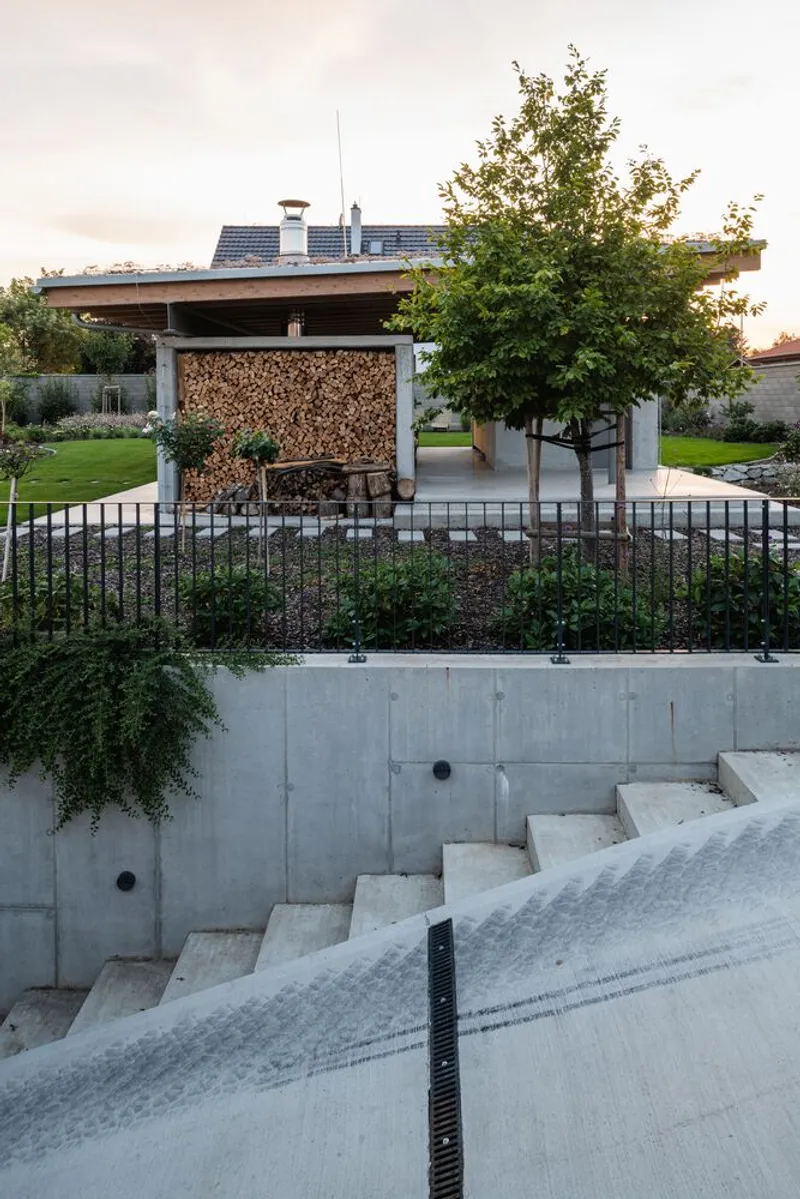
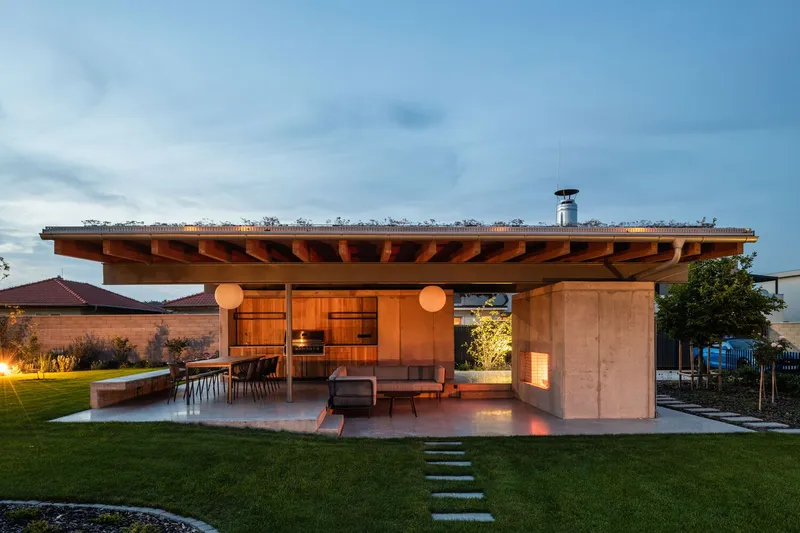
The relationship between pavilion and garden is negotiated through a series of concrete stairs and low walls that step down to lawn level. Planted beds soften the hard edges, and an existing tree stands close enough to the structure to cast shade across the roof. At dusk, the pavilion reads as a glowing platform set into the landscape, its timber ceiling lit from within while the concrete masses recede into shadow. The vegetation roof, sloped gently toward the garden, prevents overheating in the attic space and helps the structure disappear from upper-floor windows of the main house.
Adjustable screens on the south and west faces handle the low afternoon sun, a practical concession that keeps the space usable through the hottest hours. Coolstock resists the temptation to make these screens a design feature; they are simply tools that slide in when needed and vanish when they are not.
Why This Project Matters
Garden pavilions occupy an awkward spot in architectural discourse. They are too small to attract serious critical attention, yet they are the projects where many families first encounter deliberate architectural thinking. Coolstock's contribution in Bernolákovo succeeds because it treats the brief with the same rigor a larger commission would demand. The material sequence is legible, the plan is strategically organized around privacy and view, and the construction details are exposed rather than hidden.
The pavilion also demonstrates that honest construction can produce warmth, not austerity. Board-formed concrete, raw steel, and timber beams could easily tip into industrial coldness, but the fireplace, the level change, and the generous openness to the garden keep the space firmly on the domestic side of the line. It is a small building that knows exactly what it is and does not pretend to be anything else. That clarity is worth more than any amount of programmatic complexity.
Garden Pavilion by Coolstock, Bernolákovo, Slovakia. 106 m². Completed 2023. Structural engineering by Statikon. Roof construction by KONTRAKTING KROV HROU. Furniture by Todus. Photography by Nora & Jakub Čaprnka.
About the Studio
Share Your Own Work on uni.xyz
If projects like this are the kind of work you want to make, uni.xyz is a place to publish your own, find collaborators, and enter design competitions.


Popular Articles
Popular articles from the community


Opera on the Sea: Driftwood Logic Shapes a Timber Opera House on Estonia's Coast
Trevor Orgill's opera house translates the entangled drift of floating timber into a civic building where wood, water, and music converge.


ETEH Reworks the Shared Spaces of São Domingos School in Brazil Around Timber, Color and Hanging Plants
At São Domingos School in Brazil, 436 m² of hall, refectory and library are recast with timber joinery, a yellow and blue code and trailing greenery.

The Amber Palace Opera: A Geological Fiction Surfaces on Tallinn's Baltic Waterfront
Pierre Brillard reimagines a Baltic legend as a public landscape, opera house, and waterfront promenade rooted in Tallinn's coastal identity.

FCC Arquitectura Expands a Portuguese Granite House with a Board-Marked Concrete Wing
In Portugal, JV House pairs a cleaned-up whitewashed and granite dwelling with a timber-shuttered concrete extension, courtyards and a garden pool.

Similar Reads
You might also enjoy these articles


Hodi-Mandai Geram
Project Function: Preservation and revitalization of the Intangible heritage and socio-spatial identity of the Hodi by Housing, Cultural Memory Center, Sacred Grove, landscape, local tourism economy


Olio Towers: A Mid-Rise for Performers That Fuses Housing, Rehearsal, and Stage
Located blocks from Houston's Theater District, this modular tower stacks living units around a central performance atrium.

Oasis: Modular Green Housing Carved into Dhaka's Urban Fabric
A shortlisted Plugin Housing entry reclaims unauthorized settlements in Dhaka with stepped concrete volumes, green roofs, and ventilation-driven design.

Black Hole: A Floating Megastructure for the Post-Physical Era
Emiliano Mazzarotto envisions a spherical, self-scaling arena where e-sports, digital hotels, and holographic stadiums replace traditional public space.

Explore Architecture Competitions
Discover active competitions in this discipline

Challenge to reimagine the Iron Throne

Photograph architecture without architects

Illustrate the lost glory of Angkor Wat - Render Challenge

Design challenge to reuse E-waste
Comments (0)
Please login or sign up to add comments
No comments yet. Be the first to comment!