
Geemo Design Nests a Lingnan Dessert Shop into a Guangzhou Lakeside Retreat
BAN MAA distills the waters and mountains of Jiulong Lake into a 120-square-meter interior of terrazzo, timber, and black tile.


Most dessert shops sell atmosphere as much as sugar, but few bother to build an atmosphere worth inhabiting for longer than an Instagram story. BAN MAA, a 120-square-meter retail interior completed by Geemo Design in 2025 near Jiulong Lake in Guangzhou, takes a different tack. Lead architects Kirin, Yi, and Hang organized the project around the idea of "returning to the nest," a phrase that, in this case, is more spatial program than marketing copy. Every material decision, from the terrazzo walls to the brass railings to the cantilevered timber stairs, points back to a specific emotional register: the sensation of arriving somewhere familiar even if you have never been there before.
What makes BAN MAA genuinely interesting is the way it smuggles domestic scale and residential warmth into a commercial brief. The split-level layout, the sleeping alcoves, the planted courtyard, the exposed timber ceiling beams: all of these belong to a house, not a shop. By grounding the design in Lingnan dessert culture and the lakeside landscape that surrounds it, Geemo Design sidesteps the generic café interior entirely. The result is a space that earns its sense of belonging.
Threshold and Arrival

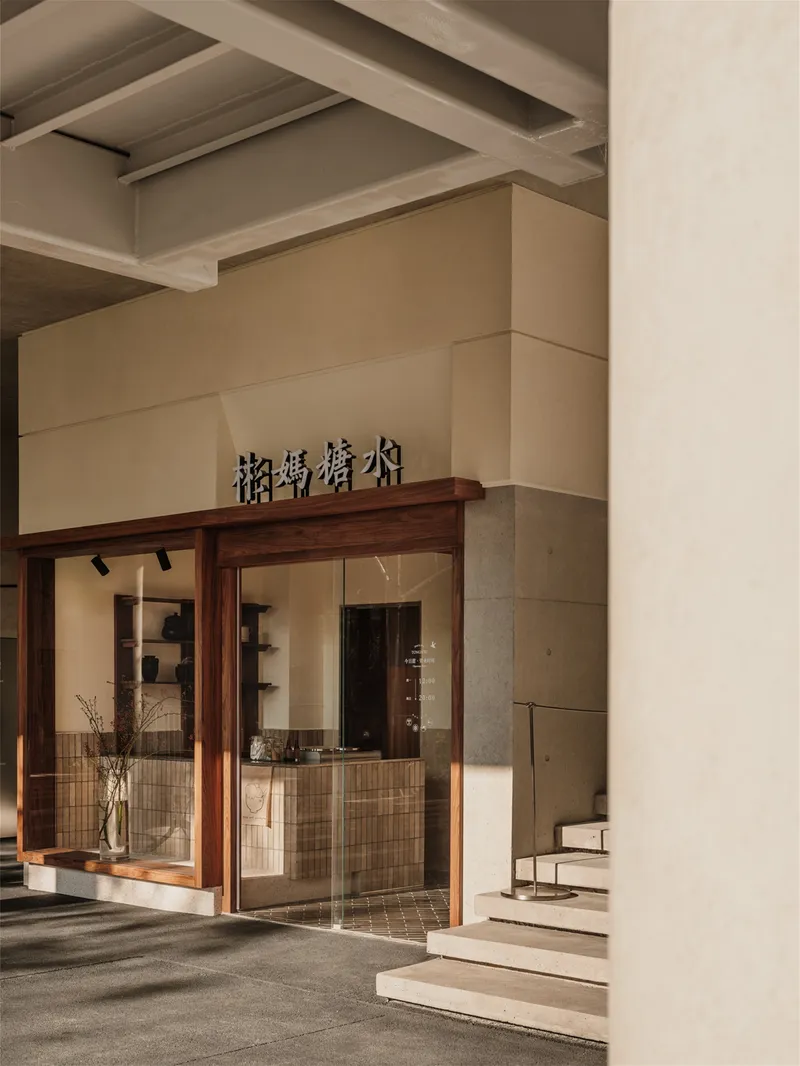

The entry sequence does a lot of work. A covered portico framed by cylindrical concrete columns sets a civic, almost temple-like tone that is immediately softened by the timber-framed glazed storefront behind it. Stepped stone pavement leads you through a tiled base into the shop, a transition that compresses and releases in a way that makes the interior feel larger than its 120 square meters. The street facade reads as a stack of concrete cantilevers with planted terraces, giving the building a quiet presence on the block without shouting for attention.
The concrete soffit overhead, the planting, the warm timber frame: these elements layer outdoor and indoor registers so that the boundary between terrace and dining room dissolves before you cross it. It is a controlled looseness that takes real discipline to achieve.
The Courtyard as Organizing Spine


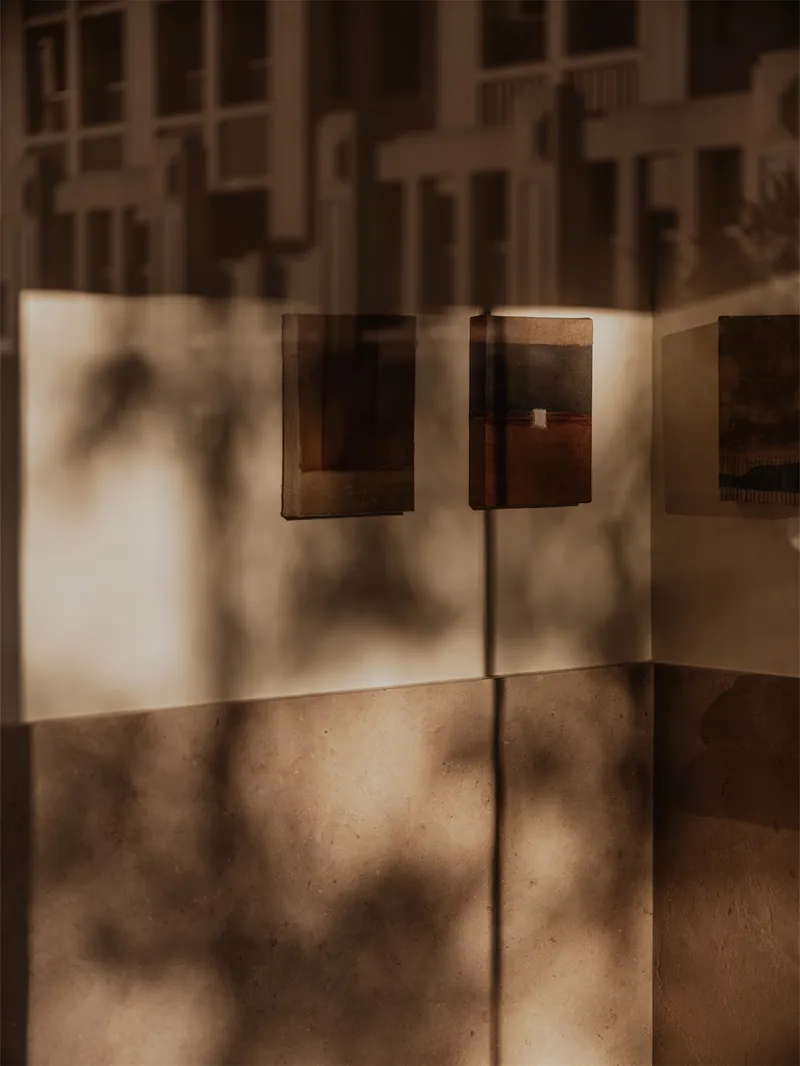
An interior courtyard anchored by cylindrical columns and surrounded by metal railings and planted balconies sits at the heart of the project. This is the structural and emotional center of BAN MAA. Dappled sunlight filters through bare branches onto terrazzo walls and tiled ledges, creating the kind of micro-climate that Lingnan architecture has refined over centuries. The courtyard pulls daylight deep into the plan and gives every adjacent room a borrowed view.
The covered terrace facing the courtyard doubles as a display surface and a decompression zone. A timber-framed mirror mounted against a column reflects the planting back on itself, deepening the sense of enclosure. Potted plants on the tiled ledge reinforce the domestic register. Nothing here reads as decoration. Every object has a spatial function.
Timber, Terrazzo, and Black Tile
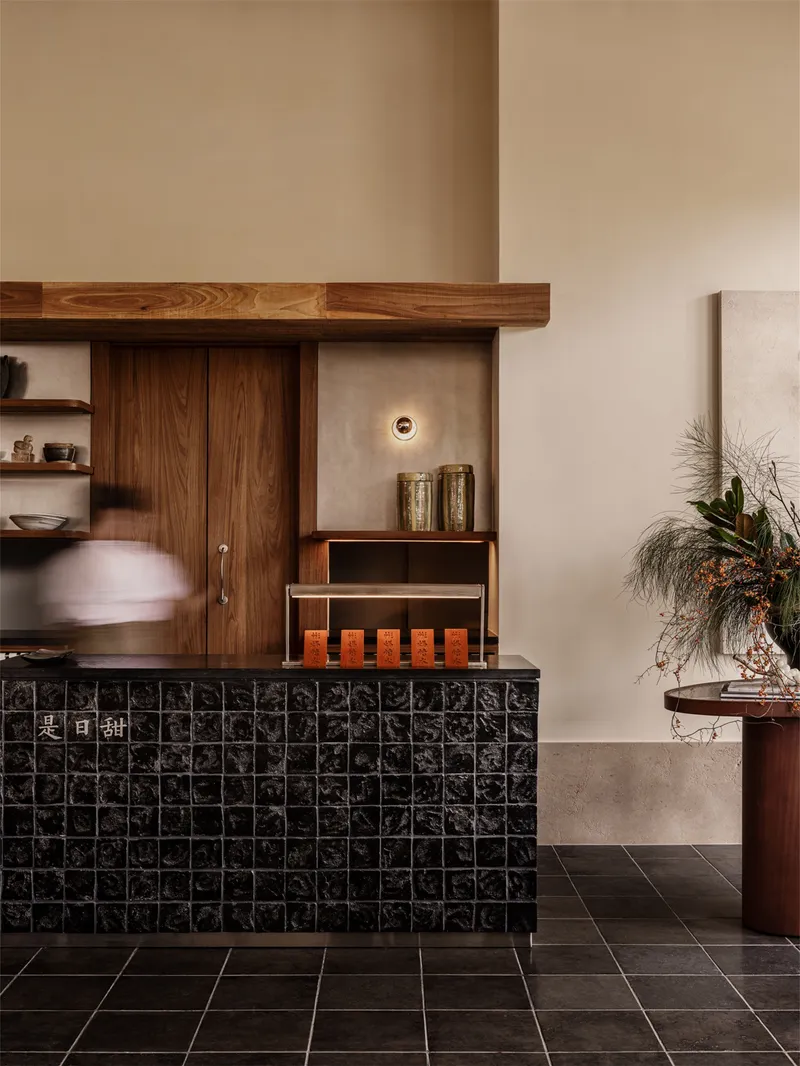


The material palette is tight and deliberate. Black glazed tile clads the service counter and kitchen island, its reflective surface playing against the matte warmth of walnut cabinetry and open shelving behind it. Terrazzo flooring runs throughout, anchoring the split-level interior with a continuous ground plane that shifts color subtly as it catches afternoon light. Timber millwork walls with sliding doors add a layer of tactile richness and functional flexibility.
The restraint here is worth noting. Three primary materials, used consistently across every room, give the space coherence without monotony. The black tile is bold enough to read as a counter-rhythm against the warm wood and pale stone. It marks the service areas clearly, so you always know where the food comes from and where you sit to eat it.
Split-Level Dining and Domestic Scale
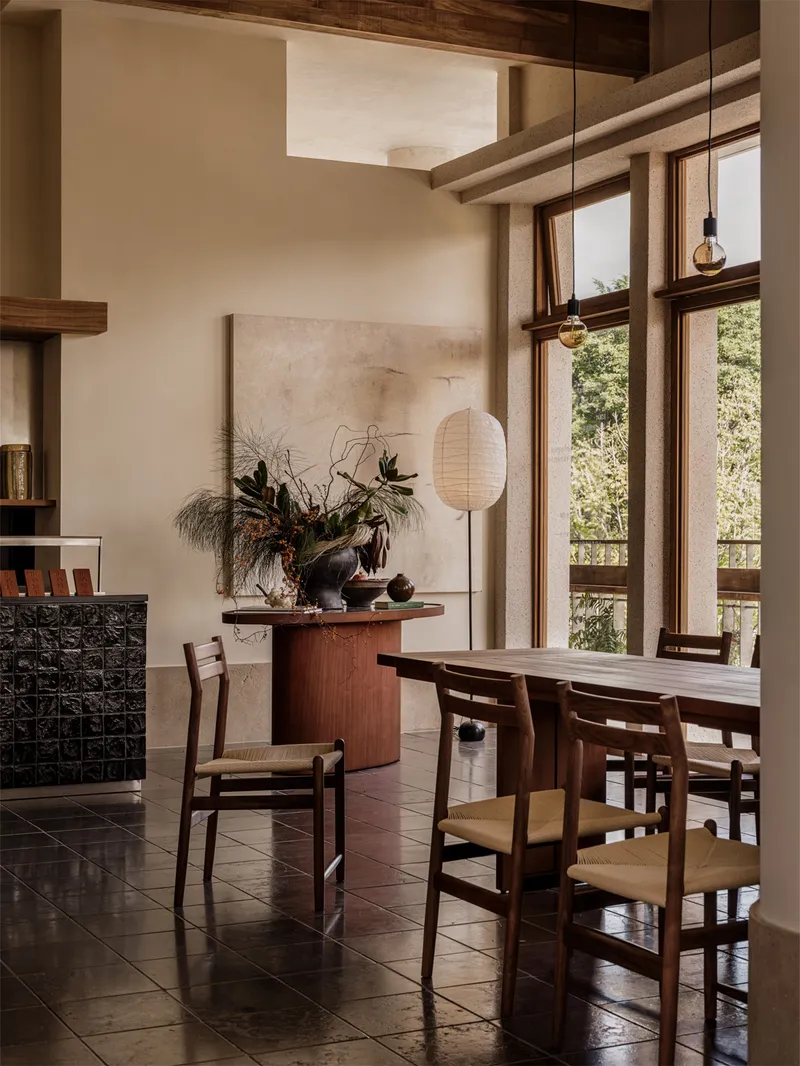
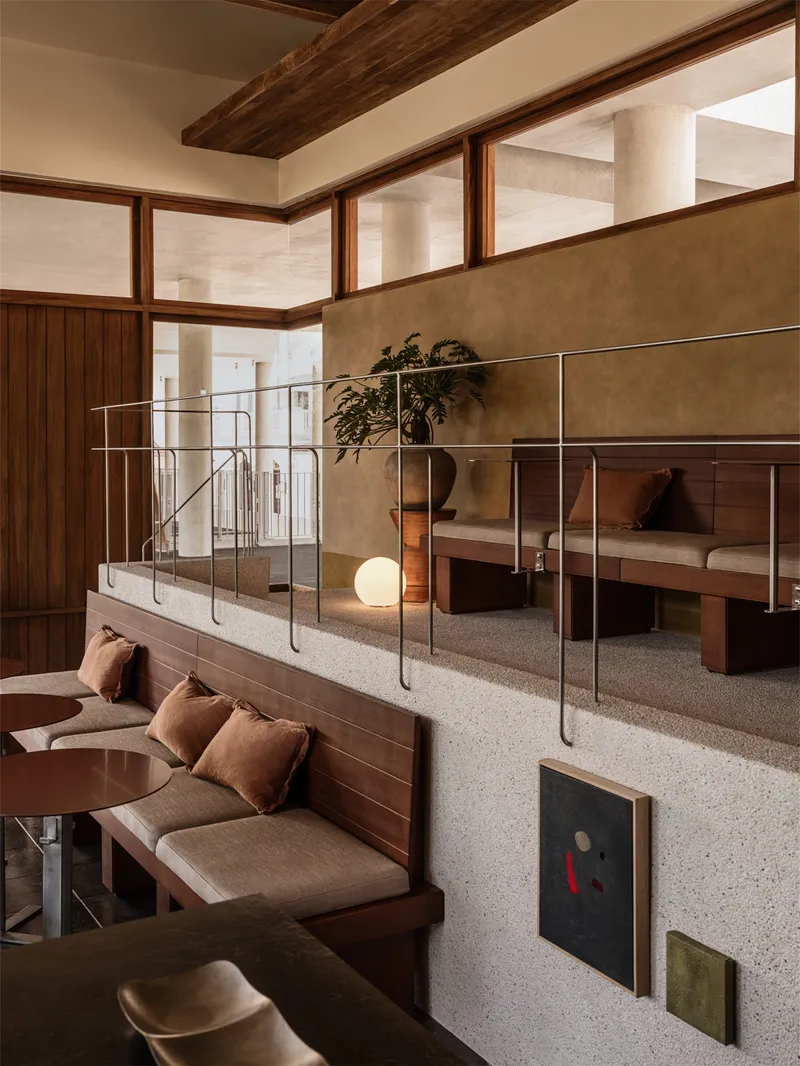

The dining areas work at two registers simultaneously. A double-height space with exposed timber beams and full-height glazing opens the interior to the surrounding greenery and lake landscape, creating the expansive, almost ceremonial feeling of a great room. But at the lower level, built-in banquette seating, timber-framed windows, and pendant lights dial the scale back down to something intimate and conversational. You can eat your Lingnan dessert in either mode.
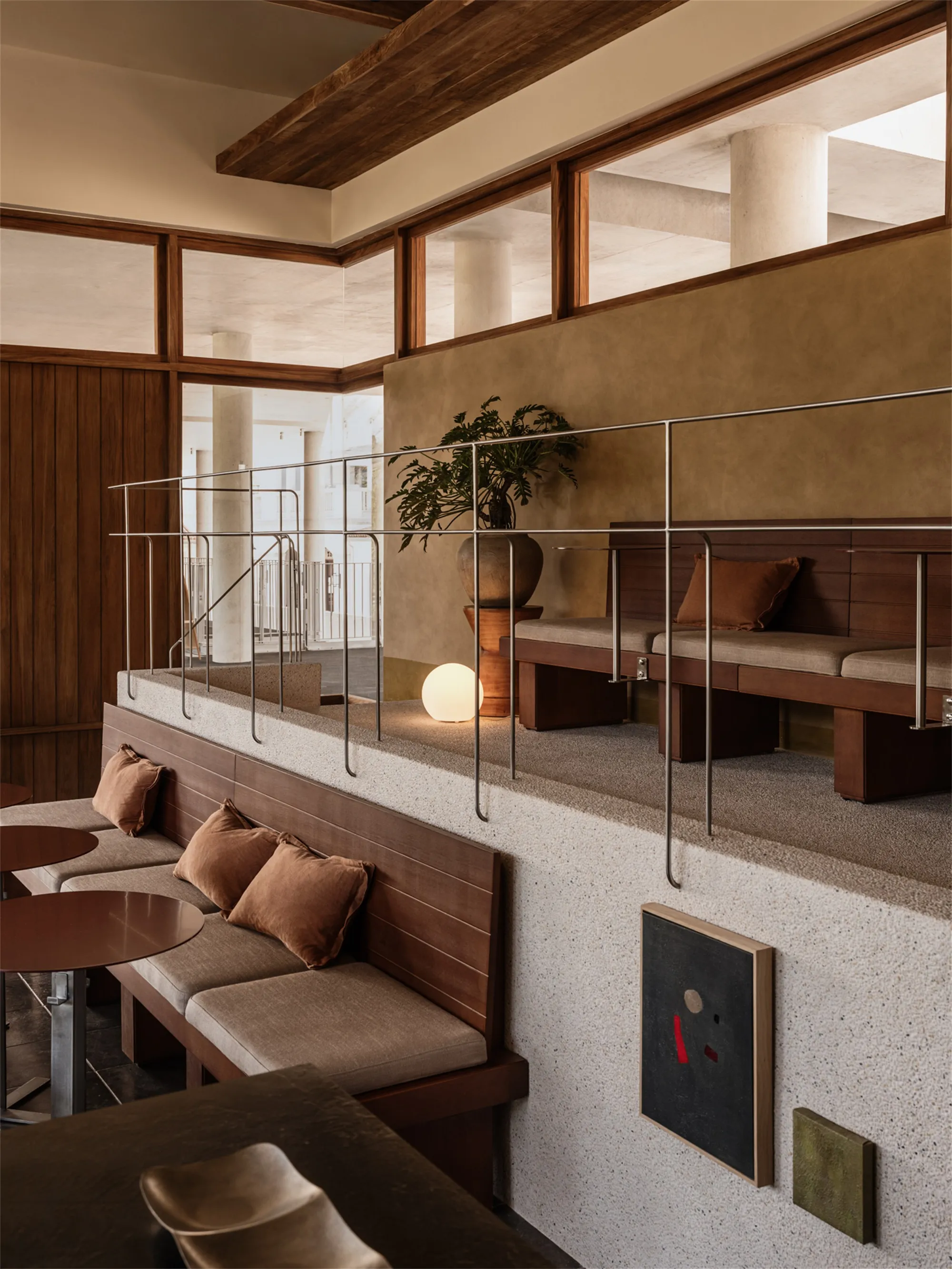
The split-level section is the move that makes BAN MAA more than a pretty café. By stepping the floor, Geemo Design creates distinct zones within a compact footprint without resorting to walls. The terrazzo floor, warm afternoon light, and exposed ceiling beams flow continuously across the level change, keeping the space unified even as it subdivides.
Craft in the Details


The project rewards close looking. A brass tubular railing anchored to a terrazzo edge with a curved corner joint is a small thing, but it signals a level of care that runs through the entire fit-out. The stair, with dark timber treads cantilevered from a textured terrazzo wall and supported by cream brick risers, is a miniature lesson in how different materials can meet without competing. The metal handrail is thin and precise, a line drawn in space that keeps you oriented as you move between levels.
Brass wall sconces casting long shadows on terrazzo floors, cylindrical bolster cushions tucked into window seats, a timber block mounted on a terrazzo wall above a terracotta tile tread: these moments accumulate quietly. They are not showpieces. They are evidence that the architects controlled every joint and every junction.
Sleeping Alcoves and the Nest Idea

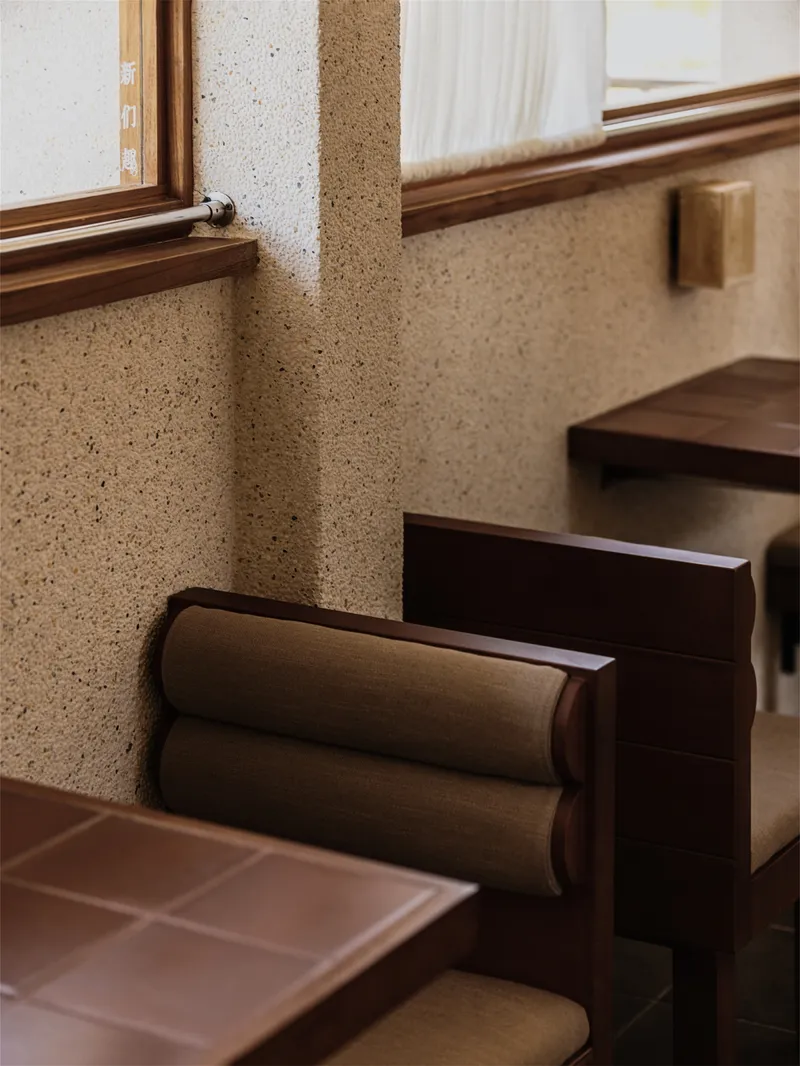
The most surprising element in BAN MAA is a set of built-in timber sleeping alcoves fitted with brass rails and set into terrazzo walls below mustard-toned panels. In a dessert shop. The idea of "returning to the nest" finds its most literal expression here: these are places to curl up, to linger, to feel enclosed without feeling confined. They collapse the distance between retail and residential typology entirely.
Whether these alcoves are actually used for sleeping or simply for lounging between courses is beside the point. Their presence shifts the entire register of the space. You stop thinking of BAN MAA as a shop and start thinking of it as a place to be. That reframing is the project's real achievement.
Light, Planting, and the Lakeside Register

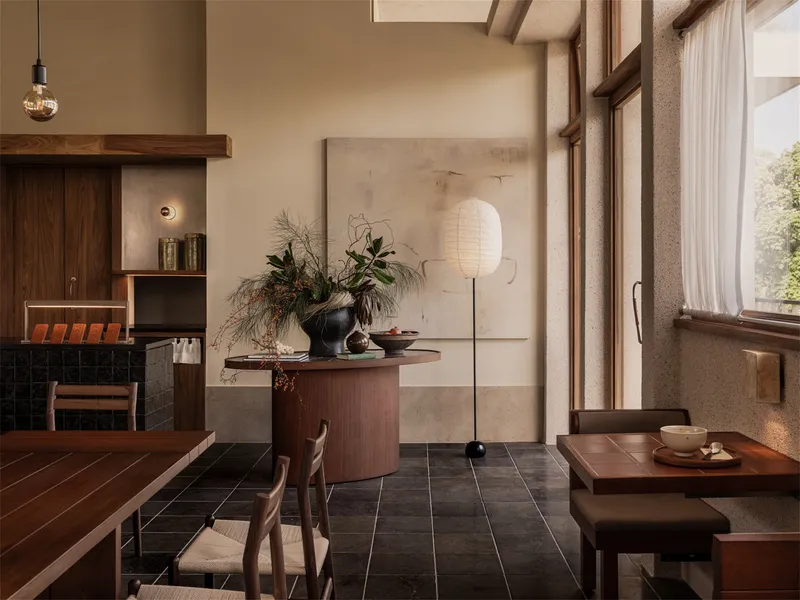

Jiulong Lake is not visible from every seat, but its presence is felt throughout. Tall windows frame green foliage and flowering grasses. A potted rubber plant in the foreground of a timber-framed opening, a paper lantern beside a floral arrangement on a dining table, a balcony with hanging sign glimpsed through leaves: these are curated views, but they do not feel forced. The landscape enters the building on its own terms.
Light management is key to the mood. Afternoon sun warms the terrazzo and timber surfaces without overheating the space. The exposed ceiling beams modulate the light into bands, and the deep reveals of the timber-framed windows soften it further. The result is a golden, enveloping atmosphere that feels specific to this latitude and this time of day.
Plans and Drawings


The floor plan confirms what the photographs suggest: a rectangular layout organized around a courtyard, with a dining hall, kitchen, and two bedrooms arranged along its perimeter. The clarity of the plan is striking. There are no wasted corridors, no ambiguous zones. The courtyard sits off-center, pulling circulation toward it and giving every room a relationship to outdoor air and daylight. The two bedrooms, unusual for a retail program, reinforce the domestic character that defines BAN MAA at every scale.
Why This Project Matters
BAN MAA matters because it takes a brief that could have been disposable and treats it with the seriousness of a house. Geemo Design has produced a retail interior that draws on Lingnan building traditions, from the courtyard plan to the material palette to the relationship between indoor and outdoor space, without turning those traditions into scenography. The sleeping alcoves, the split-level section, the brass detailing: every decision reinforces the idea that a dessert shop can be a place of genuine comfort and belonging.
In a market saturated with themed interiors designed for two-year lifespans, BAN MAA bets on durability. Terrazzo and timber age well. Brass develops patina. The courtyard will only improve as the planting matures. Whether the commercial model sustains this level of craft remains to be seen, but as an argument for what retail architecture can be when designers refuse to compromise, the project is persuasive.
BAN MAA by Geemo Design. Guangzhou, China. 120 m². Completed 2025. Lead architects: Kirin, Yi, Hang. Photography by Pianfang Studio.
About the Studio
Geemo Design
Share Your Own Work on uni.xyz
If projects like this are the kind of work you want to make, uni.xyz is a place to publish your own, find collaborators, and enter design competitions.




Popular Articles
Popular articles from the community


Lunar Spiral: Space Architecture Shaped by the Mathematics of the Universe
Lunar Spiral reimagines space architecture through Fibonacci geometry, lunar regolith, levitating habitats, and self-sustaining Moon living.

Play: Fragments of Their World
Familiar architecture becomes modular playground design, creating safe spaces where displaced children can learn, connect, imagine and play.

Riyadh For All: Intergenerational Urban Design for Active Aging in Rabat
Riyadh For All reimagines urban design in Rabat with intergenerational co-living, adaptive courtyards, and Moroccan cultural exchange today.

The Ocean Hive: Sustainable Architecture for a Self-Sufficient Civilization at Sea
The Ocean Hive imagines sustainable architecture at sea, where modular habitats, algae, wave power and ocean waste sustain a growing colony.


Similar Reads
You might also enjoy these articles

Bao Huynh Watercolor Atelier: A Serene Art Retreat in Hội An
Bao Huynh Watercolor Atelier in Hội An blends multifunctional art spaces, sustainable design, local materials, and family-friendly living in a serene environment.

Atelier Macri Concept Store Interior Design by CASE-REAL
Atelier Macri store features a "ko" counter, walnut wood details, cork displays, blending retail, gallery, and seamless customer experiences.

Manuel Vargas Izquierdo Stadium and High-Performance Sports Center: Architectural Excellence in Jalpa de Méndez
The Manuel Vargas Izquierdo Stadium blends sustainable design, inclusive sports facilities, and cultural-inspired architecture, revitalizing Jalpa de Méndez’s public spaces.

KAKR Buluh Awar Hall: Revitalizing Community and Ecology Through Bamboo Architecture
Community built bamboo hall revitalizes Buluh Awar village, empowering youth, restoring ecology, celebrating vernacular craftsmanship through sustainable architecture and culture.




Comments (0)
Please login or sign up to add comments
No comments yet. Be the first to comment!