
G.Natkevicius & Partners Threads a New Faculty Building into Kaunas's Interwar Modernist Campus
A 5,217 square meter public health faculty in Lithuania channels 1930s rationalism through concrete arches and twin atriums.


Kaunas holds one of Europe's densest concentrations of interwar modernist architecture, and the Lithuanian University of Health Sciences campus is a microcosm of that legacy. Eight heritage buildings from the 1930s define its urban structure, all registered as cultural patrimony. When the university needed a new Faculty of Public Health, the challenge was not simply fitting 5,217 square meters of program onto the site's eastern edge but doing so without breaking faith with the architectural DNA that earned the campus its protected status.
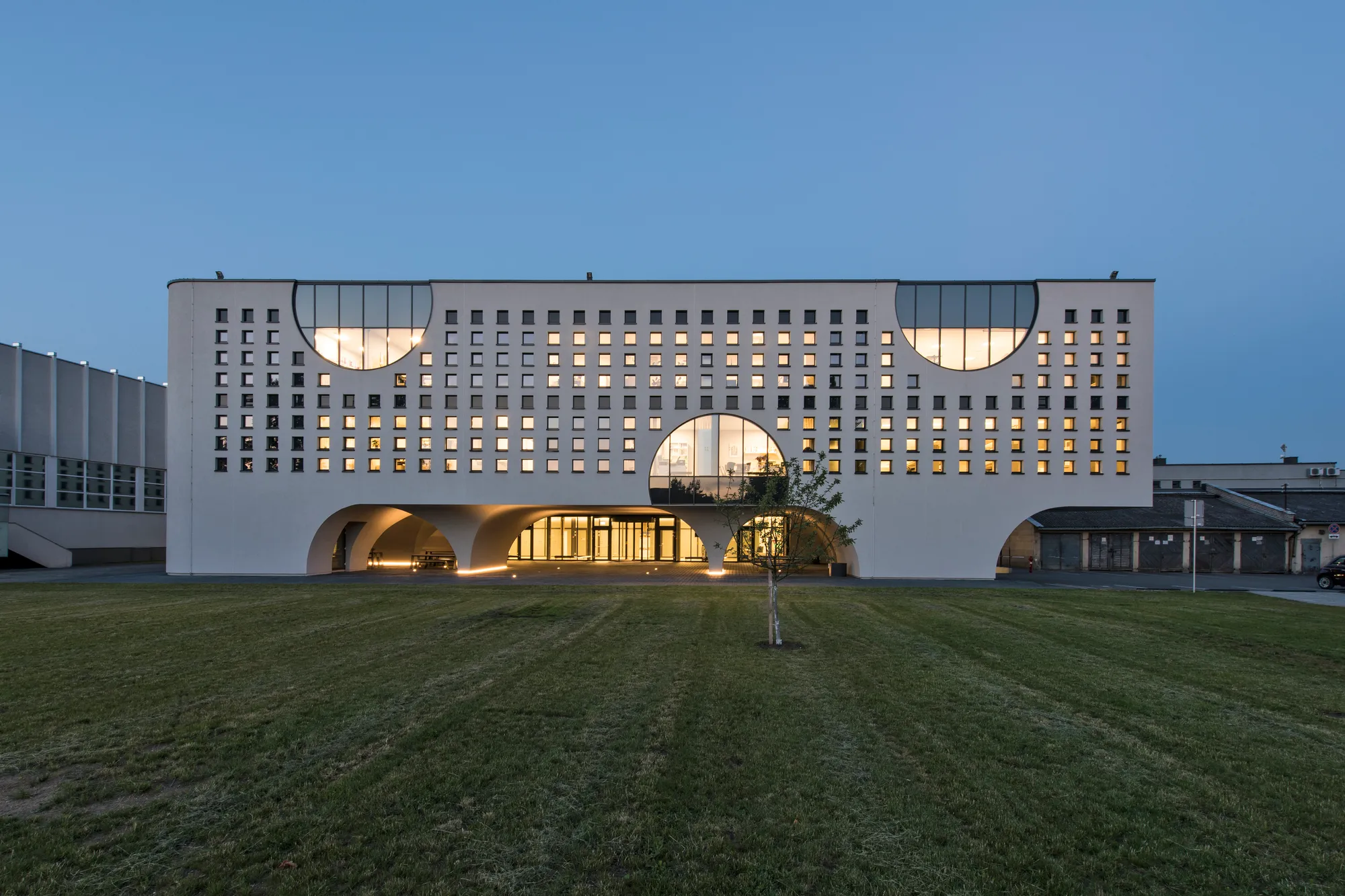
Architectural Bureau G.Natkevicius & Partners answered that challenge with a building that is neither replica nor rupture. Completed in 2020, the single volume (49 by 44 meters, roughly 12 meters tall) picks up the campus's original built edge and extends it, facing its main entrance toward the central pedestrian axis laid out in the 1930s masterplan. The construction logic is deliberately plain: concrete load-bearing walls, slabs, and columns finished in almost-white, soft-textured plaster. What is not plain is the formal language. Arched openings, circular glazed cutouts, and a disciplined grid of square windows create a facade that nods to the classical tradition without borrowing its ornamental vocabulary. The result is a building that reads as both new and deeply contextual, a kind of studied echo.
A Facade That Speaks Two Languages
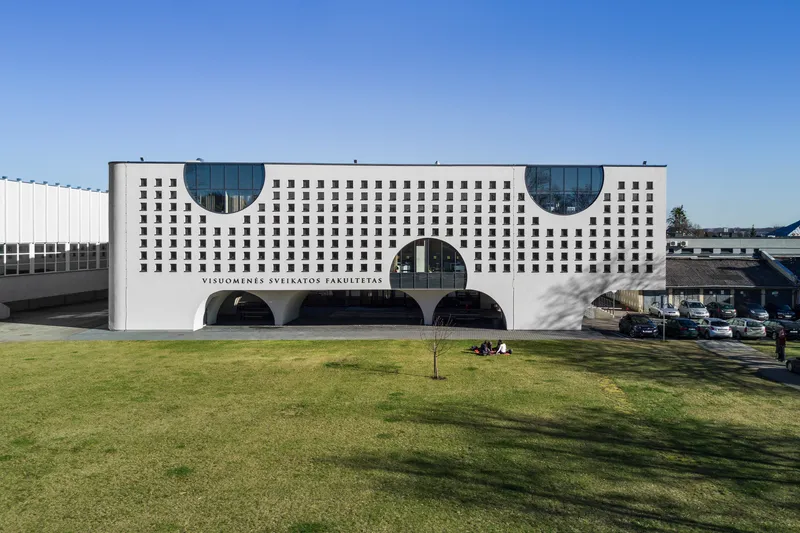
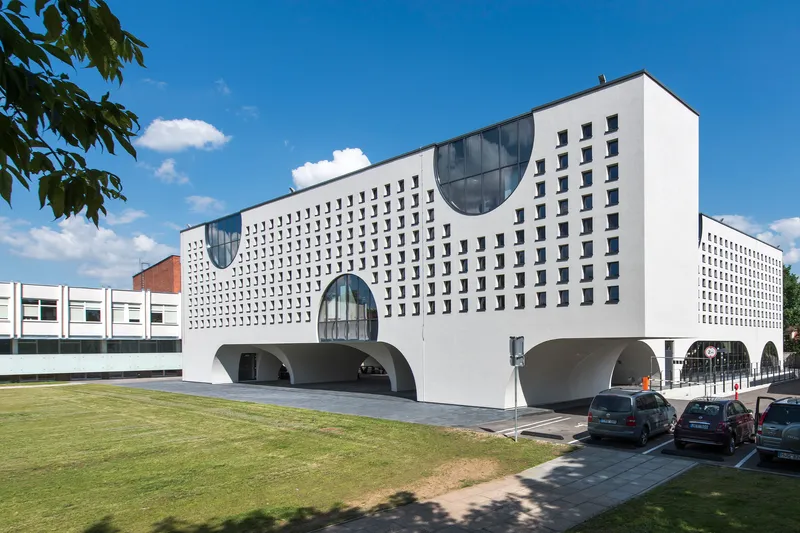
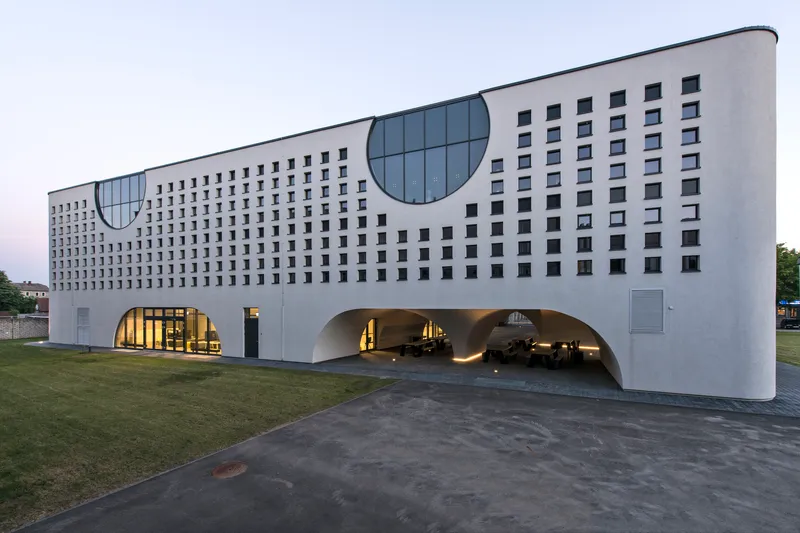
The elevations operate on two registers at once. The upper floors present an orderly rhythm of small square windows punched into white plaster, the kind of restrained repetition you find in Kaunas's interwar blocks. But large circular glazed openings interrupt that grid, pulling the eye and letting daylight flood deep into the floor plate. At ground level, sweeping arches replace the rectangle entirely, creating a covered arcade beneath cantilevered portions of the upper floors.
The interplay between rounded and right-angled geometry is the building's signature move. Rather than choosing a single formal vocabulary, the architects let the two coexist. The circular cutouts feel almost perforated, as if the white volume were a screen. The arches, by contrast, are heavy, almost classical. Together they produce a facade that rewards close reading without demanding it.
Arches as Threshold
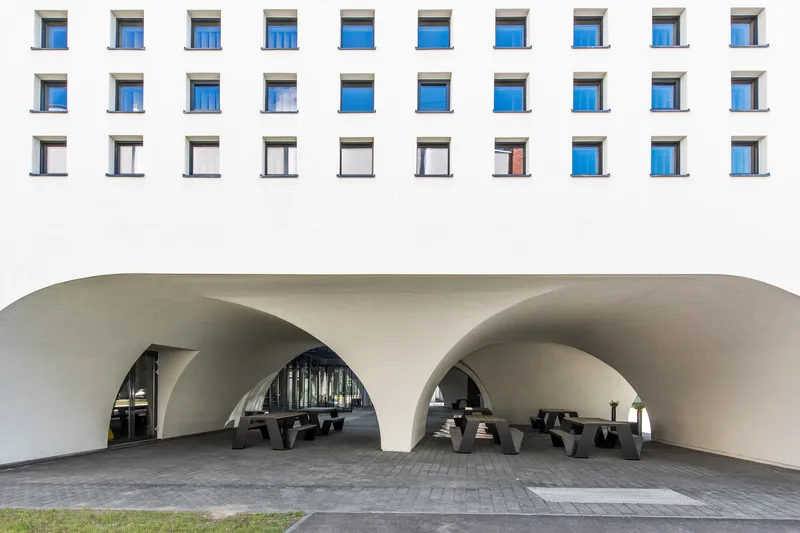
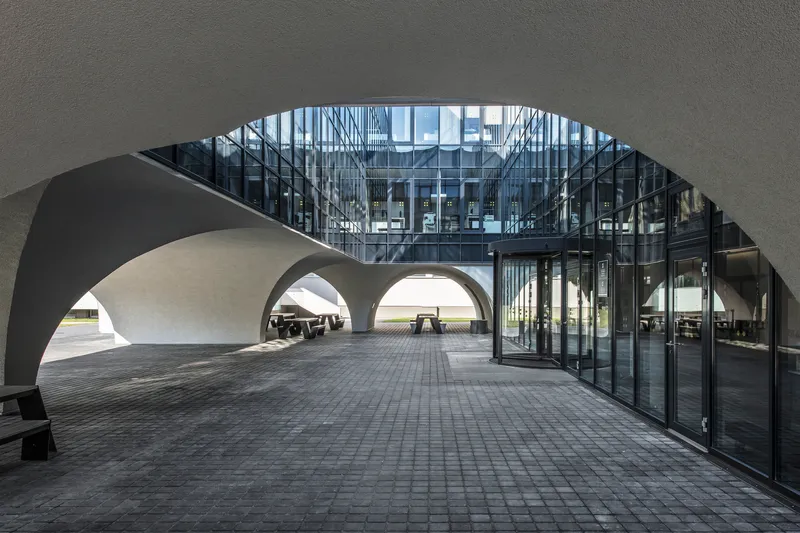
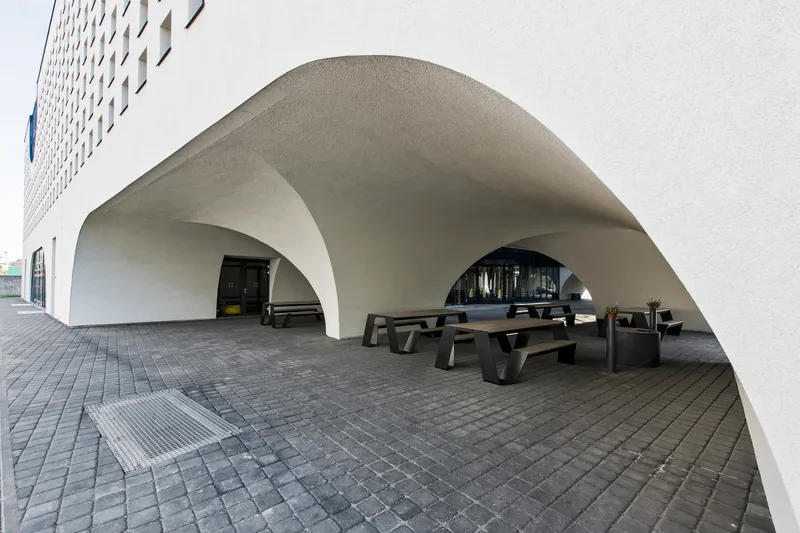
The ground-level arches do real spatial work. They are not decorative appliqué; they define the transition from campus landscape to building interior. Walk toward the entrance along the pedestrian axis and you pass through a layered sequence of curved openings, each framing the next. Black timber benches line the arcade, encouraging pause. The effect is processional, a soft deceleration before you step inside.
Viewed from the sheltered courtyard spaces, the arches layer and overlap, producing the kind of perspectival depth you associate with loggias or cloisters. Concrete vaults span the covered zones cleanly. No exposed steel, no visible waterproofing. The detailing is deliberately austere, trusting the geometry alone to generate atmosphere.
Campus Context from Above
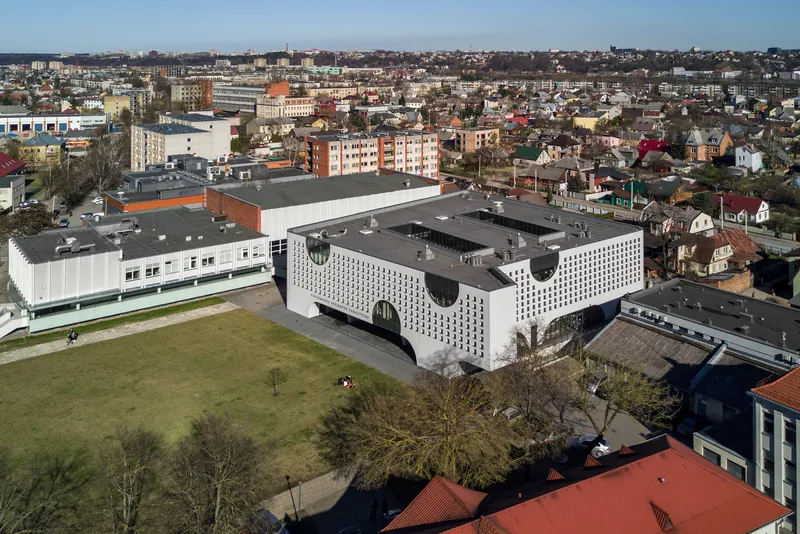
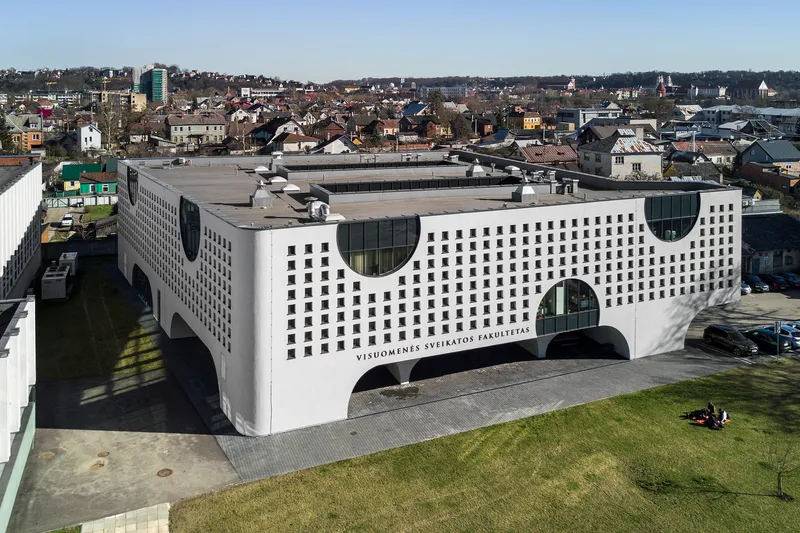
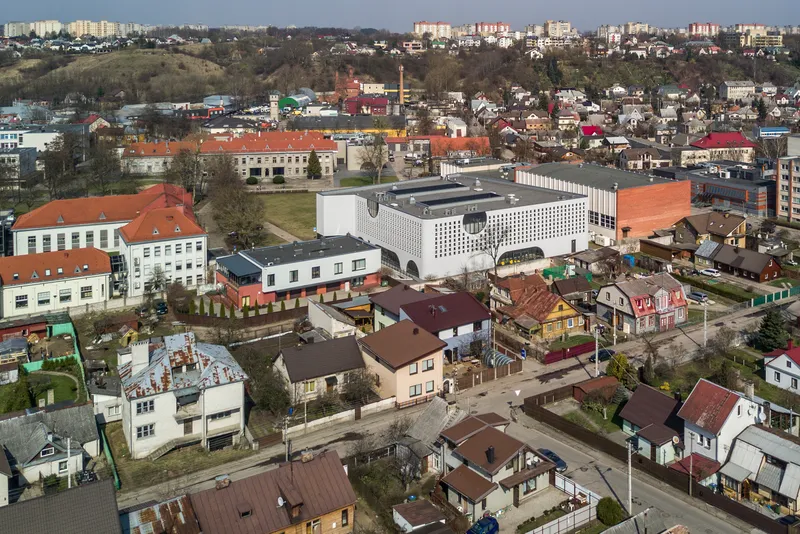
Aerial views reveal the building's U-shaped footprint and its careful positioning on the campus. The volume extends the continuous built edge established in the original 1930s masterplan, completing a boundary rather than floating as an isolated object. Surrounding rooftops, mostly red tile, provide scale. The new building is noticeably larger than its neighbors, yet its white mass, low profile (three floors above ground, one below), and perforated skin keep it from dominating.
Heritage specialists conducted a site analysis in 2011 recommending the eastern portion as the appropriate location for new construction. The architects followed that guidance closely, treating the heritage register not as a constraint but as a design brief.
Dusk Presence
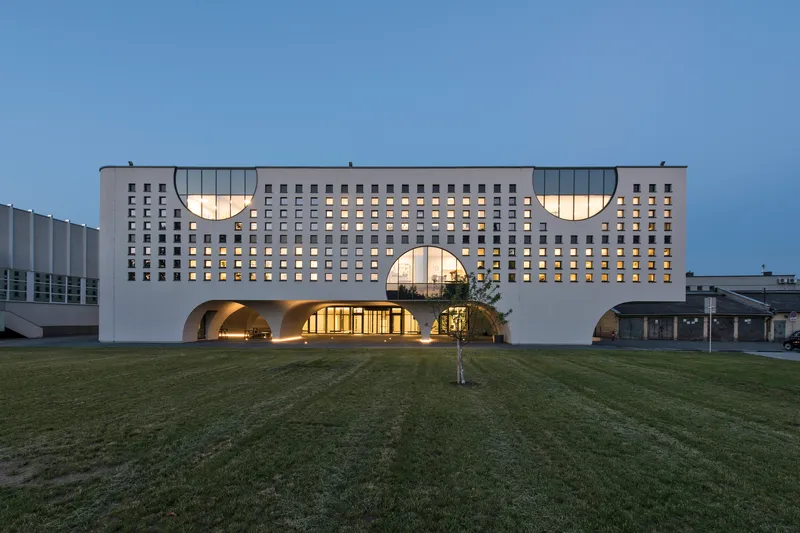
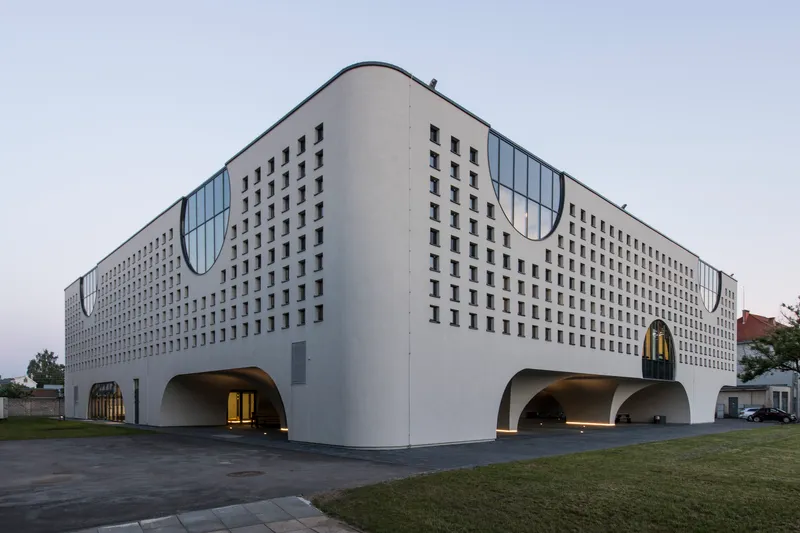
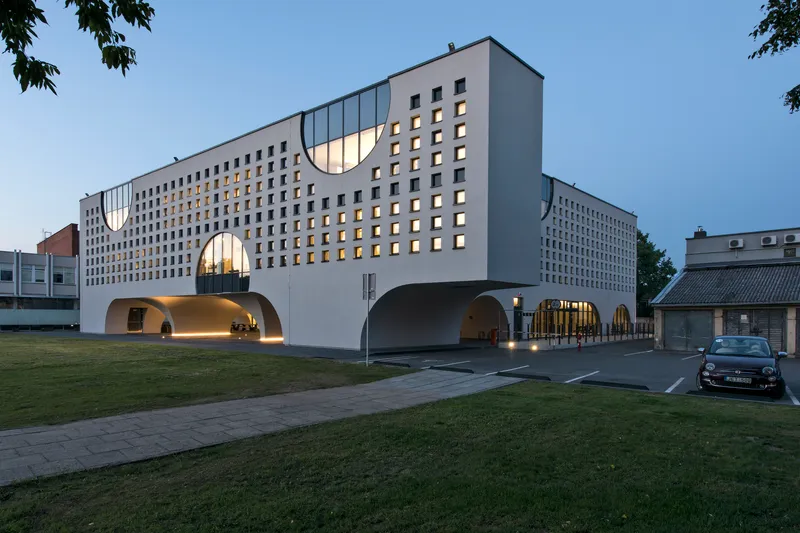
At twilight, the building's character shifts. The arched entrances become glowing portals, their warm light spilling across the pavement. The square window grid turns into a delicate lantern, each opening a small rectangle of amber. There is a generosity to this nighttime expression: it signals civic presence, a building that serves the public and makes that service visible.
The curved roofline, barely perceptible in daylight, becomes legible against the overcast evening sky. It subtly softens what could otherwise read as a hard-edged box, linking back to the arched language below.
Interior: Two Atriums, Two Moods
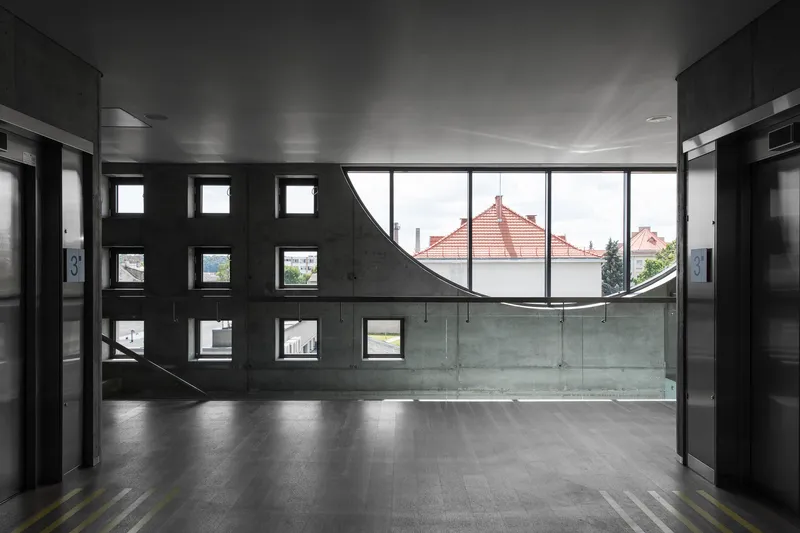
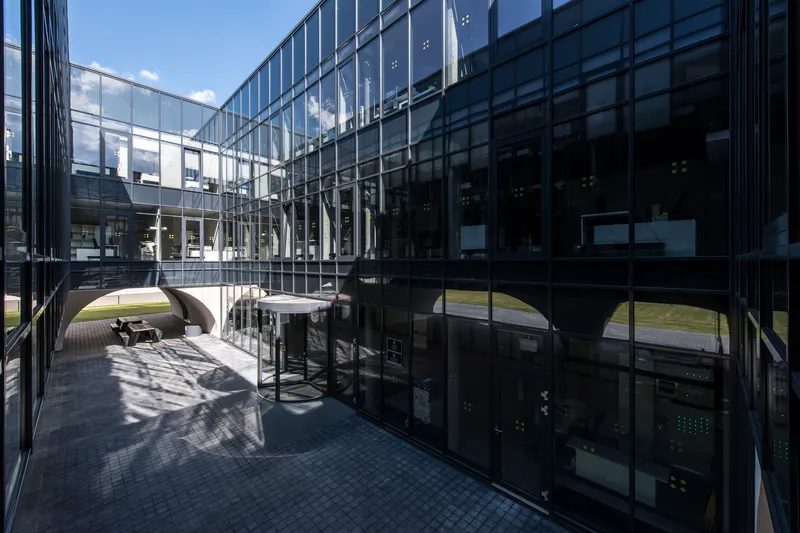
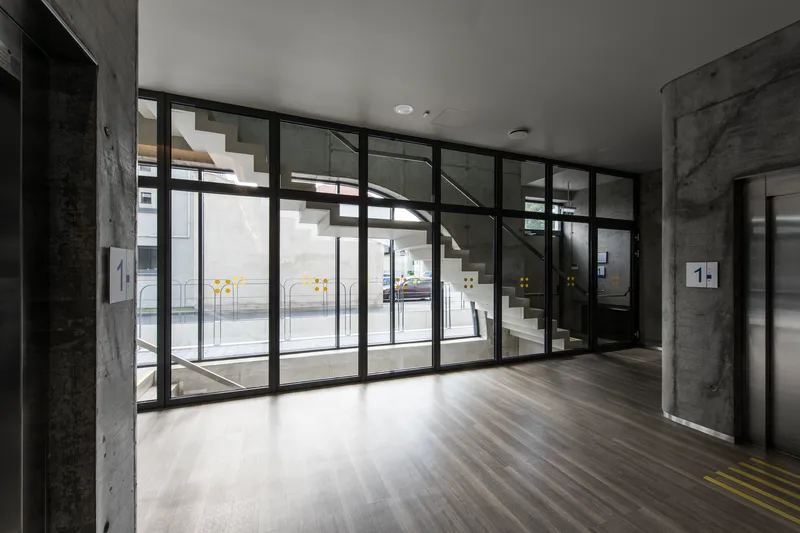
The building contains two atriums. The first, public-facing, is a lobby with a curved window wall that frames red tile roofs and rooftop views of the historic campus. Exposed concrete, black metal frames, and timber flooring establish a material palette that is warm without being soft. The second atrium is more private: a courtyard that serves as both light well and gathering space for the scientists whose offices ring its perimeter. Black glass facades reflect arched openings back on themselves, creating a quiet, inward-looking atmosphere.
The dual-atrium strategy accomplishes two things. It brings daylight deep into the floor plate, reducing reliance on artificial lighting. And it distinguishes the building's public and private zones spatially, not just programmatically. Students and visitors occupy the open, panoramic side; researchers and faculty occupy the contemplative courtyard.
Teaching and Working Spaces
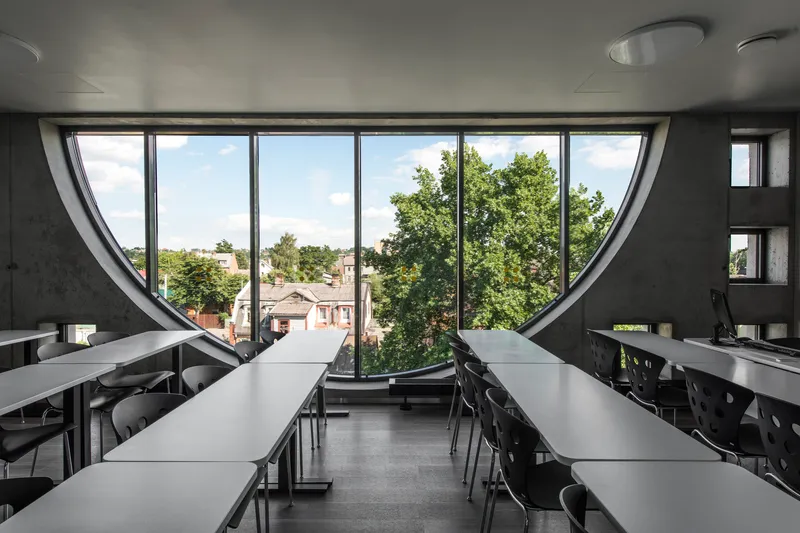
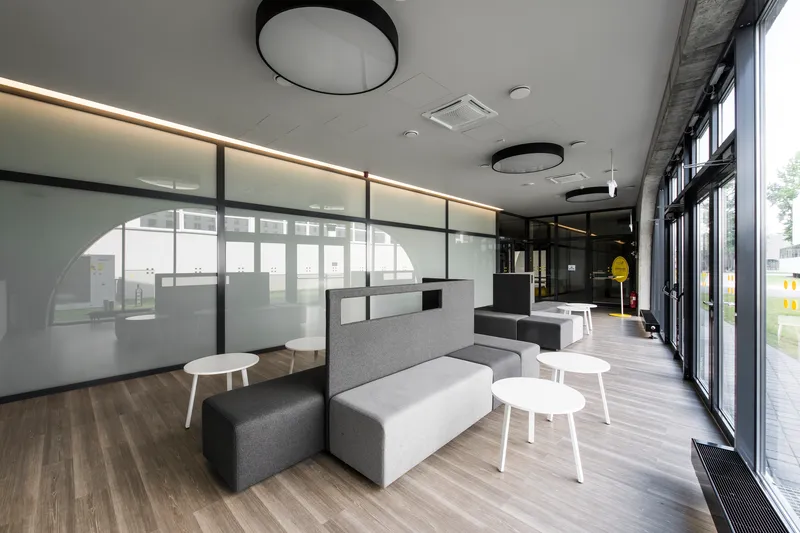
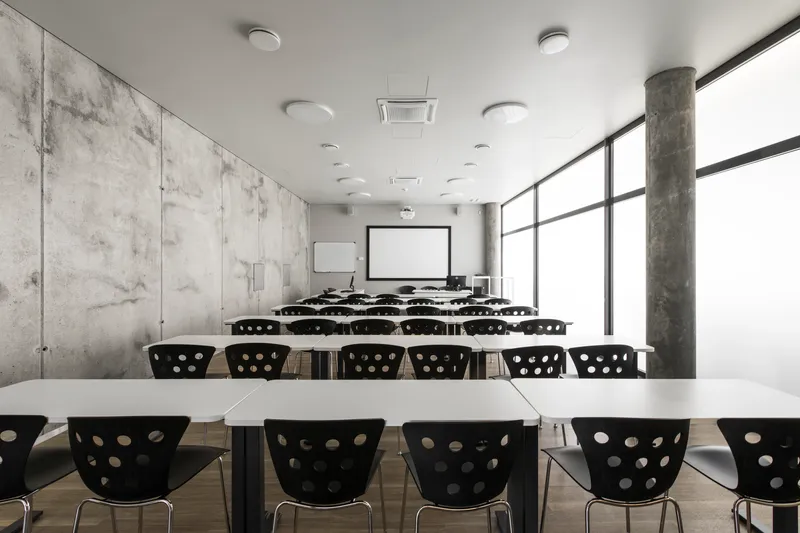
Classrooms are straightforward: white tables, perforated black chairs, projection screens. No heroic gestures. But small decisions elevate them. One classroom offers a semicircular window that looks out over leafy trees and rooftops, turning a routine lecture into a moment of visual relief. Lounge areas on the upper floors feature grey fabric seating modules and frosted glass partitions, providing informal collaboration space without resorting to the open-plan clichés that have worn out their welcome.
The ground floor houses auditoriums of transformable size, accommodating both large lectures and smaller group study. Two upper floors contain administration offices, research laboratories, and lecture rooms for seven branches of faculty. The building is planned for 60 permanent staff members and up to 550 students daily, a significant density for a compact footprint.
Material and Light
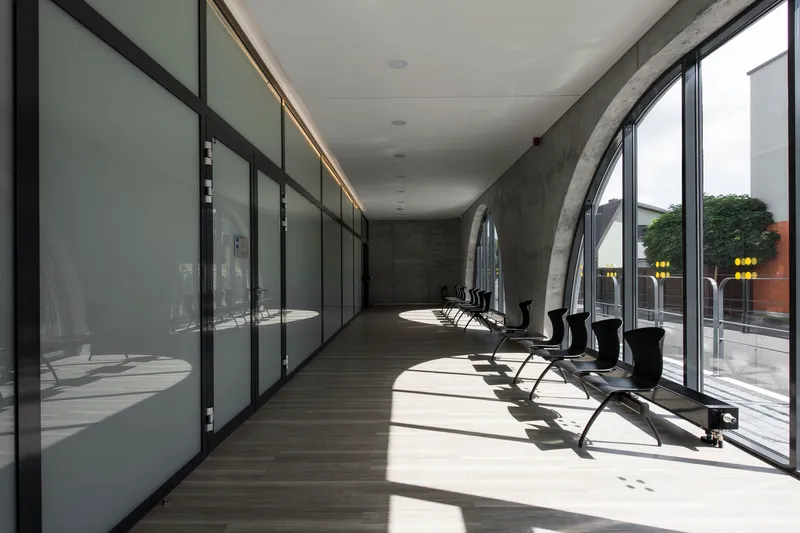
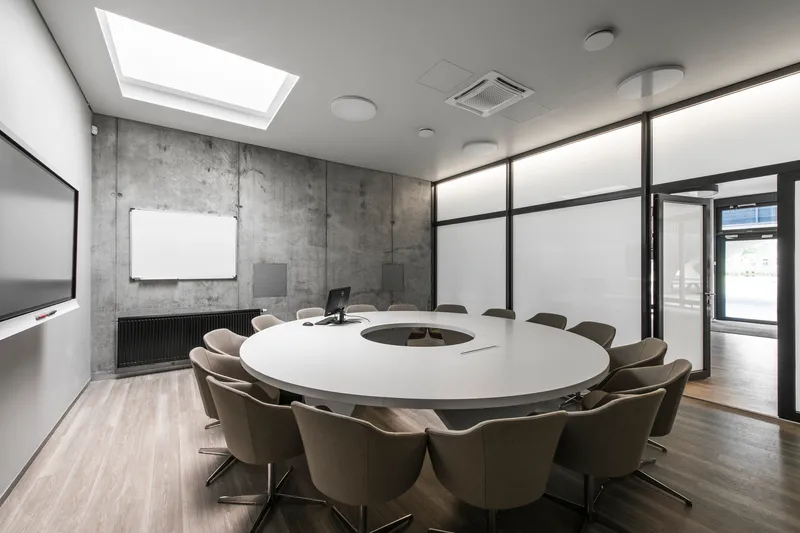
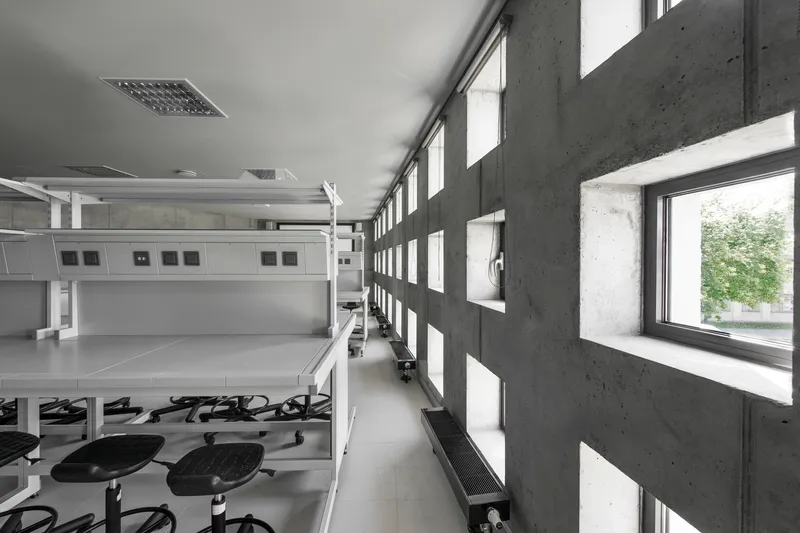
Interior materials are deliberately limited: monolithic concrete, glass, and wood-textured floors. A glazed corridor with black metal frames runs along a concrete wall, catching afternoon light in a way that feels almost residential. Elsewhere, a perforated concrete block wall filters daylight beside an open workroom, creating a subtle screen effect that mirrors the facade's circular cutouts on a smaller scale.
A conference room tucked beneath a skylight pairs an exposed concrete wall with a simple circular table. It is one of the quietest spaces in the building, designed for focused work rather than spectacle. The material restraint throughout keeps costs reasonable and construction honest, matching the rational ethos of the interwar buildings the architects drew from.
Plans and Drawings
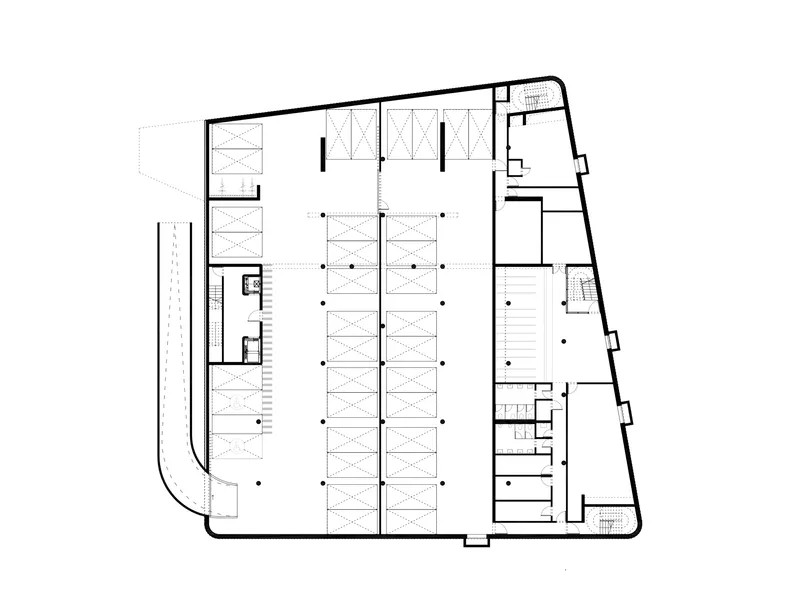
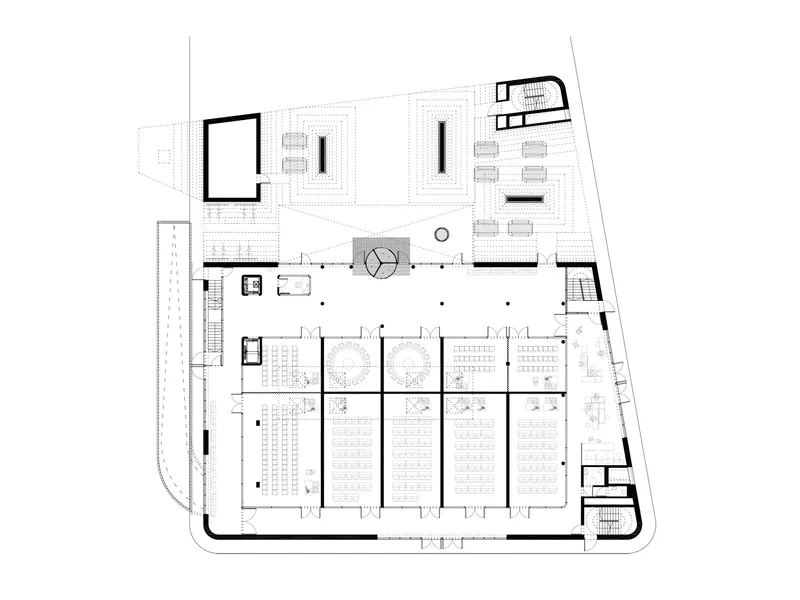
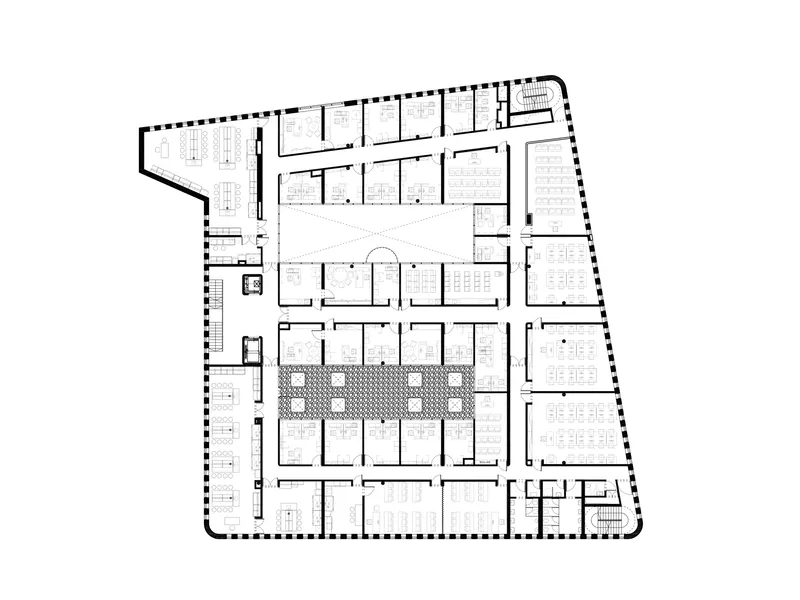
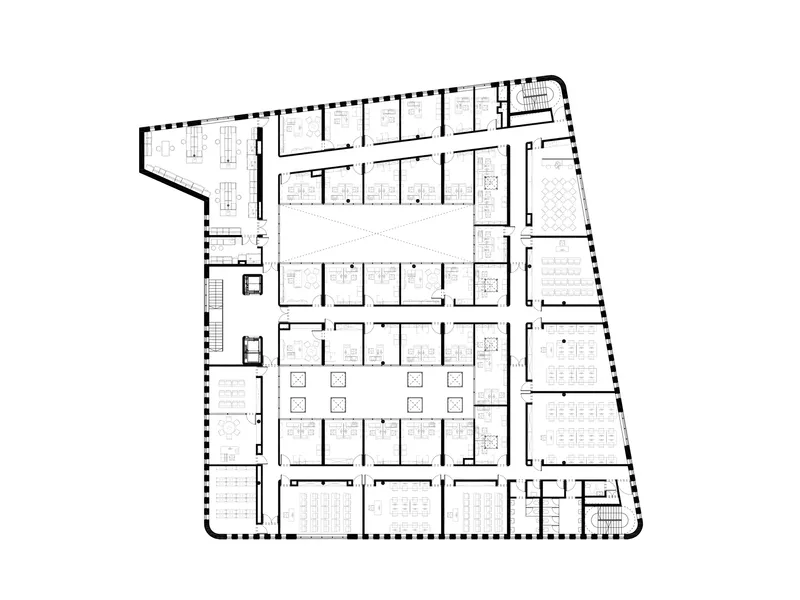
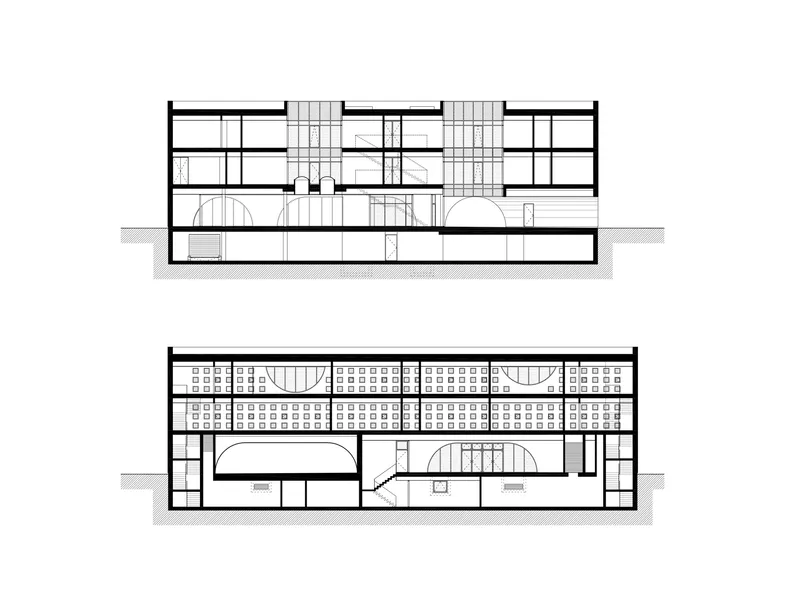
The floor plans confirm what the photographs suggest: a compact, highly organized volume. The underground level is given over entirely to staff parking, with a central circular stair core connecting it to the floors above. The ground floor radiates outward from a central open workspace. Upper floors arrange perimeter offices around the central arched atrium, maximizing daylight access for individual rooms. The section drawing reveals the two-level arched openings and the stair's role as the building's vertical spine.
What stands out in the drawings is the efficiency of the plan. The architects achieved elegance without waste, placing circulation at the core and pushing habitable rooms to the perimeter. The result is a floor plate where nearly every office and classroom benefits from natural light and a view, whether outward to the campus or inward to the courtyard.
Why This Project Matters
Heritage contexts tend to produce one of two responses: timid contextual mimicry or self-conscious formal provocation. G.Natkevicius & Partners avoided both. Their Faculty of Public Health takes the construction logic and spatial discipline of Kaunas's interwar modernism seriously enough to learn from it, then applies those lessons with a contemporary hand. The arches, the circular openings, the white plaster surface: none of these are copies. They are translations, informed by the originals but entirely new in their proportions and combinations.
For a university building designed to serve 550 students daily, the real test is whether the architecture supports the life inside it. The dual-atrium strategy, the transformable auditoriums, the courtyard that gives researchers daylight and privacy: these are practical decisions that also happen to produce memorable spaces. In a city whose modernist heritage is increasingly recognized internationally, this building demonstrates that heritage protection and architectural ambition are not at odds. They can, when handled with care, reinforce each other.
Lithuanian University of Health Sciences Medical Academy Faculty of Public Health by Architectural Bureau G.Natkevicius & Partners. Kaunas, Lithuania. 5,217 m². Completed 2020. Photography by L. Garbačauskas.
About the Studio
Share Your Own Work on uni.xyz
If projects like this are the kind of work you want to make, uni.xyz is a place to publish your own, find collaborators, and enter design competitions.




Popular Articles
Popular articles from the community


Riyadh For All: Intergenerational Urban Design for Active Aging in Rabat
Riyadh For All reimagines urban design in Rabat with intergenerational co-living, adaptive courtyards, and Moroccan cultural exchange today.

Co-life: Sustainable Architecture for Age-Friendly Community Living
Co-life reimagines sustainable architecture for seniors through courtyards, rammed earth, shared gardens, and spaces designed for belonging.

Play: Fragments of Their World
Familiar architecture becomes modular playground design, creating safe spaces where displaced children can learn, connect, imagine and play.

Lunar Spiral: Space Architecture Shaped by the Mathematics of the Universe
Lunar Spiral reimagines space architecture through Fibonacci geometry, lunar regolith, levitating habitats, and self-sustaining Moon living.


Similar Reads
You might also enjoy these articles

Bao Huynh Watercolor Atelier: A Serene Art Retreat in Hội An
Bao Huynh Watercolor Atelier in Hội An blends multifunctional art spaces, sustainable design, local materials, and family-friendly living in a serene environment.

Atelier Macri Concept Store Interior Design by CASE-REAL
Atelier Macri store features a "ko" counter, walnut wood details, cork displays, blending retail, gallery, and seamless customer experiences.

Manuel Vargas Izquierdo Stadium and High-Performance Sports Center: Architectural Excellence in Jalpa de Méndez
The Manuel Vargas Izquierdo Stadium blends sustainable design, inclusive sports facilities, and cultural-inspired architecture, revitalizing Jalpa de Méndez’s public spaces.

KAKR Buluh Awar Hall: Revitalizing Community and Ecology Through Bamboo Architecture
Community built bamboo hall revitalizes Buluh Awar village, empowering youth, restoring ecology, celebrating vernacular craftsmanship through sustainable architecture and culture.


Explore Educational Building Competitions
Discover active competitions in this discipline



Challenge to design public laboratory


Challenge to reimagine the Iron Throne


Photograph architecture without architects


Illustrate the lost glory of Angkor Wat - Render Challenge
Comments (0)
Please login or sign up to add comments
No comments yet. Be the first to comment!