

Growing My Life: Agriculture as Desert Architecture
A Saharan settlement where architecture serves an agricultural economy, transitioning nomadic communities into self-sufficient market towns.


How do you turn a nomadic community into a settled one without destroying what made it work? Growing My Life, a project by Hu Xin Yue, proposes an answer rooted in agriculture. The settlement does not ask people to stop moving. It gives them a reason to stay: food production, trade, and a built environment that supports both.
Shortlisted in the Extreme Habitat Challenge: Sahara on uni.xyz, this project stands out for its focus on economic transition rather than architectural spectacle. The buildings exist to serve a new agricultural economy, not the other way around.
From Nomadic Life to Settled Community
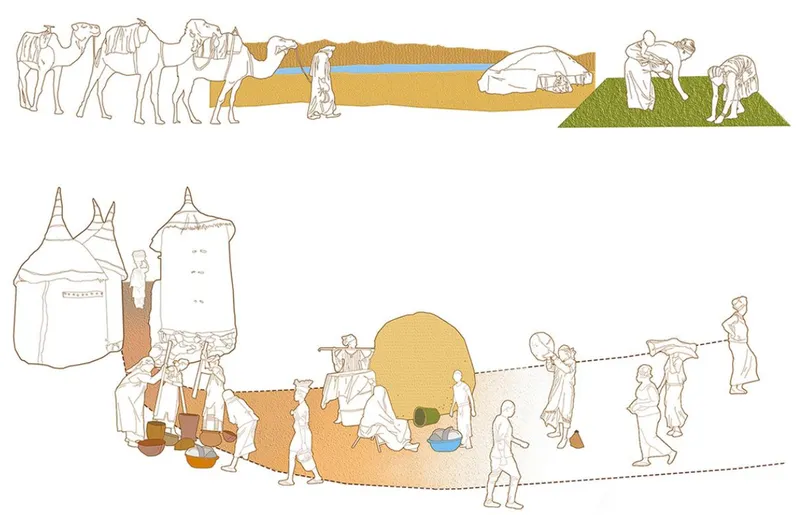
The project begins by studying the existing nomadic lifestyle: camel caravans, tent camps, communal cooking around fires, seasonal movement following water and grazing. These are not problems to solve. They are social structures to preserve. The design challenge is to build a settlement that retains the communal patterns of nomadic life while adding the stability of agriculture.
The lifestyle diagrams on the project board trace this transition honestly. They show what is gained (crop security, permanent shelter, workshops) and what must be kept (shared meals, collective labour, the social rhythms of gathering and dispersal). Architecture that ignores either side fails.
The Dwelling: Shop, Workshop, Home

Each dwelling unit combines three functions on two floors. The ground floor contains a shop facing the street and a processing workshop for crops. The upper floor holds the private programme: a terrace with shade trees, a bedroom, a cooking area, and a bathroom. Living and working happen in the same building.
This is the same mixed-use logic that drives traditional market towns. The family that grows food also processes it, sells it, and lives above the shop. There is no commute, no separation between economic and domestic life. The building is the business.
The Section: Architecture as Agriculture
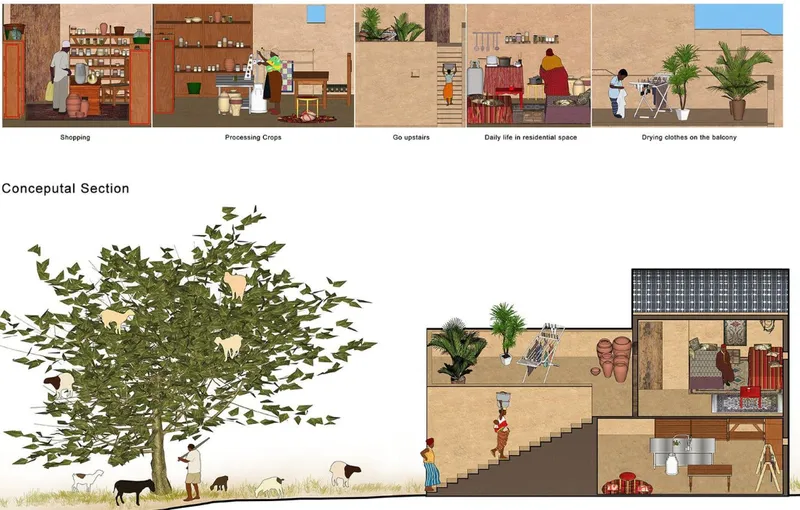
The conceptual section is the strongest drawing in the project. It shows a full dwelling unit in cross-section with programme labels: property boundaries, crop processing areas, air circulation systems, daily life zones, and living spaces. A courtyard tree sits at the centre, providing shade, marking the boundary between public and private, and anchoring the section visually.
The section reads like a diagram of a working farm household. Air moves through the building for passive cooling. Crops move from field to workshop to shop. People move from bedroom to terrace to street. Every circulation is productive.
The Market: Where Economy Meets Community

The market rendering is the project's most vivid image. Shaded produce stalls line the streets under striped canopies and umbrellas. Solar panels sit on the rooftops above. Residents trade, browse, and gather. The scale is human: narrow lanes, low buildings, shade everywhere.
Markets are the hardest public spaces to design because they must be simultaneously ordered (for logistics) and loose (for social life). This one achieves both. The stalls follow a grid. The canopies break the grid. The result is a space that feels organised and alive at the same time.
Why This Project Matters
Most extreme habitat proposals focus on survival: how to keep people alive in hostile conditions. Growing My Life focuses on livelihood: how to give people a reason to thrive. The distinction matters. A shelter keeps you alive. An economy keeps you there. This project understands that architecture for the Sahara must be economic infrastructure first and shelter second.
The project is also a useful model for anyone designing in contexts where communities are transitioning from mobile to settled life. The lesson is clear: do not design the building and hope the economy follows. Design the economy and let the building serve it.
View the Full Project
About the Designer
Designer: Hu Xin Yue
Enter a Design Competition on uni.xyz
If you are interested in sustainable design, agricultural architecture, or community-scale projects, uni.xyz runs competitions year-round that reward practical, grounded thinking.
Project credits: Growing My Life by Hu Xin Yue. Shortlisted, Extreme Habitat Challenge: Sahara (uni.xyz).



Popular Articles
Popular articles from the community

AL-JANNAH: Sustainable Architecture and Permaculture for Afghan Widows
AL-JANNAH uses sustainable architecture and permaculture to create resilient oasis of housing, learning, work and renewal for Afghan widows.

The Earth Pod: 3D Printed Homes for Resilient Refugee Communities
The Earth Pod reimagines refugee housing through 3D printed homes made from clay, combining resilience, self-sufficiency, and rapid shelter.

The Musturak Paradise: Senior Living Architecture for a Connected Future in Temara, Morocco
The Musturak Paradise reimagines senior living architecture in Temara via private homes, social spaces, culture, community, and shared care.

Riyadh For All: Intergenerational Urban Design for Active Aging in Rabat
Riyadh For All reimagines urban design in Rabat with intergenerational co-living, adaptive courtyards, and Moroccan cultural exchange today.


Similar Reads
You might also enjoy these articles

Day and Night Park: A Time-Based Urban Newsstand in Beijing
A temporary urban newsstand in Beijing blending travel, light, and reading through poetic colors, compact form, and community-focused design.

Modernist Patio Renovation in El Masnou, Barcelona by Oliver Segura Arquitectura + Cebrià Arquitectura
Modernist patio renovation blending tradition and innovation with a movable pool, leveled floors, and Catalan materials in El Masnou.

Alto Residencial Coop: Cooperative Housing Development in Santiago de Compostela by Carbajo Barrios Arquitectos
A linear cooperative housing complex blending white volumes and perforated metal façades, enhancing community living, natural light, privacy, and urban integration.

Vil Genis School by BPA ARCHITECTURE – Massy, France
Vil Genis School in Massy, France, features sustainable design, south-facing classrooms, community integration, accessible spaces, and modern educational architecture.


Explore Desert Architecture Competitions
Discover active competitions in this discipline



Challenge to reimagine the Iron Throne


Photograph architecture without architects


Illustrate the lost glory of Angkor Wat - Render Challenge


Design challenge to reuse E-waste
Comments (0)
Please login or sign up to add comments
No comments yet. Be the first to comment!