
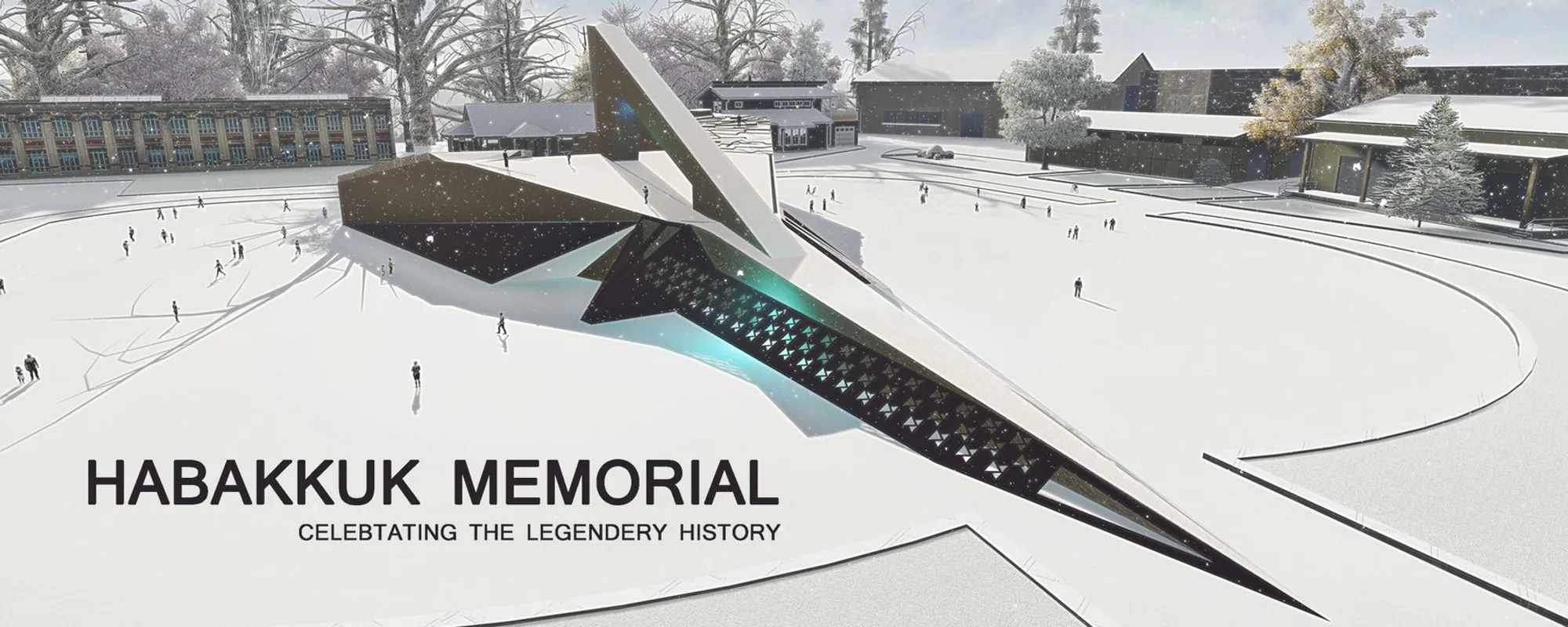
Habakkuk Monument: Wartime Ice Engineering Reborn as Sustainable Pavilion
A multi-stage pavilion at La Citadelle de Quebec reimagines Project Habakkuk through Pykrete, jute, and cedar in Quebec's extreme winter climate.


In 1942, the British military entertained a genuinely wild idea: building unsinkable aircraft carriers out of Pykrete, a composite of wood pulp and ice. Project Habakkuk never left the drawing board, but its material logic, that ice could be engineered into something structurally resilient, remains provocative. The Habakkuk Monument takes that logic and drops it into the snow-covered terrain of La Citadelle de Quebec, where a pavilion made from Pykrete, jute, and yellow cedar becomes both a memorial to wartime ingenuity and a live experiment in biodegradable construction.
Designed by Pe Za, this shortlisted entry in the Architecture on the Clock competition sits at one of Quebec City's highest points, within Canada's oldest military building and a UNESCO World Heritage site that draws over 200,000 visitors annually. The Citadelle's identity as a living emblem of defense and endurance gives the project a layered context: a speculative wartime technology finds its home in a fortification that has witnessed centuries of actual conflict. The result is a medium-scale pavilion that transforms military legacy into a conversation about eco-materiality.
Angular Rooflines Breaking Through the Snow
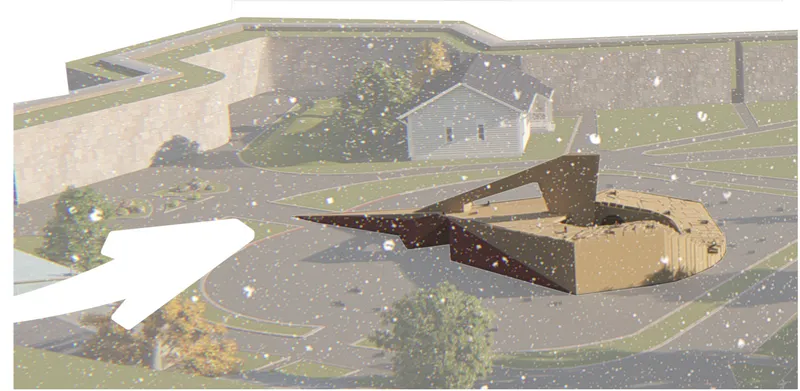
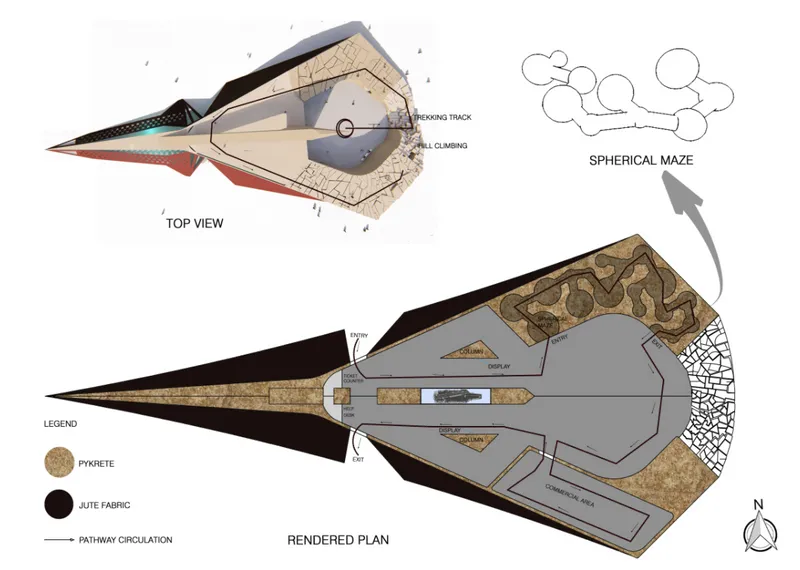
From above, the pavilion reads as a series of fractured, angular roof planes punctuated by a triangular aperture that funnels light into the gallery below. The tapered form houses a central exhibition gallery alongside a spherical maze, a playful spatial device that echoes the experimental spirit of the original Habakkuk concept. The plan reveals how the building's geometry is not arbitrary: its orientation responds to prevailing wind patterns and solar angles analyzed through detailed wind rose and temperature studies, critical when peak snowfall months regularly exceed 300mm.
Three Stages of Material Experimentation
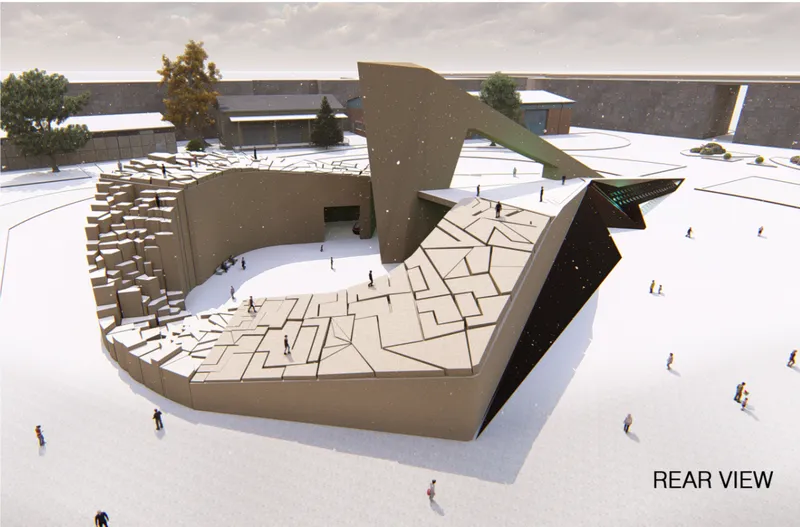
The pavilion's construction unfolds in three distinct stages, each pushing the material palette further. Stage One establishes a wooden structure of yellow cedar, chosen for its durability and natural decay resistance, housing a souvenir shop and the sphere maze. Stage Two introduces Pykrete itself as a full-scale structural material. Compared to pure ice, Pykrete offers superior structural stability and lower thermal conductivity, making it a resilient yet entirely biodegradable building component. Stage Three wraps the form in an exo-skeleton of jute, an organic textile celebrated for tensile strength, breathability, and cost-effectiveness.
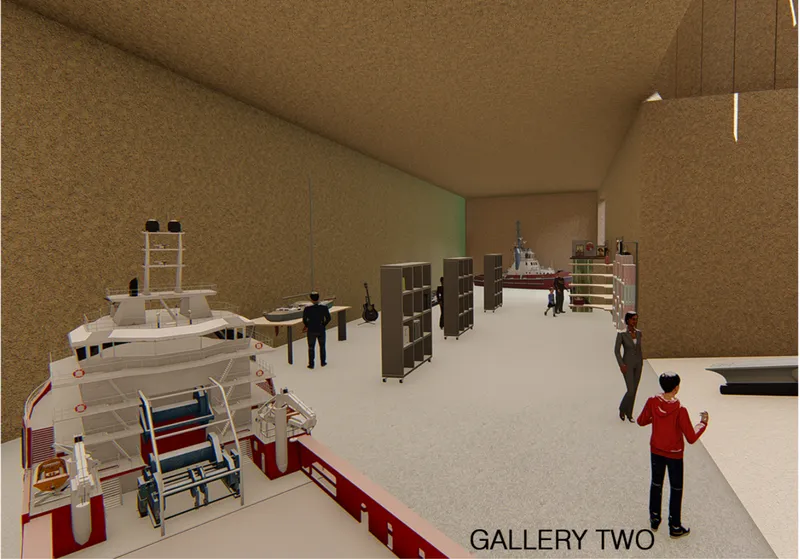
Inside the gallery, visitors move through vaulted spaces with richly textured ceilings, encountering exhibition displays that narrate both the Citadelle's military past and Habakkuk's speculative history. The stepped exterior doubles as a climbing wall, inviting physical engagement with the structure's geometric surfaces. CAIS (Custom Air Inflated Structures) supplement the permanent elements, enabling quick, lightweight, modular assembly during Quebec's narrow spring construction window, when the season arrives abruptly and leaves little margin for error.
Cantilevered Planes and Green Glazing Against Winter Sky
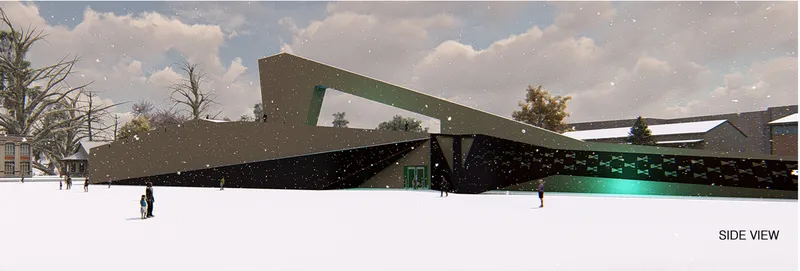
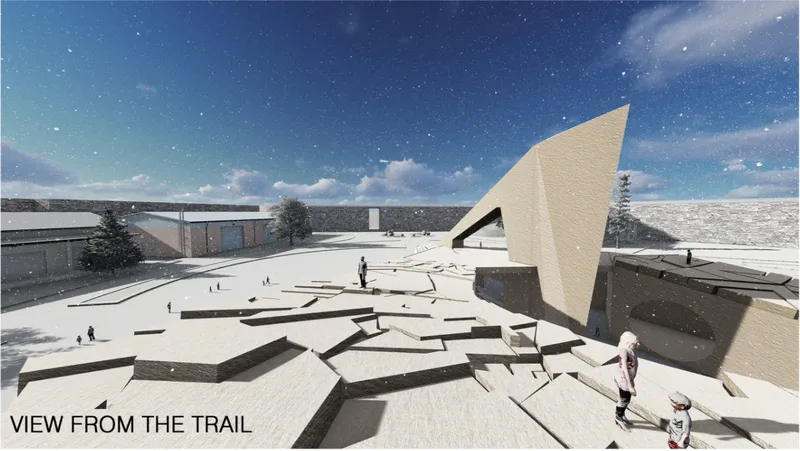
The side elevation reveals how dramatically the roof planes cantilever outward, creating sheltered zones at ground level while projecting a bold silhouette against the cloudy winter sky. Green-tinted glazing panels punctuate the facade, filtering light into interior spaces with a quality that shifts with the seasons. From the approach trail, the pavilion's fractured plaza levels step down the terrain, and triangular sail-like roof forms catch snowfall in a way that makes the structure appear to grow from the landscape rather than sit on it. The polygonal facade accumulates snow as a deliberate part of its expression: weather does not degrade the monument, it completes it.
Emerging from the Terrain Like a Fortification
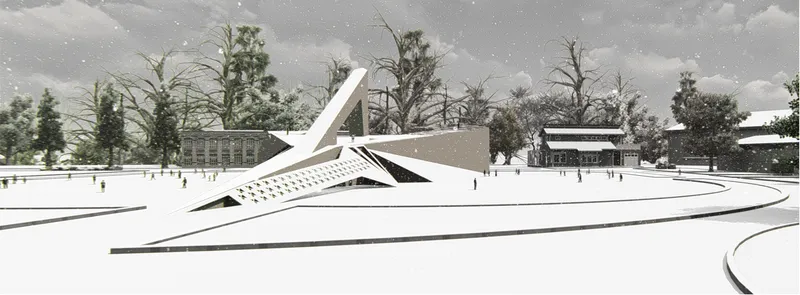
Viewed from the broader site, the pavilion's angular white roof forms emerge from snow-covered ground among scattered evergreen trees, reinforcing its identity as architecture that belongs to its climate rather than resisting it. The formal language recalls military fortification walls, yet the materials tell a completely different story: one of impermanence, biodegradability, and cyclical renewal. The structure is designed to weather, to melt, to be rebuilt. It is a monument not to permanence, but to the idea that resilience can be found in adaptation.
Why This Project Matters
The Habakkuk Monument succeeds because it refuses to treat heritage as static. By constructing a pavilion from materials that are literally impermanent, Pe Za turns the conventional memorial on its head. Monuments typically assert that we will never forget; this one acknowledges that memory, like ice, requires active maintenance. The three-stage construction sequence is not just a building method but a pedagogical framework, teaching visitors about material science through the act of inhabiting it.
More broadly, the project poses a question that the architecture profession has been slow to answer honestly: can buildings that are designed to disappear carry as much cultural weight as those built to last forever? At La Citadelle, where stone walls have endured since the 17th century, placing a Pykrete and jute structure is a deliberate provocation. It suggests that sustainable architecture does not need to mimic the permanence of its predecessors to be meaningful. Sometimes the most powerful statement a building can make is that it will, gracefully and intentionally, return to the earth.
View the Full Project
About the Designers
Designer: Pe Za
Enter a Design Competition on uni.xyz
uni.xyz runs architecture and design competitions year-round that reward proposals with spatial conviction and real site intelligence.
Project credits: Habakkuk Monument by Pe Za Architecture on the Clock (uni.xyz).



Popular Articles
Popular articles from the community


Conexión: Biophilic Design Reimagines High-Rise Living in Hong Kong
Conexión reimagines high-rise living in Hong Kong through biophilic design, green facades, shared spaces, daylight, water and nature within.

Lunar Spiral: Space Architecture Shaped by the Mathematics of the Universe
Lunar Spiral reimagines space architecture through Fibonacci geometry, lunar regolith, levitating habitats, and self-sustaining Moon living.

Play: Fragments of Their World
Familiar architecture becomes modular playground design, creating safe spaces where displaced children can learn, connect, imagine and play.

The Musturak Paradise: Senior Living Architecture for a Connected Future in Temara, Morocco
The Musturak Paradise reimagines senior living architecture in Temara via private homes, social spaces, culture, community, and shared care.

Similar Reads
You might also enjoy these articles

Day and Night Park: A Time-Based Urban Newsstand in Beijing
A temporary urban newsstand in Beijing blending travel, light, and reading through poetic colors, compact form, and community-focused design.

Modernist Patio Renovation in El Masnou, Barcelona by Oliver Segura Arquitectura + Cebrià Arquitectura
Modernist patio renovation blending tradition and innovation with a movable pool, leveled floors, and Catalan materials in El Masnou.

Alto Residencial Coop: Cooperative Housing Development in Santiago de Compostela by Carbajo Barrios Arquitectos
A linear cooperative housing complex blending white volumes and perforated metal façades, enhancing community living, natural light, privacy, and urban integration.

Vil Genis School by BPA ARCHITECTURE – Massy, France
Vil Genis School in Massy, France, features sustainable design, south-facing classrooms, community integration, accessible spaces, and modern educational architecture.

Comments (0)
Please login or sign up to add comments
No comments yet. Be the first to comment!