

Hélène Carrère d'Encausse School by archi5 + bureau faceB
A nature-immersed school merging two institutions, featuring timber structures, curved forms, and eco-friendly design that fosters community, learning, and renewal.


A School Rooted in Nature and Community
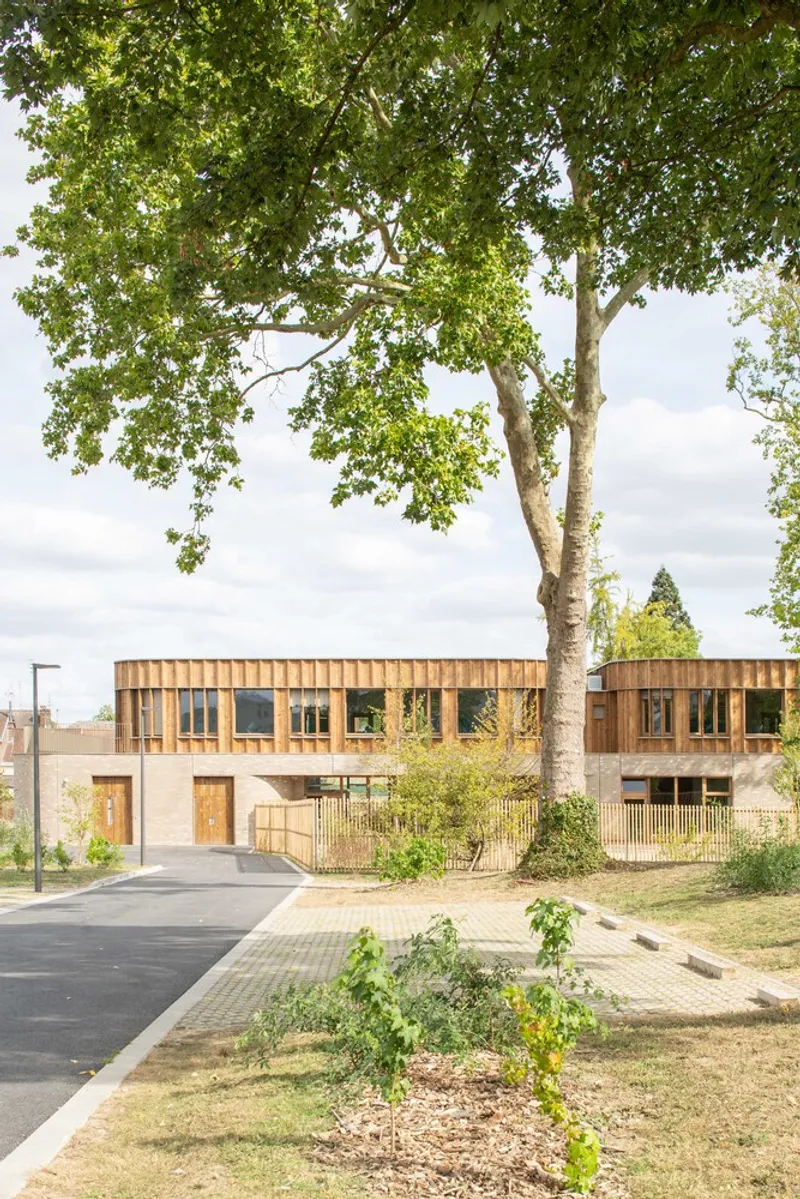
At one of the gateways to Marly, the Hélène Carrère d'Encausse School by archi5 and bureau faceB symbolizes the city’s renewal through education, sustainability, and landscape integration. This contemporary educational complex brings together the Nelson Mandela and Louise Michel Schools, merging them into a single emblematic institution that redefines what a nature-focused learning environment can be.
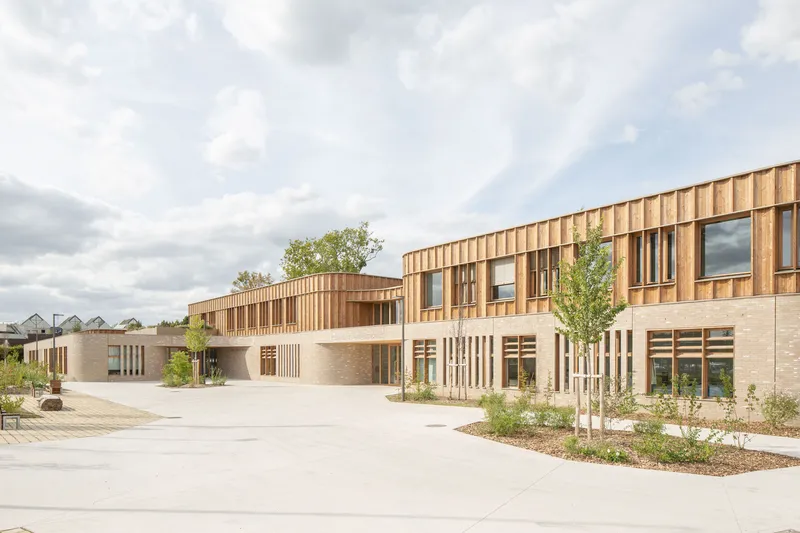
The project’s guiding principle—a school in the trees—expresses a profound connection between architecture and landscape. Conceived as a unifying civic gesture, the school acts as a bridge between urban life and the natural environment, inviting children to learn, play, and grow within a lush, green setting.
Architects: archi5
Architectural Concept: Branches That Unite
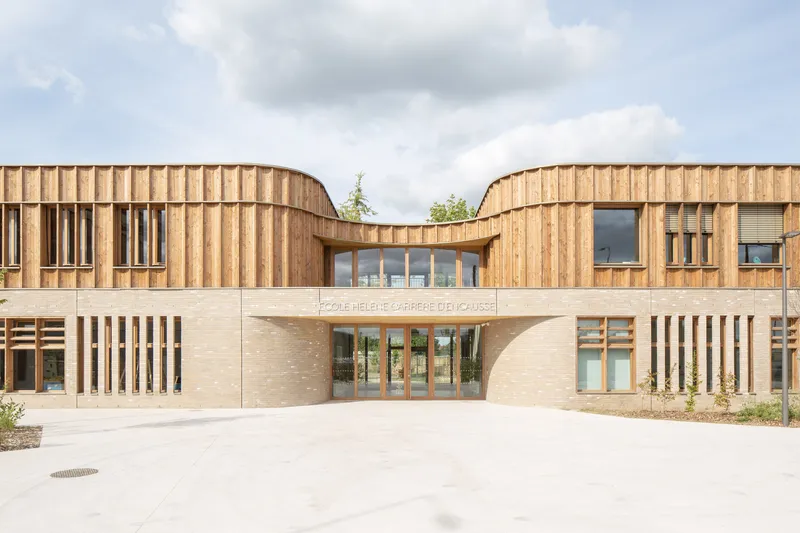
The layout of the building unfolds like two branches extending toward one another, converging at the heart of the park. One branch stretches from the east and the other from the west—symbolically representing students coming together in a shared space of discovery.
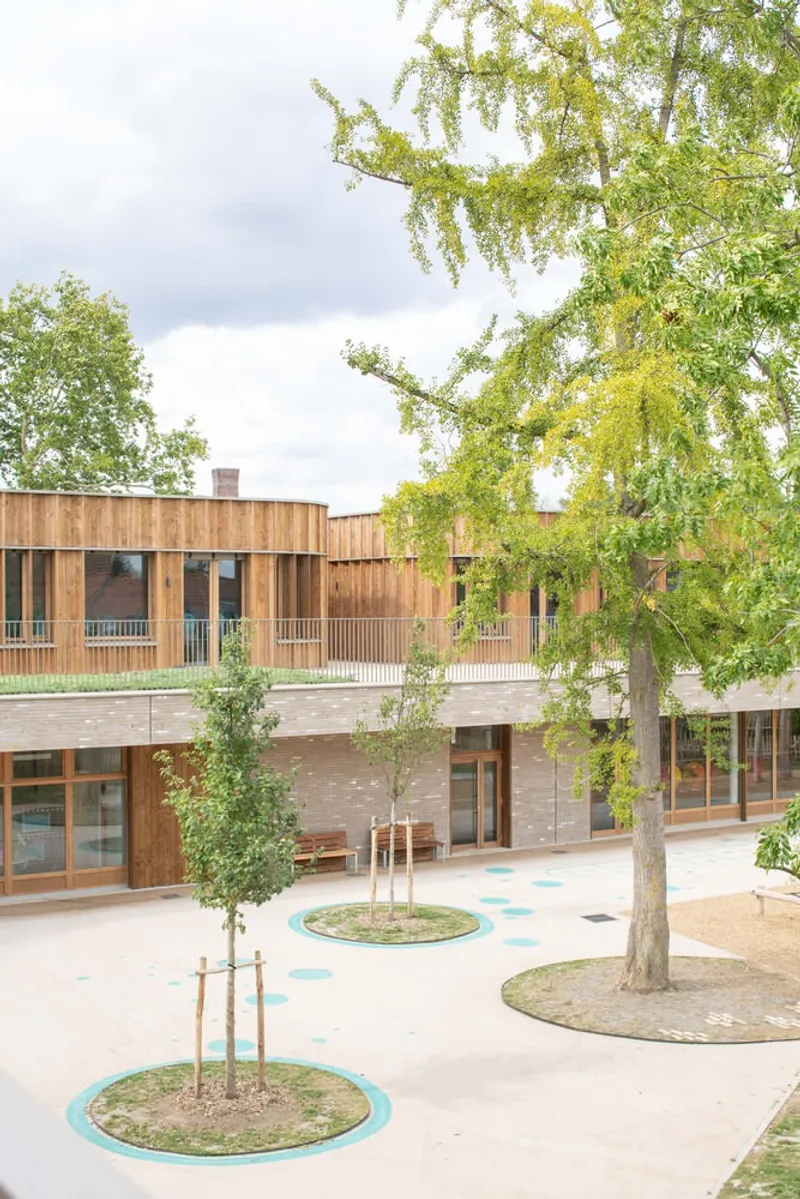
This meeting point divides the southern section of the park into two distinct yet connected playgrounds, serving the nursery and primary schools respectively. The plan embodies a balance between openness and protection, ensuring that the school engages with the surrounding city while creating a nurturing, safe world for children within.
Curves and counter-curves define the architecture, guiding movement through a fluid sequence of classrooms, communal spaces, and outdoor learning environments. These organic forms mirror the natural topography and evoke the gentle rhythm of the surrounding landscape.
Material Expression and Eco-Responsibility
The building’s composition relies on a dialogue between two essential materials:
- A solid concrete base clad in mineral brick, anchoring the school to the public realm and ensuring durability.
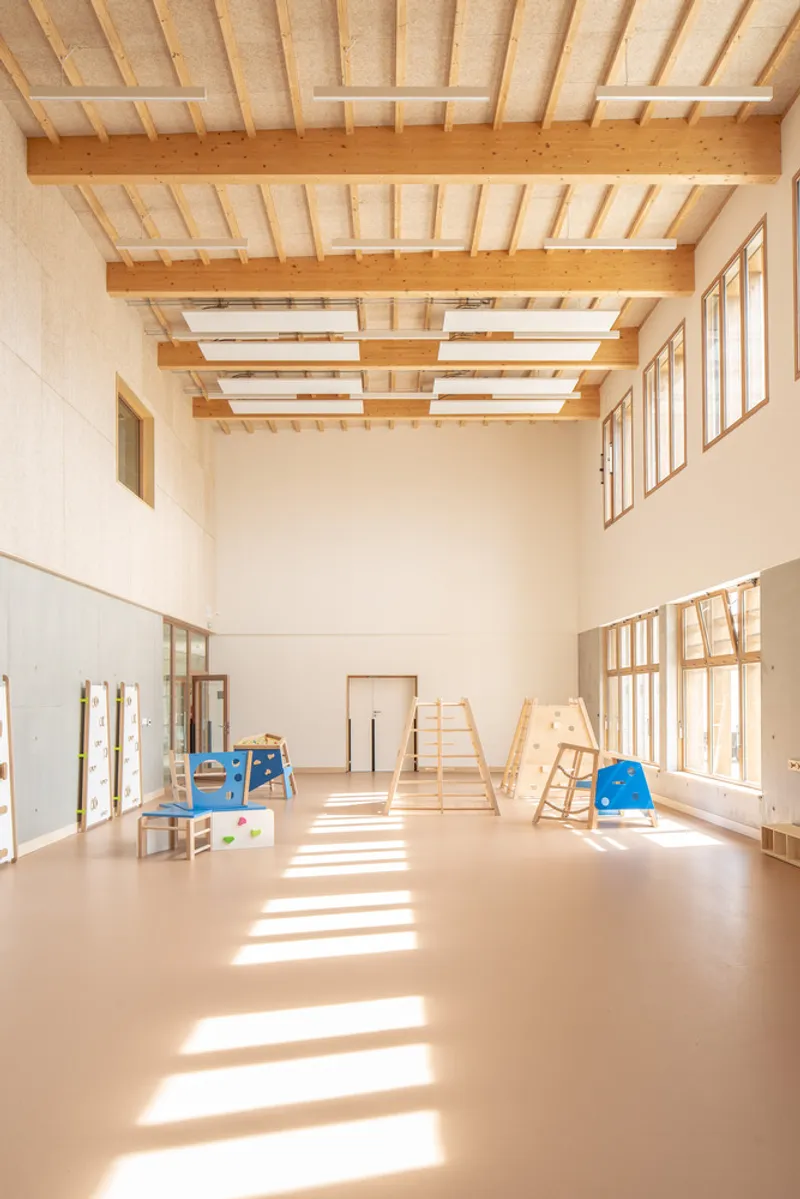
- A lightweight wooden attic with timber facades and natural insulation, expressing warmth, ecological sensitivity, and the metaphor of a school nestled among trees.
This duality reinforces both structural integrity and environmental performance. Natural materials, daylight optimization, and bioclimatic strategies combine to create a sustainable educational environment that minimizes energy use while maximizing comfort and sensory engagement.

A Holistic Learning Landscape
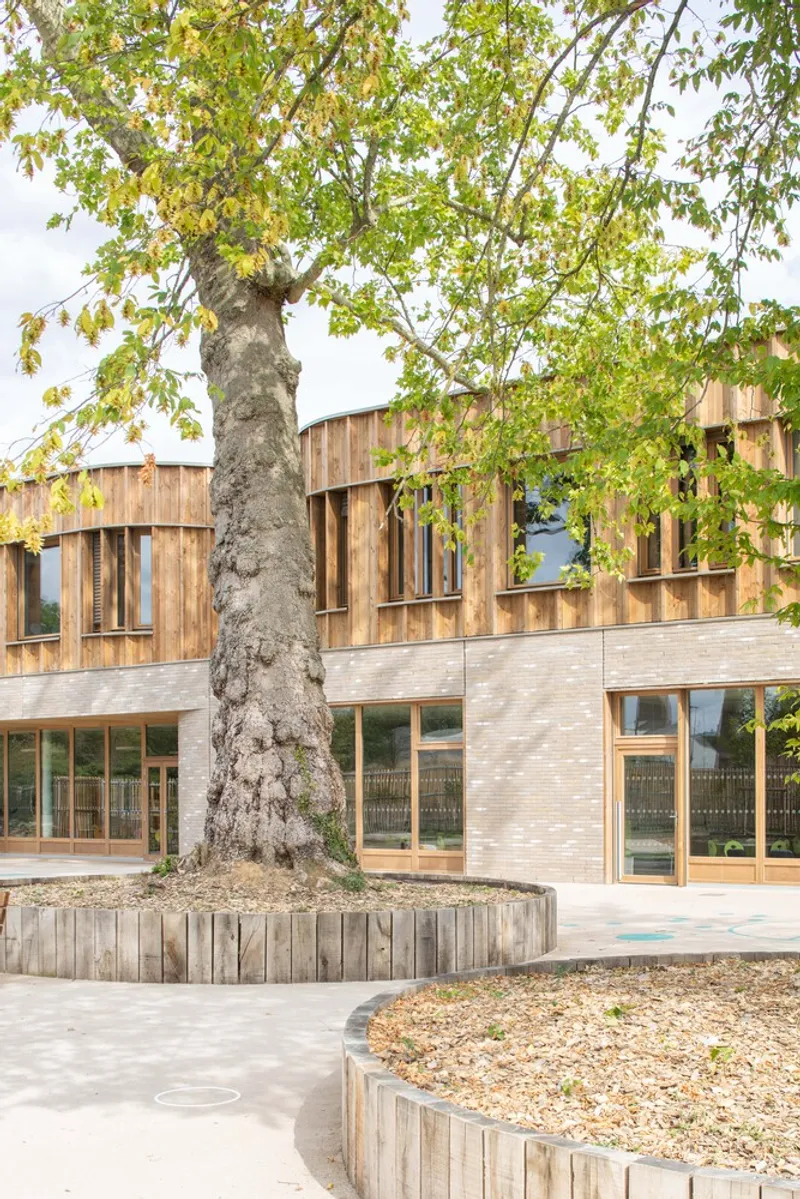
The school’s program supports 12 primary classrooms and 6 nursery classrooms, complemented by a multi-purpose hall, library, after-school care area, kitchen, and a skills room. Beyond the interiors, the landscape design plays a crucial pedagogical role—featuring tree-lined courtyards, shaded playgrounds, rooftop vegetable gardens, and a carefully preserved plant heritage.
These outdoor spaces encourage hands-on environmental learning and foster an early appreciation for ecology, biodiversity, and community responsibility.

The Architecture of a New Educational Era
Through its soft geometries, natural materials, and eco-friendly design, the Hélène Carrère d'Encausse School embodies Marly’s civic ambition: to deliver quality education grounded in sustainability, inclusivity, and shared cultural values.
All photographs are works of Louis Duboys Fresney


Popular Articles
Popular articles from the community


Manzana Morphosis: Stretching Barcelona's Grid into a Living Landscape for 2050
A radical reworking of the Eixample manzana turns density into a tool for generous public space, vertical ecology, and environmental performance.
Faces of the Soviet Avant-Garde: Turning Moscow's Street Names into an Open-Air Museum
A network of sculptural installations across a Moscow residential district transforms forgotten architect names into spatial encounters with cultural memor

The Amber Palace Opera: A Geological Fiction Surfaces on Tallinn's Baltic Waterfront
Pierre Brillard reimagines a Baltic legend as a public landscape, opera house, and waterfront promenade rooted in Tallinn's coastal identity.

Singing Woman: Contemporary Architecture Inspired by Estonia’s Voice and the Sea
Singing Woman turns Estonia’s song culture into flowing opera house architecture, blending public life, landscape, sea, and national memory.

Similar Reads
You might also enjoy these articles


Hodi-Mandai Geram
Project Function: Preservation and revitalization of the Intangible heritage and socio-spatial identity of the Hodi by Housing, Cultural Memory Center, Sacred Grove, landscape, local tourism economy


Olio Towers: A Mid-Rise for Performers That Fuses Housing, Rehearsal, and Stage
Located blocks from Houston's Theater District, this modular tower stacks living units around a central performance atrium.

Oasis: Modular Green Housing Carved into Dhaka's Urban Fabric
A shortlisted Plugin Housing entry reclaims unauthorized settlements in Dhaka with stepped concrete volumes, green roofs, and ventilation-driven design.

Black Hole: A Floating Megastructure for the Post-Physical Era
Emiliano Mazzarotto envisions a spherical, self-scaling arena where e-sports, digital hotels, and holographic stadiums replace traditional public space.

Explore Pont-Aven School Competitions
Discover active competitions in this discipline

Challenge to design public laboratory

Challenge to reimagine the Iron Throne

Photograph architecture without architects

Illustrate the lost glory of Angkor Wat - Render Challenge
Comments (0)
Please login or sign up to add comments
No comments yet. Be the first to comment!