
Luigi Rosselli Architects Burrow Four Levels Beneath a Heritage Sydney Home
In Neutral Bay, a Victorian residence designed by Walter Liberty Vernon gains a subterranean world of vaulted pools and stone grottos.


The most radical move you can make on a heritage-listed house is the one nobody sees. At Hidden Home in Neutral Bay, Luigi Rosselli Architects have excavated four new levels beneath and beside an 1889 residence originally designed by Walter Liberty Vernon, the architect responsible for Sydney's Central Station and the Art Gallery of New South Wales. The original property lost half its land to a 1990s townhouse subdivision, leaving almost no room for conventional additions. Rather than fight the constraints at grade, the team went down, carving through the sandstone ledges that characterize Sydney's lower north shore to produce 900 square metres of new space that barely registers from the street.
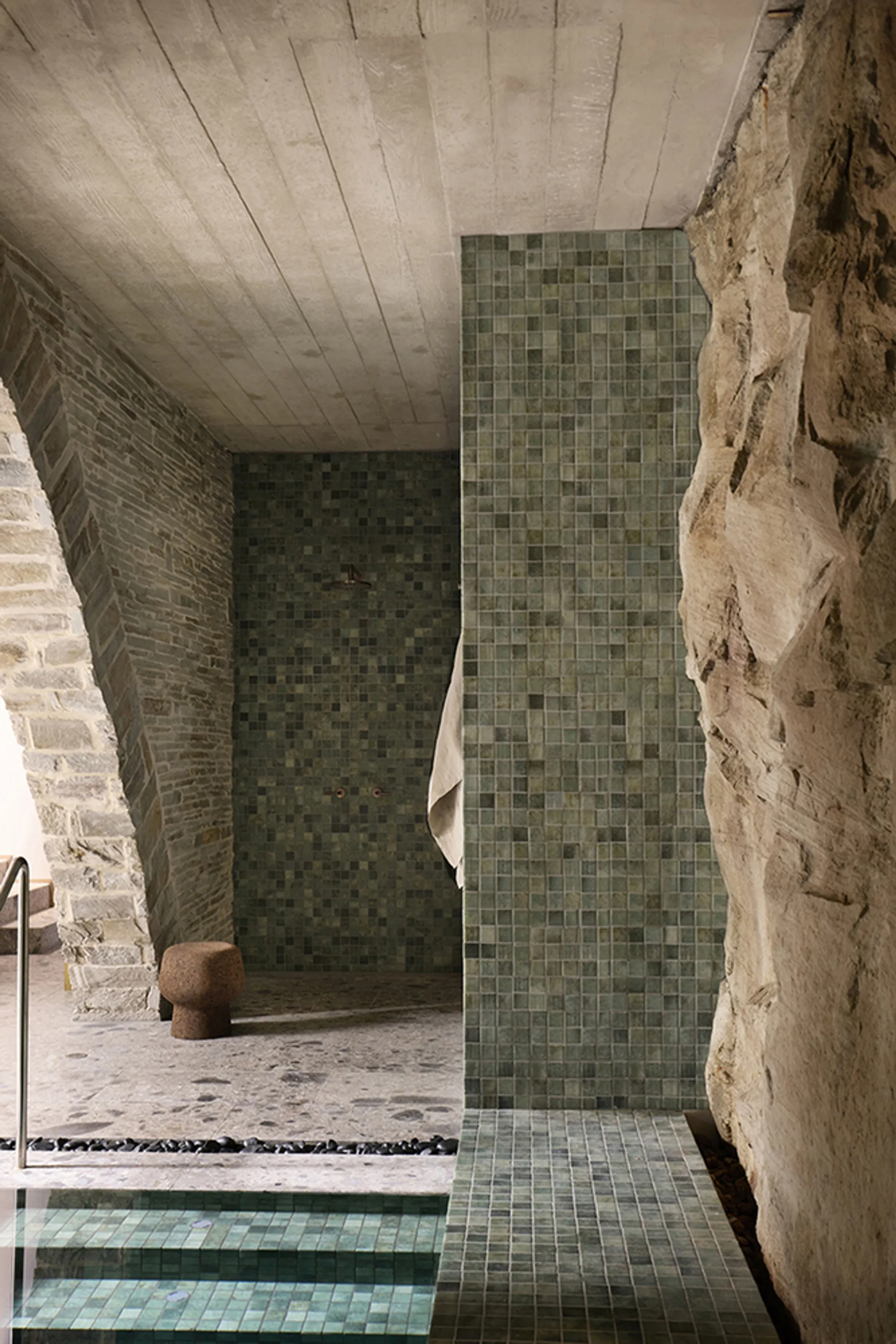
What makes the project genuinely compelling is not the scale of the excavation but the architectural personality it discovers underground. The subterranean levels are not luxury basements dressed up with track lighting. They are vaulted, stone-lined rooms that borrow their material logic from the rock they were cut from. Parabolic arches carry the load of the levels above the 15-metre lap pool. Board-formed concrete ceilings ripple overhead. Green mosaic tiles line pointed brick alcoves. The result feels less like a residential addition and more like a piece of civic archaeology, an inhabited ruin assembled in reverse.
Two Houses in One: Heritage Fabric Meets Glass Pavilion
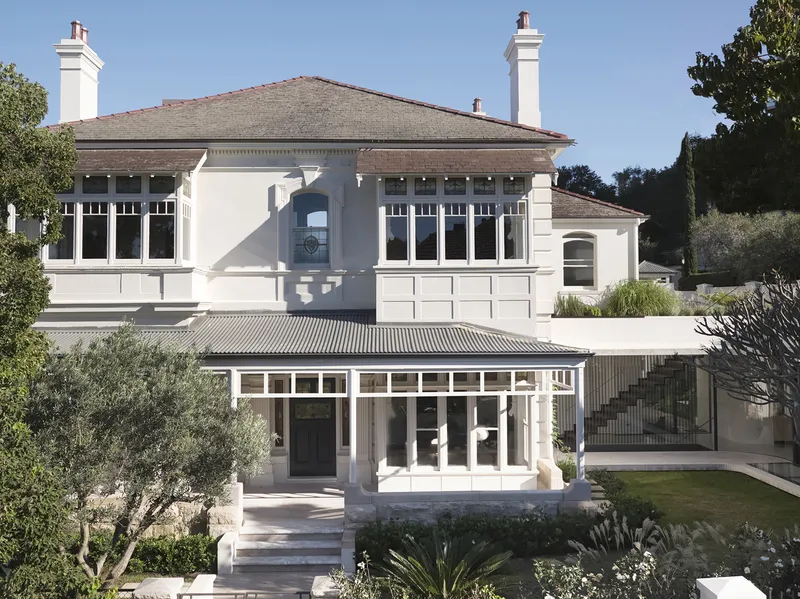

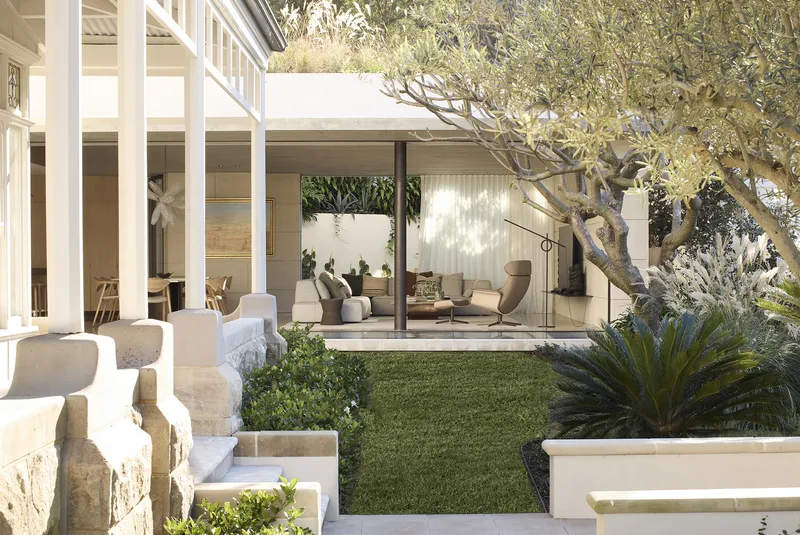
From the garden, the project reads as a deliberate dialogue between two eras. The Victorian upper level retains its hipped roof, white-painted masonry, and original proportions. Below and beside it, a glass pavilion with a pale timber ceiling slides into the landscape, connected to the old house by a glazed link that contains a central staircase reaching from rooftop garden down to the pool level. The demolition of a later garage addition cleared the site for this horizontal move, a trade that swapped dead floor area for a living connection between house and garden.
Landscape architect Will Dangar of Dangar Barin Smith threaded the two registers together with a courtyard strategy: planted beds, mature olive trees, and a compacted river gravel entry path that feels classical without being nostalgic. The garden is not decoration. It is the connective tissue that makes the heritage house and the contemporary pavilion read as a single composition.
The Pavilion Interior: Vaulted Ceilings and Borrowed Light


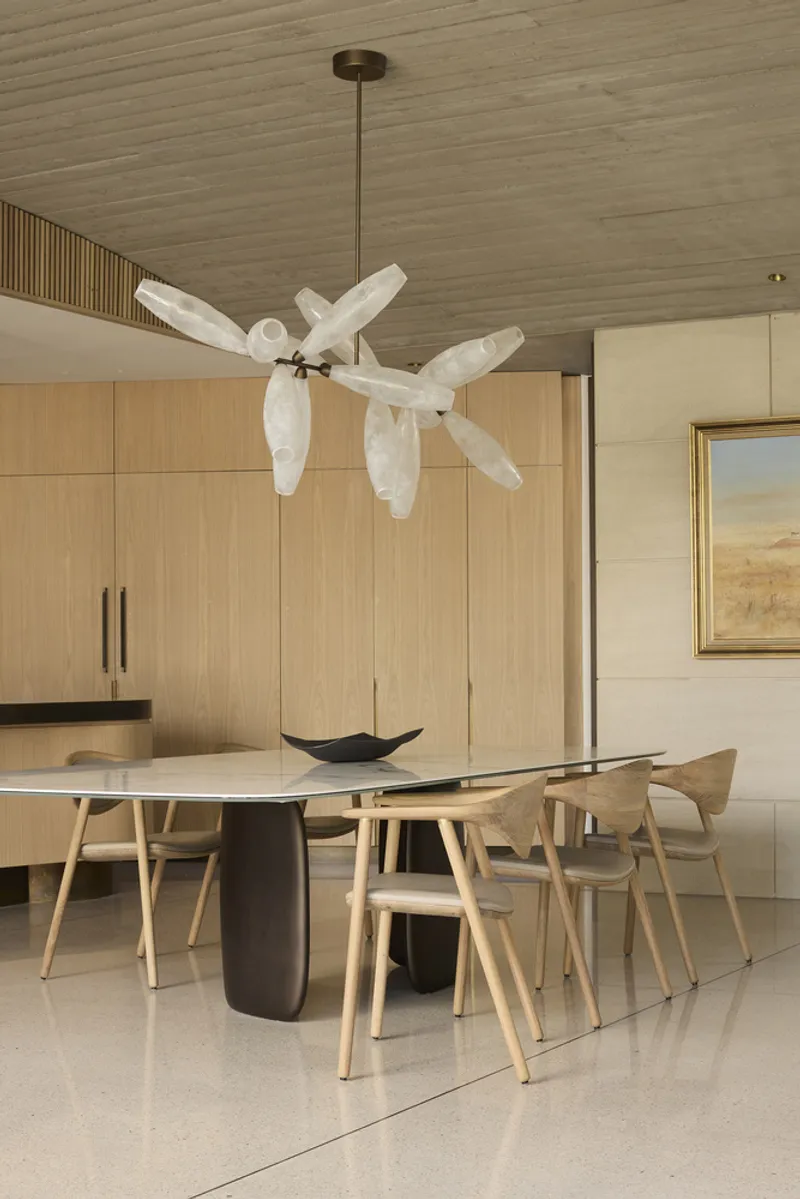
Step inside the new pavilion and the ribbed vault ceiling immediately announces that this is not a standard renovation. The concrete form, board-marked and gently curving, shelters a kitchen and dining area finished in oak joinery and Ceppo di Gre marble. Skylights are cut through two levels above the pool to pull daylight deep into the section, and the glass stair treads in the central link pass light further still. The effect is a chain of borrowed brightness that connects every level to the sky.
Interior designer Romaine Alwill of Atelier Alwill calibrated the material palette to bridge the gap between the ornate Victorian rooms upstairs and the monolithic concrete below. Polished concrete floors, veined marble backsplashes, and brass hardware by Savage Design give each room enough weight to stand next to 135-year-old leadlight windows without flinching.
The Heritage Rooms: Vernon's Architecture Restored
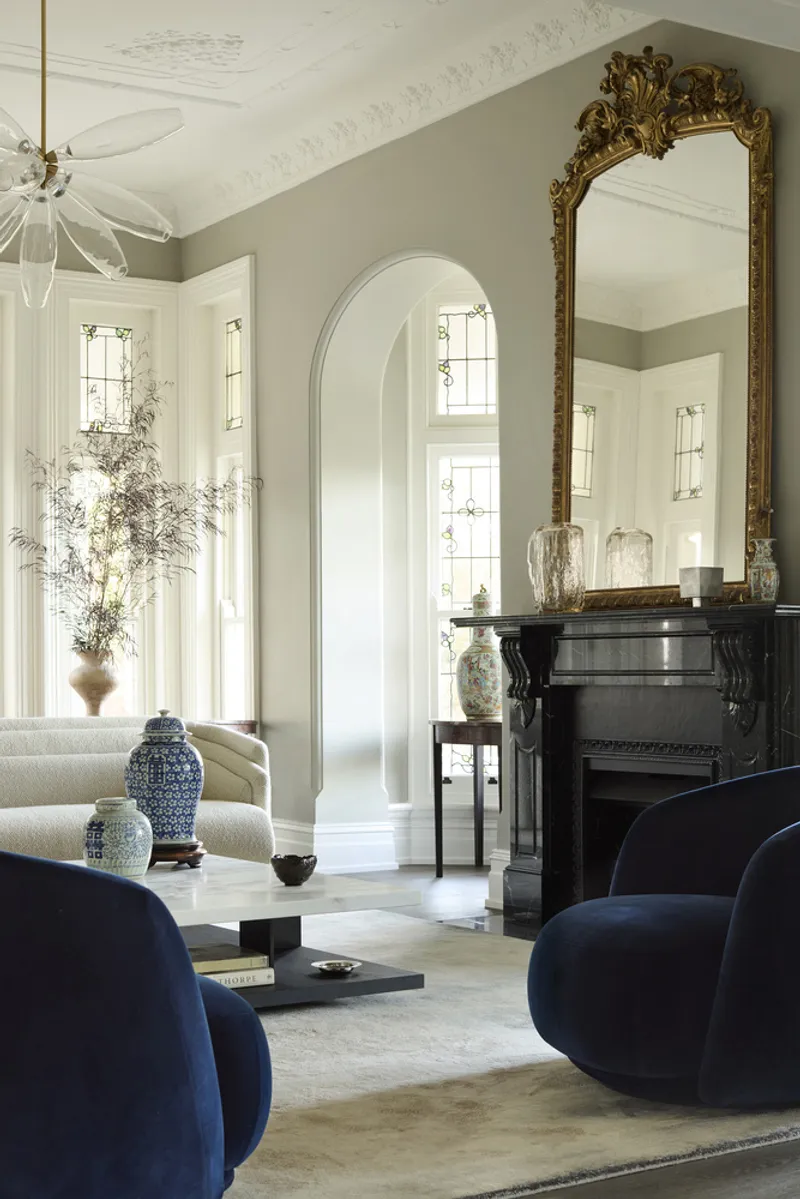
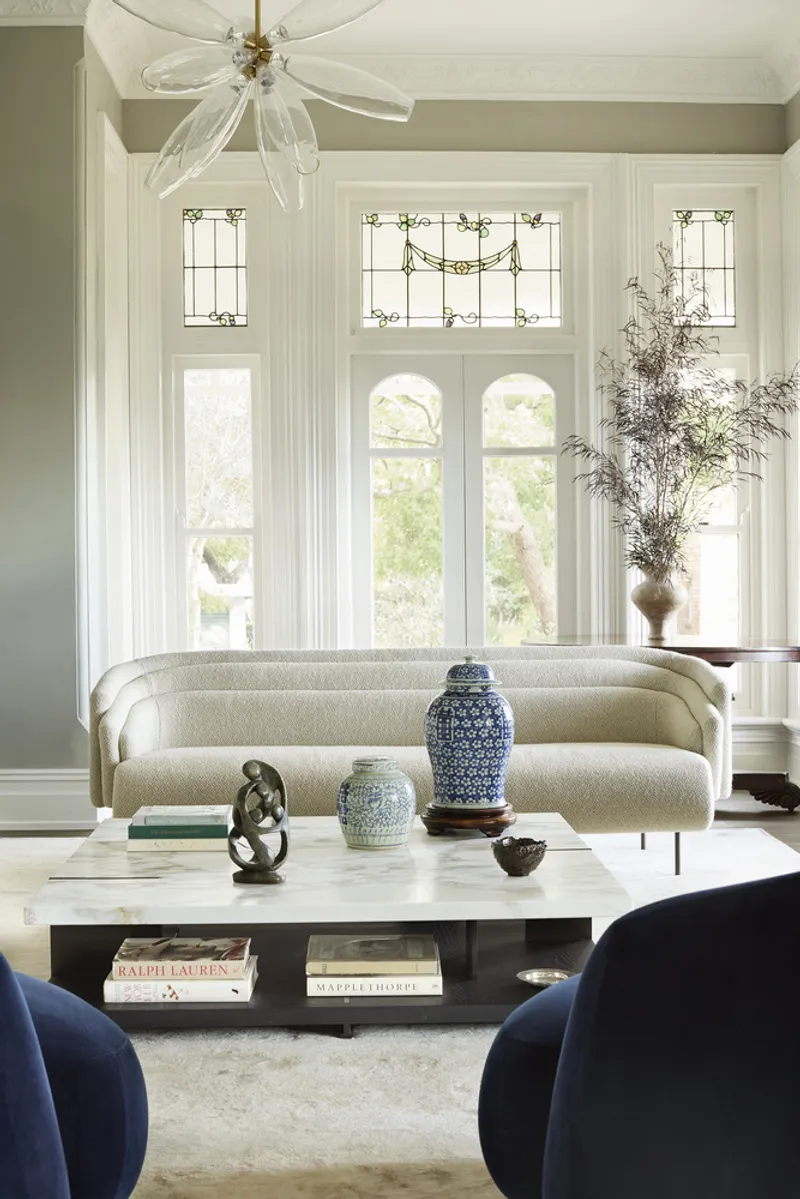

The original rooms by Walter Liberty Vernon remain the emotional anchor of the house. Arched doorways, black fireplaces topped with ornate gilded mirrors, and tall white-framed windows with decorative leadlight transoms establish a register of formality that the new work deliberately does not try to replicate. The decision to convert the existing kitchen into a bedroom and powder room, relocating the kitchen to the pavilion, freed the heritage floor plan from the functional compromises that typically degrade 19th-century houses.
A bar has been folded into the formal dining area, and a lift has been added to connect all levels. These insertions are surgical: they update the program without rewriting the spatial sequence that Vernon established. The dark timber staircase and brass pendant fixture in the entry hall could plausibly have been there since the 1880s, a sign that the restoration work has been handled with appropriate restraint.
The Stone Grotto: Excavating a Subterranean Pool
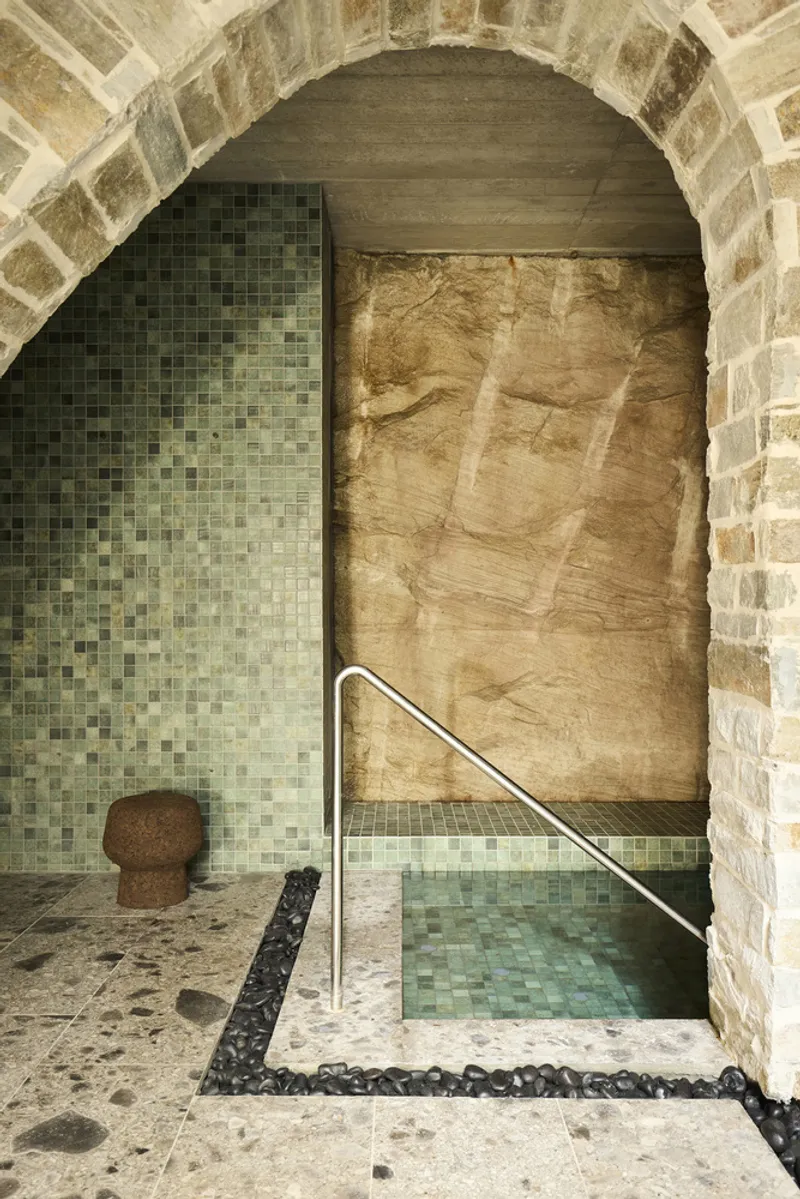


The 15-metre lap pool at the lowest level is the project's set piece, and it earns the attention. Excavated directly from the sandstone rock ledges, the pool sits beneath heavy stone-clad parabolic arches that do real structural work, carrying the load of the multiple levels stacked above. The arches are not decorative quotations. They are the most efficient structural shape for the task, and Rosselli lets them speak for themselves.
Stonemasonry by Chris French lines the walls in a language that feels geologic rather than architectural. Green mosaic tiles fill pointed brick alcoves, creating niches that reflect and refract the pool's surface light. The board-formed concrete ceiling above reads as a deliberate inversion of the timber-lined pavilion ceiling at ground level. Where the upper room is warm and open, the pool is cool and cavernous, a compressed, mineral world that the architects describe with the term "cryptic-architecture," drawing on the Latin and Greek roots for hidden.
The Bathing Rooms: Color and Craft Below Grade
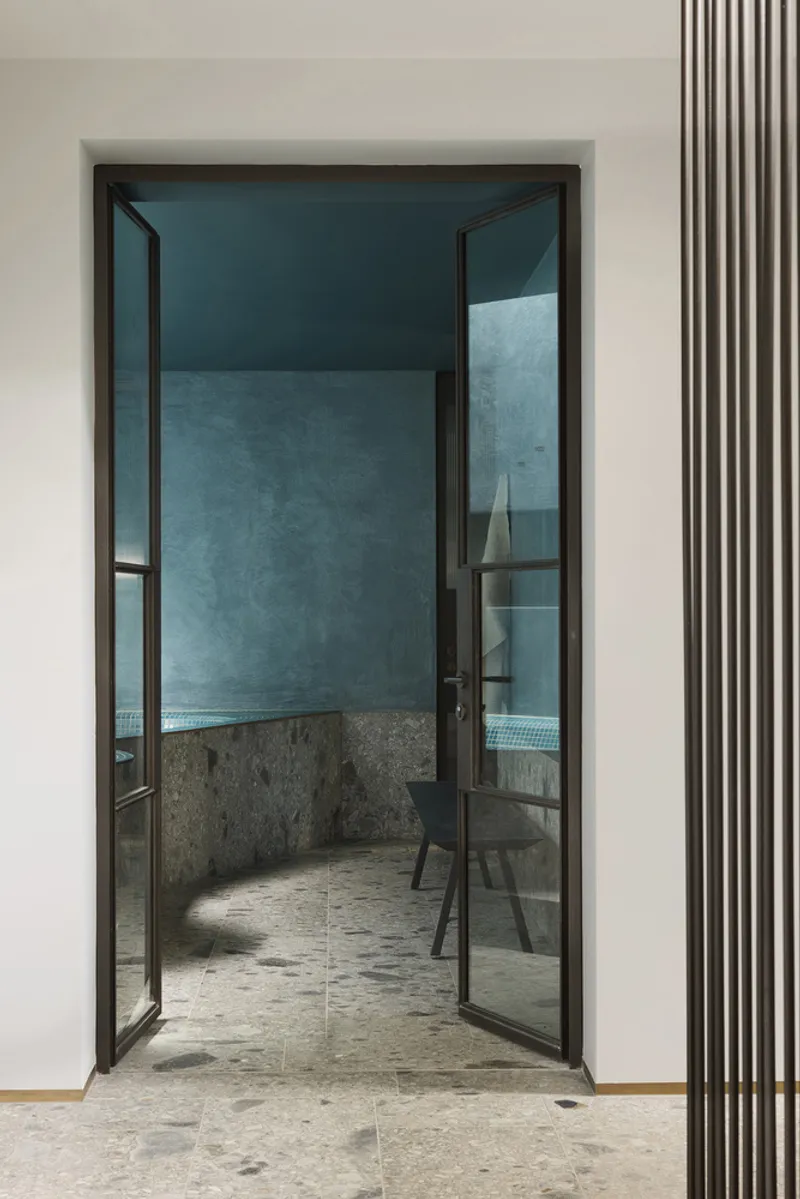
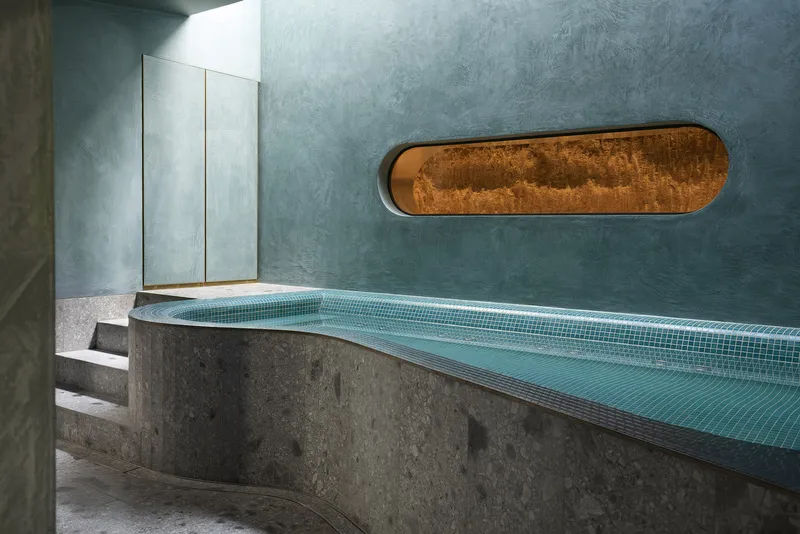

Adjacent to the main pool, a series of bathing and wellness rooms reveal the care that went into the underground program. A blue-plastered room with a curved concrete pool edge and an oval rusted metal window opening feels like a hammam transplanted to the southern hemisphere. Stucco Veneziano finishes by Mark Stanford give the walls a depth and luminosity that flat paint could never achieve. A floating vanity beneath a rounded mirror on textured blue plaster walls demonstrates how precisely the interior design was tuned to each room's specific atmosphere.
Custom skylights by Tilt Industrial Design punctuate these buried spaces with controlled pools of natural light, a detail that prevents the lower levels from feeling oppressive. The geothermal system installed throughout the house handles climate control without conventional mechanical bulk, another benefit of building into the earth.
Courtyards, Stairs, and the Rooftop Garden
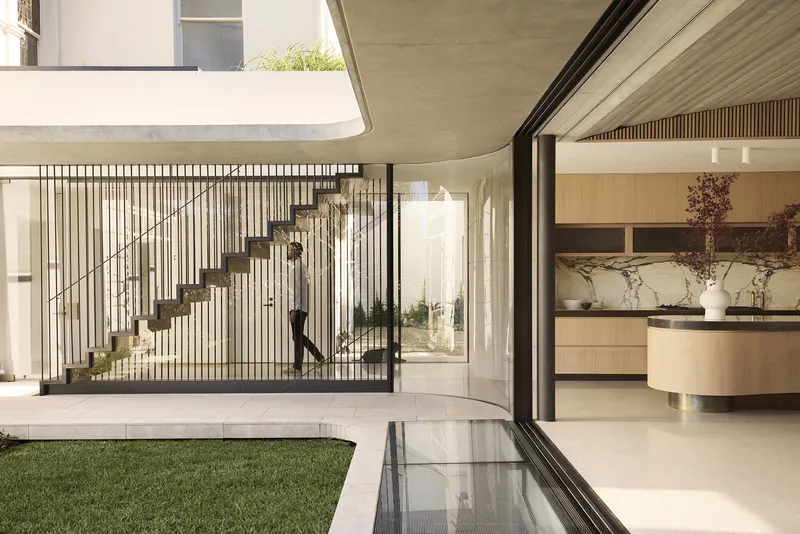
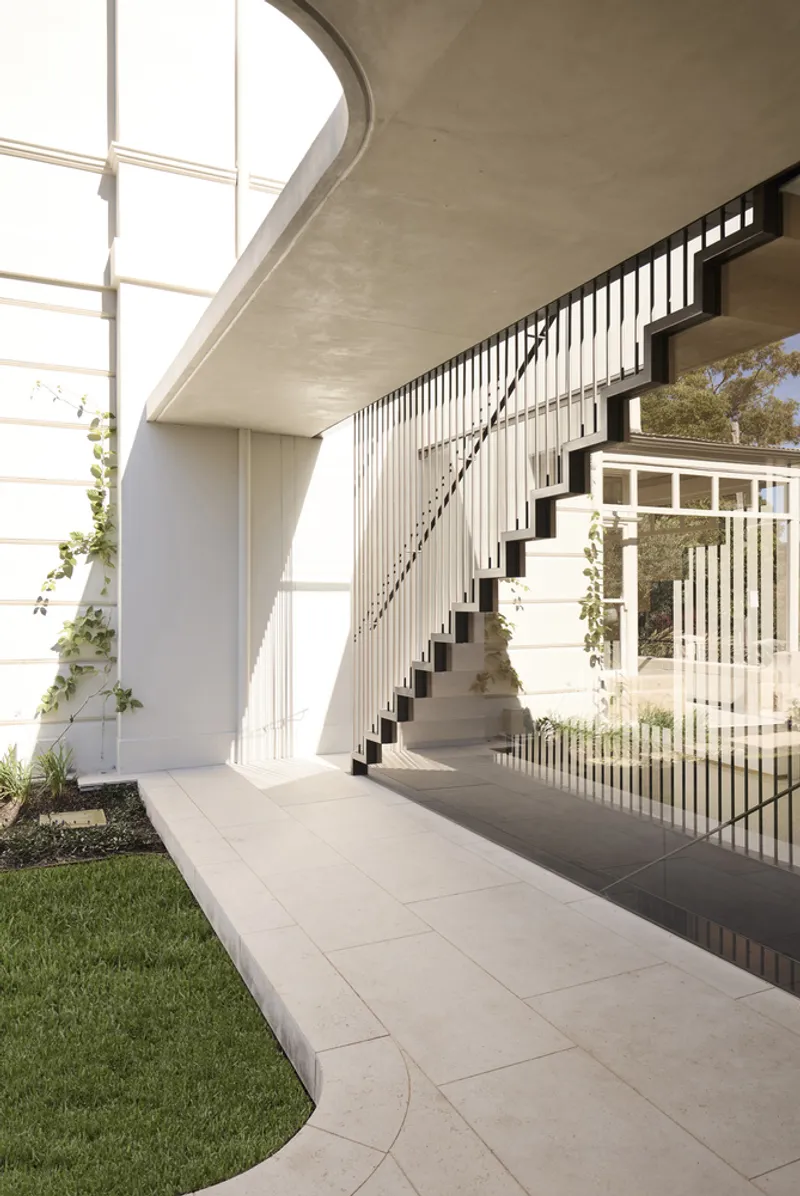

The vertical circulation is one of the project's quiet triumphs. A cantilevered steel staircase with a black rod balustrade threads through the double-height glazed link, while a concrete stair with cantilevered treads navigates the courtyard. These elements are not hidden; they are celebrated, each landing offering a framed view of planting, sky, or the distant Sydney skyline visible from the rooftop garden.
That rooftop garden, accessible via the central staircase, is the final act of camouflage. Curved timber edging contains planted beds of grasses and shrubs that soften the addition from above, effectively returning the footprint of the new construction to the landscape. A large, mature European Fan Palm was craned into the rear garden, an investment in instant canopy that signals the project's commitment to greenery as architecture, not afterthought.
Material Details: Marble, Timber, and Stone
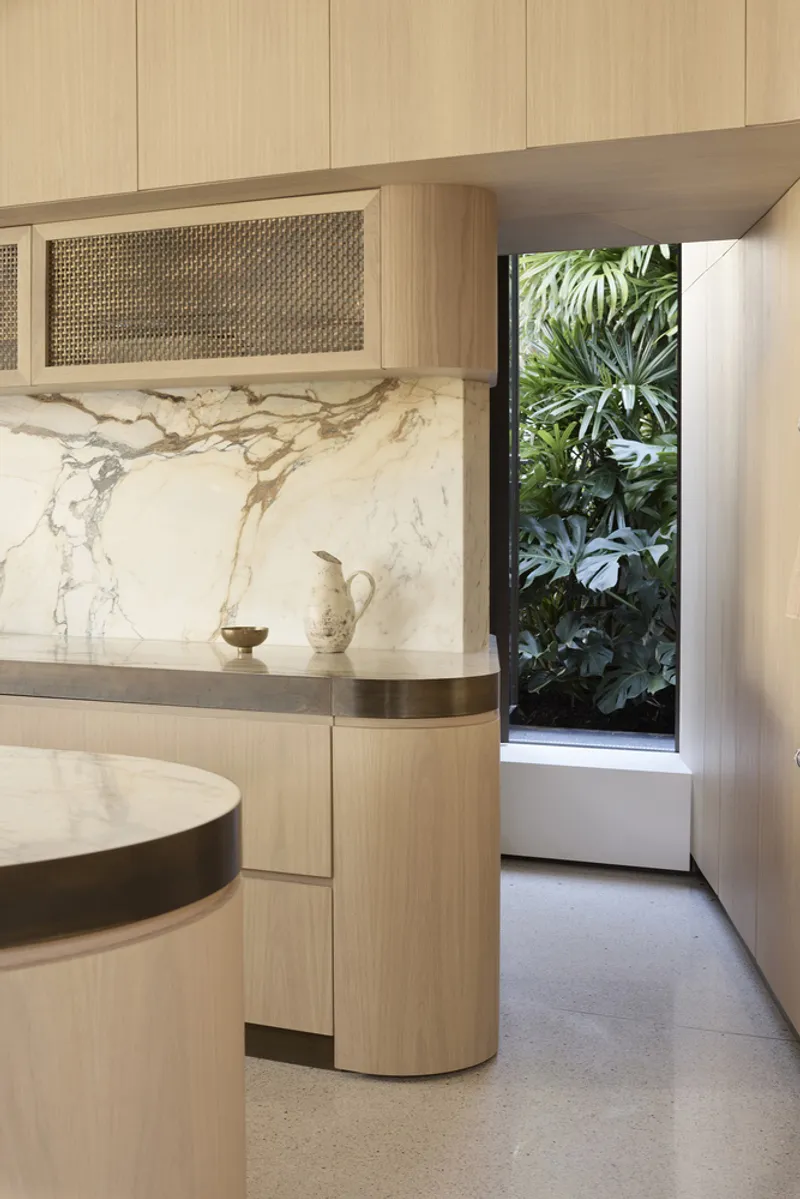

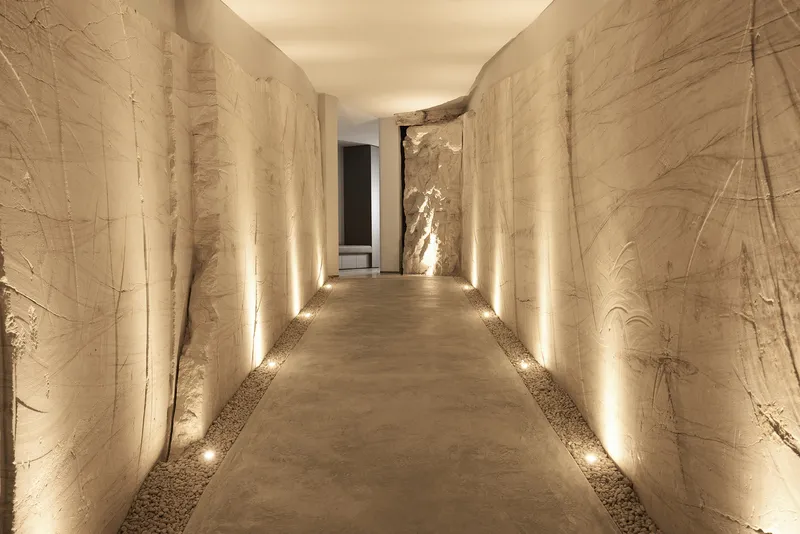
The material story is legible at every scale. In the kitchen, a veined marble backsplash meets timber cabinetry beside a narrow window framing tropical foliage. In the bathrooms, grey marble wainscoting wraps a freestanding tub, while fluted glass windows diffuse daylight into soft, even washes. In the underground corridor, carved limestone walls are illuminated by floor-level lighting along both edges, a detail that transforms a passage into a procession.
Oak joinery, polished concrete, sandstone, and brass: the palette is tight enough to feel coherent across four vertical levels but varied enough to give each room its own material identity. Builder Pimas Gale and structural engineer Phil O'Hara of Northrop Consulting Engineers deserve credit for executing a construction sequence that must have been extraordinarily complex, excavating sandstone beneath a heritage structure while keeping it intact.
Plans and Drawings


The section drawing reveals the full ambition of the project. The original two-storey residence sits at the top of the sloping terrain, while the new wing drops four levels into the hillside beneath it. The pool occupies the lowest register, with the parabolic arches clearly legible in section. What the drawing makes explicit is how much of the 900-square-metre addition is invisible from the street: the entire subterranean program is absorbed into the site's natural gradient, leaving the heritage facade and garden as the only public face.
Why This Project Matters
Hidden Home is a persuasive argument for subterranean residential architecture in Australian cities, where heritage constraints and shrinking lot sizes make conventional additions increasingly difficult. Luigi Rosselli has been making this case for decades, and the project demonstrates that going underground is not a compromise but an opportunity to create rooms with qualities that above-grade construction rarely achieves: mass, silence, thermal stability, and a direct material connection to the geology of the site.
The project also asks a useful question about what heritage preservation actually means. Rather than embalming Vernon's 1889 house in amber, the architects have given it a contemporary counterpart that is radically different in form but equally serious about craft and material. The vaulted pool, the stone corridors, and the green mosaic grottos are not nostalgic. They are new rooms with their own architectural logic, rooms that happen to sit beneath one of Sydney's finest Victorian residences. That coexistence, visible in section but invisible from the street, is the real achievement.
Hidden Home by Luigi Rosselli Architects, with interiors by Atelier Alwill and landscape by Dangar Barin Smith. Neutral Bay, North Sydney, Australia. 900 m². Completed 2024. Photography by Prue Ruscoe and Piers Haskard.
About the Studio
Share Your Own Work on uni.xyz
If projects like this are the kind of work you want to make, uni.xyz is a place to publish your own, find collaborators, and enter design competitions.



Popular Articles
Popular articles from the community


Co-Life: Senior Housing Design That Reconnects Older Adults With the City
Co-Life reimagines senior housing design through healing gardens, shared streets, workshops, and a sustainable community across generations.

The Musturak Paradise: Senior Living Architecture for a Connected Future in Temara, Morocco
The Musturak Paradise reimagines senior living architecture in Temara via private homes, social spaces, culture, community, and shared care.

The Earth Pod: 3D Printed Homes for Resilient Refugee Communities
The Earth Pod reimagines refugee housing through 3D printed homes made from clay, combining resilience, self-sufficiency, and rapid shelter.

The Ocean Hive: Sustainable Architecture for a Self-Sufficient Civilization at Sea
The Ocean Hive imagines sustainable architecture at sea, where modular habitats, algae, wave power and ocean waste sustain a growing colony.


Similar Reads
You might also enjoy these articles


Hodi-Mandai Geram
Project Function: Preservation and revitalization of the Intangible heritage and socio-spatial identity of the Hodi by Housing, Cultural Memory Center, Sacred Grove, landscape, local tourism economy


Olio Towers: A Mid-Rise for Performers That Fuses Housing, Rehearsal, and Stage
Located blocks from Houston's Theater District, this modular tower stacks living units around a central performance atrium.

Oasis: Modular Green Housing Carved into Dhaka's Urban Fabric
A shortlisted Plugin Housing entry reclaims unauthorized settlements in Dhaka with stepped concrete volumes, green roofs, and ventilation-driven design.

Black Hole: A Floating Megastructure for the Post-Physical Era
Emiliano Mazzarotto envisions a spherical, self-scaling arena where e-sports, digital hotels, and holographic stadiums replace traditional public space.

Explore Underground Competitions
Discover active competitions in this discipline



Challenge to reimagine the Iron Throne


Photograph architecture without architects


Illustrate the lost glory of Angkor Wat - Render Challenge


Design challenge to reuse E-waste
Comments (0)
Please login or sign up to add comments
No comments yet. Be the first to comment!