

Hustle Hub: Stacked Volumes and Shared Green Space for 500 Residents in Moscow
A co-living micro-city layers porous volumes, atrium forests, and climate-tuned terraces to turn individual ambition into collective urban life.


What happens when you design a building not as a container for people but as a system that turns strangers into collaborators? Hustle Hub starts from a deceptively simple premise: 500 young people from diverse regions arrive with individual goals, and the architecture itself must teach them to share space, food, air, and ideas. The project calls this philosophy "Turning one to all," and it materializes as a series of overlapping horizontal volumes that step back, lean in, and open up to create microclimates, courtyards, and visual connections between public plazas and private dormitories.
Designed by Nasrin Ahangaryan and published on uni.xyz, Hustle Hub is sited in Moscow, where its climate-responsive strategy draws directly from EPW weather data and CFD wind simulations run at 5m and 15m heights using Design Builder software. The building reads the surrounding urban fabric, aligning its orientation along existing city axes to optimize accessibility and landscape engagement, while asserting its own identity as a green civic anchor.
Rigid Massing Broken Open by Wind and Light

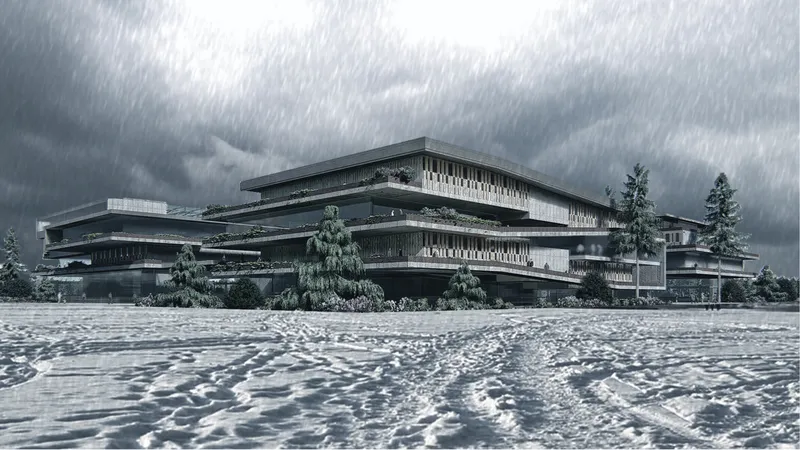
The exterior renders tell two seasonal stories of the same building. In summer, the stacked horizontal volumes sit behind vertical wood screens, their cantilevered slabs casting long shadows across an open lawn. In winter, heavy snowfall softens every edge and reveals how the stepped profile creates sheltered zones between volumes. The design began as a rigid mass, then evolved through climatic and social analysis into these overlapping, porous layers. Each block is shaped with a specific environmental purpose: minimizing wind loads on exposed faces, allowing natural cross-ventilation through gaps between volumes, and diffusing daylight into the building's deep plan.
Solar studies for January and June informed the depth of cantilevers and the placement of glazing, while the vertical timber screens serve double duty as solar shading and a unifying material language. The result is a building that looks composed from a distance but reveals its porosity up close, with terraces, planted edges, and openings that negotiate between the harsh Moscow climate and the desire for outdoor communal life.
Zoning from Plaza to Pillow: A Clear Spatial Hierarchy


The axonometric diagrams break the Hub into its constituent parts: public zones at the ground level (plazas, markets, coworking spaces, a fabrication room, material libraries), semi-public zones on intermediate floors (greenhouses, learning spaces, creative rooms), and private residential blocks stacked above. The exploded view makes the vertical circulation legible, showing how bridges and atrium walkways stitch floors together so that moving through the building is never a purely vertical act. You pass through shared zones on your way to private ones, and that choreography is deliberate.
The aerial view confirms how the rectangular volumes organize around central open courtyards, creating sheltered outdoor rooms even in a snowy landscape. The ground floor alone houses a shopping plaza with a bakery, barber, and beauty salon alongside conference rooms, phone booths, an art gallery, a restaurant, a health center, and a gym. Upper floors contain a library, family rooms, meeting halls, and large multi-purpose spaces. The program reads like a small town, and that is exactly the point: Hustle Hub is conceived as a self-sustaining urban microcosm where 500 residents rarely need to leave.
Atrium as Connective Tissue: Daylight, Stairs, and Forest
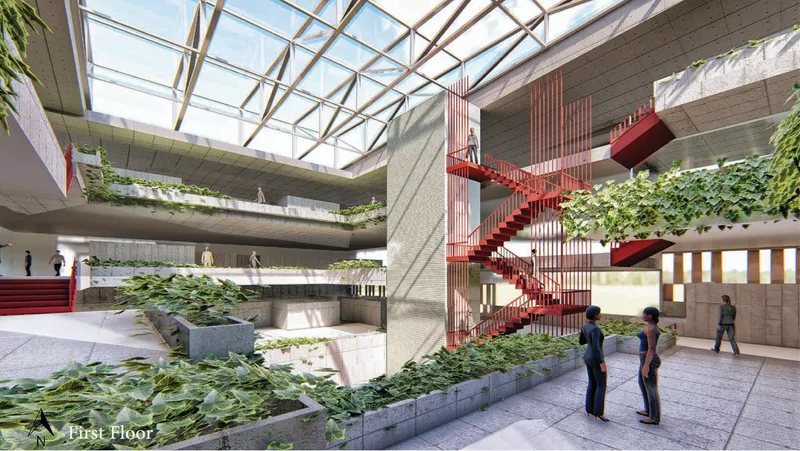
The interior atrium is the project's strongest spatial argument for co-living. A bold red staircase threads through multiple levels, planted terraces cascade down from the edges, and a glazed skylight floods the void with daylight. Figures occupy different floors simultaneously, visible to each other across the open section. Daylight simulations were run for all floors with and without atriums, proving that these voids are not a luxury but a performance requirement: they bring natural light deep into the plan where conventional corridors would create dark, isolated corridors.
The biophilic strategy operates across four defined layers: linear green terraces integrated into cantilevered slabs, courtyard gardens for relaxation, greenhouses for growing food, and atrium forests that function as internal ecological pockets enhancing air quality. Together these layers support mental well-being and communal identity, turning what could be an institutional block into a building that breathes.
Compact Living: Timber, Bunk Beds, and Considered Light
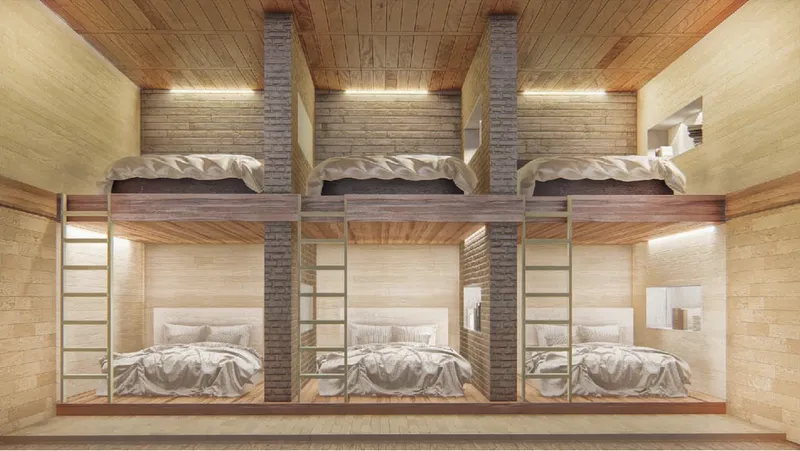
At the most intimate scale, the dormitory rooms reveal the pragmatic warmth of the project. Timber-lined walls and ceilings wrap around three bunk beds with ladder access, each pod defined by strip lighting that provides individual control within a shared room. The material palette is consistent with the exterior screens, establishing continuity between the building's public face and its most private spaces. These rooms are compact by design, nudging residents toward the shared amenities, the courtyard gardens, the coworking tables, and the atrium forests that form the real living room of the Hub.
Why This Project Matters
Hustle Hub succeeds because it refuses to separate the environmental argument from the social one. The stepped volumes are not just a formal gesture; they are the direct output of wind and solar analysis applied to a specific Moscow site. The atriums are not just dramatic voids; they are verified through daylight simulation to solve a deep-plan lighting problem. And the co-living program is not just a list of rooms; it is spatially organized along a public-to-private gradient that forces interaction without sacrificing retreat.
For a generation of designers exploring how density and sustainability can coexist, Nasrin Ahangaryan's proposal offers a concrete model. It demonstrates that a 500-person residential building can function as a micro-city, complete with markets, greenhouses, fabrication labs, and forests, all held together by an architecture that performs climatically and socially at the same time. The philosophy of "turning one to all" is not just a tagline here; it is embedded in every section, every threshold, and every planted terrace.
View the Full Project
About the Designers
Designer: Nasrin Ahangaryan
Enter a Design Competition on uni.xyz
uni.xyz runs architecture and design competitions year-round that reward proposals with spatial conviction and real site intelligence.
Project credits: Turning one to all by Nasrin Ahangaryan.




Popular Articles
Popular articles from the community


Riyadh For All: Intergenerational Urban Design for Active Aging in Rabat
Riyadh For All reimagines urban design in Rabat with intergenerational co-living, adaptive courtyards, and Moroccan cultural exchange today.

AL-JANNAH: Sustainable Architecture and Permaculture for Afghan Widows
AL-JANNAH uses sustainable architecture and permaculture to create resilient oasis of housing, learning, work and renewal for Afghan widows.

EW PARK: Sustainable Architecture Reimagines the Future of Urban Parking
EW PARK reimagines city parking as a modular wooden tower combining automation, solar energy, electric mobility, and adaptable urban design.

Conexión: Biophilic Design Reimagines High-Rise Living in Hong Kong
Conexión reimagines high-rise living in Hong Kong through biophilic design, green facades, shared spaces, daylight, water and nature within.

Similar Reads
You might also enjoy these articles

The Musturak Paradise: Senior Living Architecture for a Connected Future in Temara, Morocco
The Musturak Paradise reimagines senior living architecture in Temara via private homes, social spaces, culture, community, and shared care.

The Leaf Center: Cultural Center Architecture for Social Integration in Amsterdam
Cultural center architecture becomes a bridge at The Leaf Center, connecting international students with Amsterdam through art and exchange.
Conexión: Biophilic Design Reimagines High-Rise Living in Hong Kong
Conexión reimagines high-rise living in Hong Kong through biophilic design, green facades, shared spaces, daylight, water and nature within.

Wander to Wonder: Modular Playground Design for Children in Kutupalong Refugee Camp
Wander to Wonder uses modular playground design to create flexible, imaginative play spaces for children in Kutupalong refugee camp.


Comments (0)
Please login or sign up to add comments
No comments yet. Be the first to comment!