
Hustle Hub: Co-Living That Halves the Cost
A timber-framed cruciform tower where shared kitchens, gardens, and living rooms cut housing costs in half for young professionals and students.


Housing is expensive because you pay for space you do not share. A kitchen, a laundry, a living room, a garden: each household buys its own. Hustle Hub: Cooperative Emerging Communities, a project by Álvaro Villacís, proposes a different model. Share the expensive rooms. Keep the private ones. Cut the cost in half.
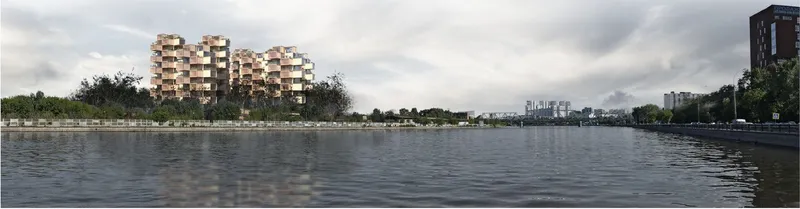
The project received an Honorable Mention in the Hustle Hub '19 competition on uni.xyz. It is one of the most architecturally resolved co-living proposals in the series: a timber-framed tower with a cruciform plan, shared communal zones on every floor, and a waterfront site that turns the ground level into a public courtyard.
The Economic Argument: Shared Property, Halved Cost
The project starts from a number: housing costs can be reduced by approximately half when kitchens, living rooms, laundries, and outdoor spaces are shared between multiple units. This is not a commune. It is a cooperative. Each resident has a private bedroom and bathroom. Everything else is common.
This economic model targets young professionals and students, the people most priced out of conventional housing markets. By sharing the expensive parts of a home, residents access waterfront living, communal gardens, and cafe-quality ground floors at a fraction of the conventional cost. The architecture enables the economics, not the other way around.
The Ground Level: Courtyard, Cafe, Community
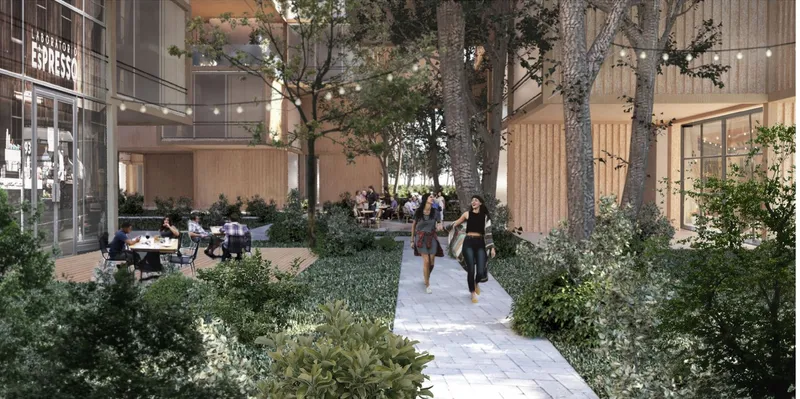
The ground-level render is the project's most inviting image. An espresso cafe opens onto a planted courtyard. String lights hang between mature trees. Dense hedges line a shared path. Residents walk, sit, and talk. The space reads as a neighbourhood street, not a building lobby.
This is the social infrastructure that makes co-living work. If the shared spaces feel institutional, residents retreat to their private rooms. If the shared spaces feel like a neighbourhood, residents use them. The courtyard, the cafe, and the planting do the work of making shared living desirable rather than merely affordable.
The Plan: Cruciform Layout Around a Core
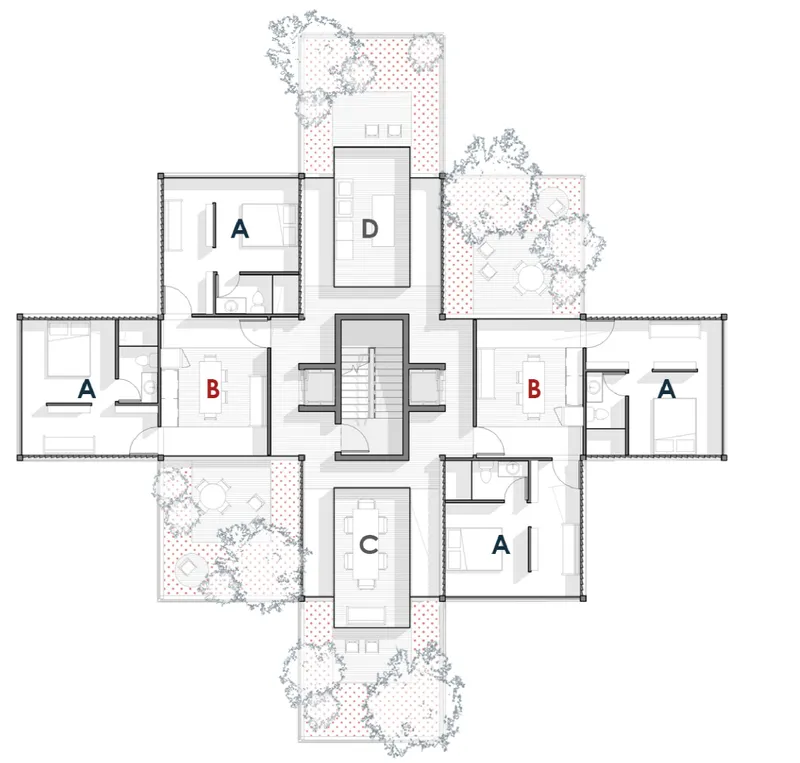
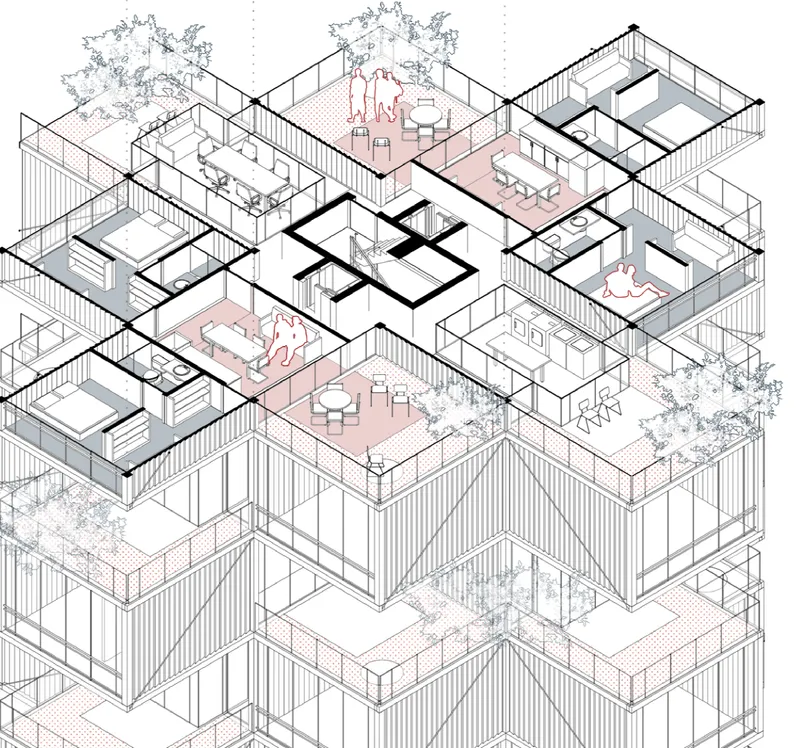
The floor plan is a cruciform: four arms extending from a central stair core. Each arm contains a different unit type (A, B, C, D), giving residents choice within the same building. The pink-shaded zones between the arms are the shared spaces: communal kitchens, living rooms, and co-working areas. Trees grow at the edges where the arms do not meet, creating planted terraces at every level.
The cruciform is a smart geometry for co-living. It maximises the perimeter (for daylight and views), creates natural zones between units (for shared programme), and produces terraces at the intersections (for outdoor space). Every benefit comes from the plan shape itself, not from added features.
Timber Construction and the Facade
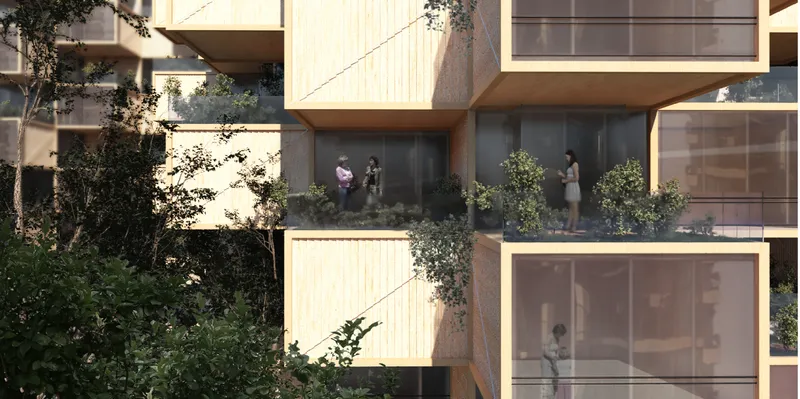
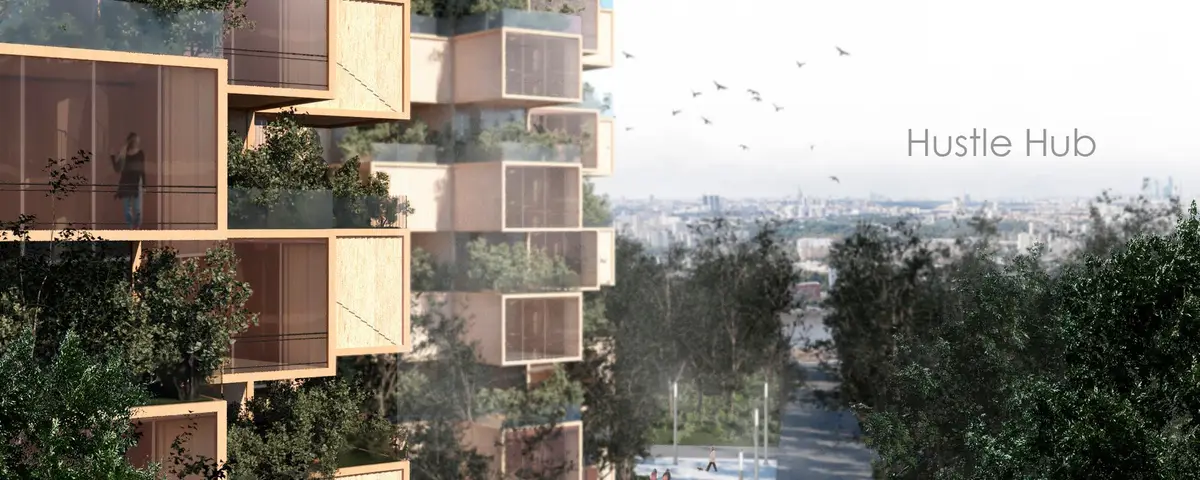
The facade close-up shows timber-clad cantilevered modules with full-height glass and planted balconies. Residents are visible inside, which signals inhabitation and warmth. The timber is locally sourced and modular, meaning the building can be assembled from standardised components and adapted to different sites.
Timber construction also carries a sustainability argument. It stores carbon rather than emitting it. It is lighter than concrete, which reduces foundation costs. And it ages well when detailed correctly, gaining character rather than losing it. For a co-living building that needs to feel like home rather than infrastructure, timber is the right material.
The Full Building: Stacked Modules, Green at Every Level
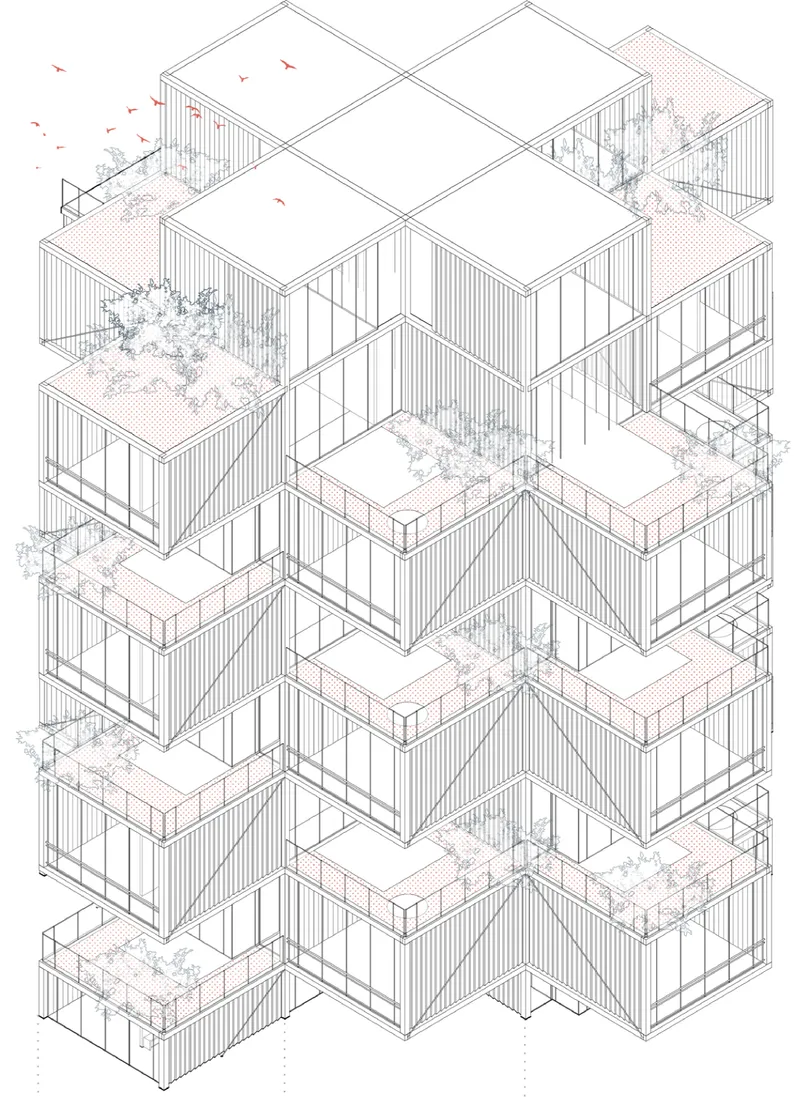
The full building axonometric shows the complete system. Modular units stack around the timber frame. Open terraces appear at every level where the cruciform arms create gaps. Vegetation is integrated from ground to rooftop: rooftop farming, terrace gardens, and balcony planting create a green volume rather than a green roof.
The building reads as a vertical garden with rooms in it. This is not accidental. The planting is structural to the co-living concept: shared gardens are one of the most valued common amenities in cooperative housing. By distributing them vertically, the project gives every floor its own outdoor space rather than concentrating it all on the roof.
Why This Project Matters
The Hustle Hub competition asked for co-living proposals. Most entries produced interesting floor plans. This one produced a building system: a cruciform plan that generates shared space from its geometry, a timber frame that can be replicated on different sites, an economic model that halves housing costs, and a ground-level public realm that makes the whole thing feel like a neighbourhood.
For anyone studying cooperative housing, timber construction, or the economics of shared living, Hustle Hub demonstrates that co-living is an architectural problem, not just a social one. The plan shape determines how much space is shared. The material determines the cost. The ground level determines whether people stay.
View the Full Project
About the Designer
Designer: Álvaro Villacís
Enter a Design Competition on uni.xyz
If cooperative housing, timber construction, or affordable co-living design is the kind of work you want to pursue, uni.xyz runs competitions year-round that reward practical, buildable proposals.
Project credits: Hustle Hub: Cooperative Emerging Communities by Álvaro Villacís. Honorable Mention, Hustle Hub '19 (uni.xyz).


Popular Articles
Popular articles from the community


Cube Design Draws an Ecological Corridor Between Two Shenzhen Hills with the Nankai Building
Beside Shenzhen's container docks, the Nankai Building pairs stacked balconies with a climbing green screen to connect two hillsides across its height.


Opera on the Sea: Driftwood Logic Shapes a Timber Opera House on Estonia's Coast
Trevor Orgill's opera house translates the entangled drift of floating timber into a civic building where wood, water, and music converge.

Singing Woman: An Opera House That Performs Before the Curtain Rises
Ovidiu Cristian Pavel's conceptual opera house translates Estonia's choral identity into a sculpted waterfront landmark facing the Baltic Sea.

FCC Arquitectura Expands a Portuguese Granite House with a Board-Marked Concrete Wing
In Portugal, JV House pairs a cleaned-up whitewashed and granite dwelling with a timber-shuttered concrete extension, courtyards and a garden pool.

Similar Reads
You might also enjoy these articles

Vereda Arquitetos Renovates a 40-Square-Meter Apartment Inside Niemeyer's Copan Building
A compact unit in São Paulo's most iconic residential tower gets a material overhaul that pairs exposed concrete with bold blue Formica.

Shakur's House: Exposed Brick as an Interior Organiser in a 168 m² Mashhad Residence
Brick moves indoors in this Mashhad residence, where masonry walls, glass partitions and teal planes sequence a compact home without closing it off.

Day and Night Park: A Time-Based Urban Newsstand in Beijing
A temporary urban newsstand in Beijing blending travel, light, and reading through poetic colors, compact form, and community-focused design.

Modernist Patio Renovation in El Masnou, Barcelona by Oliver Segura Arquitectura + Cebrià Arquitectura
Modernist patio renovation blending tradition and innovation with a movable pool, leveled floors, and Catalan materials in El Masnou.


Comments (0)
Please login or sign up to add comments
No comments yet. Be the first to comment!