

Hustle Hub Moscow: A Village Inside a City Block
A runner-up co-living entry that fits an entire village of small pitched-roof houses into a single Moscow block, with streets, plazas, and a marketplace.


Most co-living proposals in Moscow imagine towers. Hustle Hub Moscow, designed by Jiří Valenta and Igor Kovačević, imagines a village. Dozens of small pitched-roof houses are packed into a single urban block, connected by pedestrian lanes and organised around a central plaza. The project received the Runner-up position in the Hustle Hub '19 competition on uni.xyz for proposing that the right scale for Moscow co-living is not higher but smaller.
Set in Moscow's ZIL District, the project argues that community is produced by the size of the buildings, not by the amenities inside them. A tower of 400 residents produces corridors. A village of 400 small houses produces streets. The difference, in social terms, is enormous.
The Village: A Grid of Small Houses

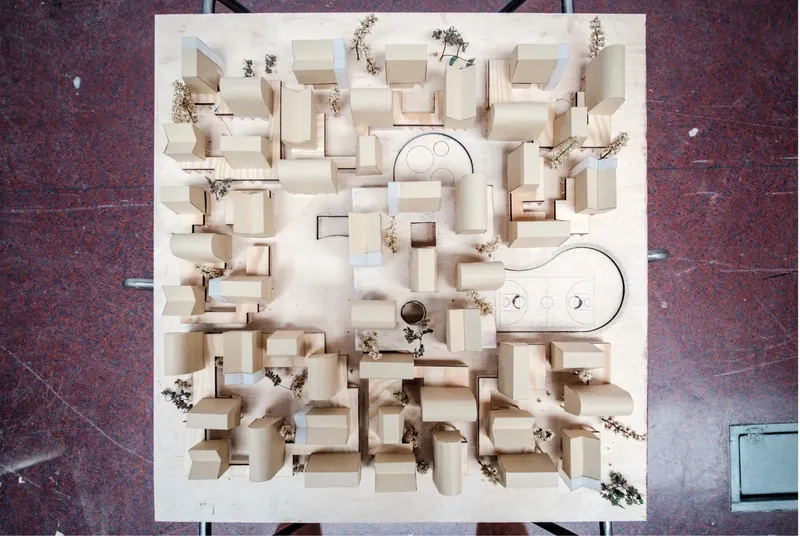
The axonometric and the aerial model photo show the project's core idea. Red, blue, green, and yellow pitched-roof houses are packed tightly onto a square site, arranged around a central plaza with a swimming pool. Each house is small, varied, and individually coloured. The coloured model makes the variety legible: this is not a repeated block, it is a collection of individual houses that happen to share a site.
The wooden aerial model confirms the density. Dozens of small volumes fit within a single urban block, with pedestrian plazas carved out between them. The scale is closer to a Mediterranean village than a Russian housing estate. The streets are narrow, the houses are low, and the public spaces are frequent.
The Grid: Evolution of a Plan
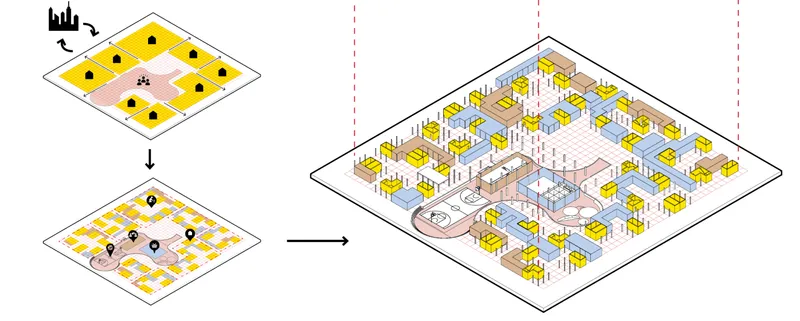
The diagrammatic evolution shows how the plan was derived. A yellow grid of points becomes a grid with pedestrian paths overlaid, which becomes the final coloured axonometric. The plan is rule-based: start with a regular grid, add circulation, fill with houses. The variation comes from the fill, not from the grid itself.
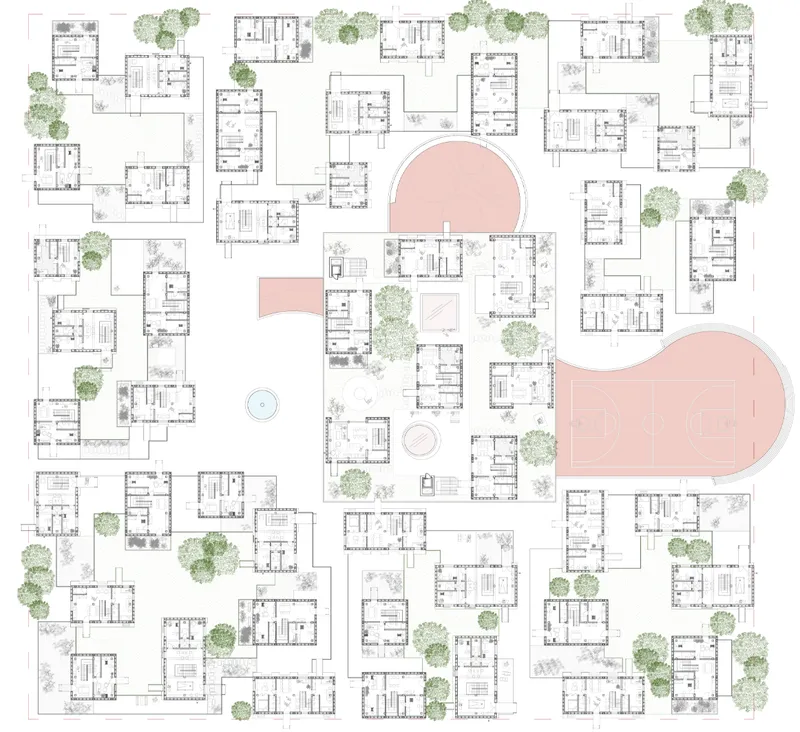
The floor plan reveals the same logic at the room level. Small house footprints are arranged on a grid with two pink organic plaza shapes carved into the centre. Trees dot the spaces between. No two houses share the same configuration, but they all derive from the same module. This is the discipline that makes the project work at density: order on the plan, variety in the volumes.
Streets and Marketplace
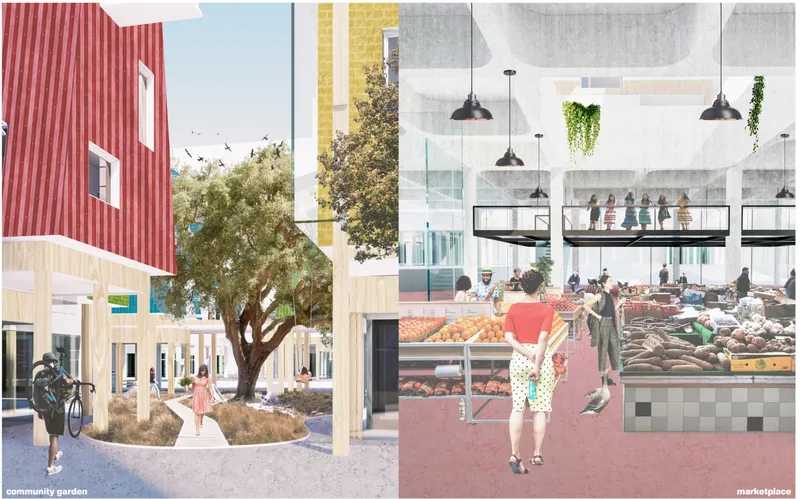
The diptych shows the neighbourhood at its best. On the left, a community garden lane: a red clapboard house, a tree, a bicycle, residents walking. On the right, a covered marketplace with greengrocer stalls, hanging pendant lights, and a shopper with a trolley. These are the two kinds of public space the project delivers: quiet residential streets and active commercial halls.
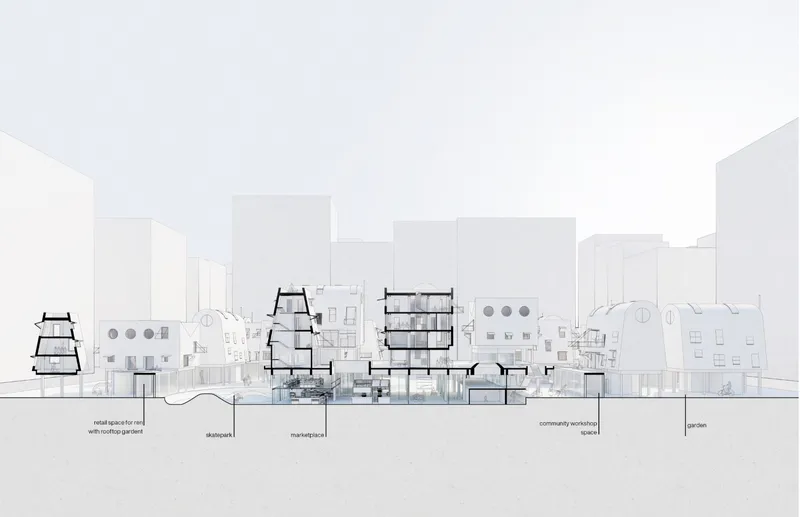
The section confirms the scale contrast that defines the project. Small pitched-roof volumes stand in the foreground. Behind them, taller grey context buildings rise. The village is deliberately lower than its surroundings. This inversion, where the new building is smaller than the old ones, is what gives the project its identity. You arrive in Moscow and find a village inside the block.
The Model: Exhibition and Process
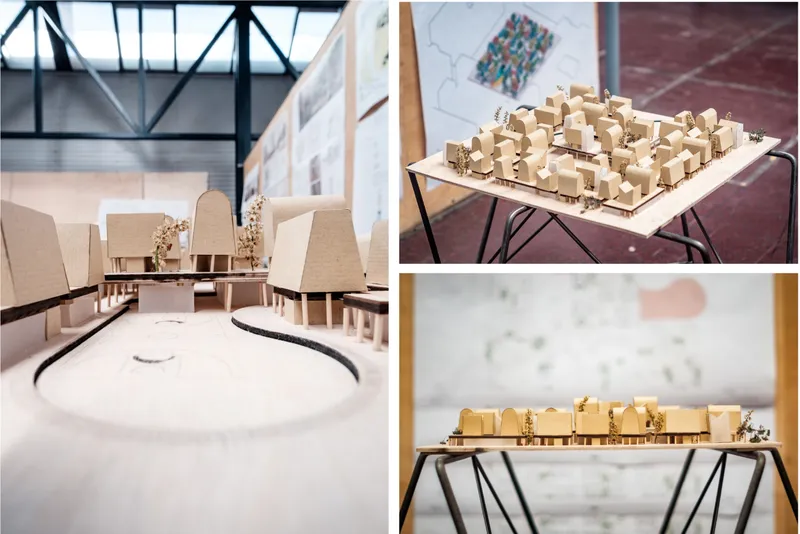
The three model photos show the physical model in different settings: displayed in an exhibition, photographed from above on a table, and shot at eye level with the pitched-roof volumes silhouetted against a white background. The model is a working tool, not a finished artefact. The photos communicate that the designers tested the idea physically, with real objects, before committing to the final form.
This process matters because it explains the clarity of the result. A project that looks this simple in the plans is usually not simple in its development. The model is the evidence: the scale, the density, and the relationship between houses and plaza were all worked out by hand before they appeared in the renders.
Why This Project Won Runner-up
The Hustle Hub competition produced ambitious entries in every direction: bigger, smarter, taller, more connected. Hustle Hub Moscow won by going in the opposite direction. Smaller, simpler, denser. A village inside a block. The scale of the houses is the argument. Moscow does not need more towers. It needs more streets, more plazas, more front doors at ground level. This project delivers all three in a single urban move.
For anyone studying low-rise high-density housing, perimeter-block alternatives, or the social geometry of villages, this project is the clearest case in the competition. The lesson is that density and intimacy are not opposed. You can fit many houses onto a single urban block without building upward, if you are willing to make the houses small and the streets narrow. The result feels like a village because it is one.
View the Full Project
About the Designers
Designers: Jiří Valenta, Igor Kovačević
Enter a Design Competition on uni.xyz
If low-rise high-density housing, village typologies, or pedestrian-scale urbanism is the kind of work you want to explore, uni.xyz runs competitions year-round that reward projects grounded in real scale and social logic.
Project credits: Hustle Hub Moscow by Jiří Valenta and Igor Kovačević. Runner-up, Hustle Hub '19 (uni.xyz).


Popular Articles
Popular articles from the community

Tsunami Convergenics: Turning Catastrophic Ocean Forces into Underwater Housing Infrastructure
A speculative underwater settlement off the coast of Onagawa, Japan, treats tsunamis and typhoons as energy sources rather than threats.
Faces of the Soviet Avant-Garde: Turning Moscow's Street Names into an Open-Air Museum
A network of sculptural installations across a Moscow residential district transforms forgotten architect names into spatial encounters with cultural memor
Extended Shell: Retrofitting Kolkata's Balconies as Living Urban Thresholds
A modular retrofit system recovers the social and environmental intelligence of Kolkata's historic verandas for contemporary Park Street residents.
Opera by the Sea Estonia: Three Shells Dissolving Architecture into Tallinn's Coastline
A winning opera house proposal replaces monumental form with interconnected shells that blur the boundary between building, park and Baltic Sea.

Similar Reads
You might also enjoy these articles

Shakur's House: Exposed Brick as an Interior Organiser in a 168 m² Mashhad Residence
Brick moves indoors in this Mashhad residence, where masonry walls, glass partitions and teal planes sequence a compact home without closing it off.

Day and Night Park: A Time-Based Urban Newsstand in Beijing
A temporary urban newsstand in Beijing blending travel, light, and reading through poetic colors, compact form, and community-focused design.

Modernist Patio Renovation in El Masnou, Barcelona by Oliver Segura Arquitectura + Cebrià Arquitectura
Modernist patio renovation blending tradition and innovation with a movable pool, leveled floors, and Catalan materials in El Masnou.
Alto Residencial Coop: Cooperative Housing Development in Santiago de Compostela by Carbajo Barrios Arquitectos
A linear cooperative housing complex blending white volumes and perforated metal façades, enhancing community living, natural light, privacy, and urban integration.


Comments (0)
Please login or sign up to add comments
No comments yet. Be the first to comment!