

i2a Architects Studio Steps a Kerala House Down a Slope Across Multiple Split Levels
On a narrow site in Ernakulam, brick screens, a bamboo courtyard, and staggered floors turn topography into architecture.


Most houses on narrow sites in Kerala wrestle with the plot, filling it edge to edge and compensating for what's lost with height. The 0 to 150 LVL House by i2a Architects Studio takes a different position: instead of fighting the longitudinal slope, it absorbs it. The floor plates step down with the terrain, producing a series of half-levels connected by staggered staircases. The name itself is a literal description, tracking the elevation change from one end of the house to the other.
What makes this 171 square meter residence in Ernakulam genuinely interesting is how it converts constraints into spatial richness. The narrowness of the site, the slope, the tropical climate: each of these problems becomes a generator. A bamboo-filled courtyard punches daylight deep into the plan. Brick jalli screens and a water body create a thermal buffer against the street. The result is a house that feels considerably larger and more layered than its modest footprint suggests, built from brick, concrete, and a precise reading of its context.
A Screened Facade That Breathes
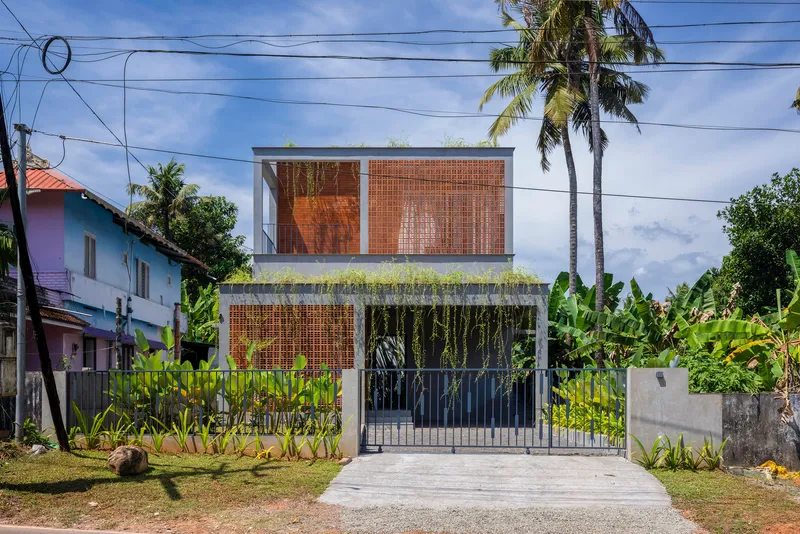
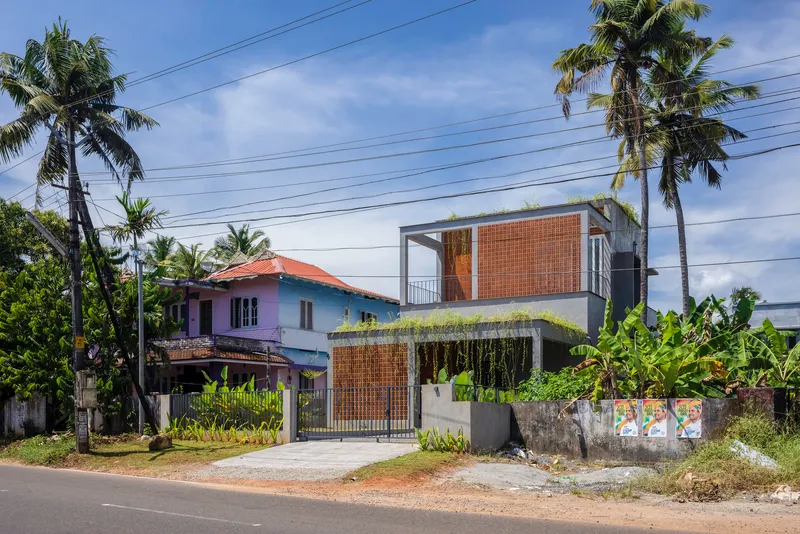
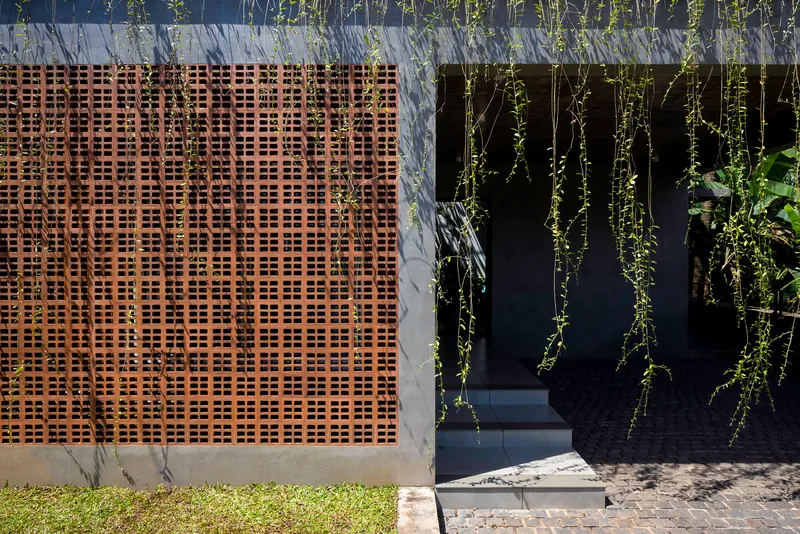
From the street, the house presents itself as a composition of woven screens and cascading greenery rather than a conventional facade. Timber and brick screens wrap the front volume, filtering the harsh Kerala sun while granting privacy to a ground-floor office room with its own separate entrance. The perforated surfaces do double duty: they break down the building's mass on a tight residential street, and they turn the facade into an instrument for controlling light and ventilation.
Behind the outer screen sits a brick wall with an integrated water body, forming a double-wall system. The air between these two layers acts as a thermal buffer, cooling the living spaces before any mechanical system is needed. It is a strategy rooted in Kerala's vernacular traditions but executed here with a contemporary material palette of concrete, brick, and tinted glass inserts.
The Courtyard as a Vertical Garden
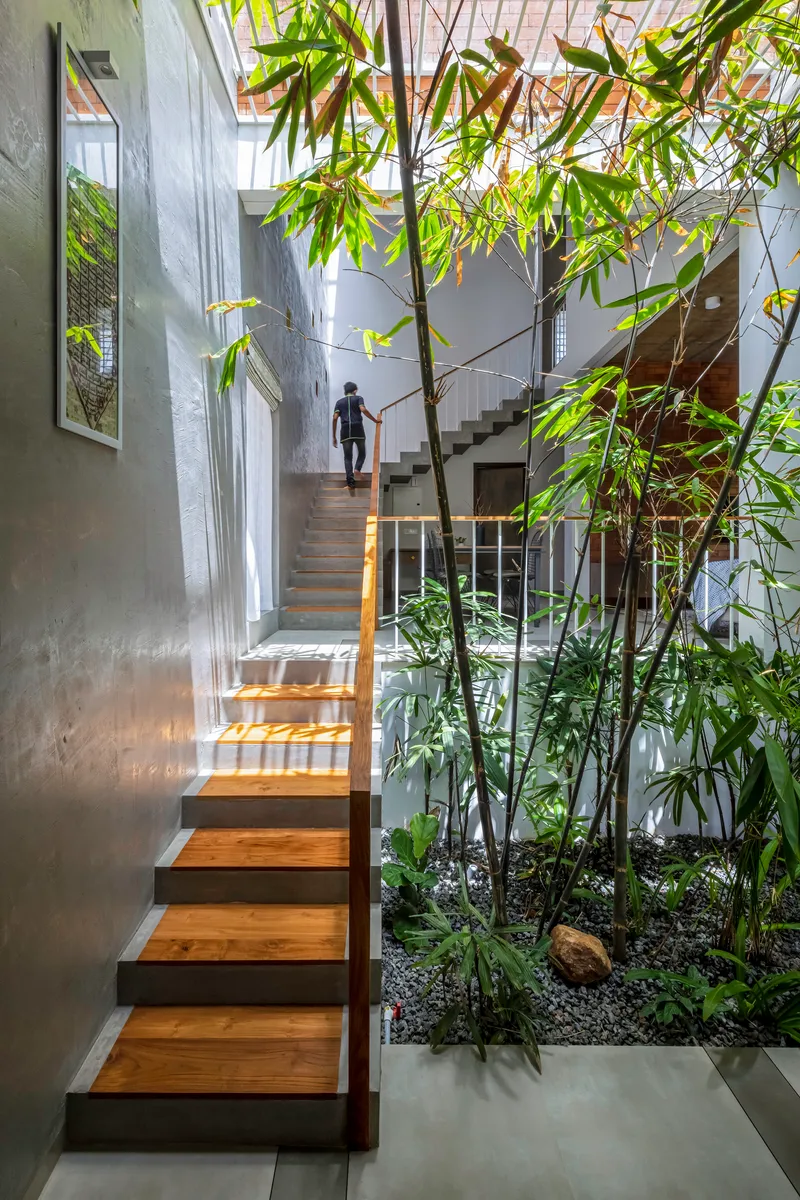
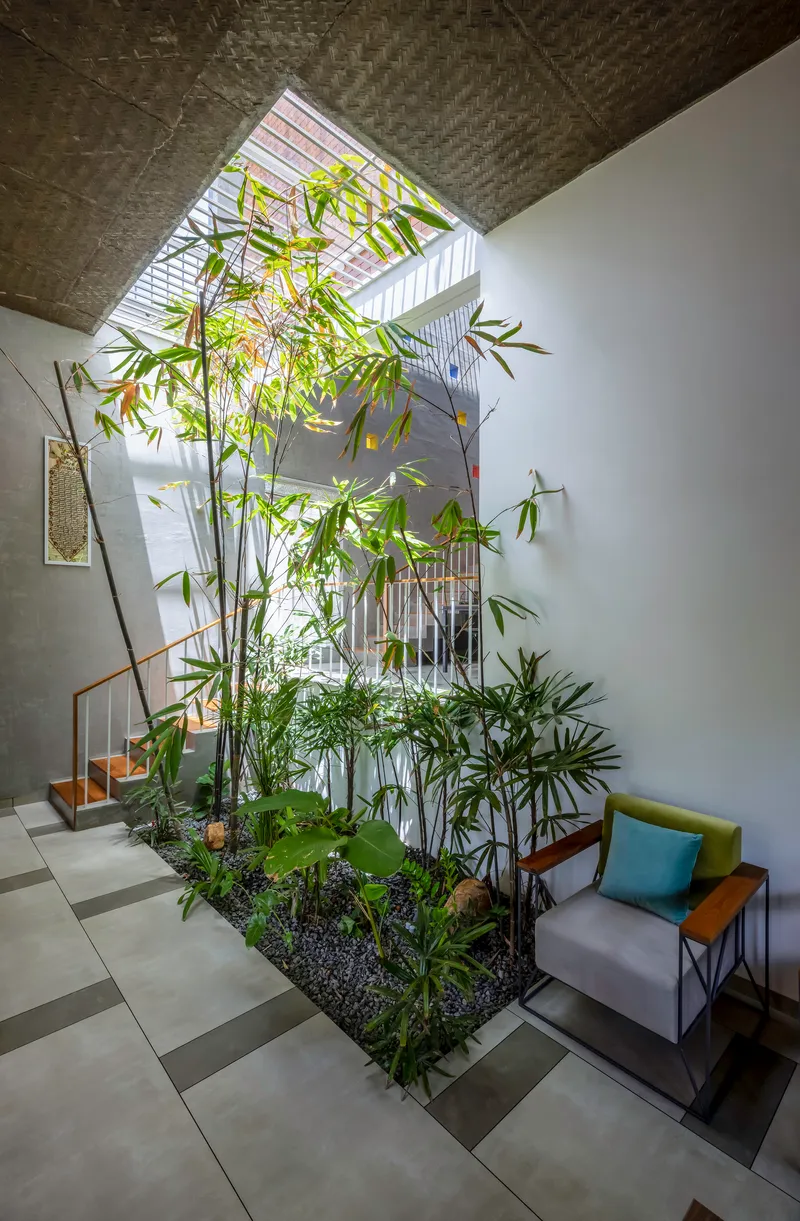
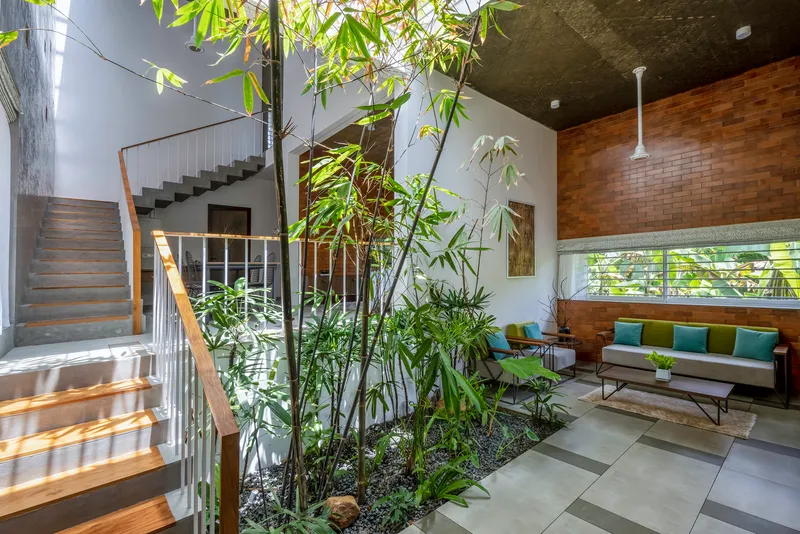
The interior courtyard is the project's spatial engine. A dense bamboo grove rises through a double-height void, lit from above by a skylight that ensures the central space stays bright throughout the day. On a narrow site where rooms line up in sequence, this courtyard prevents the plan from becoming a tunnel. Every major room borrows light and greenery from it, and the staggered staircases orbit around it, making the bamboo visible from nearly every level.
The courtyard also serves as the primary transition space on the ground floor, connecting the entry sequence to the living areas. A figure passing through the doorway, dappled sunlight shifting across white walls: the space is designed for movement, not stillness. It reads less as a garden inserted into a house and more as a vertical landscape that the house is organized around.
Staggered Floors and Floating Stairs
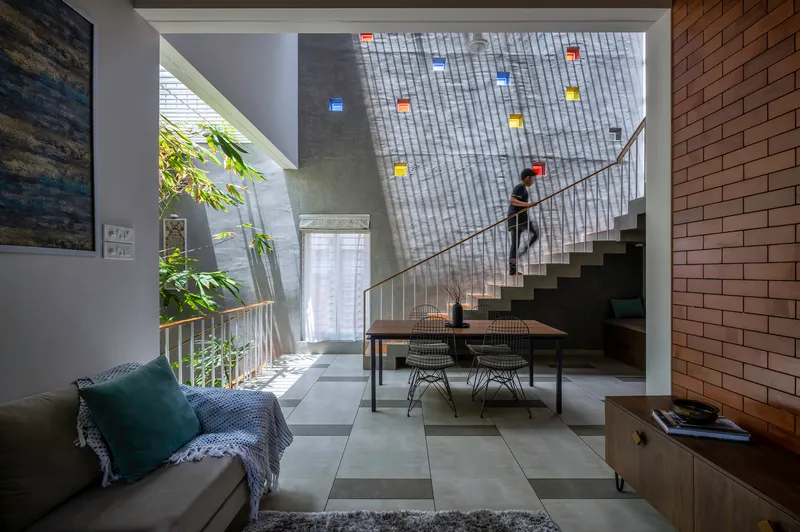
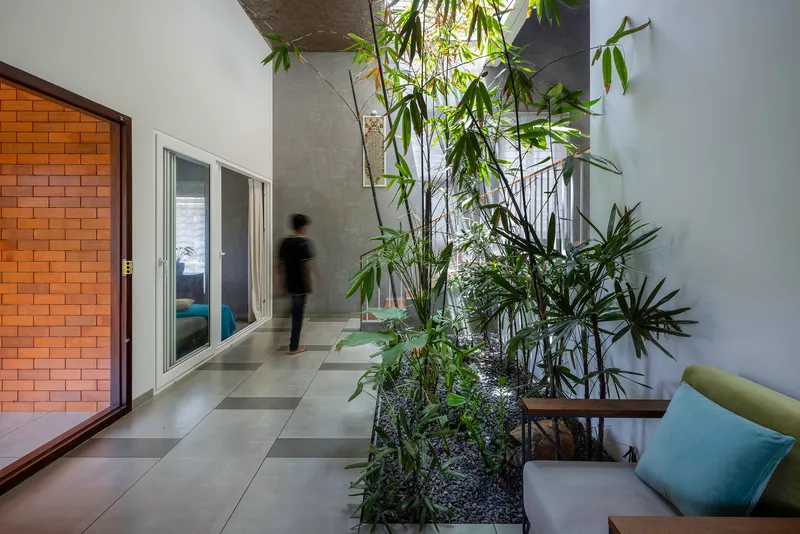
The split-level section is the defining move. Rather than excavating or filling to create flat floor plates, i2a lets the interior step down in concert with the slope. Each half-level shift produces a change in ceiling height, a new sightline, a subtle redefinition of program. The dining space, for instance, occupies a double-height zone beside a perforated brick wall that filters daylight from above, giving a modest dining area the spatial generosity of a room twice its size.
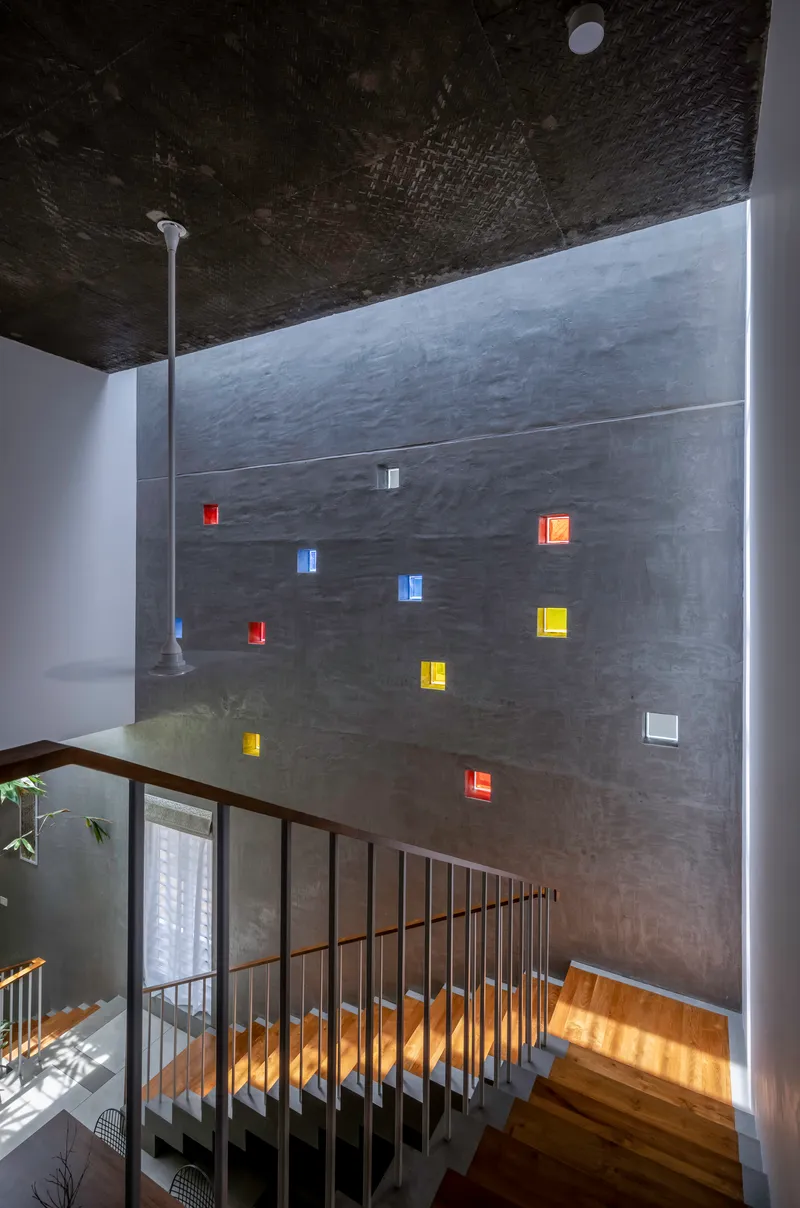
The staircases themselves are treated as architectural events. One flight features a tall concrete wall punctuated with scattered colored glass block inserts, turning the climb into a passage through shifting light. The stairs float, staggering in flight, and at each landing they open onto transitional spaces that connect visually to rooms on adjacent levels. The house avoids corridors almost entirely; circulation is woven into the living space.
Light, Shadow, and Material Texture
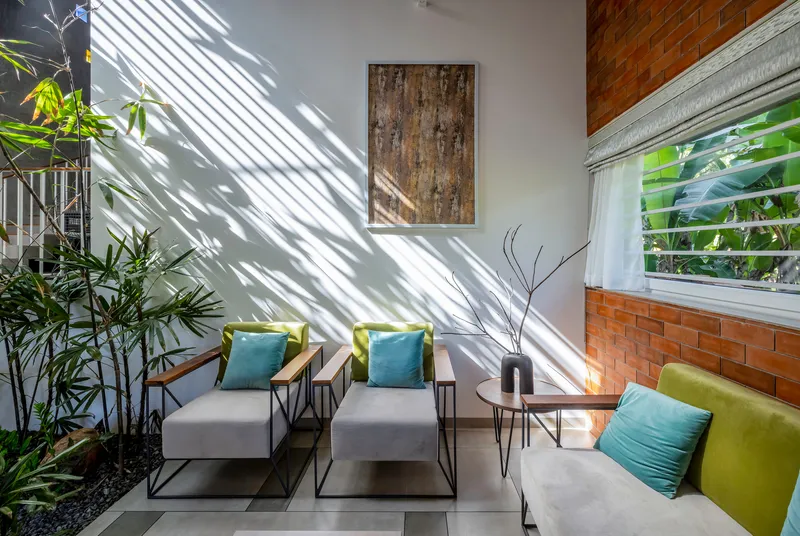
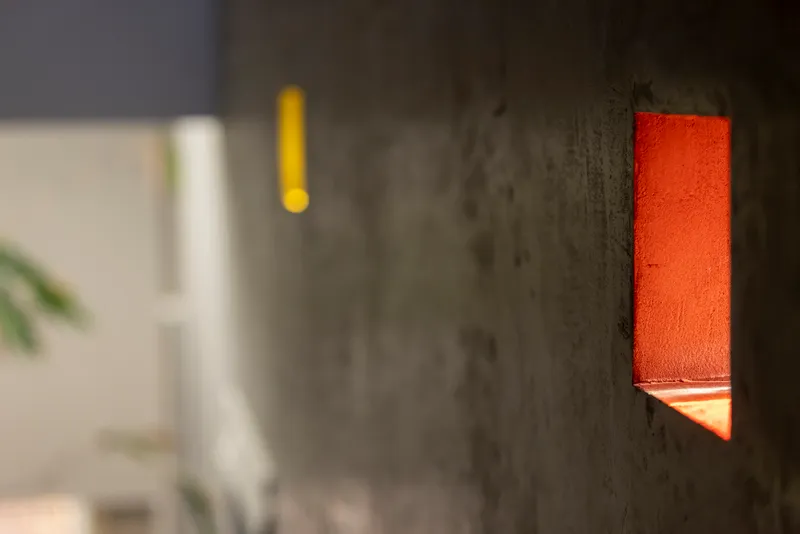
Kerala's sun is relentless, and i2a treats it as a design material. Louvered skylights cast striped shadow patterns across white walls, marking time like a sundial. An orange sconce recessed into a textured concrete surface shows the care given to small moments. The patterned exposed concrete ceilings are left unfinished in a way that reads as deliberate rather than economical, their texture absorbing and scattering light.
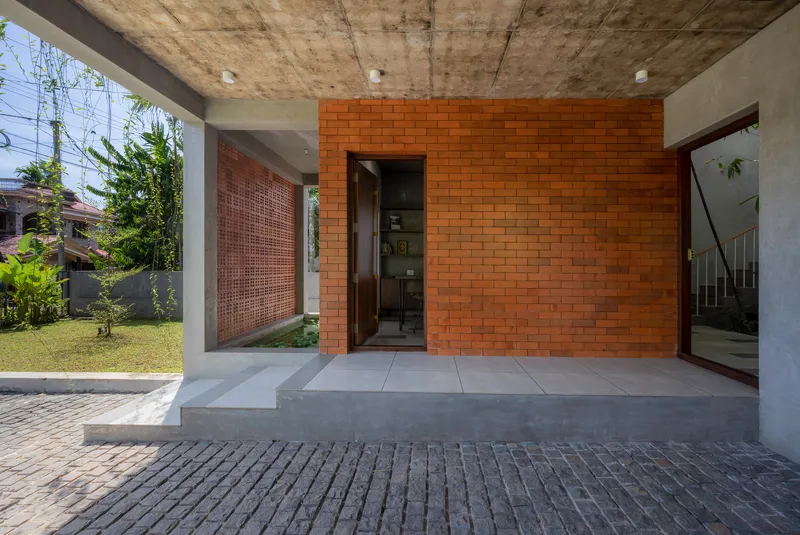
At the covered entry terrace, exposed concrete overhead meets an orange brick wall and the planted courtyard beyond. The material palette is restrained: concrete, brick, white plaster, timber, glass. No surface is arbitrary. The tinted glass inserts on walls glow at specific times of day, and the concrete and white walls become animated by shadows cast through surrounding trees.
Living Spaces and Planted Thresholds
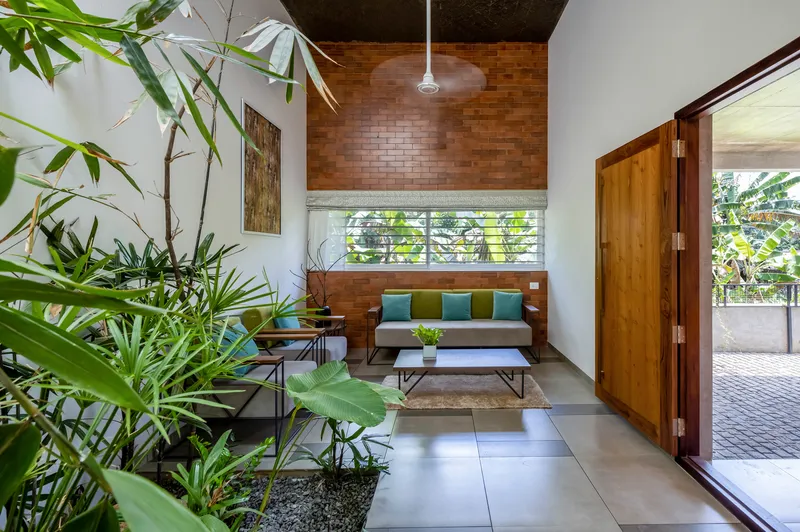
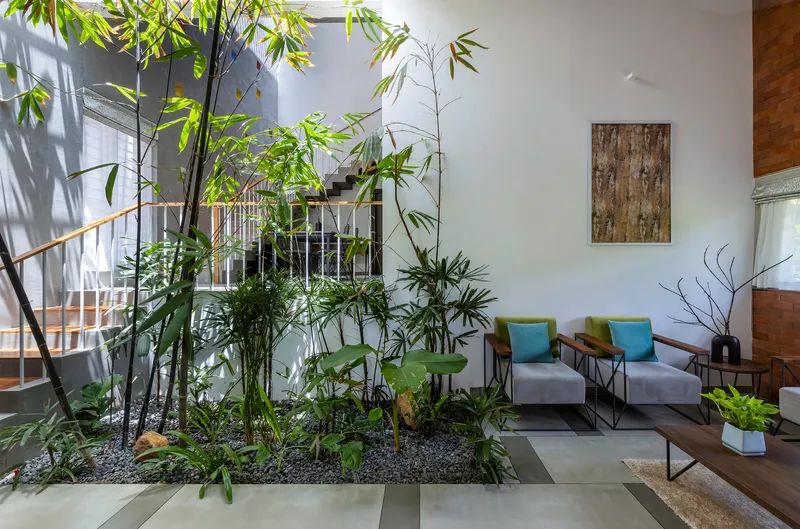
The living room pairs a timber brick accent wall with an interior bamboo planting bed, collapsing the distinction between indoors and landscape. This is not a decorative gesture. The planted beds regulate humidity, filter air, and give every seating arrangement a foreground of green. The kitchen, positioned in the northeast corner, captures morning light, a deliberate orientation that reflects an understanding of daily domestic rhythms.
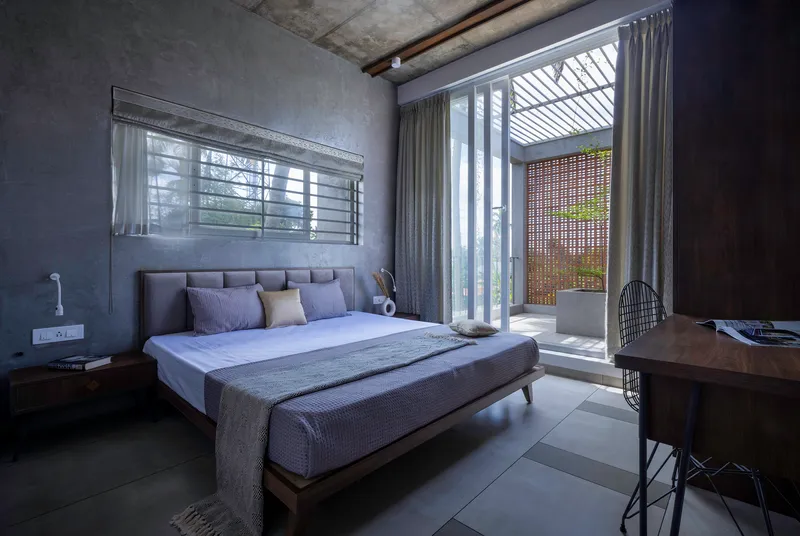
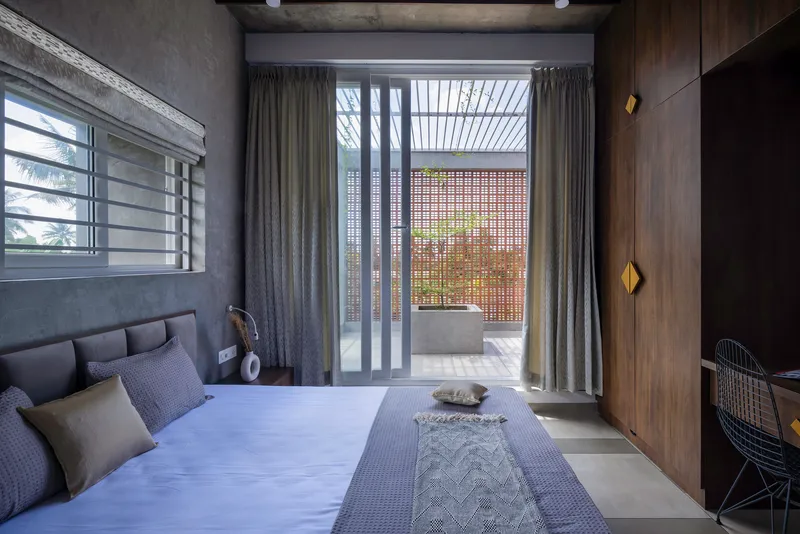
Bedrooms are treated with equal care. The master bedroom opens through curtained doors onto a slatted terrace screen, maintaining privacy while admitting breeze. The interiors lean toward minimalism, keeping clutter at bay so that material textures and the play of light can do the expressive work. There is a discipline here that avoids austerity because the spaces are so thoroughly connected to the courtyard, the sky, and each other.
Rooftop and Upper Terrace
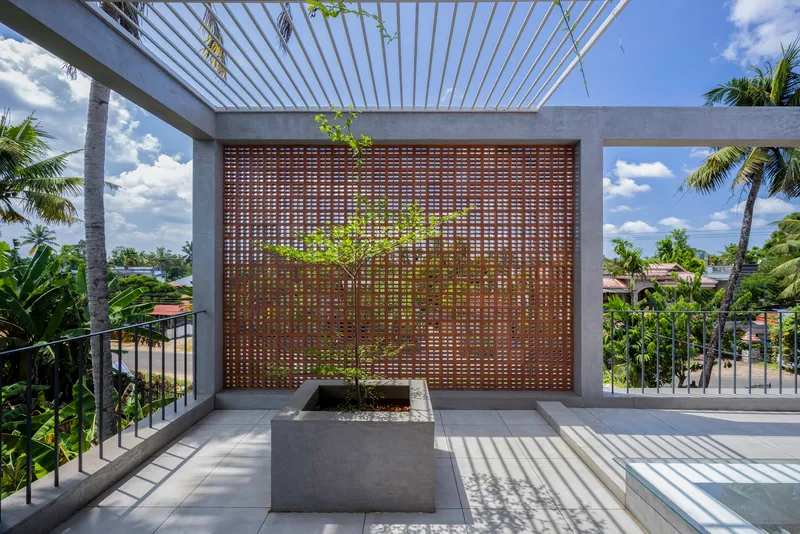
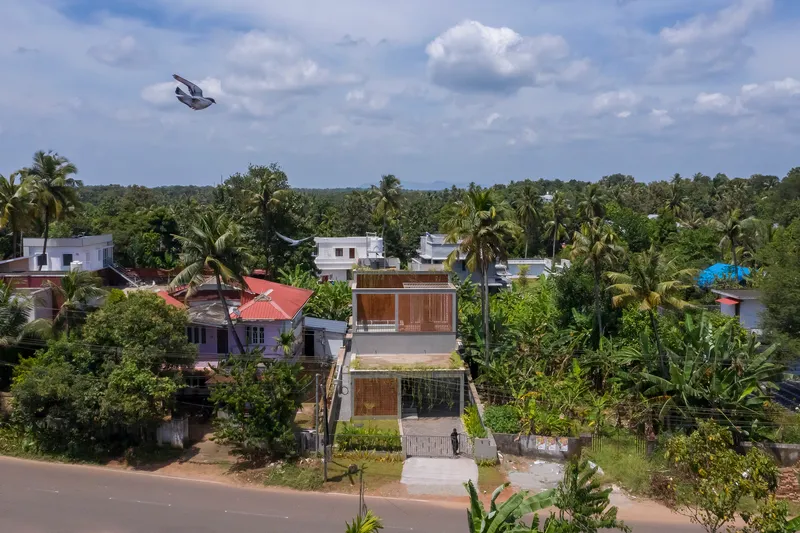
The rooftop terrace extends the layered logic of the house upward. A woven timber screen wall provides enclosure without blocking air, and a slatted overhead pergola filters direct sun. A planted bed turns the roof into productive landscape. From above, the aerial view reveals how tightly the house is nested among palm trees and neighboring rooftops, its screens blending it into the canopy rather than asserting a singular object.
These upper-level outdoor rooms, along with the green court, brick jallis, and stilted elements below, form a network of getaway spaces. The house does not offer one monolithic living experience. Instead, it provides a gradient from deep interior privacy to sun-soaked rooftop openness, all within 171 square meters.
Plans and Drawings
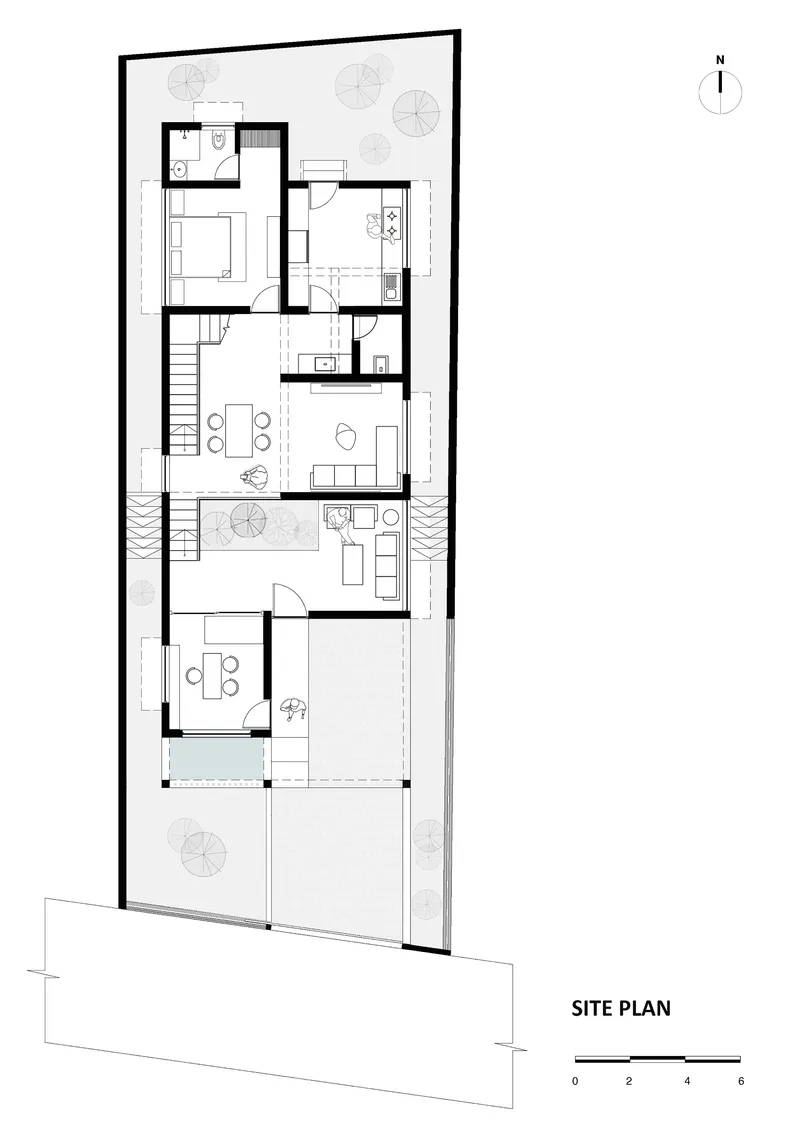
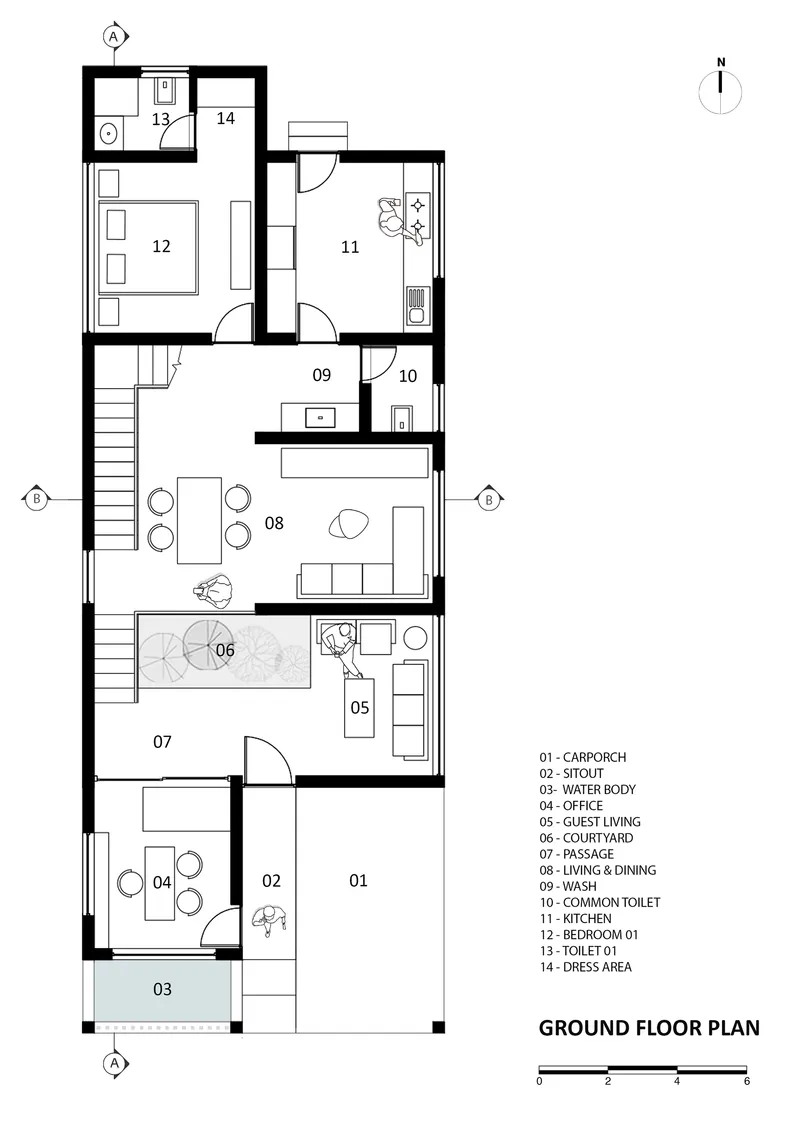
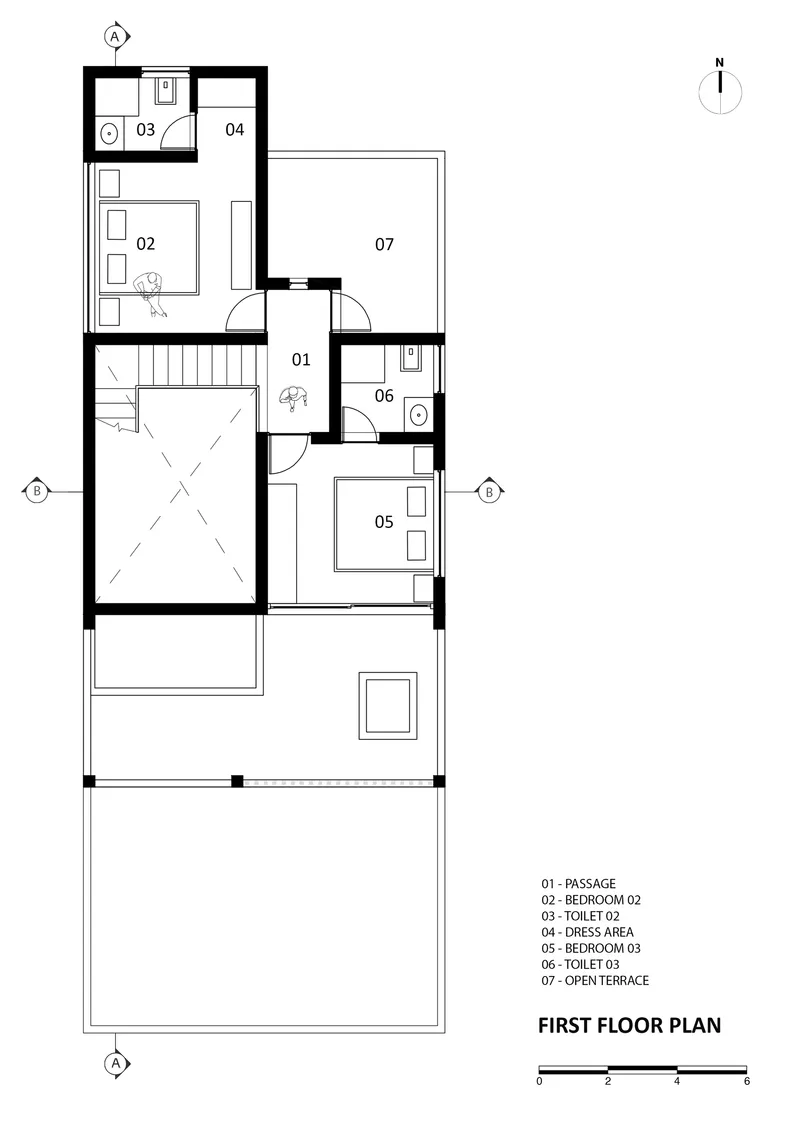
The site plan confirms the extreme narrowness of the plot and the strategic placement of the internal courtyard at its center. The ground floor plan reveals how the living areas radiate from this courtyard, with the water body integrated along the street-facing edge. On the first floor, bedrooms and an open terrace wrap around the courtyard void, maintaining visual continuity downward to the bamboo grove.
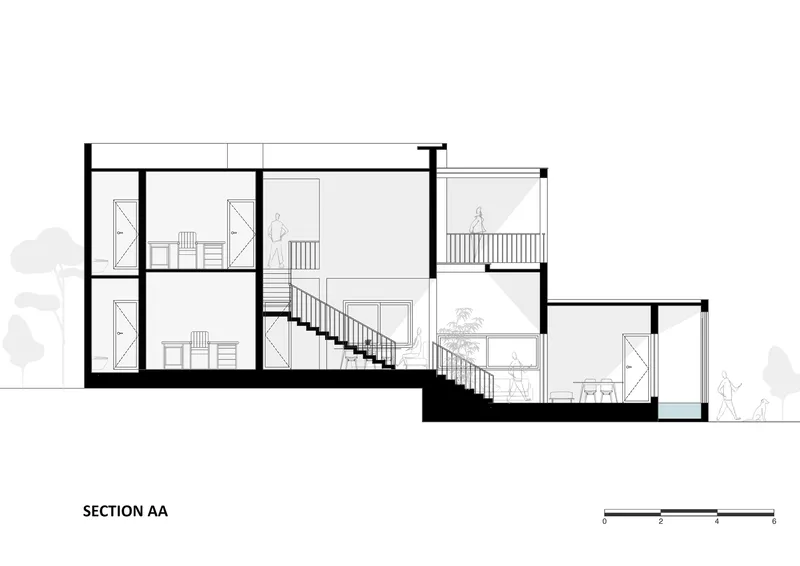
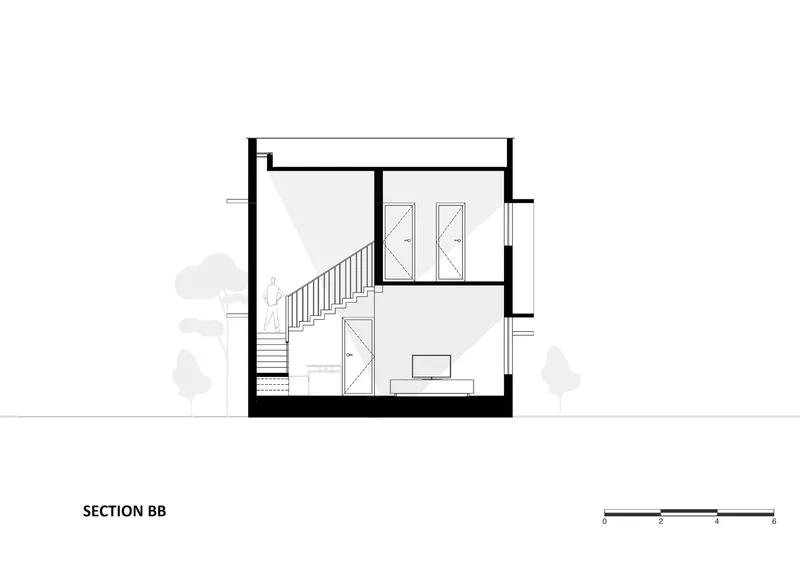
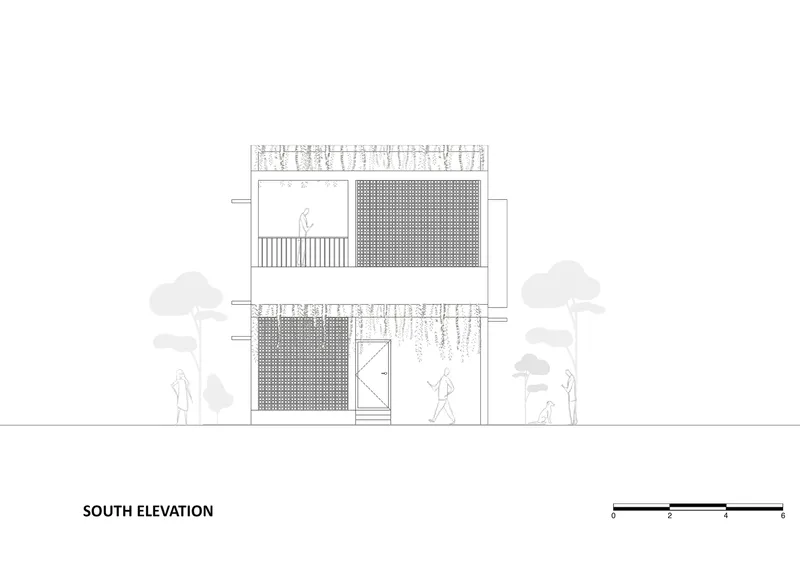
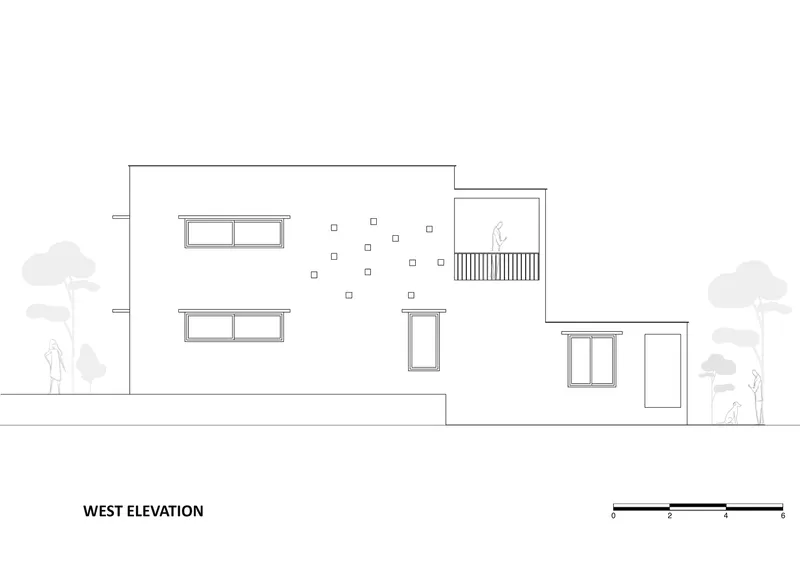
The two section drawings are the most revealing. They make legible the split-level logic: staircases connecting half-floors across the building's length, ceiling heights shifting to accommodate the slope. The perforated screen elements appear in section as layered filters between interior and exterior. The south and west elevations show how the facade is composed of distinct panels: perforated screens, horizontal window bands, and planted balconies, each calibrated to its orientation.
Why This Project Matters
The 0 to 150 LVL House is a compact demonstration that topography is not an obstacle to be graded away but a spatial resource. By following the slope, i2a Architects Studio generates a section far richer than a conventional two-story house could achieve on the same footprint. Every half-level shift creates a new relationship between rooms, between inside and outside, between the inhabitant and the sky. The project's passive climate strategies, including the double-wall system, the courtyard stack effect, and the oriented kitchen, are integrated into the architecture rather than appended to it.
For architects working on constrained urban sites in tropical climates, this house offers a clear lesson: read the site's given conditions as design parameters, not problems to solve. The narrowness produces the courtyard. The slope produces the split levels. The sun produces the screens. None of these moves are inventions from nowhere; they are consequences of paying attention. That attentiveness, more than any single material choice or formal gesture, is what makes the project worth studying.
0 to 150 LVL House by i2a Architects Studio, Ernakulam, India. 171 m², completed 2022. Photography by Running Studios.
About the Studio
Share Your Own Work on uni.xyz
If projects like this are the kind of work you want to make, uni.xyz is a place to publish your own, find collaborators, and enter design competitions.


Popular Articles
Popular articles from the community


Cube Design Draws an Ecological Corridor Between Two Shenzhen Hills with the Nankai Building
Beside Shenzhen's container docks, the Nankai Building pairs stacked balconies with a climbing green screen to connect two hillsides across its height.


Singing Woman: An Opera House That Performs Before the Curtain Rises
Ovidiu Cristian Pavel's conceptual opera house translates Estonia's choral identity into a sculpted waterfront landmark facing the Baltic Sea.

FCC Arquitectura Expands a Portuguese Granite House with a Board-Marked Concrete Wing
In Portugal, JV House pairs a cleaned-up whitewashed and granite dwelling with a timber-shuttered concrete extension, courtyards and a garden pool.

ETEH Reworks the Shared Spaces of São Domingos School in Brazil Around Timber, Color and Hanging Plants
At São Domingos School in Brazil, 436 m² of hall, refectory and library are recast with timber joinery, a yellow and blue code and trailing greenery.

Similar Reads
You might also enjoy these articles

LAVA Architecten Gives Vocational Education a Sawtooth-Roofed Face on a Mechelen School Campus
In Mechelen, Belgium, a 2,053 m² STEM school on a 6×6 m grid turns workshops and classrooms into rooms that can be rearranged as teaching changes.

KEMA Studio Turns a Derelict Marvila Attic into a 60 m² Lighthouse Apartment Above Lisbon
In Lisbon's Marvila district, a rebuilt roof, four skylights and two plywood volumes turn an unlivable attic into a bright home facing the Tagus.

Pixel Gardens: One Repeated Module Stacked Into a Terraced Social Housing Tower for Famagusta
Salem Bader's shortlisted housing tower builds a vertical neighbourhood from one repeated module, offsetting units to carve terraces, light and air.

Bao Huynh Watercolor Atelier: A Serene Art Retreat in Hội An
Bao Huynh Watercolor Atelier in Hội An blends multifunctional art spaces, sustainable design, local materials, and family-friendly living in a serene environment.

Explore Building Energy Consumption Competitions
Discover active competitions in this discipline

Comments (0)
Please login or sign up to add comments
No comments yet. Be the first to comment!