

Immigrant Family's Dream: Vertical Sanctuary for Displaced Lives in Beirut
A humanitarian housing proposal on Bani Kahtan Street transforms Syrian cultural memory into a healing, light-filled residential tower.


What could be the dream of a war-torn immigrant family other than seeking protection? That question, plainly stated, drives the entire logic of this housing proposal. Immigrant Family's Dream does not treat shelter as a minimum threshold to be met; it treats it as the beginning of psychological recovery, layering cultural memory, vertical gardens, and shared domestic rituals into a narrow tower designed for a Syrian family resettling in Beirut.
Designed by Hani Mansurnejad, Mehdi Ebadi, and Aryan Khodabakhsh Khaledi, the project was shortlisted in the Nano Nest 2020 competition on UNI. Sited on Bani Kahtan Street in Beirut, the design confronts a real urban condition: how to insert dignified, culturally continuous housing for displaced families into the dense grain of a Lebanese city already under enormous pressure.
A Colorful Shell That Speaks Two Languages
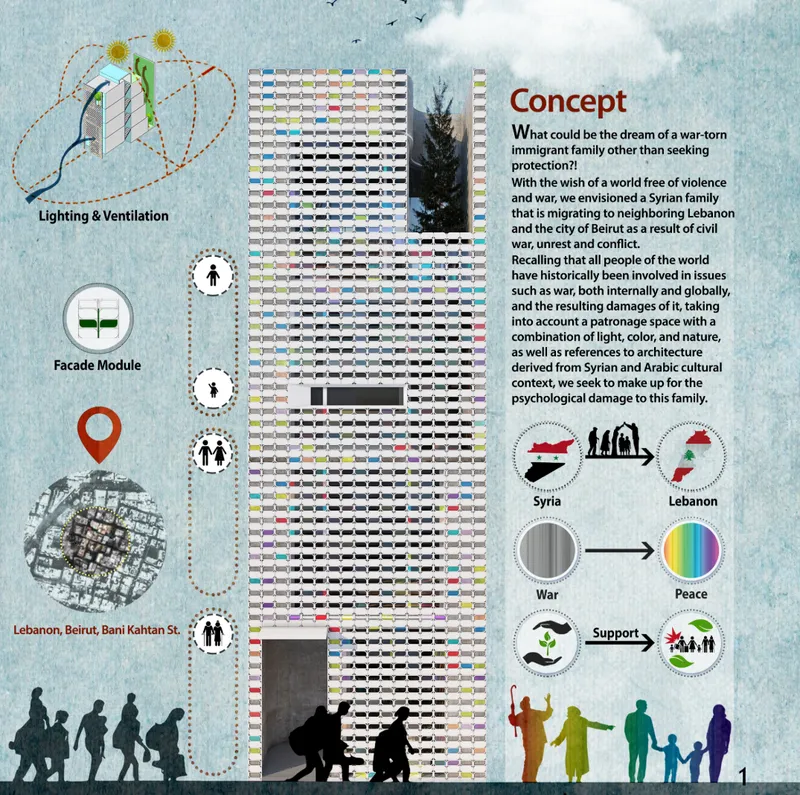
The conceptual diagram pairs the tower's massing with a text panel that lays out its core argument: post-war recovery is not only physical but deeply psychological. The facade reads as a white metal shell punctuated by colorful modules, each one a deliberate departure from the monolithic concrete slabs that define much of Beirut's reconstruction landscape. Stained glass and vibrant panel inserts draw from Syrian and Arabic decorative traditions, grounding the building in a visual language the residents already know while giving it a distinct identity on the street.
Color here is not decorative flair. It is a therapeutic strategy. The designers argue that light, color, and familiar cultural references can counteract the psychological toll of displacement. By encoding regional aesthetics into the building's skin, the facade becomes a kind of bridge: Lebanese enough to belong on Bani Kahtan Street, Syrian enough to feel like something closer to home.
Stacked Domesticity and the Central Kitchen
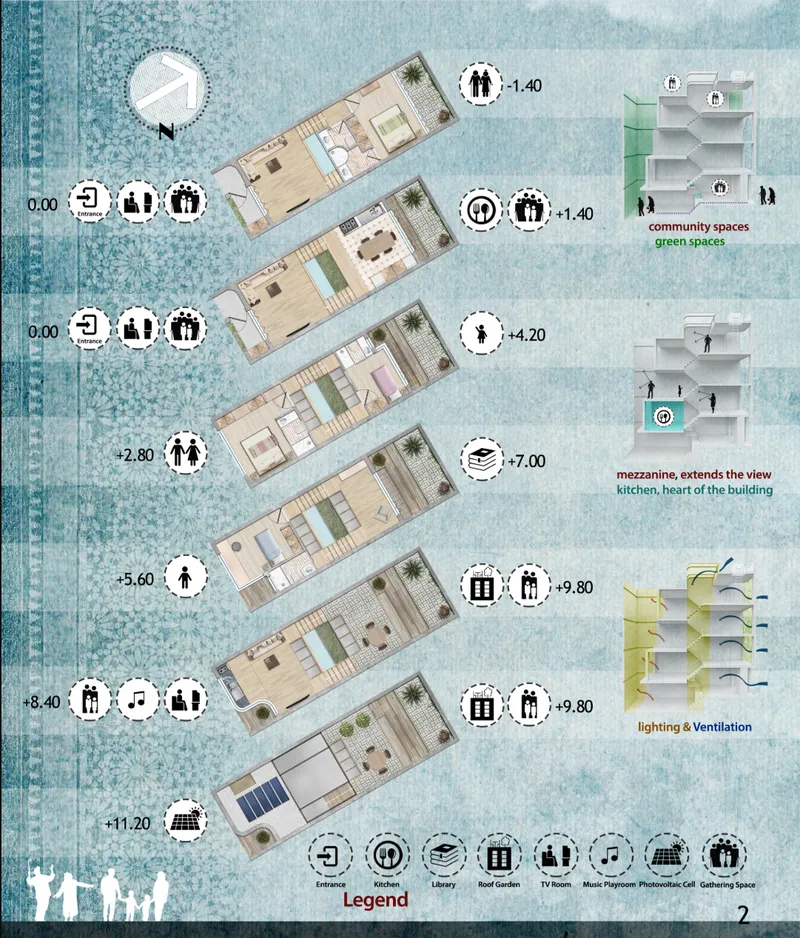
The exploded floor plan reveals how the designers stack residential units vertically while maintaining the spatial logic of traditional Middle Eastern domestic life. Each level is organized around a central kitchen, positioned not out of mere convenience but as a deliberate symbol of family unity. Green terrace spaces punctuate the section at intervals, giving every few floors direct access to planting and daylight. The layout integrates privacy through careful zoning while keeping visual connections open via mezzanine levels and split floors.
Shared spaces, including TV rooms, multi-functional halls, and a roof garden, are distributed through the tower to encourage interaction without forcing it. Accessible green areas prioritize older residents and those with limited mobility, a quiet acknowledgment that displacement affects bodies as much as it affects minds. The progressive design logic moves from a traditional building core outward to privacy screens, then upward through atrium integration, mezzanine levels, and finally the vertical garden that crowns the composition.
Concrete, Pine Wood, and the Vertical Section
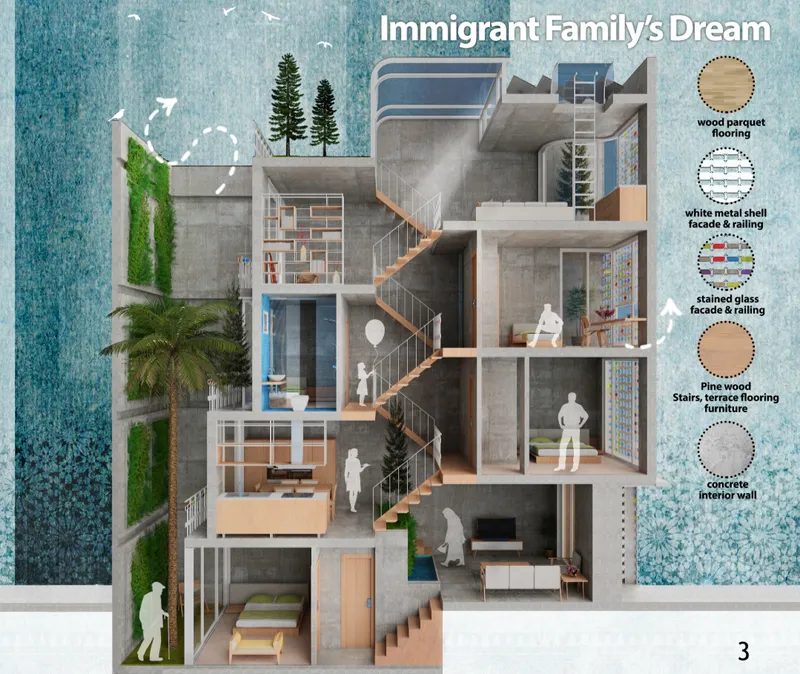
The section rendering is where the project's material honesty comes through most clearly. Concrete and pine wood alternate across the interior, both chosen for cost-effectiveness and local availability. Staircases knit the split levels together, encouraging movement and chance encounters between family members on different floors. Natural ventilation strategies are visible in the section's openings, with airflow paths designed to reduce cooling loads in Beirut's hot summers.
The mezzanine levels create sightlines that cut vertically through the building, allowing a parent on one floor to maintain visual contact with children on another. The designers frame this as a "parental control layout," a term that sounds clinical but translates spatially into something warm: an architecture of watchfulness, of being able to see your family without surveilling them. Light enters from multiple orientations, filling the central atrium and filtering through stained glass panels to cast colored light across the concrete surfaces.
Street Presence and Solar Independence
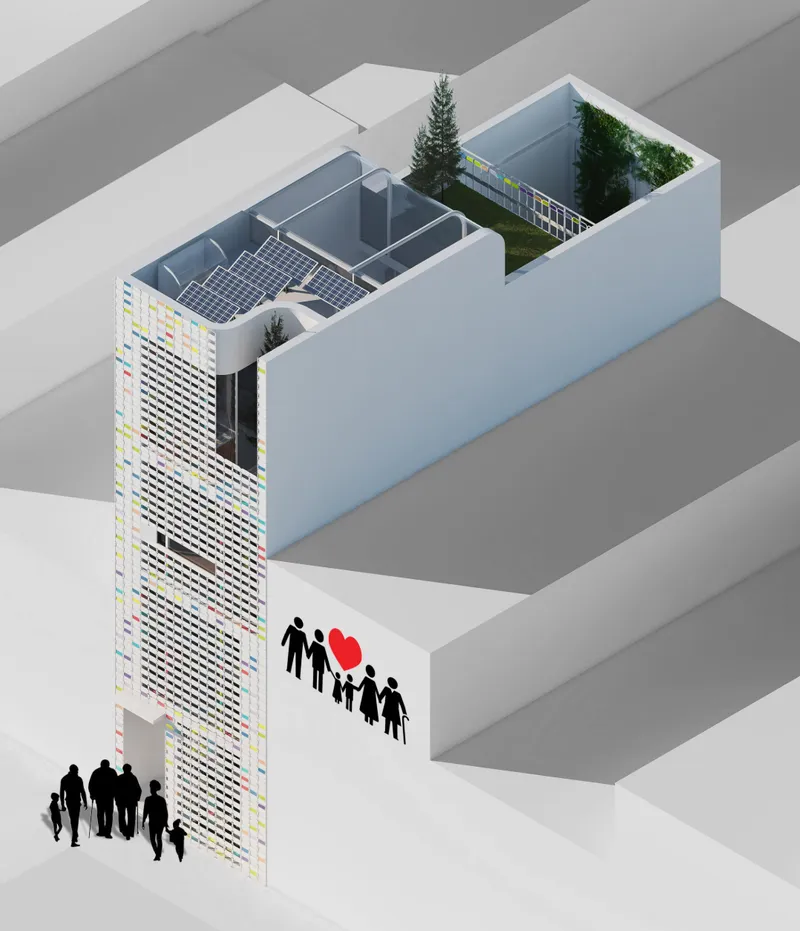
The axonometric drawing pulls the camera back to show the tower in its neighborhood context. Solar panels sit on adjacent rooftops, reducing dependence on Beirut's notoriously unreliable external energy grid. Pedestrians pass at street level, establishing a ground-floor relationship that avoids the fortress mentality common to refugee housing. The tower does not hide behind walls; it opens to the sidewalk, inviting the city in.
Green walls and the roof garden are legible from this vantage point, reinforcing the sustainability argument beyond the purely technical. These planted surfaces improve air quality, provide recreational space, and signal to the surrounding neighborhood that the building's residents are invested in the long-term health of the street. For a family that has been forcibly uprooted, the act of growing something is itself a declaration of permanence.
Why This Project Matters
Refugee housing design too often optimizes for density, cost, and speed at the expense of everything that makes a dwelling feel like a home. Immigrant Family's Dream refuses that trade-off. By rooting the design in Syrian and Arabic architectural traditions, using locally available materials like concrete, pine wood, and stained glass, and integrating therapeutic strategies such as vertical gardens, natural light, and visual connectivity, the project offers a model for humanitarian architecture that treats cultural continuity as a structural requirement rather than a decorative afterthought.
Mansurnejad, Ebadi, and Khodabakhsh Khaledi have proposed something that operates simultaneously as shelter, as community infrastructure, and as a quiet argument that displaced families deserve more than survival. The building's colorful facade, its shared kitchens and gardens, its careful calibration of privacy and openness: these are not luxuries. They are the spatial conditions under which healing becomes possible. In a city already shaped by waves of displacement and reconstruction, this tower suggests that the next layer of Beirut's built environment can be restorative rather than merely expedient.
View the Full Project
About the Designers
Designers: Hani Mansurnejad, Mehdi Ebadi, Aryan Khodabakhsh Khaledi
Enter a Design Competition on uni.xyz
uni.xyz runs architecture and design competitions year-round that reward proposals with spatial conviction and real site intelligence.
Project credits: Immigrant Family's Dream by Hani Mansurnejad, Mehdi Ebadi, Aryan Khodabakhsh Khaledi Nano Nest 2020 (uni.xyz).


Popular Articles
Popular articles from the community


Singing Woman: An Opera House That Performs Before the Curtain Rises
Ovidiu Cristian Pavel's conceptual opera house translates Estonia's choral identity into a sculpted waterfront landmark facing the Baltic Sea.

Extended Shell: Retrofitting Kolkata's Balconies as Living Urban Thresholds
A modular retrofit system recovers the social and environmental intelligence of Kolkata's historic verandas for contemporary Park Street residents.

Manzana Morphosis: Stretching Barcelona's Grid into a Living Landscape for 2050
A radical reworking of the Eixample manzana turns density into a tool for generous public space, vertical ecology, and environmental performance.

Cloaked Colonization: A Mobile Underwater Habitat That Moves Like a Fish
Micah Abaya's shortlisted EHC Pacific entry reimagines ocean settlement as a dispersed network of self-sustaining architectural organisms.

Similar Reads
You might also enjoy these articles

Shakur's House: Exposed Brick as an Interior Organiser in a 168 m² Mashhad Residence
Brick moves indoors in this Mashhad residence, where masonry walls, glass partitions and teal planes sequence a compact home without closing it off.

Day and Night Park: A Time-Based Urban Newsstand in Beijing
A temporary urban newsstand in Beijing blending travel, light, and reading through poetic colors, compact form, and community-focused design.

Modernist Patio Renovation in El Masnou, Barcelona by Oliver Segura Arquitectura + Cebrià Arquitectura
Modernist patio renovation blending tradition and innovation with a movable pool, leveled floors, and Catalan materials in El Masnou.

Alto Residencial Coop: Cooperative Housing Development in Santiago de Compostela by Carbajo Barrios Arquitectos
A linear cooperative housing complex blending white volumes and perforated metal façades, enhancing community living, natural light, privacy, and urban integration.

Explore Architecture Competitions
Discover active competitions in this discipline

Challenge to reimagine the Iron Throne

Photograph architecture without architects

Illustrate the lost glory of Angkor Wat - Render Challenge

Design challenge to reuse E-waste
Comments (0)
Please login or sign up to add comments
No comments yet. Be the first to comment!