

Studio Parisi Architects Wraps a Brutalist Suburban House in Timber, Concrete, and Green Defiance
In Drummoyne, Sydney, a 300-square-meter home fuses board-formed concrete and reclaimed brick with a lush central courtyard.


Brutalism in the suburbs is almost always a provocation. When Studio Parisi Architects dropped a house made of board-formed concrete, reclaimed brick, exposed steel, and vertical timber screens into the leafy streets of Drummoyne in Sydney's inner west, the provocation was deliberate. But the Industrial Escape House, completed in 2023, is not a brooding monolith. At 300 square meters, it is a residence that deploys raw industrial materials with real precision and then softens them, almost subversively, with a central courtyard filled with palms and a lawn that glows in the afternoon light.
What makes the project genuinely interesting is not its material palette alone but the way it negotiates between introversion and openness. The street facade reads as layered, private, even opaque: corrugated metal, timber slats, poured concrete. Step inside, and the house peels open to a northern courtyard wrapped in floor-to-ceiling glass. Every room borrows light, air, and greenery from that void. The concrete walls, imprinted with the grain of Oregon pine formwork, retain warmth in winter and stay cool in summer. Cross-ventilation moves through the plan. The house performs thermally without apology and looks striking while doing it.
A Layered Street Presence
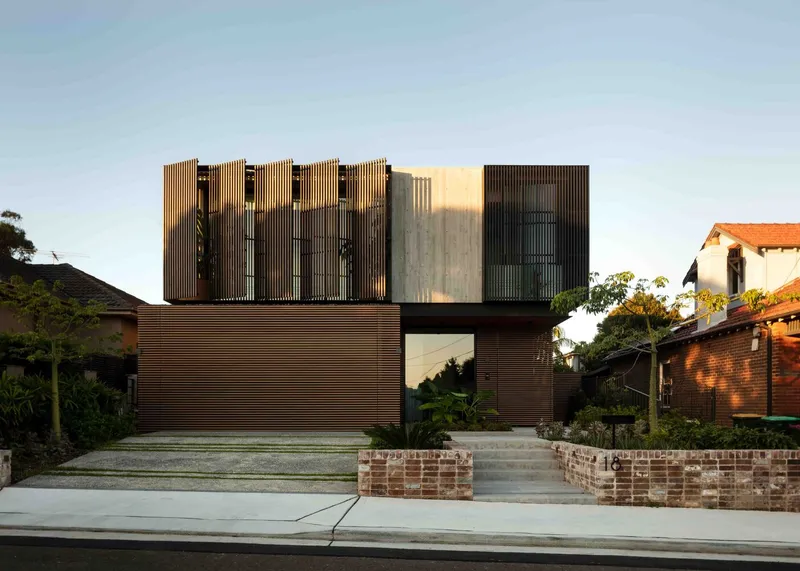
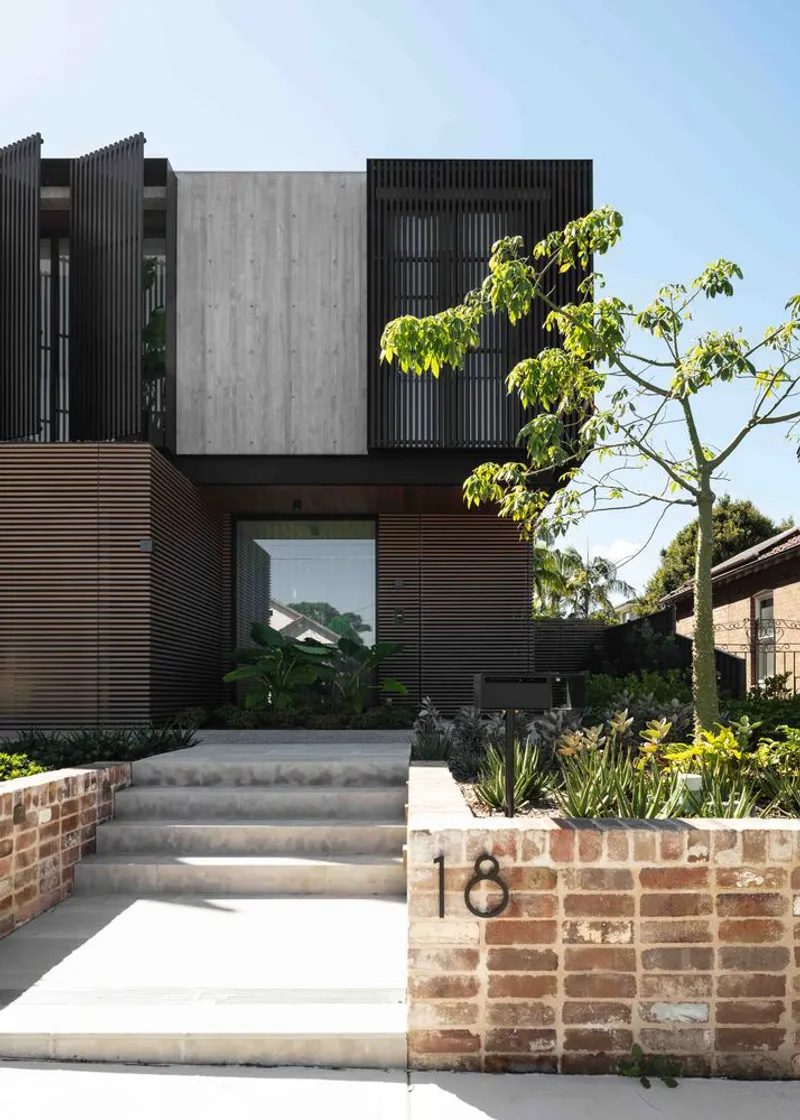
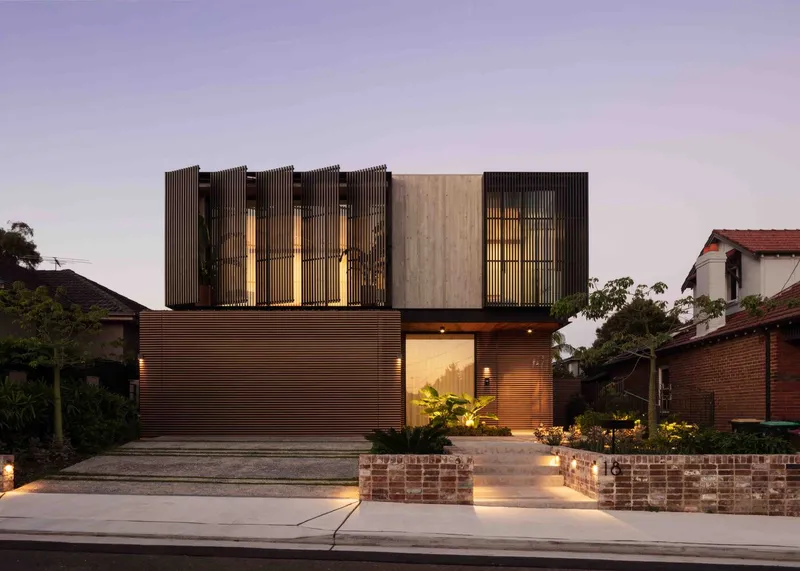
From the street, the house announces itself as something other than its neighbors without shouting. The facade is a composition of stacked volumes: vertical timber slat screens sit alongside panels of poured concrete and brick planter steps that stagger up to the entry. At dusk, the corrugated metal cladding catches ambient light while the timber screens glow from within, revealing just enough of the interior life to suggest warmth without surrendering privacy. A mature tree in the front yard roots the composition in its suburban context, reminding you that this is still a house on a street, not an art installation.
The entry sequence is carefully calibrated. Brick and concrete steps lead upward through the timber slat facade into a threshold zone where the material palette shifts. It is a compression point: tight, textured, controlled. Then the house releases you into the courtyard views beyond.
The Courtyard as Engine
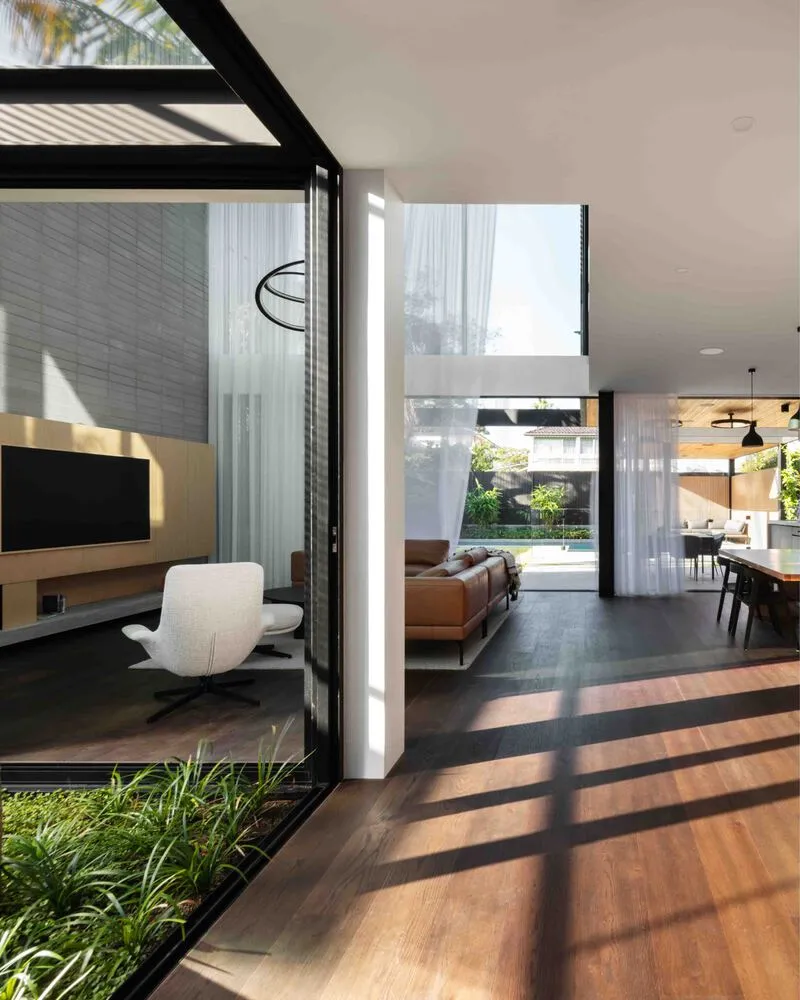
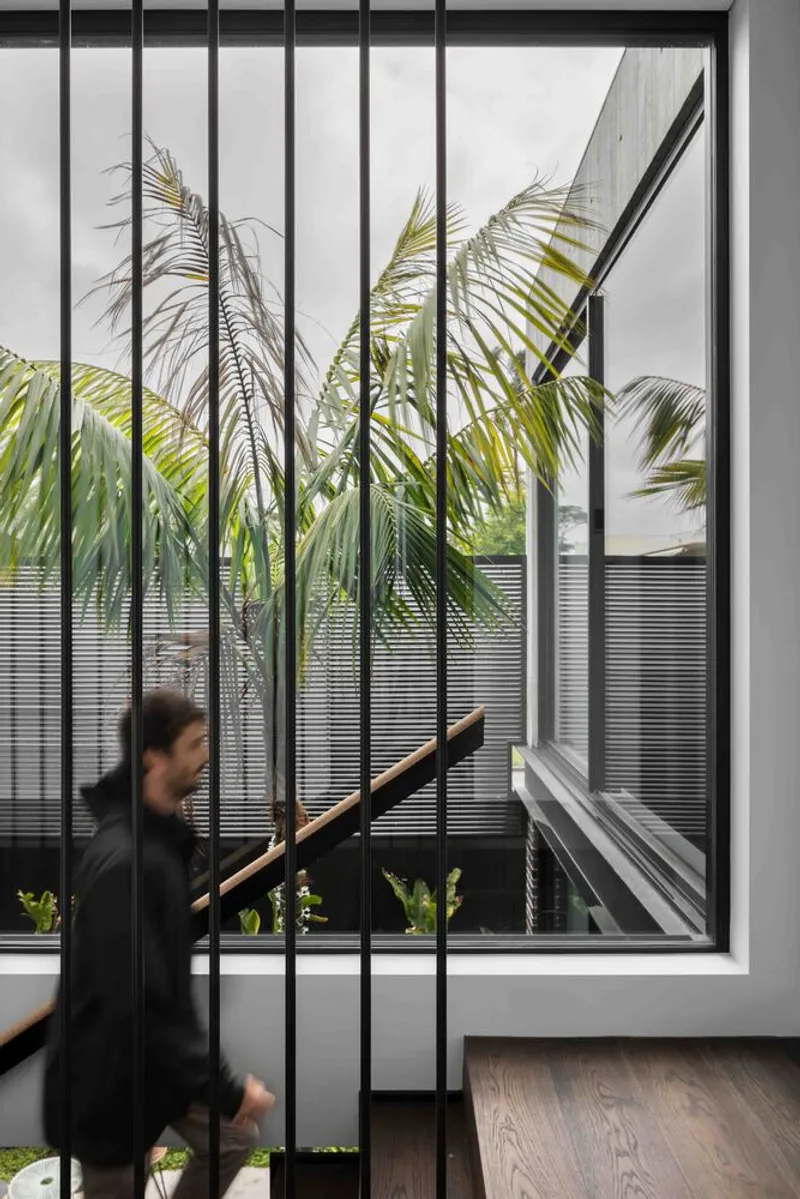
The northern courtyard is not decorative. It is the engine of the entire plan. Double-glazed sliding doors wrap around it, allowing living spaces on multiple sides to borrow its light and air. In winter, the courtyard captures and stores solar warmth through the concrete thermal mass that surrounds it. In summer, the same mass stays cool, and strategically placed openings draw cross-breezes through the interior. Studio Parisi treats the courtyard as both a passive climate device and a psychological anchor: the green lawn and palm fronds visible from nearly every room dissolve the heaviness that concrete and steel might otherwise impose.
Striped sunlight falls across timber floors in the afternoon, filtered by the slat screens and the courtyard's planting. A figure descending the stair through a vertical metal screen catches a framed glimpse of courtyard palms. These are not accidental moments. The architects have choreographed movement through the house so that the courtyard is always present, always pulling your eye toward greenery and sky.
Circulation as Sculpture
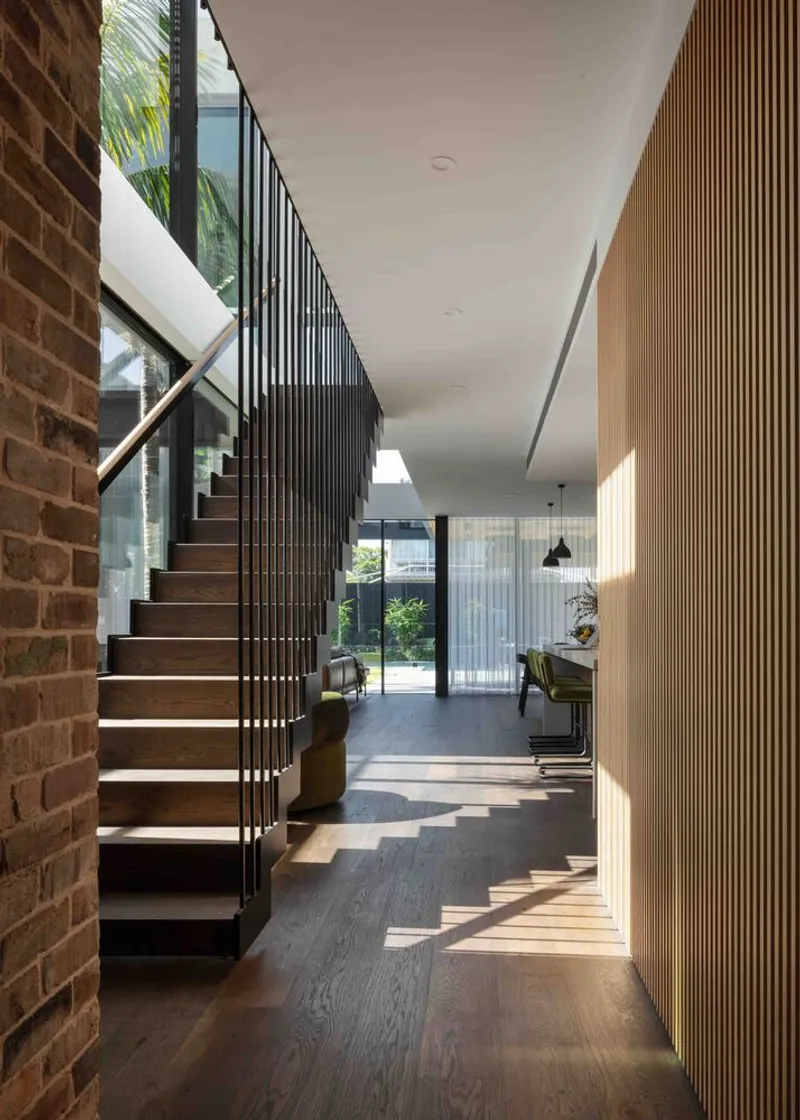
The staircase rises six meters and was engineered to minimize deflection while maintaining a spare, almost weightless appearance. A floating timber tread system is paired with a vertical metal balustrade, and the whole assembly sits against a slatted partition that frames views to the garden below. It is one of the most resolved elements in the house: structural ambition meeting visual restraint.
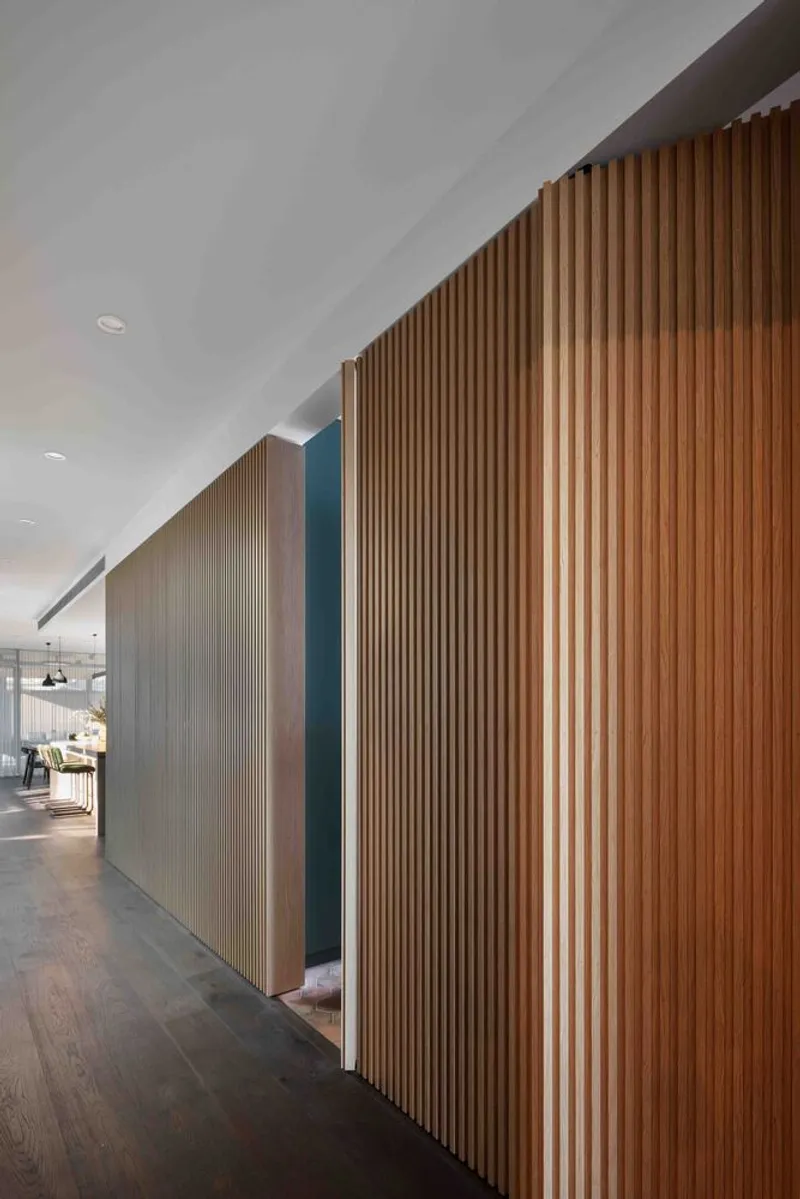
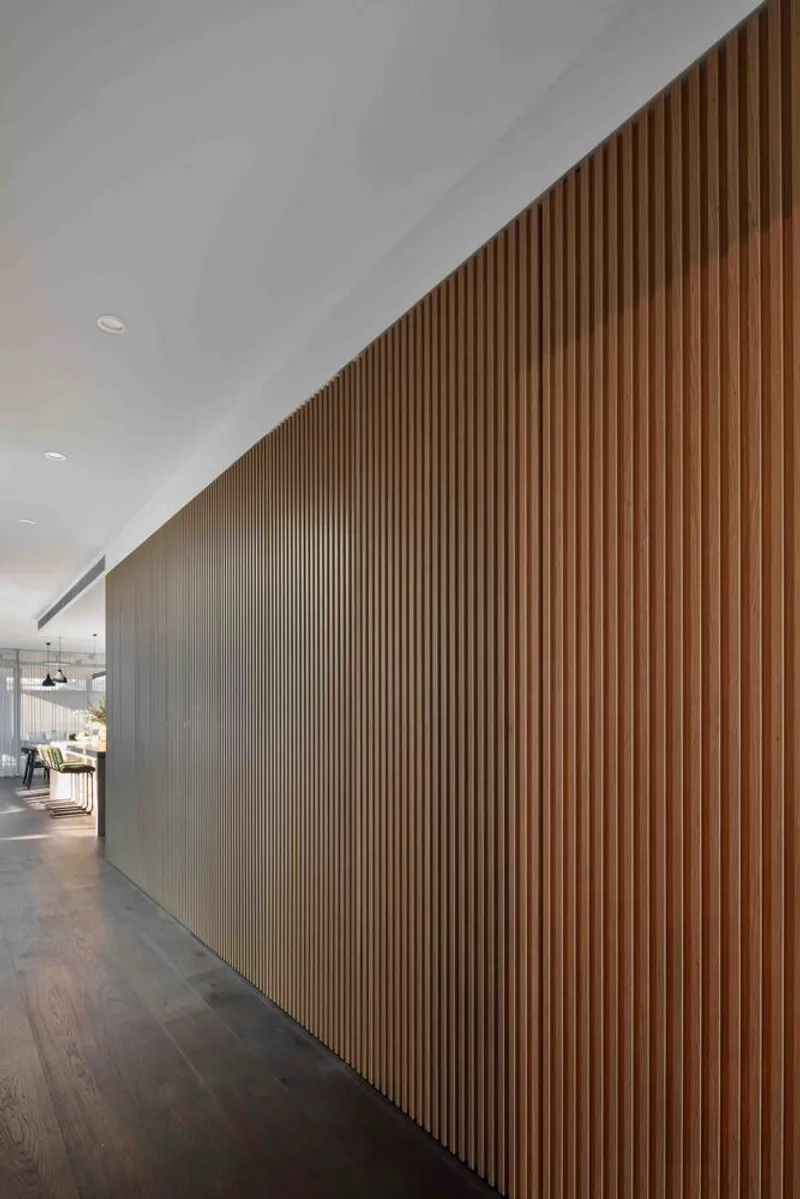
Corridors reinforce the same language. A continuous vertical timber slat partition wall runs beneath a sloped white ceiling, punctuated by recessed lighting. A recessed doorway, painted in deep blue, appears as an incision in the timber wall. The house never defaults to drywall and trim. Every surface and every transition is considered, which is what separates this project from houses that merely apply industrial materials as finish rather than structure.
The Kitchen and Living Volumes
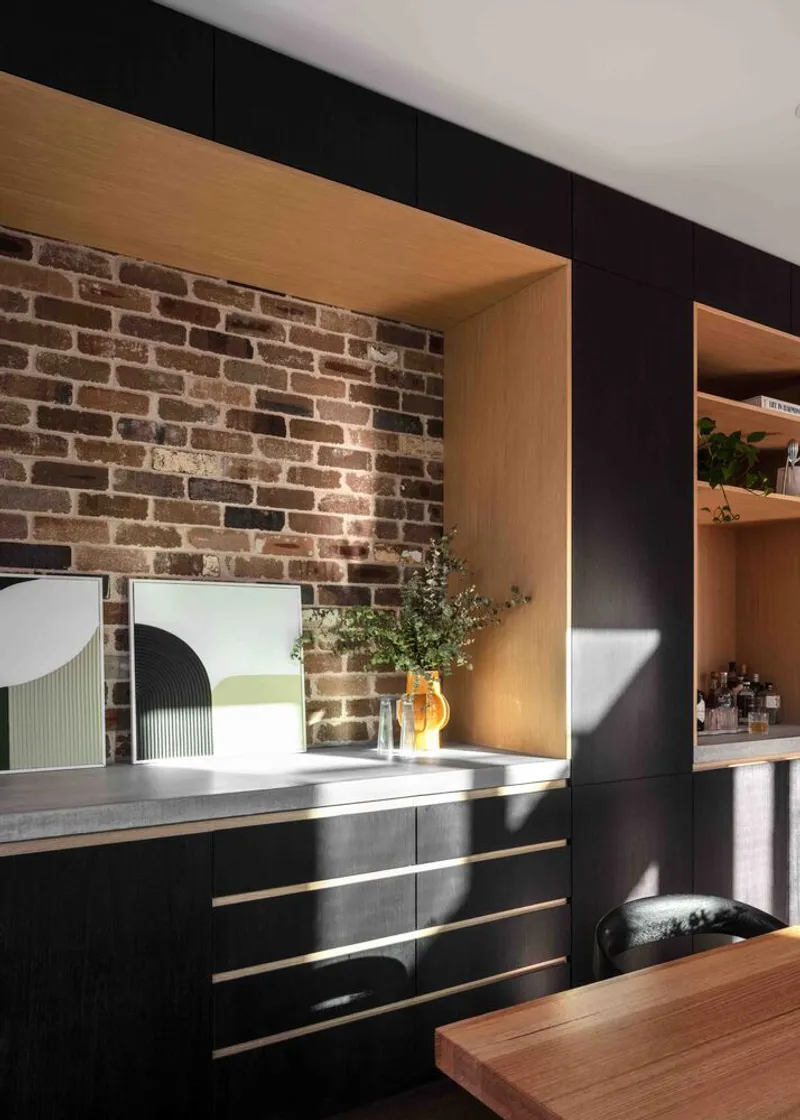
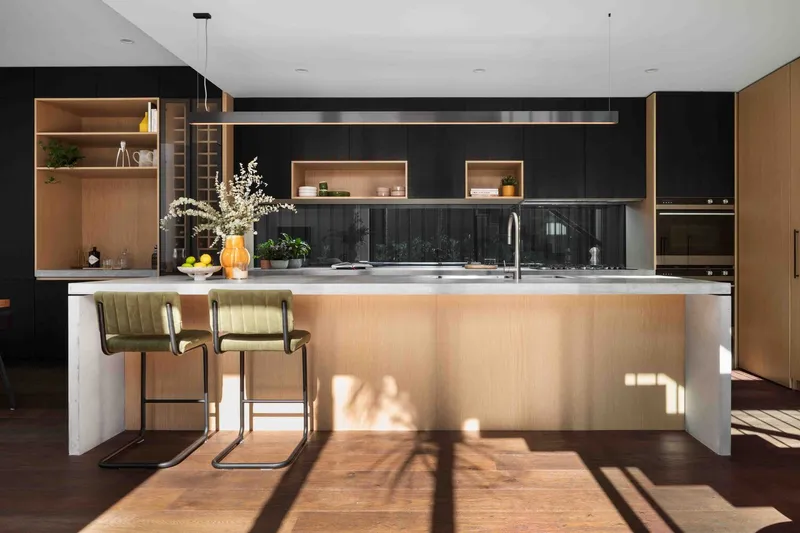
The kitchen island, with its timber-clad base and black cabinetry, anchors the open-plan living area. Behind it, an exposed brick wall sits framed inside a timber-lined alcove, a move that treats the reclaimed brick not as wallpaper but as a deliberate material event. Brass hardware on black oak cabinets adds a quiet warmth. Long shadows stretch across dark timber flooring from the island, evidence of the courtyard light doing its work from the north.
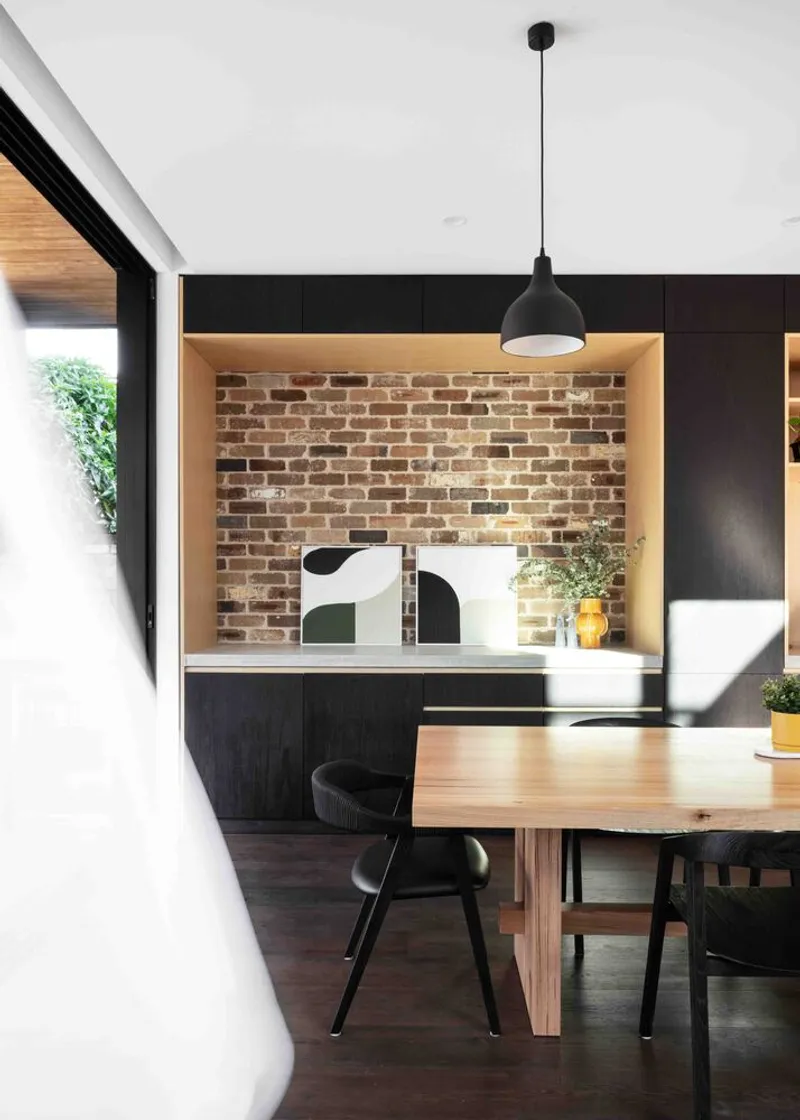
The dining area occupies a timber-lined alcove with a pendant light above and an exposed brick wall behind, creating an intimate pocket within the larger open volume. Studio Parisi understands that open-plan living works best when it contains moments of enclosure. The brick and timber alcoves provide that contrast without fragmenting the space.
Details That Earn Their Keep
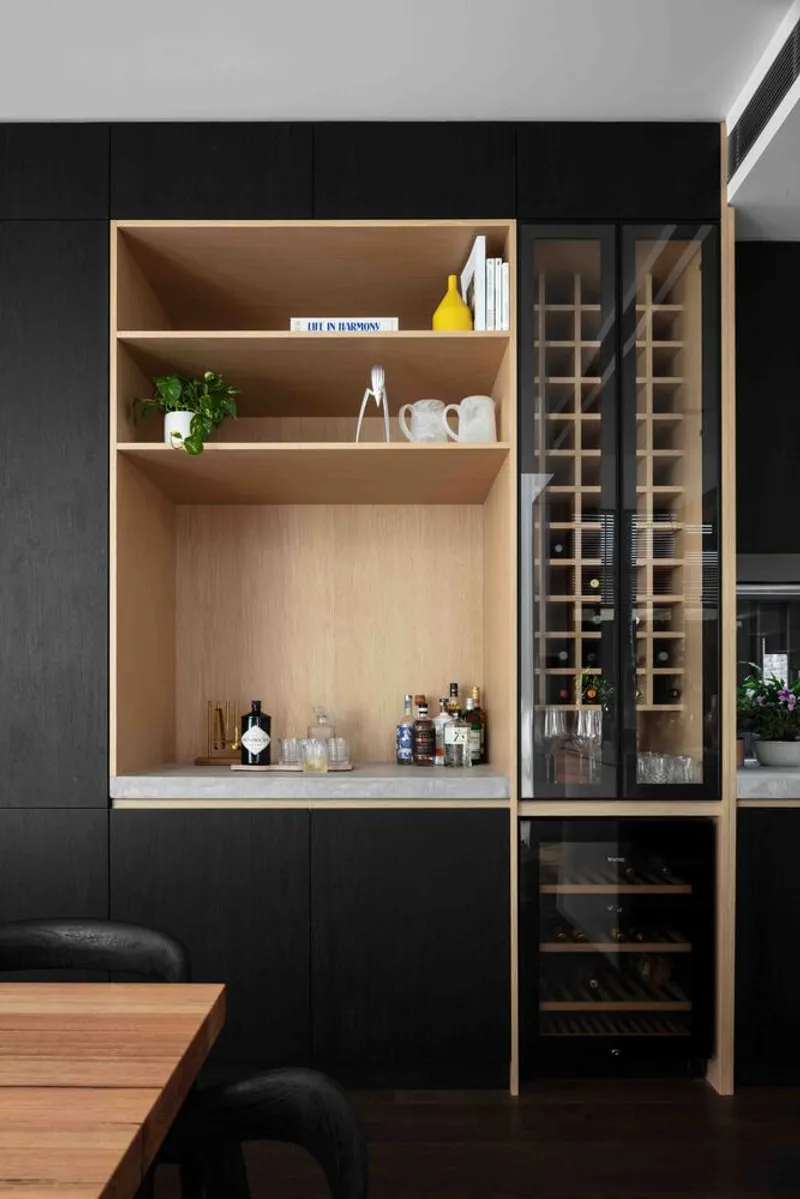
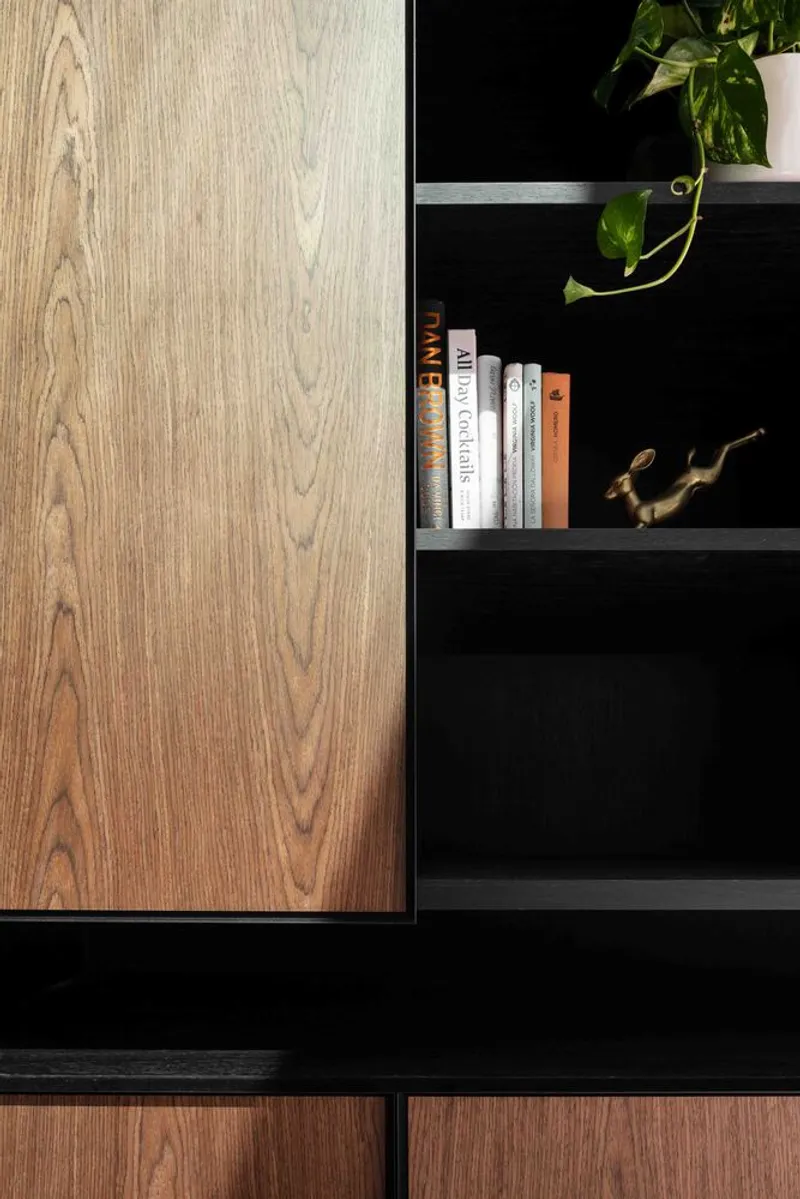
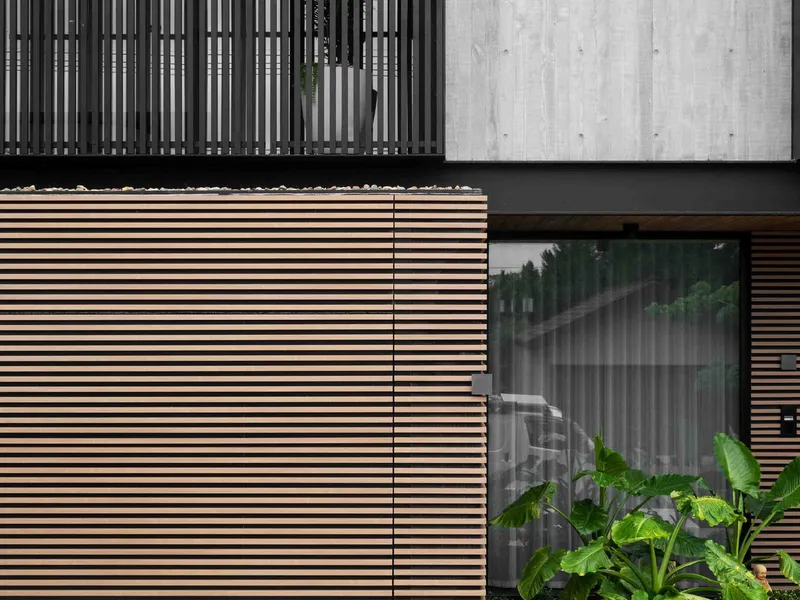
The joinery throughout the house is precise without being precious. A built-in shelving niche integrates a wine rack and storage below black upper cabinetry. Sliding timber cabinet doors meet black shelving with tight tolerances. A potted plant and a few books are enough to animate these moments because the materials do the rest of the work. Horizontal timber slat cladding on the exterior wraps around a glass window that reflects the tropical plantings below, collapsing the boundary between architecture and landscape at the detail scale.
Living with Fire, Concrete, and Earth
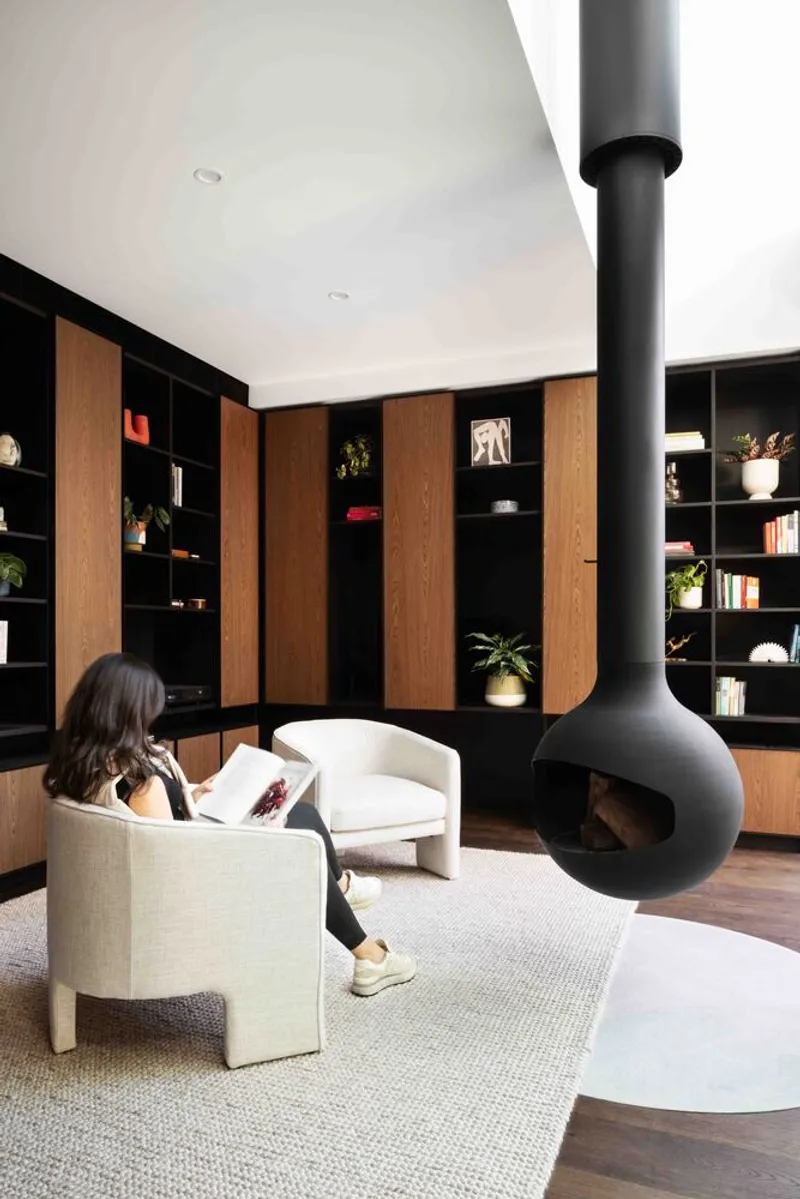
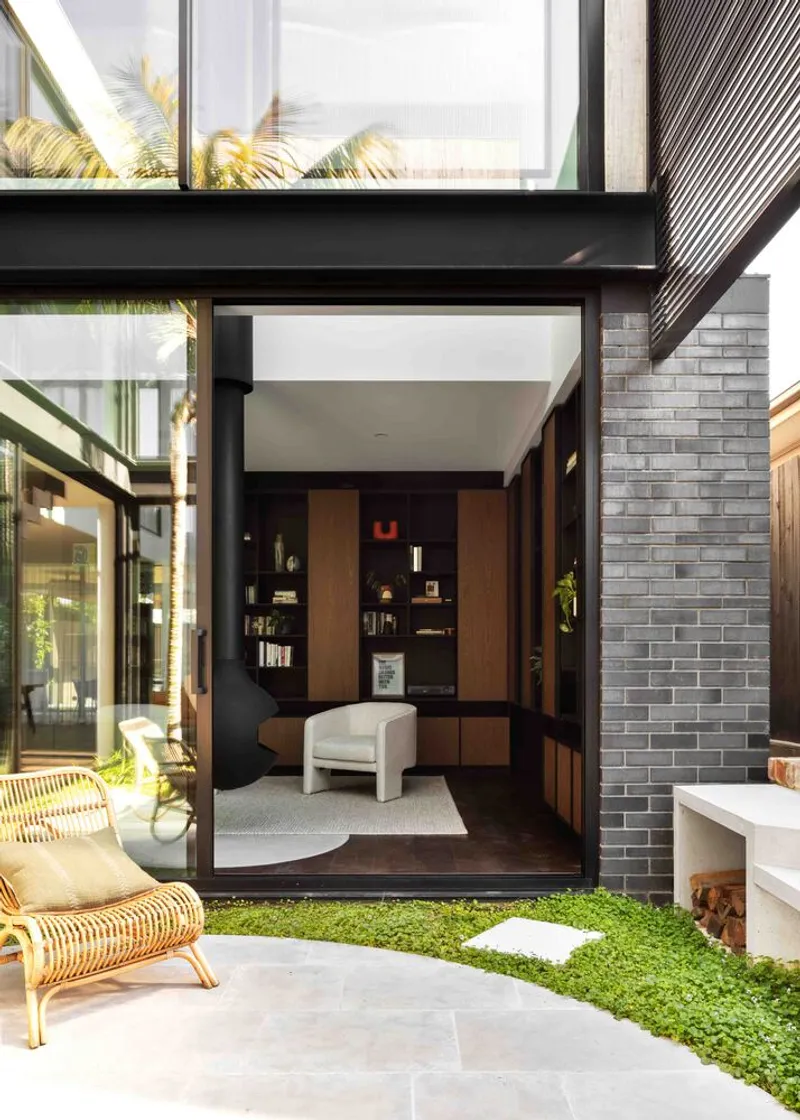
A suspended black fireplace hangs in the reading room, flanked by a wall of timber and black shelving. It is the most overtly dramatic gesture in the house, and it works because it has restraint around it. The shelving wall is flat, calm, and functional. The fireplace provides the punctuation.
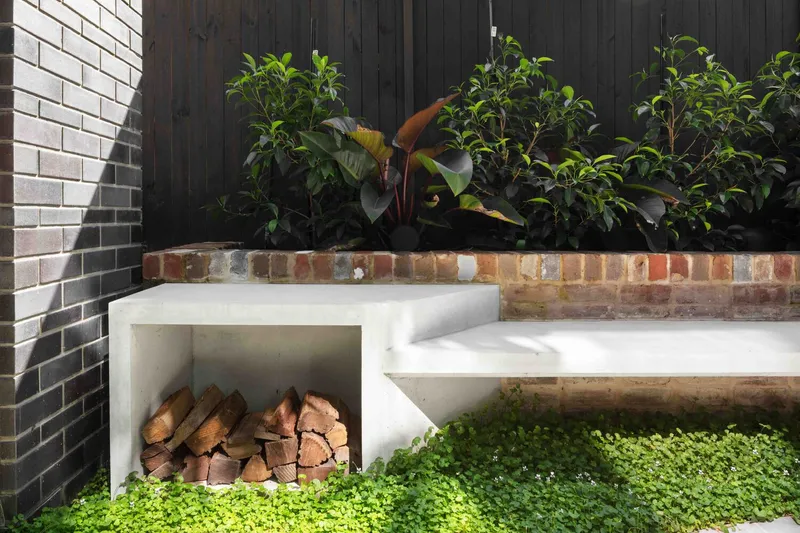
Outside, a white concrete bench seat with integrated firewood storage sits against a raised brick planter bed. This is landscape architecture that speaks the same material language as the building: concrete, brick, utility, greenery. The banana palms and garden beds visible from the street and courtyard alike are not afterthoughts but integral to the thermal and psychological strategy of the house. Studio Parisi uses planting to regulate microclimate and to humanize a material palette that could, in lesser hands, feel relentless.
Plans and Drawings
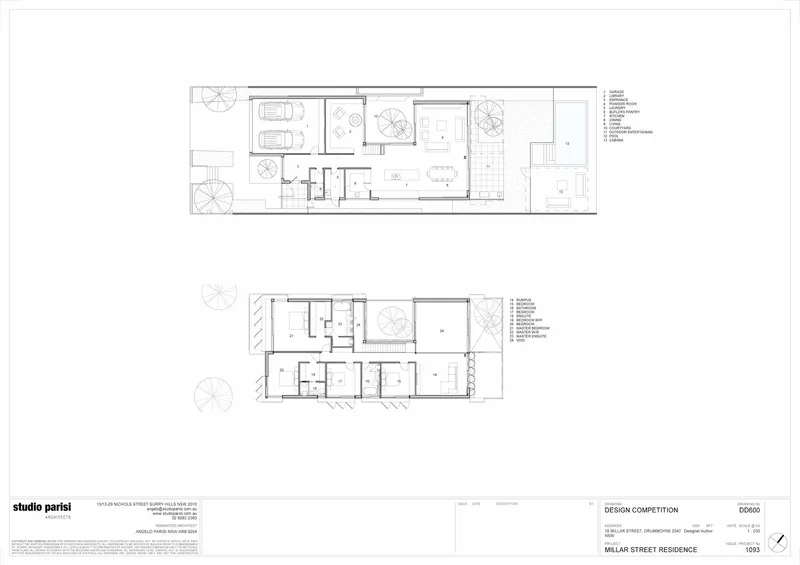
The floor plans reveal a linear organization across two levels, with rooms sequenced along a central spine that opens onto the northern courtyard. Trees marked at the corners of the site confirm how tightly the landscape and architectural strategies are interwoven. The linear arrangement is efficient for cross-ventilation: air enters from the courtyard side and exits through strategically placed openings on the opposite facade. The plans also show how the staircase, positioned near the entry, acts as a hinge between the public ground floor and the private upper level.
Why This Project Matters
The Industrial Escape House matters because it demonstrates that brutalist residential architecture does not have to be a blunt instrument. Studio Parisi has taken the heaviest materials available, concrete, steel, brick, and deployed them with the kind of craft and environmental intelligence that makes the house perform as well as it looks. The board-formed concrete walls carry the imprint of Oregon pine. The reclaimed bricks reduce the demand for new resources. The courtyard and thermal mass strategy minimize reliance on mechanical heating and cooling. These are not greenwashing gestures; they are embedded in the architecture's logic from plan to detail.
More broadly, the project pushes back against two tired assumptions: that suburban houses must be polite, and that brutalism must be hostile. In Drummoyne, a neighborhood of conventional rooflines and rendered facades, this house stands as proof that rigorous material honesty and genuine comfort are not opposites. They are, when handled with skill, the same thing.
Industrial Escape House by Studio Parisi Architects. Drummoyne, New South Wales, Australia. 300 m². Completed 2023. Photography by THAT Photographer.
About the Studio
Share Your Own Work on uni.xyz
If projects like this are the kind of work you want to make, uni.xyz is a place to publish your own, find collaborators, and enter design competitions.


Popular Articles
Popular articles from the community


Cloaked Colonization: A Mobile Underwater Habitat That Moves Like a Fish
Micah Abaya's shortlisted EHC Pacific entry reimagines ocean settlement as a dispersed network of self-sustaining architectural organisms.
Manzana Morphosis: Stretching Barcelona's Grid into a Living Landscape for 2050
A radical reworking of the Eixample manzana turns density into a tool for generous public space, vertical ecology, and environmental performance.

Singing Woman: An Opera House That Performs Before the Curtain Rises
Ovidiu Cristian Pavel's conceptual opera house translates Estonia's choral identity into a sculpted waterfront landmark facing the Baltic Sea.

Tsunami Convergenics: Turning Catastrophic Ocean Forces into Underwater Housing Infrastructure
A speculative underwater settlement off the coast of Onagawa, Japan, treats tsunamis and typhoons as energy sources rather than threats.

Similar Reads
You might also enjoy these articles


Hodi-Mandai Geram
Project Function: Preservation and revitalization of the Intangible heritage and socio-spatial identity of the Hodi by Housing, Cultural Memory Center, Sacred Grove, landscape, local tourism economy


Olio Towers: A Mid-Rise for Performers That Fuses Housing, Rehearsal, and Stage
Located blocks from Houston's Theater District, this modular tower stacks living units around a central performance atrium.

Oasis: Modular Green Housing Carved into Dhaka's Urban Fabric
A shortlisted Plugin Housing entry reclaims unauthorized settlements in Dhaka with stepped concrete volumes, green roofs, and ventilation-driven design.

Black Hole: A Floating Megastructure for the Post-Physical Era
Emiliano Mazzarotto envisions a spherical, self-scaling arena where e-sports, digital hotels, and holographic stadiums replace traditional public space.

Explore Brutalist Architecture Competitions
Discover active competitions in this discipline

Challenge to reimagine the Iron Throne

Photograph architecture without architects

Illustrate the lost glory of Angkor Wat - Render Challenge

Design challenge to reuse E-waste
Comments (0)
Please login or sign up to add comments
No comments yet. Be the first to comment!